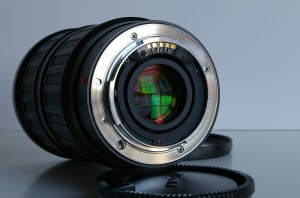
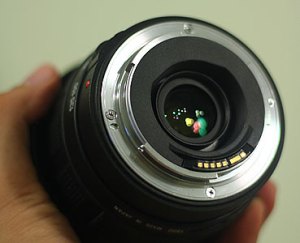
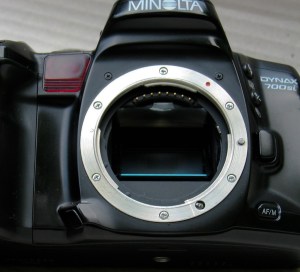
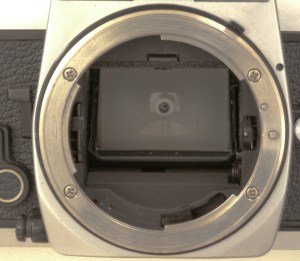
The 28-70 f:2.6 was Angenieux’s last consumer oriented zoom, designed for Canon, Minolta and Nikon AF cameras. With a very wide aperture, an all-glass and all-metal construction, it was positioned to compete with the “pro” series zooms of the big three. The tests performed by the specialized press at that time showed that it was THAT good.
Unfortunately, its price was also on par with the best of Nicanolta, which made it a tough sale beyond the small circle of admirers of French technology. When Angenieux decided to refocus on professional markets and stopped the production of its consumer oriented lenses, Tokina inherited the design, and their Tokina AT-X 287 Series – which was sold as recently as 2007, is a remote descendant of the Angenieux 28-70 AF.
I don’t have this camera anymore. I’m afraid it ended its life in the trash can – not economically repairable – a few years ago. But I used it for years, I liked it a lot, and it’s too bad that no digital SLR available today is as light and portable as the Vectis S-1 was.(*)
The gun metal version was sold in Europe.
Launched in 1996, it was the only SLR system designed from scratch for the APS film format. It inherited the best features from the Minolta mid-range 35mm cameras of its time, and exploited the new functionalities of the APS format to its full advantage. Built around a new, specific and very modern mount, the Vectis cameras and lenses were far more compacts than conventional 35mm SLRs, and than the APS SLRs developed by Canon and Nikon.
Single Lens Reflex cameras (SLRs) need a moving mirror, and the moving mirror needs room, which imposes a flange focal distance of approximately 45mm on 35mm cameras (44mm for the Canon EF, 46.5mm for the Nikon F mount). The diameter of the mount, on the other hand, is closely related to the size of the film (it’s roughly equal to the diagonal of the film – 44mm for the Nikon F mount, for instance). Both Canon and Nikon decided to make their APS cameras compatible with the large range of 35mm lens they had been selling for 10 years or more, and designed their APS SLRs around the same dimensional constraints (flange focal distance, mount diameter) as their standard 35mm offerings. Logically, the cameras could not be significantly smaller than their 35mm counterparts.
On the contrary, Minolta took the risk of making the Vectis S-1 totally incompatible with its own 35mm lens system – and opted for a shorter focal flange distance (38mm) and for a smaller mount diameter, without any mechanical linkage between the camera body and the lens. The body and the lens could be made much smaller, but Minolta had to develop a whole range of new lenses, and ended up supporting two totally incompatible product lines.
The lighthouse of the Pointe St Matthieu – Brittany, France
One could debate endlessly about who did the right thing, Minolta or Canon-Nikon. Minolta’s risky strategy did not pay off – the sales of the Vectis cameras proved disappointing, Minolta lost its independence and had to merge with Konica. But Canon or Nikon’s more prudent approach did not work either, altough they did not lose as much money with APS as Minolta did. Learning from the experience, Canon, Konica-Minolta and Pentax all decided to retain their 35mm mount on their new dSLRs with APS-C sensors. Only Panasonic and Olympus, with no legacy of 35mm AF SLRs, decided to use a smaller form factor with their Four-Thirds and Micro-Four-Thirds formats.
Minolta Vectis S-1 – a new lens mount and new lenses developed for APS
The design of the S-1 was very innovative in two important areas: it was not using the conventional central pentaprism, but a series of mirrors leading to a viewfinder implemented at the very left of the body – leaving space for the nose of the photographer, and the camera, its lenses and its accessories (such as the external flash) were all weatherproof, forming a compact, lightweight and reasonably rugged system that could even be brought in mountain expeditions.
Minolta Vectis S-1 – it was designed for enthusiast photographers with a complete set of controls – too bad the APS stock available was mainly 200 ISO color negative film.
The rest of the camera was in line with the advanced-amateur class of products of the time (P, A, S, M modes, Matrix and Spot metering, passive autofocus) and took advantage of all the new functionalities brought by the APS format – the ability to pre-select one of three print formats when taking the pictures being the most important. Some compatibility existed between the accessories of the 35mm cameras of the manufacturer (Maxxum or Dynax) and the Vectis: the flash system and the remote control could be used indifferently on both lines of cameras.
The user experience was very pleasant. Minolta cameras of the AF era have always been very pleasant to use, and the Vectis was no exception, provided you put the right lens on the body. Unfortunately, the kit lens – a 28-56mm f:4-5.6 zoom, was not something Minolta should have been proud of. Poorly built, if proved fragile, and the quality of the pictures it produced was far from impressive. Mine broke rapidly, and I replaced it with a much better 22-80mm lens, which was correctly built, and could produce great pictures – with the right film in the body. The promoters of APS had decided that 200 ISO would be the “normal” sensitivity, but APS used a smaller negative than 35mm, and the quality of the enlargments from 200 ISO film never convinced me. The 100 ISO film, on the contrary, was very good. On a good bright and sunny day, with a good lens and 100 ISO film, APS could compete with 35mm.
My Vectis was defeated by one of design flaws of APS: the fragile automatic film loading system. A tiny piece of plastic broke in the camera, preventing the film door to open. Having it repaired was not an option. I sold the lens, and trashed the camera.
Today, the Vectis S-1 still has fans, ready to pay prices in excess of $150 for a camera. I liked mine as long as it worked, but with 100 ISO APS film now unavailable, I would not spend my money trying to get another one.
Good camera, flawed format. RIP.
(*): Edited in July 2017: the Vectis S1 tipped the scales at 365g, and the fragile 28-56 kit lens added 110g. With film and battery, the whole set was probably was below 500g. Today – in 2017, the remote heir of the Vectis, the Sony A6000, weights 20 grams less (at 345g). The Sony 16-50 Power Zoom also weights 110g.
The introduction to Through The Lens (TTL) Light metering and its consequences on the lens mount
Now that the instant return mirror and the preselection mechanism of the diaphragm had made SLRs usable for action photography, the manufacturers managed to address the next challenge: the determination of the exposure.
With Robert Doisneau, he was one of the most prominent representatives of the so-called humanist school of photography. He became the first French photographer to work for Life.
He will remain famous for his black and white scenes of Paris streets, of Provence and his nudes.
One of the most famous pictures of Willy Ronis - Les Amoureux de la Bastille - Paris - 1957
Nikon was very proud a few months ago when the 50th anniversary of the F mount was celebrated. Half a century! Pentax had to abandon its original mount and transition to a new bayonet in the early seventies, Minolta and Canon in the mid eighties.
Nikon F – Photo courtesy of cameraquest (www.cameraquest.com)
But there is more to lens and body compatibility than the design of the bayonet.
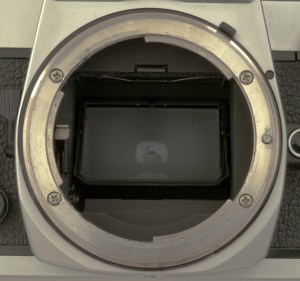
Even if the current Nikon bodies and lenses still use the same bayonet design as the Nikon F of 1959, it’s practically impossible to pair an unmodified lens from 1959 to a recent body, and vice versa: the lens and the body of a modern SLR have to exchange information and commands, and non-upgraded lenses from 1959 simply don’t share enough information to be usable.
The transmission of information from the lens to the body – focal length, maximum and minimum aperture, pre-selected aperture, focusing distance, and of commands from the body to the lens – setting the focusing distance, setting the aperture value, closing the diaphragm, can be performed from many different ways – some of them passive (a hole in the metal), some of them mechanical (rods, cogs and springs), the most recent working exclusively through electrical contacts.
Diaphragm pre-selection
Cameras of the mid fifties were far less complex than the ones we now use. No internal meter, no auto exposure, no auto-focus.
But users of SLR cameras were facing an important issue: because the viewfinders of their cameras were dim and the focusing screen grainy, the only practical way to set the focus was to open the aperture to its maximum. Let’s say F:1.4. But if on a sunny day they needed to shoot at 1/125 sec at F:11, they had to set the aperture ring to F11 AFTER they were finished with the focus and – of course – BEFORE they took the picture. Not very fast, not very convenient.
At the end of the fifties, most Japanese camera manufacturers adopted automatic diaphragms with aperture pre-selection: the lens remained at full aperture – let’s say F:1.4 -independently from the aperture value selected by the user on the aperture ring, making focusing easy. Only when the user pressed the shutter release to take the picture would a lever or a rod mechanically close the diaphragm to the value pre-selected by the user.
That’s the question that photographers hate the most. Nobody ever asked Picasso what type of brush he was using to paint “Guernica”, and photographers believe they are the ones taking the pictures. For them, their camera is just a tool, that they use it to communicate their vision.
Well, it’s not completely true. Granted, the camera is a tool, and tools don’t create. But the camera’s characteristics, its size, its weight, its ability to withstand adverse environmental conditions, the number of manual steps needed to take a picture, the performance of the shutter, the aperture of the lens, all limit the ability of the photographer to take a usable picture of what he’s witnessing, or to convert his vision into an image. Every now and then, a breakthrough in the design of cameras gives photographers more opportunities to report what they see. Whenever a new generation of cameras hits the market, photographers start experimenting, and in the process, harvest a new crop of pictures, which sometimes, will change the way they show the world to the rest of us, and ultimately, change the way we all see the world.
Few cameras had an impact comparable to that of Leica cameras’ in the first half of the 20th century. The originality of Alessandro Pasi’s book – “Leica, Witness of a Century”, is that it’s an attempt to show how the Leica changed photography, and how photographers still use it today to make different pictures.
Leica - witness of a century (Alessandro Pasi)
Alessandro Pasi’s book is organized is six chapters, each covering a different period, and showing in detail the most emblematic Leica camera of the era, as well as the pictures taken with it by the most prominent photographers of the time.
There will be no striking discovery for the well learned Leica aficionado. The cameras shown here have already been described in detail in many books, and at least half of the photographs assembled by Alessandro are well known “classics”.
But the author also included less known pictures taken by Italian photographers, as well as family snapshots taken by amateurs over the course of the century.
The texts are well written and informative, the layout is clear and the pictures are always given the priority.
This book is a very good illustration of the saying about the whole being greater than the sum of its parts.
It’s a pleasant voyage through one century of photography, an homage to the ingenuity of the creators of the Leica, and the proof that sometimes, “what camera took these pictures?” is not as stupid a question as it sounds.
Leica, Witness to a Century, is available in brick and mortar book stores, and also at Amazon . 159 pages. $35.00
For the 75th anniversary of the Leica, in 1989, the Leica Camera Group published “75 Years of Leica Photography”, which showcases more than 300 pictures taken with Leica cameras, from the test shots of Oscar Barnak in 1914 to the fall of Berlin wall in 1989. A very interesting follow up if you liked Alessandro’s book. It can still be found – used – for a bit less than $100.00
Leica launched the M9 today – the full-frame digital version of M rangefinder camera series. DPreview published its hands-on review already.
With its 24x36mm 18 Mpixels sensor, the M9 will be positioned in the same price category as the Nikon D3X and the Canon 1DS Mk III, both proposed above $6,500.
As far as I know, no price has been published for the North American market yet, but the list price published for the UK and for Continental Europe leads me to believe that the M9 will sell somewhere between US$6,750 and US$7,500 on this side of the Atlantic.
That’s a lot of money. I’m not a Leica collector, or a pro photographer always looking for ways to produce different images. I’m just an amateur, taking a few thousands of pictures per year, most of them in situations where a single lens reflex is far more efficient than a rangefinder camera like the M9. And I could not help doing some math:
a used Leica M7 can be found for $2,500. The cost difference with a brand new M9 will be $4,250 at least
$4,250 can buy enough B&W film to take 10,928 pictures and have them processed, scanned medium res and copied on CDs at Costco
$4,250 can buy enough B&W film to take 3,400 pictures and have them developed, scanned in high res and copied on CDs by a pro photo lab.
$4,250 can also buy a plane ticket to the destination of my dreams, where I would spend two months taking pictures
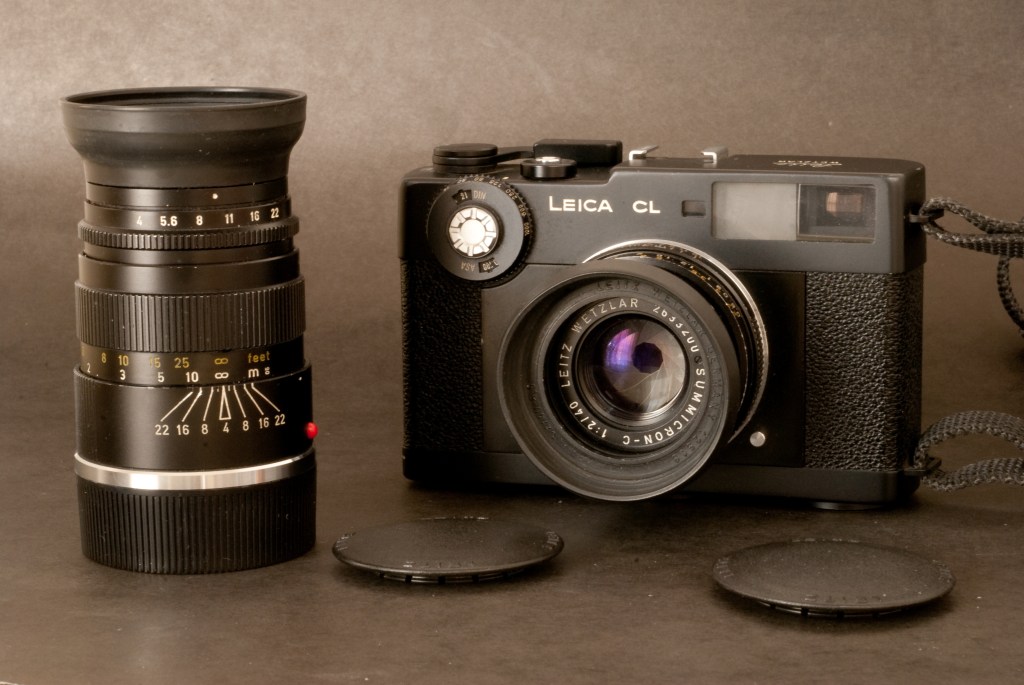
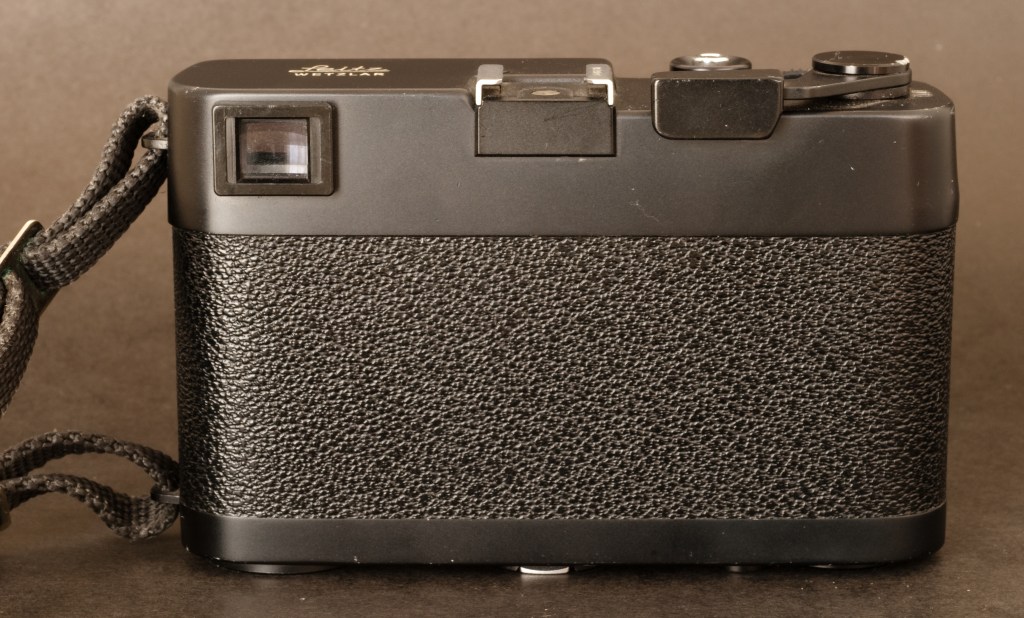
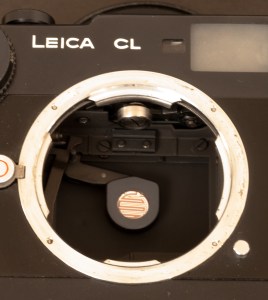
I would not even use a M7. Leicas are about street photography, the smaller, the better. An old Leica CL (or even better, its Minolta sibling, the CLE) is not as prestigious as an M7, but it does the job. For $400. How many more pictures?
Take any line of manual focus 35mm reflex camera from the eighties and mid-nineties, Leica R included. Comparable models will be worth less, on the second hand market, than an Olympus OM-4T, not to mention the OM-3 and its ultra-rare and ultra-expensive offspring, the OM-3T. Why, in spite of their very serious limitations, are the single digit OM cameras so sought after? In this test of the OM-2s, the little brother of the OM-4, we’ll try and find out why.
The OM system
Olympus OM-1n next to a 35mm film cartridge. The competition needed almost 10 years to introduce more compact SLRs, but they were designed for beginners. In the enthousiast-amateur and pro categories, the OM family remains unchallenged to this day.
Launched in the early 70s, the Olympus OM-1 and its system of lenses and accessories were incredibly compact, very well designed, and at the same time solid enough to please the pros and the very serious amateurs. The competition (Nikon in particular) needed years to develop models approaching the size of the OM-1, which sold by the millions.
The OM-2, introduced in 1974 with the same ergonomics and a similar external appearance, was the automatic exposure version of the OM-1. It pioneered the use of direct exposure metering in the film chamber, and was the first camera with Through The Lens Flash metering. The competitors followed Olympus’ example, and almost every SRL cameras introduced after 1985 measures the exposure in the film chamber and offers TTL flash metering.
The OM-2s, OM-3 and OM-4 which followed in the eighties were relatively minor updates of the previous models. They shared a new body and had much more elaborate metering options, but they retained the relatively slow shutter of the OM-1 and OM-2. Their viewfinders were not as great as the ones of the OM-1 and OM-2, and the first models had some reliability issues. The OM-3T and OM-4T (with titanium top and bottom plates and more reliable electronics) raised the level of quality of the OM line, and soldiered on until Olympus finally stopped the production of film cameras, in 2002.
I bought most of my cameras and lenses on ebay.com, sometimes through auctions, sometimes at “buy it now” prices. I never had a bad experience so far.
If you buy on eBay, you will face three types of sellers:
on-line stores specialized in photographic equipment, new or second hand.
That’s the low risk option. Some stores limit their inventory to a few brands, and only carry high quality, very nice to pristine cameras. Others are less restrictive, and also have cameras which have lived a more difficult life. If your intention is to really use the camera you’re purchasing, buying a comestically challenged camera may be a good option, as long as it’s in good mechanical condition. Specialized stores are supposed to know what they sell, and will not plead ignorance if the product does not work or is not completely similar to the published description. They will arrange for a free return, and a refund.
A word of caution, though: the products are evaluated before being listed, and the obvious lemons don’t pass, but the tests are not always as thorough as one would wish: a lens may have looked OK when tested on a particular type of body, but will fail to operate on another one, which is in theory 100% compatible but is interacting with the lens differently. Always test the equipment you purchased as soon as you receive it, and contact the seller if there is any issue. Reputable stores will listen to you, and they have a good return policy.
Over the years, I bought cameras or lenses from Adorwin (the eBay store of Adorama), Betteroffblu, Cameta and Shutterblade and could appreciate their professionalism.
Stores not specialized in photography
That’s the riskiest option, in my opinion. The store could be anything, from a pawn shop to an antique dealer, the worst being a dollar store or a shady repair shops buying broken electronic equipment in bulk and making one sellable camera out of 3 broken ones. Even if they know a few things about the products they’re selling, they will generally plead ignorance, and will offer little or no support if there is an issue with the equipment. I never had a really bad experience on eBay, but it’s with this type of seller that I came the closest to being seriously disapointed. Buyer beware.
Low volume and non professional sellers
Low volume sellers belong to multiple sub categories. You will see items sold by a person who pretends he got the equipment he’s selling from a friend but that he knows nothing about it, and you will find the passionate amateur photographer who bought his equipment new 20 years ago, used it day in day out and took great care of it; he will take pride in providing a honest and accurate description of his equipment, and that’s the person you want to be buying from.
Because of the way the auctions work, the prices tend to be highly variable and very unpredictable. Professional sellers tend to protect themselves with a “buy-it-now” price, and if the item does not sell this time, they just list it again. Non professional sellers tend to use the auction system more than professionals. With the number of people watching eBay listings every day, it’s difficult to find a real bargain, but some sellers (lazy or inexperienced) still publish unappealing listings (blurry pictures, ambiguous descriptions) that a trained bargain hunter will be able to interpret to his advantage: I bought my Nikon F3 this way, at 30% of what the action would have reached if the listing had been professionally layed out.
As always, do your homework and try and understand the market first (ads in magazines, completed items list on eBay). Set a limit for the price of the equipment you want to buy second hand. In any case, read the ads very carefully, ask questions, and only place a bid if you feel confident enough.
Other reputable sources
keh.com –
I never had the opportunity to buy second hand equipment from keh, but good friends did. keh has the reputation of being very conservative in the way they describe the equipment they’re selling (if they say it’s in good condition, then it’s very very good). They only sell over the phone or on the Internet – no walk-ins.
bhphotovideo.com –
B&H is a big photo video mail to order company, with a huge brick and mortar store in New York. I bought new equipment from them on multiple occasions. A very pleasant experience. I never had the opportunity to buy second hand equipment from them, though.
Feel free to share your comments and experiences. Thank you.
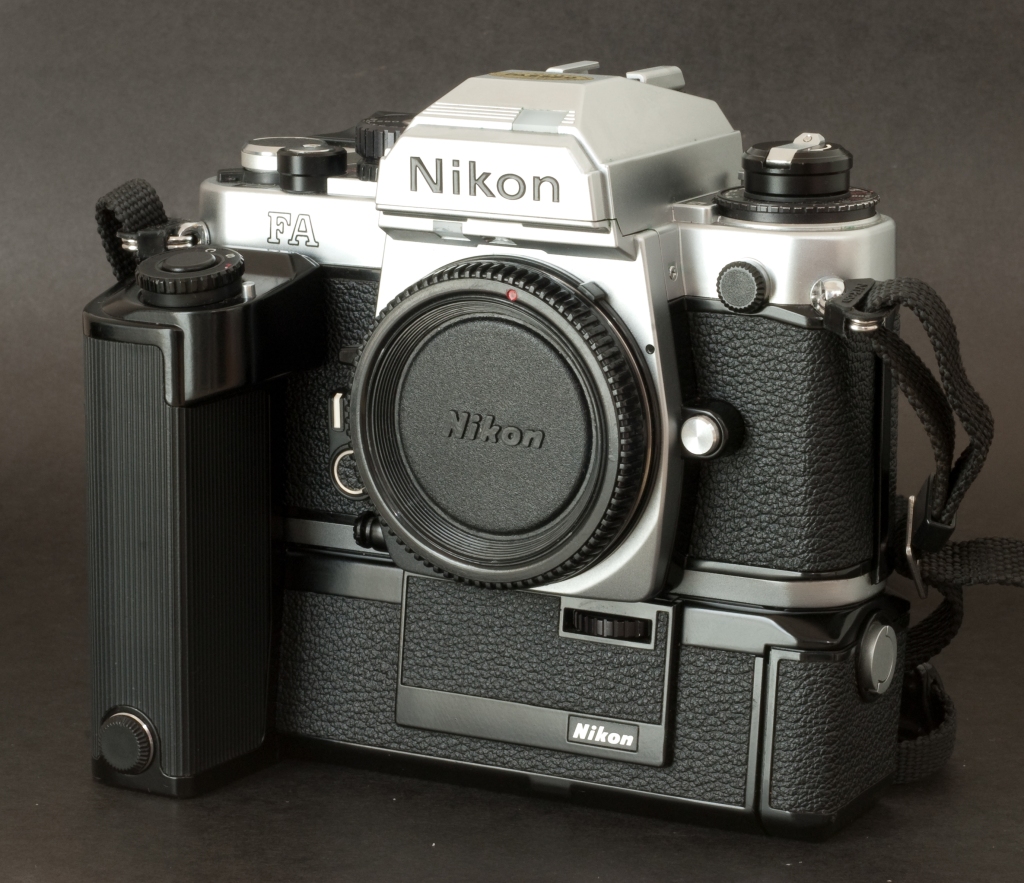
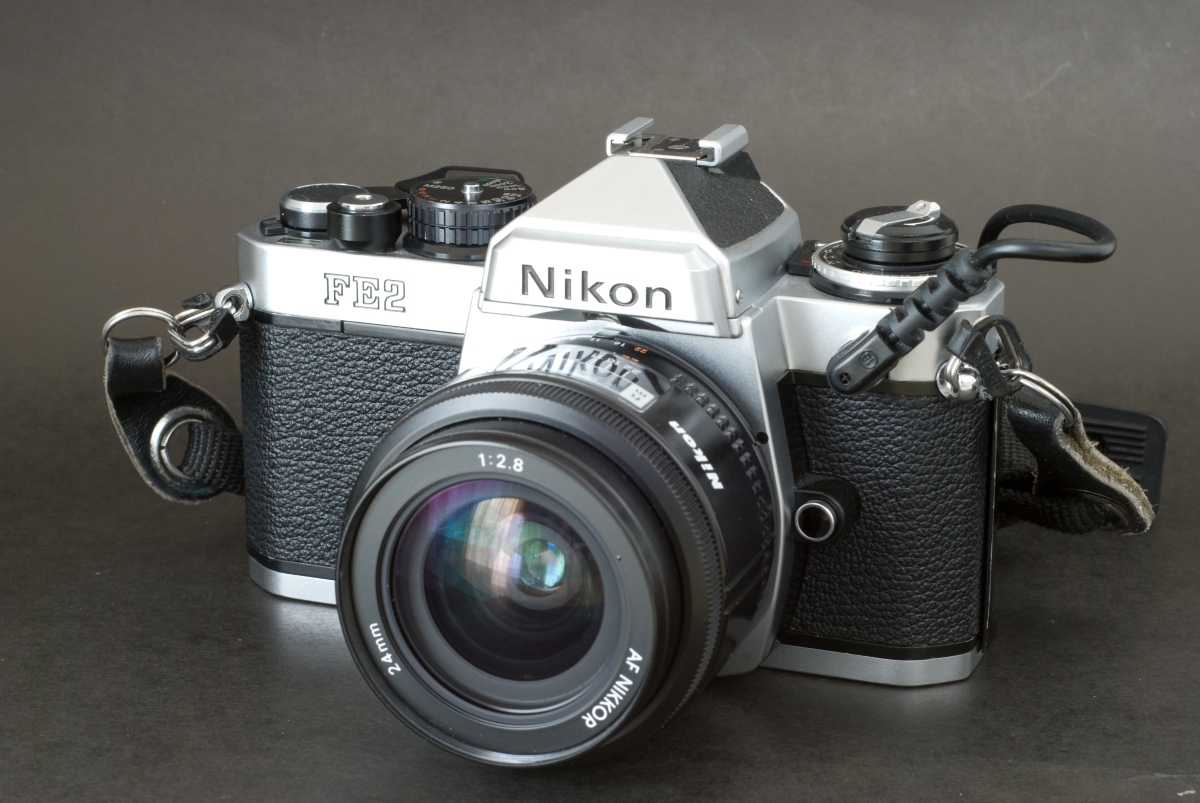
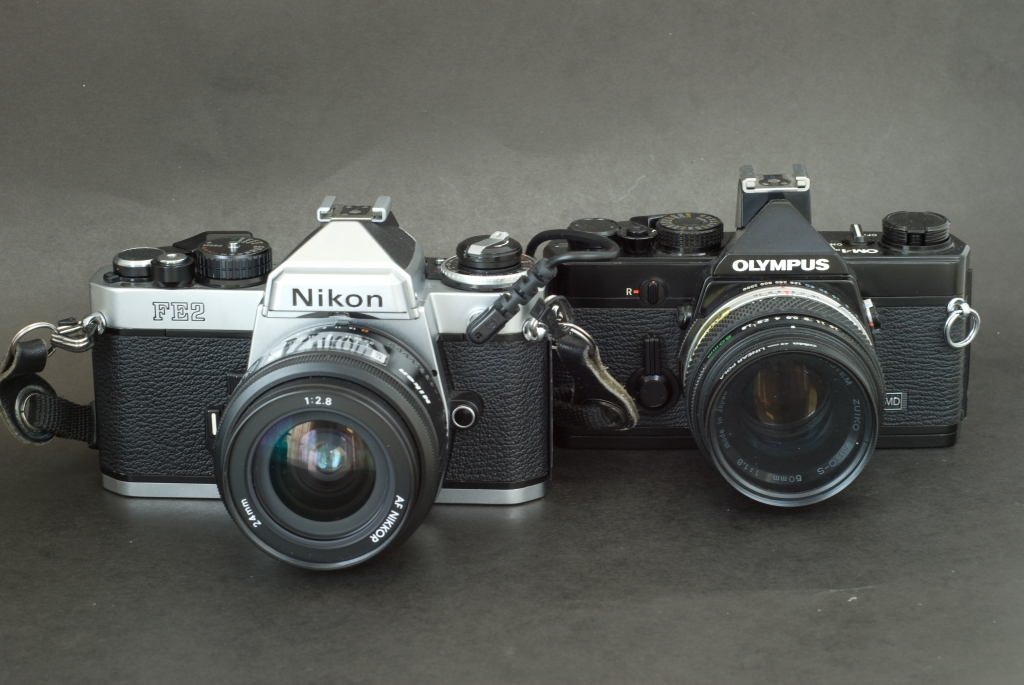
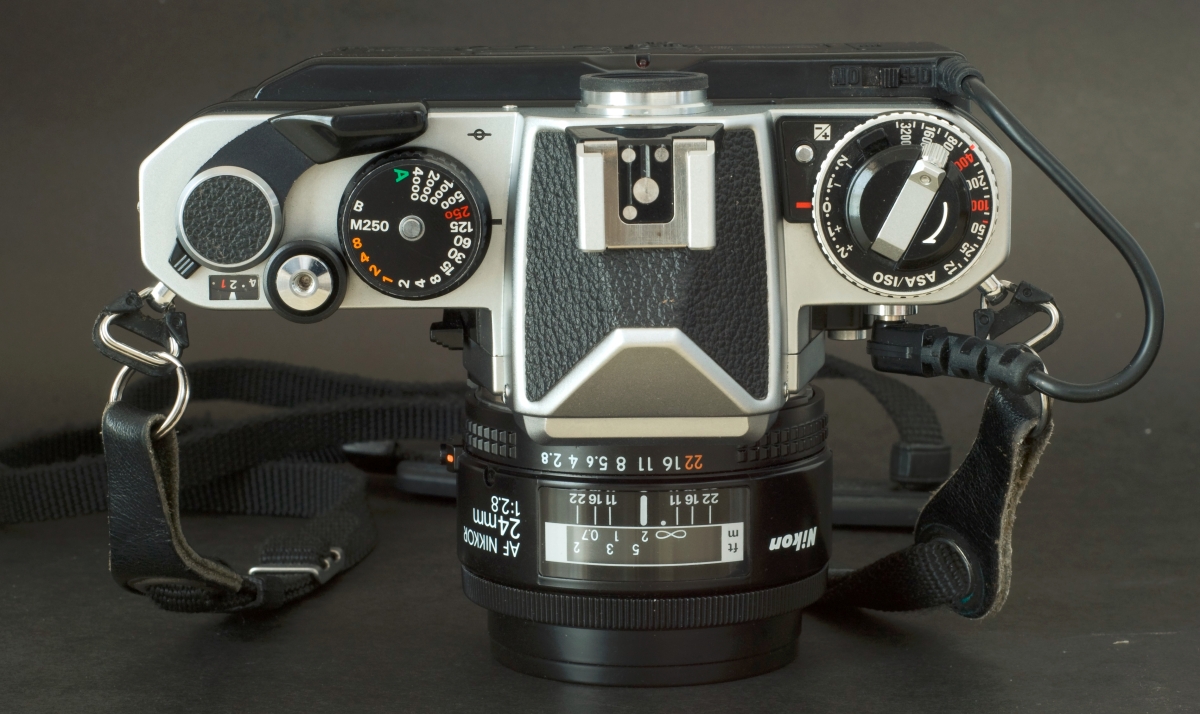
Let’s take three lines of manual focus cameras which still have a very active second hand market today: the Leica R series, the Nikons FM & FE and their derivatives, and the Olympus OM-1 & OM-2 and their “single digit” descendants. Each line contains automatic exposure cameras (Leica R4, R5, R7; Nikon FE, FE2, FA; Olympus OM-2, OM2s, OM4, OM4t), and manual exposure cameras (Leica R6, R6.2; Nikon FM and FM2; Olympus OM-1 and OM-3).
For a given generation of camera, manual exposure models are almost always worth more than their automatic exposure siblings.
Average retail price of a camera in Excellent Condition (source: a reputable specialist of used photographic equipment)