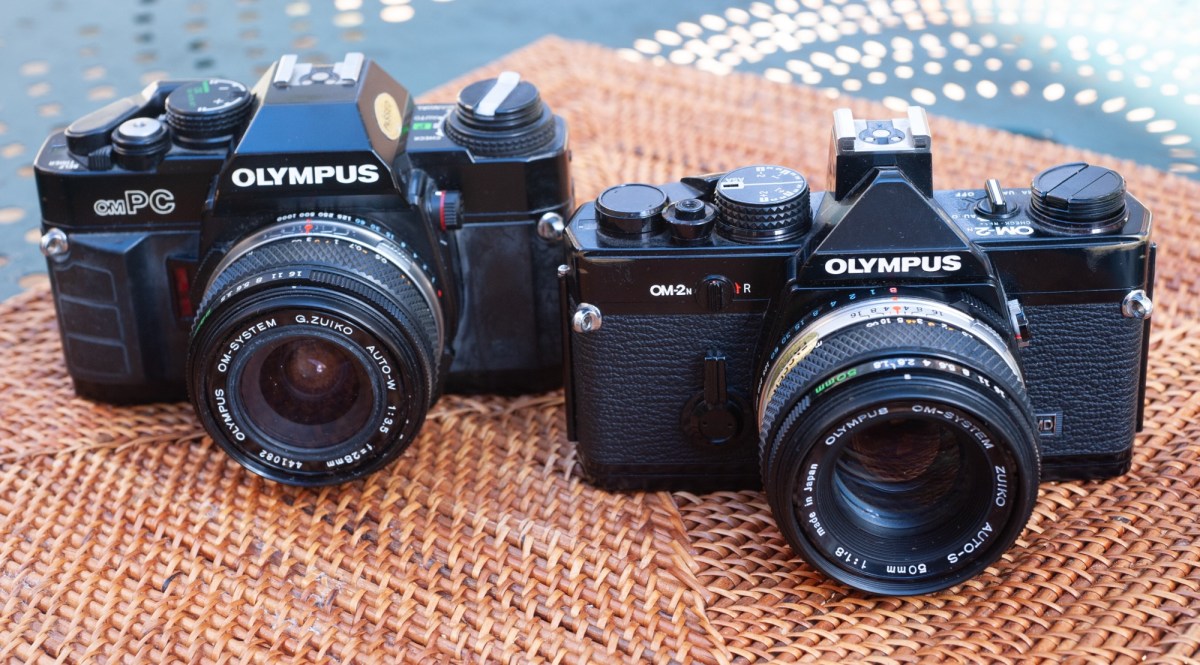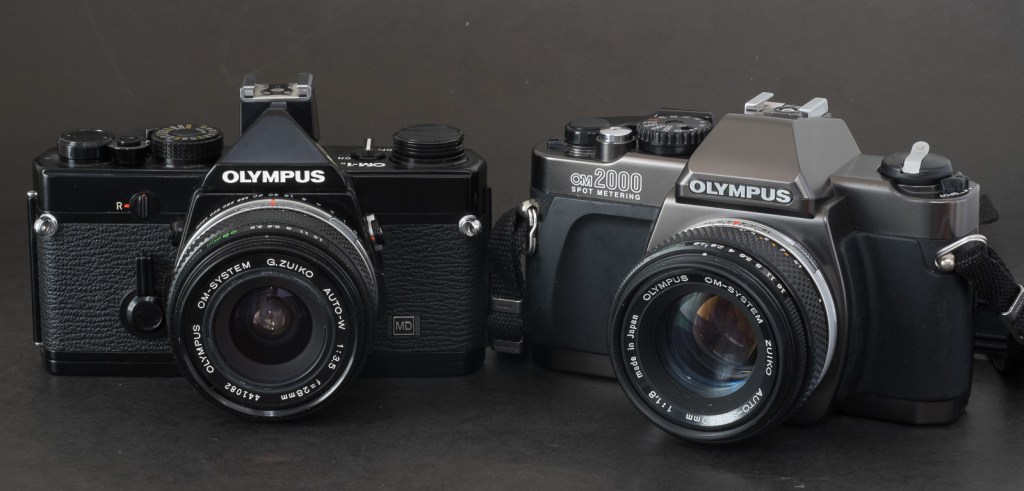
Olympus OM-40 / OM-PC : the ugly little duckling

In the times of manual focus (film) cameras, Olympus followed a pretty simple rule to name its SLRs – there was a line of one digit OM bodies (OM-1, OM-2, OM-4, OM-2SP, OM-3, OM-4ti, OM-3ti) for the enthusiasts and the pros –  those cameras were very compact, very well built, and fairly innovative. 

And a second line of “two digit” models (OM-10, OM-20, OM-30, OM-40) – designed for amateurs –  not as compact, with more plastic and fewer innovations. Obviously, the “two-digit” models were also much cheaper than their “one-digit” siblings. 

As often, some of the amateur models went by a different name on the US market: the OM-20 was sold as the OM-G, and OM-40 as OM-PC – all leading Japanese cameras makers were using US-market specific model names in the eighties and nineties – probably as a way to fight grey market imports.
Miami – Olympus OM-2

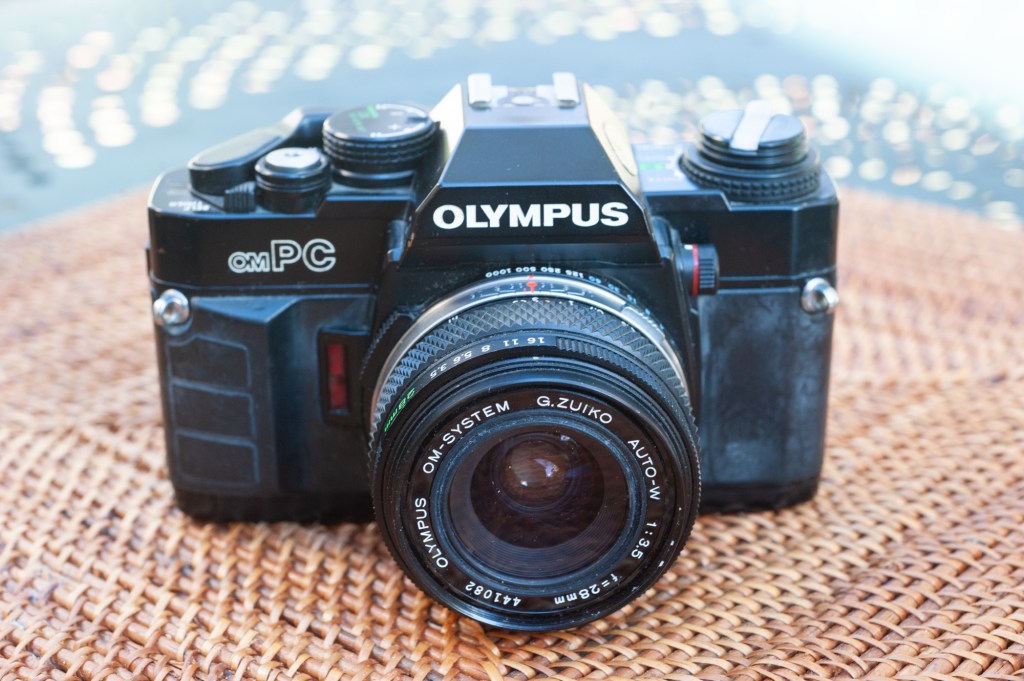
OM-40 / OM-PC

The OM-PC was launched in 1985, at the very end of the manual focus era (the revolutionary Minolta AF 7000 was launched in January that same year, and nothing would be the same afterwards).

Typically for an Olympus SLR from the eighties (like the OM-2SP or the OM-4), it has no on-off switch – and therefore tends to depletes its batteries rapidly.

Also typically for an Olympus of the eighties, its exposure metering system is  a bit “different”:  like the Nikon FA, it offers some primitive form of matrix metering (called ESP in this case).

  • Like the OM-2, the OM-40 determines the exposure by measuring the light reflected on the curtains of the shutter or on the film when the picture is being taken (they call that “OTF” for “on the film”, of course). OTF follows the conventional center weighted pattern. 
  • In addition to OTF, Olympus also designed an “Electro-Selective Pattern” or “ESP”. It’s an embryonic evaluative system, which compares the luminosity of the center of the image with the periphery, and follows a clever algorithm to determine the right exposure (more detailed explanations on the OM-40 user manual, that can be downloaded from Buktus’ excellent site).

The user manual leaves no doubt that using the ESP in conjunction with the Program mode is what Olympus recommends, but an Aperture Priority and a manual modes are also available.

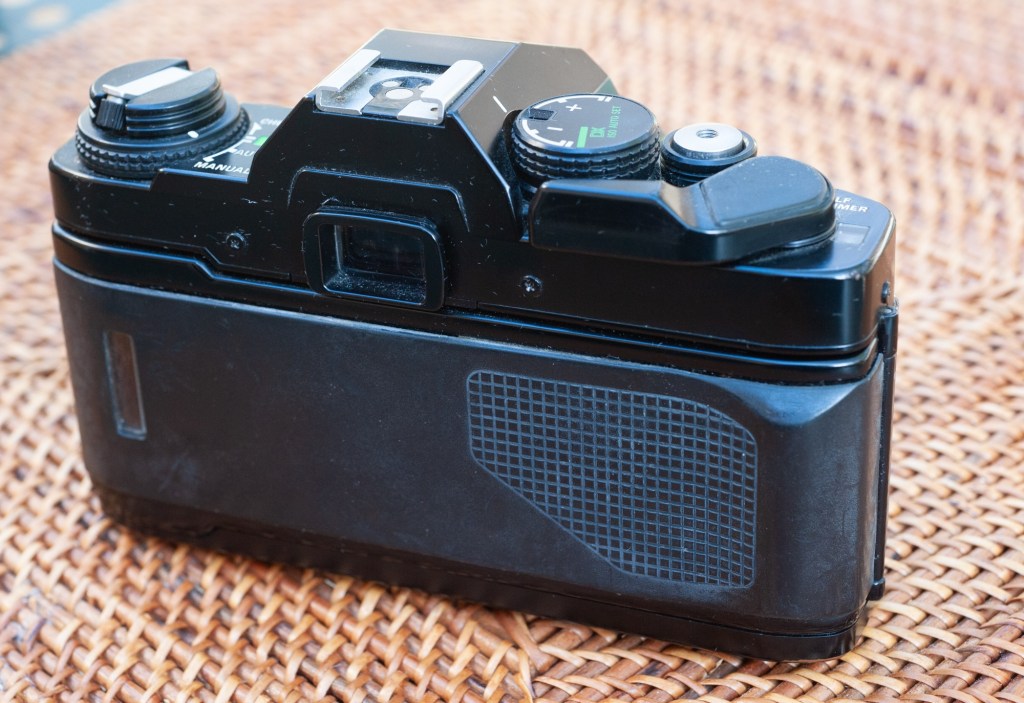
The black plastic did not age well – note the white residue.

The OM Zuiko bayonet mount remained the same all along the production run of OM cameras, which may explain why the implementation of the Program auto-exposure mode is also different from what is done by all other camera makers, and why there never was an Olympus OM camera with “Shutter Priority” auto-exposure.

Most camera makers had to create a new version of their lenses in order to support multiple auto-exposure modes: some have a lock on the smallest aperture (Nikon), some have a specific  “A” position added to the aperture ring (Canon), and some needed a new version of their bayonet mount, with a proportional control of the iris (Yashica-Contax) or with electrical contacts (Pentax KA).

Olympus did not create a new line of lenses or modify their bayonet mount – they simply expected the photographer shooting with the OM-PC to select the narrowest aperture of the lens (generally f/16 on an Olympus Zuiko lens) when operating the camera in Program mode.

But Olympus being Olympus, there’s a catch: selecting the smallest aperture is not mandatory: if the photographer sets the aperture ring to another value (f/8 for example), the “program” will try and find the right shutter speed/aperture combination without going beyond the aperture selected on the aperture ring (f/8 in our case). Interesting, if not perfectly intuitive for the beginner, who is at risk of hitting the fastest shutter speed of the camera (1/1000 sec) on a bright sunny day without understanding what’s happening. 

Miami – Olympus OM-2

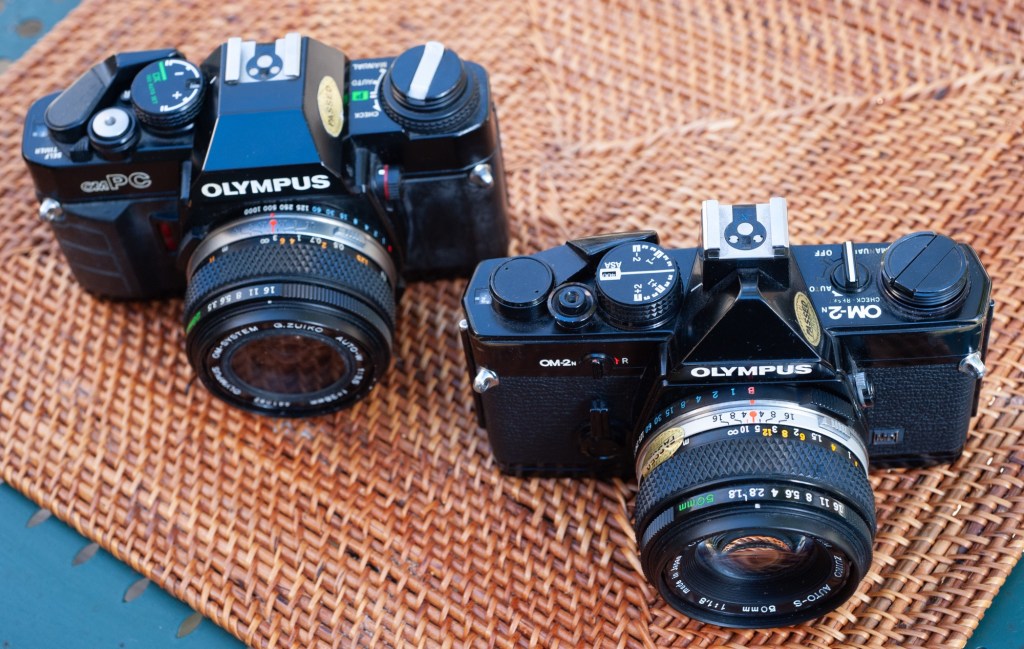
The ergonomics of the OM-PC is also typical of Olympus OM bodies, with the shutter speed ring at the periphery of the bayonet lens mount. It works great with Olympus Zuiko prime lenses (which have their aperture ring at the front of the lens, not at the back): the right hand holds the camera and presses the shutter release, and the left hand takes care of the shutter speed, the aperture and the focusing, with enough distance between each ring to avoid confusion.

Contrarily to most of their competitors, Olympus did not have a cheap line of lenses for amateurs, a line of better lenses for enthusiasts, and a “pro” line for… pro photographers. All OM Zuiko lenses were supposed to be of equal build quality and performance, the only technical differentiation between lenses of a given focal length being the maximum aperture. Therefore, for a given focal length, Olympus was typically proposing 3 models with a  maximum aperture of f/3.5, f/2.8 and f/2.0, at different price points.

 All lenses were very compact, with their own depth of field preview lever, and the aperture ring pushed at the front of the lens. Today, Olympus OM Zuiko lenses are easy to find, and the f/3.5 version of most lenses is the most common and very affordable.

Maybe it looked modern in 1985 – lots of black plastic

The so-so and the ugly

The viewfinder of the OM-PC is nowhere as good as what you find in a one-digit OM, but correct for a camera designed for the budget of amateurs. All the information is provided in a column at the left of the viewfinder (shutter speed, metering mode), but – as usual for cameras of this era, the photographer has no information about the aperture selected by the camera when operating in Program Mode.

Untypical for an Olympus OM camera, the OM-PC is ugly, and did not age well – it’s built of black plastic covered with a sort of artificial rubber, which tends to exude a white residue over time. And at the top of that, all this rubber cladding makes the camera bulky. Ugly and bulky, nothing of the grace of an OM-1 or OM-2. 

Miami – Calle Ocho – Olympus OM-2

As a conclusion

It’s difficult to love this camera – it’s not bad, it’s not expensive, the metering system is innovative, and I’ve no doubt it will produce nice pictures most of the time. But an OM-2 is in the same price range on the second hand market, and will be  as good of a tool in the hands of a knowledgeable photographer. The OM-2 is so much more beautiful. And with such a great, wide and luminous viewfinder!

Like the “amateur-oriented” manual focus SLRs of the other major brands, the OM-PC was made obsolete by the Minolta AF-7000 and its cheaper derivatives, and rapidly disappeared from the market. Contrarily to the  other four big Japanese camera makers, Olympus failed at launching an attractive autofocus camera system, and aimed their subsequent efforts at the point of shoot and bridge cameras markets, simply keeping two titanium clad and very expensive “single-digit” OM cameras (the OM-4ti and the OM-3ti) in their product line until the end of the century. 

Olympus would only return to the interchangeable lens camera market after the switch to digital (with the E1 Four-Thirds camera of 2003). They followed up with an innovative and attractive line of Micro-Four-Thirds cameras in 2009, but lost momentum – and after suffering large financial losses year after year, they finally sold their camera business to a private equity firm a few years ago. We don’t know what the new owner will do with the brand, but considering they won’t have the profits made by Olympus with their medical equipment business to keep them afloat, it’s likely they will focus their diminished resources on fewer models and fewer markets. Sic Transit Gloria Mundi. 

The commands are organized in a very similar “Olympus” way

One of the rules I had set when I started this blog fifteen years ago was that I would not write about a camera I had not tested with at least one roll of film. This post is one of the rare exceptions – there is no photo taken with the OM-PC. Because I could not resolve myself to shoot with an OM-PC, when I had an OM-2 waiting at my disposal.


Miami – Olympus OM-2.

The best OM (film) camera?

“Single digit” OM manual focus SLRs are some of the most beautiful and rewarding cameras of the film era – but some models are specially desirable:

  • OM-2 – it’s really two cameras in one – set it to manual, and you could believe you’re shooting with a semi automatic OM-1; push the selector to Auto, and a shutter speed scale shows up in the viewfinder, making it an aperture priority auto exposure camera. In my personal opinion, the OM camera to buy – not too complex, very compact, beautifully designed, and graced with an incredible viewfinder. The OM-2n is almost identical. Both run with easy to find SR44 batteries. You can find a good one for as little as $50.00.
  • OM-4t/OM-4ti – the t and the ti are the same camera – but with different names depending on the geography where they were sold, and on the finish of the top and bottom plates: made of titanium, some were painted black, some wore a more natural “champagne” color. Technically the OM-4t/ti is similar to the OM-4, except for the circuitry controlling the flash, which supports a “high speed sync” function. On those models, Olympus also fixed the battery drainage issue seen on the OM-2SP, OM-3 and OM-4. All the OM-4s have a very elaborate multi-spot metering option, and two high key and low key exposure compensation buttons on the top plate. The exposure values sampled (up to eight) are shown on a small LCD bar graph display at the bottom edge of the viewfinder. To me, it’s far too complex, but some photographers swear by it (and Canon shamelessly copied the multi-spot and high key/low key features on their T90). The champagne finish tends to be fragile and the cameras often look scruffy, but the black models are to die for if you like compact, all metal cameras. The scruffy ones sell for at least $250.00, nice copies can go up to $1000.00.
  • The OM-3ti was produced in very small volumes (assembled by hand – they were built using freshly manufactured OM4ti models as donor cameras). Not surprisingly considering how it was manufactured, the OM-3ti was also extremely expensive – in Leica M territory. Used copies are currently selling for anything between $1,500 and $3,000.

I would avoid: the OM-1 (because it needs mercury oxide batteries, which are impossible to find), the OM-2SP, OM-3 (non-t or non-ti models), and OM-4 (non-t or non-ti) because they all deplete their batteries extremely quickly due to issues with the design of their electronic circuits. Those issues were addressed with the t or ti versions of the OM-3 and OM-4.


More about Olympus cameras in CamerAgX

More pictures on CamerAgx.com Flickr Gallery

One last look at 2024….

This blog is running on WordPress, and they provide basic statistics about this site’s traffic, that I’m sharing with you.

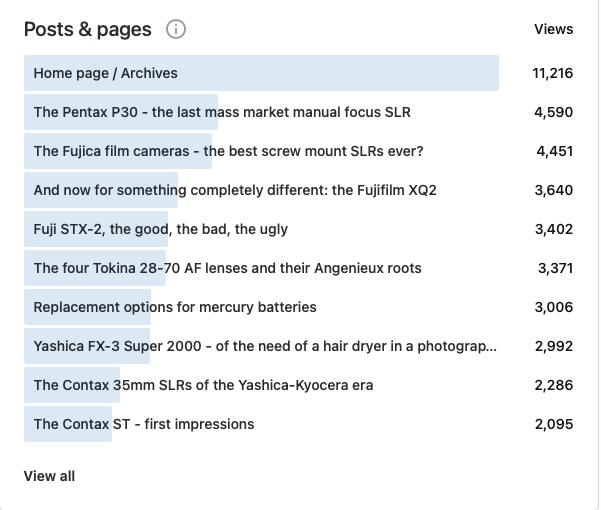
Approximately 52,000 of you visited Cameragx.com last year, for a total number of 69,000 page views. Those numbers have been fairly constant over the last few post-COVID years. Thank you.

As can be expected (since this blog is written in English), traffic is originating primarily from English speaking countries.

More interesting is to look at the most popular posts.

CamerAgX in 2024 – most popular pages

Pentax P30, Fuji STX-2, Yashica FX-3 Super 2000, all entry level, manual focus, single lens reflex cameras primarily used by learners, and less expensive than the Canon AE-1 that people new to film photography tend to buy as their first film camera.

A few years ago, there was more interest in Nikon cameras, and less in Pentax SLRs.

the same stats collected in January 2020

There seems to be a constant interest for all things Fujica, Fuji and Fujifilm – I happen to like to current crop of Fujifilm digital cameras, and a few of their SLRs from the seventies – I still believe that the ST-801 is an all time great. In-between, there are cameras like the bayonet mount SLRs from the late seventies (the AX series) which are not very well known, and for which CamerAgX is one of the rare sources of information. By the way, the index of all the cameras reviewed in those columns has been updated recently.

Recently, I’ve introduced more content related to digital cameras or to the digital workflow, but I’ll keep on reviewing film cameras in the future as well – with a focus on relatively unknown, still inexpensive, really compact cameras of the eighties and nineties.

Feel free to provide suggestions.

That being said, I wish you a Happy New Year, and plenty of success in your photographic endeavours.

X.T.


Tokyo – Tea at the Hamarikyu Gardens – Fujifilm X-T4
Tokyo – Tsukiji River – Fujifilm X-T4.
Tokyo – sake barrels at the Meiji Jingu – Fujifilm X-T4

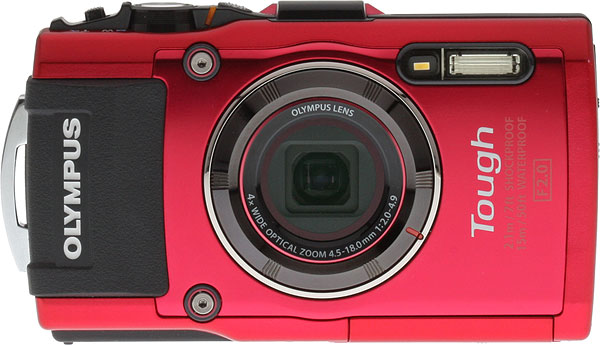
the Olympus Tough TG series – when you don’t want to risk ruining a $1000 smartphone

Nice smartphones are expensive and they control so much of our lives – the access to our bank accounts, our virtual credit cards, our boarding passes, our text messages, our emails, our Facebook, Instagram or TikTok posts, our watch, sometimes, that we can’t afford to break or lose them.

Olympus TG-4 – the commands are simple – it’s a compact, not a “pro” camera


And for those situations when we don’t want to put our precious phones in danger, a few camera companies still offer ruggedized, waterproof, shock resistant compact point and shoot digital cameras. Kodak, Fujifilm, Panasonic all have one risk-all camera in their catalog, but the Tough TG series of Olympus (now doing business as OM System) is the undisputed favorite of the specialized journalists and bloggers, who can’t stop singing its praise.

Olympus TG-4 – images can be saved simultaneously as RAW and JPEGs.


Originally launched in 2012 as the Tough TG-1, the camera has been regularly upgraded along the years. The TG-2 introduced a better water resistance, the TG-3 a 16 megapixel sensor and WiFi connectivity, and the TG-4 the ability to save RAW images. The TG-5 adopted a new 12 megapixel sensor (and a more elaborate image processing engine) for better results in low light, and finally abandoned Olympus’ proprietary connector for a standard USB plug. The TG-C adopted an USB-C connector. And to a large extent, the current TG-7 is just a TG-6 where the glorious Olympus name has been replaced with « OM System ».

(a few weeks after this blog entry was published, I found a very nice (and cheap) TG-5 – click here to read the TG-4 / TG-5 comparison).

The Tough TG-4 equipped with a few accessories (wide angle lens adapter, lens cap from JJC, attachment for floating strap OM System


All Tough TGs share the same look, and a very luminous f/2 to f/4.9, 25 to 100mm (equivalent) zoom, which reduces the need for high ISO in low lights, and help contain the noise of the sensor. It’s a very small 1/2.3 inch sensor by the way, smaller than the sensor of the main camera of an iPhone Pro, and the biggest performance limiting factor of the camera.

Down a cliff – ready for the next adventure

The Tough TG is well built, with a particular care given to protection against water ingress. In addition to the modes and scenes you would expect on a compact digital camera, it is equipped with functions befitting its calling as a camera for adventurers : GPS, compass and manometer.

A learners camera for snorkeling. Scuba divers will need a waterproof housing and strobe lights.

It has no viewfinder, but the fixed LCD display is well defined and luminous enough to allow the photographer to get a feel for what’s in the frame in bright sun light.

What is it for?

As a waterproof / shockproof camera, it fits the bill. It will shine in all adventures, all water sports, from family beach outing to canyoning, rafting, sailing or snorkeling. On its own, it’s too limited for scuba diving (it can’t go deeper than 15m), but OM System can sell you a waterproof housing and a strobe light if you want to go deeper.


Is it also a good everyday camera? Definitely, if there’s enough light. It’s very reactive, it nails the exposure and the white balance almost all the time, and the jpegs are very nice, natural with just enough clarity, vibrance and sharpness to make them pleasant to look at. They don’t look over processed and artificial like the images shot with a smartphone, or mushy because of overly aggressive noise cancellation. In the shade, image quality suffers from visible digital noise and working on RAW files does not seem to improve the situation much. And in poorly lit interiors, you have to use the integrated flash, and the less said about it, the better. A smartphone will deliver much nicer pictures in the same situation, without the need for a flash.

On the beach – it will resist a drop in the sand or a long swim in the ocean


Is it a substitute to high end compact cameras like Sony Rx100? No – except in really bad weather or aggressive environments. Its sensor is too small, and it lacks some of the the controls an enthusiast photographer expects (you can’t select the shutter speed, for instance) – but I would pick a Tough TG over any small sensor compact digital camera, be it a Canon, a Panasonic or a Sony: it’s a very coherent package, solidly built, which will deliver the best images you can get in really difficult environments, and good enough pictures the rest of the time.

The camera I reviewed is a TG-4. The conclusions would be similar for the TG-3, which is almost identical. The TG-5, 6 and 7 benefit from a 12 megapixel sensor and a more recent image processing engine and are said to deliver better images in low light scenes. There is not much difference between the three more recent models. All three are significantly more expensive than a TG-4, and I was not sure a TG-5 or a TG-6 was worth the extra cost. With the benefit of the experience, I’m happy with the TG-4, which does what I expected it to do and I don’t feel the need for more.

Because it’s been on the market for so long, the price you have to pay for a nice TG will vary widely. On market places like eBay, you will find a Tough TG-1 for little more than $100.00, and a TG-3 or 4 will sell typically for less than $200.00. TG-5 and TG-6 are second hand purchases whose price is ultimately defined in relation to the cost of a new TG-7, which is currently listed at $550 by OM-System.

All pictures taken in the island of La Guadeloupe, in the Caribbean. The water is incredibly clean and transparent.

The compact digital camera – in demand but not available

Compact cameras – digital cameras with fixed lenses that could fit in pocket – are in high demand, but unavailable. Fujifilm can’t meet the demand for its most recent X100, Canon’s G7x is always out of stock, the Panasonic LX 100 Model II is no longer available.

Fujifilm XQ2 (left) and Z1000EXR – the 12 Mpix XQ2 produces much better images than the 16Mpix Z1000.

Cameras manufacturers have retreated almost completely from the compact digital camera market (the “point and shoot” of yore), and very few are still offering “premium” or “niche” compact cameras. The smartphone is king, the historical camera makers seem to believe they can’t compete with the thousands of software engineers working for Apple and Google, and are leaving them all the space.

But as good as they are, the smartphones are still limited by their ergonomics (you need two hands, one to hold the phone, one to tap, pinch, swipe or whatever), their absence of long telephoto lens and viewfinder, and their relative frailness. They offer very little in terms of direct controls – they’re extremely capable, but you have to trust them. At the top of that, they’re expensive. And we depend so much on them that we don’t want to risk them on the beach or while rock climbing.

Nelson’s Dockyard – Antigua – shot with a Fujifilm QX2

There is still room for small but good quality cameras, with good ergonomics an a complete set of controls.

The camera companies are primarily focused on the full frame, interchangeable lens camera market, but full frame ILCs are not really pocketable. Their little brothers with APS-C sensors are smaller, but not by much. Even the Fujifilm X100 is still too large to fit in a coat pocket.

So, what’s left? In the cheap point and shoot camera segment, only a few cameras proudly wearing famous brand names such as Kodak or Minolta. I’ve read relatively good reviews of the Kodak Pixpro cameras, but they’re very basic and you can’t expect too much from their tiny sensor.

Olympus (now OM-System) is still leading the fray when it comes to rugged, waterproof cameras – the Tough TG, currently in its 7th iteration – has discouraged all competition.
Fujifilm XQ2 with the WP-XQ1 waterproof case.

It leaves us with the premium category – with the cameras from Canon, Panasonic and Leica largely unobtainable, and Sony’s RX100 series in a state of virtual monopoly.

Older versions of the cameras listed above can be found on the second hand market, but you have to understand what you’re losing by going for a five or ten year old camera:

  • Video capabilities – most of the progress in recent years has been in that area, 
  • Easier Bluetooth and WiFi connectivity, with a better integration with smartphone apps,
  • Reactivity (autofocus), 
  • Quality of the JPEGs (“out of the box”) thanks to better processing engines – you won’t need to process RAW files as frequently
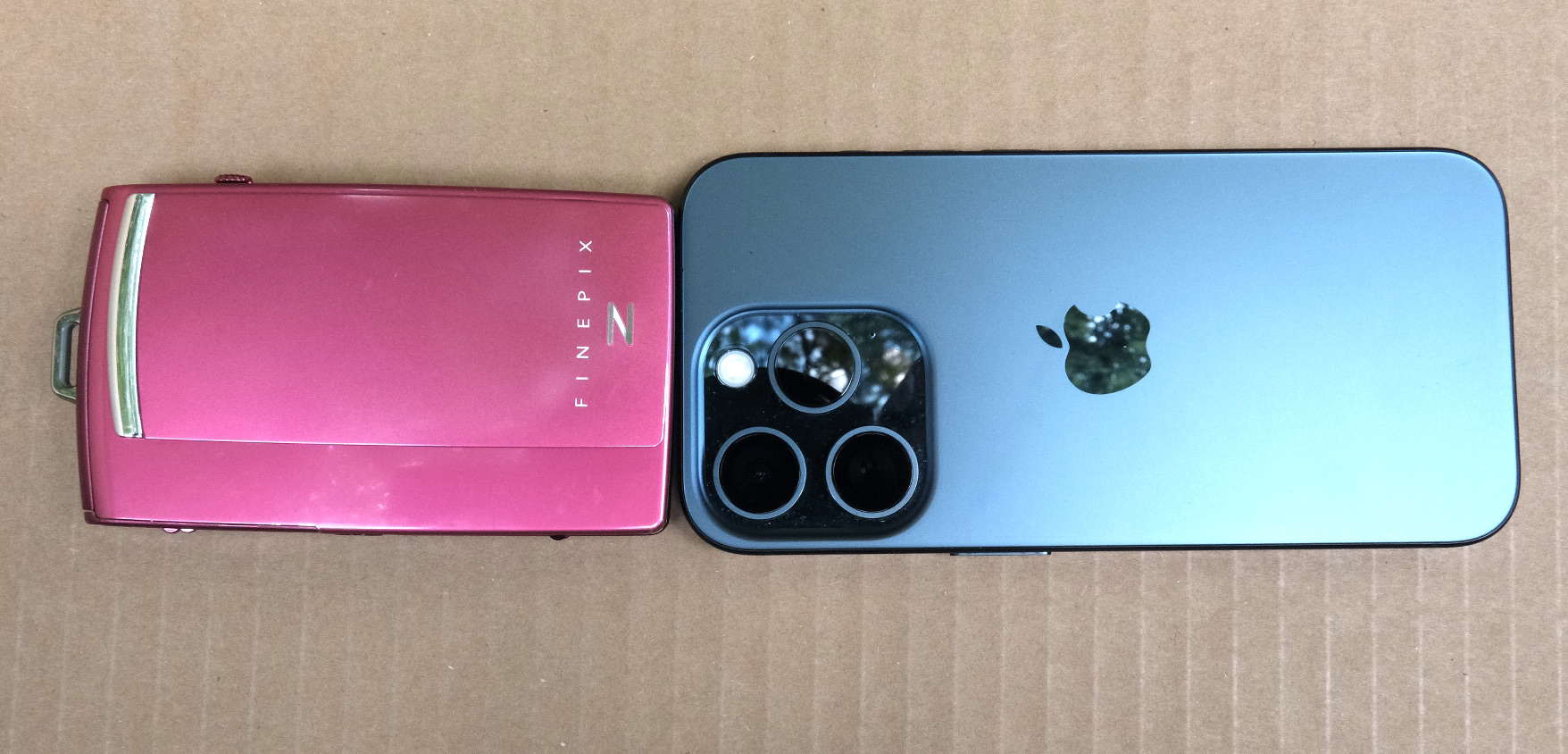
Fujifilm z1000 (left) and iPhone 15 Pro (right). Today a standard sized iPhone can be bigger than a dedicated camera.

More conventional P&S such as the Canon Powershoot S90 or S120; the Sony HX and WX series, Nikon’s Coolpix 9000 series are somehow cheaper, but they’re also more limited: the last models were launched in pre-COVID days, and they have tiny sensors and relatively slow zooms – which makes the use of a flash a necessity in low light.

You could also look for a compact film camera. At the top of the heap the Contax T series reigns supreme (but these cameras are now extremely expensive), followed by a group of still expensive models from Nikon (35ti, 28ti), Leica (Minilux), Ricoh (the GR1), Konica (the Big Mini) and others from Minolta or Olympus. 

But those cameras are now twenty five year old at best – and some of their components didn’t age well (electronics in general and LCDs in particular). Most of those models have at least one big flaw that makes buying them at today’s prices a risky proposition (and even if it works today, will the camera work tomorrow?). The cost of film is also an issue (we’re currently trending towards a total cost of $1.00 per scanned image).
Olympus Tough TG-4 – generations differ by their sensors and processing engines, but the fundamentals of the camera have not changed since the TG-1.

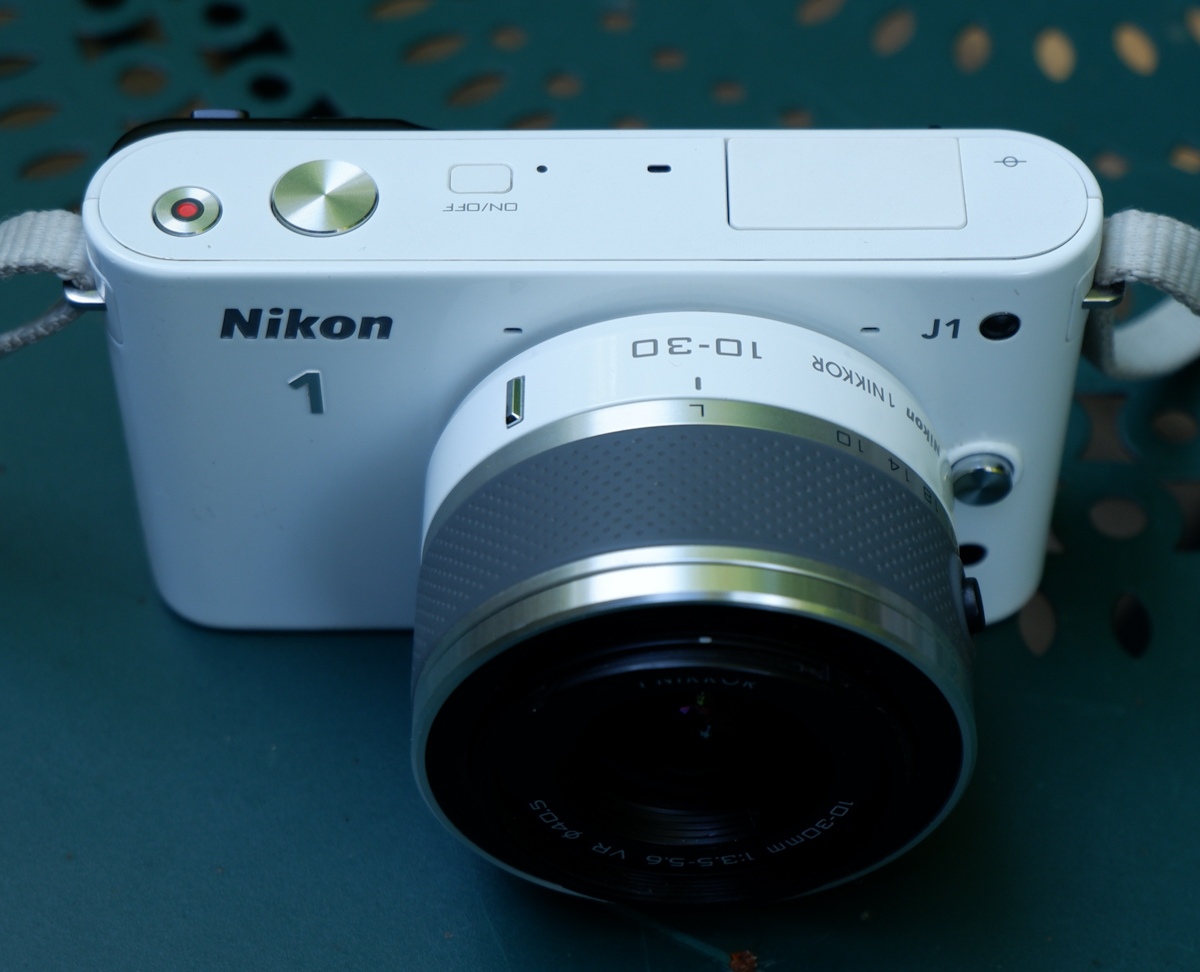
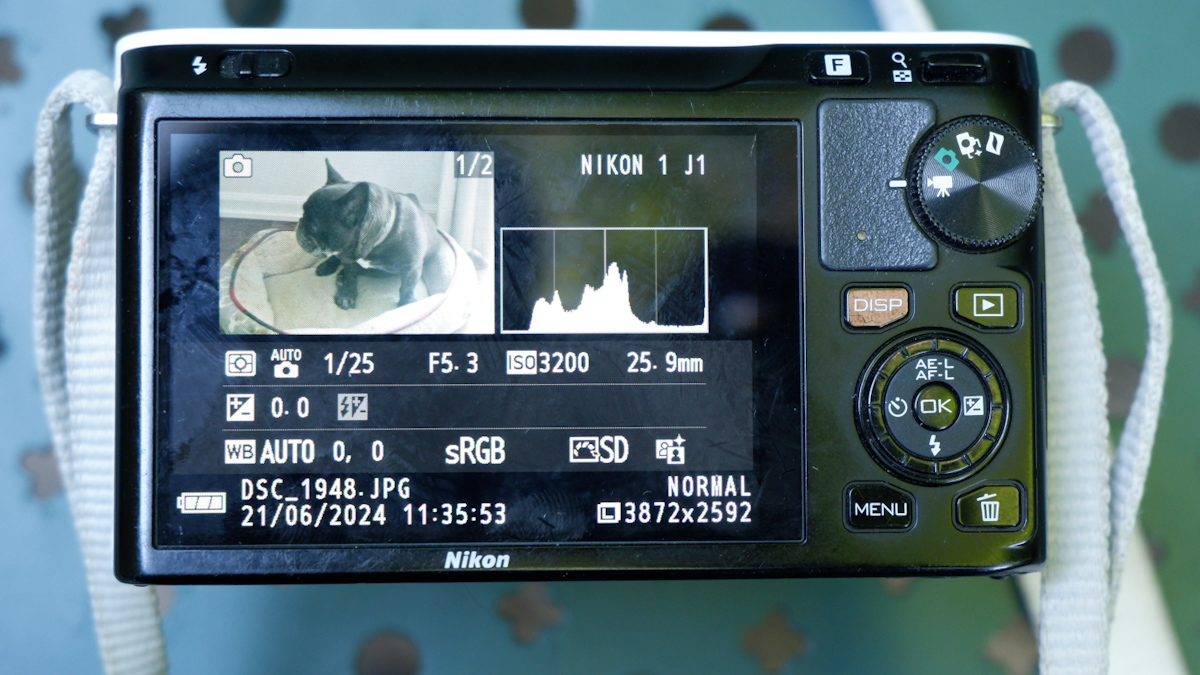
What am I shooting with when I don’t use my smartphone, and can’t bring a mirrorless camera? I have a bit of everything in my bag. I tested (but did not keep) a Nikon J1 and I kept but don’t use a tiny Fujifilm z1000EXR – they’re cute but the quality of the images they were delivering was sub-par. I still use a very compact Fujifilm XQ2 – a sort of semi-premium homage to Sony’s RX100, and an Olympus Tough TG-4. They’re pocketable, produce images which are not as nice as what a recent iPhone can deliver but look more natural, and are a pleasure to use.  I found an original Fujifilm waterproof case for the XQ2, and even with the case, it remains reasonably compact, if not pocketable. As for the Olympus, I’m waiting impatiently for my next trip to the beach to test it in its element – but it has already earned his stripes as a carry-along camera for my hikes in the nearby parks.

Chattahoochee National Recreation Area – Olympus TG-4
Chattahoochee National Recreation Area – the bamboo forest – Olympus TG-4

Js and Vs – Nikon’s first attempt at mirrorless

The J1 was the first member of the Nikon 1 family of cameras, a very compact 10 Megapixel camera with a small 1 inch sensor, interchangeable lenses but no viewfinder, and very few of the physical controls that expert photographers expect. Its sibling the V1 had an electronic viewfinder, but for the rest was more or less identical to the J1.

The Nikon One project was largely managed as an independent initiative – there were little technical commonalities between the Nikon One cameras and the point and shoot Coolpix, on the one hand, and the conventional dSLRs, on the other hand. It was also an opportunity for Nikon to test the image sensors of a new manufacturer (Aptina, instead of Sony) and to validate some technologies that would be integrated in the Z6 and Z7 full frame mirrorless cameras at a later stage.

I had bought a V1 when it was launched, and had been deeply disappointed by the image quality – the V1 did not cut it for me.

The controls: an intermediate step between a point and shoot and a dSLR.

When the J1 was new, the reviews were rather positive – photographers loved that it was a very reactive camera with a quick autofocus and a better than average build quality. Only the high ISO/low light performance was a disappointment – and the subsequent iterations (J2, J3, J4, V2 and V3) never really addressed the problem. Until Nikon switched to a sensor provided by Sony (for the final model of the series, the J5 of 2015) – image quality (too aggressive noise cancellation, so-so colors, limited dynamic range) remained markedly inferior to what you could get with a micro 4/3rd or an APS-C camera – and partially explains why – as a whole – the Nikon 1 series was deemed a failure on the marketplace.

Compared to a modern APS-C mirrorless camera – playing in a different ball park entirely.

If image quality (in low light in particular) was already disappointing in 2010, it’s obviously very far from what a good smartphone can deliver today. Shooting in RAW and post-processing in Lightroom really improves the results, but even in RAW I was not convinced by the results – some images are good (well lit subjects at relatively close range), but most of them lack punch.

The J1 at its best – well lit subject, at relatively close range

A J1 still has two major advantages over a phone: the long tele range, and the ergonomics.

Conceptually, the J models were point and shoot compact cameras with interchangeable lenses. The standard zoom was a 10-30mm affair (equivalent to a 28-80 on a full frame camera), but longer range zooms (a 30-110 and an extra-long 70-300 – equivalent to 80-300 and 190-800 respectively) were available, and if it was not enough, an adapter was available to mount a Nikon F telephoto lens. Some wildlife photographers were big fans of the Nikon 1 series, because it gave them a very long range with a reactive autofocus in a very light and compact setup.

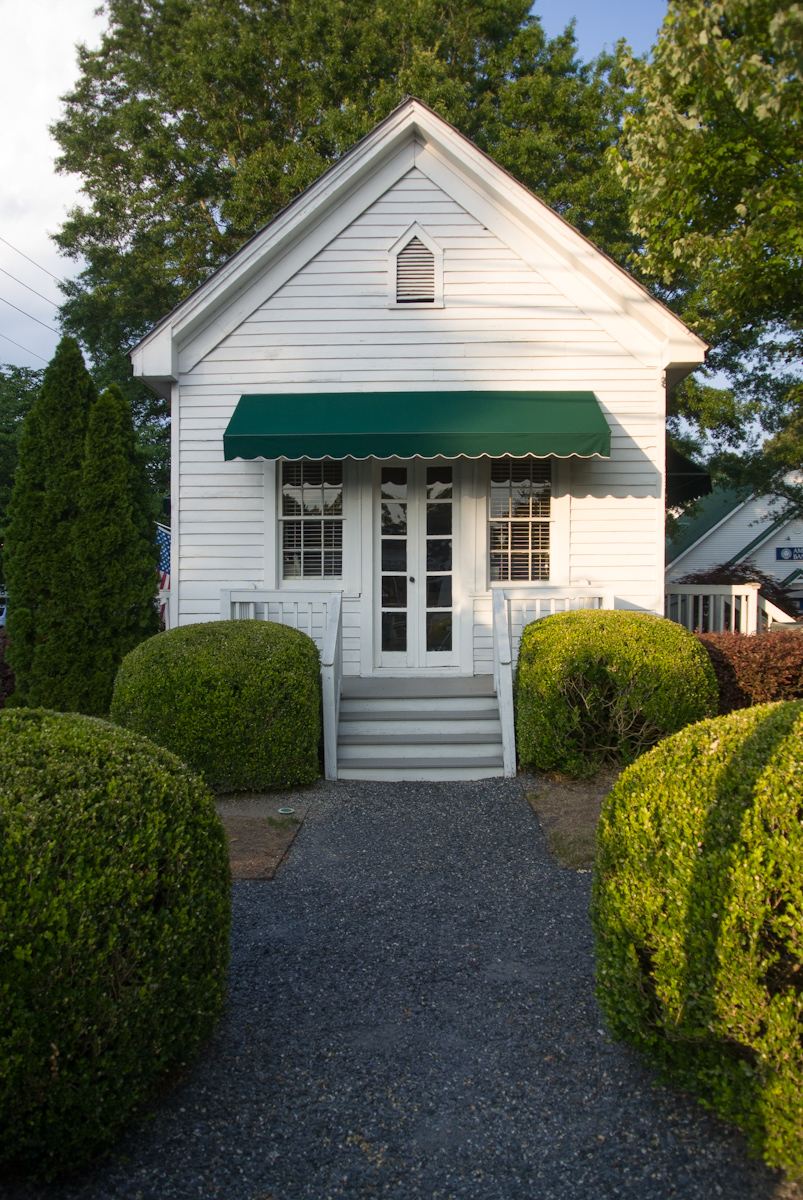
An old inn in Vinings, GA – they built small at that time – Nikon J1

As for ergonomics, I would say that anything is better than a smartphone. Smartphones need to be operated with two hands (one to hold the phone, one to play with the controls on the screen), and pinch to zoom is not as easy or direct as rotating a ring on a lens. Even if it’s shaped like a bar of soap, the J1 is still easier to hold than a phone, and has more physical controls.

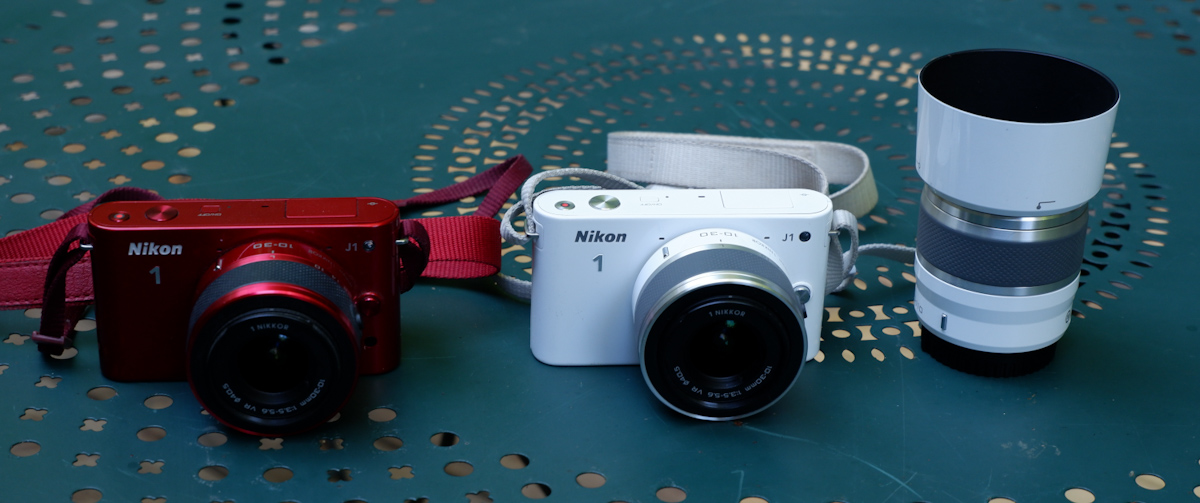
What about the colors? The J series cameras were available in a wide variety of colors, with coordinated lenses. White, Black and Silver were always available, but each iteration also benefited from not so common colors (Dark Red and Light Pink for the J1, Orange and  Dark Pink for the J2, Beige and Wine Red for the J3, Tangerine for the J4). Only the final model (which is also technically the best, by far) bowed to convention, and was only available in an “all black” pro attire, or with a “retro-look” silver with black leatherette.

Processed in Lightroom – the RAW files of the J1 respond well to post processing

The J1s are apparently reliable, but the lenses are not. The lenses (all models except for the 6.7-13mm and the 70-300 zooms) rely on very small plastic cogs to open the diaphragm to the requested aperture, and those little cogs may become brittle over time, then break and make the lens unusable. If you buy a lens, ensure that it has been tested by the vendor – you can be sure that “untested” just means “not working or for parts”.

A Nikon J1 is still a pleasant camera to shoot with, provided it’s outdoors and under a nice weather. It’s very reactive and much more usable than micro 3/4rds or APC-C cameras of the same vintage, which were still relying exclusively on contrast detection for autofocus. It’s just a tad too big to fit in a pocket, but with its small size and its funky colors, it does not scare people like more serious looking cameras tend to do nowadays.

The dollar tree – RAW file processed in Lightroom – Nikon J1 – 10-30 lens
The same dollar tree – shot a few months earlier with an iPhone 15 Pro. The contrast and the resolution are much better.
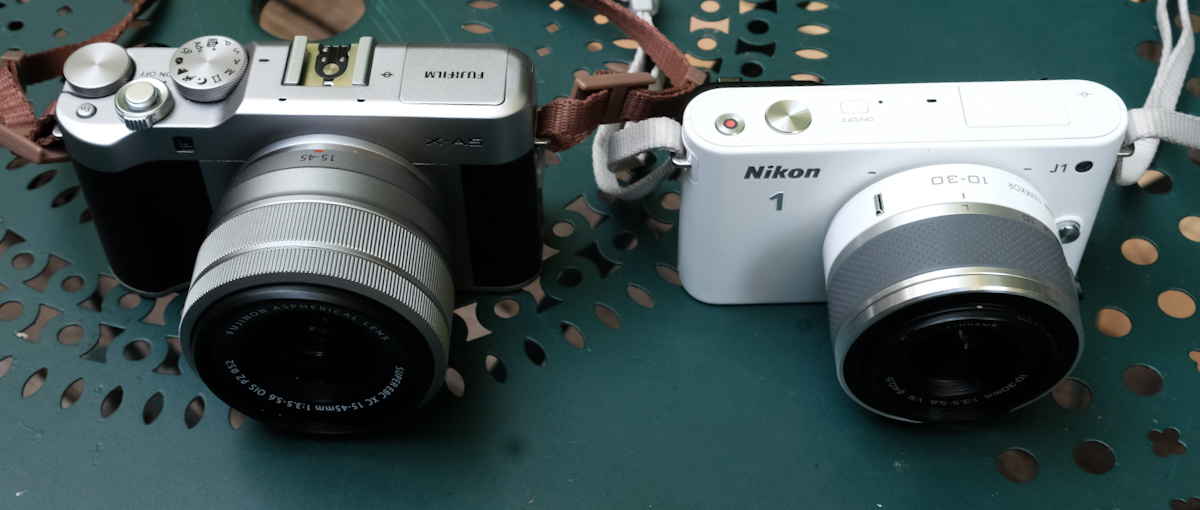
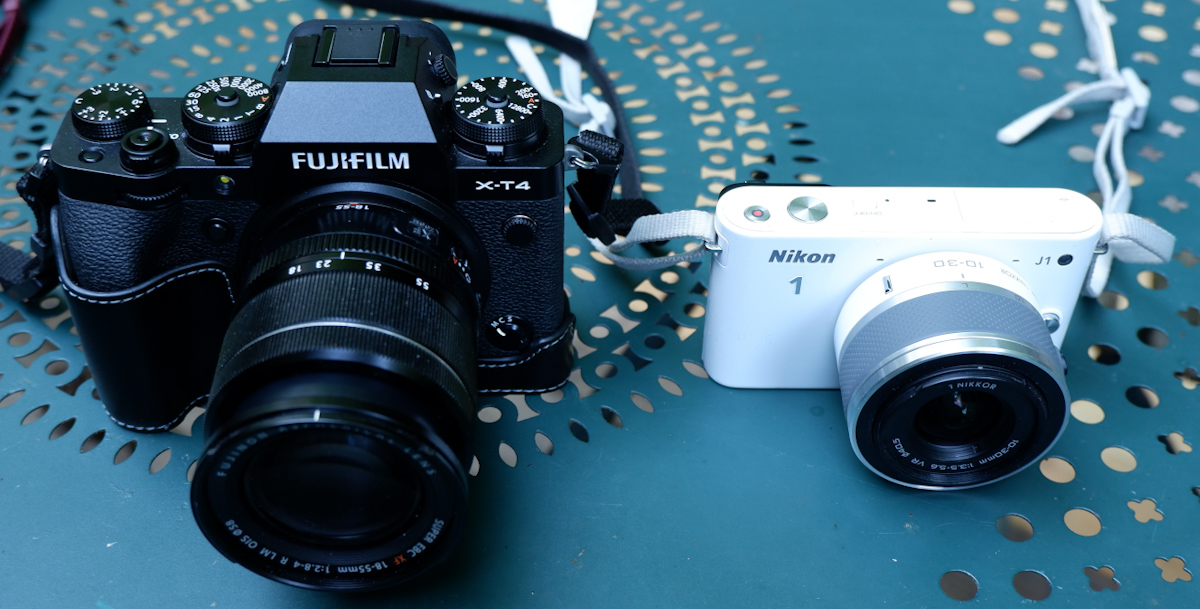
A Nikon 1 next to the smallest mirrorless ILC from Fujifilm (here the X-A5). The X-A5 is larger but produces much nicer pictures, out of the camera.

The J series are fun and cute cameras, let down but insufficient image quality – the J5 apart – and by unreliable lenses. A J1 in working order can be had for far less than $100 with a standard zoom, and a body only J5 can not be found at less than $200. Non standard lenses (tested, and in good working order) are more expensive ($100 to $400 depending on the model).

Well lit, close up – another good picture – at least technically.

Photos taken in Vinings and in the Coalmont OHV Park (TN) where dollars grow on trees.

/

Looking for my next “serious” digital camera

It’s not that I’m competitive, or that I carve for attention. But when I travel with my better half, she also takes pictures, and good ones at that. She has no interest at all in the technicalities of photography, but she has a good eye. And with an iPhone, that’s enough to get very good pictures, most of the time.
Within a few minutes of the picture being shot, it’s posted on one or two social networks, “liked” and commented.
Now, imagine yourself shooting with a 10 year old dSLR, in RAW, of course. You won’t get usable pictures until you’re back home, and find the time to fire up your laptop and launch Lightroom. By the time you’re done, your pictures will be yesterday’s news. Or most probably, last week’s.

The manufacturers of conventional cameras have understood that, and are slowly addressing the problem. The newest digital cameras are much better at uploading the freshly shot images to a smartphone, and they’ve improved their jpeg rendering enough that shooting RAW is not an absolute necessity, and that Jpegs are usable straight out of camera most of the time.

High level, I was happy with my Fujifilm X-T1, but I was ready for something a bit more recent, with a better viewfinder than my X-T1’s. I was still missing the large top of the plate display of the enthusiast oriented dSLRs, and I wanted a better integration with smartphone apps.

So I purchased a very nice Fujifilm X-H1 on eBay, The X-H1 was Fuji’s flagship camera in 2018 – with a 24 Megapixel sensor and – a first for Fujifilm – in body image stabilization. The fit and finish was splendid, the viewfinder much better than the X-T1’s, and the images were stunning – straight out of the camera. But I was extremely disappointed by the battery life of the camera. In the real life, not even 100 pictures per battery charge. I admit I’ve been spoiled with Nikon dSLR and their 1000 shots per charge, but 100 was definitely too little – imagine the logistical nightmare if travelling for a few days in a place without easy access to electricity – having to carry something like six batteries, two chargers, a few power banks to feed the chargers … No way.

So, maybe a dSLR was the solution after all. I still love shooting with a reflex camera – the optical viewfinder of a full frame is a pure delight for the eyes – and over the years I have accumulated a large number of Nikon F lenses. And I feel at home with a Nikon. Every command at the right place. I found a well used Nikon D750 at MPB, and started using it. The battery life was what I expected from a Nikon dSLR, and it was a pleasure to shoot with. But…. there was a long list of “buts”.

It’s not that the camera is large or heavy (in fact, the D750 and its descendant the D780 are the smallest and lightest full frame dSLRs from Nikon, on par with Canon’s smallest and lightest, the EOS 6D), but the lenses are big and ponderous. The more recent, the larger and the heavier. As for my old cherished lenses, they may be smaller and lighter, but they’re a bit overwhelmed by the 24 Megapixel sensor.

You may consider that Fujifilm’s “film simulations” are just brilliant marketing, and that Nikon’s Picture Control does more or less the same (preparing JPEGS usable straight out of the camera). But in reality, Picture Controls are not as easy to use (and not as good) as Fuji’s simulated film, and – in my opinion – the D750 still gives you better results if you shoot RAW and massage your pictures to taste in Lightroom.

Lastly, the D750 is still tied to Nikon’s ancient WMU (Wireless Mobile Unit) mobile app, and the less said about it, the better. This camera was launched in 2014, and it shows.

So, now what? I sold the X-T1, I sold the X-H1, I sold the D750, and finally purchased a lightly used Fujifilm X-T4 and a wide angle zoom. The X-T4 is still small for a modern mirrorless camera, the viewfinder is beautiful, the fit and finish impressive, and the battery life is correct (I did not feel the need to buy a second battery yet, and you can charge it directly from a USB source).

Admittedly, there is no top plate display, but almost all of the exposure parameters are controlled by dials on the top plate. If you buy a Fujifilm lens of the XF series, aperture is controlled by a ring around the lens, which is very intuitive if you’ve worked with film cameras in the pre-autofocus days. Zooms with a sliding aperture (like the 18-55 f/2.8-4) have an unmarked aperture ring, but the recent constant aperture zooms and the fixed focal lenses have easy to read aperture markings.

Because the camera is built around an APS-C image sensor, its lenses are much smaller than optics designed for a full frame camera.

Out of camera, the JPEGs are very good, and there are many film simulations to play with. Lastly, the smartphone app (Xapp) is a significant improvement over the old Camera Remote.

I’m just at the beginning of my new digital journey. I need to test all those film simulations, and I have to create a new workflow, laptop free and Lightroom Classic free. A workflow only relying on iOS devices (iPhone, iPad) and on the mobile version of Lightroom.

Pictures shot in Marietta, GA – Fujifilm XT-4 – default settings

Air Travel with photo equipment in the smartphone era…

And other ramblings…

Have you noticed? Everybody’s shooting with a smartphone, anytime, anywhere, and nobody seems to be objecting or even paying attention. But pull a conventional, dedicated camera from a photo equipment bag, and people start freaking out.

And suspicious neighbors or passersby are not the only ones panicking at the sight of a camera.

US Formula One Grand Prix – Austin – Nikon D700

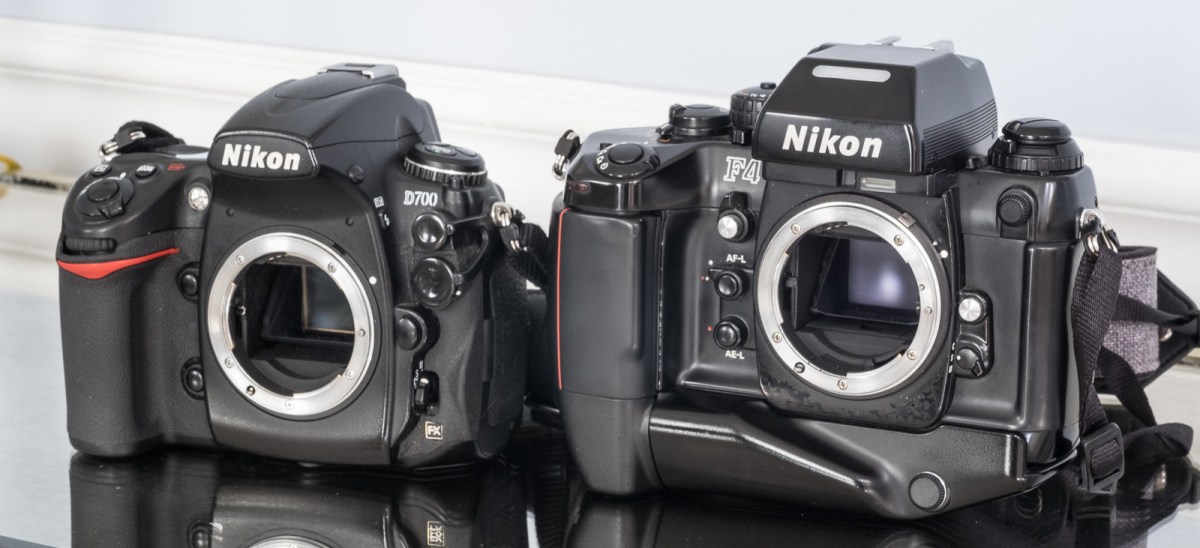
Two weeks ago I was stopped for a good 20 minutes at a TSA checkpoint at the Atlanta airport, because the agents were intrigued by the camera I was carrying (a Nikon D700 with a 28-70 f/2.8 zoom lens). Admittedly, it was a relatively bulky camera + lens combo, but I’ve also been stopped when I was carrying a much smaller Nikon FM with a 35mm fixed focal lens. It’s just that photography as we knew it – with dedicated cameras – has to a large extent left the mainstream. Shooting with film cameras was already an oddity, but it increasingly looks as if shooting with DSLRs is following the same route.

You can see from time to time, typically in touristy areas, a young person carrying a film camera strapped to his or her neck (a Canon AE1 in most of the cases), but I don’t see them actually taking pictures (they wear a camera like you would wear jewelry) and I don’t see film making a come back. Not with those prices, for sure. Film is getting expensive, and the cost of processing and scanning has gone to the roof during the COVID years. My favorite color film is Kodak’s Ektar 100, and it’s now costing $15.00 a roll. Fujifilm are raising their prices massively as well. Processing and scanning are now around $20.00 per roll – which brings the total cost of a scanned image to more than $1.00.

Of course, users of digital cameras don’t have to pay the Kodak or Fujifilm  « tax », but cheap cameras have almost totally disappeared from the new equipment market. And even the best dedicated digital cameras are still miles away from the convenience of smartphones: what the software engineers manage to do with  « computational photography » on modern smartphones never ceases to impress me, and the simplicity of the integration of the iOS or Android native photo apps with all forms of image sharing services is something a dedicated camera user can only dream of: if you’re happy with the resolution of a 12 Mega Pixels image, and with a focal range equivalent to a 13 to 75mm lens on a full frame camera, the smartphone is hard to beat.

Soap Creek Park – Marietta, GA – iPhone 15 Pro – Straight out of the camera

Beyond the obvious (launching cameras with higher resolution sensors and long range zoom lenses that don’t have an equivalent in the smartphone world), the historical camera manufacturers are working at slowly transposing in the dedicated camera world advances we’ve enjoyed on smartphones for years (“global” electronic shutters and the near real time upload of the pictures to the cloud is the most recent example). They’re also working at making the conventional digital workflow of the pros and enthusiasts (shoot in RAW, post-process in Adobe Lightroom, and export to JPEG for social media consumption) less of a given – with film simulations and picture control modes, images can be shared “straight out of the camera”.

Marietta (GA) – the square – JPEG “straight out of the camera”

Lastly, there seems to be a renewed interest for compact digital cameras. Since nobody manufactures them anymore, the second hand market is the only option. And (for no reason I can think of), the Nikon Coolpix seems to be the hottest item – in particular if it’s painted in a striking “velours red”. Maybe it’s the color? Modern dedicated cameras are high end products built out of magnesium, and they would not convey the same image of competent seriousness if they were pink or yellow.

Nikon Coolpix S6900 – pretty in pink

After a long pause, I’m returning to this blog. With a pink compact camera (not a Nikon), a full frame DSLR (a Nikon), and a best of breed mirrorless camera. Stay tuned.

Dia de los muertos 2023 – Atlanta – Shot with a Nikon D750 in RAW and post processed in Adobe Lightroom

An alternative to eBay? shopgoodwill.com


eBay has been here for 15 years now. Buyers and sellers had ample time to learn all the tricks of the trade, and if reasonably careful, they face little risk of a really bad surprise.


A significant percentage of the sellers on eBay are professionals, or experts in their field. Others have been using a product for years and can write about its history. Most know the value of the products they’re selling, and how to attract the attention of their audience. They take good pictures of the items they want to sell, and because they want to preserve their hard earned feed-back, they won’t provide blatantly misleading product descriptions.


But if the risk is somehow limited, the odds of scoring big are also getting pretty slim. With more than 200 million registered users, 2 million new auctions a day, and all sorts of search and reporting options, eBay is as transparent as a market can get. If the seller did his home work and followed the rules of the game when posting his listing, more than one buyer will notice, a small bidding war will take place, and the final price of the item will be very similar to the average of what similar items sold for during the weeks preceding the auction.


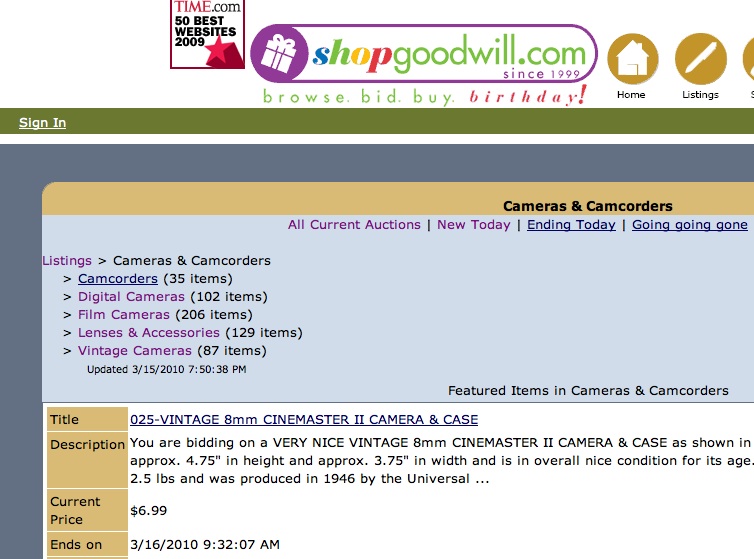
Shopgoodwill.com – the online auction site of Goodwill Industries – is a much smaller marketplace. Founded in 1999, it “provides a safe and secure venue for Goodwill® member organizations to sell donated items through an online auction“.


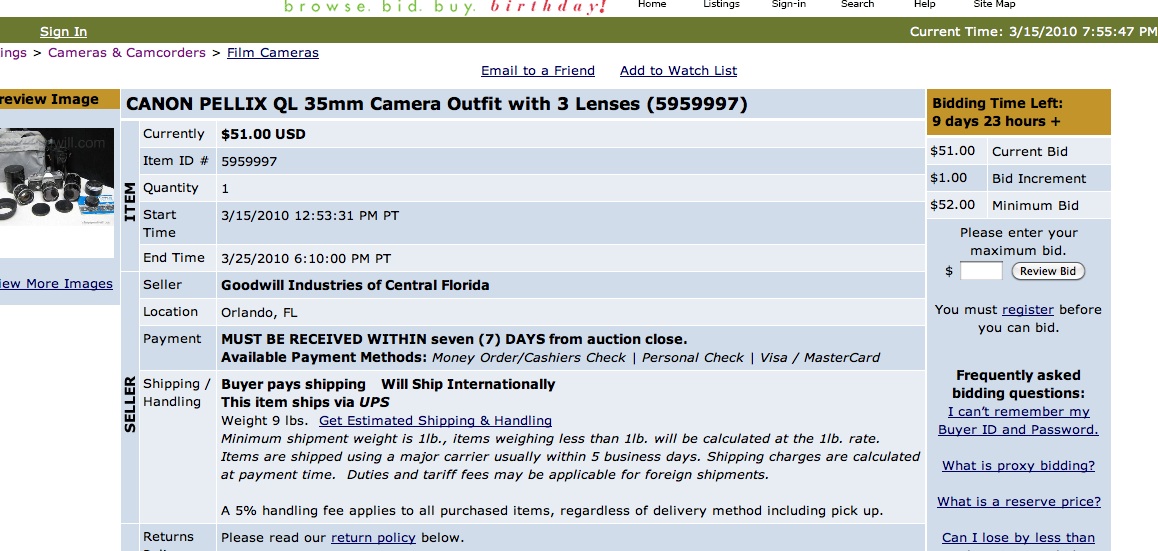
The photography related auctions of the day


On Shopgoodwill, the cameras and lenses presented for auction have been donated, and the people describing the products know very little about their past. Most of them are not specialists of photographic equipment, either. They do not want to raise false expectations, and will stay extremely conservative in their assessments. In the best case, they will write that the product “appears to be in a good condition” or that it “appears to be working”, but all items are sold as is.


The item descriptions are sometimes very generic (“Nikon Camera”) or written by someone who can’t tell the difference between a filter and camera (“Hoya 49mm camera made in Japan”). The quality of the pictures of the items improved significantly lately, but they are still low res, and it’s often difficult to find out what’s really being sold.


While not as large as eBay, the number of potential buyers is far from small, and the odds are that a rare and valuable item will be discovered by more than one buyer. I’ve seen a few Leica cameras for sale on Shopgoodwill, and they all fetched good prices. But I’ve also seen nice vintage cameras stay unnoticed.


So where is the fun? Shopgoodwill is like a garage sale or a flee market. Tonight 27,000 film cameras were listed on eBay. Less than 300 were listed on Shopgoodwill. You have relatively few items to look at, and you can go rapidly through the list of cameras or lenses being auctioned. The product descriptions are not always very good, but lovers of old equipment will raise to the challenge and put their geekiness to good use, with the hope of discovering a true gem.


Example of a listing on Shopgoodwill.com


Buying a camera or a lens at Shopgoodwill is a bit of a gamble. The intentions of the sellers are undoubtedly good, but their expertise is somehow limited, and the buyer will know little about the true condition of the item he’s bidding for. I never had the guts to buy a really expensive camera or lens on Shopgoodwill, and I never spent more than $30 on an item.


The camera I bought (a Praktica camera sold under the “Cavalier” name in the US) was cosmetically nice, and ended up working after some TLC, in spite of its old age. I also bought a lens, on a separate occasion. Although a bit dirty, it was in good general condition, and proved to be a very nice item once cleaned. A good experience overall. Try your luck too; it’s for a good cause.


More about Shopgoodwill.com
The presentation of the Shopgoodwill site by Goodwill Industries
A review of Shopgoodwill by Time: 50 best Websites 2009: Shopgoodwill.com


Olympus OM-1 / Praktica LTL - The Praktica (sold as a Cavalier in the US) was bought on Shopgoodwill.com.

Single Lens Reflex or Rangefinder Camera? A few days with a Leica CL


I was back in Paris for a few days at the end of last year, and since there was still room in my equipment bag, I pulled my old and battered Leica CL from a drawer and took it with me. A good opportunity to check whether I could get acceptable results out of it this time.


I never was a rangefinder guy. When I started being interested in photography, semi-automatic Single Lens Reflex cameras (SLRs) were already the norm, and Leica an expensive brand of obsolete cameras. My formative years were spent with a Pentax MX, and I’ve always found natural to see the world on the matte focusing screen of a reflex camera. But I was intrigued by the Leica legend, and one day, purchased a Leica CL. Over the last 15 years, I used it rarely, but being light and compact, it could find a slot in my equipment bag from time to time.


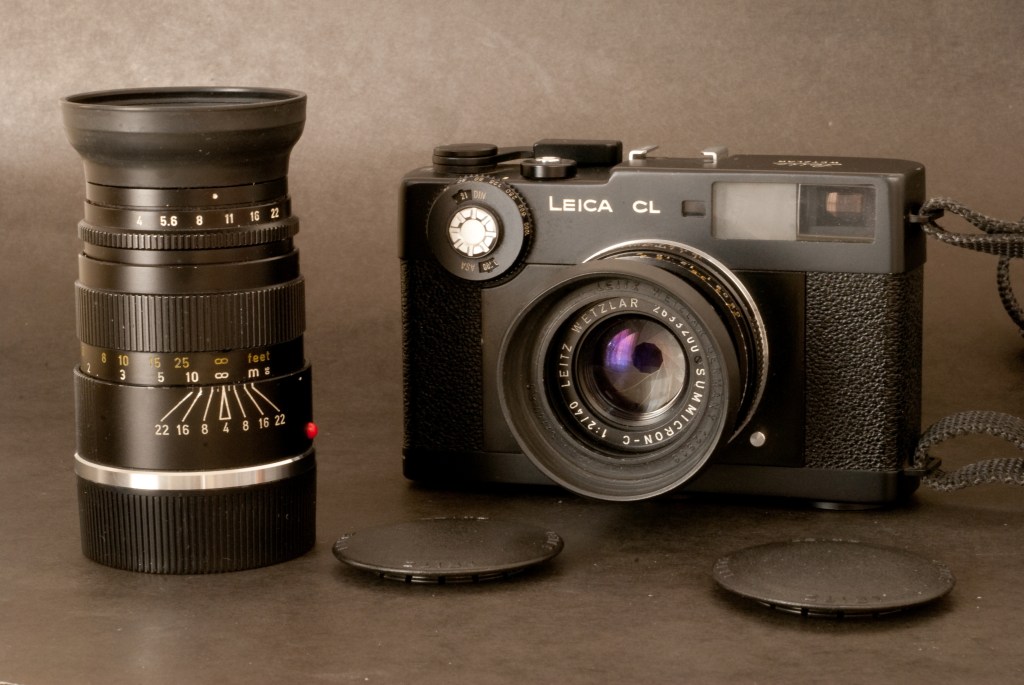
Leica CL with its two lenses

The CL was a sort of entry-level rangefinder camera, designed by Leitz in Germany and built by Minolta in Japan from 1973 to 1976.


From a technical point of view, it is a miniature M5, and very advanced for a Leica of its time. A semi-auto camera with through the lens metering, it used a mechanism very similar to the system used in the much maligned M5’s.


After the CL and the M5 were abandoned in the mid seventies, Leitz reverted to fully manual cameras with no metering capabilities, and aficionados had to wait for another 10 years before a semi-auto rangefinder camera was proposed again by the German firm.


With its M bayonet mount, the CL could use the 50 mm lenses of its bigger brothers, but Leitz had also designed two lenses specifically for the CL, a 40mm Summicron (F:2) and a 90mm Elmar (F:4).

Using the Leica CL


A true Leica, it also used a focal plan textile shutter (1/2 sec up to 1/1000 sec). The rangefinder has a short base and is not as accurate as the M6’s, but is good enough for the 90mm Elmar.

A class at the Louvres Museum- Jan.2010. Paris
A class at the Louvres Museum- The CL is small and silent, and nobody paid attention to me or to the camera.


With its mechanical shutter, the CL only needs a battery for metering, and uses it sparingly. Mine still has the mercury battery I bought it with, but I suspect it must be at the end of its life, because the recommendations of the metering system were so bizarre that I decided to forget about it and apply the “sunny 16” rule. With a battery in working order, the determination of the exposure is very simple (a match needle at the right of the viewfinder).


On the CL, the image in the viewfinder is large and clear. The viewfinder has a greater field of view than the 40mm lens normally mounted on the camera, and projected bright lines show to the photographer what the actual picture will look like. There is little difference between the respective field of views of the viewfinder (similar to a 35mm) and of the 40mm lens, but the bright frame projected of the 90mm lens will seem minuscule at the center of a viewfinder, whose enlargement factor does not change. Disconcerting, but not dramatic.


What really requires adaptation is focusing. On a manual focus Single Lens Reflex camera, the image of the subject is projected on a matte ground glass, and the photographer can see immediately whether the image is in focus or not. Similarly, with tele-zooms used at large apertures, the effects of the reduced depth of field are easily visible, and the photographer can visualize what will be in focus, and what will be pleasantly blurred.

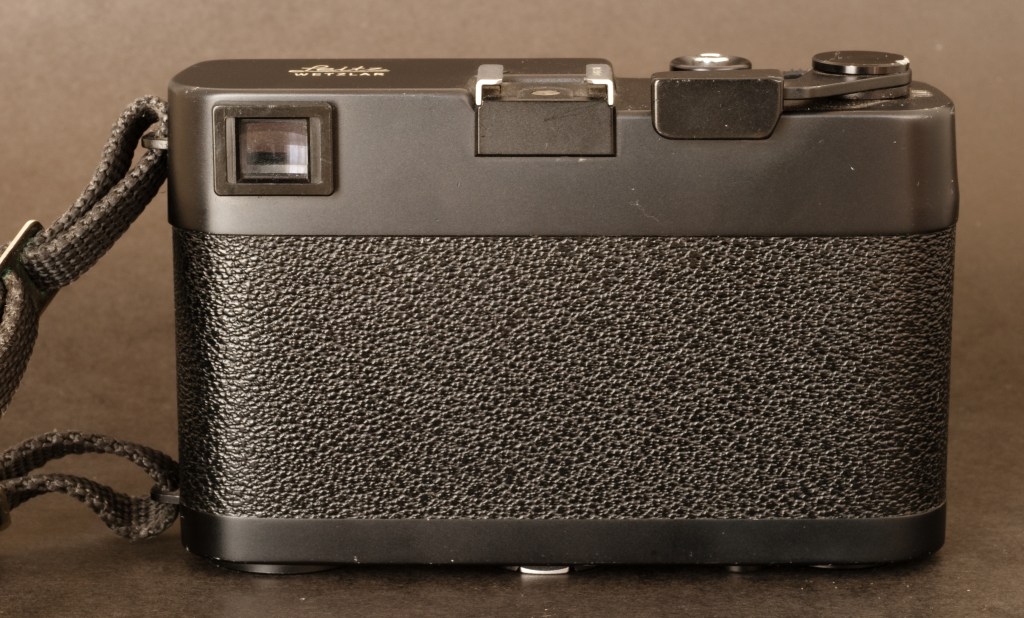
The back of the Leica CL
The back of the Leica CL – Note the viewfinder at the top left corner of the body, leaving ample space for the nose of the photographer


On a rangefinder camera, the finder does not provide any feed-back when it comes to focusing. Every element of the image seems in focus: it’s very easy too forget to set the focus, and very difficult to predict the depth of field.


The coupled rangefinder is materialized by a small window at the center of the viewfinder. It’s extremely accurate, but the focusing ring on the small lens is narrow and rather stiff, and you get the impression that you could have reacted much faster with the large focusing ring of the 50mm lens of your SLR.


I guess it gets better with experience, but it’s very frustrating for a beginner.


If you can get over the idiosyncrasies of the viewfinder, the Leica experience is very rewarding. The camera is virtually silent, and being small and black, gets totally unnoticed. The pictures are sharp, with a lot of micro-contrast, and give the impression of being of higher quality than the images taken with most of the SLRs (provided you could master the focusing system). Your success rate will be lower than with a manual SLR, and far lower than with a dSLR of the latest generation, but when the images are good, they’ll be very good.


Buying a rangefinder camera


Rangefinder cameras are markedly different from SLRs, and will not produce good pictures without some serious practice. The first attempts will be frustrating, and there is no point in spending a lot of money in a Leica M9 if you discover after a few days that you’re totally allergic to this style of cameras.


The Leica CL is one of the cheapest options for a photographer who would like to try rangefinder cameras. Good Leica CL are rather easy to find in the US or in Europe. Even in a pristine condition, they never cross the $1,000 threshold, and nice items can be found between $300 and $600. In Japan, the CL was sold as a Leitz-Minolta camera, with no other difference with the “Leitz only” CL than the logo.


A few years after the production of the CL was stopped, Minolta launched the CLE, an automatic exposure version of the CL, and the first camera to propose On the Film (OTF) flash metering. There is no semi-auto or manual mode. The CLE contains much more electronics than the CL, and it can not be repaired if the main circuit decides it had enough. The CLE is much more difficult to find than the CL. Expect to pay $600 for a nice one, and thousands for collector editions.


Full size M series Leica are either more primitive (no exposure metering) or more recent and significantly more expensive than the CL. Even in poor condition, a Leica M6 can not be found for less than $1,000. Cosina is still producing a line of rangefinder cameras, sold under the Voigtlander brand, and available with Leica M lens mount as well as less common mounts such as the Nikon and Contax rangefinder mounts. Amongst all the the rangefinder cameras from Voigtlander, the Bessa R3M is the closest to the CL (it accepts the same 40 and 90mm lenses), and can be found between $400 (used) and $600 (new).

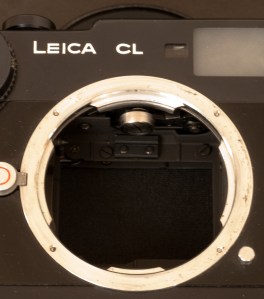
Leica CL - The shutter is not armed
The light chamber of the Leica CL – In this picture, the shutter is not armed. As a consequence, the CdS sensor of the exposure meter is not deployed.

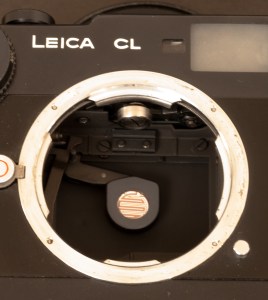
Leica CL -Armed shutter
The shutter is armed; the CdS sensor of the exposure meter is deployed. It will retract when the shutter release is pressed, just before the shutter opens.


References and links


A specialized source for rangefinder cameras (Leica, Nikon and modern Voigtlander): http://www.cameraquest.com/leicacl.htm


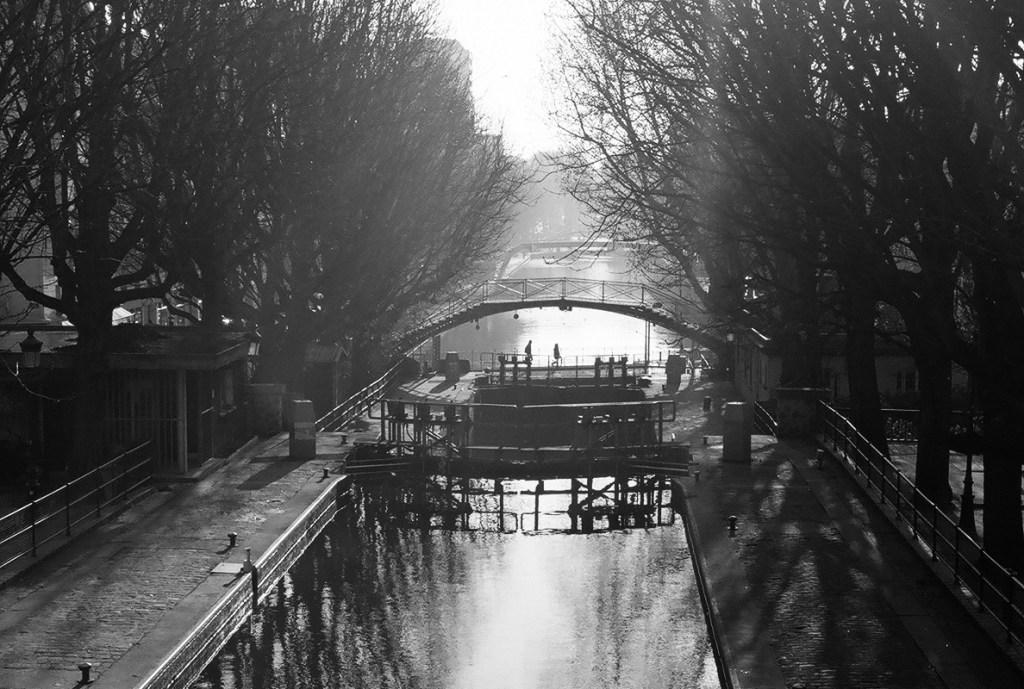
Canal St Martin - Paris - Located between the Gare de l'Est and the Bastille, the canal was a favorite set of the French film makers in the thirties. Using a Leica with B&W film seemed appropriate.
Canal St Martin – Paris – Located between the Gare de l’Est and the Bastille, the Canal was a favorite set of the French film makers in the thirties. Using a Leica with B&W film seemed appropriate

The Nikon FE2: one of the very best manual focus SLRs ever.

Launched in 1983, the successor of the FE had a relatively short sales career, but a long legacy. It can be argued that the Nikon FM3a, sold from 2001 to 2006, is much more a descendant of the FE2 than of the FM2.

Nikon FE2 - Shutter
Nikon FE2 – The titanium blade shutter was the most advanced at the time of the camera’s launch, with a top speed of 1/4000 sec and a flash sync speed of 1/250 sec.

In 1977, a few years after Olympus initiated the compact SLR revolution, Nikon presented the FM. Like the Olympus OM-1, the FM was a compact semi automatic camera with a mechanical shutter, which could be equipped with a motor drive. But contrarily to the OM-1, which still relied on a CdS light metering system and on mercury batteries, the FM used modern gallium photo diodes and silver oxide batteries. It also benefited from a vertical blade metallic shutter, and the exposure metering was relying on 3 LEDs instead of the more conventional match needle arrangement of the OM-1. Solidly built and reliable, the FM was very successful commercially, and the ancestor of a large family of models whose production only stopped in 2006.

Nikon FE2
Nikon FE2 with the MF-12 data back – the data back connects to the PC Sync of the camera

The FE from 1978 is the automatic exposure version of the FM. It looks very similar to the FM, but instead of LEDs, it uses two needles to show the shutter speed selected by the photographer (semi-auto mode) and by the automatic exposure system (aperture priority auto mode). In 1982, the FM became the FM2, receiving a new mechanic shutter with titanium blades, which could reach 1/4000 sec and had a flash synch speed of 1/200 sec.

IMG_1099
Nikon FE2 – Auto Exposure Mode – the thin black needle shows the shutter speed selected by the metering system of the camera. Note the aperture value at the top of the viewfinder.

One year later, the FE2 was launched. Its titanium shutter is an improved and electronic version of the FM2’s, with a X synch speed now reaching to 1/250 sec. The FE2 also benefits from a modern on the film (OTF) flash metering system (that the FM2 never got). The FM/FE range of products was extended the following year with the presentation of the Nikon FA, which added matrix metering (a world premiere), a programmed exposure mode and trade the brass prism cover of the FM/FE models for a polycarbonate one. Both FE2 and FA were discontinued in 1988. The FM2 lived longer, and was ultimately replaced by the FM3a, which merged the mechanical shutter of the FM2 with the electronics of the FE2.

Using the FE2 as an every day camera

Reasonably light and compact, the Nikon FE2 is very solidly built, and very nicely finished. Compared to a previous generation model like the FM, the FE2 has smoother commands. The viewfinder is typical from a pre-high eye point construction – the enlargement factor is high (0.86) for a good focusing precision, but the frame coverage is limited (93%), and the eye point is very short (14mm), which could be an issue for photographers wearing glasses. Even with thin glasses, it’s impossible to see 100% of the image projected on the focusing screen without having to move one’s eye ball right to left and left to right: you only perceive 90% of the focusing screen when you look straight into the viewfinder, which compounded with the rather limited frame coverage, ensures that you’ll have a wide safety margin on both sides of your prints.

Nikon FE2 / Olympus OM-1n
Nikon FE2 / Olympus OM-1n – The FE2 is a bit larger, but not significantly.

The determination of the exposure is very conventional for a camera of its generation, with a center weighted measurement provided by two silicon photodiodes. In automatic mode, a needle indicates the speed selected by the exposure system of the camera on a large scale at the left of the viewfinder. The photographer has multiple ways to override the automatism: he can memorize the exposure (pushing the self timer lever towards the lens), apply a correction factor on the film speed selector (from -2 up to +2EV), or switch to semi-auto mode. In this case, a second needle – larger and transparent – appears in the viewfinder, showing the shutter speed selected by the photographer.

IMG_1100
Nikon FE2 – Semi auto exposure mode. The fat blue needle shows the selected shutter speed, the thin black needle shows the shutter speed recommended by the metering system.

In a very simple matching needle arrangement, the photographer just has to align the meter needle with shutter speed needle. The shutter speed knob is much smoother than on the FM (in the FE2 the shutter is controlled electronically), and surprisingly the camera is more pleasant to use in semi-auto mode than the FM. No wonder that Nikon derived the exposure control system of the FM3a from the FE2’s and not from FM’s.


Nikon FE2 with MF-12 back
A very clean Nikon FE2 with the MF-12 data back – All the commands are grouped on the top plate – with the exception of the depth of field preview and the exposure lock levers, located at the right of the lens mount. A very simple and efficient layout.

Conclusion

Powered by two easy to find LR44 silver oxyde batteries, the camera also operates without battery at a speed of 1/250sec. Compatible with any AI, AIs and AF lenses, it’s still perfectly usable today.

Less rugged than its FM and FM2 cousins (it has an electronic shutter and a potentially more fragile match needle metering system), it is more pleasant to use and can respond efficiently to a larger variety of photography opportunities. Like the FA and the FM3a, but unlike the FM2, the FE2 benefits from a modern through the lens (on the film or OTF) flash metering system, compatible with the flash units currently sold by Nikon.

Nikon FE2 with MF-12 back
Nikon FE2 with the MF-12 back. The MF-12 back was designed for the FM/FE cameras, which did not have internal synchronization contacts for a data back inside the film chamber. Hence the need for an external synchronization cord. The FE2 could also use the MF-16 data back, which did not need the external sync cord.

Its automatic exposure system is very easy to override, and does not get in the way. The matching needle system in the viewfinder is very informative, easier to read in the sun light than the LEDs of the FG, and than the small LCD display of the FA.

With the F3, the FE2 is probably the most usable Nikon camera of the early eighties.

How much for a Nikon FE2?

The Nikon FE2 is a very good automatic exposure film camera, and its reputation has obviously an impact on its price. Specialized retailers like KEH sell it between $130 (Bargain) and $270 (Top Condition).

As usual, prices are a bit lower on eBay, but the FE2 does not seem to sell for less than $100, with peaks up to $180 for very nice items.

There are few alternatives to the FE2: the more recent FM3a is much more expensive (typically from $400 up to $700) and the FE, with its modest shutter and no OTF flash metering, is far more primitive and more difficult to recommend.


Eight years later…

I wrote this blog entry in 2009. Eight years later, after having tested and used many other SLRs from Canon, Fuji, Nikon, Olympus and Pentax, the FE2 is still one of my preferred cameras:

  • it’s simple – very few options and commands. You read directly on the rings and knobs how it’s set up (pretty easy – aperture, shutter speed, ISO – that’s all). Controlling it rapidly becomes instinctive – an extension of your eyes and hands .
  • with average metering weighted towards the center/lower half of the scene, and an easy to find exposure memorization lever – it’s easy to get the exposure right.
  • the focusing screen is very clear – almost as clear as the viewfinder of a rangefinder camera, but not at the detriment of precision – you can get the focus right, even with very luminous lenses. It’s a relatively short eye point viewfinder – if you wear glasses, you won’t see the borders of the focusing screen unless you really pay attention to it.  You just see the scene – you’re in the middle of it – it’s an immersive experience.

More about the FE2


Photography in Malaysia


Tree trunk
Tree trunk – Along the Nickajack Creek – Smyrna, GA (Nikon FE2, Nikon 50mm lens, Kodak CN400 film.