50 Years of Lens Mount Evolution: Part VI of VI


The last 10 years – digital cameras and image stabilized lenses


The massive adoption of digital cameras has not led – so far – to a dramatic change of the design of the lens mount of the cameras. Canon, Nikon, Pentax and Sony (aka Konica Minolta) did not design specific lens mounts for digital cameras, even if they designed specific series of lenses adapted to the smaller size of the digital “APS-C” sensors.
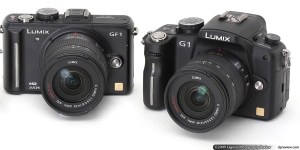

Panasonic GF1 and G1
Panasonic GF1 and G1 - the most radical development in interchangeable lens cameras since the Contax S and the Leica M3 (Photo courtesy of DPReview)


Only camera makers which had been absent from the 35mm Autofocus SLR market and had no installed base to please had the liberty to start from a clean slate. In 2003, Panasonic and Olympus launched the “Four Thirds” format, combining a relative small size sensor with a large all-electric mount. Last year, Panasonic finally presented the Micro Four Thirds G1, a camera with an electronic viewfinder and interchangeable lenses (EVIL), the first digital camera to really depart from the conventional SLR design of the Contax S of the late forties.


Why did the camera manufacturers keep the same bayonet mount for digital?


When the first digital SLRs from Nikon and Canon were presented in 2000, large imaging sensors were so difficult to manufacture and therefore so expensive that the camera makers settled for a form factor smaller than the 36x24mm dimensions of 35mm film (23.7mmx15.6mm for Nikon, 22mmx14.9mm for the Canon EOS-D30).


This form factor was dubbed “APS-C“, because it was close to the dimensions of an APS picture, shot with the “Classic” image format (25.1×16.7mm) of the APS cameras. The sensor being smaller than a 35mm negative (the diagonal of 35mm film is 1.5 times larger than the diagonal of an APS-C imager), the camera makers had an opportunity to design a new series of smaller bodies and lenses, but they all decided to stick to their legacy lens mounts and to design digital SLRs at least as large as their film counterparts.


Being the undisputed leaders of the film camera market, Nikon and Canon in particular had no interest in starting a new incompatible product line, at the risk of alienating their large user base; it would have leveled the playing field, and offered an easier entry in the dSLR market to companies like Panasonic or Sony. Nikon and Canon also wanted to limit the cost and the technical risk of going digital by reusing most of the components of their film cameras in their first generations of dSLRs. And they may have anticipated that one day, with the help of Moore’s law, cameras using full size digital sensors would become affordable for their professional and enthusiast customers, making their large F or EF bayonets more relevant than ever.


For a few years, however, dSLRs with APS-C sensors were the only game in town. Canon and Nikon both developed specific lenses for their small sensor bodies. Canon decided to modify the EF mount so that the EF-S lenses designed for the small sensor cameras can not be mounted on full frame SLRs or dSLRs. Nikon did not change the F bayonet – small sensor DX lenses can also be mounted on full frame (or FX) bodies, but being designed for the APS-C sensor size, they do not cover the full format of the FX sensors and the image is automatically cropped.


The Four Thirds and Micro Four Thirds formats


In 2003, Olympus and Panasonic launched the “Four Thirds” format. At that time, Canon had already started producing the first full frame 35mm digital camera (the EOS 1D), and was preparing much more affordable 35mm digital SLRs like the EOS-5D for the enthusiast photographer market. A large sensor was still complex and expensive to manufacture, but getting high quality pictures out of it would prove much easier than with a small sensor, in particular in low light situations.


The Olympus Four Thirds system was based on design decisions completely opposed to Canon or Nikon’s . The sensor size chosen for Four Thirds cameras is very small (its diagonal is only half of the diagonal of a 35mm sensor), but at the same time the lenses and bodies are designed around a large diameter bayonet mount (44mm, the same as Nikon’s F), with a relatively long focal flange distance (38mm). When the system was designed, it was believed that a large diameter lens and a long focal flange distance were required to get optimal results from the imaging sensor, but the Leica M8 and M9 have since proven that it was not the case.


On the positive side, the relatively large dimensions imposed by the Four Thirds mount gave the engineers more freedom to design high quality lenses with very fast apertures, but on the negative side the body & lens combination could not be made significantly smaller than the more conventional APS-C cameras of their competitors. To add insult to injury, the relative small size of the sensor proved a handicap in low light situations (all things being equal, small sensors are more subject to noise than larger ones), and steered most of the enthusiast photographers away from Four Thirds cameras. Four Thirds only got traction on the low end of the market.
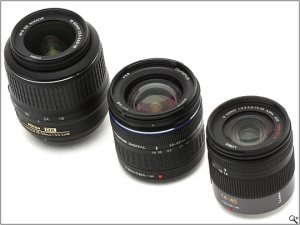

Size comparison: Nikon 18-55 DX, Olympus 14-42, Panasonic 14-45 Micro 4/3
Size comparison: Nikon 18-55 DX (APS-C), Olympus 14-42 (Four Thirds), Panasonic 14-45 (Micro Four Thirds) - Image courtesy of DP Review


Failing to make a significant impact on the mid-level dSLR market, and completely barred from the professional market dominated by new full frame cameras with extraordinary low light capabilities, Panasonic and Olympus decided to create a new niche for themselves, and launched Micro Four Thirds cameras. Using the same sensor as the “Four Thirds” dSLRs, the Micro 4/3rd cameras have abandoned the reflex mirror chamber and the pentaprism viewfinder of conventional dSLRs for an electronic viewfinder. They are designed for a much shorter focal flange distance (approx. 20mm instead of 38mm, and the mount diameter is also smaller (32mm approx. instead of 44mm).
As a result, the body+lens combination is much more compact than any other dSLR on the market. It’s still difficult to predict how this new category of cameras will fare in the future, but they finally bring something new to the table.


Image Stabilization

The migration from film to digital is without a doubt the most significant evolution of photographic equipment in the last ten years. Image stabilization gained acceptance during the same time, and is now a feature expected by amateurs using digicam as well as enthusiasts and pros using expensive large aperture teles. The objective of image stabilization systems is to compensate automatically the involuntary movements of the photographers, and to produce sharper pictures even at slower shutter speeds.


Canon, Nikon and Panasonic adopted relatively similar systems, all based on the controlled movement of optical modules installed inside the lenses. Minolta, Pentax and Olympus opted for in-camera systems compensating the movements of the photographer by moving the image sensor itself. Apparently both systems produce good results. In-camera image stabilization systems do not require any change to the lens mount, but in-lens systems need to be managed from the body, and require a few more electric contacts. Most of the current lens mounts are all-electric now, and adding a few contacts is an easy done job.


The state of the art in 2009


Pentax: Progressive introduction of the KAF3 version of the K bayonet mount, with autofocus motor in the lens. The majority of the lenses in the product line still need an autofocus motor in the camera body.


Canon: No change to the EF mount of the EOS cameras. Starting with the Rebel and the 20D cameras, Canon used a specific variant (EF-S) of the mount for lenses dedicated to the APS-C format. Canon dSLRs all work with EF lenses, but only the Rebel and 20D, 30D, 40D and 50D cameras can use the EF-S lenses.


Minolta, Konica Minolta and Sony: Progressive introduction of SSM lenses, with the focusing motor inside the lens. The majority of the lenses in the product line still need an autofocus motor in the camera body.


Nikon: Multiple variants of the F mount were used during the last 15 years:
– AF-D: no mechanical difference with the AF mount, the D lenses transmit the focusing distance value back to the body for 3D Matrix Metering
– AF-I: focusing motor in the lens – used for tele-lenses between 1992 and 1996;
– AF-S lenses: ultra-sonic (“Silent Wave”) autofocus motor built into the lens. Most of Nikon’s zoom lenses are now AF-S, and the conversion of prime lenses has started a few years ago.
– The new PC-E (perspective control electromagnetic) lenses now use an electromagnetic diaphragm command. All the other Nikon lenses still use the mechanical stop down mechanism introduced with the F mount in 1959.


Olympus & Panasonic started promoting the Four Thirds format in 2003. Four Third lenses use an all electric bayonet mount. The Micro Four Thirds are more compact, and use 11 electrical contacts instead of 9 for regular Four Third lenses. Thanks to the very short focal flange distance of Micro Four Third cameras, it is easy to develop adapters for Canon EF, Nikon F, Olympus OM or Leica M or R lenses.

Gull in Essaouira (Morroco)
An exception on this blog: a digital picture (Nikon D80) taken in Essaouira - Morroco

50 Years of Lens Mount Evolution – Part IV of VI


Programmed exposure


The automatic bodies of the early seventies still required some input from their users: they could only determine the shutter speed (or the aperture in the case of Canon cameras) after the photographer had set an aperture (or a shutter speed) compatible with the film speed, the intensity of the light and the characteristics of the scene (portrait, action shots, macro, and so on).
If the aperture set by the user was too low or too high, a matching shutter speed could not be selected by the camera and the picture was hopelessly under or over exposed.
Similarly, if the photographer let the camera select a very slow shutter speed with a long tele-lens, the picture would be blurry and unusable. Trained photographers knew that. But a better automatic exposure solution had to be found for the photographers who did not want to be bothered with technical details.

Nikon FA - the commands for the multi-mode exposure automatism (PSAM)
Nikon FA (1984) – the command for the multi-mode exposure automatism (PSAM) is in front of the shutter speed knob


Inspired by the program modes already available in point and shoot cameras, Canon launched the A-1, a new SLR with programmed exposure modes in 1978. Practically, it meant that the auto exposure system of the body had to simultaneously command the shutter speed and the aperture of the diaphragm.


Canon did not have to change anything on the FD mount, which had been created for full aperture shutter priority exposure. 


Nikon introduced the “AI-S” generation in 1979 when the mount was modified to support a linear command of the diaphragm. The first Nikon cameras to take advantage of the AI-S lenses and to offer a program mode and shutter priority were launched in 1982 and 1984 respectively. Because the camera body was informed of the focal length of the objective, it could choose automatically between two aperture-speed combinations when configured in program mode, one for wide angle and normal lenses, and one for lenses of 135mm and longer .

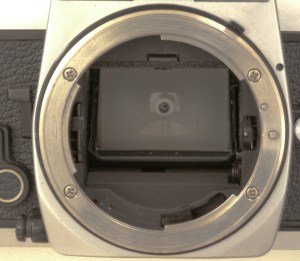
Nikon F mount - AIS on the Nikon FA
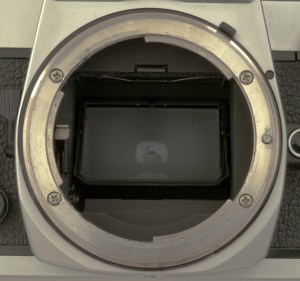
The AI-S variant of Nikon F mount, shown here on the Nikon FA. Compared to the lens mount of the FE2, the FA’s is using three more sensors: a small pin above the lens lock – which informs the body that the lens is of the AI-S type, a larger sensor inside the reflex chamber (right of the picture, in the middle) which is used to transmit the focal length of the lens to the body, and a slider at the bottom of the reflex chamber, used to transmit the maximum aperture of the lens to the body. The use of mechanical sensor had reached its limits. It was time to adopt electrical contacts instead.
Nikon F mount - AI on the Nikon FE2
For reference, the much simpler design of the AI mount (Nikon FE2). The stop down lever controlling the diaphragm is on the left side on the picture. You can still find it on current Nikon digital cameras.


Still trying to catch up with Nicanolta, Pentax adopted a brand new bayonet mount, the K mount, in 1975. The first K mount, however, did not support shutter priority or program modes. Electric contacts would have to be added with the KA declination of the K mount in 1983 to make it possible. Its close derivatives are still used today on Pentax DSLRs.


The state of the art between 1971 and 1985


Pentax: Aperture priority automatic cameras launched in 1971 with modified 42mm screw mount lenses supporting full aperture metering.
Change from the 42mm screw mount to a new Pentax K bayonet in 1975 (automatic pre-selection, full aperture metering, transmission of the pre-selected aperture value from the lens to the body);
Shutter priority and program mode introduced in 1983 with the KA version of the K mount.


Canon: The FD breech mount introduced in 1971 was ready for the Shutter priority cameras launched in 1973 (Canon EF) and for the program mode (Canon A1, 1978).


Minolta: MD declination of the SR Mount (one pin added for the support of the Shutter priority mode) to support the Shutter priority mode in 1977.


Nikon: Aperture priority cameras available since 1971 (Nikon EL) with the manual indexing F mount. Launch of the AI version of the F mount in 1977 to improve the ease of use. Progressive adoption of the AI-S declination of the F mount in 1979 to prepare for the arrival of cameras offering a program mode (Nikon FG, 1982) and a shutter priority automatic exposure (Nikon FA, 1984).


Olympus: the OM mount was introduced in 1971, and was ready to support programmed exposure from the beginning.


More about the lens mounts


Photography in Malaysia: information related to the F lens mount


American Petit LeMans - the Atlanta Pipe Band. Nikon FA - Kodak CN400
American Petit LeMans – the Atlanta Pipe Band. Nikon FA – Kodak CN400 – Processed by Costo. Cropping and minor adjustments in Lightroom 2

The Olympus OM system and a camera to rediscover: the OM-2s (Intro)


Take any line of manual focus 35mm reflex camera from the eighties and mid-nineties, Leica R included. Comparable models will be worth less, on the second hand market, than an Olympus OM-4T, not to mention the OM-3 and its ultra-rare and ultra-expensive offspring, the OM-3T. Why, in spite of their very serious limitations, are the single digit OM cameras so sought after? In this test of the OM-2s, the little brother of the OM-4, we’ll try and find out why.


The OM system


Olympus OM-1n next to a 35mm film cartridge. The competition needed almost 10 years to introduce more compact SLRs, but they were designed for beginners. In the enthousiast-amateur and pro categories, the OM family remains unchallenged to this day.


Launched in the early 70s, the Olympus OM-1 and its system of lenses and accessories were incredibly compact, very well designed, and at the same time solid enough to please the pros and the very serious amateurs. The competition (Nikon in particular) needed years to develop models approaching the size of the OM-1, which sold by the millions.


The OM-2, introduced in 1974 with the same ergonomics and a similar external appearance, was the automatic exposure version of the OM-1. It pioneered the use of direct exposure metering in the film chamber, and was the first camera with Through The Lens Flash metering. The competitors followed Olympus’ example, and almost every SRL cameras introduced after 1985 measures the exposure in the film chamber and offers TTL flash metering.


The OM-2s, OM-3 and OM-4 which followed in the eighties were relatively minor updates of the previous models. They shared a new body and had much more elaborate metering options, but they retained the relatively slow shutter of the OM-1 and OM-2. Their viewfinders were not as great as the ones of the OM-1 and OM-2, and the first models had some reliability issues. The OM-3T and OM-4T (with titanium top and bottom plates and more reliable electronics) raised the level of quality of the OM line, and soldiered on until Olympus finally stopped the production of film cameras, in 2002.


More after the jump


Why are manual exposure cameras worth more than automatics ? (Intro)


The facts


Let’s take three lines of manual focus cameras which still have a very active second hand market today: the Leica R series, the Nikons FM & FE and their derivatives, and the Olympus OM-1 & OM-2 and their “single digit” descendants. Each line contains automatic exposure cameras (Leica R4, R5, R7; Nikon FE, FE2, FA; Olympus OM-2, OM2s, OM4, OM4t), and manual exposure cameras (Leica R6, R6.2; Nikon FM and FM2; Olympus OM-1 and OM-3).


For a given generation of camera, manual exposure models are almost always worth more than their automatic exposure siblings.


Average retail price of a camera in Excellent Condition (source: a reputable specialist of used photographic equipment)

Brand Manual Camera Auto exposure Camera
Leica R6.2: $ 999 R7: $ 550
Nikon FM: $ 190 FE: $ 170
Nikon FM2: $ 245 FE2: $ 199
Olympus OM-1: $ 150 OM-2: $ 190
Olympus OM-3: much more than $500 * OM-4: $ 235
Olympus OM-3T: much more than $1,000 * OM-4T or TI: $ 450


More after the jump

Viewfinders: coverage, magnification and eye relief (Intro)

Eye Relief
Eye Relief


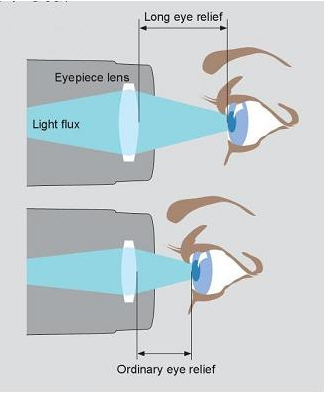
A large proportion of photographers wears prescription glasses – I know, I’m one of them – and almost everybody wears sun glasses occasionally. But surprisingly, until high eye point or high eye relief viewfinders appeared – on the Nikon F3 HP in the early eighties, photographers with glasses could not see the integrality of the scene – let alone the aperture or speed information on the LED displays surrounding the view of the scene- without having to move their eye balls up and down and left to right.


As far as viewfinders are concerned, some cameras are better than others, though. The quality of the viewfinder of a manual focus camera is influenced by three factors:

  • Coverage: It’s the percentage of the image captured through the lens which is going to be shown in the viewfinder. 100% coverage is desirable – but expensive to manufacture, and only top of the line cameras (the real “pro” models) show the integrality of the scene in the viewfinder. Most SLRs show between 85% and 95% of the scene. Point and shoot cameras, (more precisely the few P&S which still have an optical viewfinder) are much worse. The best of them, the Canon G11 only shows 77% of the scene that will be captured through the eye piece.

  • Magnification: If the magnification was equal to 1, an object seen through the viewfinder would appear to be the same size as seen with the naked eye (with a 50mm lens on a 35mm camera). The photographer could even shoot with both eyes open. If the magnification ratio is lower than 1, then the object will appear smaller in the viewfinder than seen with the naked eye.


    Magnification has an impact on composition and focusing. If the magnification ratio is very low (below 0.4) the image becomes so small that it’s difficult to compose the picture. Magnification is also a critical factor for picture sharpness on manual focus cameras: the accuracy of the focusing is directly related to what the photographer can see on the matte focusing screen, and the higher the magnification, the easier it’s going to be for him or her to focus accurately.


    More after the jump