Nikons’s most advanced manual focus “ultra-compact” SLR: the Nikon FG


In 1972, Olympus launched the OM-1. Much smaller and lighter than any other single lens reflex (SLR), it opened the path for a new generation of more compact cameras. Nikon’s own FM (launched in 1977) was remarkably smaller than the Nikkormat cameras it was replacing, but still a tad bigger than the Olympus OM-1n. Built like a tank, it was not light, either.


It would take another model, deliberately designed for the beginners, the Nikon EM (1979), to finally beat the OM-1 at its own game (weight: 460g against 510g, width: 135mm instead of 136mm). Small and light, the EM had a plastic (polycarbonate) body over an aluminum chassis, an aperture-priority exposure control system, and very few ways to over-ride the automatism. A magic -2EV button could be used for back-lit scenes, and that was about it: there was no semi-automatic exposure mode. It could use all Nikon’s previous AI (auto-indexing) lenses, as well as a new series of cheaper lenses (the E-Series) launched for the occasion. The E-series lenses were smaller and less elaborate than the other Nikkor lenses, but some of them (like the 50mm f:1.8) gained a very good reputation over time. It has to be noted that the E-Series lenses were the first to use the AI-S version of the F mount. Geeks can learn more about the evolution of the lens mounts of SLRs in the pages published a few months ago in this blog. 50 years of lens mount evolution.


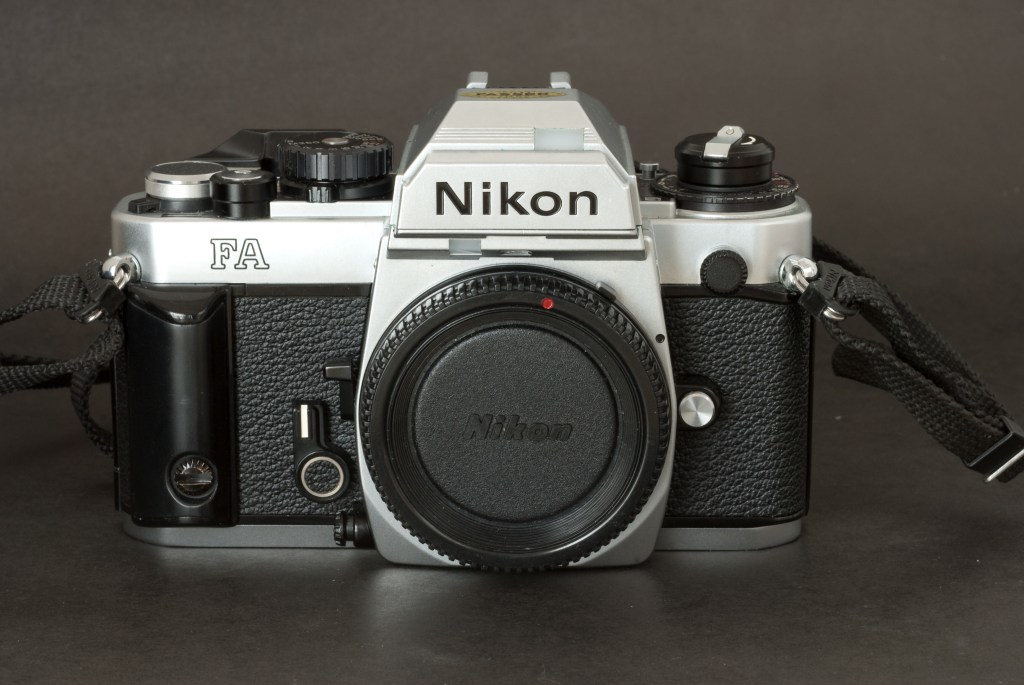
Nikon FG
Nikon FG


In 1982, Nikon extended their “ultra-compact SLR” range with the FG. It retained the platform, the dimensions and the shutter of the EM, but its electronics had been revised to incorporate two exposure modes, a semi-auto and fully automated program adjusting the aperture and the shutter speed. It also adopted the On the Film (OTF) flash metering system of the FE2. Not a pro camera yet, but not a beginner’s camera anymore.


To this day, the FG remains the smallest of the manual Nikon SLRs targeting the “advanced-amateur” market. A few “all-plastic” autofocus SLRs tipped the scales at 350g in the subsequent years, but Nikon’s digital reflex cameras are all bigger and heavier.


Shooting with the FG


The FG was available in two versions: “chrome” or black. Both had a small removable grip at the right of the body, and looked like smaller copies of the F3. After all these years, the FG is still a very nice little camera. Like the EM, it’s built around an aluminum chassis, and the body itself is in polycarbonate. The commands are simple and well organized. A single selector controls the shutter speed (for semi-automatic operation) and the type of exposure automatism (aperture priority or program). When the program mode is selected (after pressing a safety lock), the aperture ring of the lens has to be set at the smallest aperture. If the photographer forgets to set the aperture, the “overexposure” LED will flash in the viewfinder. The shutter is taken over from the EM and can not offer anything better than 1/1000 sec, with a flash synchro speed of 1/90. Incidentally the shutter still works at 1/90sec when the batteries are dead.


There are few other controls on the FG. A switch disables the warning beeps that the camera emits in multiple occasions, and a push button on the left side of the body can be used to open-up the exposure by 2 stops, to prevent under-exposure in back-lit scenes. There is no way to switch off the camera, and the best way to prevent battery drain is to leave the shutter speed selector on the manual 1/90sec setting when the camera is not in use.


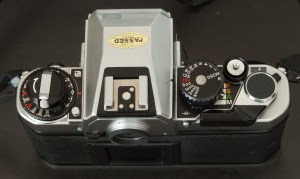
Nikon FG - The commands
Nikon FG – The commands


The viewfinder is one of the places where savings were made. With 0.84x magnification and 92% coverage, its performances are similar to the FM or the FE’s, but remarkably inferior to the exceptional OM-1, which in spite of being so compact, still combines a magnification of 0.92x with 97% coverage. At the right of the viewfinder, the photographer will find a scale representing the shutter speeds, with one or many (up to three) red LEDs showing the actual shutter speed and/or the ones recommended by the metering system. Red LEDs, as usual, happen to be invisible when the camera is used in a bright environment.


Derived from the EM and largely built in plastic, the FG is obviously not in the same league as the FE2 or the F3 when it comes to build quality. The articulated winding lever is not as smooth as the F3’s (which is mounted on roller bearings) or the FE2’s, which gives the impression of being mounted on a bronze bearing. The camera has the reputation of being prone to a scary shutter lock (nothing dramatic – set the shutter dial to Manual 1/90sec , and everything goes back in order). To me, it looks more like a “bug” than anything else.

Olympus OM-1 and Nikon FG


In a few words, the FG is a strange combination of relatively advanced features (multi-mode exposure automatism, on the film flash metering) with a base which is derived from an entry-level camera. In particular in its black version, it looks very competent and professional, which could lead to some disappointment. Because of its small size and its serious looks, it’s easy to believe that it’s a pro camera, comparable to its FM2 and FE2 stablemates, or to the Olympus OM-2.


Nothing could be more wrong. The Nikon FM2 and FE2 are equipped with an exceptional titanium or aluminum shutter, with flash sync speeds up to 1/250sec and a maximum speed of 1/4000 sec. The shutter of the FG is much more limited, and its top speed of 1/1000 sec is a serious limitation on a bright sunny day now than 400 ISO seems to be the universal film sensitivity, in black and white as in color.


The FM2, FE2, OM-1 or OM-2 were cameras built for demanding amateurs or professionals; a small size was one of the design objectives of their manufacturers, but it came second to build quality.


The second hand market recognizes those facts: a nice FE2 costs at least $ 125, with the FM2 and some late Olympus models crossing the $250 barrier. Well received on the market when it was launched, the FG is still abundant on the second hand market and a very nice one can be found for approx. $50.00. A nice compact SLR for casual photography.


More about the Nikon FG


Nikon’s own words about the FG
Photography in Malaysia: the “bible” for the amateurs of Nikon cameras. Check the Nikon FG pages.


The Nikon FG - a light SLR for mountain hikes
The Nikon FG – a light SLR for mountain hikes

Single Lens Reflex or Rangefinder Camera? A few days with a Leica CL


I was back in Paris for a few days at the end of last year, and since there was still room in my equipment bag, I pulled my old and battered Leica CL from a drawer and took it with me. A good opportunity to check whether I could get acceptable results out of it this time.


I never was a rangefinder guy. When I started being interested in photography, semi-automatic Single Lens Reflex cameras (SLRs) were already the norm, and Leica an expensive brand of obsolete cameras. My formative years were spent with a Pentax MX, and I’ve always found natural to see the world on the matte focusing screen of a reflex camera. But I was intrigued by the Leica legend, and one day, purchased a Leica CL. Over the last 15 years, I used it rarely, but being light and compact, it could find a slot in my equipment bag from time to time.


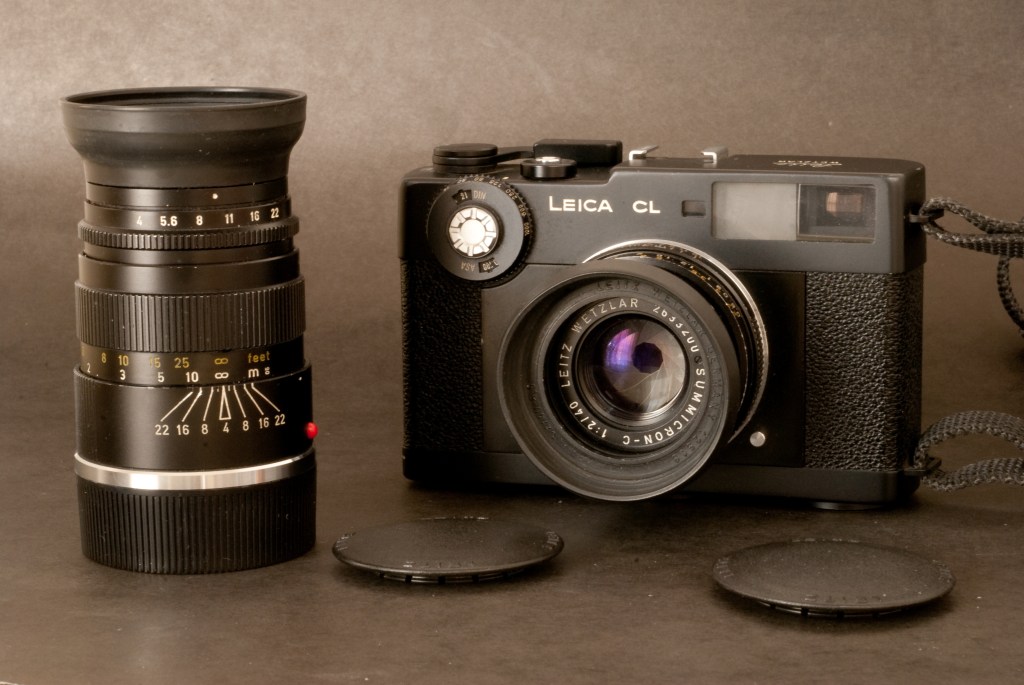
Leica CL with its two lenses

The CL was a sort of entry-level rangefinder camera, designed by Leitz in Germany and built by Minolta in Japan from 1973 to 1976.


From a technical point of view, it is a miniature M5, and very advanced for a Leica of its time. A semi-auto camera with through the lens metering, it used a mechanism very similar to the system used in the much maligned M5’s.


After the CL and the M5 were abandoned in the mid seventies, Leitz reverted to fully manual cameras with no metering capabilities, and aficionados had to wait for another 10 years before a semi-auto rangefinder camera was proposed again by the German firm.


With its M bayonet mount, the CL could use the 50 mm lenses of its bigger brothers, but Leitz had also designed two lenses specifically for the CL, a 40mm Summicron (F:2) and a 90mm Elmar (F:4).

Using the Leica CL


A true Leica, it also used a focal plan textile shutter (1/2 sec up to 1/1000 sec). The rangefinder has a short base and is not as accurate as the M6’s, but is good enough for the 90mm Elmar.

A class at the Louvres Museum- Jan.2010. Paris
A class at the Louvres Museum- The CL is small and silent, and nobody paid attention to me or to the camera.


With its mechanical shutter, the CL only needs a battery for metering, and uses it sparingly. Mine still has the mercury battery I bought it with, but I suspect it must be at the end of its life, because the recommendations of the metering system were so bizarre that I decided to forget about it and apply the “sunny 16” rule. With a battery in working order, the determination of the exposure is very simple (a match needle at the right of the viewfinder).


On the CL, the image in the viewfinder is large and clear. The viewfinder has a greater field of view than the 40mm lens normally mounted on the camera, and projected bright lines show to the photographer what the actual picture will look like. There is little difference between the respective field of views of the viewfinder (similar to a 35mm) and of the 40mm lens, but the bright frame projected of the 90mm lens will seem minuscule at the center of a viewfinder, whose enlargement factor does not change. Disconcerting, but not dramatic.


What really requires adaptation is focusing. On a manual focus Single Lens Reflex camera, the image of the subject is projected on a matte ground glass, and the photographer can see immediately whether the image is in focus or not. Similarly, with tele-zooms used at large apertures, the effects of the reduced depth of field are easily visible, and the photographer can visualize what will be in focus, and what will be pleasantly blurred.

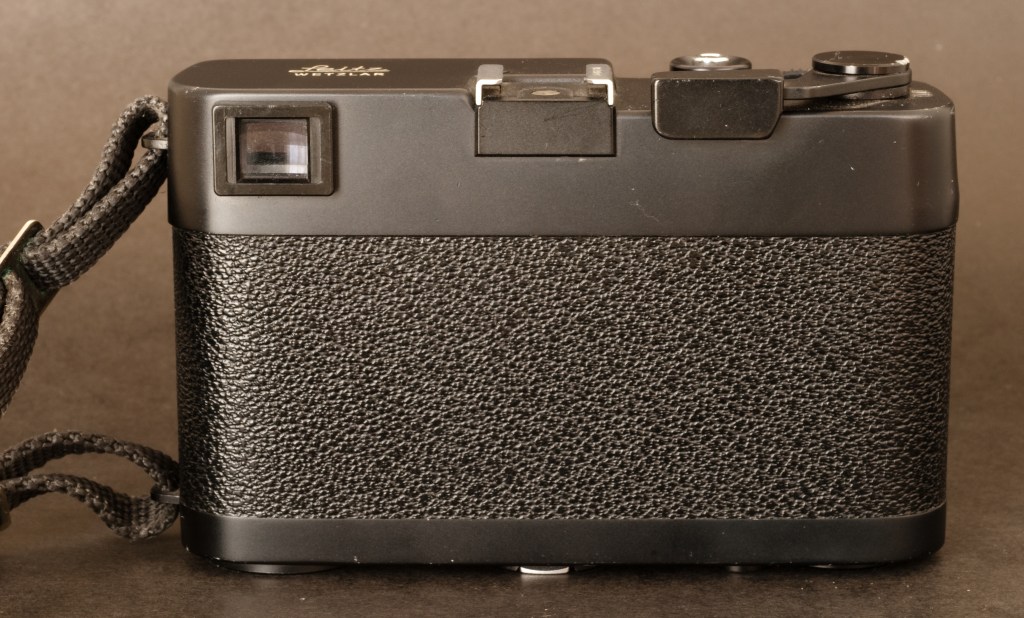
The back of the Leica CL
The back of the Leica CL – Note the viewfinder at the top left corner of the body, leaving ample space for the nose of the photographer


On a rangefinder camera, the finder does not provide any feed-back when it comes to focusing. Every element of the image seems in focus: it’s very easy too forget to set the focus, and very difficult to predict the depth of field.


The coupled rangefinder is materialized by a small window at the center of the viewfinder. It’s extremely accurate, but the focusing ring on the small lens is narrow and rather stiff, and you get the impression that you could have reacted much faster with the large focusing ring of the 50mm lens of your SLR.


I guess it gets better with experience, but it’s very frustrating for a beginner.


If you can get over the idiosyncrasies of the viewfinder, the Leica experience is very rewarding. The camera is virtually silent, and being small and black, gets totally unnoticed. The pictures are sharp, with a lot of micro-contrast, and give the impression of being of higher quality than the images taken with most of the SLRs (provided you could master the focusing system). Your success rate will be lower than with a manual SLR, and far lower than with a dSLR of the latest generation, but when the images are good, they’ll be very good.


Buying a rangefinder camera


Rangefinder cameras are markedly different from SLRs, and will not produce good pictures without some serious practice. The first attempts will be frustrating, and there is no point in spending a lot of money in a Leica M9 if you discover after a few days that you’re totally allergic to this style of cameras.


The Leica CL is one of the cheapest options for a photographer who would like to try rangefinder cameras. Good Leica CL are rather easy to find in the US or in Europe. Even in a pristine condition, they never cross the $1,000 threshold, and nice items can be found between $300 and $600. In Japan, the CL was sold as a Leitz-Minolta camera, with no other difference with the “Leitz only” CL than the logo.


A few years after the production of the CL was stopped, Minolta launched the CLE, an automatic exposure version of the CL, and the first camera to propose On the Film (OTF) flash metering. There is no semi-auto or manual mode. The CLE contains much more electronics than the CL, and it can not be repaired if the main circuit decides it had enough. The CLE is much more difficult to find than the CL. Expect to pay $600 for a nice one, and thousands for collector editions.


Full size M series Leica are either more primitive (no exposure metering) or more recent and significantly more expensive than the CL. Even in poor condition, a Leica M6 can not be found for less than $1,000. Cosina is still producing a line of rangefinder cameras, sold under the Voigtlander brand, and available with Leica M lens mount as well as less common mounts such as the Nikon and Contax rangefinder mounts. Amongst all the the rangefinder cameras from Voigtlander, the Bessa R3M is the closest to the CL (it accepts the same 40 and 90mm lenses), and can be found between $400 (used) and $600 (new).

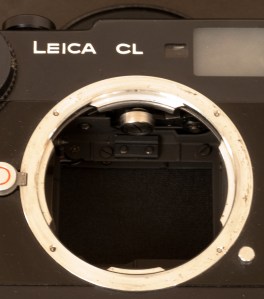
Leica CL - The shutter is not armed
The light chamber of the Leica CL – In this picture, the shutter is not armed. As a consequence, the CdS sensor of the exposure meter is not deployed.
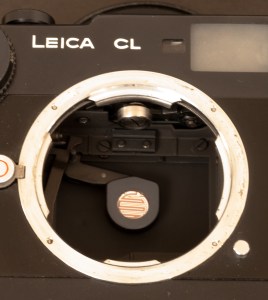
Leica CL -Armed shutter
The shutter is armed; the CdS sensor of the exposure meter is deployed. It will retract when the shutter release is pressed, just before the shutter opens.


References and links


A specialized source for rangefinder cameras (Leica, Nikon and modern Voigtlander): http://www.cameraquest.com/leicacl.htm


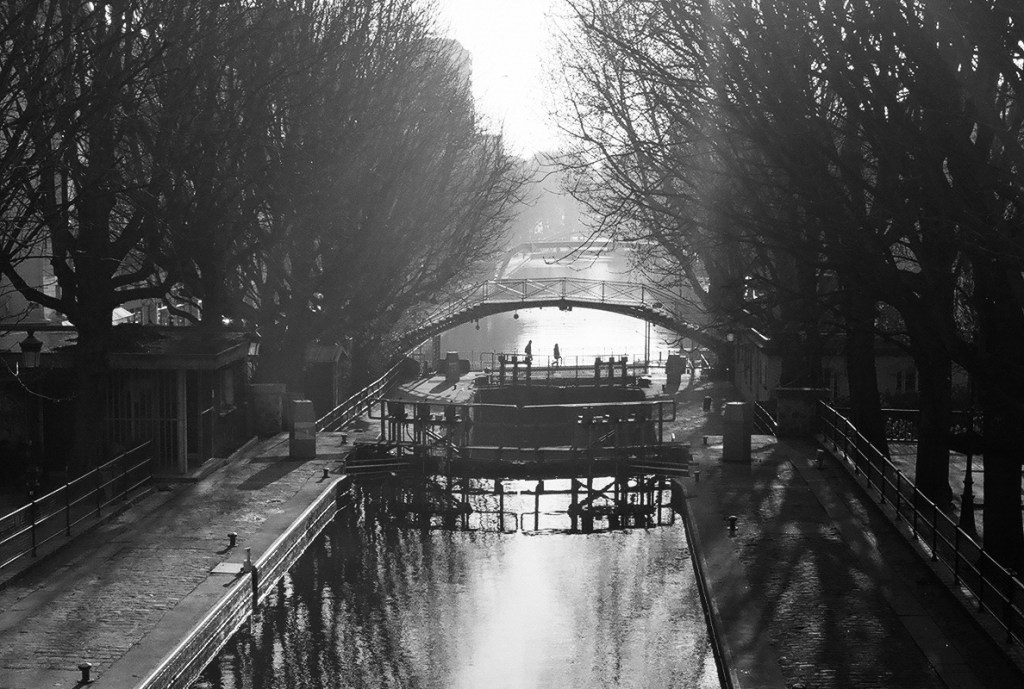
Canal St Martin - Paris - Located between the Gare de l'Est and the Bastille, the canal was a favorite set of the French film makers in the thirties. Using a Leica with B&W film seemed appropriate.
Canal St Martin – Paris – Located between the Gare de l’Est and the Bastille, the Canal was a favorite set of the French film makers in the thirties. Using a Leica with B&W film seemed appropriate

50 Years of Lens Mount Evolution: Part VI of VI


The last 10 years – digital cameras and image stabilized lenses


The massive adoption of digital cameras has not led – so far – to a dramatic change of the design of the lens mount of the cameras. Canon, Nikon, Pentax and Sony (aka Konica Minolta) did not design specific lens mounts for digital cameras, even if they designed specific series of lenses adapted to the smaller size of the digital “APS-C” sensors.


Panasonic GF1 and G1
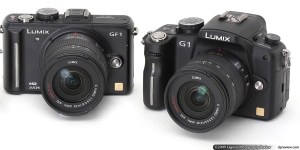
Panasonic GF1 and G1 - the most radical development in interchangeable lens cameras since the Contax S and the Leica M3 (Photo courtesy of DPReview)


Only camera makers which had been absent from the 35mm Autofocus SLR market and had no installed base to please had the liberty to start from a clean slate. In 2003, Panasonic and Olympus launched the “Four Thirds” format, combining a relative small size sensor with a large all-electric mount. Last year, Panasonic finally presented the Micro Four Thirds G1, a camera with an electronic viewfinder and interchangeable lenses (EVIL), the first digital camera to really depart from the conventional SLR design of the Contax S of the late forties.


Why did the camera manufacturers keep the same bayonet mount for digital?


When the first digital SLRs from Nikon and Canon were presented in 2000, large imaging sensors were so difficult to manufacture and therefore so expensive that the camera makers settled for a form factor smaller than the 36x24mm dimensions of 35mm film (23.7mmx15.6mm for Nikon, 22mmx14.9mm for the Canon EOS-D30).


This form factor was dubbed “APS-C“, because it was close to the dimensions of an APS picture, shot with the “Classic” image format (25.1×16.7mm) of the APS cameras. The sensor being smaller than a 35mm negative (the diagonal of 35mm film is 1.5 times larger than the diagonal of an APS-C imager), the camera makers had an opportunity to design a new series of smaller bodies and lenses, but they all decided to stick to their legacy lens mounts and to design digital SLRs at least as large as their film counterparts.


Being the undisputed leaders of the film camera market, Nikon and Canon in particular had no interest in starting a new incompatible product line, at the risk of alienating their large user base; it would have leveled the playing field, and offered an easier entry in the dSLR market to companies like Panasonic or Sony. Nikon and Canon also wanted to limit the cost and the technical risk of going digital by reusing most of the components of their film cameras in their first generations of dSLRs. And they may have anticipated that one day, with the help of Moore’s law, cameras using full size digital sensors would become affordable for their professional and enthusiast customers, making their large F or EF bayonets more relevant than ever.


For a few years, however, dSLRs with APS-C sensors were the only game in town. Canon and Nikon both developed specific lenses for their small sensor bodies. Canon decided to modify the EF mount so that the EF-S lenses designed for the small sensor cameras can not be mounted on full frame SLRs or dSLRs. Nikon did not change the F bayonet – small sensor DX lenses can also be mounted on full frame (or FX) bodies, but being designed for the APS-C sensor size, they do not cover the full format of the FX sensors and the image is automatically cropped.


The Four Thirds and Micro Four Thirds formats


In 2003, Olympus and Panasonic launched the “Four Thirds” format. At that time, Canon had already started producing the first full frame 35mm digital camera (the EOS 1D), and was preparing much more affordable 35mm digital SLRs like the EOS-5D for the enthusiast photographer market. A large sensor was still complex and expensive to manufacture, but getting high quality pictures out of it would prove much easier than with a small sensor, in particular in low light situations.


The Olympus Four Thirds system was based on design decisions completely opposed to Canon or Nikon’s . The sensor size chosen for Four Thirds cameras is very small (its diagonal is only half of the diagonal of a 35mm sensor), but at the same time the lenses and bodies are designed around a large diameter bayonet mount (44mm, the same as Nikon’s F), with a relatively long focal flange distance (38mm). When the system was designed, it was believed that a large diameter lens and a long focal flange distance were required to get optimal results from the imaging sensor, but the Leica M8 and M9 have since proven that it was not the case.


On the positive side, the relatively large dimensions imposed by the Four Thirds mount gave the engineers more freedom to design high quality lenses with very fast apertures, but on the negative side the body & lens combination could not be made significantly smaller than the more conventional APS-C cameras of their competitors. To add insult to injury, the relative small size of the sensor proved a handicap in low light situations (all things being equal, small sensors are more subject to noise than larger ones), and steered most of the enthusiast photographers away from Four Thirds cameras. Four Thirds only got traction on the low end of the market.


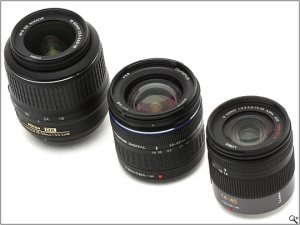
Size comparison: Nikon 18-55 DX, Olympus 14-42, Panasonic 14-45 Micro 4/3
Size comparison: Nikon 18-55 DX (APS-C), Olympus 14-42 (Four Thirds), Panasonic 14-45 (Micro Four Thirds) - Image courtesy of DP Review


Failing to make a significant impact on the mid-level dSLR market, and completely barred from the professional market dominated by new full frame cameras with extraordinary low light capabilities, Panasonic and Olympus decided to create a new niche for themselves, and launched Micro Four Thirds cameras. Using the same sensor as the “Four Thirds” dSLRs, the Micro 4/3rd cameras have abandoned the reflex mirror chamber and the pentaprism viewfinder of conventional dSLRs for an electronic viewfinder. They are designed for a much shorter focal flange distance (approx. 20mm instead of 38mm, and the mount diameter is also smaller (32mm approx. instead of 44mm).
As a result, the body+lens combination is much more compact than any other dSLR on the market. It’s still difficult to predict how this new category of cameras will fare in the future, but they finally bring something new to the table.


Image Stabilization

The migration from film to digital is without a doubt the most significant evolution of photographic equipment in the last ten years. Image stabilization gained acceptance during the same time, and is now a feature expected by amateurs using digicam as well as enthusiasts and pros using expensive large aperture teles. The objective of image stabilization systems is to compensate automatically the involuntary movements of the photographers, and to produce sharper pictures even at slower shutter speeds.


Canon, Nikon and Panasonic adopted relatively similar systems, all based on the controlled movement of optical modules installed inside the lenses. Minolta, Pentax and Olympus opted for in-camera systems compensating the movements of the photographer by moving the image sensor itself. Apparently both systems produce good results. In-camera image stabilization systems do not require any change to the lens mount, but in-lens systems need to be managed from the body, and require a few more electric contacts. Most of the current lens mounts are all-electric now, and adding a few contacts is an easy done job.


The state of the art in 2009


Pentax: Progressive introduction of the KAF3 version of the K bayonet mount, with autofocus motor in the lens. The majority of the lenses in the product line still need an autofocus motor in the camera body.


Canon: No change to the EF mount of the EOS cameras. Starting with the Rebel and the 20D cameras, Canon used a specific variant (EF-S) of the mount for lenses dedicated to the APS-C format. Canon dSLRs all work with EF lenses, but only the Rebel and 20D, 30D, 40D and 50D cameras can use the EF-S lenses.


Minolta, Konica Minolta and Sony: Progressive introduction of SSM lenses, with the focusing motor inside the lens. The majority of the lenses in the product line still need an autofocus motor in the camera body.


Nikon: Multiple variants of the F mount were used during the last 15 years:
– AF-D: no mechanical difference with the AF mount, the D lenses transmit the focusing distance value back to the body for 3D Matrix Metering
– AF-I: focusing motor in the lens – used for tele-lenses between 1992 and 1996;
– AF-S lenses: ultra-sonic (“Silent Wave”) autofocus motor built into the lens. Most of Nikon’s zoom lenses are now AF-S, and the conversion of prime lenses has started a few years ago.
– The new PC-E (perspective control electromagnetic) lenses now use an electromagnetic diaphragm command. All the other Nikon lenses still use the mechanical stop down mechanism introduced with the F mount in 1959.


Olympus & Panasonic started promoting the Four Thirds format in 2003. Four Third lenses use an all electric bayonet mount. The Micro Four Thirds are more compact, and use 11 electrical contacts instead of 9 for regular Four Third lenses. Thanks to the very short focal flange distance of Micro Four Third cameras, it is easy to develop adapters for Canon EF, Nikon F, Olympus OM or Leica M or R lenses.


Gull in Essaouira (Morroco)
An exception on this blog: a digital picture (Nikon D80) taken in Essaouira - Morroco

50 Years of Lens Mount Evolution – Part IV of VI


Programmed exposure


The automatic bodies of the early seventies still required some input from their users: they could only determine the shutter speed (or the aperture in the case of Canon cameras) after the photographer had set an aperture (or a shutter speed) compatible with the film speed, the intensity of the light and the characteristics of the scene (portrait, action shots, macro, and so on).
If the aperture set by the user was too low or too high, a matching shutter speed could not be selected by the camera and the picture was hopelessly under or over exposed.
Similarly, if the photographer let the camera select a very slow shutter speed with a long tele-lens, the picture would be blurry and unusable. Trained photographers knew that. But a better automatic exposure solution had to be found for the photographers who did not want to be bothered with technical details.

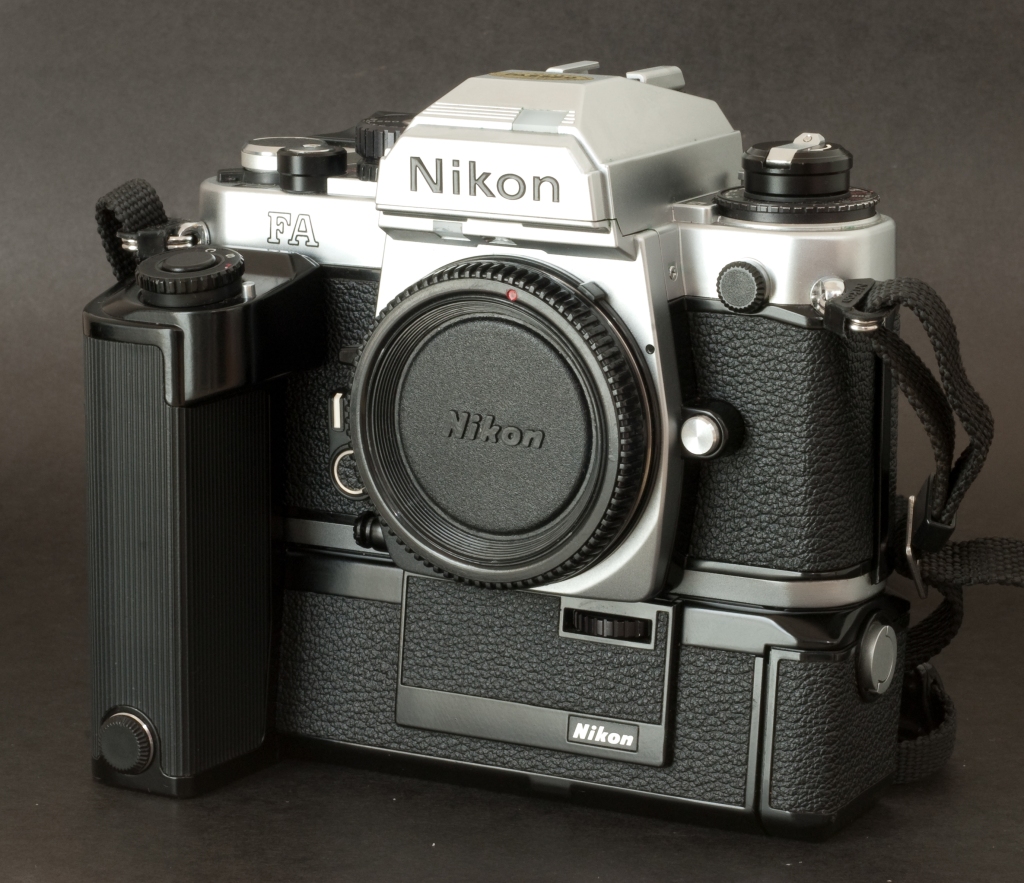
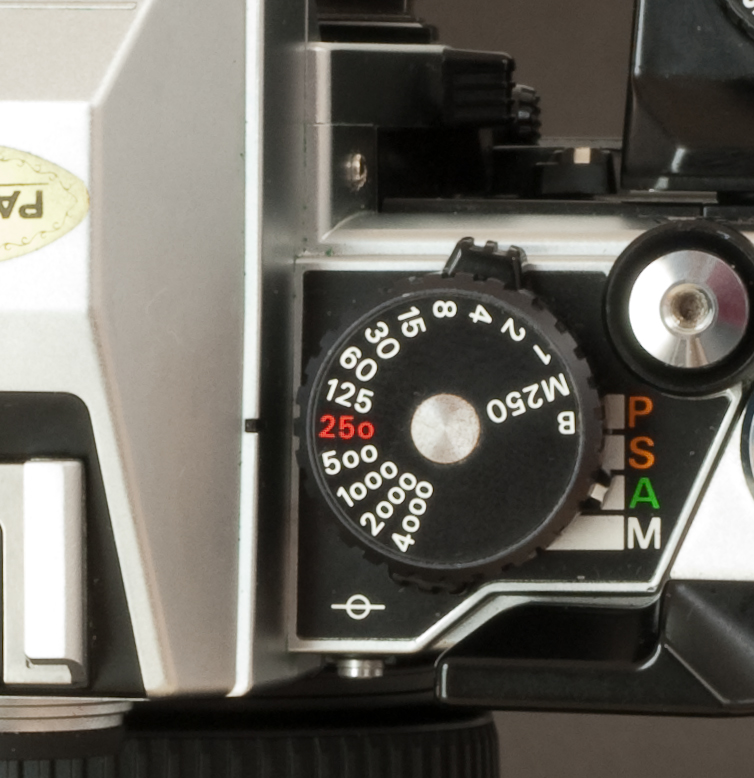
Nikon FA - the commands for the multi-mode exposure automatism (PSAM)
Nikon FA (1984) – the command for the multi-mode exposure automatism (PSAM) is in front of the shutter speed knob


Inspired by the program modes already available in point and shoot cameras, Canon launched the A-1, a new SLR with programmed exposure modes in 1978. Practically, it meant that the auto exposure system of the body had to simultaneously command the shutter speed and the aperture of the diaphragm.


Canon did not have to change anything on the FD mount, which had been created for full aperture shutter priority exposure. 


Nikon introduced the “AI-S” generation in 1979 when the mount was modified to support a linear command of the diaphragm. The first Nikon cameras to take advantage of the AI-S lenses and to offer a program mode and shutter priority were launched in 1982 and 1984 respectively. Because the camera body was informed of the focal length of the objective, it could choose automatically between two aperture-speed combinations when configured in program mode, one for wide angle and normal lenses, and one for lenses of 135mm and longer .

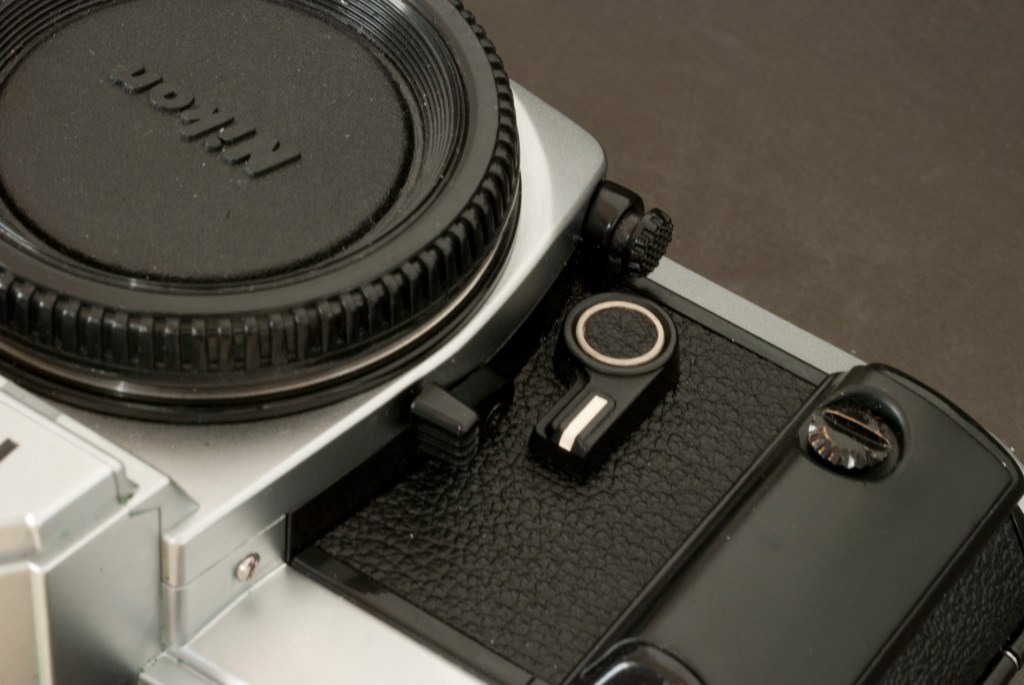
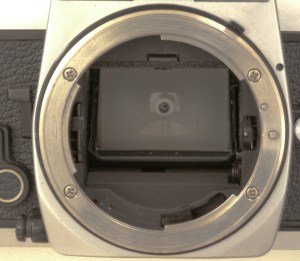
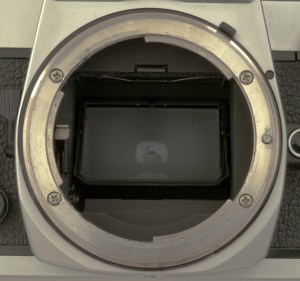
Nikon F mount - AIS on the Nikon FA
The AI-S variant of Nikon F mount, shown here on the Nikon FA. Compared to the lens mount of the FE2, the FA’s is using three more sensors: a small pin above the lens lock – which informs the body that the lens is of the AI-S type, a larger sensor inside the reflex chamber (right of the picture, in the middle) which is used to transmit the focal length of the lens to the body, and a slider at the bottom of the reflex chamber, used to transmit the maximum aperture of the lens to the body. The use of mechanical sensor had reached its limits. It was time to adopt electrical contacts instead.
Nikon F mount - AI on the Nikon FE2
For reference, the much simpler design of the AI mount (Nikon FE2). The stop down lever controlling the diaphragm is on the left side on the picture. You can still find it on current Nikon digital cameras.


Still trying to catch up with Nicanolta, Pentax adopted a brand new bayonet mount, the K mount, in 1975. The first K mount, however, did not support shutter priority or program modes. Electric contacts would have to be added with the KA declination of the K mount in 1983 to make it possible. Its close derivatives are still used today on Pentax DSLRs.


The state of the art between 1971 and 1985


Pentax: Aperture priority automatic cameras launched in 1971 with modified 42mm screw mount lenses supporting full aperture metering.
Change from the 42mm screw mount to a new Pentax K bayonet in 1975 (automatic pre-selection, full aperture metering, transmission of the pre-selected aperture value from the lens to the body);
Shutter priority and program mode introduced in 1983 with the KA version of the K mount.


Canon: The FD breech mount introduced in 1971 was ready for the Shutter priority cameras launched in 1973 (Canon EF) and for the program mode (Canon A1, 1978).


Minolta: MD declination of the SR Mount (one pin added for the support of the Shutter priority mode) to support the Shutter priority mode in 1977.


Nikon: Aperture priority cameras available since 1971 (Nikon EL) with the manual indexing F mount. Launch of the AI version of the F mount in 1977 to improve the ease of use. Progressive adoption of the AI-S declination of the F mount in 1979 to prepare for the arrival of cameras offering a program mode (Nikon FG, 1982) and a shutter priority automatic exposure (Nikon FA, 1984).


Olympus: the OM mount was introduced in 1971, and was ready to support programmed exposure from the beginning.


More about the lens mounts


Photography in Malaysia: information related to the F lens mount


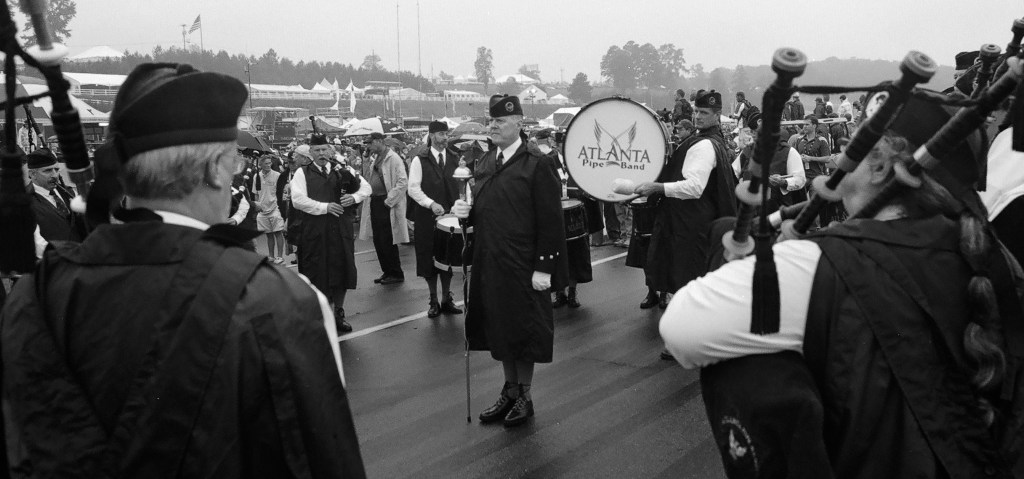
American Petit LeMans - the Atlanta Pipe Band. Nikon FA - Kodak CN400
American Petit LeMans – the Atlanta Pipe Band. Nikon FA – Kodak CN400 – Processed by Costo. Cropping and minor adjustments in Lightroom 2

Nikon F3


Nikon’s F3 was the “pro” camera of the early eighties, but it kept on selling until 2001. A dwarf compared to current mid-level digital SLRs, not to mention monsters like an EOS 1DS or a D3. Incredibly simple to use compared to anything digital sold these days. Aperture Priority Automatic or Semi-Auto exposure. Center weighted metering. That’s all. It worked. And it still works today.


Nikon F3 - cosmetically not perfect - it simply works
This Nikon F3 is far from perfect cosmetically – but it works

Consider all the changes that took place in the SLR design between 1980 and 2001. Multi mode exposure, spot and matrix metering, integrated motors, autofocus, DX coding, the F3 had none of that, but it outlived two or three generations of newer-better-faster pro bodies from Nikon or Canon. The F3 had the elegance to hide its real technical advances under a classical skin, and to let the photographer communicate his instructions through smooth and oversized controls. Of all the pre-autofocus SLRs of Nikon, the F3 is the most pleasant to use, and probably the one which will yield the best results.

The F3 is an exception in the Nikon F lineup. It’s compact, smaller than its predecessors, and way smaller than its successors, the F4 and F5. In fact, its size is very comparable to that of the FM, itself hardly bigger than the yard stick of compact SLRs, the Olympus OM-1. The F3 is also easy to use, without the idiosyncrasies of the F and F2s with their Photomic finders and manual aperture indexing, and without the myriads of commands of an F4 or the menus and submenus of an F5.


Olympus OM-1n / Nikon F3
Olympus OM-1n / Nikon F3 – The F3 is larger, of course, but not that much. Compact and not very loud, it can be used for street photography, among other things.

The F3 is much more modern and usable in everyday life than a semi auto camera like the FM: its commands are larger and smoother, and the automatic exposure system is faster to operate; thanks to the center-weighted metering and a memory lock button, it does not deprive the photograph of his control on the exposure . When a flash is needed, the FM still requires the user to concern himself with Guide Numbers. The F3’s flash system is modern: following the path opened by the Olympus OM2, the SPD (silicon) cell is housed under the main mirror, and provides On The Film flash metering. But the Nikon engineers avoided loading the F3 with complications like multi-mode auto-exposure or multiple metering patterns. The F3 has few commands, and they’re so easy to understand that no manual is needed.


Nikon F3 (above)
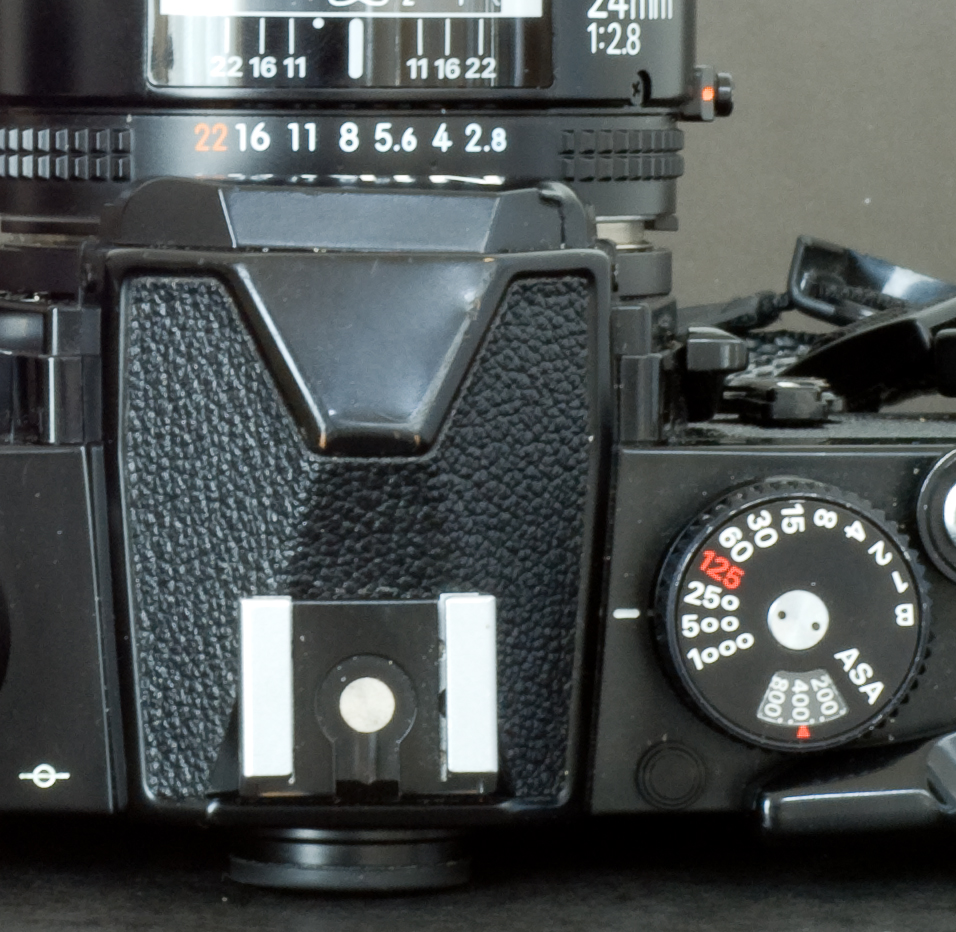
Nikon F3 – a view of the commands – add the exposure memory lock and the backup shutter release on the front, you have them all.

All the commands are generously sized, and very smooth to operate (the film advance mechanism is mounted on ball bearings). The view finder is wide, bright and clear, making focusing easy. After a few years of production, Nikon replaced the viewfinder with a high eyepoint (HP) model, which could be used more easily byglass wearers. The viewfinder is the only part of the camera which is really larger than what you would find on contemporary advance-amateur SLRs.


Of course, the F3 is not perfect. It may be compact, but it’s heavy (approx. 750g). Its OTF flash system may have been advanced for its time, but the shutter only syncs at 1/60sec, and none of the viewfinders of the F3 system has a standard flash hot shoe: the F3 requires a specific flash adapter, to be inserted at the top of the rewind lever. But if I had to own and use only one film camera, that would be the F3, without any hesitation.

viseur Nikon F3
Nikon F3 and its DE02 viewfinder at the front – Note that the exposure metering system and the LCD showing the selected shutter speed are on the body, not on the removable viewfinder (the little windows at the front of the viewfinder are aligned with the LCD and the aperture see through when it is in position on the body)


How much for a Nikon F3?


The price of an F3 is extremely variable. The F3s were produced over 21 years, and some of them could be fairly recent, when others could have been used and abused since the early eighties. F3s were built like tanks, but they were used as their everyday work horse by legions of professional photographers, and they may have had a rough life.


Old and scruffy models in perfect working condition – like the 1983 model represented on those pictures – can be had for a little more than $70.00. Nicer and more recent models with the HP viewfinder and a motor drive will cost you at least $300.00. Beyond the standard F3 and F3 HP, Nikon also produced many derivatives of its flagship camera, for specialized applications or to test new technologies like the autofocus system they showed in 1983. Some of them are relatively rare collector items and will command a much higher price.


Nikon F3 in CF-22 case
Nikon F3 in its CF-22 case. Designed by Giorgetto Giugiaro, the F3 had to show some italian bravado. The body design is classical, but the leather everready case is bright red.


More about the Nikon F3


Photography in Malaysia – the Nikon F3
Shutterbug: the Nikon F3 (2007)


Lunch Break - Quais de la Seine. Paris. April 2009
Lunch Break along the Seine. Paris-April 2009. Nikon F3 – Nikkor 24mm AF

The Minolta Vectis S-1: APS done right?

Originally published in September 2009.


I don’t have this camera anymore. I’m afraid it ended its life in the trash can – not economically repairable – a few years ago. But I used it for years, I liked it a lot, and it’s too bad that no digital SLR available today is as light and portable as the Vectis S-1 was.(*)

The gun metal version was sold in Europe.

Launched in 1996, it was the only SLR system designed from scratch for the APS film format. It inherited the best features from the Minolta mid-range 35mm cameras of its time, and exploited the new functionalities of the APS format to its full advantage. Built around a new, specific and very modern mount, the Vectis cameras and lenses were far more compacts than conventional 35mm SLRs, and than the APS SLRs developed by Canon and Nikon.


Single Lens Reflex cameras (SLRs) need a moving mirror, and the moving mirror needs room, which imposes a flange focal distance of approximately 45mm on 35mm cameras (44mm for the Canon EF, 46.5mm for the Nikon F mount). The diameter of the mount, on the other hand, is closely related to the size of the film (it’s roughly equal to the diagonal of the film – 44mm for the Nikon F mount, for instance). Both Canon and Nikon decided to make their APS cameras compatible with the large range of 35mm lens they had been selling for 10 years or more, and designed their APS SLRs around the same dimensional constraints (flange focal distance, mount diameter) as their standard 35mm offerings. Logically, the cameras could not be significantly smaller than their 35mm counterparts.


On the contrary, Minolta took the risk of making the Vectis S-1 totally incompatible with its own 35mm lens system – and opted for a shorter focal flange distance (38mm) and for a smaller mount diameter, without any mechanical linkage between the camera body and the lens. The body and the lens could be made much smaller, but Minolta had to develop a whole range of new lenses, and ended up supporting two totally incompatible product lines.

The lighthouse of the Pointe St Matthieu – Brittany, France


One could debate endlessly about who did the right thing, Minolta or Canon-Nikon. Minolta’s risky strategy did not pay off – the sales of the Vectis cameras proved disappointing, Minolta lost its independence and had to merge with Konica. But Canon or Nikon’s more prudent approach did not work either, altough they did not lose as much money with APS as Minolta did. Learning from the experience, Canon, Konica-Minolta and Pentax all decided to retain their 35mm mount on their new dSLRs with APS-C sensors. Only Panasonic and Olympus, with no legacy of 35mm AF SLRs, decided to use a smaller form factor with their Four-Thirds and Micro-Four-Thirds formats.

Minolta Vectis S-1 – a new lens mount and new lenses developed for APS

The design of the S-1 was very innovative in two important areas: it was not using the conventional central pentaprism, but a series of mirrors leading to a viewfinder implemented at the very left of the body – leaving space for the nose of the photographer, and the camera, its lenses and its accessories (such as the external flash) were all weatherproof, forming a compact, lightweight and reasonably rugged system that could even be brought in mountain expeditions.

Minolta Vectis S-1 – it was designed for enthusiast photographers with a complete set of controls – too bad the APS stock available was mainly 200 ISO color negative film.


The rest of the camera was in line with the advanced-amateur class of products of the time (P, A, S, M modes, Matrix and Spot metering, passive autofocus) and took advantage of all the new functionalities brought by the APS format – the ability to pre-select one of three print formats when taking the pictures being the most important. Some compatibility existed between the accessories of the 35mm cameras of the manufacturer (Maxxum or Dynax) and the Vectis: the flash system and the remote control could be used indifferently on both lines of cameras.


The user experience was very pleasant. Minolta cameras of the AF era have always been very pleasant to use, and the Vectis was no exception, provided you put the right lens on the body.
Unfortunately, the kit lens – a 28-56mm f:4-5.6 zoom, was not something Minolta should have been proud of. Poorly built, if proved fragile, and the quality of the pictures it produced was far from impressive. Mine broke rapidly, and I replaced it with a much better 22-80mm lens, which was correctly built, and could produce great pictures – with the right film in the body. The promoters of APS had decided that 200 ISO would be the “normal” sensitivity, but APS used a smaller negative than 35mm, and the quality of the enlargments from 200 ISO film never convinced me. The 100 ISO film, on the contrary, was very good. On a good bright and sunny day, with a good lens and 100 ISO film, APS could compete with 35mm.


My Vectis was defeated by one of design flaws of APS: the fragile automatic film loading system. A tiny piece of plastic broke in the camera, preventing the film door to open. Having it repaired was not an option. I sold the lens, and trashed the camera.


Today, the Vectis S-1 still has fans, ready to pay prices in excess of $150 for a camera. I liked mine as long as it worked, but with 100 ISO APS film now unavailable, I would not spend my money trying to get another one.


Good camera, flawed format. RIP.


(*): Edited in July 2017: the Vectis S1 tipped the scales at 365g, and the fragile 28-56 kit lens added 110g. With film and battery, the whole set was probably was below 500g. Today – in 2017, the remote heir of the Vectis, the Sony A6000, weights 20 grams less (at 345g). The Sony 16-50 Power Zoom also weights 110g.

Minolta Vectis S-1 with 22-80 zoom


More about the Minolta Vectis S-1
camerapedia.org: la page du Vectis S-1
collection-appareils.fr (site in French)

More about APS film in CamerAgX:

The APS Film Format

Nikon Pronea S


Pointe St Matthieu – Britany (France) July 2003 – Minolta Vectis S1
Portsall harbour at low tide (near Brest, France)

SaveSave

Buying photo equipment on eBay


I bought most of my cameras and lenses on ebay.com, sometimes through auctions, sometimes at  “buy it now” prices. I never had a bad experience so far.


If you buy on eBay, you will face three types of sellers:

  • on-line stores specialized in photographic equipment, new or second hand.


That’s the low risk option. Some stores limit their inventory to a few brands, and only carry high quality, very nice to pristine cameras. Others are less restrictive, and also have cameras which have lived a more difficult life. If your intention is to really use the camera you’re purchasing, buying a comestically challenged camera may be a good option, as long as it’s in good mechanical condition. Specialized stores are supposed to know what they sell, and will not plead ignorance if the product does not work or is not completely similar to the published description. They will arrange for a free return, and a refund.


A word of caution, though: the products are evaluated before being listed, and the obvious lemons don’t pass, but the tests are not always as thorough as one would wish: a lens may have looked OK when tested on a particular type of body, but will fail to operate on another one, which is in theory 100% compatible but is interacting with the lens differently. Always test the equipment you purchased as soon as you receive it, and contact the seller if there is any issue. Reputable stores will listen to you, and they have a good return policy.


Over the years, I bought cameras or lenses from Adorwin (the eBay store of Adorama), Betteroffblu, Cameta and Shutterblade and could appreciate their professionalism.

  • Stores not specialized in photography


That’s the riskiest option, in my opinion. The store could be anything, from a pawn shop to an antique dealer, the worst being a dollar store or a shady repair shops buying broken electronic equipment in bulk and making one sellable camera out of 3 broken ones. Even if they know a few things about the products they’re selling, they will generally plead ignorance, and will offer little or no support if there is an issue with the equipment. I never had a really bad experience on eBay, but it’s with this type of seller that I came the closest to being seriously disapointed. Buyer beware.

  • Low volume and non professional sellers


Low volume sellers belong to multiple sub categories. You will see items sold by a person who pretends he got the equipment he’s selling from a friend but that he knows nothing about it, and  you will find the passionate amateur photographer who bought his equipment new 20 years ago, used it day in day out and took great care of it; he will take pride in providing a honest and accurate description of his equipment, and that’s the person you want to be buying from.


Because of the way the auctions work, the prices tend to be highly variable and very unpredictable. Professional sellers tend to protect themselves with a “buy-it-now” price, and if the item does not sell this time, they just list it again. Non professional sellers tend to use the auction system more than professionals. With the number of people watching eBay listings every day, it’s difficult to find a real bargain, but some sellers (lazy or inexperienced) still publish unappealing listings (blurry pictures, ambiguous descriptions) that a trained bargain hunter will be able to interpret to his advantage: I bought my Nikon F3 this way, at 30% of what the action would have reached if the listing had been professionally layed out.


As always, do your homework and try and understand the market first (ads in magazines, completed items list on eBay). Set a limit for the price of the equipment you want to buy second hand. In any case, read the ads very carefully, ask questions, and only place a bid if you feel confident enough.


Other reputable sources

  • keh.com


    I never had the opportunity to buy second hand equipment from keh, but good friends did. keh has the reputation of being very conservative in the way they describe the equipment they’re selling (if they say it’s in good condition, then it’s very very good). They only sell over the phone or on the Internet – no walk-ins.

  • bhphotovideo.com


    B&H is a big photo video mail to order company, with a huge brick and mortar store in New York. I bought new equipment from them on multiple occasions. A very pleasant experience. I never had the opportunity to buy second hand equipment from them, though.


Feel free to share your comments and experiences. Thank you.


Nikon FE2
Nikon FE2

Why are manual exposure cameras worth more than automatics ? (Intro)


The facts


Let’s take three lines of manual focus cameras which still have a very active second hand market today: the Leica R series, the Nikons FM & FE and their derivatives, and the Olympus OM-1 & OM-2 and their “single digit” descendants. Each line contains automatic exposure cameras (Leica R4, R5, R7; Nikon FE, FE2, FA; Olympus OM-2, OM2s, OM4, OM4t), and manual exposure cameras (Leica R6, R6.2; Nikon FM and FM2; Olympus OM-1 and OM-3).


For a given generation of camera, manual exposure models are almost always worth more than their automatic exposure siblings.


Average retail price of a camera in Excellent Condition (source: a reputable specialist of used photographic equipment)

Brand Manual Camera Auto exposure Camera
Leica R6.2: $ 999 R7: $ 550
Nikon FM: $ 190 FE: $ 170
Nikon FM2: $ 245 FE2: $ 199
Olympus OM-1: $ 150 OM-2: $ 190
Olympus OM-3: much more than $500 * OM-4: $ 235
Olympus OM-3T: much more than $1,000 * OM-4T or TI: $ 450


More after the jump

Nikon FM: compact and rock solid, a good risk-all backup camera for Nikon users


In the mid seventies, a new generation of SLRs hit the market. They were following the example set by the Olympus OM-1 and were much more compact than their predecessors. They also used less mechanical components and more electronics.


The FM was Nikon’s response to the OM-1, and to similarly compact cameras from their main competitors. The FM outlived them all. The FM and its derivatives, the FM2 and the FM3a,  were sold for more than 30 years, and when the production of the FM3a was finally stopped, they were still in such demand that for a while used FM3a’s were selling for more than when their price when new.


Compact, reasonably light and rock solid, the FMs were often used as backup cameras by professional photographers until they stopped using film a few years ago.


Nikon FM
Nikon FM – it accepts pre-AI lenses, AI, AIS, AF and AF-D lenses.

 The FM is a mechanical, manual focus, semi-auto camera. It leaves you total control over your images, and does not change the aperture/speed combination you selected on its own. No need to memorize the settings in backlit pictures. But total control comes at a cost: speed of operations in a rapidly changing environment. It’s a nice camera for landscapes, travel, street photography, but more recent autofocus cameras will deliver better results for sports and action photography.

 
The flash control system is also old school – the camera exchanges very little information with the flash unit, and the photographer has to set the shutter speed and the aperture by himself, using guide number tables: there are obviously better cameras to shoot indoors.


The FM as a photographic tool


By modern standards, the FM is a bit of a disappointment. On the one hand, it feels very well built and solid, and it can be carried around everywhere because of its (relative) small size. The Olympus OM1 or the Pentax M series are still smaller, but don’t feel as robust.  Like the other semi automatic cameras with mechanical shutters, the FM also works without batteries. The light meter does not use a galvanometer (no needle) but a series of bright red LEDs are the right of the viewfinder screen: there are very few parts that can break on a FM.


On the minus side, the mechanical commands are firm, and the advance film lever doubles as a shutter release lock: you can only use the light meter and press the shutter release if the advance film lever is pulled out of the body (by an angle of approximately 45°). It’s not very practical, and slows down the operations. I missed more than a few snapshots because the lever was pushed flush with the camera body, in the off position. I guess you can get used to it, but it’s not ideal. (the Nikon F3 does not have this issue; the film advance lever does just that).

Nikon FM / Olympus OM1n
Nikon FM / Olympus OM1n – the smaller prism cover make the OM-1 look smaller.


The Olympus OM1 was the forerunner of a new generation of very compact but still very capable SLRs. Coming a few years later, the FM is not as compact as the OM1, but not that much larger. It’s heavier, though. Its electronics (the light meter, the rest of the camera is mechanical) aged very well, the batteries it needs are still easy to find, its mechanical components are solid and it’s compatible with any Nikkor lens built between the early sixties and the last few years.


Nikon FM - Shutter
Nikon FM – Metallic shutter. Clearly a camera from the seventies.


The FM has a mechanical metallic shutter. Its fastest speed is 1/1000sec, with a  maximum flash synchronization speed of 1/125 sec. The different versions of the FM2 and the FM3a have much faster shutters, built in aluminum or titanium, with a maximum speed of 1/4000s and a flash synchronization. speed of 1/200 (early models) or 1/250.

Nikon FM
Nikon FM –  depth of field preview lever and self-timer at the right of the lens.


The FM holds a special place in the Nikon product range: it’s one of the few Nikon cameras (the only other compact SLR to share this characteristics is the FE) which is compatible with the pre-AI lenses as well as the modern AI, AIS and AF lenses. The other members of the family – FM2, FE2, FA, F3A – are only compatible with the AI, AIS and AF lenses; trying to mount an older pre-AI lens can damage the camera.

That’s the reason why the FM is sometimes referred as the Rosetta Stone of Nikon cameras


Summary


The Nikon FM is a simple, compact, rock solid and reliable camera, with a decent viewfinder and an accurate light meter. It’s not very fast to operate and not always pleasant to use because of firm commands and of the protruding film advance lever, but it can take advantage of a huge variety of lenses, built by Nikon over a period of almost 50 years. The FM2/FE2 are a bit smoother, the automatic FE and FE2 are also faster to operate, but the F3 beats them all, with its very soft commands, its good ergonomics and its large viewfinder.


The last FMs were produced in the early eighties, and good ones are still easy to find. They command lower prices than the much more sought after FM2’s and FM3a’s. A very nice one from a reputable seller will not cost you more than $150, and not so nice ones can be bought for less than $70 on eBay.


Charleston - July 09 - Nikon FM - Nikkor 24mm
Charleston – July 09 – Nikon FM – Nikkor 24mm


More about the Nikon FM


The best site of reference about the Nikon FM: Photography in Malaysia


The site has not been updated recently, but it contains very detailed information about the Nikon cameras and lenses manufactured until the F5.


Nikon Pronea S

Nikon Pronea

Originally published in August 2009


Launched in 1998,  the Pronea S is Nikon’s second and last APS SLR. Nikon rapidly lost interest in the APS format, and refocused its R&D (and sales) efforts on the more promising Coolpix digital cameras. With its smaller image format and lenses, the Pronea can be considered a remote ancestor of the vastly more successful Nikon D40.

Nikon Pronea S (flash deployed)
Nikon Pronea S (with the built-in flash deployed and a Nikkor AF 24mm lens)


Apart from the fact it’s using APS film instead of more conventional 135 (24x36mm) film, there is nothing really remarkable about the Pronea S. Its characteristics are aligned on the other mid-level amateur cameras of its time.


It benefits from the advantages brought by the APS format (smaller size than 24×36 cameras, choice of three aspect ratios for the prints) but it also suffers from all the limitations that ultimately caused the demise of the APS format.


In a typical Nikon fashion, the Pronea S preserves some form of compatibility with the large family of Nikkor F lenses: in fact, modern AF and AF-S lenses work perfectly on a Pronea. However the IX-Nikkor lenses, designed specifically for the Pronea and its smaller APS  format are absolutely incompatible with the rest of the Nikon bodies: the back of the IX lenses protrudes so far in the reflex  chamber that it would be on the trajectory of the reflex mirror of a 24×36 SLR.

Nikon F mount / Nikon Pronea mount
Both use the F mount, but an IX lens can only be mounted on a Pronea body
Nikon F mount / Nikon Pronea mount
The back of the IX lens protrudes much more in the reflex chamber than the back of a Nikkor AF or AF-s lens

The resale value of the Nikon Pronea S is very limited. Mint (if not new) cameras and lenses can still be found, and they generally sell for a few dozens of dollars. They can be collected as curiosities, but their usage value is limited: Kodak and Fuji may cease manufacturing APS film rapidly, and the IX-Nikkor lenses are absolutely incompatible with any “normal” Nikon body.

Nikon Pronea S (front)
Nikon Pronea S
Nikon Pronea S (back)
Nikon Pronea S (back) – not the “C-H-P” selector at the left of the viewfinder – the photographer can select the aspect ratio of the prints.
Nikon Pronea S (above)
Nikon Pronea S

Olympus OM1n / Nikon Pronea S (Side)
  • APS SLR cameras are smaller than a comparable 24×36 autofocus SLR with a built-in flash, but the Pronea S is larger than an older SLR such as the Olympus OM-1
  • The choice of films was already very limited when the format was supposed to be the next big thing: practically, color print film from Kodak and Fuji in 100, 200 and 400 ISO declinations was the only thing you could get. Now that the format is near extinct, only 200 ISO film is available.
  • Color slide and black and white film were never widely available, if available at all.
  • Compared to a 24×36 image, an APS image is 56% smaller. APS requires higher enlargement ratios, which makes film grain more visible.
  • The film loading mechanism of APS cameras is fragile. The film can stay trapped in the camera if one of the little plastic parts holding the cartridge in place breaks.
Olympus OM-1/ Nikon Pronea S / Cartridge

For more about the Pronea S

Another point of view about the Pronea S, courtesy of Ken Rockwell.

More about APS Film And APS cameras in CamerAgX:

APS Film Format

Minolta Vectis S-1