Exposure Metering: Multi-Spot or Matrix


All film cameras have to live with the same design constraint: their shutter and their diaphragm are built in such a way that, for a given picture, the shutter speed and the aperture are the same for each square millimeter of the film. There is no way for the shutter of a film camera to block the light in excess in a particular zone of the scene, or to stay open longer only for the portion of the scene located in the shade. At some point the researchers of Canon were rumored to be working on an LCD based shutter, which could to exactly that, but the research never materialized.


Olympus OM-3
Olympus OM-3. Picture: Wikipedia


Since the shutter only works in an all or nothing, one-duration-fits-all mode, some zones of the film will receive more light than the optimum, and others will receive less. Films have the ability to give acceptable results when portions of the scene are a few f: stops brighter and a few stops darker than the optimum (that’s the exposure latitude of the film). As a consequence, the exposure metering systems of the cameras are calibrated to determine the correct exposure for the portion of the subject located in the mid-tones, with the expectation that the film will have enough exposure latitude to render the highlights and the shadows correctly.


Unfortunately, in some cases, the brightness range of the scene greatly exceeds the exposure latitude of the film (think of the backlit portrait at sunset with the sun in the frame); supposing the photographer can not reduce the brightness range of the scene – using a flash or a reflector to bring more light to the subject, for instance, the exposure parameters will only be optimal for a subset of the scene, the highlights or the shadows, and the rest of the picture will be burned or left in the dark.


When cameras started being equipped with Through the Lens (TTL) metering systems in the sixties, most of the manufacturers opted for Average or Center Weighed Average Metering. Those metering systems were not adapted to high contrast scenes, and the photographers had to put their experience to good use and take control manually of the exposure metering process. If they had automatic cameras, they had to use exposure lock or exposure compensation systems. The alternative – measuring the brightness of a very narrow section of the scene with a spot meter, was not easy to master for the average photographer. Elaborate exposure determination procedures such as the “zone system” were adapted to small format cameras using roll film, but their complexity put them out of reach from the majority of photographers.


The Olympus OM-4 and the Nikon FA


In 1983, two cameras manufacturers tried to address the problem of high contrast/high brightness range scenes, and they chose two very different approaches.


Olympus tried to make the principles of the zone system accessible to more photographers, and developed a multi-spot system for the new OM-3 and OM-4 cameras. With the new OMs, the photographer could make up to eight successive spot measurements, whose result were presented in the viewfinder on an analog bar scale showing each individual result and the average. The cameras also had a “shadow” and a “highlight” push button, letting the photographer compose his picture following the principles of the zone system.


The photographer Ken Norton described the process in his blog:


Olympus OM-3 and OM-4: exposure metering controls
Olympus OM-3 and OM-4: exposure metering controls. Picture: Wikipedia


“for example, I can take a spot reading of a highlight, a midtone and a shadow. Three dots will appear on the display. If I’m using a film with six stop exposure range, I’ll make sure that all three dots appear within the +/- 3 stop marks. Of course, I can bias my exposure to place a highlight or shadow anywhere I want on the scale. Digital cameras are capable of producing a histogram of an image. The multi-spot scale, with the “dots” is a poor-man’s variation of the histogram where we are able to define our bright areas and dark areas of a scene and like a histogram we are able to move these points around to place them within the acceptance range of the film.


You can read more about the subject, and see actual pictures of the viewfinder on Ken’s pages.


Nikon chose a totally different approach. In the first iteration – the Automatic Multi Pattern (AMP) of the Nikon FA – the camera was equipped with a database containing the mathematical description of thousands of potential pictures, with the exposure value to be used in each situation. The light meter was divided in five zones (a large central zone, two zones at the bottom left and right, two zones at the top, left and right also), and the electronic circuit would correlate the exposure value of each zone with other elements such as the focal length of the lens to define the characteristics of the scene, and associate it with one of the many typical pictures described in the database of the camera.
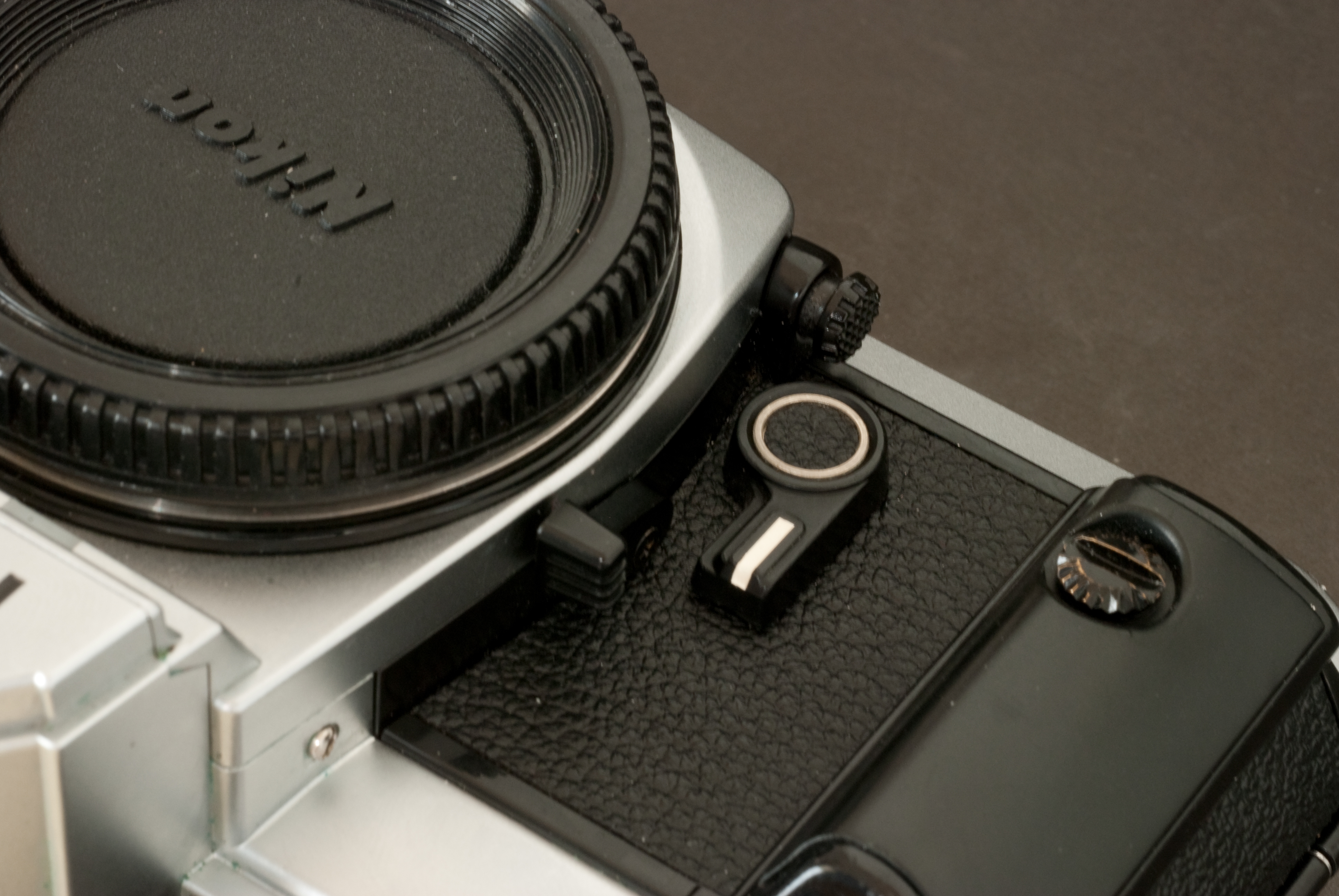

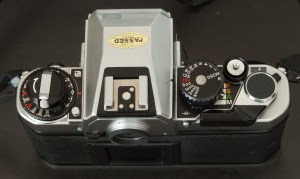
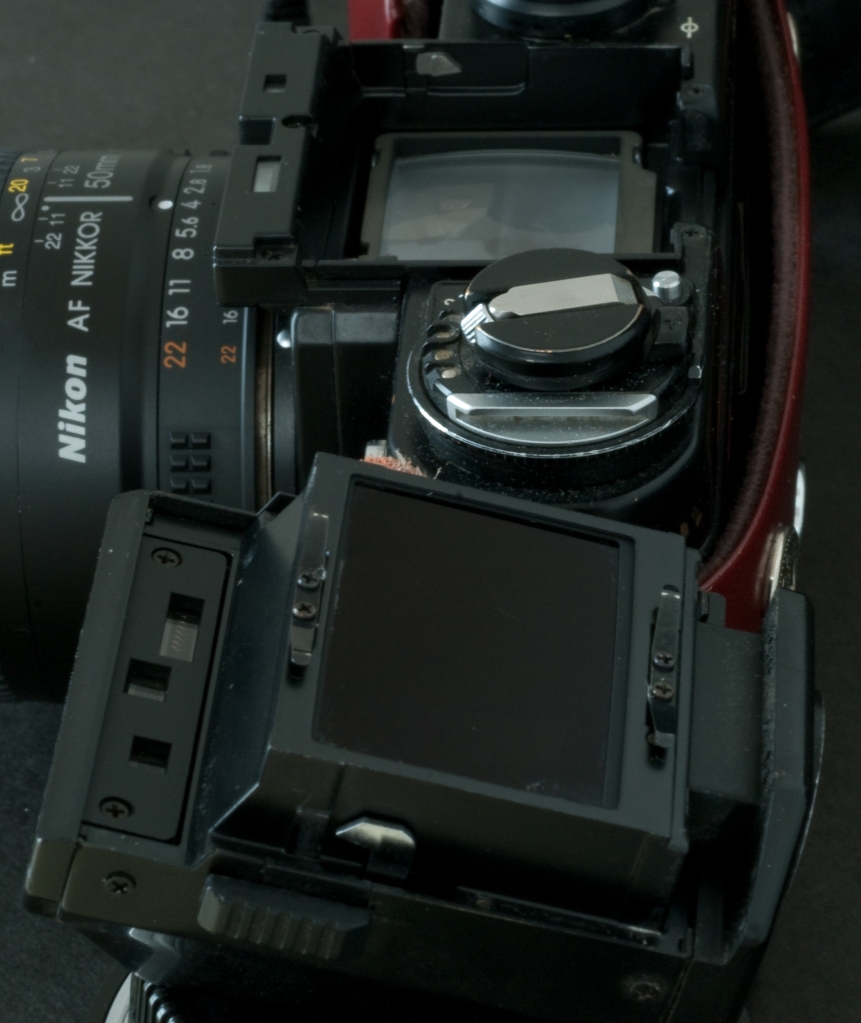
Nikon FA (the round knob controlling the exposure mode ( matrix or center weighted) is on the right side of the lens mount, at the top on this picture


The FA could also be operated in a more conventional Center Weighted Metering mode, and in all honesty, the results of the AMP system were not that different from the center weighted mode. But the system required no intervention and no expertise of the user, and was rapidly made more efficient with the addition of more metering zones and the capture of more parameters (focusing distance, color of the subject, for instance). Current Nikon cameras have a color sensor dedicating to metering, with more than 1,000 metering points. Equivalent systems have been developed by Canon, Minolta and the other manufacturers, under different names: Canon’s system is “evaluative”, and Nikon’s AMP is better known now as “Matrix metering”.


Modern digital cameras all use elaborate variants of matrix or evaluative metering as their default exposure mode, and give good results in a huge majority of cases. They use so many parameters that it’s sometimes very difficult to understand how the camera chose a particular exposure value; in doubt, photographers can visualize the picture they’ve just taken on high definition displays, and use histograms to analyze the exposure of their pictures. Olympus’ Multi-Spot system happened to be too complex for the huge majority of photographers, and left no legacy.


More about Exposure and Metering


Cambridge in Colour. A good (and free) on-line tutorial about digital photography.
A good book about exposure: “Exposure“, by Chris Weston.

Destin- The beach (Nikon FA- Nikkor 24mm AF - Kodak Ultramax) Sept.09

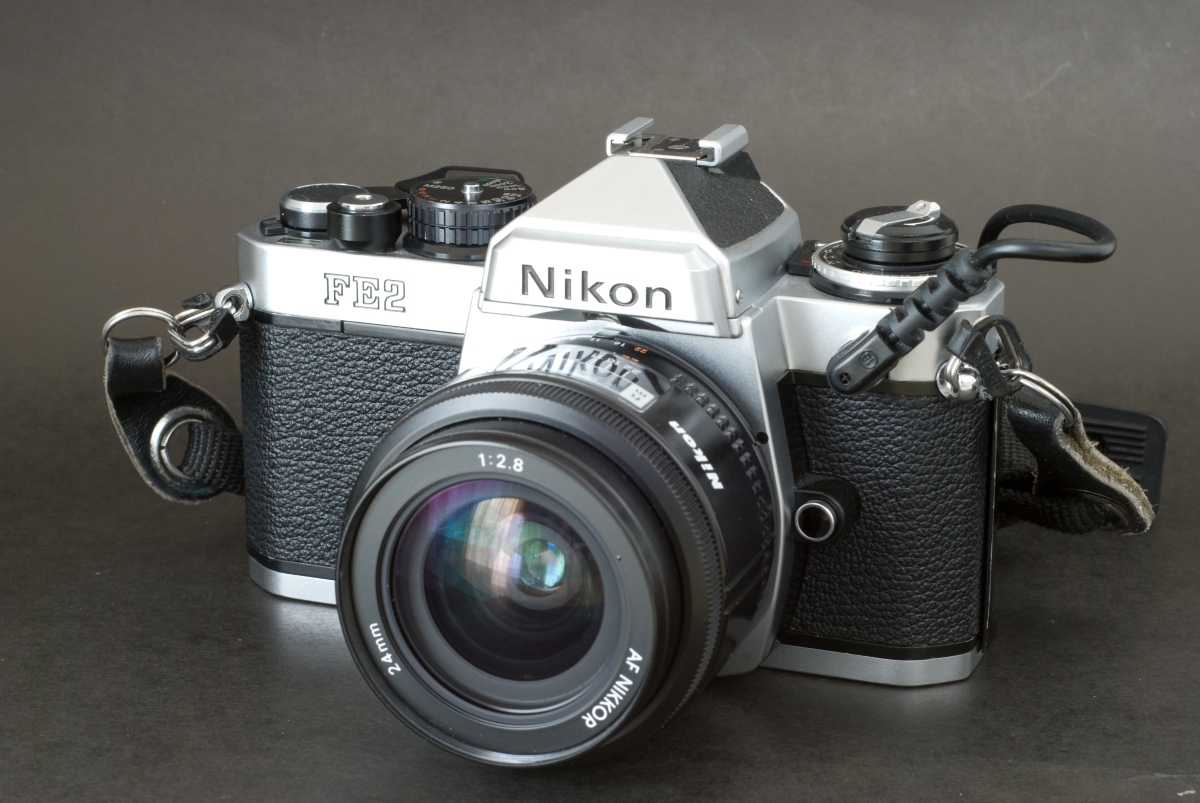
The Nikon FE2: one of the very best manual focus SLRs ever.

Launched in 1983, the successor of the FE had a relatively short sales career, but a long legacy. It can be argued that the Nikon FM3a, sold from 2001 to 2006, is much more a descendant of the FE2 than of the FM2.

Nikon FE2 - Shutter
Nikon FE2 – The titanium blade shutter was the most advanced at the time of the camera’s launch, with a top speed of 1/4000 sec and a flash sync speed of 1/250 sec.

In 1977, a few years after Olympus initiated the compact SLR revolution, Nikon presented the FM. Like the Olympus OM-1, the FM was a compact semi automatic camera with a mechanical shutter, which could be equipped with a motor drive. But contrarily to the OM-1, which still relied on a CdS light metering system and on mercury batteries, the FM used modern gallium photo diodes and silver oxide batteries. It also benefited from a vertical blade metallic shutter, and the exposure metering was relying on 3 LEDs instead of the more conventional match needle arrangement of the OM-1. Solidly built and reliable, the FM was very successful commercially, and the ancestor of a large family of models whose production only stopped in 2006.

Nikon FE2
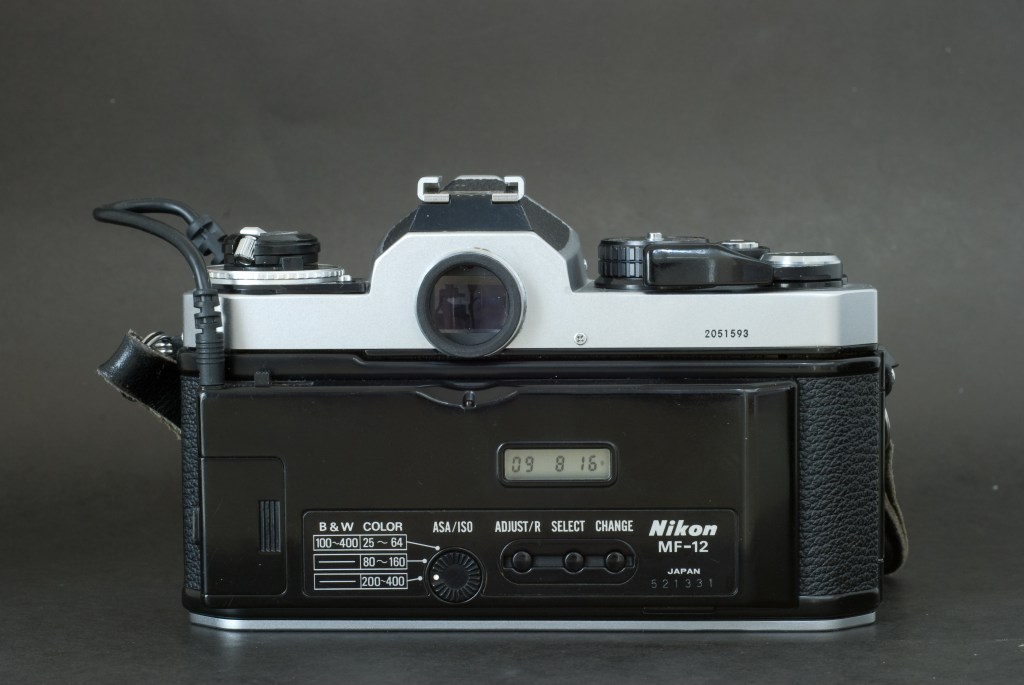
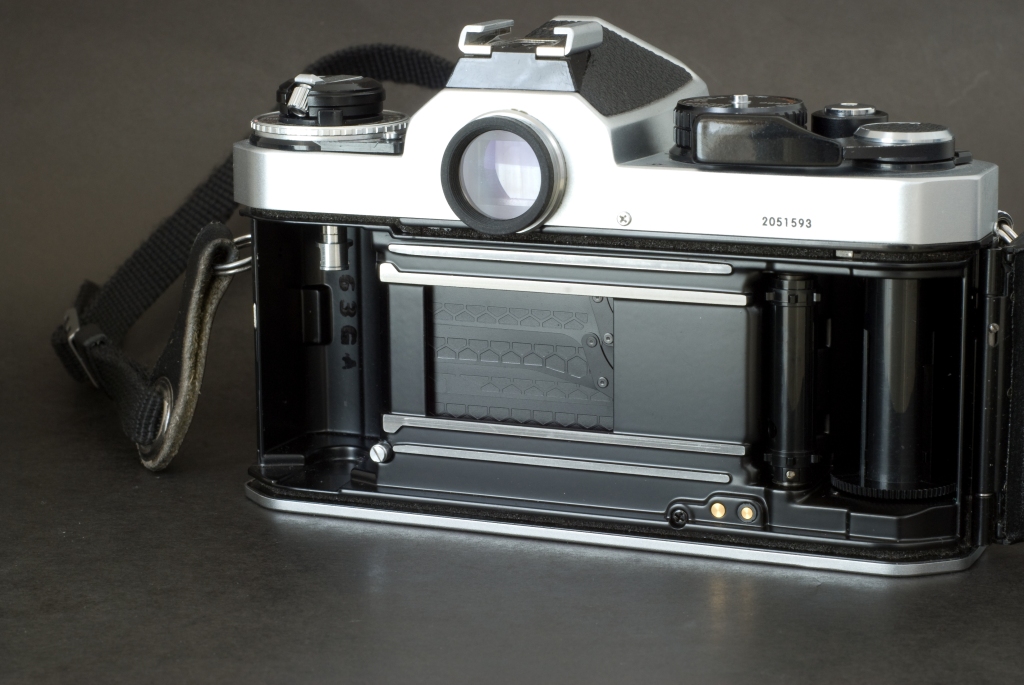
Nikon FE2 with the MF-12 data back – the data back connects to the PC Sync of the camera

The FE from 1978 is the automatic exposure version of the FM. It looks very similar to the FM, but instead of LEDs, it uses two needles to show the shutter speed selected by the photographer (semi-auto mode) and by the automatic exposure system (aperture priority auto mode). In 1982, the FM became the FM2, receiving a new mechanic shutter with titanium blades, which could reach 1/4000 sec and had a flash synch speed of 1/200 sec.

IMG_1099
Nikon FE2 – Auto Exposure Mode – the thin black needle shows the shutter speed selected by the metering system of the camera. Note the aperture value at the top of the viewfinder.

One year later, the FE2 was launched. Its titanium shutter is an improved and electronic version of the FM2’s, with a X synch speed now reaching to 1/250 sec. The FE2 also benefits from a modern on the film (OTF) flash metering system (that the FM2 never got). The FM/FE range of products was extended the following year with the presentation of the Nikon FA, which added matrix metering (a world premiere), a programmed exposure mode and trade the brass prism cover of the FM/FE models for a polycarbonate one. Both FE2 and FA were discontinued in 1988. The FM2 lived longer, and was ultimately replaced by the FM3a, which merged the mechanical shutter of the FM2 with the electronics of the FE2.

Using the FE2 as an every day camera

Reasonably light and compact, the Nikon FE2 is very solidly built, and very nicely finished. Compared to a previous generation model like the FM, the FE2 has smoother commands. The viewfinder is typical from a pre-high eye point construction – the enlargement factor is high (0.86) for a good focusing precision, but the frame coverage is limited (93%), and the eye point is very short (14mm), which could be an issue for photographers wearing glasses. Even with thin glasses, it’s impossible to see 100% of the image projected on the focusing screen without having to move one’s eye ball right to left and left to right: you only perceive 90% of the focusing screen when you look straight into the viewfinder, which compounded with the rather limited frame coverage, ensures that you’ll have a wide safety margin on both sides of your prints.

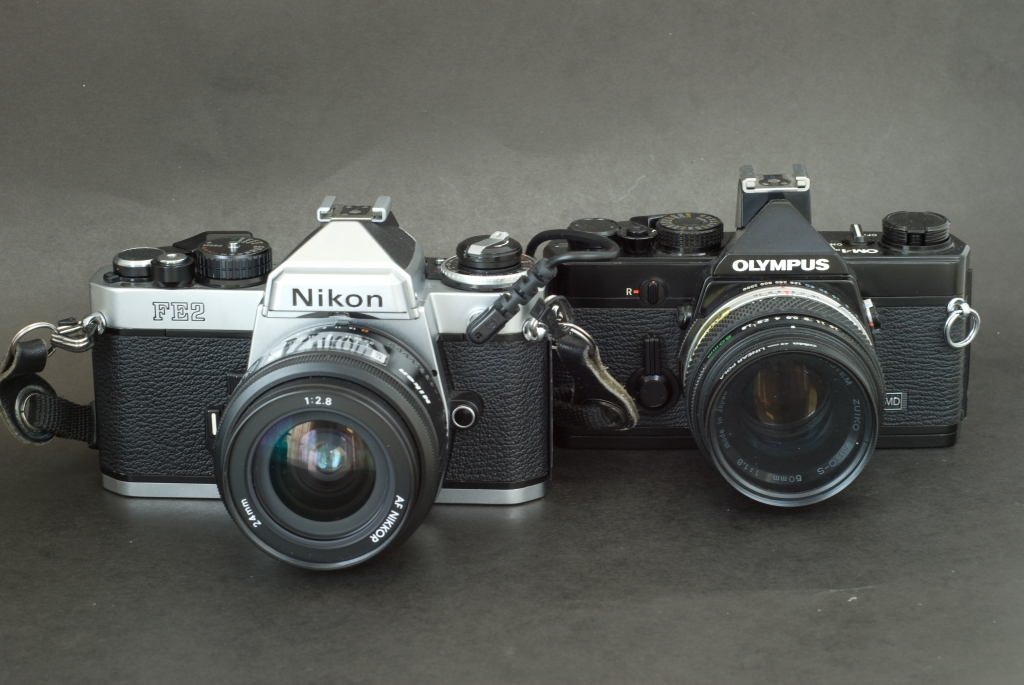
Nikon FE2 / Olympus OM-1n
Nikon FE2 / Olympus OM-1n – The FE2 is a bit larger, but not significantly.

The determination of the exposure is very conventional for a camera of its generation, with a center weighted measurement provided by two silicon photodiodes. In automatic mode, a needle indicates the speed selected by the exposure system of the camera on a large scale at the left of the viewfinder. The photographer has multiple ways to override the automatism: he can memorize the exposure (pushing the self timer lever towards the lens), apply a correction factor on the film speed selector (from -2 up to +2EV), or switch to semi-auto mode. In this case, a second needle – larger and transparent – appears in the viewfinder, showing the shutter speed selected by the photographer.

IMG_1100
Nikon FE2 – Semi auto exposure mode. The fat blue needle shows the selected shutter speed, the thin black needle shows the shutter speed recommended by the metering system.

In a very simple matching needle arrangement, the photographer just has to align the meter needle with shutter speed needle. The shutter speed knob is much smoother than on the FM (in the FE2 the shutter is controlled electronically), and surprisingly the camera is more pleasant to use in semi-auto mode than the FM. No wonder that Nikon derived the exposure control system of the FM3a from the FE2’s and not from FM’s.


Nikon FE2 with MF-12 back
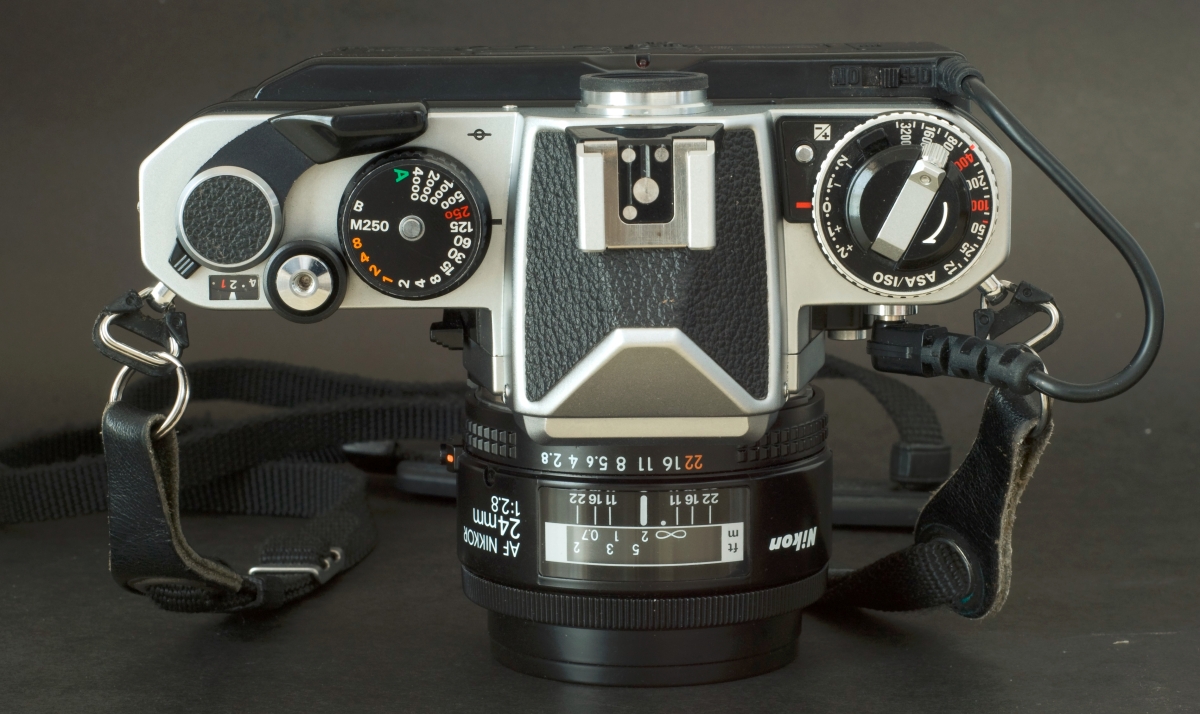
A very clean Nikon FE2 with the MF-12 data back – All the commands are grouped on the top plate – with the exception of the depth of field preview and the exposure lock levers, located at the right of the lens mount. A very simple and efficient layout.

Conclusion

Powered by two easy to find LR44 silver oxyde batteries, the camera also operates without battery at a speed of 1/250sec. Compatible with any AI, AIs and AF lenses, it’s still perfectly usable today.

Less rugged than its FM and FM2 cousins (it has an electronic shutter and a potentially more fragile match needle metering system), it is more pleasant to use and can respond efficiently to a larger variety of photography opportunities. Like the FA and the FM3a, but unlike the FM2, the FE2 benefits from a modern through the lens (on the film or OTF) flash metering system, compatible with the flash units currently sold by Nikon.

Nikon FE2 with MF-12 back
Nikon FE2 with the MF-12 back. The MF-12 back was designed for the FM/FE cameras, which did not have internal synchronization contacts for a data back inside the film chamber. Hence the need for an external synchronization cord. The FE2 could also use the MF-16 data back, which did not need the external sync cord.

Its automatic exposure system is very easy to override, and does not get in the way. The matching needle system in the viewfinder is very informative, easier to read in the sun light than the LEDs of the FG, and than the small LCD display of the FA.

With the F3, the FE2 is probably the most usable Nikon camera of the early eighties.

How much for a Nikon FE2?

The Nikon FE2 is a very good automatic exposure film camera, and its reputation has obviously an impact on its price. Specialized retailers like KEH sell it between $130 (Bargain) and $270 (Top Condition).

As usual, prices are a bit lower on eBay, but the FE2 does not seem to sell for less than $100, with peaks up to $180 for very nice items.

There are few alternatives to the FE2: the more recent FM3a is much more expensive (typically from $400 up to $700) and the FE, with its modest shutter and no OTF flash metering, is far more primitive and more difficult to recommend.


Eight years later…

I wrote this blog entry in 2009. Eight years later, after having tested and used many other SLRs from Canon, Fuji, Nikon, Olympus and Pentax, the FE2 is still one of my preferred cameras:

  • it’s simple – very few options and commands. You read directly on the rings and knobs how it’s set up (pretty easy – aperture, shutter speed, ISO – that’s all). Controlling it rapidly becomes instinctive – an extension of your eyes and hands .
  • with average metering weighted towards the center/lower half of the scene, and an easy to find exposure memorization lever – it’s easy to get the exposure right.
  • the focusing screen is very clear – almost as clear as the viewfinder of a rangefinder camera, but not at the detriment of precision – you can get the focus right, even with very luminous lenses. It’s a relatively short eye point viewfinder – if you wear glasses, you won’t see the borders of the focusing screen unless you really pay attention to it.  You just see the scene – you’re in the middle of it – it’s an immersive experience.

More about the FE2


Photography in Malaysia


Tree trunk
Tree trunk – Along the Nickajack Creek – Smyrna, GA (Nikon FE2, Nikon 50mm lens, Kodak CN400 film.

50 Years of Lens Mount Evolution: Part VI of VI


The last 10 years – digital cameras and image stabilized lenses


The massive adoption of digital cameras has not led – so far – to a dramatic change of the design of the lens mount of the cameras. Canon, Nikon, Pentax and Sony (aka Konica Minolta) did not design specific lens mounts for digital cameras, even if they designed specific series of lenses adapted to the smaller size of the digital “APS-C” sensors.


Panasonic GF1 and G1
Panasonic GF1 and G1 - the most radical development in interchangeable lens cameras since the Contax S and the Leica M3 (Photo courtesy of DPReview)


Only camera makers which had been absent from the 35mm Autofocus SLR market and had no installed base to please had the liberty to start from a clean slate. In 2003, Panasonic and Olympus launched the “Four Thirds” format, combining a relative small size sensor with a large all-electric mount. Last year, Panasonic finally presented the Micro Four Thirds G1, a camera with an electronic viewfinder and interchangeable lenses (EVIL), the first digital camera to really depart from the conventional SLR design of the Contax S of the late forties.


Why did the camera manufacturers keep the same bayonet mount for digital?


When the first digital SLRs from Nikon and Canon were presented in 2000, large imaging sensors were so difficult to manufacture and therefore so expensive that the camera makers settled for a form factor smaller than the 36x24mm dimensions of 35mm film (23.7mmx15.6mm for Nikon, 22mmx14.9mm for the Canon EOS-D30).


This form factor was dubbed “APS-C“, because it was close to the dimensions of an APS picture, shot with the “Classic” image format (25.1×16.7mm) of the APS cameras. The sensor being smaller than a 35mm negative (the diagonal of 35mm film is 1.5 times larger than the diagonal of an APS-C imager), the camera makers had an opportunity to design a new series of smaller bodies and lenses, but they all decided to stick to their legacy lens mounts and to design digital SLRs at least as large as their film counterparts.


Being the undisputed leaders of the film camera market, Nikon and Canon in particular had no interest in starting a new incompatible product line, at the risk of alienating their large user base; it would have leveled the playing field, and offered an easier entry in the dSLR market to companies like Panasonic or Sony. Nikon and Canon also wanted to limit the cost and the technical risk of going digital by reusing most of the components of their film cameras in their first generations of dSLRs. And they may have anticipated that one day, with the help of Moore’s law, cameras using full size digital sensors would become affordable for their professional and enthusiast customers, making their large F or EF bayonets more relevant than ever.


For a few years, however, dSLRs with APS-C sensors were the only game in town. Canon and Nikon both developed specific lenses for their small sensor bodies. Canon decided to modify the EF mount so that the EF-S lenses designed for the small sensor cameras can not be mounted on full frame SLRs or dSLRs. Nikon did not change the F bayonet – small sensor DX lenses can also be mounted on full frame (or FX) bodies, but being designed for the APS-C sensor size, they do not cover the full format of the FX sensors and the image is automatically cropped.


The Four Thirds and Micro Four Thirds formats


In 2003, Olympus and Panasonic launched the “Four Thirds” format. At that time, Canon had already started producing the first full frame 35mm digital camera (the EOS 1D), and was preparing much more affordable 35mm digital SLRs like the EOS-5D for the enthusiast photographer market. A large sensor was still complex and expensive to manufacture, but getting high quality pictures out of it would prove much easier than with a small sensor, in particular in low light situations.


The Olympus Four Thirds system was based on design decisions completely opposed to Canon or Nikon’s . The sensor size chosen for Four Thirds cameras is very small (its diagonal is only half of the diagonal of a 35mm sensor), but at the same time the lenses and bodies are designed around a large diameter bayonet mount (44mm, the same as Nikon’s F), with a relatively long focal flange distance (38mm). When the system was designed, it was believed that a large diameter lens and a long focal flange distance were required to get optimal results from the imaging sensor, but the Leica M8 and M9 have since proven that it was not the case.


On the positive side, the relatively large dimensions imposed by the Four Thirds mount gave the engineers more freedom to design high quality lenses with very fast apertures, but on the negative side the body & lens combination could not be made significantly smaller than the more conventional APS-C cameras of their competitors. To add insult to injury, the relative small size of the sensor proved a handicap in low light situations (all things being equal, small sensors are more subject to noise than larger ones), and steered most of the enthusiast photographers away from Four Thirds cameras. Four Thirds only got traction on the low end of the market.


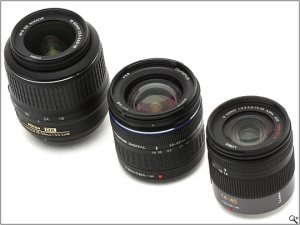
Size comparison: Nikon 18-55 DX, Olympus 14-42, Panasonic 14-45 Micro 4/3
Size comparison: Nikon 18-55 DX (APS-C), Olympus 14-42 (Four Thirds), Panasonic 14-45 (Micro Four Thirds) - Image courtesy of DP Review


Failing to make a significant impact on the mid-level dSLR market, and completely barred from the professional market dominated by new full frame cameras with extraordinary low light capabilities, Panasonic and Olympus decided to create a new niche for themselves, and launched Micro Four Thirds cameras. Using the same sensor as the “Four Thirds” dSLRs, the Micro 4/3rd cameras have abandoned the reflex mirror chamber and the pentaprism viewfinder of conventional dSLRs for an electronic viewfinder. They are designed for a much shorter focal flange distance (approx. 20mm instead of 38mm, and the mount diameter is also smaller (32mm approx. instead of 44mm).
As a result, the body+lens combination is much more compact than any other dSLR on the market. It’s still difficult to predict how this new category of cameras will fare in the future, but they finally bring something new to the table.


Image Stabilization

The migration from film to digital is without a doubt the most significant evolution of photographic equipment in the last ten years. Image stabilization gained acceptance during the same time, and is now a feature expected by amateurs using digicam as well as enthusiasts and pros using expensive large aperture teles. The objective of image stabilization systems is to compensate automatically the involuntary movements of the photographers, and to produce sharper pictures even at slower shutter speeds.


Canon, Nikon and Panasonic adopted relatively similar systems, all based on the controlled movement of optical modules installed inside the lenses. Minolta, Pentax and Olympus opted for in-camera systems compensating the movements of the photographer by moving the image sensor itself. Apparently both systems produce good results. In-camera image stabilization systems do not require any change to the lens mount, but in-lens systems need to be managed from the body, and require a few more electric contacts. Most of the current lens mounts are all-electric now, and adding a few contacts is an easy done job.


The state of the art in 2009


Pentax: Progressive introduction of the KAF3 version of the K bayonet mount, with autofocus motor in the lens. The majority of the lenses in the product line still need an autofocus motor in the camera body.


Canon: No change to the EF mount of the EOS cameras. Starting with the Rebel and the 20D cameras, Canon used a specific variant (EF-S) of the mount for lenses dedicated to the APS-C format. Canon dSLRs all work with EF lenses, but only the Rebel and 20D, 30D, 40D and 50D cameras can use the EF-S lenses.


Minolta, Konica Minolta and Sony: Progressive introduction of SSM lenses, with the focusing motor inside the lens. The majority of the lenses in the product line still need an autofocus motor in the camera body.


Nikon: Multiple variants of the F mount were used during the last 15 years:
– AF-D: no mechanical difference with the AF mount, the D lenses transmit the focusing distance value back to the body for 3D Matrix Metering
– AF-I: focusing motor in the lens – used for tele-lenses between 1992 and 1996;
– AF-S lenses: ultra-sonic (“Silent Wave”) autofocus motor built into the lens. Most of Nikon’s zoom lenses are now AF-S, and the conversion of prime lenses has started a few years ago.
– The new PC-E (perspective control electromagnetic) lenses now use an electromagnetic diaphragm command. All the other Nikon lenses still use the mechanical stop down mechanism introduced with the F mount in 1959.


Olympus & Panasonic started promoting the Four Thirds format in 2003. Four Third lenses use an all electric bayonet mount. The Micro Four Thirds are more compact, and use 11 electrical contacts instead of 9 for regular Four Third lenses. Thanks to the very short focal flange distance of Micro Four Third cameras, it is easy to develop adapters for Canon EF, Nikon F, Olympus OM or Leica M or R lenses.


Gull in Essaouira (Morroco)
An exception on this blog: a digital picture (Nikon D80) taken in Essaouira - Morroco

50 Years of Lens Mount Evolution – Part V of VI


Autofocus


Point and shoot cameras started adopting autofocus mechanisms in 1977, following Konica’s introduction of the C35 AF.
Pentax and Nikon were the first to show autofocus SLRs with passive autofocus systems (in 1981 and 1983 respectively), but were not successful. For the occasion, both companies had designed a system where the camera body (or prism) housed the focus sensors and the lenses contained the motor used for focusing. Both cameras were using a “contrast detection” autofocus system. Pentax and Nikon had to develop specific variants of their mount (K-F and F3-AF respectively) for the occasion. In the typical Nikon manner, the two lenses designed for the F3-AF will still be compatible with the F4 body launched a few years later.


Minolta and the hybrid design

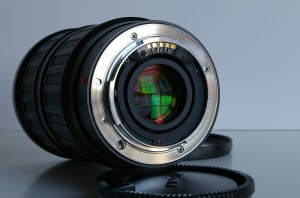
Minolta A Mount (on the Angenieux 28-70 zoom)
Minolta A Mount (shown here on the Angenieux 28-70 zoom) – note the electrical contacts, the autofocus drive shaft, and the rod used for stopping down the diaphragm. The combination of electrical and mechanical commands is typical of an hybrid design.


In 1985, Minolta took a different approach. Using a much more efficient “phase detection” autofocus module, the engineers of Minolta developed a brand new camera system from the ground up. Abandoning the MD mount, Minolta designed a large diameter bayonet mount, and launched the new series of “A” lenses. No compatibility with the old Minolta system was offered, but it did not prevent the Minolta 7000 from being a huge success. It redefined the SLR category, and with the exception of the Canon EOS cameras, all autofocus SLRs would be following the same design principle for a long time.


The “A” mount – which is still used today on Sony SLRs, is a mechanical-electrical hybrid. The lenses have no aperture ring and the transmission of the aperture parameters between the lens and the body is electric, but the diaphragm is closed to its designated aperture by a mechanical lever. Minolta placed the autofocus motor in the body, and had to implement a telescopic shaft mechanism to control the focusing group of the lenses.


The competition was quick to react. Nikon (at the end of 1985) and Pentax (1987) adopted the same hybrid design, but decided to make the new models compatible with their legacy: their AF bodies could still accept non-AF lenses, and their new AF lenses could also be used on conventional SLR bodies.


Canon’s revolutionary EOS system

EF-lens-mount (source: wikipedia)


Canon needed more time than Nikon to react to Minolta’s innovations, but took a much more radical approach. The EOS system, launched in 1987, adopted an all-electrical approach, using an electrical command for the diaphragm and placing the focusing motor in the lenses (as opposed to the camera’s body). The EOS cameras and their lenses used the brand new EF mount, which did not offer any compatibility with the older FL or FD mounts. The absence of compatibility was a shocker for the faithful Canon users, but the new EOS system was obviously designed for the future: Canon did not need to make any change to the mount since its inception, and the all-electric exchange of information between the body and the lens was adopted progressively by all of its competitors.


At the beginning, most of the EF lenses used a conventional electrical motor to control focusing, but a few pro-telephoto lenses benefited from an ultrasonic motor (“USM” in Canon’s marketing brochures). Ultrasonic motors have a very low inertia and operate silently: USM lenses focus very rapidly, and allow the photographer to adjust the focus manually, after the autofocus process has taken place, and without the risk of breaking a cog wheel or the autofocus transmission shaft. USM lenses gave Canon a huge competitive advantage, in particular for sports and action photography.


Nikon recognized rapidly that mounting the autofocus motor in the lens was the right thing to do, and started converting its professional telephoto lenses to an almost all-electrical design (AF-I mount in 1992), which evolved into the current AF-S mount when ultrasonic (“Silentwave”) autofocus motors were adopted (1996). Pentax and Sony were slower to place the autofocus motor in the lens, and most of their current lenses still follow the original hybrid design of Minolta.


Some of the other camera makers decided not to convert their product line to autofocus (Leica, Konica), while some tried but could not get market acceptance (Olympus, Contax). In all cases, the failure to adopt autofocus relegated the camera makers to a niche market, and all ended up stopping production of SLRs altogether.


Almost 25 years after the introduction of the Minolta 7000, it’s interesting to compare Canon’s strategy with Nikon’s. Canon’s users had to absorb a huge change in 1987 (they had to throw away their lenses and buy new ones if they wanted to use the new EOS cameras), but the EF mount and the lenses have remained the same for the last twenty years. All-electrical USM lenses gave Canon a huge competitive advantage, and Nikon, with its more conservative and evolutionary approach, needed almost 20 years to catch up on the professional market.


The state of the art in 1987

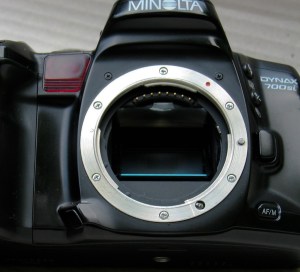
Minolta A Mount on a 700si body (1993)
Minolta A Mount on a 700si body (1993) – Note the electrical contacts, the stop down aperture command, the autofocus drive shaft.


Pentax: KAF version of the K bayonet mount. Mechanical control of the diaphragm, autofocus motor in the camera body.


Canon: New EOS mount, 100% electric. Totally incompatible with the FL and FD mounts


Minolta: New A mount totally incompatible with the old SR, MC and MD mounts. Mechanical control of the diaphragm, electric transmission of the required aperture value from the body to the lens, autofocus motor in the camera body.


Nikon: AF version of the F mount. Mechanical control of the diaphragm, electric transmission of the required aperture value from the body to the lens, autofocus motor in the camera. Upward and backward compatibility preserved on professional cameras and lenses (and with limitations on the consumer grade cameras and lenses).


Olympus: new line of lenses, with no focusing ring (autofocus had to be overriden using a rocker switch on the camera body). The reception of the market was so disappointing for Olympus that they gave up on autofocus SLRs, and reverted to conventional OM cameras until 2003.


House in Brittany - Minolta Vectis S1 - The Vectis, launched in 1996, adopted Canon's all-electric autofocus design
House in Brittany – Minolta Vectis S1 – The Vectis, launched in 1996, adopted Canon’s all-electric autofocus design

50 Years of Lens Mount Evolution – Part IV of VI


Programmed exposure


The automatic bodies of the early seventies still required some input from their users: they could only determine the shutter speed (or the aperture in the case of Canon cameras) after the photographer had set an aperture (or a shutter speed) compatible with the film speed, the intensity of the light and the characteristics of the scene (portrait, action shots, macro, and so on).
If the aperture set by the user was too low or too high, a matching shutter speed could not be selected by the camera and the picture was hopelessly under or over exposed.
Similarly, if the photographer let the camera select a very slow shutter speed with a long tele-lens, the picture would be blurry and unusable. Trained photographers knew that. But a better automatic exposure solution had to be found for the photographers who did not want to be bothered with technical details.

Nikon FA - the commands for the multi-mode exposure automatism (PSAM)
Nikon FA (1984) – the command for the multi-mode exposure automatism (PSAM) is in front of the shutter speed knob


Inspired by the program modes already available in point and shoot cameras, Canon launched the A-1, a new SLR with programmed exposure modes in 1978. Practically, it meant that the auto exposure system of the body had to simultaneously command the shutter speed and the aperture of the diaphragm.


Canon did not have to change anything on the FD mount, which had been created for full aperture shutter priority exposure. 


Nikon introduced the “AI-S” generation in 1979 when the mount was modified to support a linear command of the diaphragm. The first Nikon cameras to take advantage of the AI-S lenses and to offer a program mode and shutter priority were launched in 1982 and 1984 respectively. Because the camera body was informed of the focal length of the objective, it could choose automatically between two aperture-speed combinations when configured in program mode, one for wide angle and normal lenses, and one for lenses of 135mm and longer .

Nikon F mount - AIS on the Nikon FA
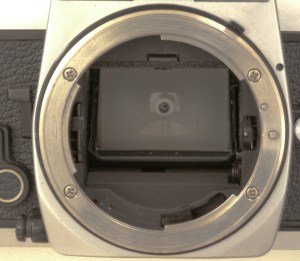
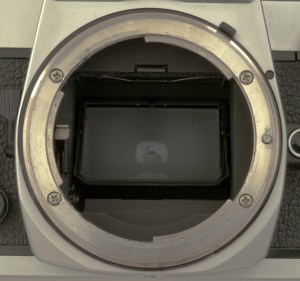
The AI-S variant of Nikon F mount, shown here on the Nikon FA. Compared to the lens mount of the FE2, the FA’s is using three more sensors: a small pin above the lens lock – which informs the body that the lens is of the AI-S type, a larger sensor inside the reflex chamber (right of the picture, in the middle) which is used to transmit the focal length of the lens to the body, and a slider at the bottom of the reflex chamber, used to transmit the maximum aperture of the lens to the body. The use of mechanical sensor had reached its limits. It was time to adopt electrical contacts instead.
Nikon F mount - AI on the Nikon FE2
For reference, the much simpler design of the AI mount (Nikon FE2). The stop down lever controlling the diaphragm is on the left side on the picture. You can still find it on current Nikon digital cameras.


Still trying to catch up with Nicanolta, Pentax adopted a brand new bayonet mount, the K mount, in 1975. The first K mount, however, did not support shutter priority or program modes. Electric contacts would have to be added with the KA declination of the K mount in 1983 to make it possible. Its close derivatives are still used today on Pentax DSLRs.


The state of the art between 1971 and 1985


Pentax: Aperture priority automatic cameras launched in 1971 with modified 42mm screw mount lenses supporting full aperture metering.
Change from the 42mm screw mount to a new Pentax K bayonet in 1975 (automatic pre-selection, full aperture metering, transmission of the pre-selected aperture value from the lens to the body);
Shutter priority and program mode introduced in 1983 with the KA version of the K mount.


Canon: The FD breech mount introduced in 1971 was ready for the Shutter priority cameras launched in 1973 (Canon EF) and for the program mode (Canon A1, 1978).


Minolta: MD declination of the SR Mount (one pin added for the support of the Shutter priority mode) to support the Shutter priority mode in 1977.


Nikon: Aperture priority cameras available since 1971 (Nikon EL) with the manual indexing F mount. Launch of the AI version of the F mount in 1977 to improve the ease of use. Progressive adoption of the AI-S declination of the F mount in 1979 to prepare for the arrival of cameras offering a program mode (Nikon FG, 1982) and a shutter priority automatic exposure (Nikon FA, 1984).


Olympus: the OM mount was introduced in 1971, and was ready to support programmed exposure from the beginning.


More about the lens mounts


Photography in Malaysia: information related to the F lens mount


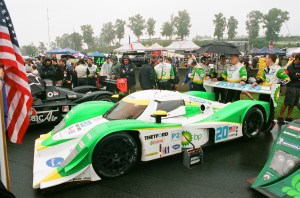
American Petit LeMans - the Atlanta Pipe Band. Nikon FA - Kodak CN400
American Petit LeMans – the Atlanta Pipe Band. Nikon FA – Kodak CN400 – Processed by Costo. Cropping and minor adjustments in Lightroom 2

The American Petit LeMans 2009 starting grid and Kodak Ultramax

American Petit Lemans - Corvette
American Petit Lemans 2009 - Corvette C6 R
American Petit Lemans-Porsche GT3 RSR
American Petit Lemans 2009 -Porsche GT3 RSR
American Petit Lemans 2009 - Lola B09 60 Judd
American Petit Lemans 2009 - Lola B09 86 Mazda
American Petit LeMans 2009 - Lola B09 86 Mazda


The American LeMans 2009 Starting Grid


The weather was very bad in north Georgia last week-end for the Petit LeMans race. So bad that the race had to be interrupted.
America LeMans events are still managed by people who love motorsports and respect the fans. The starting grid remains open to the public until the least ten minutes preceding the race start. A good opportunity to test the Kodak Ultramax 400 with a Nikon FA body and the Nikkor AF 24mm lens.


The film was processed and scanned by Costo on Noritsu equipment, and delivered on a CD-ROM for less than $5.00.
Costco saved each image as a 3088×2048 jpeg (equivalent to 6MPixels). Image crop and minor adjustments (sharpness) were performed in Lightroom 2.


More about the 2009 Petit Lemans at Road Atlanta

The Road Atlanta race track

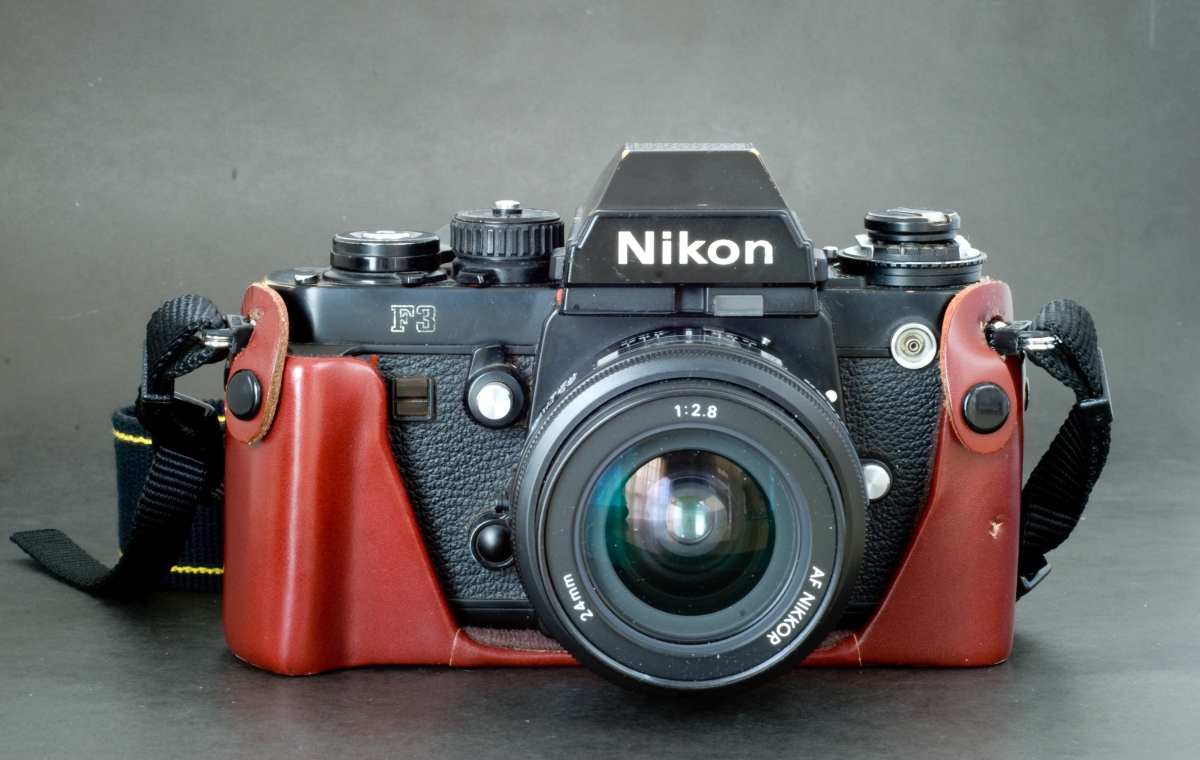
Nikon F3


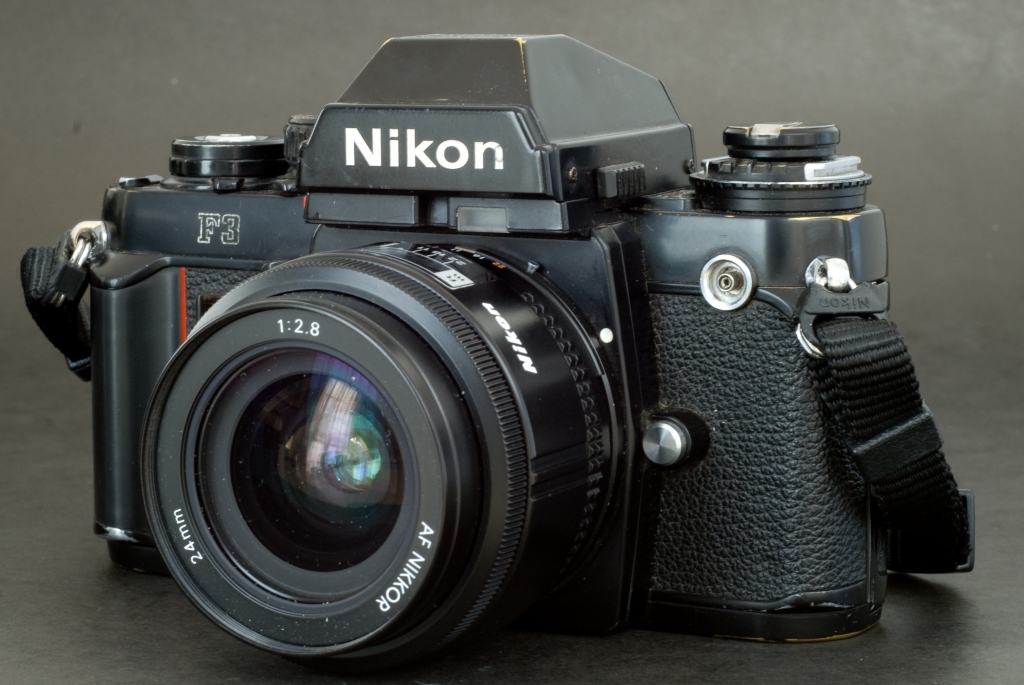
Nikon’s F3 was the “pro” camera of the early eighties, but it kept on selling until 2001. A dwarf compared to current mid-level digital SLRs, not to mention monsters like an EOS 1DS or a D3. Incredibly simple to use compared to anything digital sold these days. Aperture Priority Automatic or Semi-Auto exposure. Center weighted metering. That’s all. It worked. And it still works today.


Nikon F3 - cosmetically not perfect - it simply works
This Nikon F3 is far from perfect cosmetically – but it works

Consider all the changes that took place in the SLR design between 1980 and 2001. Multi mode exposure, spot and matrix metering, integrated motors, autofocus, DX coding, the F3 had none of that, but it outlived two or three generations of newer-better-faster pro bodies from Nikon or Canon. The F3 had the elegance to hide its real technical advances under a classical skin, and to let the photographer communicate his instructions through smooth and oversized controls. Of all the pre-autofocus SLRs of Nikon, the F3 is the most pleasant to use, and probably the one which will yield the best results.

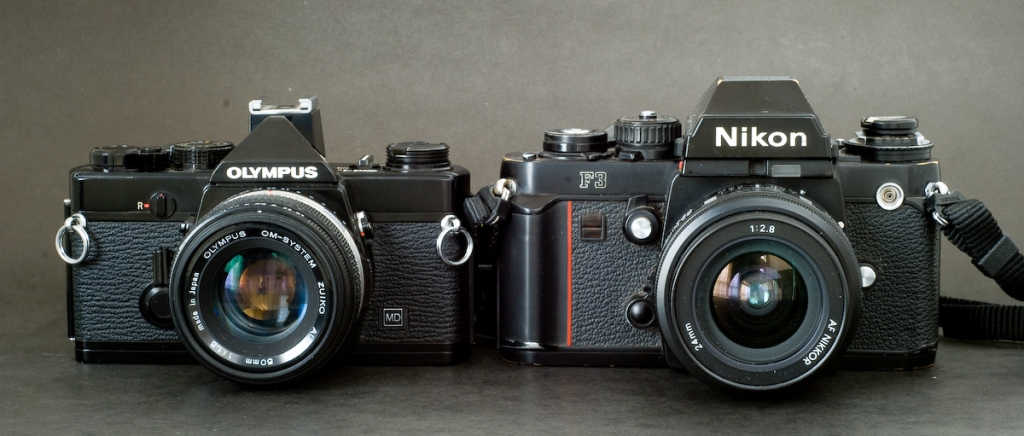
The F3 is an exception in the Nikon F lineup. It’s compact, smaller than its predecessors, and way smaller than its successors, the F4 and F5. In fact, its size is very comparable to that of the FM, itself hardly bigger than the yard stick of compact SLRs, the Olympus OM-1. The F3 is also easy to use, without the idiosyncrasies of the F and F2s with their Photomic finders and manual aperture indexing, and without the myriads of commands of an F4 or the menus and submenus of an F5.


Olympus OM-1n / Nikon F3
Olympus OM-1n / Nikon F3 – The F3 is larger, of course, but not that much. Compact and not very loud, it can be used for street photography, among other things.

The F3 is much more modern and usable in everyday life than a semi auto camera like the FM: its commands are larger and smoother, and the automatic exposure system is faster to operate; thanks to the center-weighted metering and a memory lock button, it does not deprive the photograph of his control on the exposure . When a flash is needed, the FM still requires the user to concern himself with Guide Numbers. The F3’s flash system is modern: following the path opened by the Olympus OM2, the SPD (silicon) cell is housed under the main mirror, and provides On The Film flash metering. But the Nikon engineers avoided loading the F3 with complications like multi-mode auto-exposure or multiple metering patterns. The F3 has few commands, and they’re so easy to understand that no manual is needed.


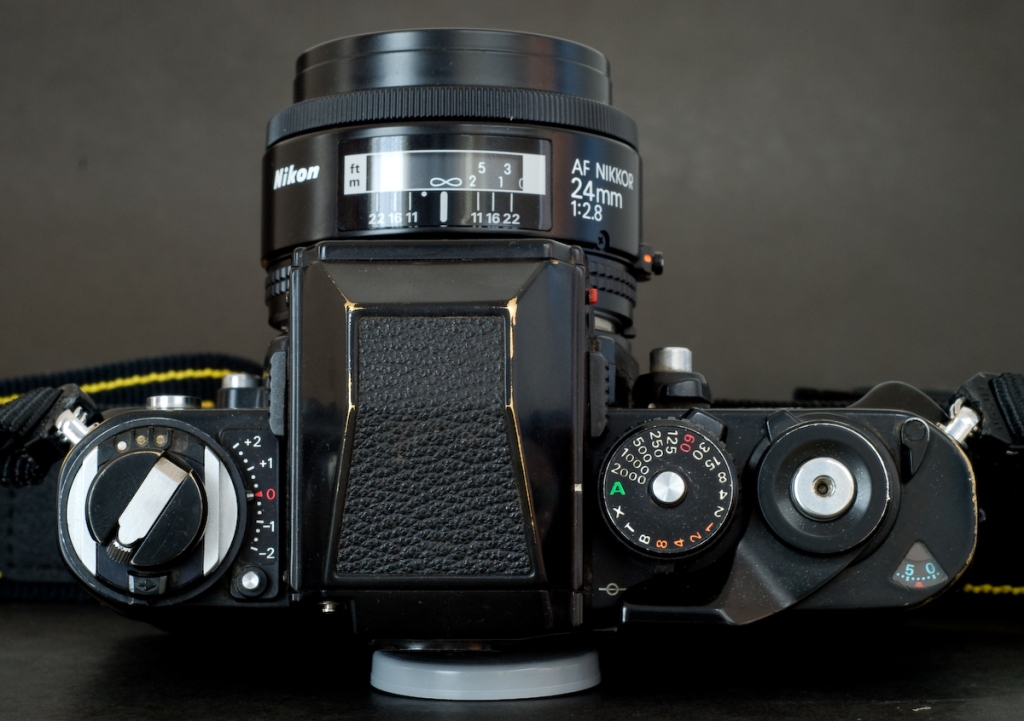
Nikon F3 (above)
Nikon F3 – a view of the commands – add the exposure memory lock and the backup shutter release on the front, you have them all.

All the commands are generously sized, and very smooth to operate (the film advance mechanism is mounted on ball bearings). The view finder is wide, bright and clear, making focusing easy. After a few years of production, Nikon replaced the viewfinder with a high eyepoint (HP) model, which could be used more easily byglass wearers. The viewfinder is the only part of the camera which is really larger than what you would find on contemporary advance-amateur SLRs.


Of course, the F3 is not perfect. It may be compact, but it’s heavy (approx. 750g). Its OTF flash system may have been advanced for its time, but the shutter only syncs at 1/60sec, and none of the viewfinders of the F3 system has a standard flash hot shoe: the F3 requires a specific flash adapter, to be inserted at the top of the rewind lever. But if I had to own and use only one film camera, that would be the F3, without any hesitation.

viseur Nikon F3
Nikon F3 and its DE02 viewfinder at the front – Note that the exposure metering system and the LCD showing the selected shutter speed are on the body, not on the removable viewfinder (the little windows at the front of the viewfinder are aligned with the LCD and the aperture see through when it is in position on the body)


How much for a Nikon F3?


The price of an F3 is extremely variable. The F3s were produced over 21 years, and some of them could be fairly recent, when others could have been used and abused since the early eighties. F3s were built like tanks, but they were used as their everyday work horse by legions of professional photographers, and they may have had a rough life.


Old and scruffy models in perfect working condition – like the 1983 model represented on those pictures – can be had for a little more than $70.00. Nicer and more recent models with the HP viewfinder and a motor drive will cost you at least $300.00. Beyond the standard F3 and F3 HP, Nikon also produced many derivatives of its flagship camera, for specialized applications or to test new technologies like the autofocus system they showed in 1983. Some of them are relatively rare collector items and will command a much higher price.


Nikon F3 in CF-22 case
Nikon F3 in its CF-22 case. Designed by Giorgetto Giugiaro, the F3 had to show some italian bravado. The body design is classical, but the leather everready case is bright red.


More about the Nikon F3


Photography in Malaysia – the Nikon F3
Shutterbug: the Nikon F3 (2007)


Lunch Break - Quais de la Seine. Paris. April 2009
Lunch Break along the Seine. Paris-April 2009. Nikon F3 – Nikkor 24mm AF

50 years of lens mount evolution (Part III of VI)


Automatic Exposure


The first SLR cameras with TTL metering were semi-automatic – the needle of a galvanometer indicated how far the shutter speed/aperture combinaison was from the ideal exposure, but it was up to the user to turn the aperture ring or the shutter speed knob to adjust the exposure parameters following the directions provided by the needle.


The next step was obviously to design a camera which would set automatically the aperture value or the shutter speed corresponding to the ideal exposure.

Olympus OM Mount
Olympus OM Mount: it remained unchanged from 1971 until the end of the production of the OM-4 in 2003. Note the design and the wonderful finish of this mount


Automatic exposure was first adopted by point and shoot cameras, and by a few amateur oriented reflex cameras.


Before Integrated Circuits capable of controlling a focal plane shutter became available, the simplest way to provide auto-exposure was to keep the conventional mechanical shutter, and to use a servo-motor to link mechanically the match needle of the exposure galvanometer to a series of rods controlling the aperture of the diaphragm. It was easier to implement such a system on a fixed lens camera, which explains why at first auto-exposure SLRs (such as the Mamyia Auto-Lux 35 or the Canonex) did not have removable lenses.


The engineers developing conventional SLRs had a few technical hurdles to pass before they could produce auto exposure SLRs capable of attracting a wider audience of seasoned photographers. The difficulties were cleared at the beginning of the 70s, and two types of automatic SLRs started hitting the market between 1971 and 1973.


Aperture Priority Automatic Exposure


The development of integrated circuits made Aperture Priority (pre-selecting the aperture and letting the camera set its shutter speed automatically) relatively easy to implement. The mechanically controled shutter had to be replaced by an electronically controlled model, but no change was needed on the lens mount -at least for Minolta and Nikon. Aperture priority cameras did not need a delicate linkage between the body and the lens, and could be used even with specialized diaphragm-less lenses (mirror lenses, for instance). Pentax had to adopt full aperture metering – they added a few cams to the 42mm screw mount for the introduction of the first electronic SLR, the Spotmatic ES. Nikon and Minolta launched their own aperture priority SLRs soon after (1971-1972). Olympus followed with the OM-2 in 1975.


Shutter Speed Priority Automatic Exposure


On the contrary, Shutter Speed Priority (pre-selecting the shutter speed and letting the camera set the lens aperture automatically) did not require any change on the shutter mechanism used on previous semi-automatic cameras, but precision mechanics was needed to ensure that the diaphragm would close at the exact value determined by the exposure system of the body.
The automatic diaphragms used in pre-selection lenses – see: 50 years of evolution of SLR lens mounts (Part I of VI) had so far been working in an all or nothing mode: full aperture, or closed down as far as the lens could go, namely to the aperture pre-selected by the user. With Shutter priority, the brute force approach did not work anymore: a lever on the mount (camera side) had to transmit to the lens the exact aperture value determined by the automatic exposure system, and all the lenses of the system had to react identically to the movement of the exposure lever of the camera.


The lenses and the mounts had to be modified again, either by the addition of aperture transmission pins (that’s what Canon did in 1971 with the new FD mount), or by the transformation of the all or nothing stop down command of the diaphragm into something much more linear, where the movement of the stop down lever was proportional to the value of the aperture to be used. Nikon chose the latter route with the AI-S mount introduced progressively after 1979, in preparation of the launch of future cameras offering Shutter Speed Priority and Programmed Exposure modes.


The first Shutter Priority SLR of one of the “big four” was were introduced by Canon (the EF model in 1973) following the tracks of Konica, which had been producing its Autoreflex T series since 1968.


More about it
A history of the Nikon F mount by Denton Images


Angenieux 28-70mm f:2.6 AF

The 28-70 f:2.6 was Angenieux’s last consumer oriented zoom, designed for Canon, Minolta and Nikon AF cameras. With a very wide aperture, an all-glass and all-metal construction, it was positioned to compete with the “pro” series zooms of the big three. The tests performed by the specialized press at that time showed that it was THAT good.

Unfortunately, its price was also on par with the best of Nicanolta, which made it a tough sale beyond the small circle of admirers of French technology. When Angenieux decided to refocus on professional markets and stopped the production of its consumer oriented lenses, Tokina inherited the design, and their Tokina AT-X 287 Series – which was sold as recently as 2007, is a remote descendant of the Angenieux 28-70 AF.

Continue reading