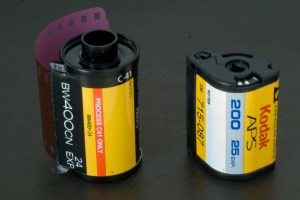
I’d like to know what type of film you’re using when you shoot with a film camera. It will help me focus my attention on what really matters to you.
Thank you
Autofocus
Point and shoot cameras started adopting autofocus mechanisms in 1977, following Konica’s introduction of the C35 AF.
Pentax and Nikon were the first to show autofocus SLRs with passive autofocus systems (in 1981 and 1983 respectively), but were not successful. For the occasion, both companies had designed a system where the camera body (or prism) housed the focus sensors and the lenses contained the motor used for focusing. Both cameras were using a “contrast detection” autofocus system. Pentax and Nikon had to develop specific variants of their mount (K-F and F3-AF respectively) for the occasion. In the typical Nikon manner, the two lenses designed for the F3-AF will still be compatible with the F4 body launched a few years later.
Minolta and the hybrid design
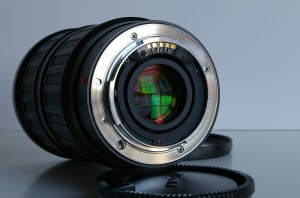
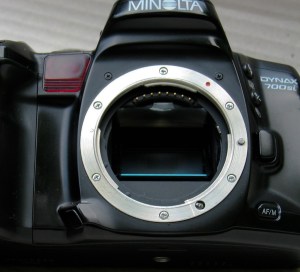
In 1985, Minolta took a different approach. Using a much more efficient “phase detection” autofocus module, the engineers of Minolta developed a brand new camera system from the ground up. Abandoning the MD mount, Minolta designed a large diameter bayonet mount, and launched the new series of “A” lenses. No compatibility with the old Minolta system was offered, but it did not prevent the Minolta 7000 from being a huge success. It redefined the SLR category, and with the exception of the Canon EOS cameras, all autofocus SLRs would be following the same design principle for a long time.
The “A” mount – which is still used today on Sony SLRs, is a mechanical-electrical hybrid. The lenses have no aperture ring and the transmission of the aperture parameters between the lens and the body is electric, but the diaphragm is closed to its designated aperture by a mechanical lever. Minolta placed the autofocus motor in the body, and had to implement a telescopic shaft mechanism to control the focusing group of the lenses.
The competition was quick to react. Nikon (at the end of 1985) and Pentax (1987) adopted the same hybrid design, but decided to make the new models compatible with their legacy: their AF bodies could still accept non-AF lenses, and their new AF lenses could also be used on conventional SLR bodies.
Canon’s revolutionary EOS system
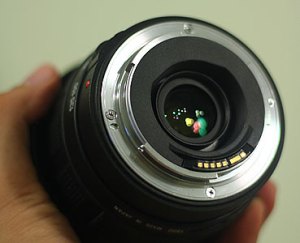
Canon needed more time than Nikon to react to Minolta’s innovations, but took a much more radical approach. The EOS system, launched in 1987, adopted an all-electrical approach, using an electrical command for the diaphragm and placing the focusing motor in the lenses (as opposed to the camera’s body). The EOS cameras and their lenses used the brand new EF mount, which did not offer any compatibility with the older FL or FD mounts. The absence of compatibility was a shocker for the faithful Canon users, but the new EOS system was obviously designed for the future: Canon did not need to make any change to the mount since its inception, and the all-electric exchange of information between the body and the lens was adopted progressively by all of its competitors.
At the beginning, most of the EF lenses used a conventional electrical motor to control focusing, but a few pro-telephoto lenses benefited from an ultrasonic motor (“USM” in Canon’s marketing brochures). Ultrasonic motors have a very low inertia and operate silently: USM lenses focus very rapidly, and allow the photographer to adjust the focus manually, after the autofocus process has taken place, and without the risk of breaking a cog wheel or the autofocus transmission shaft. USM lenses gave Canon a huge competitive advantage, in particular for sports and action photography.
Nikon recognized rapidly that mounting the autofocus motor in the lens was the right thing to do, and started converting its professional telephoto lenses to an almost all-electrical design (AF-I mount in 1992), which evolved into the current AF-S mount when ultrasonic (“Silentwave”) autofocus motors were adopted (1996). Pentax and Sony were slower to place the autofocus motor in the lens, and most of their current lenses still follow the original hybrid design of Minolta.
Some of the other camera makers decided not to convert their product line to autofocus (Leica, Konica), while some tried but could not get market acceptance (Olympus, Contax). In all cases, the failure to adopt autofocus relegated the camera makers to a niche market, and all ended up stopping production of SLRs altogether.
Almost 25 years after the introduction of the Minolta 7000, it’s interesting to compare Canon’s strategy with Nikon’s. Canon’s users had to absorb a huge change in 1987 (they had to throw away their lenses and buy new ones if they wanted to use the new EOS cameras), but the EF mount and the lenses have remained the same for the last twenty years. All-electrical USM lenses gave Canon a huge competitive advantage, and Nikon, with its more conservative and evolutionary approach, needed almost 20 years to catch up on the professional market.
The state of the art in 1987
Pentax: KAF version of the K bayonet mount. Mechanical control of the diaphragm, autofocus motor in the camera body.
Canon: New EOS mount, 100% electric. Totally incompatible with the FL and FD mounts
Minolta: New A mount totally incompatible with the old SR, MC and MD mounts. Mechanical control of the diaphragm, electric transmission of the required aperture value from the body to the lens, autofocus motor in the camera body.
Nikon: AF version of the F mount. Mechanical control of the diaphragm, electric transmission of the required aperture value from the body to the lens, autofocus motor in the camera. Upward and backward compatibility preserved on professional cameras and lenses (and with limitations on the consumer grade cameras and lenses).
Olympus: new line of lenses, with no focusing ring (autofocus had to be overriden using a rocker switch on the camera body). The reception of the market was so disappointing for Olympus that they gave up on autofocus SLRs, and reverted to conventional OM cameras until 2003.

Programmed exposure
The automatic bodies of the early seventies still required some input from their users: they could only determine the shutter speed (or the aperture in the case of Canon cameras) after the photographer had set an aperture (or a shutter speed) compatible with the film speed, the intensity of the light and the characteristics of the scene (portrait, action shots, macro, and so on).
If the aperture set by the user was too low or too high, a matching shutter speed could not be selected by the camera and the picture was hopelessly under or over exposed.
Similarly, if the photographer let the camera select a very slow shutter speed with a long tele-lens, the picture would be blurry and unusable. Trained photographers knew that. But a better automatic exposure solution had to be found for the photographers who did not want to be bothered with technical details.
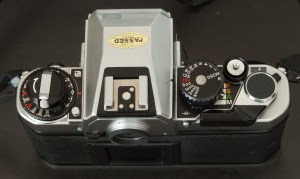
Inspired by the program modes already available in point and shoot cameras, Canon launched the A-1, a new SLR with programmed exposure modes in 1978. Practically, it meant that the auto exposure system of the body had to simultaneously command the shutter speed and the aperture of the diaphragm.
Canon did not have to change anything on the FD mount, which had been created for full aperture shutter priority exposure.
Nikon introduced the “AI-S” generation in 1979 when the mount was modified to support a linear command of the diaphragm. The first Nikon cameras to take advantage of the AI-S lenses and to offer a program mode and shutter priority were launched in 1982 and 1984 respectively. Because the camera body was informed of the focal length of the objective, it could choose automatically between two aperture-speed combinations when configured in program mode, one for wide angle and normal lenses, and one for lenses of 135mm and longer .
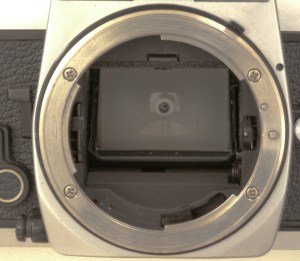
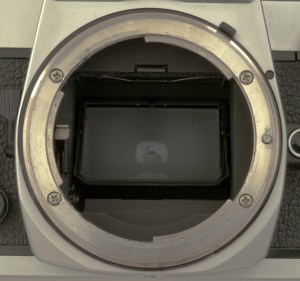
Still trying to catch up with Nicanolta, Pentax adopted a brand new bayonet mount, the K mount, in 1975. The first K mount, however, did not support shutter priority or program modes. Electric contacts would have to be added with the KA declination of the K mount in 1983 to make it possible. Its close derivatives are still used today on Pentax DSLRs.
The state of the art between 1971 and 1985
Pentax: Aperture priority automatic cameras launched in 1971 with modified 42mm screw mount lenses supporting full aperture metering.
Change from the 42mm screw mount to a new Pentax K bayonet in 1975 (automatic pre-selection, full aperture metering, transmission of the pre-selected aperture value from the lens to the body);
Shutter priority and program mode introduced in 1983 with the KA version of the K mount.
Canon: The FD breech mount introduced in 1971 was ready for the Shutter priority cameras launched in 1973 (Canon EF) and for the program mode (Canon A1, 1978).
Minolta: MD declination of the SR Mount (one pin added for the support of the Shutter priority mode) to support the Shutter priority mode in 1977.
Nikon: Aperture priority cameras available since 1971 (Nikon EL) with the manual indexing F mount. Launch of the AI version of the F mount in 1977 to improve the ease of use. Progressive adoption of the AI-S declination of the F mount in 1979 to prepare for the arrival of cameras offering a program mode (Nikon FG, 1982) and a shutter priority automatic exposure (Nikon FA, 1984).
Olympus: the OM mount was introduced in 1971, and was ready to support programmed exposure from the beginning.
More about the lens mounts
Photography in Malaysia: information related to the F lens mount




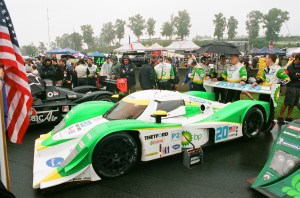
The American LeMans 2009 Starting Grid
The weather was very bad in north Georgia last week-end for the Petit LeMans race. So bad that the race had to be interrupted.
America LeMans events are still managed by people who love motorsports and respect the fans. The starting grid remains open to the public until the least ten minutes preceding the race start. A good opportunity to test the Kodak Ultramax 400 with a Nikon FA body and the Nikkor AF 24mm lens.
The film was processed and scanned by Costo on Noritsu equipment, and delivered on a CD-ROM for less than $5.00.
Costco saved each image as a 3088×2048 jpeg (equivalent to 6MPixels). Image crop and minor adjustments (sharpness) were performed in Lightroom 2.
More about the 2009 Petit Lemans at Road Atlanta
The Road Atlanta race track
Nikon’s F3 was the “pro” camera of the early eighties, but it kept on selling until 2001. A dwarf compared to current mid-level digital SLRs, not to mention monsters like an EOS 1DS or a D3. Incredibly simple to use compared to anything digital sold these days. Aperture Priority Automatic or Semi-Auto exposure. Center weighted metering. That’s all. It worked. And it still works today.
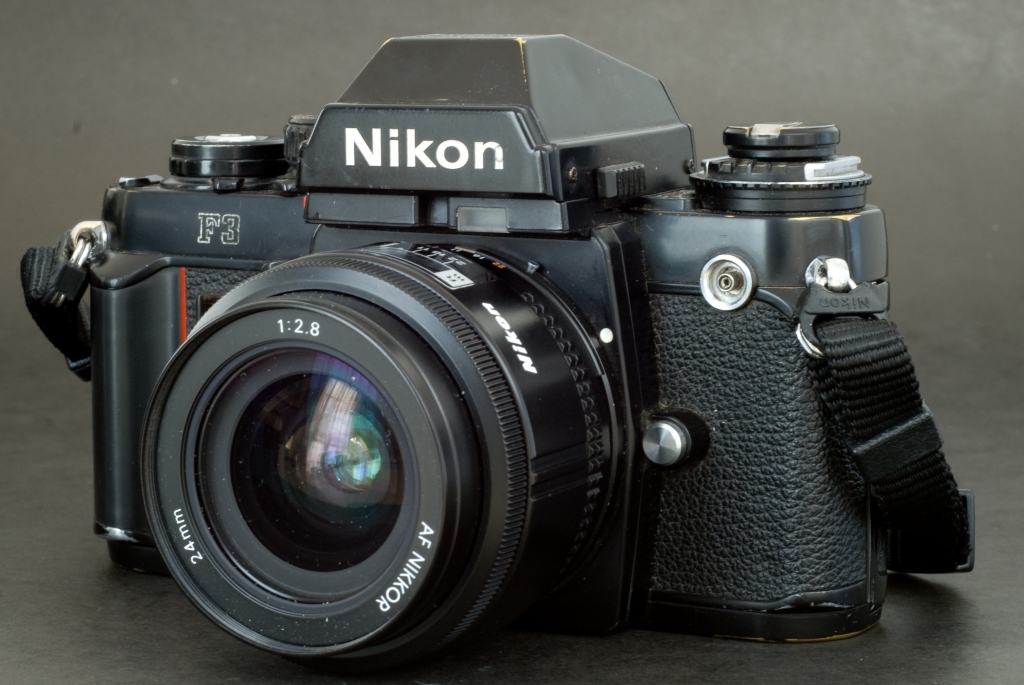
Consider all the changes that took place in the SLR design between 1980 and 2001. Multi mode exposure, spot and matrix metering, integrated motors, autofocus, DX coding, the F3 had none of that, but it outlived two or three generations of newer-better-faster pro bodies from Nikon or Canon. The F3 had the elegance to hide its real technical advances under a classical skin, and to let the photographer communicate his instructions through smooth and oversized controls. Of all the pre-autofocus SLRs of Nikon, the F3 is the most pleasant to use, and probably the one which will yield the best results.
The F3 is an exception in the Nikon F lineup. It’s compact, smaller than its predecessors, and way smaller than its successors, the F4 and F5. In fact, its size is very comparable to that of the FM, itself hardly bigger than the yard stick of compact SLRs, the Olympus OM-1. The F3 is also easy to use, without the idiosyncrasies of the F and F2s with their Photomic finders and manual aperture indexing, and without the myriads of commands of an F4 or the menus and submenus of an F5.
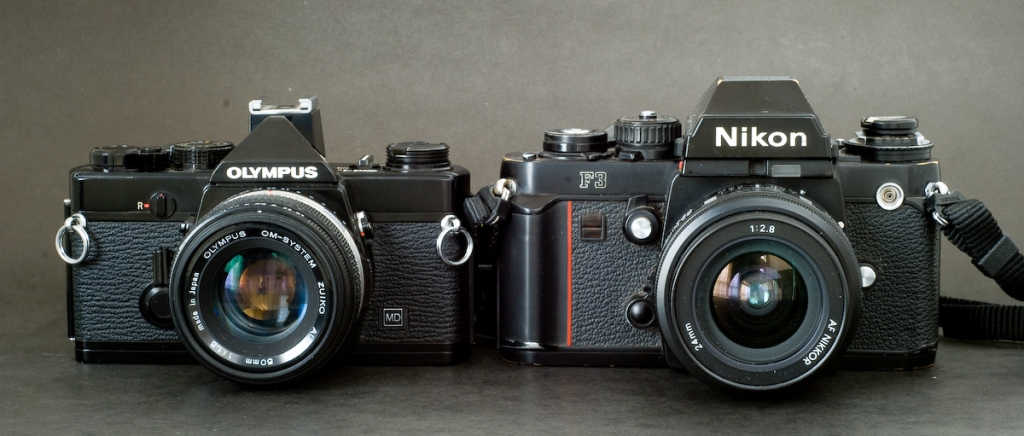
The F3 is much more modern and usable in everyday life than a semi auto camera like the FM: its commands are larger and smoother, and the automatic exposure system is faster to operate; thanks to the center-weighted metering and a memory lock button, it does not deprive the photograph of his control on the exposure . When a flash is needed, the FM still requires the user to concern himself with Guide Numbers. The F3’s flash system is modern: following the path opened by the Olympus OM2, the SPD (silicon) cell is housed under the main mirror, and provides On The Film flash metering. But the Nikon engineers avoided loading the F3 with complications like multi-mode auto-exposure or multiple metering patterns. The F3 has few commands, and they’re so easy to understand that no manual is needed.
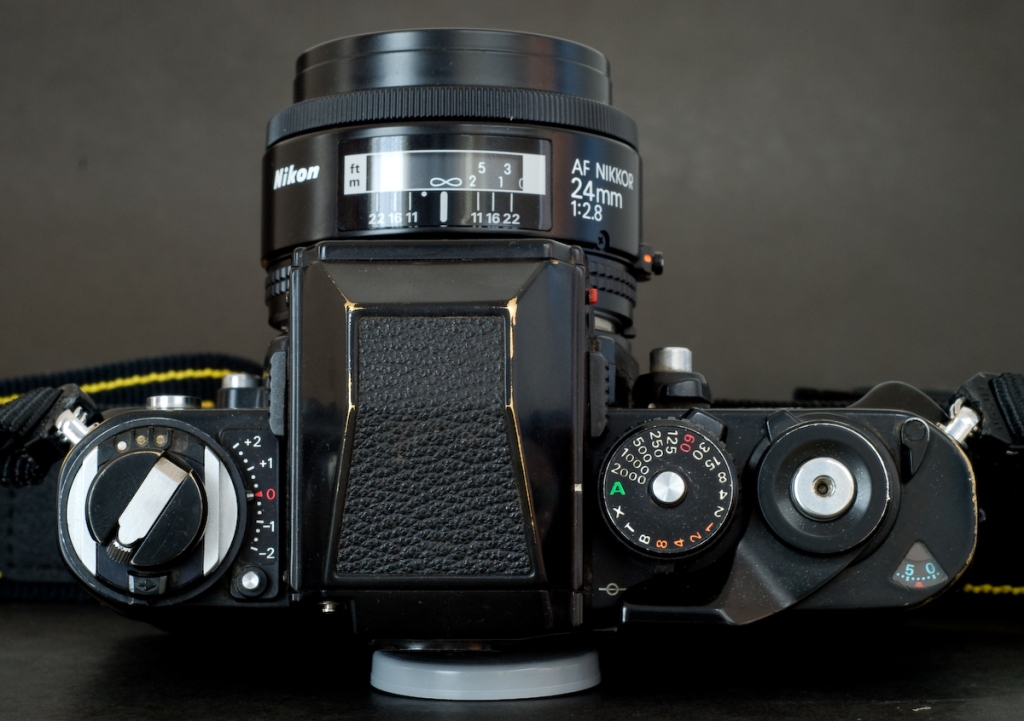
All the commands are generously sized, and very smooth to operate (the film advance mechanism is mounted on ball bearings). The view finder is wide, bright and clear, making focusing easy. After a few years of production, Nikon replaced the viewfinder with a high eyepoint (HP) model, which could be used more easily byglass wearers. The viewfinder is the only part of the camera which is really larger than what you would find on contemporary advance-amateur SLRs.
Of course, the F3 is not perfect. It may be compact, but it’s heavy (approx. 750g). Its OTF flash system may have been advanced for its time, but the shutter only syncs at 1/60sec, and none of the viewfinders of the F3 system has a standard flash hot shoe: the F3 requires a specific flash adapter, to be inserted at the top of the rewind lever. But if I had to own and use only one film camera, that would be the F3, without any hesitation.
How much for a Nikon F3?
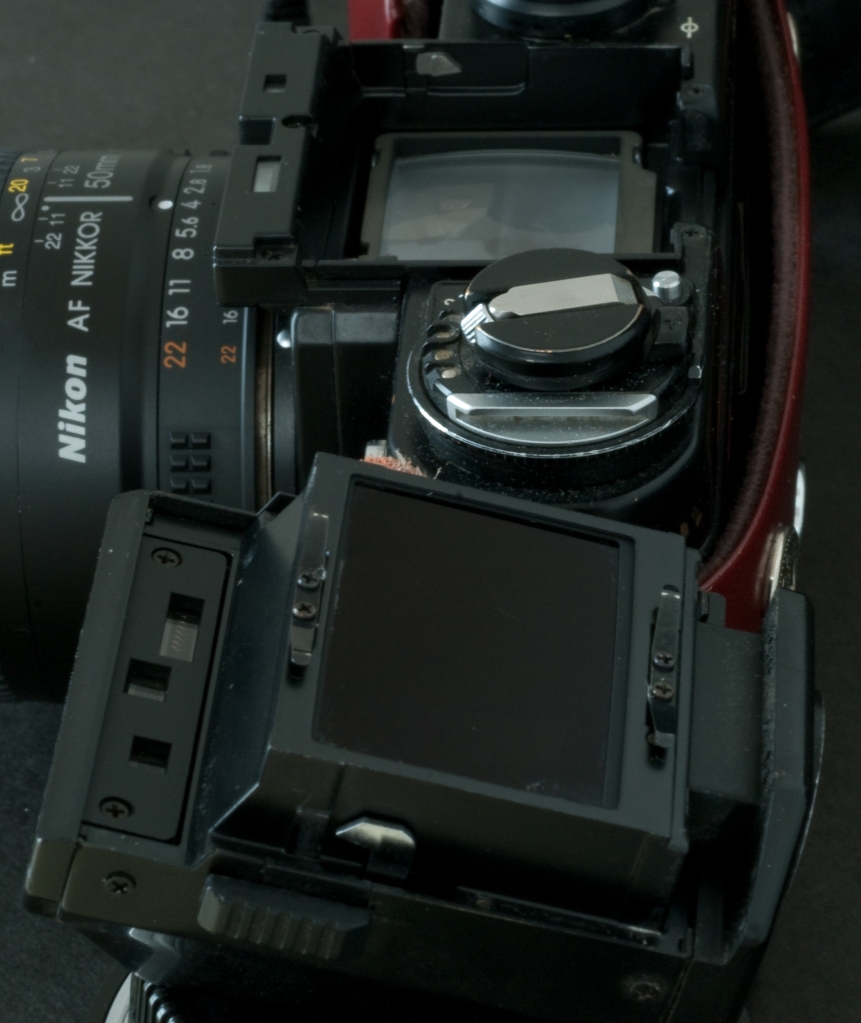
The price of an F3 is extremely variable. The F3s were produced over 21 years, and some of them could be fairly recent, when others could have been used and abused since the early eighties. F3s were built like tanks, but they were used as their everyday work horse by legions of professional photographers, and they may have had a rough life.
Old and scruffy models in perfect working condition – like the 1983 model represented on those pictures – can be had for a little more than $70.00. Nicer and more recent models with the HP viewfinder and a motor drive will cost you at least $300.00. Beyond the standard F3 and F3 HP, Nikon also produced many derivatives of its flagship camera, for specialized applications or to test new technologies like the autofocus system they showed in 1983. Some of them are relatively rare collector items and will command a much higher price.
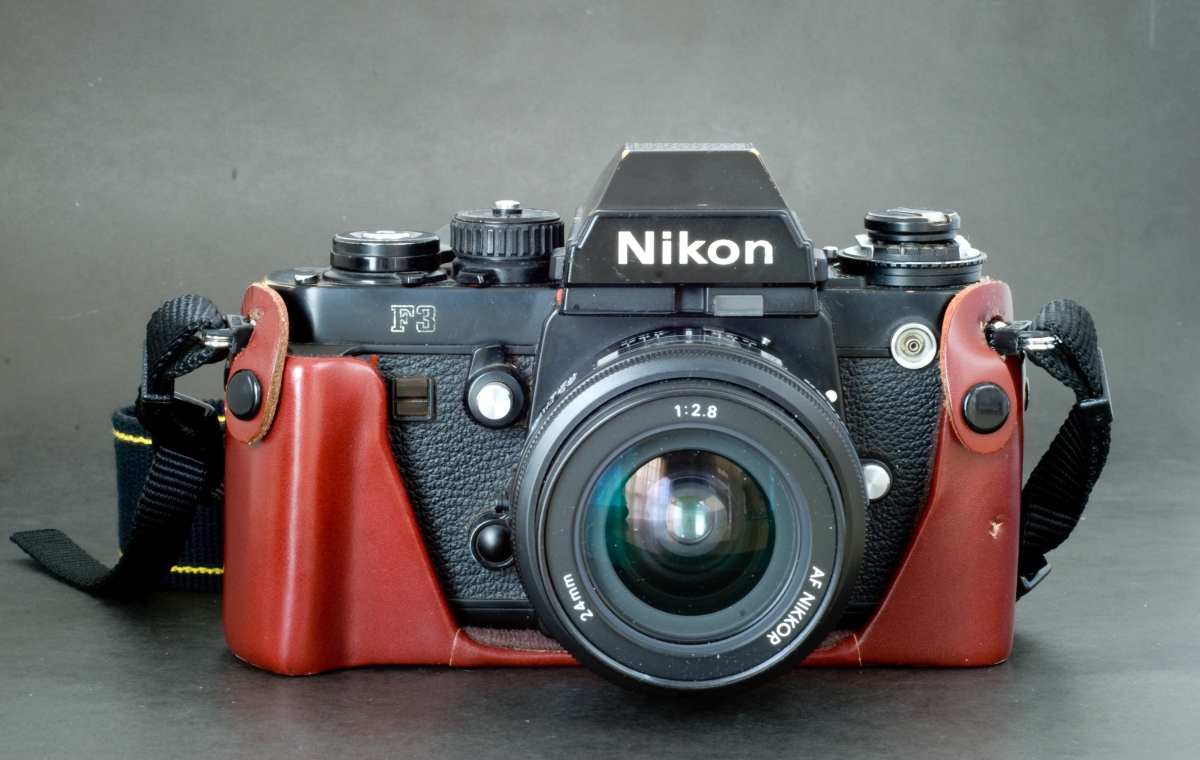
More about the Nikon F3
Photography in Malaysia – the Nikon F3
Shutterbug: the Nikon F3 (2007)

Automatic Exposure
The first SLR cameras with TTL metering were semi-automatic – the needle of a galvanometer indicated how far the shutter speed/aperture combinaison was from the ideal exposure, but it was up to the user to turn the aperture ring or the shutter speed knob to adjust the exposure parameters following the directions provided by the needle.
The next step was obviously to design a camera which would set automatically the aperture value or the shutter speed corresponding to the ideal exposure.
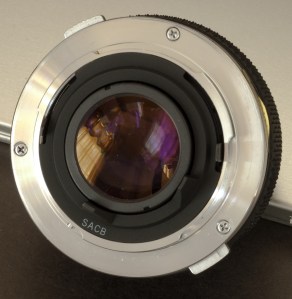
Automatic exposure was first adopted by point and shoot cameras, and by a few amateur oriented reflex cameras.
Before Integrated Circuits capable of controlling a focal plane shutter became available, the simplest way to provide auto-exposure was to keep the conventional mechanical shutter, and to use a servo-motor to link mechanically the match needle of the exposure galvanometer to a series of rods controlling the aperture of the diaphragm. It was easier to implement such a system on a fixed lens camera, which explains why at first auto-exposure SLRs (such as the Mamyia Auto-Lux 35 or the Canonex) did not have removable lenses.
The engineers developing conventional SLRs had a few technical hurdles to pass before they could produce auto exposure SLRs capable of attracting a wider audience of seasoned photographers. The difficulties were cleared at the beginning of the 70s, and two types of automatic SLRs started hitting the market between 1971 and 1973.
Aperture Priority Automatic Exposure
The development of integrated circuits made Aperture Priority (pre-selecting the aperture and letting the camera set its shutter speed automatically) relatively easy to implement. The mechanically controled shutter had to be replaced by an electronically controlled model, but no change was needed on the lens mount -at least for Minolta and Nikon. Aperture priority cameras did not need a delicate linkage between the body and the lens, and could be used even with specialized diaphragm-less lenses (mirror lenses, for instance). Pentax had to adopt full aperture metering – they added a few cams to the 42mm screw mount for the introduction of the first electronic SLR, the Spotmatic ES. Nikon and Minolta launched their own aperture priority SLRs soon after (1971-1972). Olympus followed with the OM-2 in 1975.
Shutter Speed Priority Automatic Exposure
On the contrary, Shutter Speed Priority (pre-selecting the shutter speed and letting the camera set the lens aperture automatically) did not require any change on the shutter mechanism used on previous semi-automatic cameras, but precision mechanics was needed to ensure that the diaphragm would close at the exact value determined by the exposure system of the body.
The automatic diaphragms used in pre-selection lenses – see: 50 years of evolution of SLR lens mounts (Part I of VI) had so far been working in an all or nothing mode: full aperture, or closed down as far as the lens could go, namely to the aperture pre-selected by the user. With Shutter priority, the brute force approach did not work anymore: a lever on the mount (camera side) had to transmit to the lens the exact aperture value determined by the automatic exposure system, and all the lenses of the system had to react identically to the movement of the exposure lever of the camera.
The lenses and the mounts had to be modified again, either by the addition of aperture transmission pins (that’s what Canon did in 1971 with the new FD mount), or by the transformation of the all or nothing stop down command of the diaphragm into something much more linear, where the movement of the stop down lever was proportional to the value of the aperture to be used. Nikon chose the latter route with the AI-S mount introduced progressively after 1979, in preparation of the launch of future cameras offering Shutter Speed Priority and Programmed Exposure modes.
The first Shutter Priority SLR of one of the “big four” was were introduced by Canon (the EF model in 1973) following the tracks of Konica, which had been producing its Autoreflex T series since 1968.
More about it
A history of the Nikon F mount by Denton Images
The 28-70 f:2.6 was Angenieux’s last consumer oriented zoom, designed for Canon, Minolta and Nikon AF cameras. With a very wide aperture, an all-glass and all-metal construction, it was positioned to compete with the “pro” series zooms of the big three. The tests performed by the specialized press at that time showed that it was THAT good.
Unfortunately, its price was also on par with the best of Nicanolta, which made it a tough sale beyond the small circle of admirers of French technology. When Angenieux decided to refocus on professional markets and stopped the production of its consumer oriented lenses, Tokina inherited the design, and their Tokina AT-X 287 Series – which was sold as recently as 2007, is a remote descendant of the Angenieux 28-70 AF.
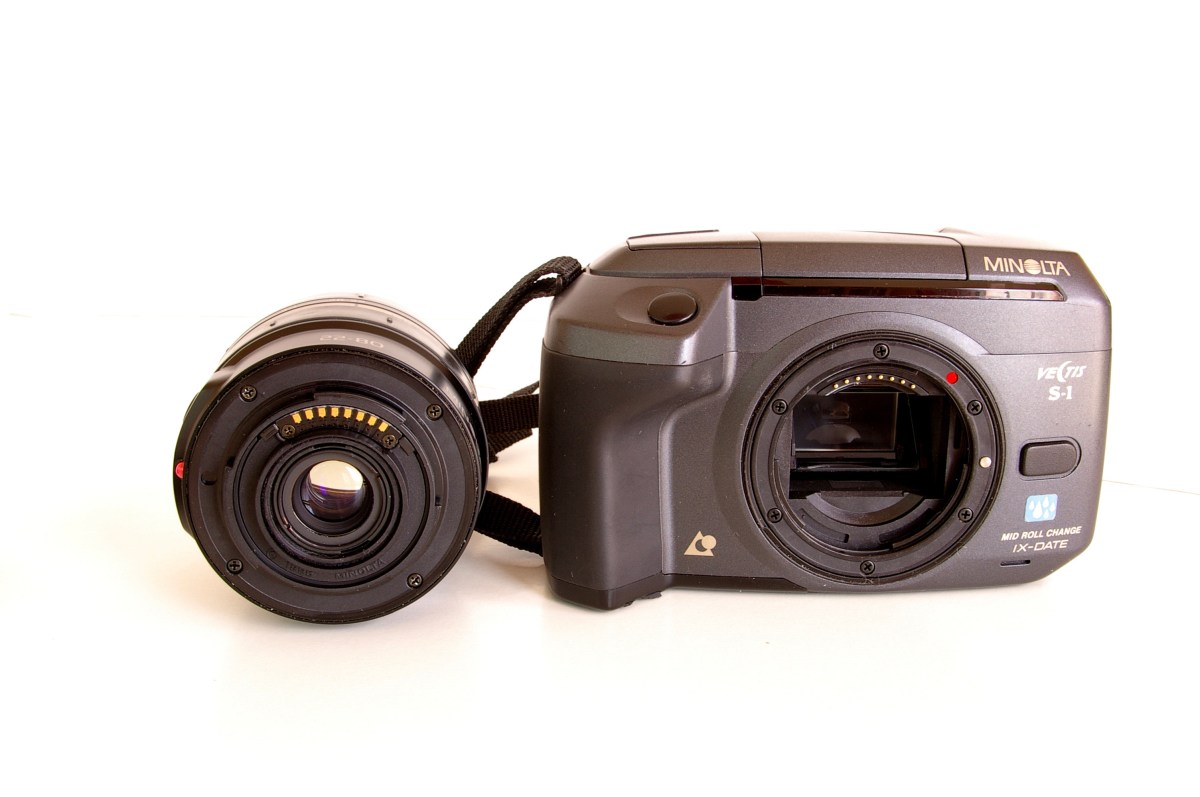
Originally published in September 2009.
I don’t have this camera anymore. I’m afraid it ended its life in the trash can – not economically repairable – a few years ago. But I used it for years, I liked it a lot, and it’s too bad that no digital SLR available today is as light and portable as the Vectis S-1 was.(*)

Launched in 1996, it was the only SLR system designed from scratch for the APS film format. It inherited the best features from the Minolta mid-range 35mm cameras of its time, and exploited the new functionalities of the APS format to its full advantage. Built around a new, specific and very modern mount, the Vectis cameras and lenses were far more compacts than conventional 35mm SLRs, and than the APS SLRs developed by Canon and Nikon.
Single Lens Reflex cameras (SLRs) need a moving mirror, and the moving mirror needs room, which imposes a flange focal distance of approximately 45mm on 35mm cameras (44mm for the Canon EF, 46.5mm for the Nikon F mount). The diameter of the mount, on the other hand, is closely related to the size of the film (it’s roughly equal to the diagonal of the film – 44mm for the Nikon F mount, for instance). Both Canon and Nikon decided to make their APS cameras compatible with the large range of 35mm lens they had been selling for 10 years or more, and designed their APS SLRs around the same dimensional constraints (flange focal distance, mount diameter) as their standard 35mm offerings. Logically, the cameras could not be significantly smaller than their 35mm counterparts.
On the contrary, Minolta took the risk of making the Vectis S-1 totally incompatible with its own 35mm lens system – and opted for a shorter focal flange distance (38mm) and for a smaller mount diameter, without any mechanical linkage between the camera body and the lens. The body and the lens could be made much smaller, but Minolta had to develop a whole range of new lenses, and ended up supporting two totally incompatible product lines.

One could debate endlessly about who did the right thing, Minolta or Canon-Nikon. Minolta’s risky strategy did not pay off – the sales of the Vectis cameras proved disappointing, Minolta lost its independence and had to merge with Konica. But Canon or Nikon’s more prudent approach did not work either, altough they did not lose as much money with APS as Minolta did. Learning from the experience, Canon, Konica-Minolta and Pentax all decided to retain their 35mm mount on their new dSLRs with APS-C sensors. Only Panasonic and Olympus, with no legacy of 35mm AF SLRs, decided to use a smaller form factor with their Four-Thirds and Micro-Four-Thirds formats.

The design of the S-1 was very innovative in two important areas: it was not using the conventional central pentaprism, but a series of mirrors leading to a viewfinder implemented at the very left of the body – leaving space for the nose of the photographer, and the camera, its lenses and its accessories (such as the external flash) were all weatherproof, forming a compact, lightweight and reasonably rugged system that could even be brought in mountain expeditions.

The rest of the camera was in line with the advanced-amateur class of products of the time (P, A, S, M modes, Matrix and Spot metering, passive autofocus) and took advantage of all the new functionalities brought by the APS format – the ability to pre-select one of three print formats when taking the pictures being the most important. Some compatibility existed between the accessories of the 35mm cameras of the manufacturer (Maxxum or Dynax) and the Vectis: the flash system and the remote control could be used indifferently on both lines of cameras.
The user experience was very pleasant. Minolta cameras of the AF era have always been very pleasant to use, and the Vectis was no exception, provided you put the right lens on the body.
Unfortunately, the kit lens – a 28-56mm f:4-5.6 zoom, was not something Minolta should have been proud of. Poorly built, if proved fragile, and the quality of the pictures it produced was far from impressive. Mine broke rapidly, and I replaced it with a much better 22-80mm lens, which was correctly built, and could produce great pictures – with the right film in the body. The promoters of APS had decided that 200 ISO would be the “normal” sensitivity, but APS used a smaller negative than 35mm, and the quality of the enlargments from 200 ISO film never convinced me. The 100 ISO film, on the contrary, was very good. On a good bright and sunny day, with a good lens and 100 ISO film, APS could compete with 35mm.
My Vectis was defeated by one of design flaws of APS: the fragile automatic film loading system. A tiny piece of plastic broke in the camera, preventing the film door to open. Having it repaired was not an option. I sold the lens, and trashed the camera.
Today, the Vectis S-1 still has fans, ready to pay prices in excess of $150 for a camera. I liked mine as long as it worked, but with 100 ISO APS film now unavailable, I would not spend my money trying to get another one.
Good camera, flawed format. RIP.
(*): Edited in July 2017: the Vectis S1 tipped the scales at 365g, and the fragile 28-56 kit lens added 110g. With film and battery, the whole set was probably was below 500g. Today – in 2017, the remote heir of the Vectis, the Sony A6000, weights 20 grams less (at 345g). The Sony 16-50 Power Zoom also weights 110g.

More about the Minolta Vectis S-1
camerapedia.org: la page du Vectis S-1
collection-appareils.fr (site in French)
More about APS film in CamerAgX:

The introduction to Through The Lens (TTL) Light metering and its consequences on the lens mount
Now that the instant return mirror and the preselection mechanism of the diaphragm had made SLRs usable for action photography, the manufacturers managed to address the next challenge: the determination of the exposure.
Willy Ronis passed away on Sept. 12th.
With Robert Doisneau, he was one of the most prominent representatives of the so-called humanist school of photography. He became the first French photographer to work for Life.
He will remain famous for his black and white scenes of Paris streets, of Provence and his nudes.

More about Willy Ronis
A selection of pictures on Artnet
The Willy Ronis page in Wikipedia
 CamerAgX - a new life for old gear