I recently moved to a new home – half the size of the one I was leaving. In a big home, you have lots of storage, a basement, an attic, a large garage, rooms you never use, and you tend to keep stuff. Lots of old stuff. Like old computers.
The iMac G4 fully deployed with keyboard, mouse and loudspeakers. Source: unknown (probably a scan of an Apple catalog)
But when you move, you can’t leave anything behind. You check all the hidden corners of your home, and you find your old iMac. Second generation, officially known as the iMac G4 700 MHz. And often nicknamed Sunflower, because of its very original shape.
I had bought it in 2002. My first Mac. My first Apple widget.
I decided to give it a test run. In the spirit of “a new life for old gear”. But if 40 year cameras can still produce nice pictures (provided you can find film for them, of course), computers half their age are hardly usable.
The machine did age very well. It had been solidly built, with good quality components. It boots, and makes all the right sounds and moves. You log-in, and find a desktop which is not really different from what you see on a modern Mac (this machine is running OS X 10.5 Leopard – the last OS X version to run over PowerPC processors). Your spirits are high. You’ve been reunited with an old friend.
On paper, the specs of an old iMac – a 700 MHz 32 bit processor, 512 MB RAM, WiFi, Firewire – are not totally ridiculous if you compare them with a recent entry level machine. A modern Macbook has a 64 bit dual core processor, generally running at 1.3 GHz, with the ability to burst at 3 GHz. It does not look like a huge difference. Admittedly, a modern laptop also has much more RAM (8 GB) and more storage (256 GB SSD as opposed to a 40 GB spinning drive). But in the real life, it results in a huge gap in speed.
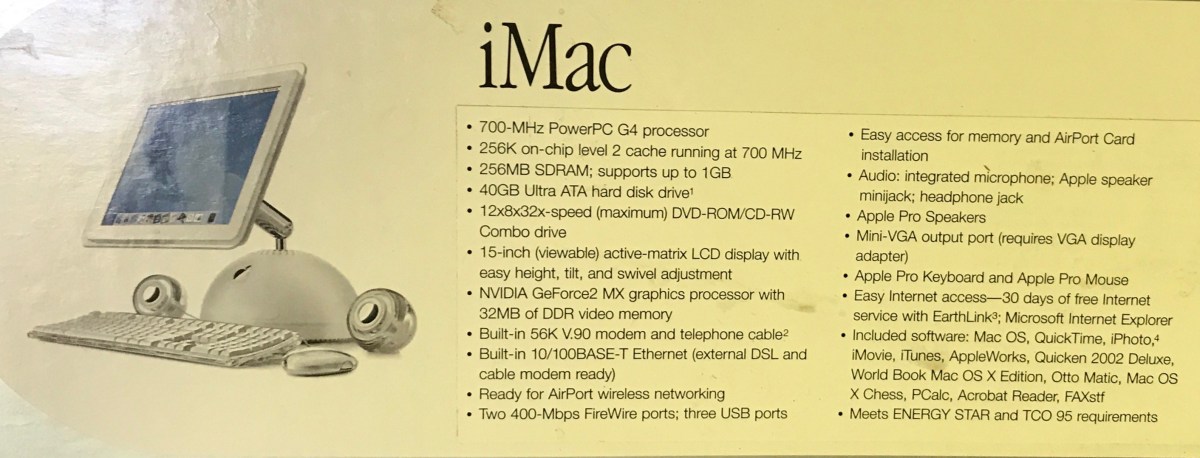
Technical specs of the iMac G4 700 MHz (from the package)
The iMac is incredibly slow at performing tasks as simple as ripping a music CD. And the worst is not the speed, it’s the inability to do anything really useful with the machine because the hardware and OS X Leopard can’t cope with modern security protocols:
you can’t connect to a wireless LAN, because the iMac and OS X Leopard support at best WPA (original version) and not WPA2 which is the standard today.
you can’t browse any modern Internet site, because the browser does not support the recent encryption layers of https, and every site worth its salt defaults to https now.
you can’t access any of the on-line services requiring a fat client (the Apple Music store from iTunes, for instance) because nobody’s accepting connections from such an old thing (probably another TLS vs SSL issue)
Software from 2009 still works (things like Photoshop Elements 2 or Microsoft Word 2008) but obviously recent versions of popular software are written for Intel Macs, and don’t run over Power PC processors (not even software as basic as a browser).
iMac G4 – trying to browse an https page – fairly typical error message
Basically, it could work if you downgraded your home WiFi network to WPA (or even worse, WEP), and only browsed sites whose servers have not been updated since the end of support of OS X Leopard (in 2009, I believe). That’s a scary perspective.
So, what will happen with this Mac? I will donate it. To people who still have room in their large home, where it will join a burgeoning computer museum. Until they decide to downsize of course.
An anecdote – the iMac was the first Apple computer I bought, but not the first I used. In the early eighties, I even had the privilege of being trained on Apple SOS (nicknamed Applesauce, of course), the operating system of the Apple III. It makes me a true geek.
For the fans of all things Apple, and among all the bios of Steve Jobs, I recommend the excellent “Becoming Steve Jobs“, by Brent Schlender and Rick Tetzeli.
“les petits chapeaux” – Apple iPhone 7. Even a recent iPhone outperforms an iMac G4 – and it also takes pictures.
I don’t want this blog to turn into a Nikon fansite. But Nikon related pages are now the most read: the Nikon D700 and FE2 entries have been the two most visited pages lately, leapfrogging the pages related to the Angenieux 28-70 f/2.6 zoom, which had been the readers’ favorite for years. And I can’t hide that Nikon film cameras are those I prefer, and that I’ve put my money where my mouth was.
Interesting things are happening at Nikon’s. On August 23rd, they will unveil a new full frame mirrorless digital system, launch a new lens mount and at least one lens.
Teaser from Nikon: the silhouette of Nikon’s new mirrorless body, and its huge lens mount. It looks much simpler than the Nikon F mount below,
The new lens mount will be typical of modern mirrorless cameras (short flange distance, and, I assume, no mechanical interface at all – autofocus and aperture control being all electric ), but its diameter will be unusually large – much larger in any case that the Sony E lens mount.
Over its 59 years of commercial life (so far), the Nikon F mount has gone through many revisions to support successively aperture indexing, automatic aperture indexing, matrix metering, auto-focus, silent wave auto-focus motors, and more recently, electronic diaphragm control.
Because Nikon has made a core business principle to guarantee at least a modicum of compatibility between its older lenses and its newer generation of bodies (particularly for high-end cameras sold to professionals), the new full frame mirrorless body will accept Nikon F lenses, via an adapter. But Nikon has not shared any detail about this adapter yet.
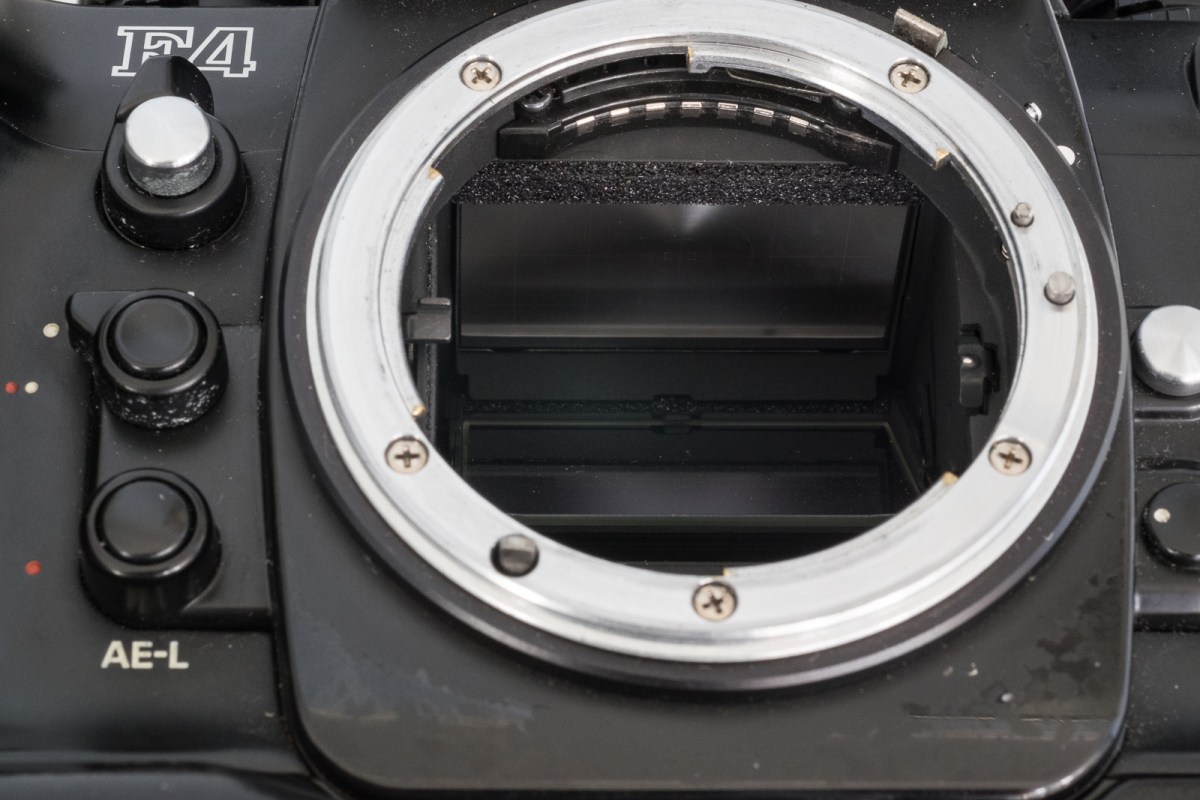
Nikon F mount – clockwise from top, on the mount’s flange : the meter coupling lever used for aperture indexing, the lens type signal pin, the lens release pin, the auto-focus shaft. On the inside of the exposure chamber: the electrical contacts used by AF lenses (top), the focal length indexing pin (right) and the aperture stop-down lever (left).
The adapter could be made simple, with no electrical contact and no mechanical linkage to the lens. Generally speaking, mirrorless cameras are not dependent on the automatic aperture pre-selection capabilities of the lens, so it’s likely that any Nikon F lens old enough to have an aperture ring will not only physically mount on the adapter, but will somehow work when the camera is set to semi-automatic exposure and manual focus mode. But recent lenses deprived of an aperture ring (or with an electronic control of the aperture) would not work with such a simple adapter. Which would go against Nikon’s tradition of preserving compatibility in priority for recent and/or expensive pieces of equipment.
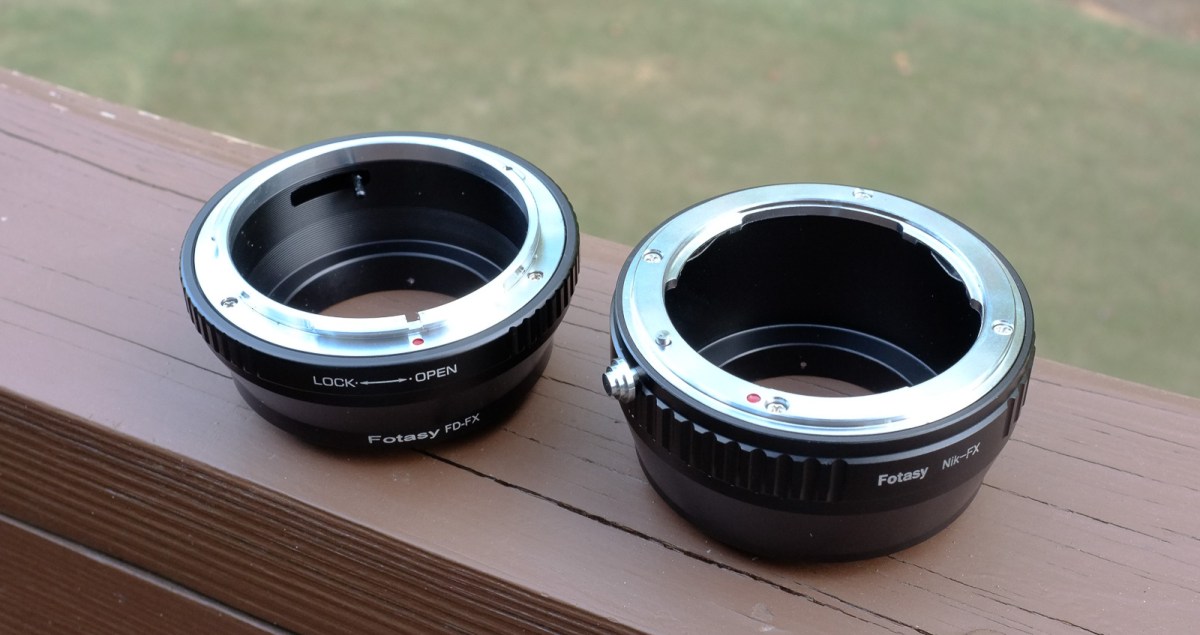
2 very simple adapters: Canon FD to Fujifilm X (left), Nikon F to Fujifilm X (right). In both cases the mirrorless body does not control the aperture on the lens (no pre-selection, no shutter priority or program automatism).
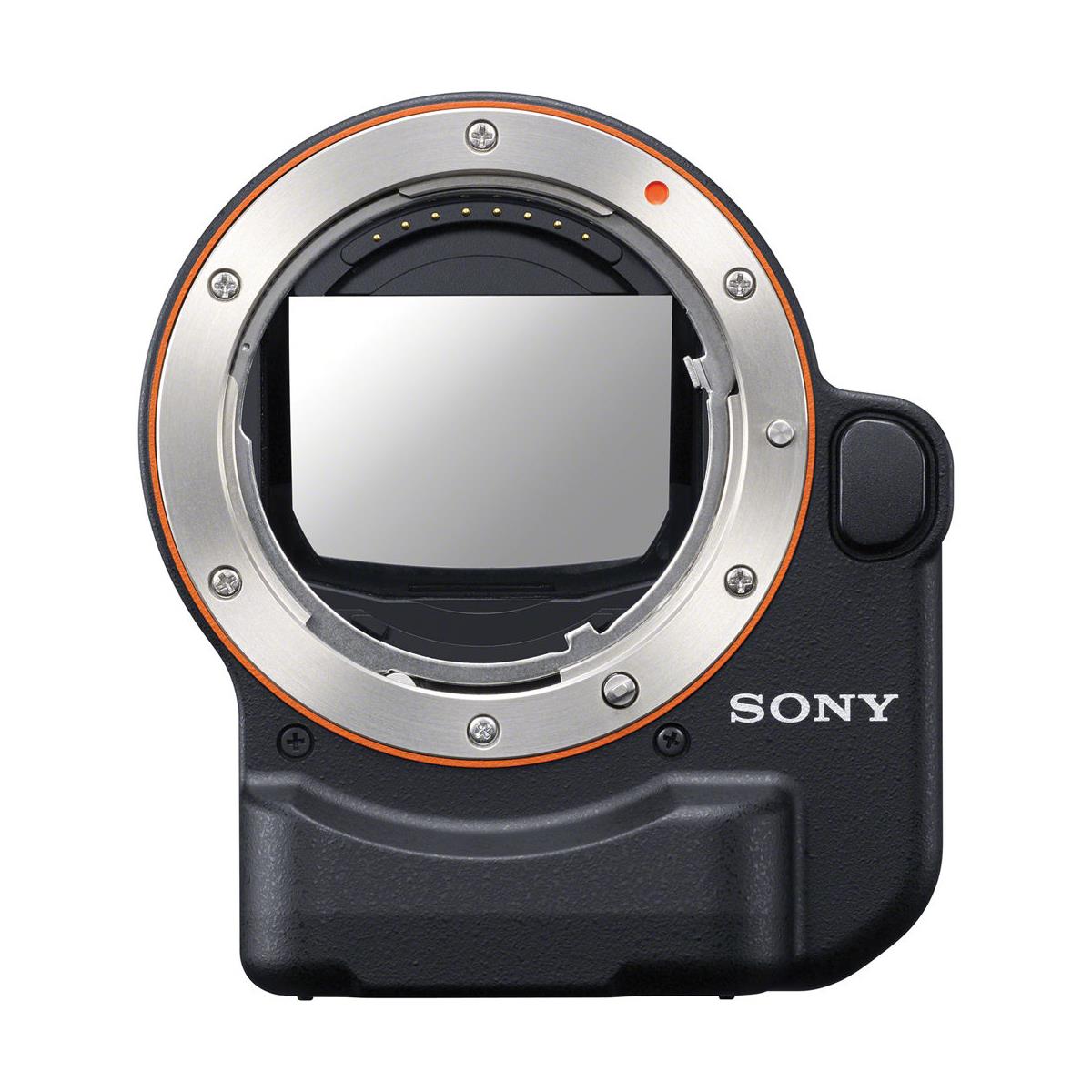
The adapter could be made very complex. Sony supports Minolta/Konica-Minolta/Sony A mount lenses on its E Mount mirrorless bodies thanks to two models of adapters. The most complex of the two, the LA-E4, has its own autofocus motor in order to provide support and adequate AF performance for screw-drive autofocus lenses (which still constitute the majority of the Series A lenses offered by Sony today). Sony’s adapter also has a Phase Detection AF module, probably because its A series lenses were not designed for the contrast detection auto-focus system of its NEX mirrorless bodies.Nikon’s original AF and AF-D lenses (the screw drive lenses without an auto focus motor) could be supported using a similar setup if Nikon really wanted to, but I doubt they’ll have any appetite for such a solution (one of the reasons being that professionals have been buying AF-S lenses with a built-in auto focus motor for almost 20 years now – and probably don’t use many screw-drive auto-focus lenses anymore).
Sony LA-E4 A NEX Camera Mount Adapter (Source: Adorama). With its built-in auto-focus motor, it accepts any Minolta/Konica/Sony A lens (with the AF drive shaft), and its Phase detection AF module behind a semi-transparent mirror offered better performance than the contrast detection AF of the early Sony Nex bodies.
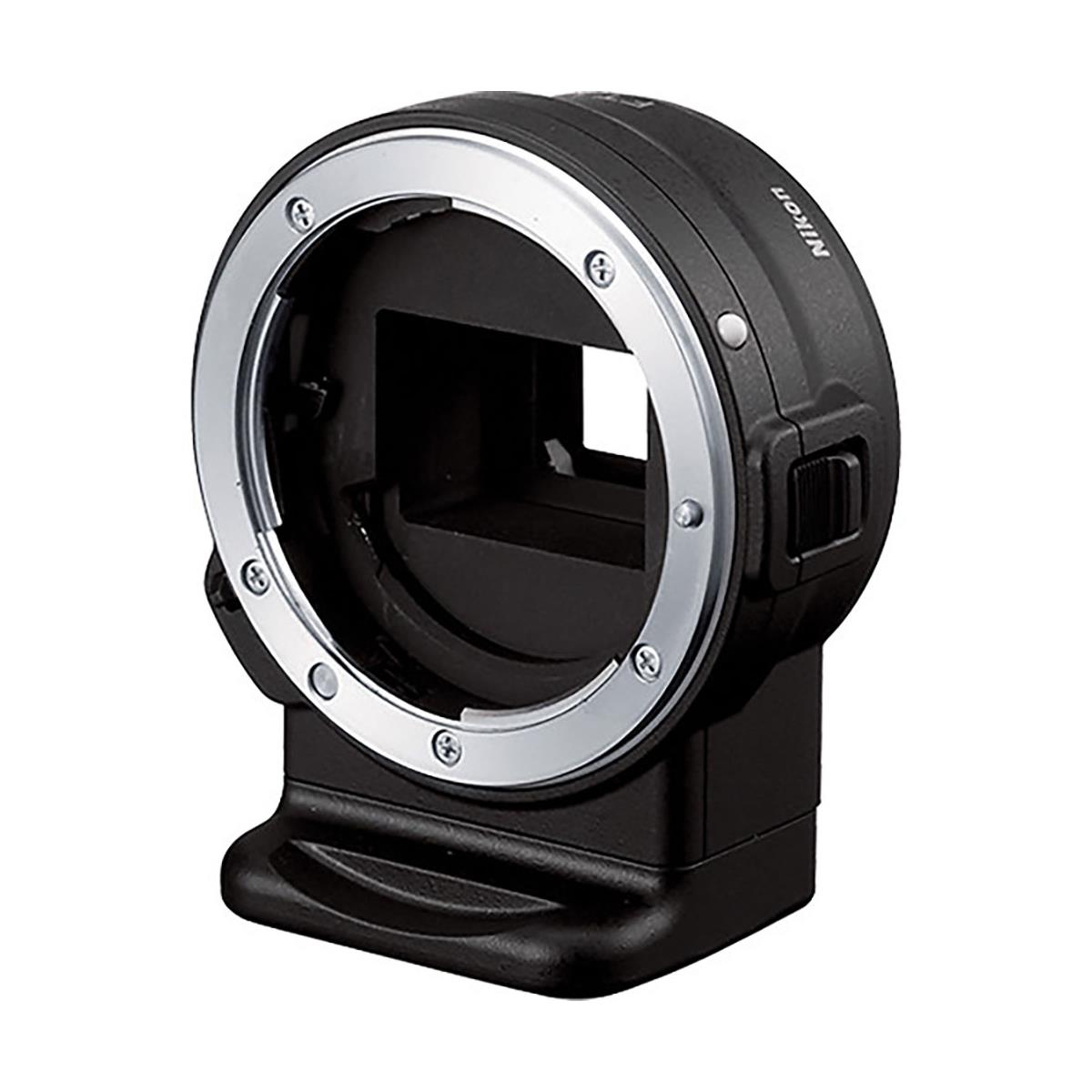
Nikon’s now defunct One series (J1 to J5 viewfinder-less cameras and V1 to V3 SLR like models) could accept F mount lenses thanks to an adapter. With the FT1 adapter, auto-focus lenses with a built-in auto-focus motor (AF-S lenses, with or without an aperture ring) are fully supported (all auto-exposure modes, vibration reduction and auto-focus, of course).
Older auto-focus lenses (the AF and AF-D lenses) can be used in all the auto-exposure modes but don’t auto-focus. Lastly, AI and AI-S manual focus lenses will only be usable in Manual or Aperture Priority Auto Exposure modes.
Nikon FT1 adapter (Nikon F to Nikon One lens mount adapter) – the adapter is seen from the front (where the F lens will be mounted). Source: Adorama
My bet is that the new adapter will offer the same functions as the FT1. It will fully support any lens introduced in the market since the last years of the XXth century (AF-S, AF-S G, VR, AF-P), and with reduced capabilities, most of the older lenses.
Will there be a penalty in terms of auto-focus performance for users of AF-S lenses ?
That’s the real question.
First answers on Aug. 23rd…
Update: Aug 24th, 2018
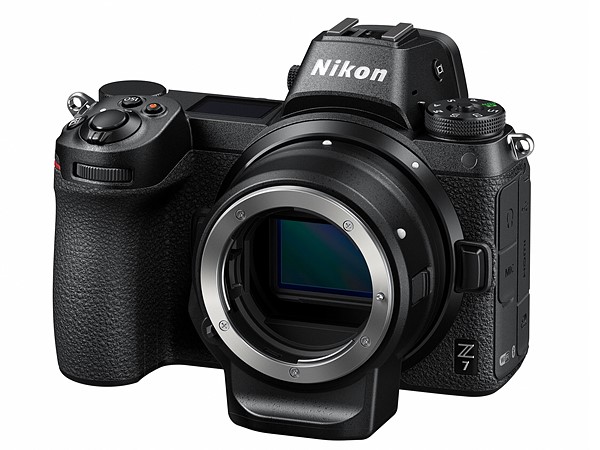
So.. Nikon had a busy day yesterday: they launched a new Z series of bodies with 2 cameras, the Z6 and the Z7, 3 lenses of a new S series, and a F to Z adapter.
Nikon Z7 body with the adapter in place – it’s the only official picture of the adapter seen from the front of the camera. The mechanical actuator operating the aperture is visible on the left, inside the lens mount. Source: Nikon.
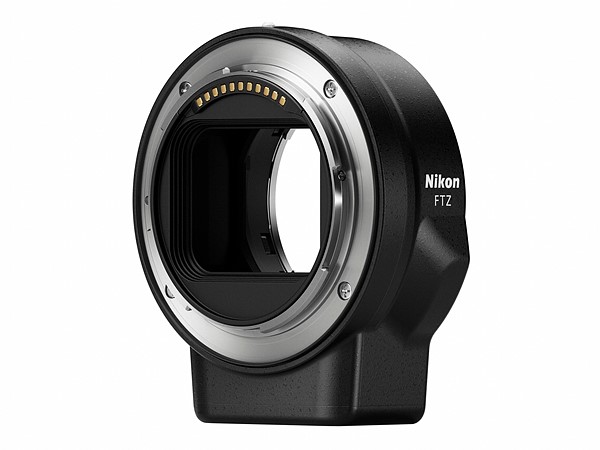
In the picture above, the Nikon F to Z adapter looks very similar to the FT1 adapter – no built-in auto-focus motor, no auto-indexing mechanism to support full aperture metering for AI or AI-S lenses, but “a mechanical actuator to operate the aperture on the lens you mount to it” (according to DPREVIEW)
Nikon F to Z adapter – What you see here is the back of the adapter – which will be attached to the Z6/Z7 body. The diameter of the back of the adapter is larger than the front – the new Z mount is definitely huge. (Source: Nikon)
As I expected last week, lenses released during the last 18 years (AF-S, AF-S G, VR, AF-P) are fully supported, and the VR lenses gain 5 axis image stabilization in the process.
Older lenses (AF, AF-D) will not auto-focus but will still access all the auto-exposure modes of the Z bodies. Older manual focus lenses will mount but will have more limited exposure control capabilities.
For more (and in particular an opinion about the auto-focus performance), you can check DPREVIEW’s very interesting first take on the F to Z adapter.
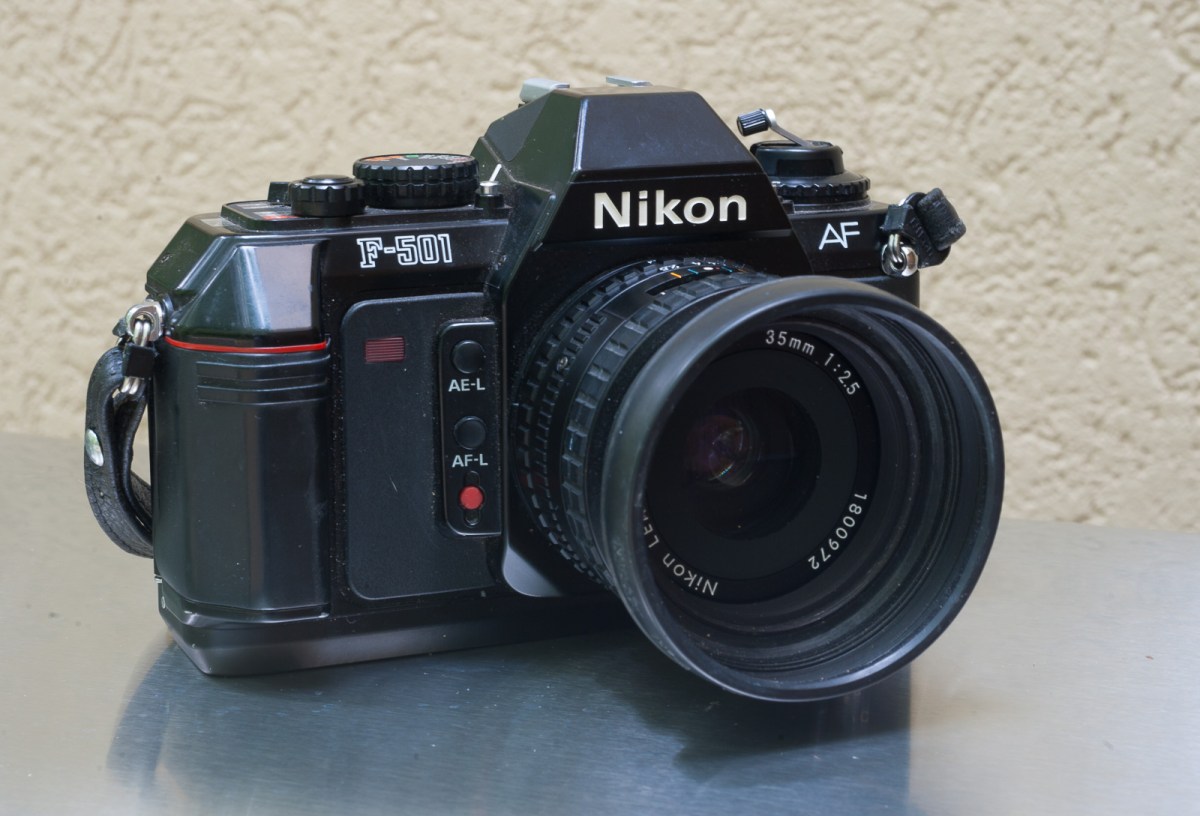
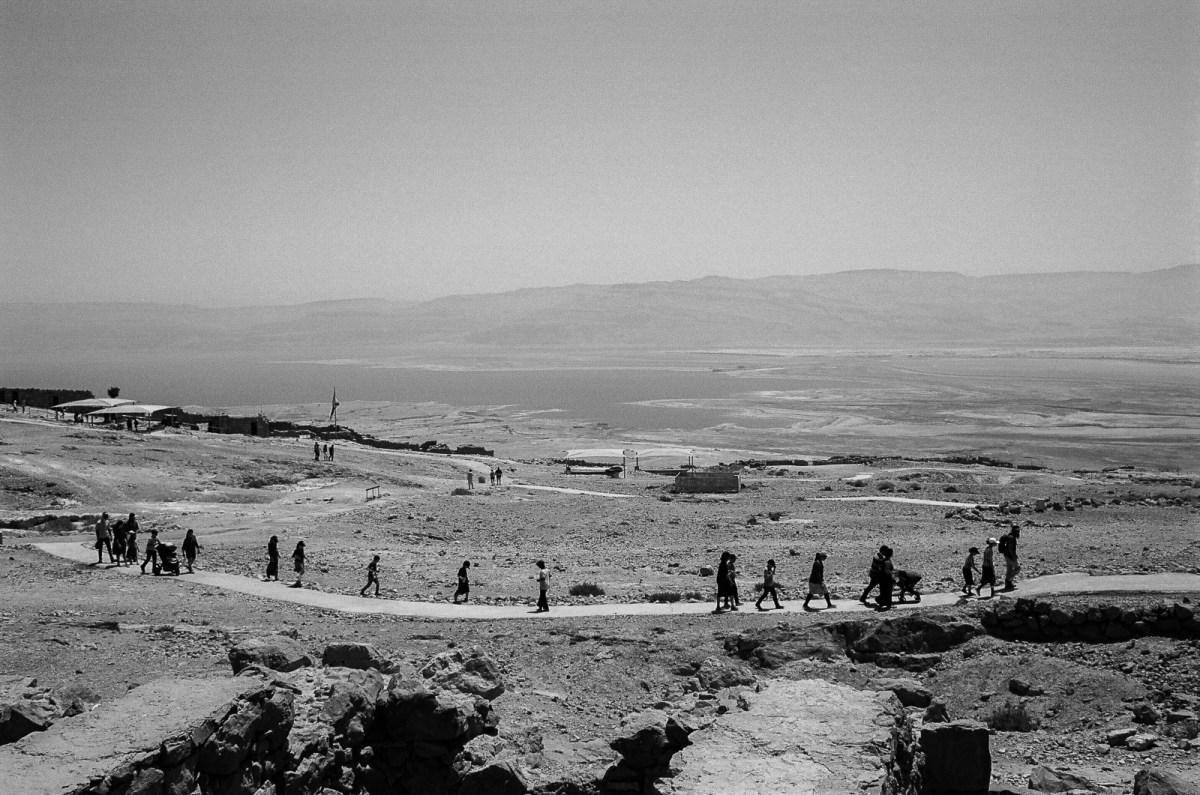
Massada (Israel) – Kodak CN400, Nikon F501 – Nikon E series 35mm f/2.5 lens.
The city, located in the desert between the Red Sea and the Dead Sea, was a very prosperous trade hub in the Antiquity, but lost of its importance in the Middle Ages to the point it was uninhabited and totally forgotten until its ruins were rediscovered by an archeologist in the early 1800s. The city had been built at the far end of a narrow canyon, and is famous because of its temples directly carved in the walls of rock forming the canyon. It was recently used as the lair of the bad guys in Indiana Jones’ “Last Crusade”.
Petra – the approach through the canyon. (Petra, Jordan – Kodak Ektar 100 – Nikon N2020 – Nikon Series E 35mm lens)
Getting there is not exactly easy – a long flight to Amman or Eilat, followed by a long bus drive through the Wadi Rum desert (of Lawrence of Arabia fame), followed by a walk under an excruciating heat. And at the top of that, the access fees are exorbitant. But the place is absolutely unique, and the end of the approach in the narrow canyon is really magic.
Petra is one of those places that always look good in pictures – and I absolutely wanted to bring back images I would be pleased with. So why did I bring to Jordan a 40 year old camera I had never used before?
Petra – at the end of the canyon you finally discover the “Treasury” (Petra, Jordan – Kodak Ektar 100 – Nikon N2020 – Nikon Series E 35mm lens)
Normally, before an important trip, you’re supposed to test the camera in advance: you change the batteries, you expose a roll of film, you have it processed, and you look at the pictures it produced very carefully, before you finally declare the camera fit for service.
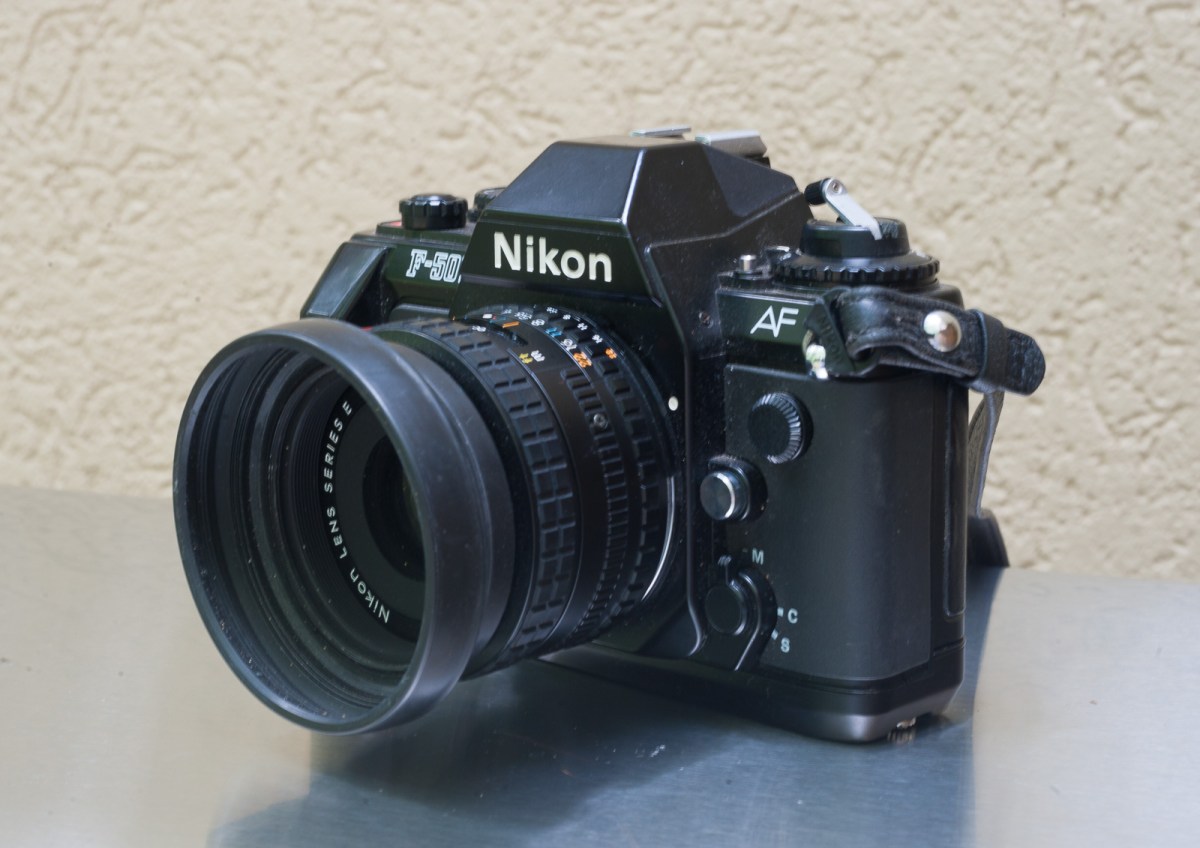
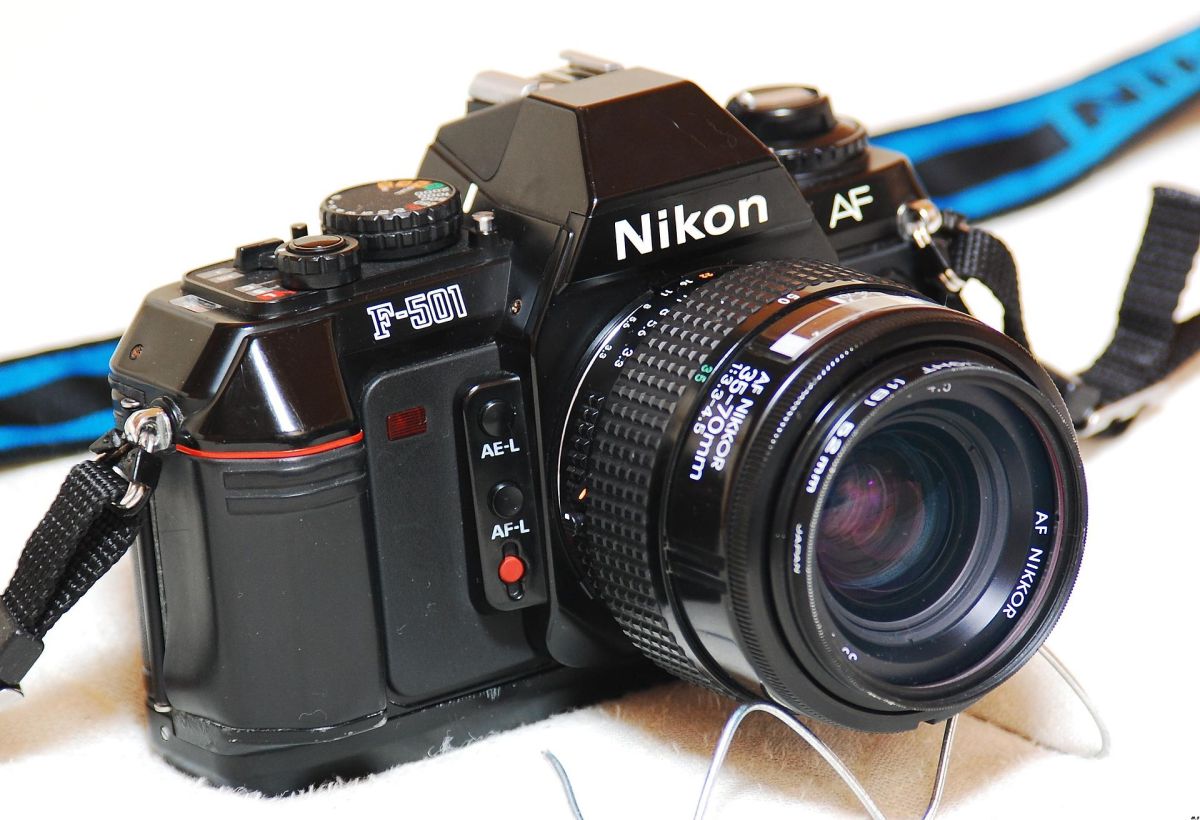
That’s the process I followed, with a Fujica AX-3 I had earmarked for this trip. But it did not pass the test. When I downloaded the scanned images, only a few days before I was due to the airport, 30% of the images were severely under-exposed and I could not see a pattern (it looked like random). I had just moved to a new home, my trusted cameras were still in a storage facility and too difficult to access, so I decided to trust Nikon, and brought with me a Nikon N2020 (aka F501) I had just bought for a miser a few days before, and only briefly examined.
To be honest, it was not that big of a risk. I had bought the Nikon from a second hand camera dealer of good reputation. I live in the 21st century and I have a good digital camera, and can use an iPhone as a backup. I decided that on this trip, on a given day, I would shoot digital for a few hours, then switch to the film camera. This way, even if the Nikon severely malfunctioned, I was not going to come back with no image at all.
Petra – the “Treasury” – (Petra, Jordan – Kodak Ektar 100 – Nikon N2020 – Nikon Series E 35mm lens)
At the top of that, Nikon cameras from that era are reliable. From all the cameras I have used over the years, Nikons are the only ones that have never let me down:
Fujica and Pentax cameras from the seventies have all sorts of mechanical problems (with the shutter, in particular). Cameras from the early eighties also suffer from relatively troublesome electronics (capacitors, stabilization circuits).
I owned Minolta Maxxum and Vectis cameras and Minolta AF lenses in the nineties, and they were not trouble free when they were in their prime (the only lens that ever broke in my photo equipment bag was a Minolta Vectis zoom). I have no recent experience with those cameras, but time generally makes reliability worse, not better.
The Olympus OM cameras I’ve used have been solid and reliable, but some models (the OM-2 Spot Program in particular) tend to go through their batteries with an alarming voracity, which could be an issue on a long trip.
Canon A series tend to develop a well documented shutter problem over time. I can’t use my Canon A-1 until I have it fixed.
My Canon T90 has been flawless (and a pleasure to use), but the model has a reputation for being a ticking bomb (from a reliability point of view) because of issues with the magnets used to control the aperture, and because of capacitors and batteries soldered to the camera’s integrated circuits.
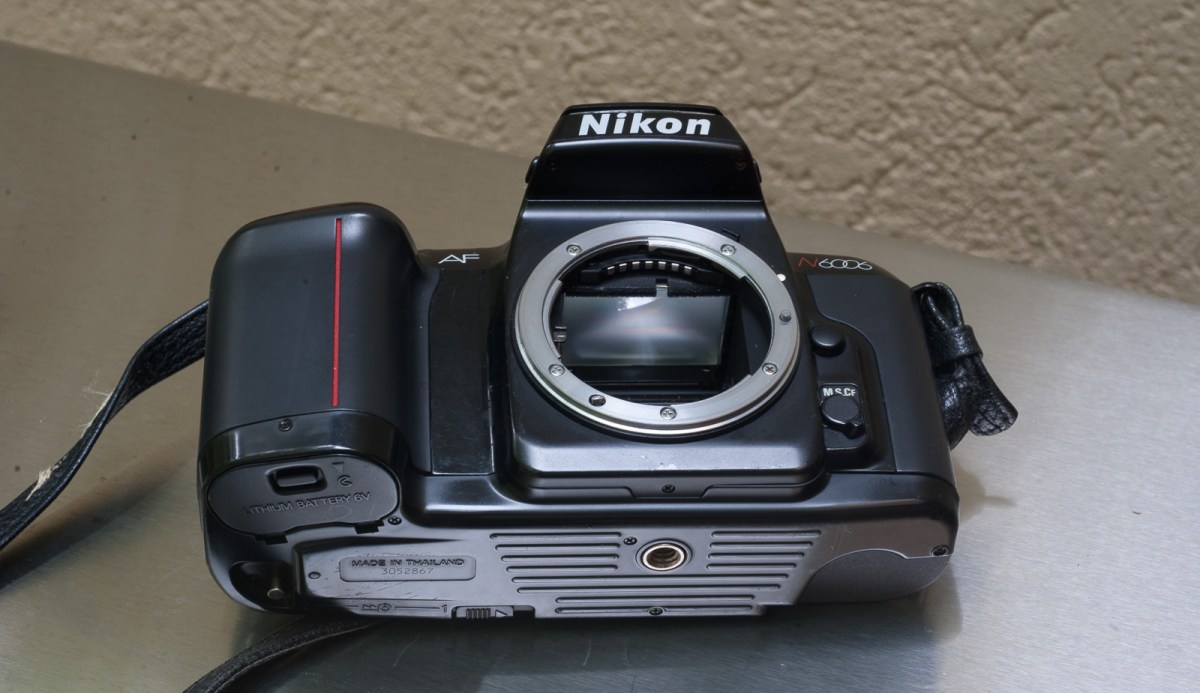
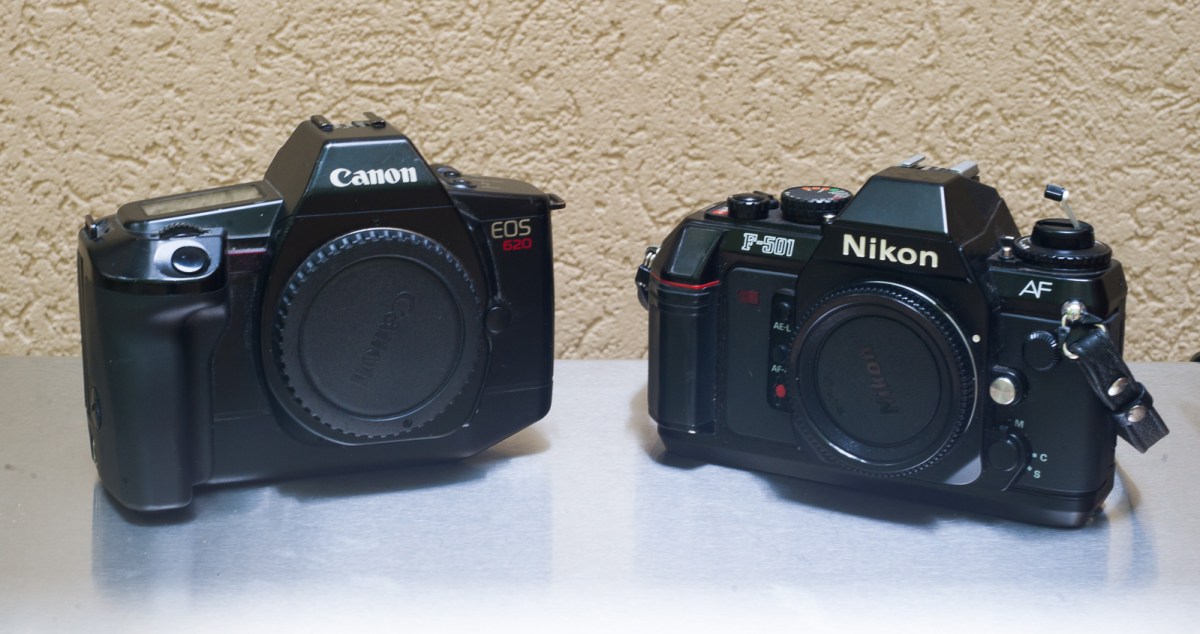
Nikon F501/N2020 – Source: it.wikipedia
On the other hand, even Nikon cameras I bought in bulk in antique shows or from thrift stores have been easy to bring back in service – generally the only thing missing was a good battery. They have a very reliable shutter and an accurate meter, and no light leak issue. Some Nikon cameras develop some annoying issues (the rubber grip on modern Nikon digital cameras, the LCD display in the viewfinder of the F4), but nothing that would prevent you from taking good pictures.
As a conclusion
I received the scans a few days ago. The exposure was a bit off (over-exposed by 1/2 stop in average – it’s likely that the camera had not been calibrated by Nikon for such a luminous landscape), but nothing that could not be adjusted in Adobe Lightroom in a couple of seconds. There’s still life in those old cameras.
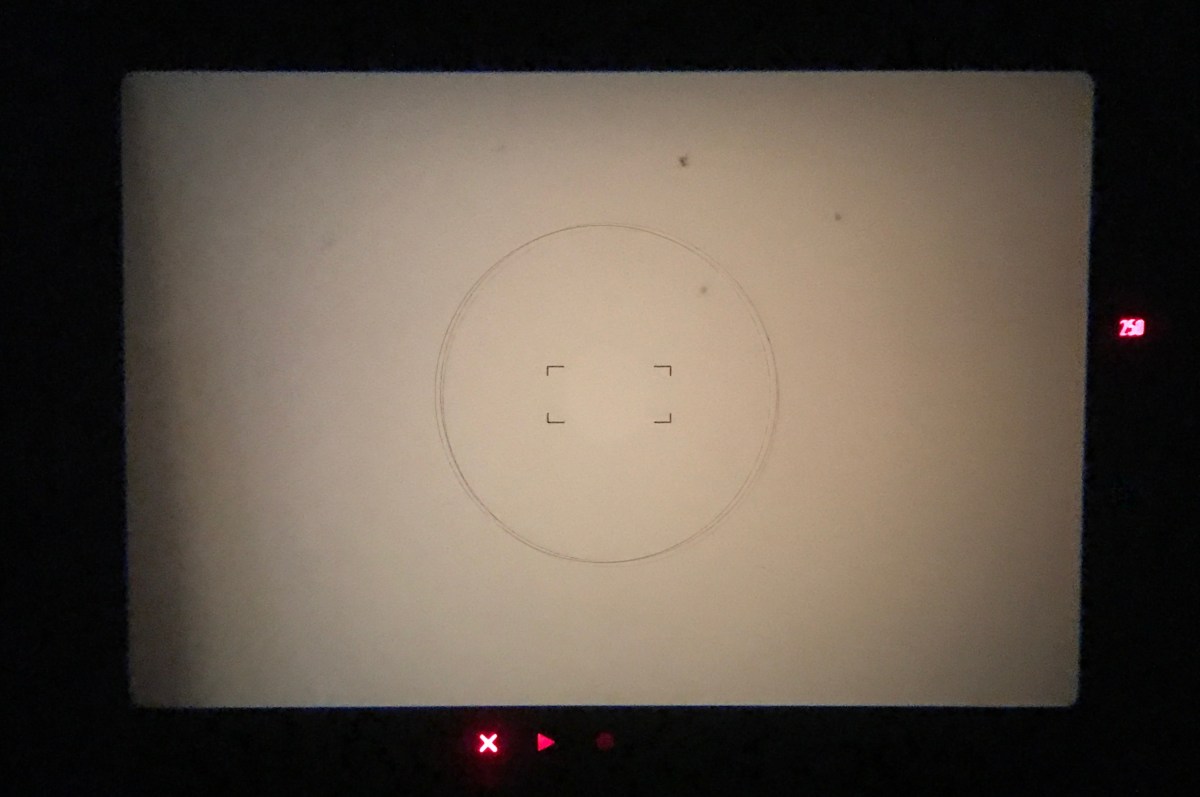
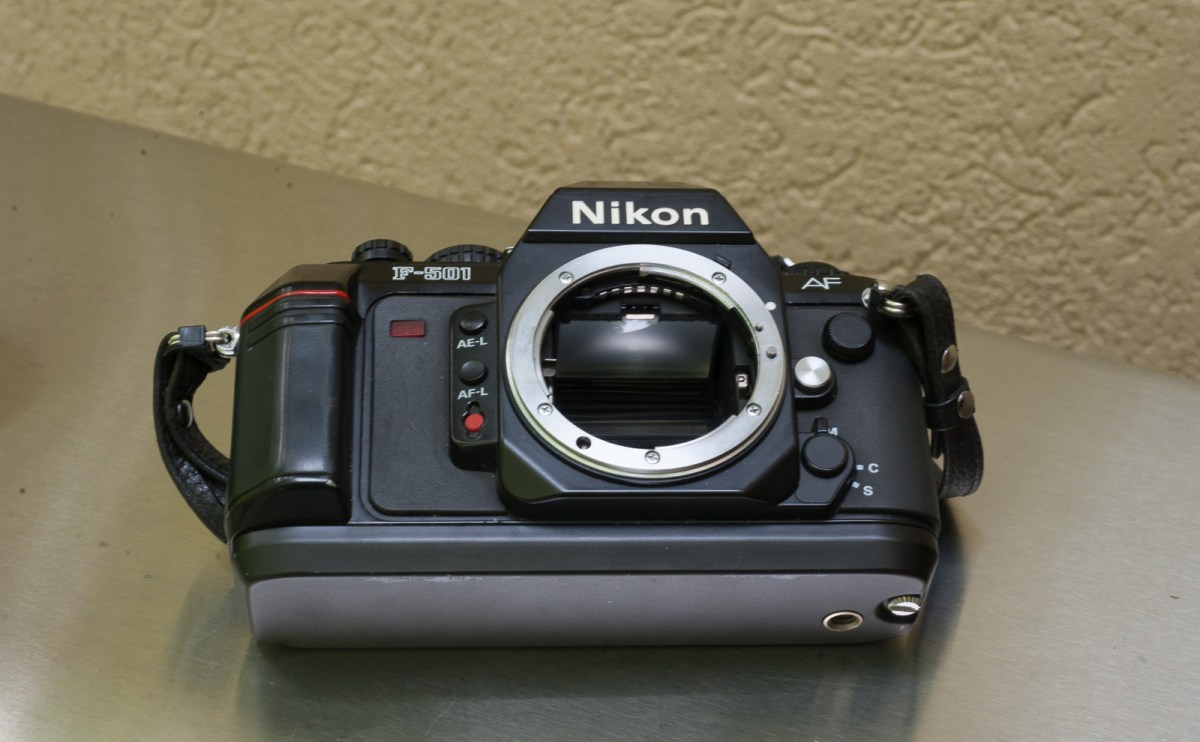
The N2020 (F-501 outside of the US) was Nikon’s first mass market auto-focus SLR. It was an upgrade of the N2000 (F-301 “in the rest of the world”), Nikon’s first SLR with an integrated motor.
On this trip, I used it as a manual focus camera, with a very compact Series E 35mm f/2.5 lens. The ergonomics is still very conventional (dials and rings instead of menus and LCDs), it simply needs four AAA batteries that you can find anywhere in the world, and it’s a pleasure to use.
More about the Nikon F501/N2020 in a few weeks.
Treasury, Monastery?
I initially wrote that the building shown in my photos and drawn by Herge in “Coke en Stock” was the “Monastery”. It was wrong. In fact, it’s known as the “Treasury”. And it was neither a monastery or a treasury, but the mausoleum of King Aretas IV, who ruled the region in the 1st century AD.
And I watched “Indiana Jones and the Last Crusade” again – in the movie, the “Treasury” is not the liar of the bad guys, it’s the place where the Holy Grail and its guardian reside.
Petra’s “Treasury” has inspired many authors – here in Herge’s Tintin series (“Coke en Stock” in the original French, “Red Sea Sharks” in English).
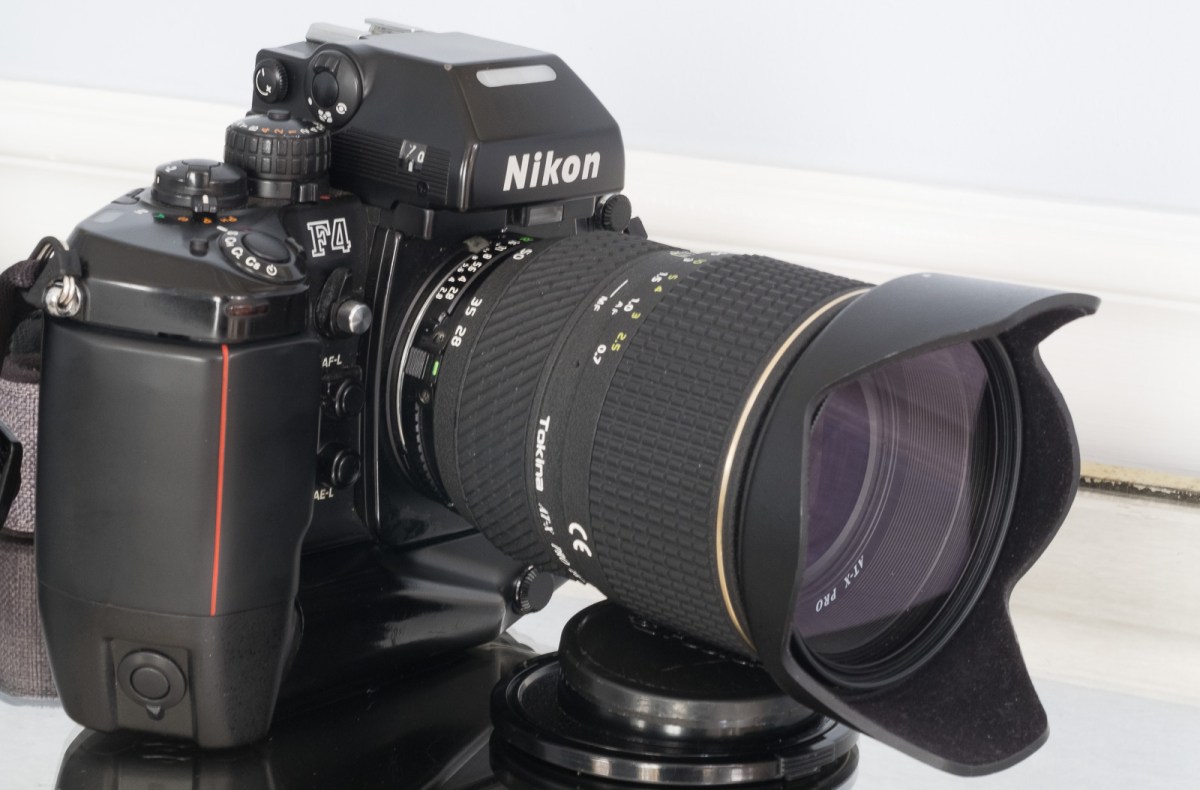
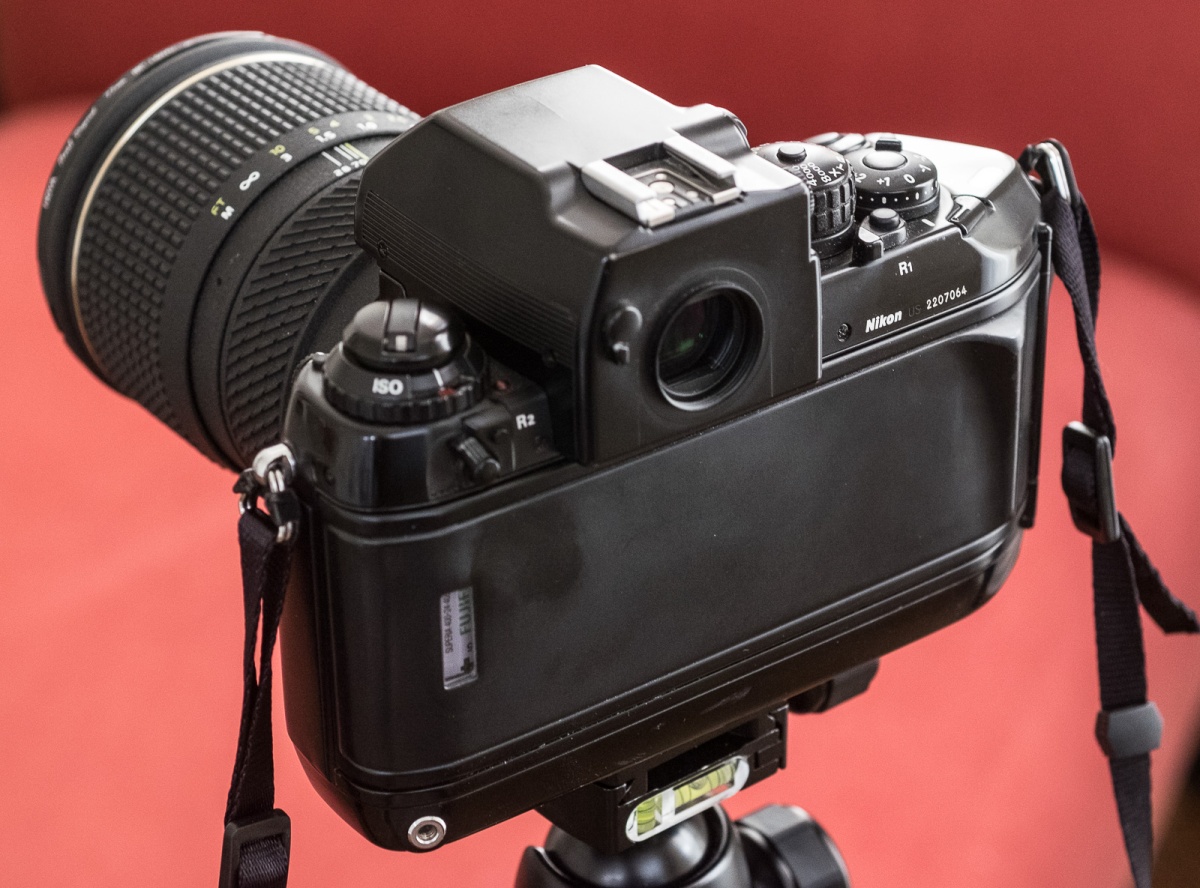
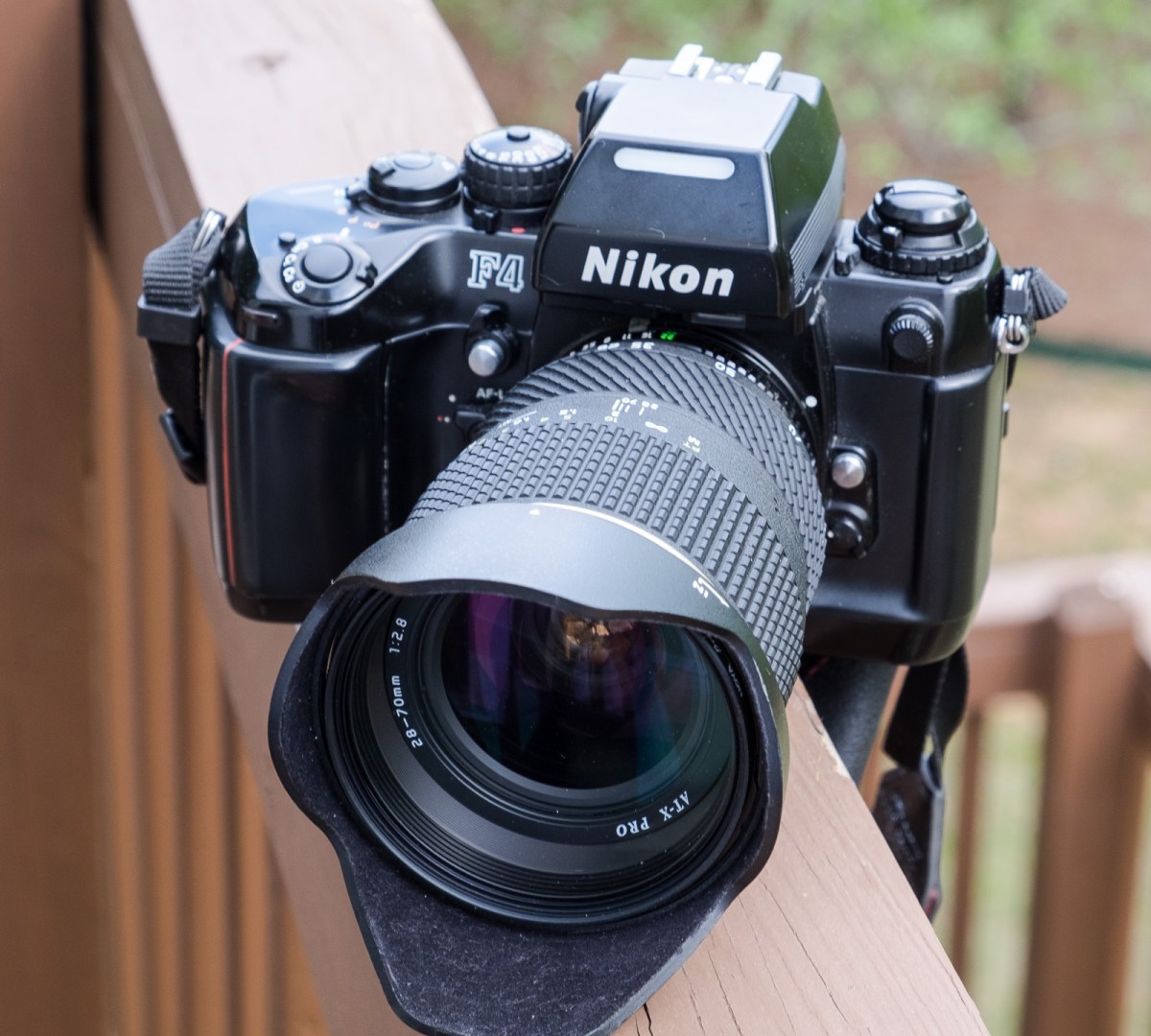
The F4 was the last Nikon camera to enjoy (for a few years) an undisputed supremacy on the professional market. Successor of a long line of modular pro cameras, the F4 uniquely combines conventional ergonomics with a modern feature set.
A typical Nikon pro-camera
Now that we have discussed in detail the F4’s auto-focus system, let’s spend a few cycles on what makes it such a great camera.
Interchangeable viewfinder, knobs and safety locks everywhere – a typical Nikon F camera.
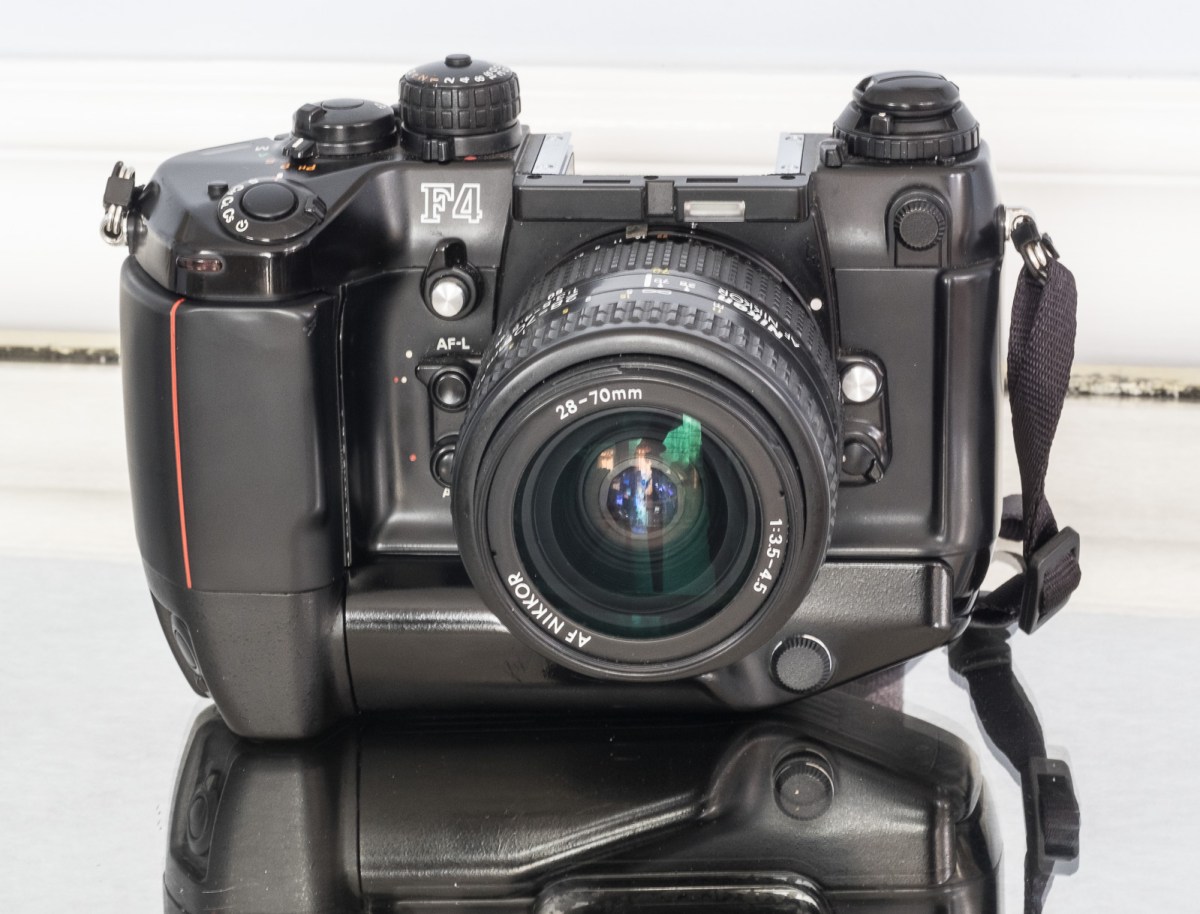
The F4 is a true Nikon F – a modular body with an extremely high built quality, compatible to some degree with almost anything Nikon has ever made. With 24 different focusing screens, 4 models of viewfinders, 3 grips and 3 backs to choose from, it can be customized to almost any specific requirement.
Nikon F4 with MB-21 grip. With the prism removed, the camera still operates (but only with spot metering)
It has been designed so that it will never let the photographer (or an unexperienced assistant) waste a roll of film or botch a shooting session:
there is no menu, just knobs and switches – just look at the camera, and you visualize how it’s set up.
there are locks on the film door, on the shutter speed knob, on the ISO dial, on the exposure mode switch, on the on/off switch, and a flashing red LED will warn the photographer if the film is not properly loaded in the camera.
Nikon F4. The MB-20 grip holds 4 standard 1.5 volt AA batteries. With the MB-20 grip, the camera is significantly more compact.
It oozes build quality: it’s a full metal precision instrument.
Another Rosetta Stone
Nikon has been using the same bayonet lens mount since 1959, but even if its basic dimensions have stayed the same, it has evolved to the point where old lenses could damage some of the recent bodies, and recent lenses can’t be reasonably used on most of the older cameras.
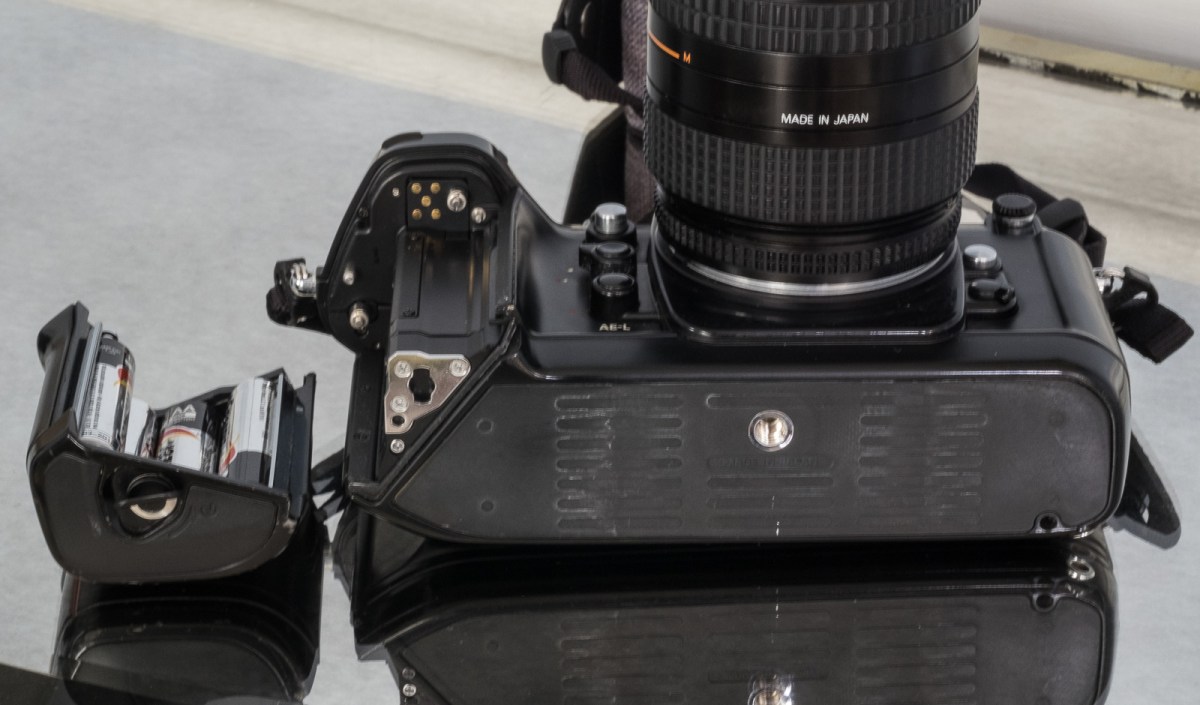
Nikon F4. The MB-21 grip is composed of a base holding two AA batteries (right) and a hand grip holding the 4 AA batteries (left)
In the Nikon line-up, the “pro” or “advanced-enthusiast” cameras are compatible with more generations of the Nikon F bayonet than the amateur oriented models, and a few bodies are exceptionally good at bridging the generations. The F4 is one of those, and deserves its “Rosetta Stone” nickname.
High level, the F4 can work with almost any manual focus lens (pre-AI made from 1959 to 1976, adapted AI, AI and AI-S), thanks to an array of pins inherited from the Nikon FA (like the FA, it offers matrix metering with manual focus lenses). Old ultra-wide angle lenses protruding deep in the mirror chamber can also be accommodated: the mirror can be locked in the raised position. And it has the electrical contacts needed by more recent AF lenses.
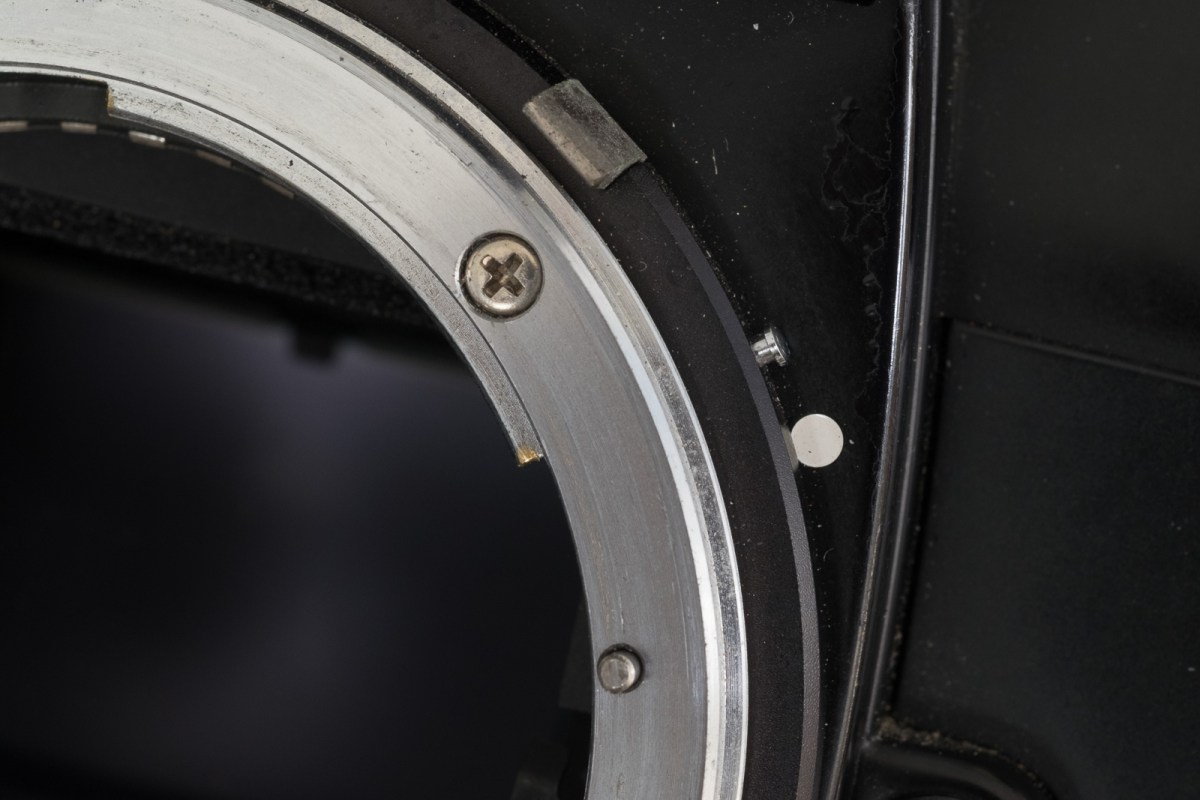
Nikon F4 – clockwise from top, on the mount’s flange : the meter coupling lever used for aperture indexing, the lens type signal pin, the lens release pin, the auto-focus shaft. On the inside of the exposure chamber: the electrical contacts used by AF lenses (top), the focal length indexing pin (right) and the aperture stop-down lever (left).
Of course, not all the exposure modes are available (pre-AI lenses have to be used stopped down, and only the Aperture Priority and Manual mode work with AI and AI-S lenses – but with the benefit of matrix metering and focus assist).
Nikon F4 – the grey tab on the left is the meter coupling lever used to transmit the selected aperture to the body with AI, AI-S and AF lenses; before mounting pre-AI lenses on the camera, press the shiny button to lift the meter coupling lever.
With Nikon’s AF and AF-D lenses, everything works. AF-S (motorized) lenses work also, as long as they still have an aperture ring. The AF-S G lenses (deprived of an aperture ring) can only be used in Shutter Priority and Program Mode.
Only very recent lenses (the AF-P with an electronic control of the lens’ iris) can’t be used at all.
Reliability
The F4 is not known for any major issue (Nikon was wise enough to abstain from using magnets as a substitute to springs in the shutter mechanism or soldering capacitors or batteries to the mother board).
In the eighties, LCD displays were a new thing, and vendors were often adding warnings or disclaimers in their user manuals, because they did not know how LCDs would age. In fact, they seem to have aged pretty well with most cameras, with the exception of the Nikon F4.
Nikon F4 -through the DP20 viewfinder. The top LCD shown here is damaged (a common flaw of the F4).
The camera has two different LCDs: a small one at the top left of the viewfinder, showing the number of remaining images on the film roll, and a large display at the bottom of the viewfinder, showing to usual exposure parameters (metering mode, shutter speed, aperture …).
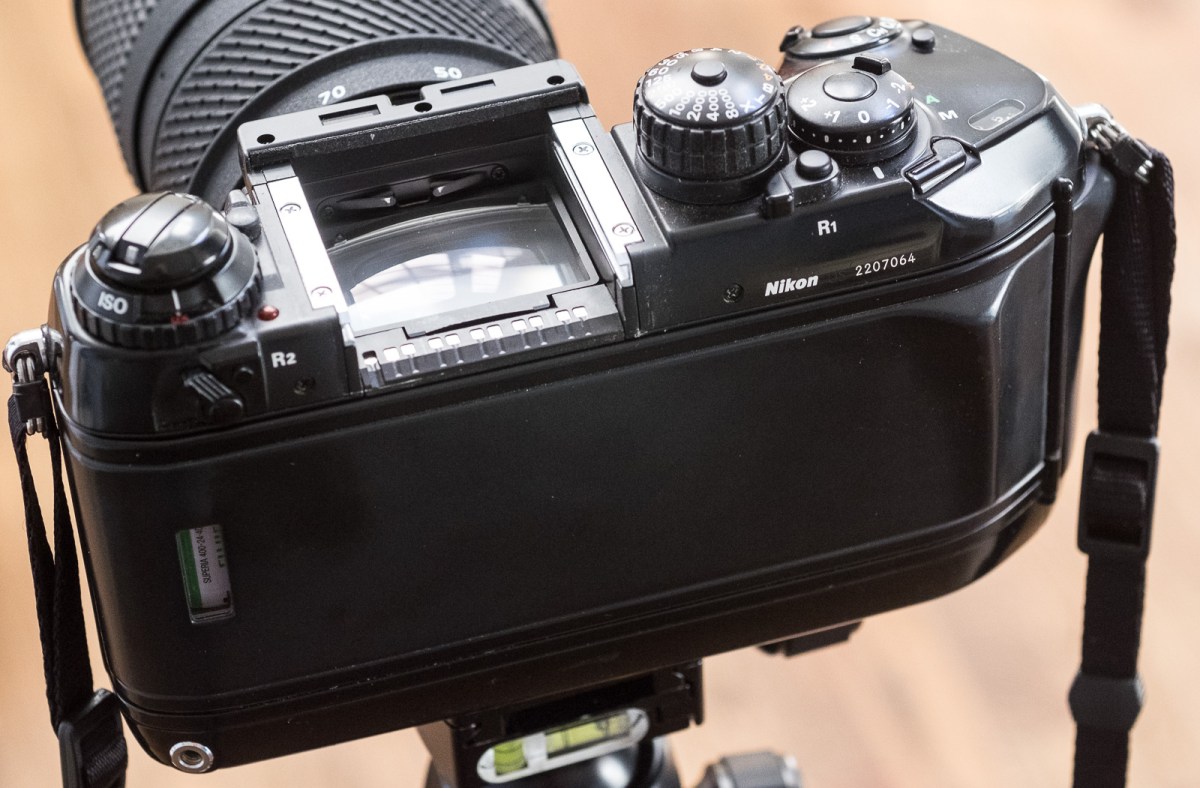
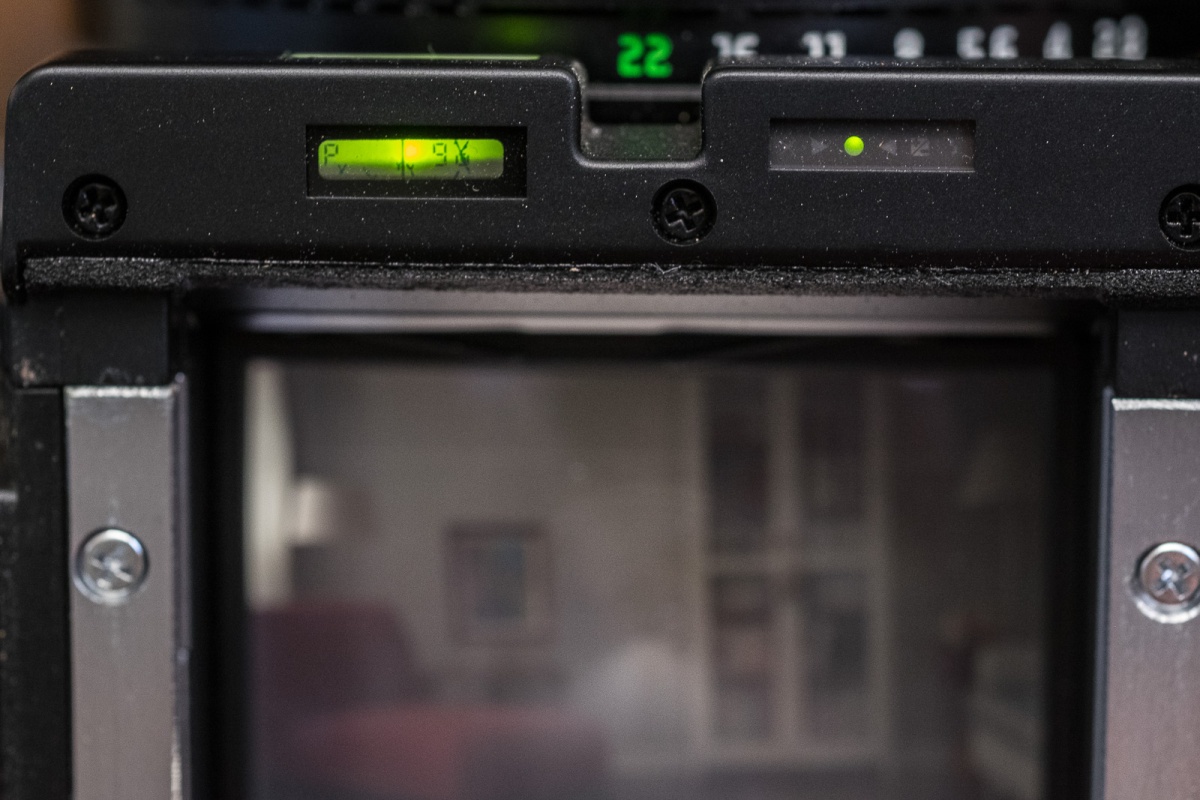
Nikon F4 – with the viewfinder removed, the small LCD display on the top left is part of the body; the large LCD showing the exposure parameters is part of the DP-20 viewfinder.
The top LCD is in fact part of the body of the camera itself (a small prism redirects its image so that it’s visible at the top of the viewfinder’s focusing screen). On the camera I purchased, it looks like it was covered by a dark green spider web. It’s distracting, but not a big issue, as the information displayed is not essential (I’m considering covering the LCD with a piece of black tape).
The issue of the “leaking” main LCD is more serious. In the most acute cases, the LCD display at the bottom of the viewfinder is all black (as if it was covered with black ink), and totally useless. This LCD is part of the viewfinder. Replacement DP-20 viewfinders are easy to find, in the $50.00 to $70.00 range on eBay, but even copies deemed “perfect” show small signs of leakage at the edge of the LCD. I don’t know whether they’re now as bad as they will ever be, or if they will further degrade over time.
Nikon F4 -through the DP20 viewfinder. My second DP-20 viewfinder – on the first one the LCD leakage was very pronounced. Here, only a tiny corner at the lower left corner of the LCD has started leaking.
How does it compare?
The F4 is unique – no other camera offered such a combination of modern features (matrix metering, multiple automatic exposure modes, auto-focus) in a somehow conventional modular body.
In the Nikon family, the F3 is a much simpler camera. Its High eye Point (HP) viewfinder is better suited to manual focus operations (longer eye point and higher magnification) – it is easier on the eyes, but gives very little information (the shutter speed selected by the camera in Auto exposure mode, augmented by a + or a – in semi-auto mode). If you only intent to operate in manual focus mode, don’t need spot or matrix metering and don’t mind the weight (the F3 is a surprisingly compact camera, but it’s very dense), the Nikon F3 is very good pick.
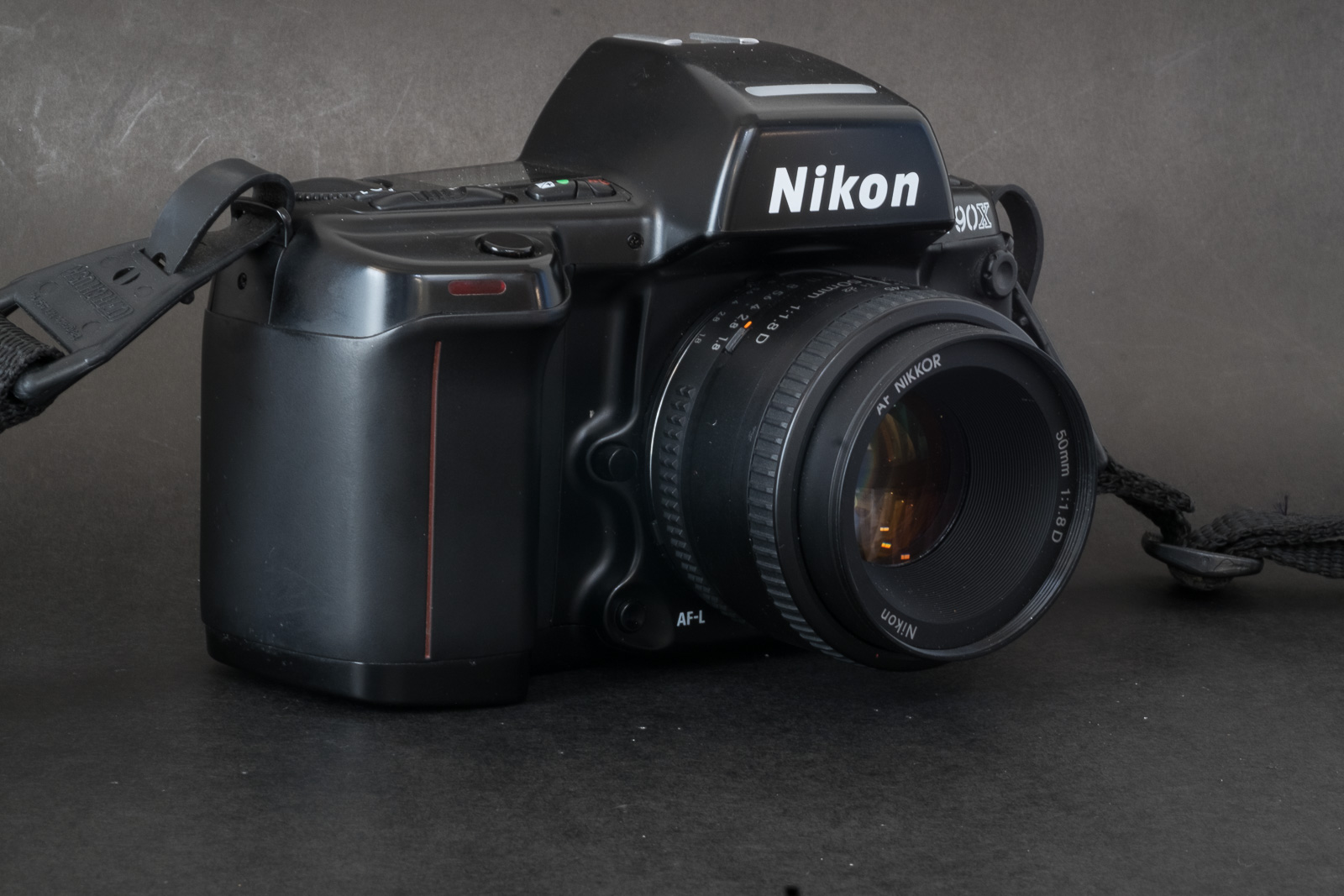
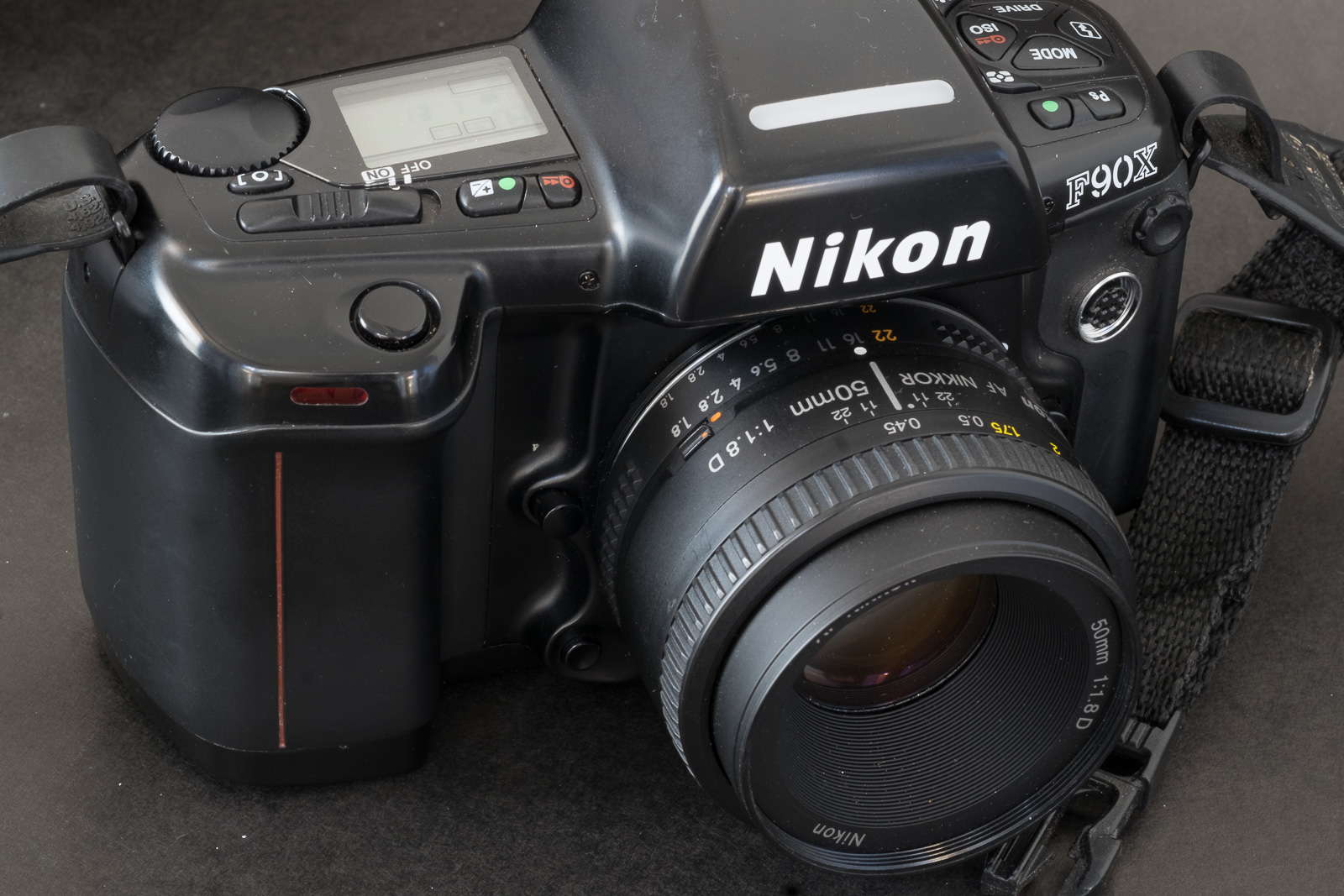
The N90s (F90x) is not a modular camera, it is not as solidly built and is more plasticky (with a peeling film door). It is designed around a modal interface (press a button, turn the control wheel to change shooting parameters). In terms of everyday performance, it’s more capable than the F4. Its viewfinder shows a larger image (0.78x), its auto-focus is much faster, and although large and heavy in its own right, it’s not as voluminous as the F4. But because it does everything so well (in the background) and only communicates with the photographer through LCD screens, it feels more robotic than the F4.
A great combination, if it was not for the size and the weight (I did not have any holster bag large enough to carry it).
When the F4 was launched in 1988, Canon was starting its transition to the new EOS camera generation. They still had two manual focus professional models – the modular and very conventional New-F1 of 1981, and the T90, with modern ergonomics but without matrix metering. Canon would not offer a real pro auto-focus camera until the EOS-1 of 1989 and they had no trans-standard constant aperture USM zooms until 1993, leaving a few years of reprieve to Nikon. The EOS-1 had a fixed viewfinder, but could be fitted with battery grips of various capacity. Nikon’s F4 successor, the F5, followed Canon’s example: modern ergonomics, and less modularity than its predecessor (the battery grip was integrated to the body and could not be changed). In that sense, the F4 is the last really conventional and modular 35mm SLR.
How much
The F4 is not a rare camera. It may have struggled at the end of its sales career, but during its first three years, it sold in large quantities (270,000 copies sold between 1988 and 1990).
Fully functional cameras with some issues (cosmetic or leaky LCD display in the viewfinder) sell for a bit more than $100.00, with faultless copies fetching twice as much.
To a large extend, the value of the F4 is related to the accessories it’s coming with – non standard grips, viewfinders and focusing screens were not sold in large quantities (and sometimes only in select geographies), and sold separately, they can be worth more than the camera itself.
As a conclusion
The F4’s mission #1 was to never let a photographer miss a picture inadvertently – all settings are visible on clearly identified knobs and dials, there are locks everywhere, and even a warning LED if the film is not properly attached to receiving spool – it’s the play-it-safe tool for a pro who does not want the embarrassment (and the potential loss of revenue) of failing to deliver.
Nikon F4 with the MB-20 grip and a small sliding aperture zoom. The MB-20 grip is smaller than the MB-21, and was standard equipment in most of the world. In the US, the MB-21 was standard (I know, everything has to be bigger over here).
Technically, if offers what was the best in 1988 and still is pretty good now (large viewfinder, 1/8000 shutter, OTF Flash with 1/250 sync, matrix and spot metering). Its auto-focus system, while not as capable as a modern camera’s, is still good enough for any scene where you have the time to focus first and then re-frame.
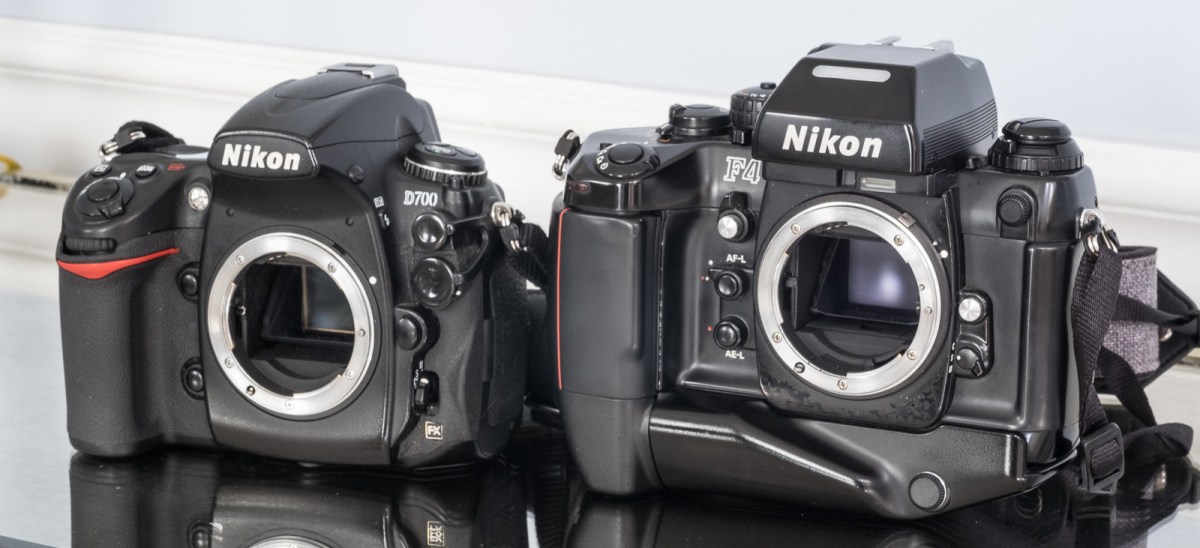
Nikon F4 with MB-21 grip: it’s even larger than a recent D700/D800 body.
Like the F3, it’s a camera that grows on you. I was not crazy about it when I started using it (its size, its weight and a narrow auto-focus zone were a serious let down), but I rapidly came to appreciate it. It does not feel like a computer or a robot taking all the decisions for you (like a N90S would), it’s still an analog camera with conventional commands, with an auto-focus system that forces you to pay attention to what you’re doing.
It will give its best results if you have the deliberate approach that makes shooting with conventional film cameras so rewarding.
Horace – Nikon F4 – Tokina 28-70 f/2.8 AT-X PRO II – during this photo session, I used the Tokina at full aperture all the time,Max – Nikon F4 – Tokina 28-70 f/2.8 AT-X PRO II – getting a good exposure of a black dog with brown eyes is not easy – the F4 got it right (I did not have to correct the exposure in Lightroom)
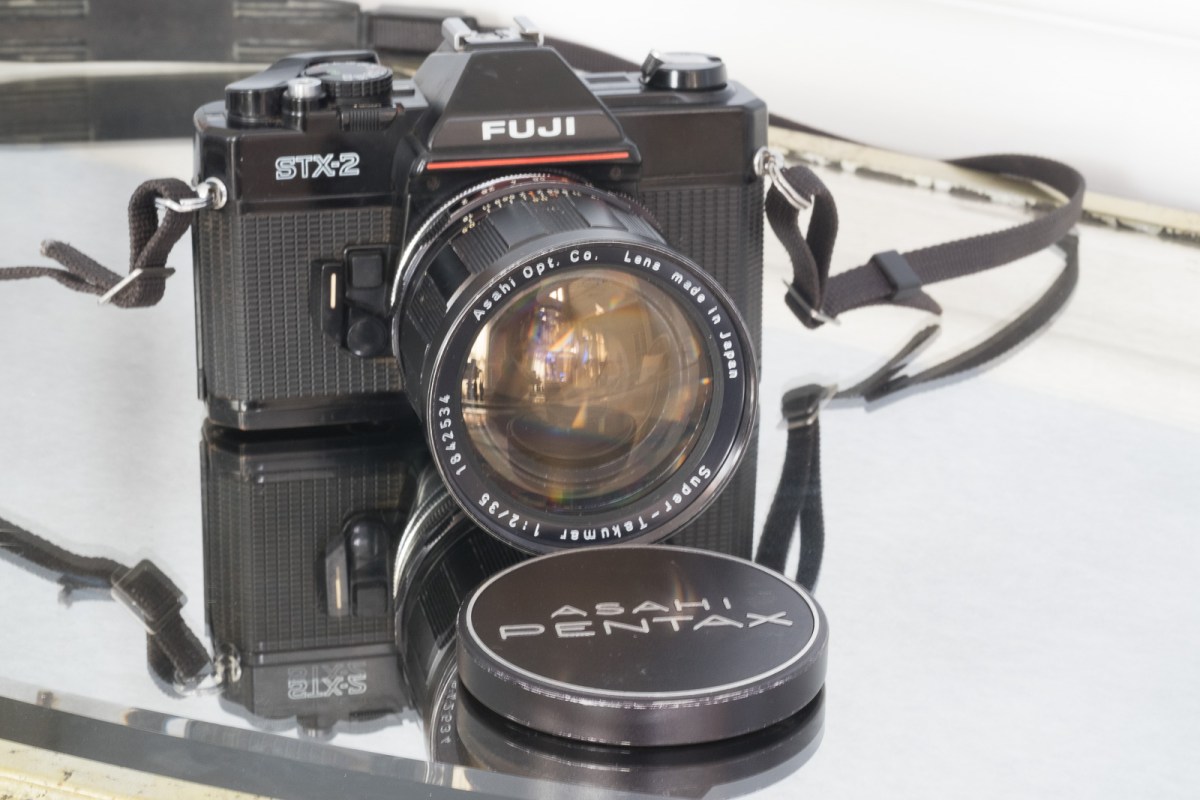
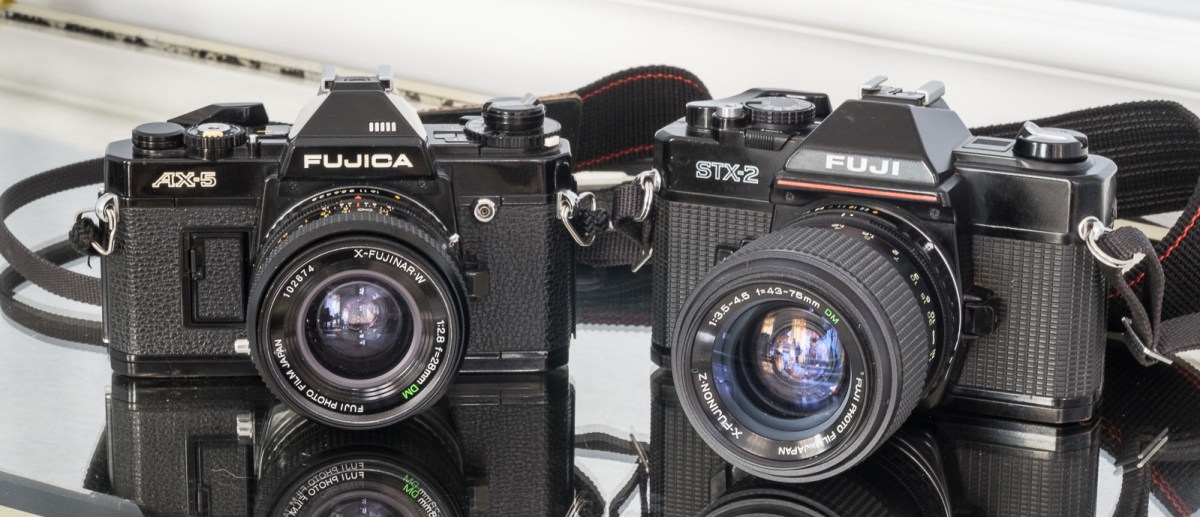
A simple semi-auto 35mm SLR, the Fuji STX-2 is a typical learner’s camera. It is better at this exercise than the over simplified and somehow antique Pentax K1000, although it does not benefit from the huge supply of Pentax K compatible lenses on the second hand market: it uses Fujica’s proprietary X-mount bayonet.
Over the course of the last 18 months, I’ve purchased and tested half a dozen Fujica and Fuji SLRs from the seventies and early eighties.
Some I really liked – the ST801 (1972) is one of the very best m42 (universal screw mount) semi-auto cameras ever built. The AX-3 of 1979 is a very competent aperture-priority camera designed for enthusiast amateurs. Some I did not particularly like – the AZ-1 of 1978, an automatic camera deprived of a semi-auto override and of the digital numeric display of the ST901- or the AX-5, too close to its entry-level siblings in spite of its impressive specs sheet. The worst of the Fuji 35mm SLRs was also the last one, the AX-Multi Program of 1985, with very limited capabilities and a questionable build quality.
Fuji tried to make the camera easy to use: the shutter release lock is clearly marked…
When Fuji launched their X-mount bayonet mount in 1979, they presented three new models all based on the same new chassis (the program mode only AX-1, the AX-3 and the top of the line AX-5), as well as an entry level semi-auto camera, the STX-1. The first two letters of its name were telling the whole story: it was a close derivative of the ST series, where the m42 lens mount had simply been replaced with the new Fujica X-mount bayonet. In 1982, its matching needle meter was replaced with 3 LEDs, and it became the STX-1n. In 1985, in parallel to the AX Multi, Fuji also launched an updated version of the semi-auto STX-1n, the STX-2. High level, it is a plastic bodied version of the STX-1n, with a shutter upgraded to go up to 1/1000 sec.
…and the battery door is easy to open at the top of the camera.
The good
Contrarily to the AX Multi, the STX-2 is not an over-simplified camera. It’s a true semi-auto camera, with a depth of field preview, a split image telemeter, a big needle showing the pre selected shutter speed in the viewfinder, and a mechanical timer for…selfies, all features that the prototypical learners’ camera, the Pentax K1000, is missing. Its metering system is based on a silicon cell, which controls a set of 3 LEDs at the right of the viewfinder. TTL (Through The Lens) metering not only works with the Fujica’s X-Fujinon lenses, but also, thanks to an adapter, with almost any m42 screw mount lens (stopped down).
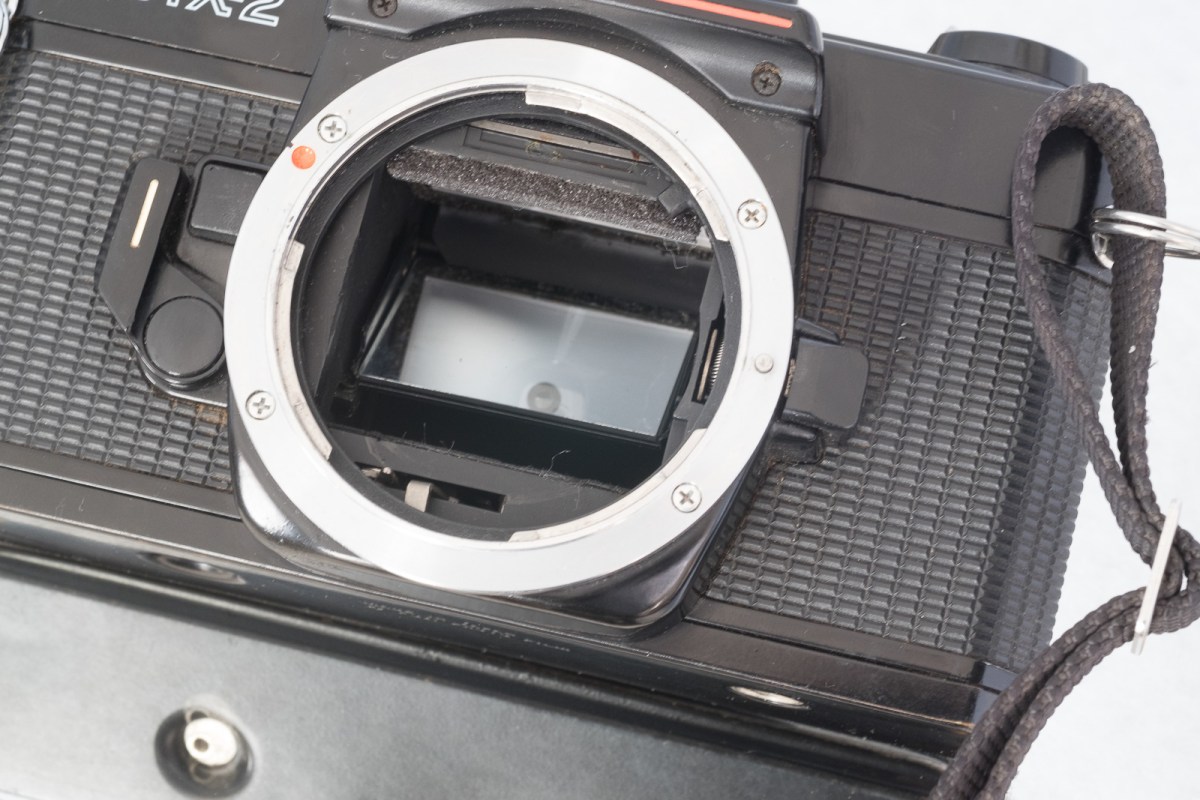
At the bottom of the bayonet, 2 levers control the iris of the lens: the lever on the left stops down the m42 lenses, the lever on the right does it for the X bayonet lenses.
The average weighted metering system seems reasonably accurate, and only requires two very common LR-44 batteries (alcaline) or SR-44 (silver oxide).
The STX-2 is a good bearer of m42 lenses (with an adapter that Fuji used to sell in the late seventies). The TTL metering still operates, but stopped down.
It can not be equipped with a winder, does not show the pre-selected aperture in the viewfinder, but on an entry level camera it’s not a big issue.
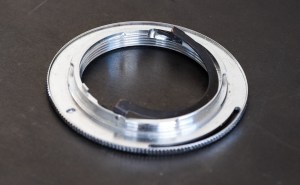
The original Fujica m42 to X-mount adapter. Note the black semi-circular metallic part at the back of the adapter.
The black semi-circular metallic part is pushed by a rod in the camera, and pushes the stop-down pin on the m42 lens.
The bad
The biggest disappointment is the viewfinder. It’s narrow, dark, and lacks contrast. It is significantly worse than the viewfinder of the AX-3 and AX-5 cameras (which is somehow OK without being great), and horribly worse than the viewfinder of their common ancestor the ST801, which is at the same time wider, brighter and more precise.
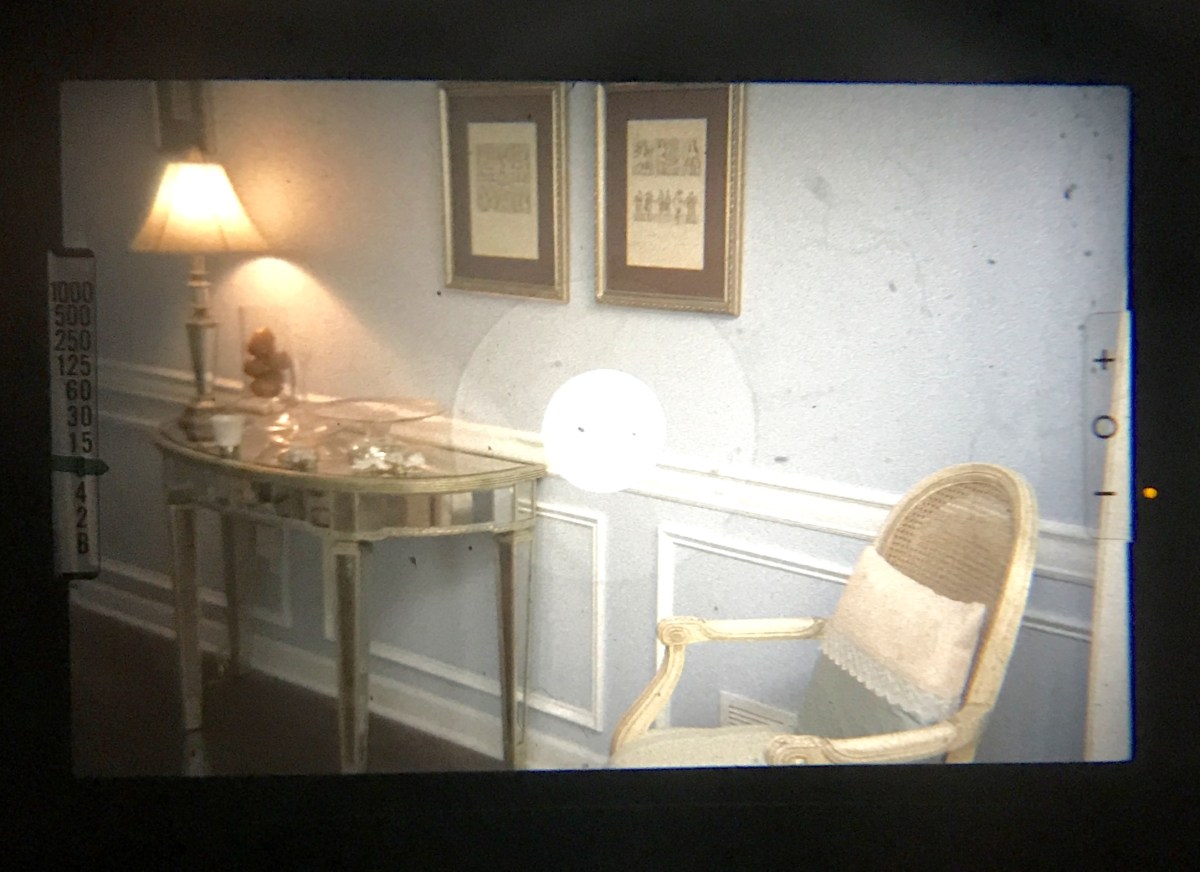
The viewfinder is informative (shutter speed scale on the left, micro prism and split image telemeter at the center, LEDs to help determine the exposure on the right), but it’s narrow, grainy and suffers from a poor contrast.
The other issue, of course, is the scarcity of X-Fujinon lenses on the market place. The Fujica STX and AX cameras came generally bundled with one of the multiple variants of a 50mm f/1.9 standard lens, which are still abundant today, but very few photographers bothered to buy anything else. Those who did mainly purchased the 43-75mm zoom or the 135mm tele, with the 28mm wide-angle lens finding a few takers. Other lenses (while nominally on Fuji Photo Film’s large catalog of lenses) were probably never stocked by retailers, and are nowhere to be seen today. And the situation is not really better with the independent optical companies: with the exception of Tamron (which had an Adaptall 2 ring for the Fujica X mount), none of the big brands seem to have made lenses for Fuji’s bayonet.
The ugly
The STX-2 does not look as bad as the AX-Multi, but only by a small margin. The fit is correct (no gap between parts, no loose part) but the finish disappoints: black plastics body is dull and easily scratched, and the dials and knobs leave an unmistakable feeling of cheapness.
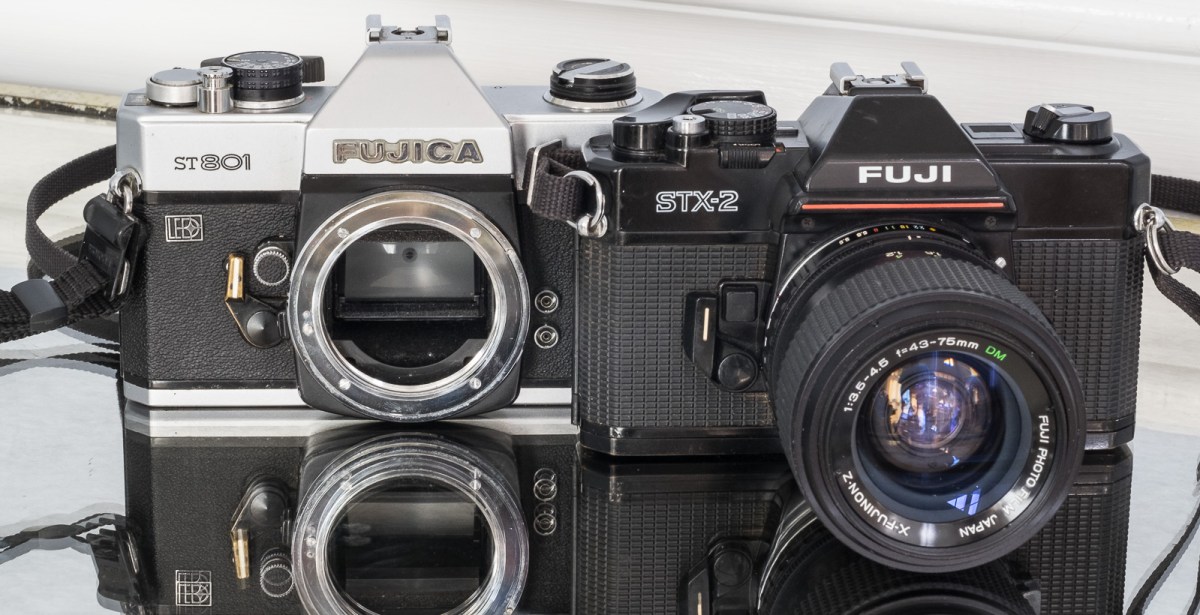
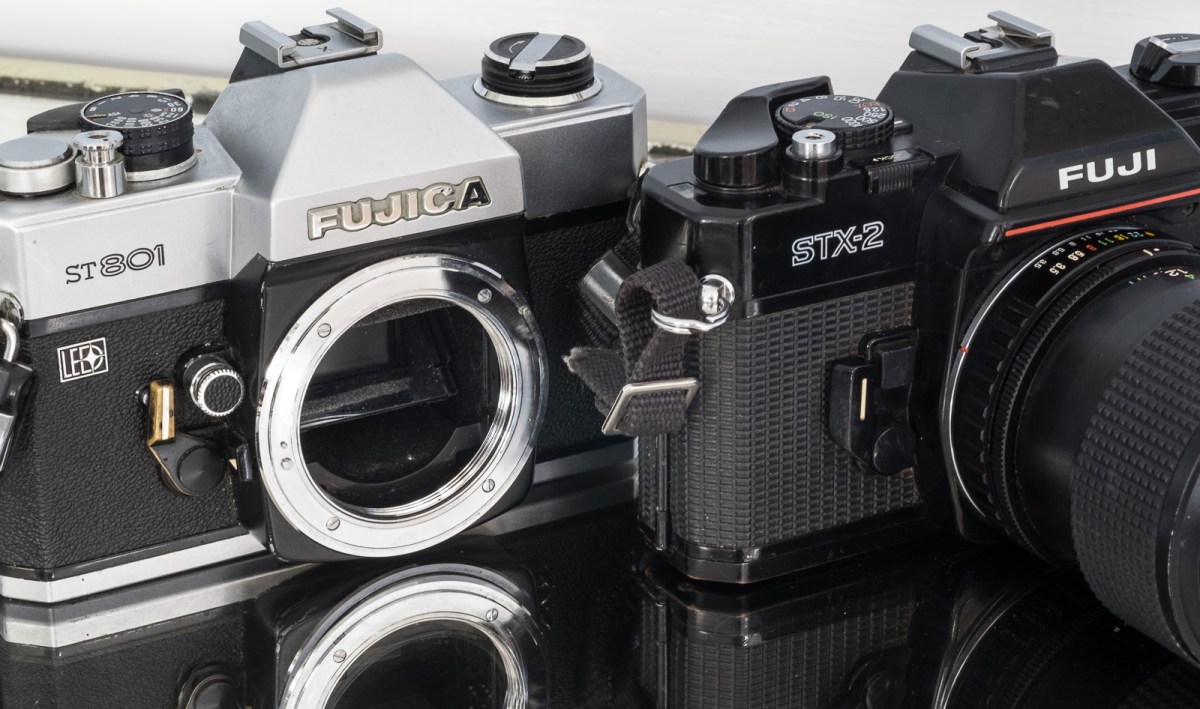
The STX-2 (1985) next to its remote predecessor, the ST801 (1972). The organization of the commands is the same, but the ST801’s build is conventional (brass and aluminum) and the camera looks much nicer.
As a conclusion
Because it’s a simple mechanical camera closely derived from a long line of m42 screw mount semi-auto SLRs (from the ST701 to the ST605), the STX-2 does not seem to have suffered from the reliability issues of the AX series. It has not been spec’d down to give a false impression of simplicity like the AX-1 or the Multi-AX, and on paper, it has everything a beginner eager to learn the basics of photography will need. Because it’s mainly built out of plastics, it’s also a very light camera (510g), and you will forget it’s in your backpack when you’re hiking. With an adapter, it can use almost any m42 screw mount lens (Fujinon or other) in addition to the difficult to find X-Fujinon lenses.
The STX-2 (1985) next to the top of the line AX-5. Being derived from the older ST generation, the STX-2 is a bit larger than the AX-5.
That being said, it’s also an ugly camera with a bad viewfinder. If I had a large collection of m42 screw mount lenses, I would rather use them with a nice Fujica ST801. The 801’s shutter is faster (1/2000 sec, which is sometimes useful now that 400 ISO is the new normal film sensitivity) and its viewfinder much more comfortable to use.
If I had a few really good X-Fujinon lenses (there is a 50mm F/1.2 EBC I’d like to find one day), mounting them on an Fujica AX-3 would make more sense to me: it’s a fully featured aperture priority camera, with a good semi-auto mode, a decent viewfinder and a nice finish. I would simply bring along a STX-2 as a backup, in case the electronics of the AX-3 decides to go on strike.
If you look at the prices on eBay, the STX-2 is almost the most expensive of the Fujica and Fuji bayonet SLRs: only the rare top of the line AX-5 will cost you more. I can understand why it could be worth more than other Fujica and Fuji AX cameras: it’s the best spec’d of the mechanical semi-auto cameras, and it’s simpler and probably more reliable than its siblings of the AX series. But if I was on the market for a learner’s camera, I would also consider cameras such as the Nikon FM or the Olympus OM-2000: they may be slightly more expensive, but the FM is more solidly built, the OM-2000 has a faster shutter, and both have a better viewfinder and a much wider choice of lenses on the second-hand market. Not to mention that they also look much nicer.
In my opinion, unless you’re a passionate collector of all things Fuji, buying a STX-2 only makes sense if you can get it for real cheap (a few US dollars), or with one or two lenses to sweeten the deal.
Brand salad:
the ST, STX and AX 35mm SLR cameras were manufactured in Japan by Fuji Photo Film, and sold under the Fujica brand until 1985, when they were simply rebranded as Fuji. The company is still in business today, and operates under the Fujifilm name. The lenses were sold as Fujinon (m42 mount), X-Fujinon and X-Fujinar (X- mount). Fuji also had lenses branded as X-Kominar in their catalog (from Komine, an independent optics company also working for Vivitar).
Fuji film’s current bayonet is also named the X-mount, their current lenses are named Fujinon-XC or XF, but there is absolutely no compatibility between the old and the new generation.
Fuji was (and still is very) proud of its lens treatment process, and the lenses that benefit from it are recognized as Fujinon EBC lenses.
Fuji also sold its camera and lenses in Germany and Central Europe through the Porst retail network. I don’t think that the STX-2 was every sold by Porst, but the STX-1 was sold as the Porst CR-1, and Fuji’s lenses as Porst UMC X-F lenses.
Today, Fujifilm is known for its digital cameras (APS-C and medium format mirrorless systems), and still makes serious money in the film business, with its instant film and cameras (Instax). The majority of the revenues of the company come from their document printing equipment business, and to a lesser extent, from their activities in the chemical and cosmetic industries.
The STX-2 (1985) next to its remote predecessor, the ST801 (1972). The timer lever and the depth of field preview button are at the same place.
The F4 is at the same time the last Nikon pro-camera with conventional/analog controls, and the first offering most of the functions that modern bodies have made us familiar with (auto-focus, matrix metering, PASM multi-automatism, motorized film advance and rewind). It was also the last Nikon camera to enjoy (for a few years) an undisputed supremacy on the professional market.
In 1988, auto-focus was still in its infancy. Minolta had launched the Maxxum 7000 in 1985, and Nikon had followed with their first auto-focus SLR, the F501 (N2002 in the US) one year later. The F4 was the first implementation of auto-focus on a professional SLR.
Compared to what was available in 1988, the F4’s auto-focus was not bad at all, but the arrival of the Canon EOS-1 one year later made it look slow and primitive, and today, the performance of its auto-focus system is what makes photographers think twice before using or buying an old F4.
Nikon F4 – an analog user interface with an incredible number of locks (counting 5 just in this pictures)
The F4 is built around Nikon’s second generation auto-focus module, the “Advanced AM200”. Its single horizontal AF zone is composed of 200 CCD sensors, and the focus zone is very small (probably 3mm wide and 1mm high – if the engraving on the viewfinder’s focusing screen is any indication). The module is shared with other Nikon auto-focus SLR bodies of the same period (F801/N8008, F601/N6006 for instance) but the F4’s auto-focus motor is stronger and the use of a 8 bit microprocessor makes the whole setup faster than on lesser cameras.
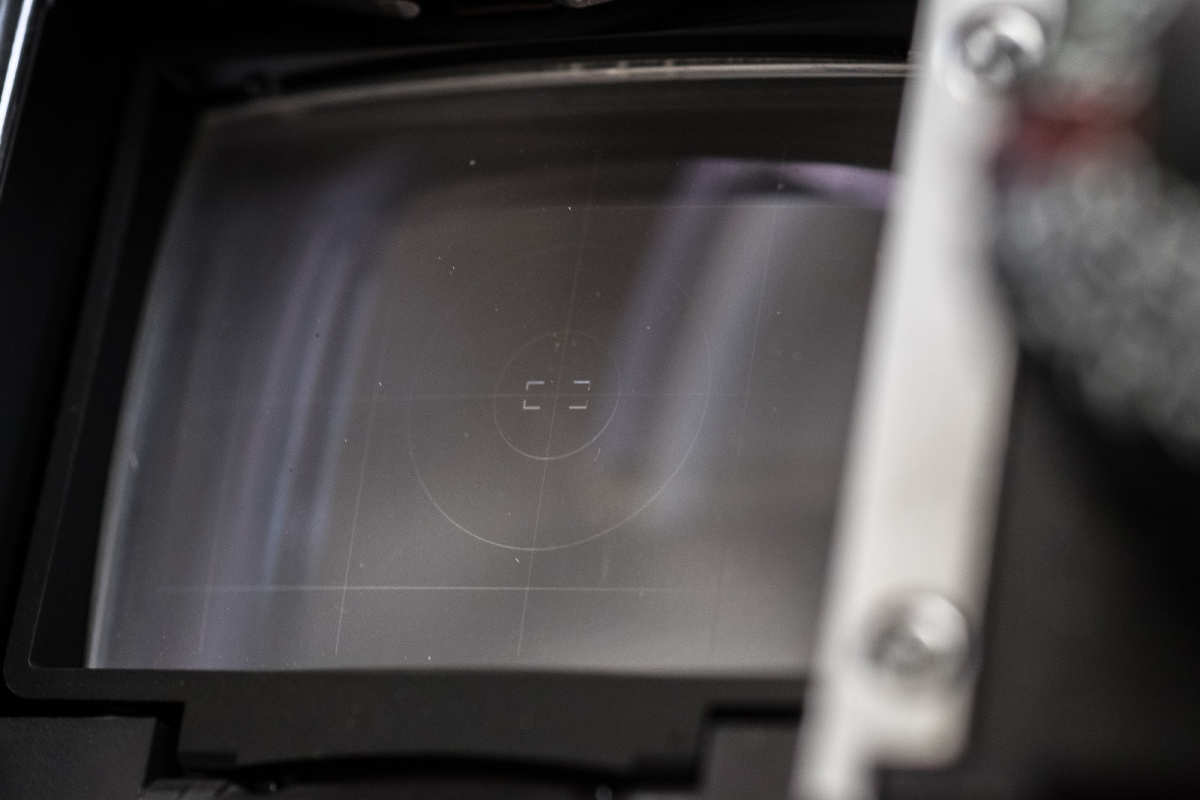
On the viewfinder’s focusing screen, at the place where the split image rangefinder would be on a manual focus camera, the AF zone is signaled by two small brackets engraved on the glass of the focusing screen. The markers of AF area are very difficult to see if the subject is poorly lit, and it can be difficult to visualize exactly where the camera is focusing (on modern cameras the active auto-focus zone is often surrounded by red LEDs. Nothing of that sort here).
Nikon F4 – the type “E” focusing screen. the auto-focus zone indicator is etched into the glass. Note how small it is compared to the overall surface of the screen.
So, is the auto-focus really that bad?
The F4 was famously launched at the Seoul Summer Olympic games. Today, nobody would use a F4 to shoot sporting events with long tele-zooms, but in all fairness, with lenses of shorter focal distance, the auto-focus is reactive and accurate. Its biggest weakness in my opinion is not its slowness, or that it tends to hunt if the scene is poorly lit. It’s that the AF zone is so narrow that you really have to pay attention to what part of the scene the AF sensor is pointed at. You can not simply point the camera loosely towards the subject, and expect the auto-focus system to locate it somewhere in the central area of the frame. You have to aim precisely at it, right at the center of the focusing screen, let the system focus on it, then keep the shutter release button half pressed (to lock the focus) and re-frame your picture. In that sense, it’s more a focus-assist system (Nikon write about an “electronic rangefinder” in their user manual) than an auto-focus system as we know it now.
The N90S (F90X outside of the US) that came a few years later (1994) benefits from an auto-focus system of a newer generation: it still has a single zone auto-focus module, but it’s much wider (7 x 3mm), and is shaped like a cross (it can focus on subjects presenting vertical lines as well as horizontal lines), even in low light and with slow (f/5.6) lenses.
The user experience is very different. The camera easily finds the subject even if not perfectly centered in the frame, and it focuses rapidly and accurately, even on mobile subjects moving erratically. In that regard, the N90S is already a modern camera.
Using the F4 as a manual focus camera
A common opinion in the forums is that you should simply forget about the auto-focus system, and use manual focus lenses on the F4. Even if it’s technically possible – the F4 accepts almost any manual focus lens ever made by Nikon (with very few limitations) – I’m not sure it’s a great idea: the viewfinder of the camera has not been designed for that.
In the days of manual focus cameras, manufacturers had to make focusing as easy as possible for the eyes of the photographer, and as result, they used to design viewfinders with a high level of magnification (0.9X) and they spec’d focusing screens to be as precise as possible, even at the cost of looking at bit dark and coarse. As soon as auto-focus systems became the norm, manufacturers adopted viewfinders with much lower magnification factors (0.7X), in conjunction with much brighter and smoother focusing screens, which had a more limited ability to show small differences in focusing. [more about the evolution of the viewfinders of SLRs over time]
The F4’s default viewfinder (the DP-20) and its default focusing screen (the BriteView Type “B”) are typical of an auto-focus camera. The DP-20 is a long eyepoint / low magnification viewfinder (22mm and 0.70X respectively), and the “Type B” focusing screen is bright but not very precise. The Type B provides none of the focusing aids you find on a manual focus camera (no micro prism, no split image rangefinder). It’s difficult to set the focus with the naked eye when you can’t or don’t want to use the auto-focus system.
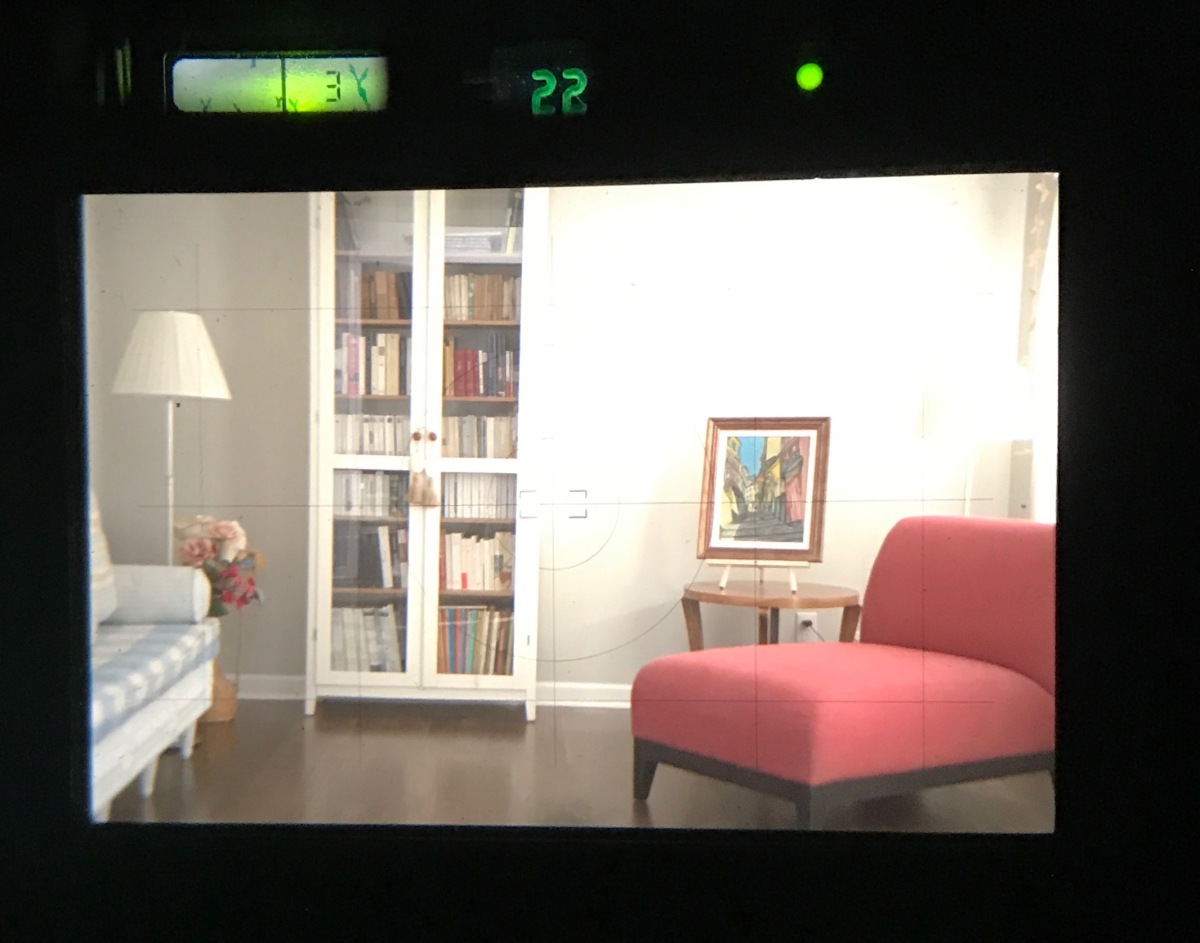
Nikon F4 -through the DP20 viewfinder. On this picture only the top LCD is shown (number of remaining pictures on the left, aperture in the middle, green dot for the focus. The grid of the “E” focusing screen is somehow visible.
Optional focus screens optimized for manual focusing were available from Nikon and from third party vendors (Nikon’s Type “K” and Type “P” focusing screens have a ring of micro prisms around a split image rangefinder spot, the Type “J” just has a central micro prism focusing spot). Equipped with such a focusing screen, the F4 could be used as you would use a F3 or a FE2 – with the additional benefit of matrix metering. Those focusing screens are pretty scarce now, and are sometimes offered for more than $150.00 (they’re specific to the F4 – you won’t be able to focus accurately with a focusing screen designed for the F, F2 or F3).
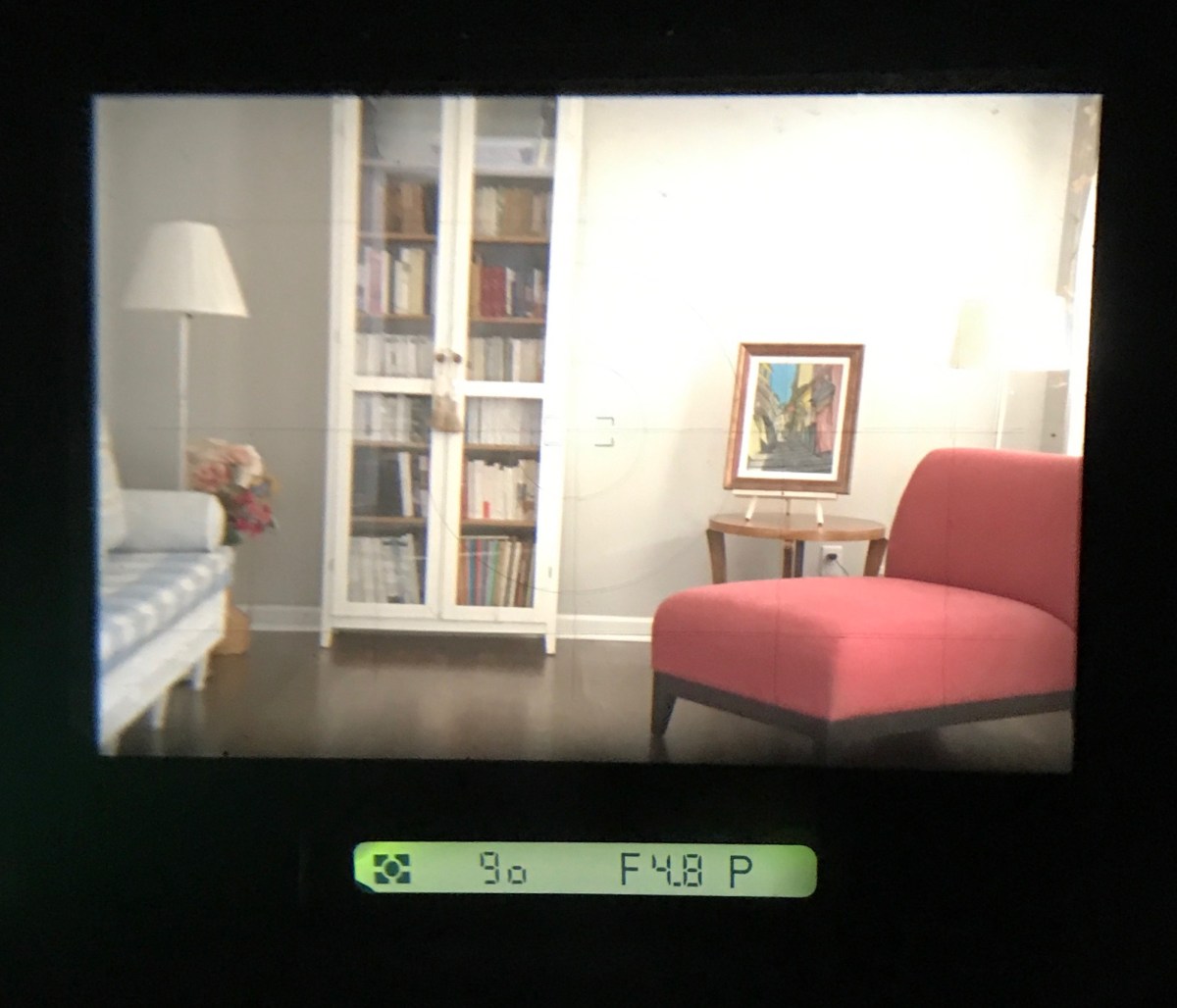
Nikon F4 -through the DP20 viewfinder. On this picture only the botton LCD is shown (showing the metering mode – Matrix – the shutter speed, the aperture and the exposure mode: Program)
On the F4 I bought, the Type B focusing screen had been replaced with a Type E. It’s a variant of the Type B with horizontal and vertical lines etched in the glass. If I mount a manual focus lens on the camera, I just use the auto-focus system as an electronic rangefinder – when the big green dot is on in the viewfinder, it’s focused. This “electronic rangefinder” is as good as a split image rangefinder – you just have to trust it.
More in a few weeks, with my take on compatibility, reliability and ….
Nikon F4 – with the viewfinder removed, the small LCD display on the left does not show the same information: here the exposure mode. The green dot on the right shows that the focus has successfully been set by the camera (the auto-focus module and the microprocessor are in the camera’s body, as well as the spot metering system – only the matrix and the average weighted cells are in the DP20 viewfinder).
Early Nikon AF cameras and their AF modules
On a camera, the overall performance of the auto-focus system (and the quality of user experience) depend on much more than just the AF module.
An auto-focus system is composed of hardware (the AF module with its CCD sensors, the microprocessors) and of software (the AF algorithm). It is part of an even larger system (the camera itself with its other subsystems and its lenses) with which it has to integrate smoothly.
As an example, an explanation of the AF performance improvements between the F90 (N90 in the USA) and the F90X (N90s in the USA), both equipped with the same CAM246 AF module (from a very interesting blog entry in 678vintagecamera.ca :”Improvements over the F90 included faster AF speed and tracking. Nikon claimed a 2x increase in CPU speed, a 25% faster AF lens drive speed over the F90, and a new AF algorithm.”Same AF module, dramatically improved performance thanks to hardware and software improvements. (source: https://www.678vintagecameras.ca/blog/forgotten-film-warrior-the-nikon-f90x-aka-n90s)
Nikon AF Modules (1986-1995)
Name of the AF module
Number of AF Points
Shape of the AF zone
Number of AF Pixels in the module
Nikon cameras equipped with the module
Launch year of the camera
no name
1
horizontal
96 horizon.
F501
1986
AM200
1
horizontal
200 horiz.
F401
1987
Advanced AM 200
1
horizontal
200 horiz.
F801, F4, F601
1988, 1990, 1991
CAM246
1
horizontal + vertical
172 hor; 74 vert;
F90, F90X
1992, 1994
Multicam 1300
5
multiple horizontal +vertical
1300
F5, F100
1996, 1999
Nikon F4 – with the standard DP-20 viewfinder and the MB-20 grip (4 AA batteries)
It is well known that Angenieux – before retreating to less cost sensitive markets like the movie industry and the military – made a final attempt to secure a place in the consumer market, with a now legendary Angenieux 28-70 F/2.6 AF zoom, launched in 1990. In 1994, the company was sold to its current owner, Thales, and left the consumer market for good. Tokina launched its own 28-70 f/2.6-2.8 soon after, and is widely rumored to have purchased the blue prints of the lens from Angenieux.
Tokina 28-70 AT-X PRO II – this one is a Japanese Domestic Market (JDM) model – export models were marketed as f/2.6-2.8 lenses
But in France, there are collectors who believe that Tokina had played a role in the design and the manufacturing of the Angenieux 28-70 lens. For them, Tokina did not have to buy the blue-prints, because the Angenieux lens was itself the result of a cooperation between Angenieux and the Japanese optics company.
The Angenieux lens (Minolta A mount) I had bought in 1991. I sold it in 2005 after I had come to the (wrong) conclusion that Konica-Minolta and the A mount would not survive the transition to digital – I had not anticipated Sony’s purchase of K-M’s photography business.
After all, Angenieux had no prior experience with auto-focus lenses, and may have seen a cooperation with Tokina as a way to accelerate the product development and reduce the costs.
Token 28-70 AT-X PRO II – the focusing ring can be pulled to switch to manual focusing (it’s a Tokina feature)
The Angenieux lens: two large rings – one for zooming, one for focus. The layout of the Tokinas is similar. Only the Nikon version of the lens has an aperture ring.
How similar are the various Tokina AF 28-70 lenses to the original Angenieux AF 28-70 F/2.6?
Just looking at the characteristics, the 28-70 f/2.8 lenses can be grouped in 3 generations:
1988 – 1994 – the 28-70 F/2.8 AT-X (the non-PRO model) predates the Angenieux by two years. The optical groups share a similar high level design: 16 elements organized in 12 groups. Apart from that, the Tokina and the Angenieux look very different: the Angenieux carries the brand’s very distinctive design language, and is beefed up in every dimension. It’s longer, wider and heavier. The AT-X requires 72mm filters. The Angenieux and all the other Tokina 28-70mm F/2.8 lenses need 77mm filters.
Tokina 28-70 AT-X f/2.8 from 1988 – Courtesy KEH
1994 – 1999 – the AT-X PRO 28-70 AF/2.6-2.8 (and PRO II) lenses are the ones whose main specifications are the closest to the Angenieux. The main difference between the Tokina and the Angenieux comes from the ability to disengage the auto-focus on the lens itself on the Tokina (by pulling the focusing ring): Angenieux never had such a feature.
On the Japanese Domestic Market, the Tokina were sold as F/2.8 lenses (no reference to F/2.6), but in the rest of the world they were marketed as f/2.6-2.8 zooms. [The Angenieux was sold as a F/2.6 constant aperture lens – in theory, a lens opening at f/2.6 lets 10% more light go through than a lens opening at f/2.8 – the difference is largely symbolic.
The PRO II of 1997 was a significant upgrade over the first AT-X Pro, and benefited from one “High Refraction Low Dispersion” (HLD) optical element, from a better multi-layer coating, and from a faster focusing mechanism. The lettering on the lens’ body still reads AT-X PRO. The easiest way to recognize the PRO II: a bayonet hood mount that replaces the screw-on mount of the previous Angenieux and Tokina models.
Tokina 28-70 f/2.8 AT-X PRO II – Note the 77mm filter, the bayonet hood mount typical of the PRO II, and the f/2.8 marking typical of a JDM model. (source: Youtube)
2000-2002 – the 28-80 AT-X “PRO” of Year 2000, and the “Special Value” AT-X PRO SV 28-70 AF F/2.8 of 2002 are clearly 2 variants of the same model, but seem to have little in common with the earlier AT-X PRO models and with the Angenieux: significantly different dimensions, different minimum focusing distance, two aspheric optical elements, internal focusing.
Tokina 28-70 f/2.8 AT-X PRO SV (Source: MIST722 on eBay)
Angenieux
Tokina AT-X 270
Tokina AT-X Pro
AF 28-70 F/2.6
AF 28-70 F/2.8
AF 28-70 F/2.6-2.8
Year
1990-1994
1988-1994
1994-1997
Elements / groups
16/12
16/12
16/12
Filter diameter
77mm
72mm
77mm
Weight
660g
600g
760g
Length
111mm
90mm
109.5
Width
78.5mm
70mm
79.5mm
closest focusing dist.
65cm
70cm
70cm
Lens hood
screw-on mount
screw-on mount
screw-on mount
Tokina AT-X Pro II
Tokina AT-X Pro 280
Tokina AT-X 287 PRO SV
AF 28-70 F/2.6-2.8
AF 28-80 IF f/2.8
AF 28-70 IF f/2.8
Year
1997-1999
2000-
2002-
Elements / groups
16/12
Special glass elements
1 HLD
2 Aspheric, 1 SD
2 Aspheric, 1 SD
Filter diameter
77mm
77mm
77mm
Weight
772g
810g
715g
Length
109.5mm
120mm
108.5mm
Width
79.5mm
84mm
84mm
closest focusing dist.
70cm
50mm
50mm
Lens hood
bayonet mount
bayonet mount
bayonet mount
Using one of those lenses today?
With the full frame digital cameras becoming more affordable, there has been a renewed interest in the Tokina 28-70 f/2.8 AF lens family in the recent years. They’re a far cheaper alternative to current luminous trans-standard zooms from the big camera makers. What do you lose if you use a lens from the nineties?
compatibility: the lenses were designed for 35mm film, and are only a good fit with full frame digital cameras (on cameras with an APS-C sensor, their angle of view is similar to a 43-105mm zoom on a 35mm camera). The Angenieux was available in Nikon AF and Minolta AF mounts (both of the screw driver AF type), and in a Canon EF variant, with an integrated auto-focus motor. In addition to the mounts of the big three, the Tokina models were also available for the Pentax KAF mount. As far as I know, Canon and Minolta-Konica-Sony have never altered the bayonet mount of their auto-focus lenses, and Sony Alpha bodies still have the motor required to focus automatically with a “screw–drive” lens: any of the Tokina AF lenses should work on a Canon or Sony camera. The case of Nikon is more complex. All those lenses behave like Nikkor AF lenses of the first generation, which means they won’t auto-focus on Nikon bodies deprived of an auto-focus motor, such as the D3x00 and D5x00 series, as well as the new D7500 (there should be no issue with Nikon’s full frame cameras, as they still have an in-board auto-focus motor).
Performance of the 28-70 f/2.8 lenses compared to modern offerings
It’s difficult to assess – few of the tests conducted by paper magazines in the nineties are still available today (most of the magazines are gone, and the online archives of the survivors don’t often go that far back). Shutterbug is a good source of information: they’re one of the few surviving US photography magazines, and the articles they published in the nineties are still available on their Web site.
Tests were made with film cameras, in reference to equivalent zooms from Canon, Minolta and Nikon. A few tests published on the Web 10 years ago were conducted with digital cameras with a smaller APS-C sensor and a lower resolution, and are of little value with today’s high resolution full frame sensor cameras.
on the forums, as usual, there is a lot of hear say, wishful thinking and self re-inforcing opinions, but little in terms of facts or serious tests.
That being said,
there is not much information about the original 28-70 AT-X (non-PRO) of 1988 on the Web. It got a good review from Ken Rockwell in 2011 (obviously as a “used” lens option for cost conscious buyers). He liked its price, its relatively small size and weight, and its sharpness at the center, even at full aperture. In his opinion, you needed to stop down to f/8 to get to excellent levels in the edges or at 70mm.
the 28-70 AT-X PRO 2.6-2.8 (the so-called “Angenieux” design) generally got great reviews. Reviewers were impressed by its built quality and its sharpness (with a few restrictions): the review of Peter Burian on Shutterbug is very positive (it was originally published in 1999, and Peter was shooting with film). He rates the image quality as exceptional in the center of the frame at full aperture, and excellent even in the edges at F/4 and above, with a sweet spot in the 35 to 60mm range between F/5.6 and F/11 where it’s as good as a prime lens. Maybe because he tested the lens more recently on a digital full frame camera (a Nikon D700), Eric Tastad in ERPhotoReview is not as enthusiastic. In his opinion, the lens is very sharp in the center at 28mm and full aperture, but needs to be stopped down to F/5.6 to reach excellent levels across the frame and above 50mm. And it will remain relatively weak at 70mm even when stopped down. To summarize, you could say that in his opinion the lens should have been sold as a 28-60 f/2.8-4.
The 28-70 AT-X PRO II – Just the right size for a full frame digital body.
the 28-80 AT-X Pro F/2.8 IF – there does not seem to be a definite opinion about this lens – according to some of the reviews, it’s inferior to its predecessors, while others (Peter Burian at Shutterbug in particular) say it’s the best of the bunch (which would be logical considering it’s more recent, and that it does not seem to have been designed with aggressive cost cutting in mind). The fact is that it had much serious competitors than its predecessors: lenses such as the more recent Nikon 28-70 F/2.8 AF-S are significantly better at full aperture, and focus faster and silently thanks to an integrated auto-focus motor.
the 28-70 Pro SV is a budget version of the 28-80, and is generally considered inferior in performance to the 28-70 AT-X Pro II.
Price: The Angenieux is a collector’s item. Its value on the market has little to do with its usage value. It can not be found for less than $1,500 – much higher than more recent Canon, Minolta or Nikon 28-70 f/2.8 lenses.
The price of the Tokina lenses does not necessarily reflect the reputation (good or bad) of a specific 28-70 model – poorly regarded AT-X PRO SV lenses are often proposed for prices as high as the AT-X PRO II ($250 to $275 for perfect copies). The AT-X Pro 28-80 tends to be even more expensive (up to $400.00), but at this price it’s getting dangerously close to the cheapest lenses f/2.8 zooms of the Big Three (the Nikon 28-70 f/2.8 AF-S zoom can be found at $500.00).
More about the Tokina 28-70 AT-x PRO II f/2.6-2.8 in a few weeks…
Chastain Park, Atlanta. Nikon D700. Tokina 28-70 – Shot at f/6.3 and 40mm. A first attempt to assess the performance of the lens (according to tests published in the past, 40mm and f/6.3 are right in the sweet spot of the lens).
Angenieux: made in Saint-Heand, Loire, France – Editions du Pecari
Unfortunately, his book (written in French) was never translated and seems currently unavailable (I ordered it from Eyrolles a while ago and they’re still trying to fulfill my order).
Max, French Bulldog. Nikon D700. Tokina 28-70 f/2.8 (picture taken with the lens set at f/2.8 and 70mm, where the lens is supposed to be at its weakest).
When kids take a photography class in high school, the teachers typically recommend cameras like the Pentax K1000. If you Google “best learner camera for film photography”, most of the sites making the top of the list will recommend the Pentax K1000 (again), or cameras such as the Canon AE-1 (often), the Nikon FM, the Minolta X-700 or the Olympus OM family. All are manual focus cameras, all were launched in the seventies or in the early eighties, and most of them only offer semi-automatic (some people call it “manual”) exposure.
The Nikon FE2 of 1983 is objectively not as capable as the N90s (F90X) – but it’s more sought after. Nobody seems to like auto-focus SLRs from the early nineties.
James Toccio in his blog “Casual Photophile” is almost the only one to make the case that newcomers to film photography should start with a camera from the mid nineties, because with its multi-mode auto-exposure and reliable auto-focus system, it’s more similar to the current digital cameras, and will yield much better results for an untrained photographer than a semi-auto/manual focus camera from the seventies (in: Casual Photophile – How to cheat at Film Photography)
James may have a point here. And if you look for a reliable, auto-focus multi-mode SLR with great performance and a large supply of lenses, the Nikon N90s is a very good choice.
The Maxxum 9xi next to a Nikon N90s (aka F90x in Europe). Two very capable cameras to be had for next to nothing.
Unfortunately, if the value of a camera on the second hand market is any indication, most buyers disagree: very good enthusiast-oriented auto-focus SLRs from the mid-nineties such as the N90s or the Minolta Maxxum 9xi seldom sell for more than $25.00, in the same ball park as the very primitive K1000, with more amateur-oriented auto-focus SLRs (such as Minolta’s Maxxum 400si or Nikon’s N6006) struggling to reach the $10.00 mark.
The Nikon N90s was sold as the F90X in the most of the world (in fact, anywhere but in the USA). Note the trademark Nikon Red Stripe on the front grip –
The Nikon N90s
Nikon joined the auto-focus market shortly after Minolta launched the Maxxum 7000. Its first auto-focus SLRs were slow to focus – even the flagship F4, but it did not matter much at the beginning, at least not until Canon launched the EOS-1, and showed what a good auto-focus camera should be able to do. From there on, Nikon had to play catch-up. It took them almost 10 years to do so (with the F5 & F100 bodies and the motorized AF-S lenses), and in the meantime, Nikon’s cherished pros kept on defecting to Canon in droves.
The N90/N90S – In terms of design, uncomfortably seating between the analog Nikons (F, F2, F3, FM, FE) manual focus bodies, and the modern auto-focus generation (F100, F6, D700, D800).
Launched in 1992, the N90 (named F90 in the rest of the world) was Nikon’s first real response to the EOS series. Officially, the N90 was designed for committed enthusiasts. But scores of pros also bought the N90, because it had the best auto-focus system Nikon could provide at the time. The “N90s” aka “F90X” that rapidly followed was a level of performance above the N90 (improved auto-focus and weather sealing), with a mission to retain the pros who had fallen in love with the Canon EOS system until the launch of the F5.
The aperture value is controlled by the aperture ring of the lens itself (and not by a second control wheel at the front of the grip as is the case with more recent SLRs or dSLRs)
Size, Weight, Features and Ergonomics
Size, weight, features and ergonomics
Size, Weight, Features and Ergonomics
The N90s is a typical auto-focus SLR of the mid-nineties – with a black polycarbonate shell and high levels of automation: auto-exposure with the conventional Aperture Priority, Shutter priority, Program and Manual (understand semi-auto) modes, Matrix, Weighted average and spot metering, and motorized film loading and rewind. Compared to its lesser amateur oriented siblings, the N90 has no built-in flash, but a better shutter (1/8000 sec and flash sync at 1/250), a better viewfinder and runs on AA batteries (instead of the harder to find and more expensive lithium batteries).
Nikon N90s – a single control wheel at the right of the top place – the main ergonomic difference with modern “Enthusiast-oriented” Nikon AF SLRs and dSLRs, which have two.
Apart from the build quality and the use of Nikon F lenses, the N90S has very little in common with the previous generation of “enthusiast” and “pro” cameras, the FE2 and the F3. While not as bulky as a modern full frame dSLRs (like the D810), N90s is larger than the FE2, as heavy as the F3, and very close to the D7500 in its dimensions and weight.
Nikon Film Cameras
Nikon dSLRs
FE2
F3
N90/N90s
D7500
D810
35mm film
35mm film
35mm film
Digital – APS-C (DX)
Digital (full frame – FX)
weight (g)
550g
760g
755g
640g
980g
height (mm)
90mm
101mm
106mm
104mm
123mm
width (mm)
142mm
148mm
154mm
136mm
146mm
Viewfinder In my opinion, the long eye point viewfinder of the N90 is one of the two reasons to prefer the camera to a FE2, the other one being its very accurate matrix metering. With a magnification of 0.78, a 19mm eyepoint and 92% coverage, it’s a good compromise between magnification (the image is large enough) and the eye point distance (at 19mm, it’s confortable for photographers wearing glasses).
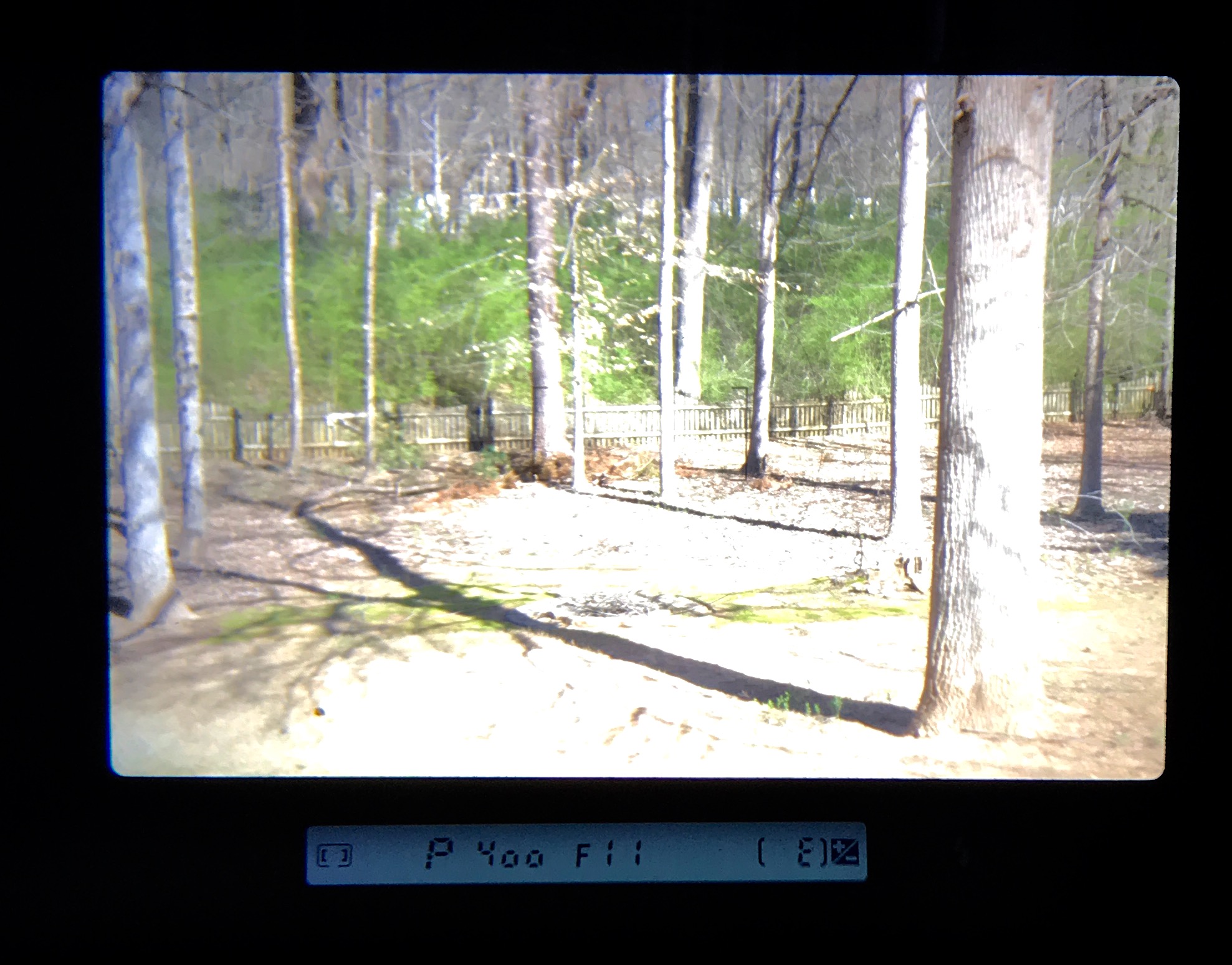
It’s not as good as the high-point viewfinder of the F3, but much wider than the viewfinder of a conventional SLR such as the FE2 – and of course than the narrow viewfinder of APS-C dSLRs. It’s also very luminous, not as much as a modern full frame dSLR (such as a d700), but much more than its Minolta competitors of the nineties. All the necessary information is grouped on a green LCD display at the bottom of the screen. The only significant difference with modern Nikon cameras (and with Minolta cameras from the nineties) is that there is no LCD overlay to show information (such as the area of the image chosen by the auto-focus system) – considering there is only one central autofocus area, it’s not much of an issue.
The information is grouped at the bottom of the screen – it’s less crowded than the viewfinder of a modern dSLR.
Shutter, metering and auto-focus system: The shutter is still at the state of the art (1/8000 sec and flash sync at 1/250). Nikon’s matrix metering was considered the best in the nineties, and it’s still very good. You can trust it most of the time. The auto-focus (a single sensor, in the middle of the screen) is reactive, accurate, and works well in low light situations.
Lens selection and accessories compatibility
Designed for Nikon’s “screw drive” AF lenses (Nikon AF and AF-D lenses), the N90 also works with AI and AI-S lenses – basically, anything sold by Nikon after 1977. The camera can also focus with modern Nikon AF-S lenses (the ones with the focus motor in the lens), and works in Program and Shutter Priority modes with lenses devoid of an aperture ring (most of the current Nikon AF-S lenses). It can’t work with them in Aperture preferred or Manual (semi-auto) mode, because there is no way for the photographer to directly set the aperture. It is not compatible with pre-AI lenses (unless they’ve been converted to AI, of course) and can not take advantage of the vibration reduction (VR) function of the recent lenses.
The N90 was part of Nikon’s line of Enthusiast and Pro cameras, and many accessories (the remote control systems, for instance) are still inter compatible with Nikon’s current Enthusiast and Pro dSLRs. The flash systems are downwards compatible (you can use a recent Nikon flash on the N90, but the opposite is not true).
Fifteen years separate those cameras. But the connectors (PC Sync, Remote) and the buttons (AF settings) are still at the same place.
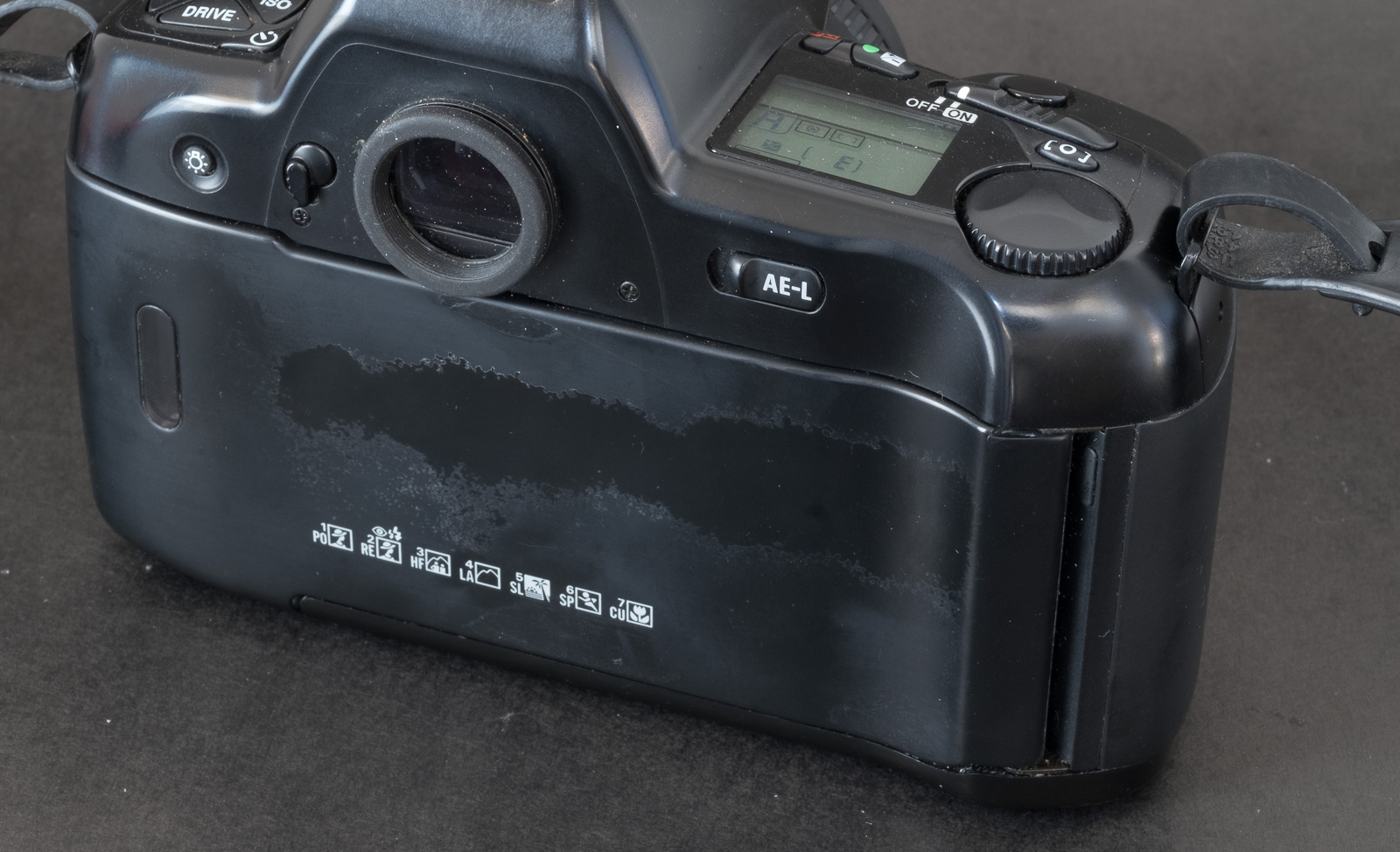
Reliability The N90’s polycarbonate film door was initially covered with a sort of mat soft skin which has a tendency to peel. Rubbing alcohol will take care of it, and will leave you with a shiny, naked camera. Apart from this somehow minor issue, it is a very solid and reliable camera.
Nikon N90s – the film door was covered with a thin soft skin, which is peeling. It’s not specific to this copy – all N90 cameras suffer from this issue at various degrees.
Battery The N90 uses four AA batteries, which are cheap and easy to find, and do not seem to be depleting too fast.
Cost and availability I don’t have production figures for the N90. But the camera was a sales success, had a long production run, and has withstood the test of time pretty well. It is still easy to find. Supply apparently widely exceeds demand, and the prices a incredibly low for a camera of such quality (if you’re lucky, $25.00 buys a good one).
Conclusion: why is this camera so unloved?
Objectively, the N90s is a very good film camera. It has a great viewfinder, you can trust its metering system and its auto-focus. It is solid, reliable, and runs on cheap AA batteries. It’s designed to be used as an automatic camera, but lets you operate with manual focus lenses or in semi-auto exposure mode if you so wish. Why is it so unloved?
Because it’s a tweener. It’s far too modern for some, and not enough for others.
Its predecessor in the eighties, the FE2 and the F3, are simple cameras, with a single auto-exposure mode, average weighted metering and no integrated motor. They offer the minimum a photographer needs, and a few goodies at the top of that (shutter speed and aperture values displayed in the viewfinder, depth of field preview, exposure memorization). Nothing more.
The FE2 and the F3 are the cameras that a photographer will look for when he wants to work on his technical skills, as a pianist would do with his scales.
They will also appeal to photographers who believe that using a simple tool and following the deliberate process it imposes will help them create more authentic, more personal pictures.
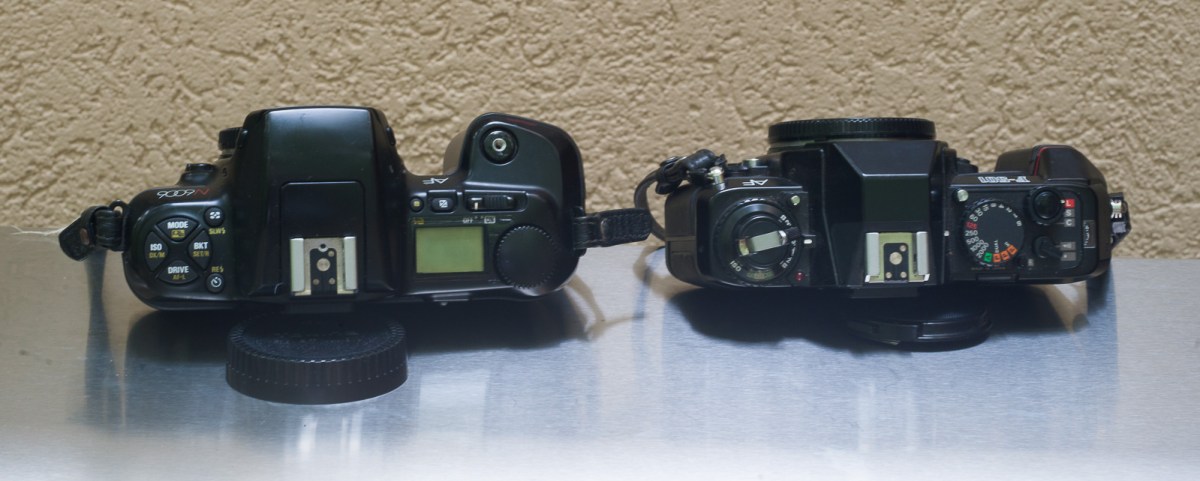
The N90S next to its predecessor of 1983 – autofocus, matrix metering, large long eye-point view finder, modal interface on the left, manual focus, center-weighted metering, and analog interface on the right.
For those photographers, the N90 is already a modern (understand feature bloated) electronic camera. It is not too dissimilar in terms of ergonomics, commands, auto-exposure and auto-focus performance to a recent entry level dSLR – except that you shoot with real film instead of relying on a digital sensor and on film simulation algorithms. The technical difficulties of photography are to a large extent masked: you can shoot for a whole day in the programmed auto exposure mode, with matrix metering and auto-focus, simply concentrate on the composition of the pictures, and still get mostly good results.
Nikon N90s next to a Nikon D700. High end cameras have a built in flash now. It was not the case in 1991.
But the N90’s successor – the Nikon F100 – is even better at producing technically perfect pictures with little human intervention. Manufactured from 1999 to 2006, it is closer technically to the high-end dSLRs that Nikon is selling today (general organization of the commands, meter and auto-focus performance, full support of AF-S and VR lenses). The F100 is a better choice for photographers shooting not only with film but also with a full frame Nikon dSLR – they can use the same lenses and rely on their muscle memory because the commands are so similar between the F100 and a high end Nikon dSLR.
Nikon N90s (front) and Nikon D700 (back). The cameras had the same place in the Nikon hierarchy (just below the top of the line F4 or D3 bodies). With “only” 17 switches or buttons, the interface of the N90S looks simple in comparison to the D700’s.
It relegates the N90S to a narrow niche of film photographers who want the convenience of auto-focus and automatic exposure, the build quality and the viewfinder of a pro-camera, without having to pay to the roof for the ultimate film SLR.
Finding a product name that is not ridiculous or offensive when selling it to international audiences is difficult – there are famous examples of faceplants.
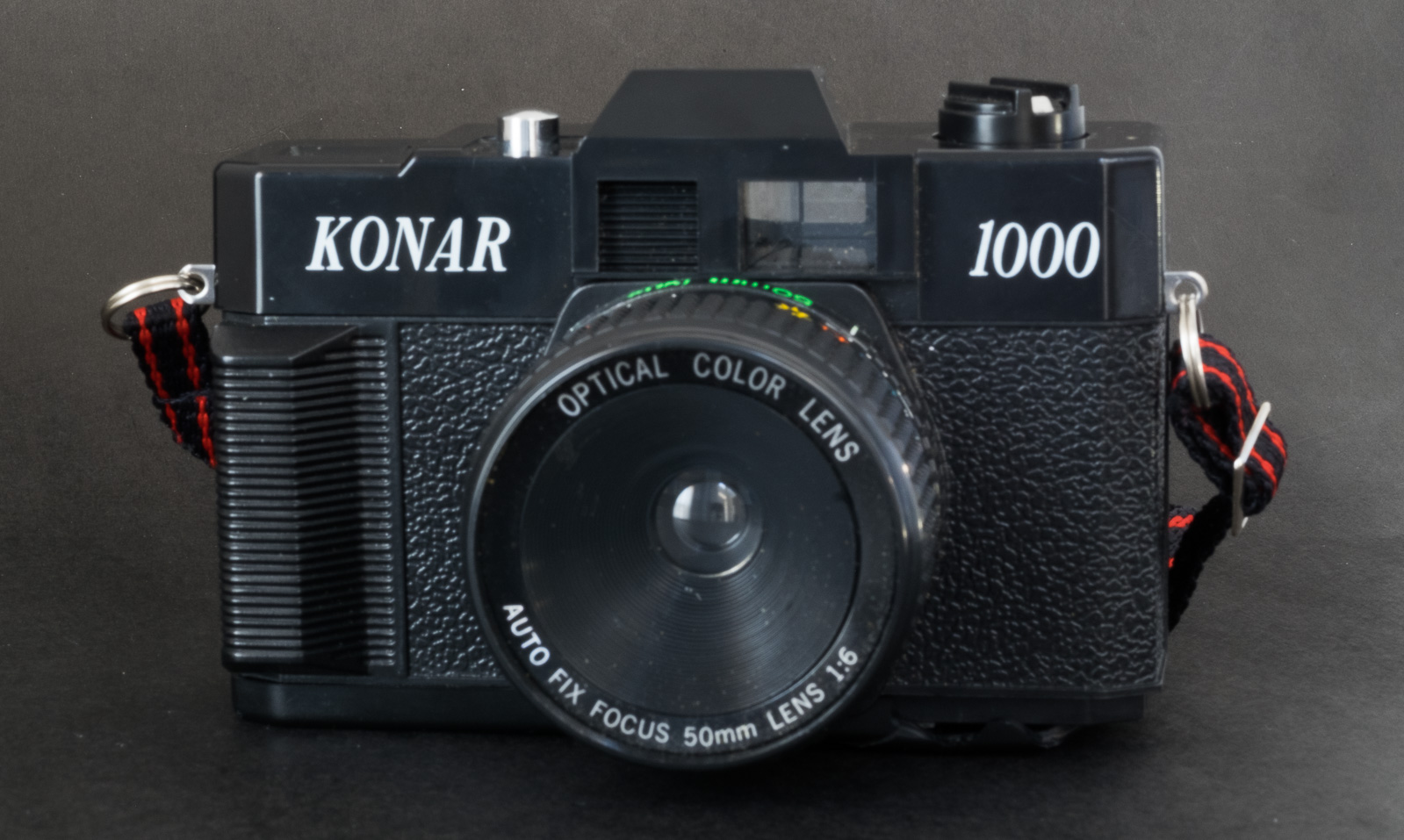
Konar 1000 – a taiwanese camera from 1985.
In the world of cars. Rolls Royce, for instance, has a tradition of naming its cars “Silver-something”, the “something” being a word evoking “ghosts” or “spirits”, in reference to the car that made them famous, the Silver Ghost of 1906.
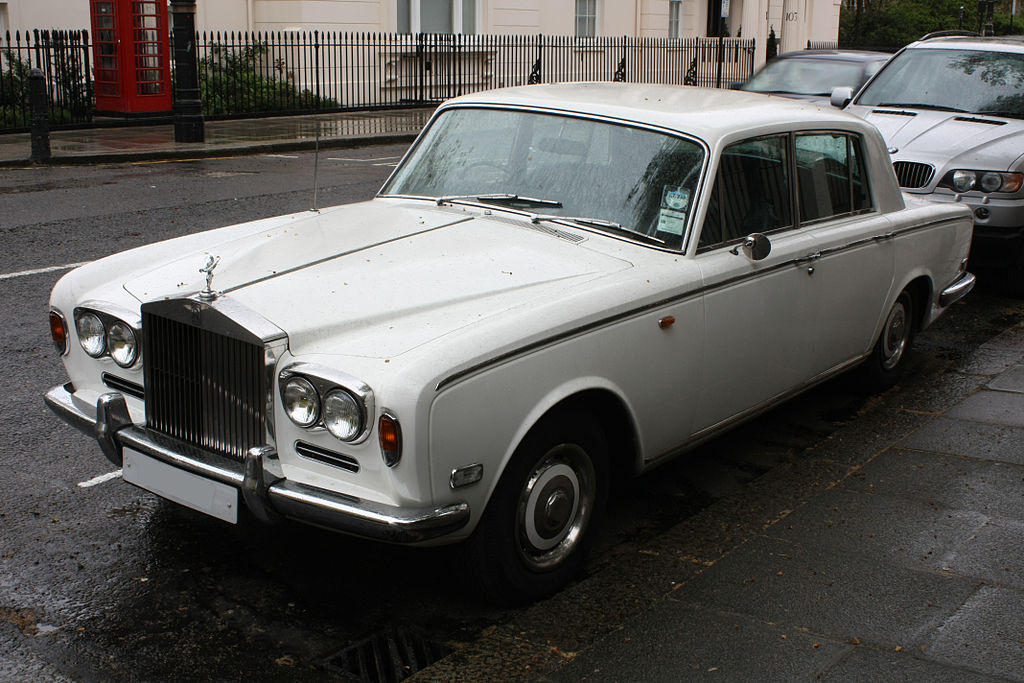
It does not always work that well, though. Rolls Royce’s bread and butter model of the sixties was destined to be named “Silver Mist”, which unfortunately would have translated into “silver manure” in German. Germany was a market of significant importance for Rolls-Royce, and the issue was addressed in time: the model was launched as the “Silver Shadow”, which was better, although not that huge of an improvement. “Shadow” sounding pretty much like “Shade”, the German word for “pity” or “shame”.
Rolls-Royce Silver Shadow – it sounds like “silver shame” in German (Source: wikipedia).
Toyota had the same issue with a little two seater they were selling in the nineties – named MR2 in most of the markets, it was simply named MR in France because MR2, phonetically, would have sounded like “Merde” or “Merdeux” (“Shit”, or “Shitty”).
Cameron lens (Source: eBay)
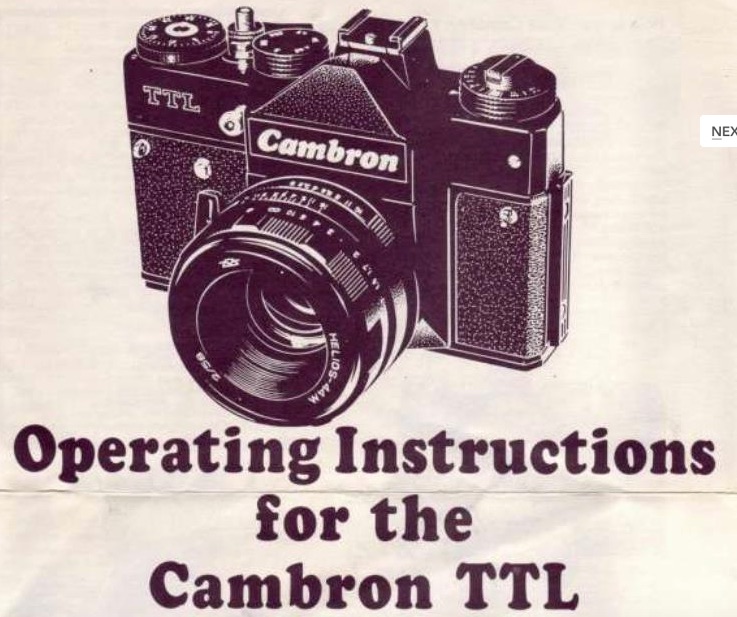
In this country, I was surprised to find lenses named “Cambron” – the private label of the Cambridge Camera Exchange store, in New York. They even had their own private label camera, the Cambron TTL, manufactured in the USSR by KMZ and sold all other the world as the Zenit TTL.
Cambronne was a general in Napoleon’s army at the Waterloo battle – when asked to surrender, he famously shouted what is still known in France as the “word of Cambronne”, “Merde!” (a word which in addition to meaning “shit” – as Toyota’s marketing department had found out – is also used in French to convey exasperation – a very impolite form of “go to hell”).
I would have liked to find a Cambron TTL – I found a Konar instead….
Speaking about French, a rather strong insult in that beautiful language is “connard” [pronounce ko-nar]. A “connard” is a despicable man, at the same time profoundly stupid, petty and mean. “A.. H..e” would probably be a good translation in modern English.
As I could not find a Cambron TTL, my consolation prize was a Konar 1000 – a very simple point and shoot camera with the looks of a SLR. The trademark belonged to a “Selectdirect Inc”, and has been available since 1987.
No comment
You could understand that a small photo equipment store in New York, NY or a company importing $1.00 cameras for the US market would not be bothered with checking what a name like Cambron or Konar meant to French people, but what about a large company with a global presence like Ricoh. In addition to their “Rikenon” lenses, they also sold a line of entry level lenses named “Riconar” – which in French sounds literally like the imperative form of “to laugh”, followed by an insult: “Laugh, A.. H..e”, what a name for a product.
What does a Konar look like?
When I found a Konar 1000 camera on Shopgoodwill.com, I had to have it.
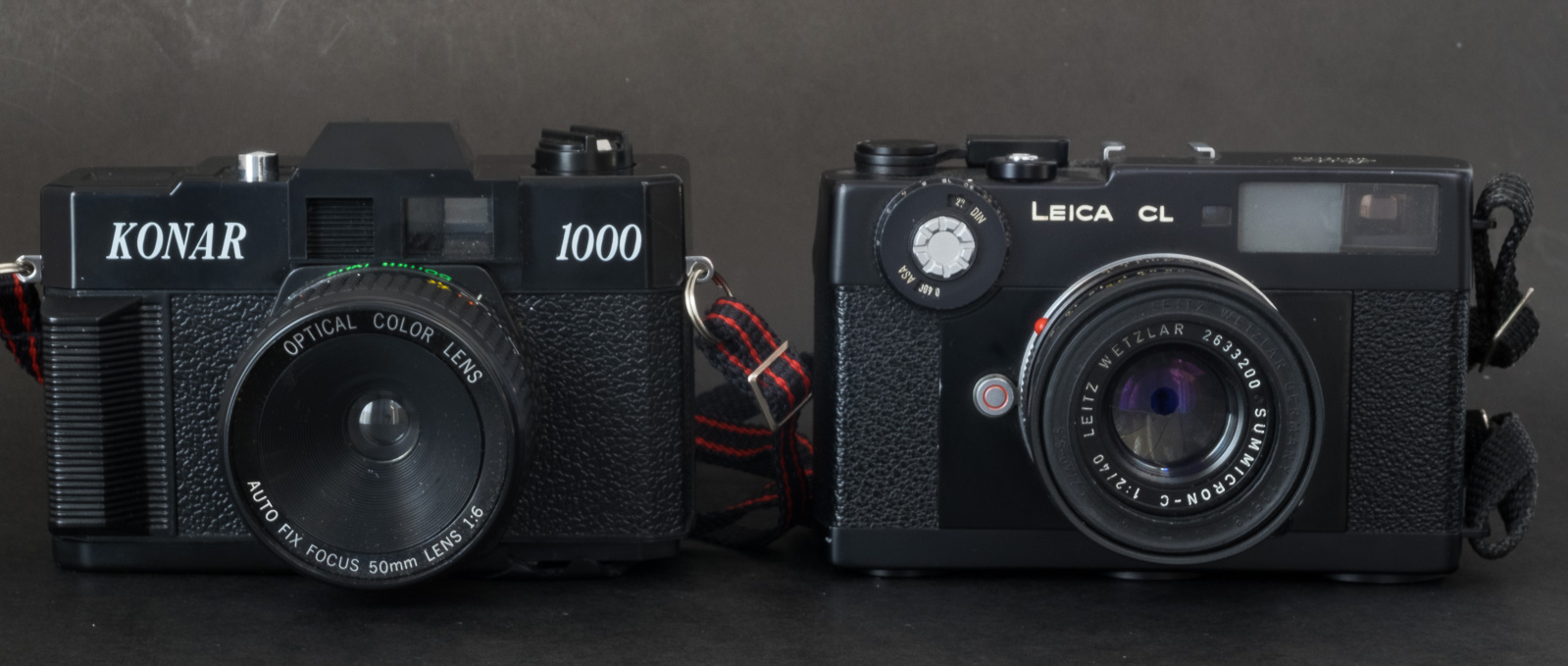
The Konar 1000 is one of those ultra-simple cameras that look – from a distance – like a “real” rangefinder – it even has a small hump where the viewfinder of a reflex camera would be to add to the confusion. It was made in Taiwan in the mid eighties, was also sold under names such as Capital MX II or Ultronic, and was often given out for free with a magazine subscription (the Time Kinetic camera) or after a visit to a casino (there is a golden Caesar’s Palace version).
Konar 1000 – with Auto Fix Focus lens (!)
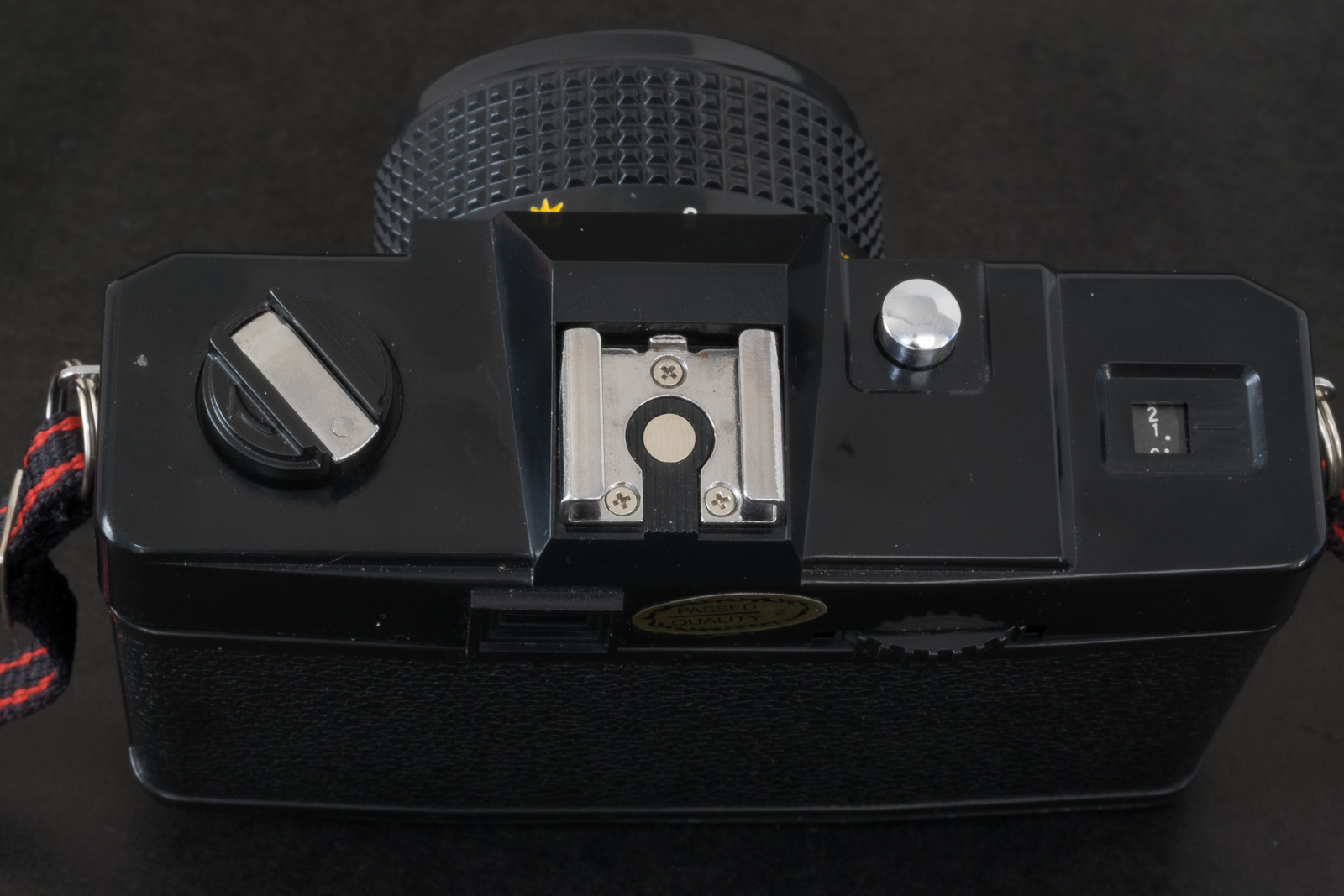
Technically, they’re all the same, and to my surprise, they’re real, functional cameras. They use 35mm film, have a single element fix focus lens (plastic, of course), and a single speed shutter. The aperture can be set at F/6, F/8, F/11 and F/16, but there is no metering or auto-exposure mechanism. The flash hot shoe is functional and the viewfinder – usable.
Konar 1000 and Leica CL – the Konar looks like a real camera.
All in all, it does not look any worse than a Holga – and judging by pictures published by users of Capital MX cameras on Lomography.com, the results are somehow OK, considering the lens is a piece of plastic.
Buying a Konar?
They’re no Leica, they’re no Nikon, and have a very limited usage value. Objectively, considering you can get a Nikon autofocus SLR for $3.50, the value of a Konar should be expressed in cents, not in dollars. But sellers won’t be bothered selling a camera for 10 cents, so you’ll have to pay a few dollars to get one. In any case, shipping, packaging and handling costs will exceed the cost of the camera itself.
Konar 1000 from above – film rewind crank, functional hot shoe, exposed view counter on the right – it’s a real camera.
The same should be true for Cambron lenses – in theory a manual focus trans-standard zoom from the seventies sold under a distributor’s label is virtually worthless. But surprisingly, there are still people willing to engage on a bidding war to get one.
The Konar 1000 at full aperture (F/6). The aperture is set by a sliding blade located at the back of the shutter.
Konar 1000 – the aperture is now set at F/16. The slit in the sliding blade is now much narrower.
I briefly introduced the D700 in a recent post from the perspective of a collector and regular user of Nikon film cameras. Let’s see now how this ten year old dSLR compares with recent mirror-less cameras.
Impressive image quality, impressive white balance, impressive auto-focus
I’m not equipped to test a dSLR, and, honestly, I lack points of comparison. So I will just share a few thoughts.
The d700 – one button or dial per command – an informative top plate LCD, and hundreds of options in the menus
Firstly, for a photographer used to Nikon dSLRs (I’ve had a D80 as my primary camera for almost 10 years until I switched to a mirrorless system), the D700 is very easy to apprehend.
It’s a conventional motorized auto-focus single lens reflex. There are more knobs, buttons and switches than on an enthusiast camera, the menus offer more options and a much greater level of customization, but the D700 is a camera a nikonist will feel immediately comfortable with, without having to spend too much time buried in the manuals.
Nikon D700 – a pro-camera with a very useful built-in flash (it controls Nikon’s cobras remotely)
Secondly, it’s a big and heavy camera. More than three pounds if equipped with a light prime lens or a consumer-grade zoom, almost five if equipped with one of the f/2.8 wide angle or trans-standard zooms that the pros love to use.
Thirdly, its performance is still impressive for a ten year old camera. Admitedly it’s only a 12 Megapixel camera, but when it comes to overall image quality, dynamic range, white balance, auto-focus speed and exposure accuracy, it still holds its rank compared to recent mirrorless cameras.
The D700 – still the ergonomics of a conventional auto-focus SLR
Use a modern mirror-less camera and a D700 side by side – and it’s immediately obvious that the D700 is much closer to Nikon’s last auto-focus SLRs of the film era than to a Sony A7 series or a Fujifilm X-T2. And I’m not even considering the size.
An electronic viewfinder (here the Fujifilm X-T1). It shows the picture as “seen” by the image sensor, and as it will be exposed. Information (like the artificial horizon or the histogram) can be overlaid if the photographers so chooses.
Modern mirrorless cameras have been designed to let the photographer not only frame but also visualize the image as it will be exposed directly on the big LCD monitor at the back of the camera, or in a high-resolution electronic viewfinder.
Sony and Fujifilm cameras have a large exposure compensation dial at the right of the top plate, just under the thumb of the photographer – who can adjust the exposure values based on what is shown on the screen. The LCDs are now good enough to render accurately variations in exposure, contrast and image density as the photographer plays with the settings, and in difficult lighting situations, it’s extremely helpful. What you see is really what you will get.
The top plate of a mirror-less camera (Fujifilm x-t1). The exposure correction dial is large, and is easier to get to than the shutter speed knob. Note the Wi-Fi button, absent from the d700.
On the D700, the viewfinder, being optical, can not show the image as it will be exposed. And if the photographer plays with the exposure compensation settings, he will have to take one picture and then play it back to visualize what the corrections did to the images.
The D700 has a Live View mode, but it’s very primitive and can’t help with the exposure. It’s slow and relatively loud (the mirror first has to be lifted to clear the way to the sensor). The lens is locked at full aperture, and changes made to the exposure parameters (aperture, shutter speed, exposure compensation) are not reflected on the LCD, and the depth of field can not be pre-viewed. Lastly, the LCD monitor is fixed, which further limits the usefulness of Live View – it still is difficult (acrobatic) to frame a picture with the camera close to the ground, or above the heads in a crowd.
Live view 1.0 – it helps when working on a tripod (a detail of the image can be enlarged to facilitate focusing). But the LCD is fixed, and does not show the picture as it will be exposed.
ISO settings
The other difference is what you do with the ISO settings. The best cameras have reached such a performance level (almost no noise up to 6,400 ISO) that they can be left in Auto-ISO mode if the photographer so wishes. Instead of considering the ISO value as a constant and the shutter speed and the aperture as the variables (like in the old film and early digital days), photographers can – for a given scene – set the aperture and the shutter speed to get the depth of field and the movement freeze they want, and let the camera adjust the ISO value to get to the right exposure. On cameras such the Fujifilm X-T1 for instance, it is as easy to adjust the ISO value that it is to adjust the shutter speed, if you don’t want to rely on auto ISO. It’s not that the D700 could not be configured to react like a X-T1 (it supports Auto-ISO and you simply have to press the ISO button on the top plate to change the sensitivity with the control wheel), but it’s not a natural way to operate the camera.
Compact Flash reader and laptop required
Lastly, I have come to expect from a digital camera that it connects to a smart phone or a tablet over wi-fi, in order to edit and share jPEG pictures on the spot.
The D700 does not support Bluetooth or WiFi natively (it’s a camera from 2008). Eye-Fi cards (memory cards with a built-in wi-fi adapter) don’t exist in the Compact Flash format used by the D700. An optional Nikon branded adapter is available (Nikon Wireless Transmitter WT-4), but it costs more than what I paid for the camera. And when laptops have a slot for a memory card, that’s for an SD card, not for a Compact Flash.
For all practical purposes, this D700 will remain tied to a conventional PC based workflow – and a traveling photographer will have to carry a laptop and a Compact Flash reader in addition to the camera (and find an Internet connection) if he/she wants to edit, publish or backup pictures while on the road.
Focusing with manual focus lenses
The focusing screen does not offer any of the focusing aids of a conventional manual focus camera (no micro-prism, no split image rangefinder), and no other focusing screen is available from Nikon. When a manual focus lens is mounted on the camera, the auto-focus system is still providing information to the photographer (a green dot in the viewfinder when the lens is focused on the subject), and if the camera is installed on a tripod, you can use Live View and zoom into the image to check if the image will be in focus. But you don’t have any of the fancy manual focus assist systems (Zebra, Focus Peaking, Digital Image Split) of modern mirror-less cameras.
With a manual focus lens, the photographer can still chose the focus area (the black rectangle) and the green dot at the left of the LCD display indicates that the picture is on focus. No other focusing aid is available in the viewfinder.
That being said, the focusing screen is luminous, very fine, and the viewfinder is large (it’s a full frame camera, remember): when it comes to coverage and enlargement it sits somewhere between a N90 and a F3 HP. Getting the focus right with a wide-angle or standard lens does not seem too difficult, even without the focus assist modes.
Nikon D700 – on a digital reflex camera, the photographer will see the image as it comes from the lens, but can not visualize how the sensor and the electronics of the camera will record it before the picture is taken (here with a Nikkor 50mm f/1.8 AF-D mounted on the camera)
Full frame digital – dSLR or mirror-less?
As I’m writing this article (early 2018), the cheapest way to shoot “full frame” is to use second hand dSLRs such as the Canon 5D or the Nikon D700.
Shooting with conventional dSLRs with an optical viewfinder still has its benefits: the optical viewfinder is much easier on the eyes in bright light, the autofocus of dSLRs is still faster and more reliable, and the battery life far superior. If you compound that with Nikon’s decades of experience serving the most demanding professional photographers, and a line of auto-focus lenses built over 30 plus years, you understand why their dSLRs still win comparative reviews when opposed to mirrorless cameras (check DPReview‘s end of the year Buying Guides: Nikon D7500 – best camera under $1,500, Nikon D750 – best camera under $2,000, Nikon D850 – best camera over $2,000).
DPReview may still prefer dSLRs to mirrorless system cameras, but there’s no denying that mirrorless cameras bring unique advantages: you can use indifferently the electronic viewfinder or the LCD monitor to compose your pictures, and you will visualize how the picture will be exposed before you shoot. I had never used the exposure compensation dial on any camera before, because I never knew if I had to set it to +.5 or -.5 or whatever to get the exposure I wanted – I simply used to switch the camera to the manual exposure mode. On a mirrorless camera, exposure compensation becomes extremely easy to use because you see what it does in real time, not after the fact.
Non-CPU lenses (namely manual focus AI and AI-S lenses) can be preconfigured in the camera – the camera will base its matrix metering exposure on the actual focal length and the actual aperture of the lens – which should make it more accurate.
Nikon D700 – when a manual focus lens is pre-configured in the camera, its actual F aperture value is displayed on the LCD (instead of the number of stops above full aperture).
Nikon and Canon are both widely rumored to be launching full frame mirror-less systems in the coming months. Because they’re late entrants on this market, Nikon and Canon can’t be content with “just average” cameras – you can expect their future mirror-less systems to raise the bar of performance to a level not yet reached by Olympus, Fujifilm or Sony. If they manage to preserve a good level of compatibility with their traditional dSLRs systems, many of their faithful customers will rapidly add one of the new mirrorless models to their equipment bag. And it’s likely that the DPReview’s Buying Guides will put forward very different winners at the end of this year.
As for the D700,
it’s a very satisfying camera to use. Like the Nikon F3 in the world of film, it’s a unique opportunity for an amateur photographer to shoot with a tool built for professionals, but still of a manageable weight, size and complexity.
I don’t use my F3 that often, but taking pictures with a camera of such a build quality, with such a great viewfinder is an experience I enjoy from time to time. I suspect the D700 will follow the same path – I’ll shoot with a smaller and lighter APS-C mirrorless camera more often – when traveling in particular – but will go back to the D700 when I need to shoot digital, but still want to use my old Nikkor lenses and enjoy the true Nikon SLR experience.
How does a d700 compare with an entry-level APS-C dSLR such as the Nikon d3400, which can be had more or less for the same price?
only d700s with hundreds of thousands of actuations sell in the same price range as a new d3400. The d700 is a very solid and reliable camera, but buying a used d700 is riskier and could lead to high repair costs.
compared to the d3400, the d700 is a large and heavy camera, which will need larger, heavier and much more expensive full frame lenses.
the d700 is an old camera – it still requires to be used in a traditional workflow (Compact Flash cards instead of SD cards, no Bluetooth, no WiFi). Not that the d3400 fares particularly well in that regard – it also lacks WiFi, and neither the d700 or the d3400 have an articulated lcd monitor on the back of the body.
On the other hand,
The choice of lenses is limited on the d3400 (no wide-angle prime lens, only zooms). No such issue with the d700.
If you’re planning on using lenses of the film era (AI, AI-S, AF and AF-D lenses), the d700 is also a much better pick: it can meter with any of those lenses, it can auto-focus with conventional “screw-drive” auto-focus lenses, it does not “crop” the image, and its large viewfinder makes manual focusing easier.
regarding image quality, DXOmark, – for what it’s worth – rates a d3400 at 86, and a D700 at 80. Not everybody agrees with their methodology, but in their world the d3400 with a 24 Megapixel APS-C sensor and a dynamic range of 13.9 EVs is rated higher than a d700 with a full frame 12 Megapixel sensor and a dynamic range of 12.2 EVs. Interestingly, the d700 still leads in the high ISO race – they consider it’s usable up to 2,300 ISO, while a d3400 will peak at only 1,200 ISO. The benefit of the full frame imaging sensor, and of its relatively low pixel density.
Max – Nikon D700 – Nikon 135mm f/3.5 AI – 1600 ISO – 1/60 sec.