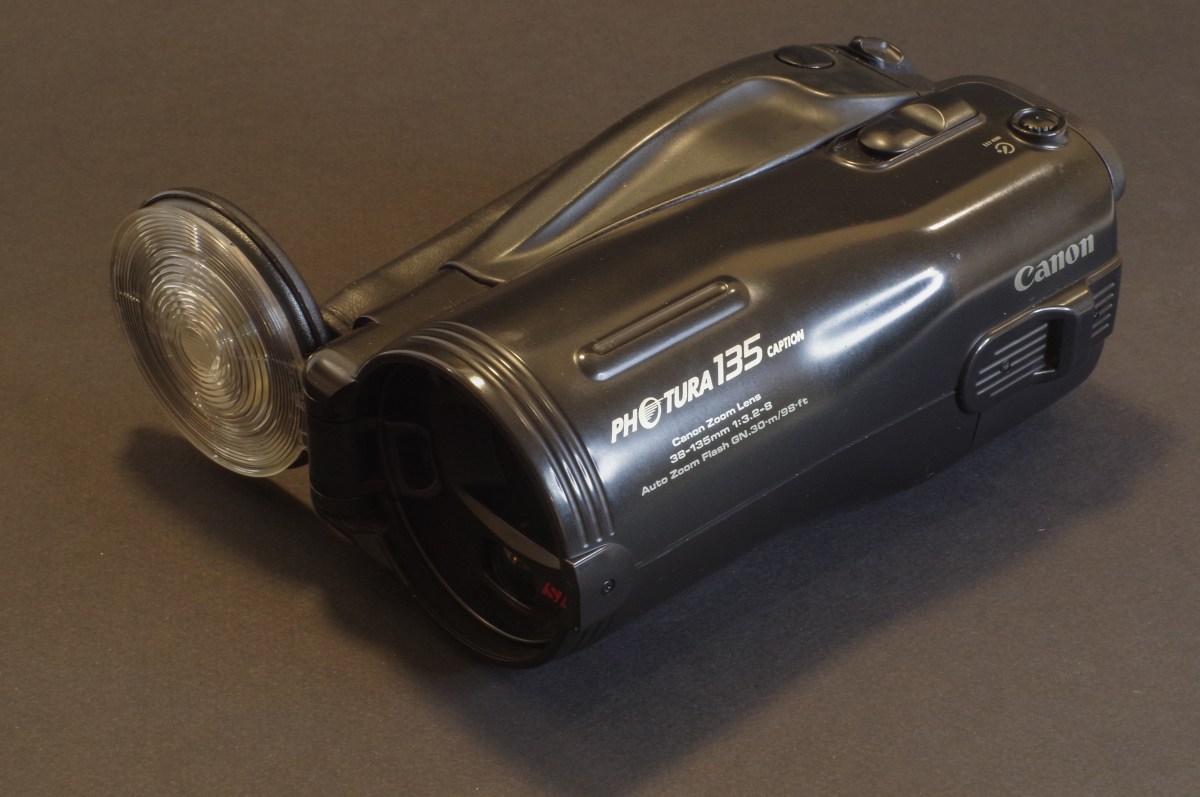
Doubling down on a strange camera – the Canon Photura 135 Caption

I don’t know much about the genesis of the first version of the camera sold by Canon under the names of “Photura”, “Epoca” or “Autoboy Jet”. Being a profoundly original camera (which, because of its unusual shape, probably required some very specific tooling in Canon’s manufacturing plants), I can only guess that the version 1.0 was not rushed to market but was the product of a long and well thought out development process instead.

Case in point, the model that replaced it two years after its launch, the Photura 135, was not that different from the original. It simply addressed some of the weaknesses of Photura 1.0, and its two main points of differentiation over its predecessor were its longer zoom (a 38-135mm instead of the 35-105mm of the first Photura), and the color of its body.

I had been so pleasantly surprised by the first series Photura when I had tested it in the Cabbagetown neighborhood in Atlanta, that I decided to bring it with me to a trip in Corsica, where it did not disappoint, for the most part.
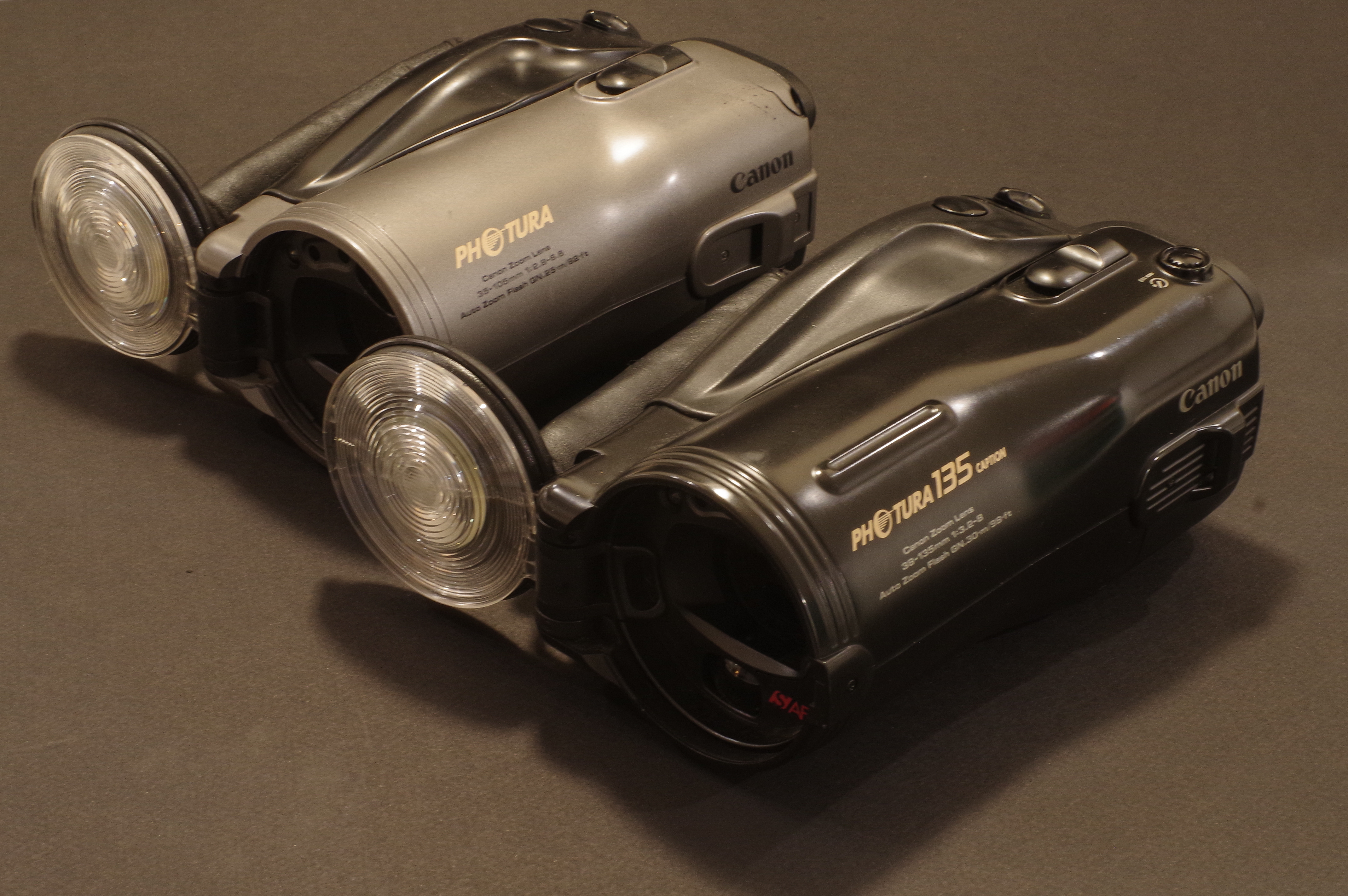
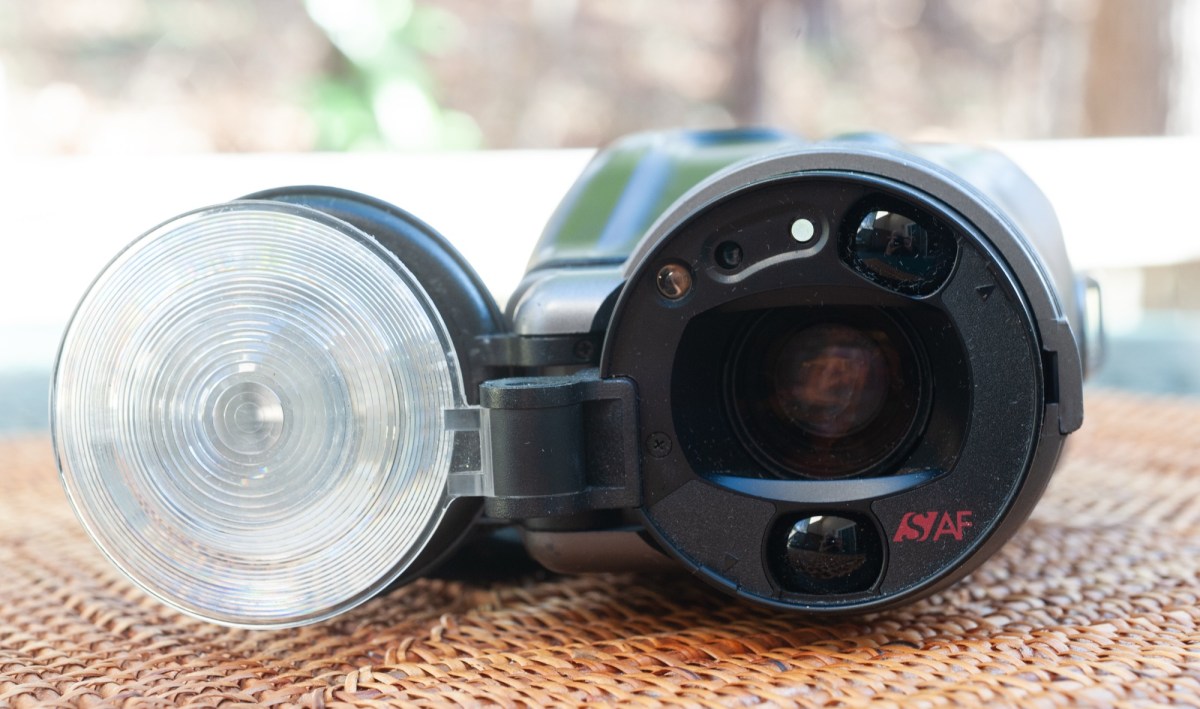
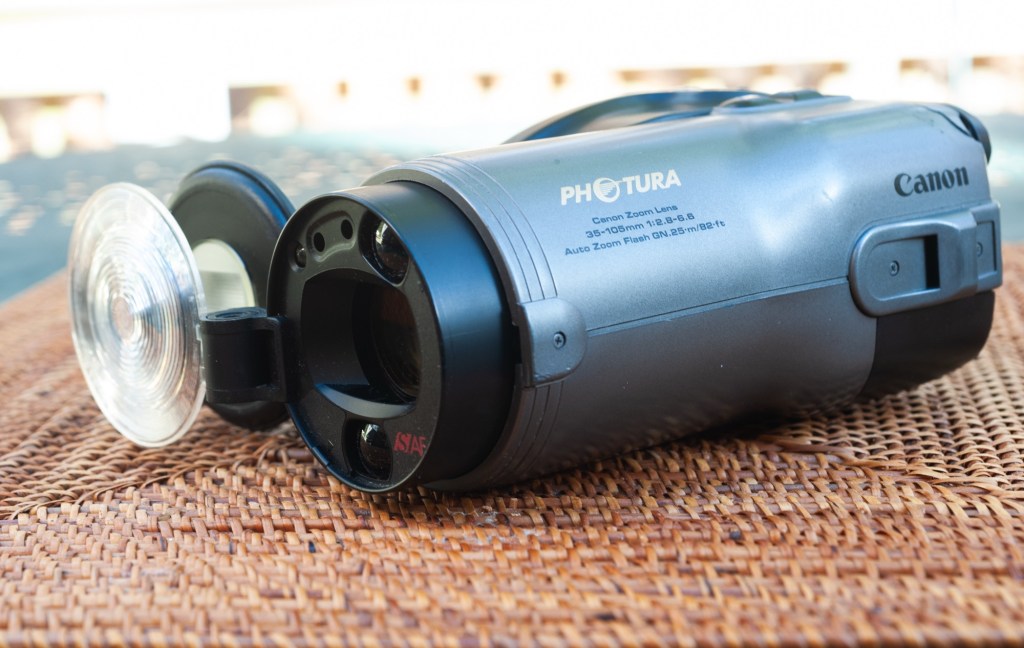
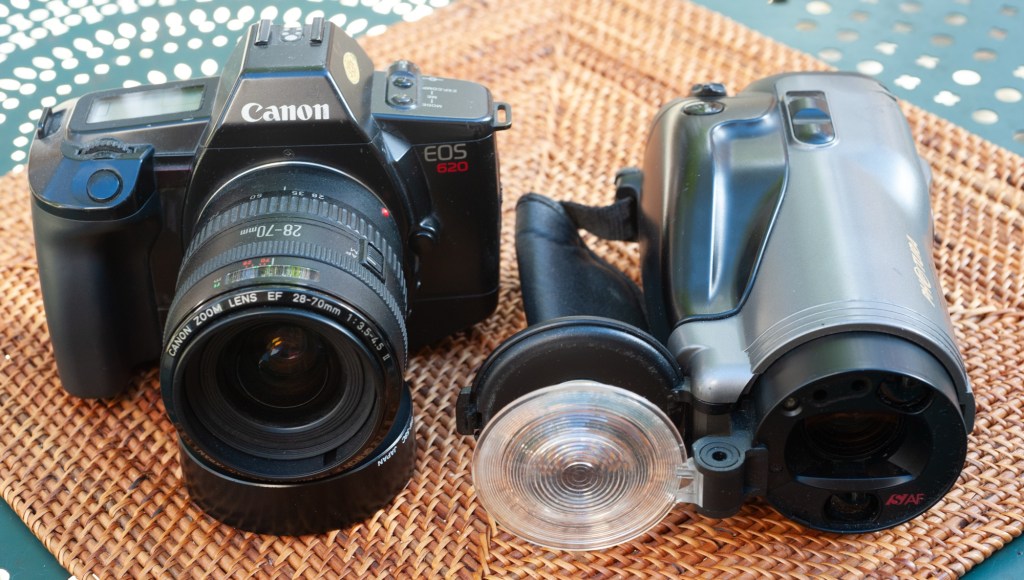
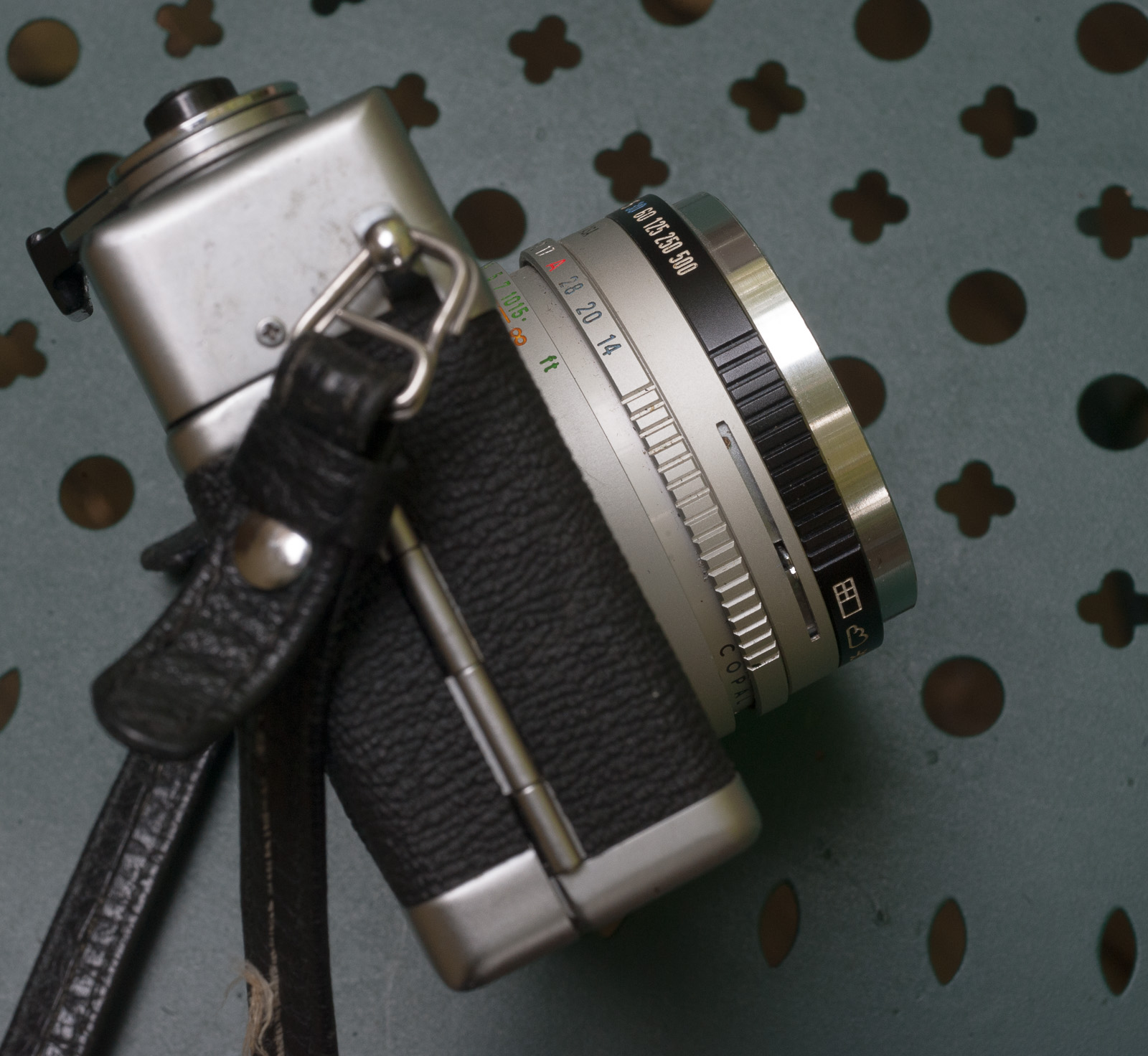
Canon Photura 135 next to the first Photura – the 135 is painted satin black and bit longer to make room for the 38-135 zoom

In spite of its size, I found it easy to store in a bag (it’s shaped like a tube, at the opposite of the normal SLR shape, which is more like a long a tube attached to a large brick). It’s easy to keep your right hand wrapped around it when walking around town, and it’s fairly reactive for an autofocus point and shoot. The color pictures I had taken with it in Atlanta had impressed me (the exposure and the focus were tack on, the colors pleasant), and most of the B&W pictures I shot in Corsica and in the Riverside neighborhood happened to be pretty good as well.

My biggest gripe with the first Photura was that it its autofocus system was still very primitive, incapable of focusing on its own on a human being when held in portrait orientation (it needed a complex gymnastic to memorize the focus before re-framing). It also required the photographer to force the focus to infinity when shooting landscapes (by pressing a tiny rubber key at the back of the camera while pressing the shutter release). And the camera missed the exposure in some tricky situations.
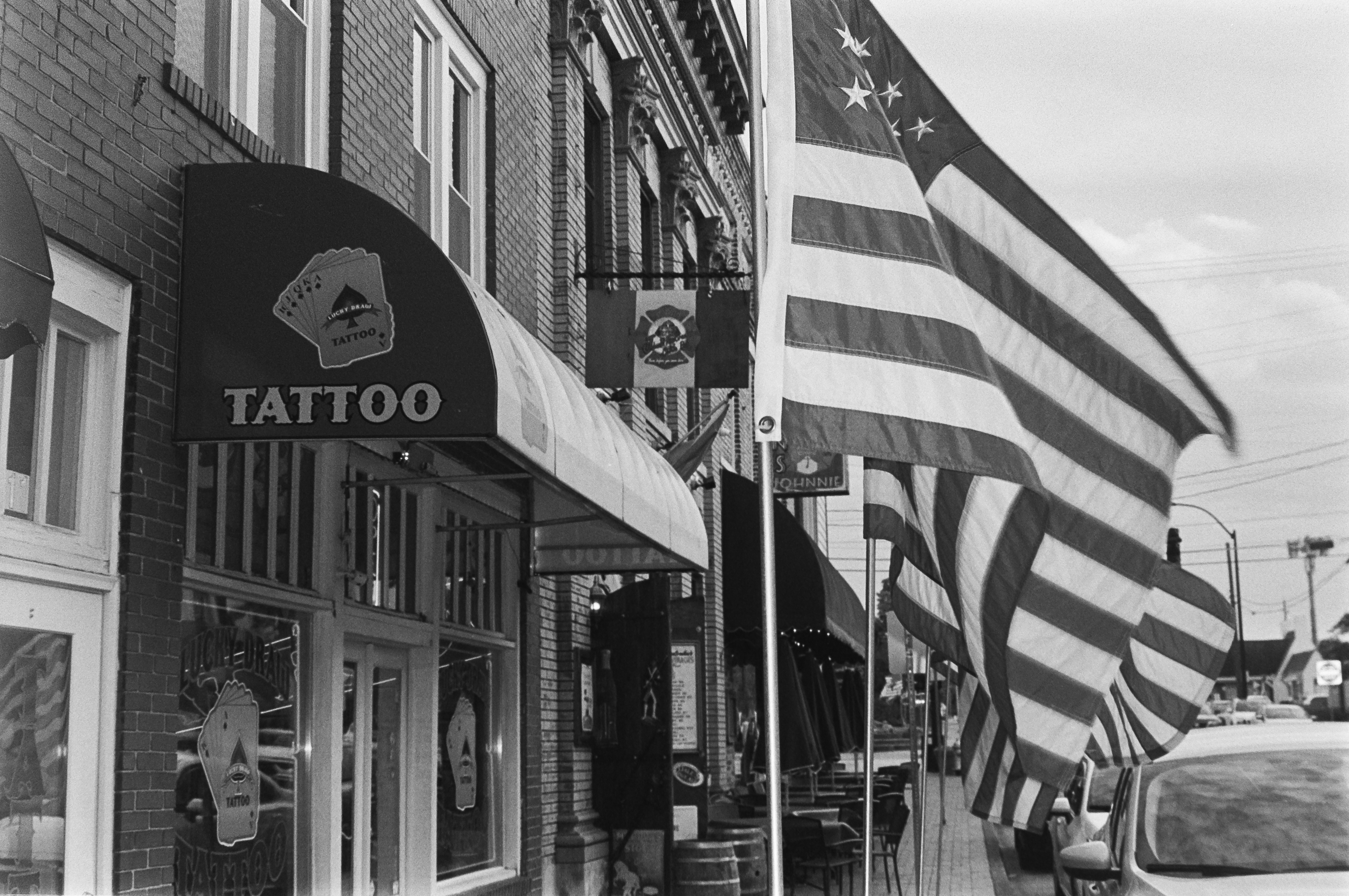
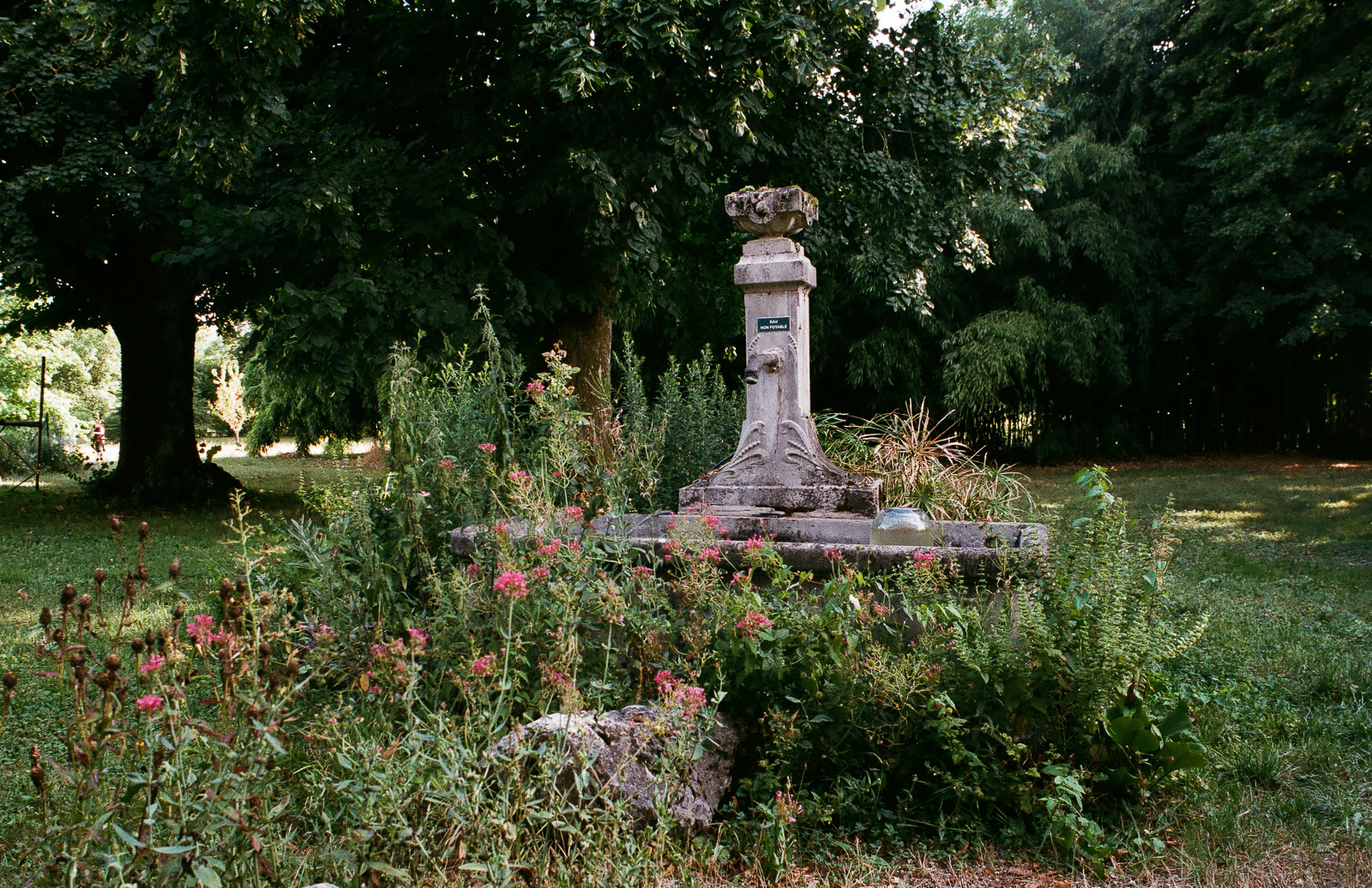
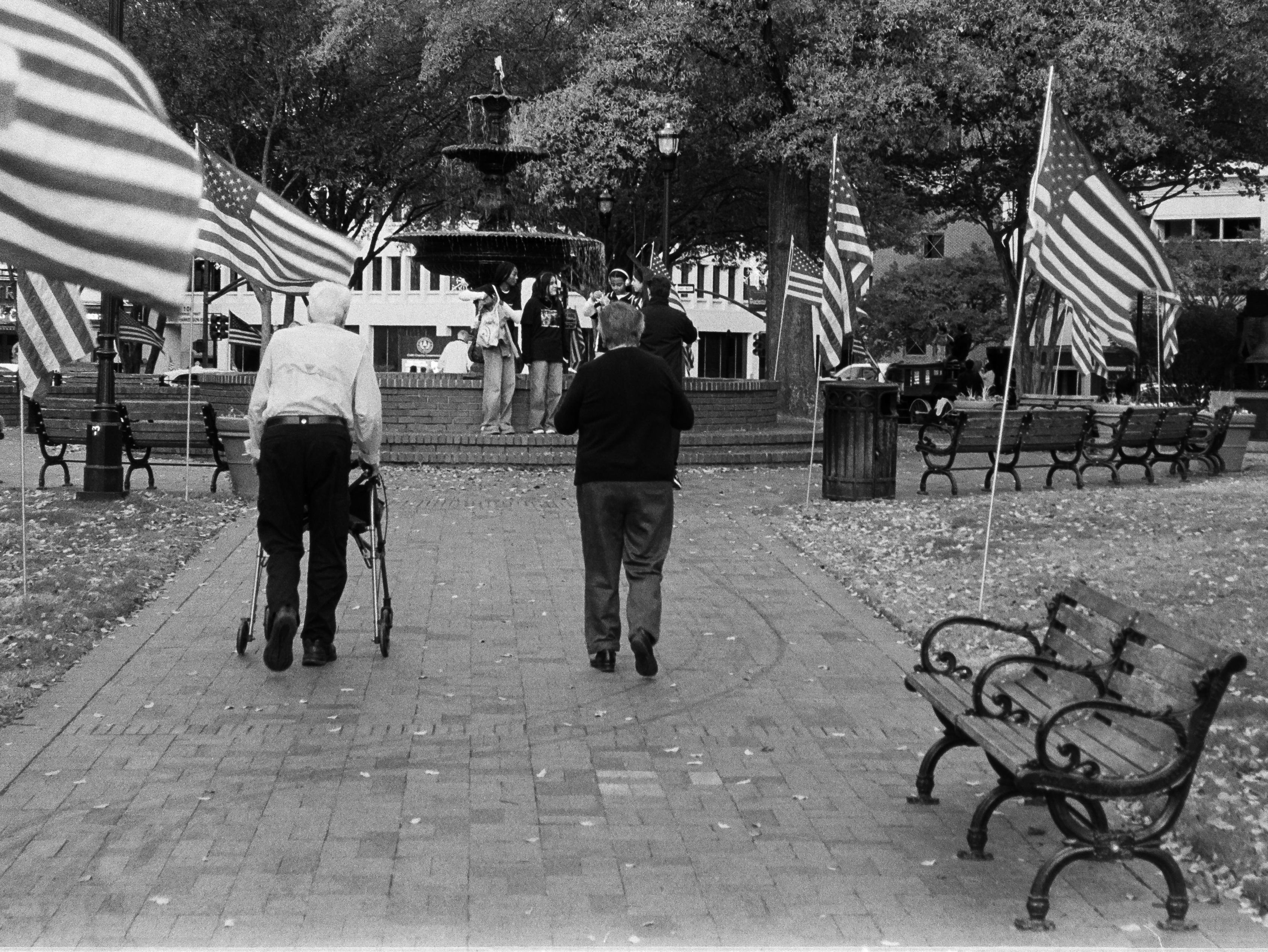
Canon Photura 135 – Ilford HP5 – Marietta, Veterans Day 2025

The Photura 135 Caption

This “Canon Photura 135 Caption” is another of my Shopgoodwill finds – there were two of them for sale the week I bought it, and only one bidder, me. I picked what I believed was the nicest of the two for $19.00.

Canon created at least three different variants of the Photura 135, the “Base”, the “Caption” and the “Panorama”. Mine is a “Caption”. It can print the date or a choice of 5 messages on the negatives. Cool!

Contrarily to my Photura 105 which was a bit scruffy, this “135 Caption” is in a very good shape, cosmetically. And it’s finished in satin black, with pale, matt gold lettering. It may sound tacky, but it’s done with restraint, and the camera is rather pleasant to the eyes.
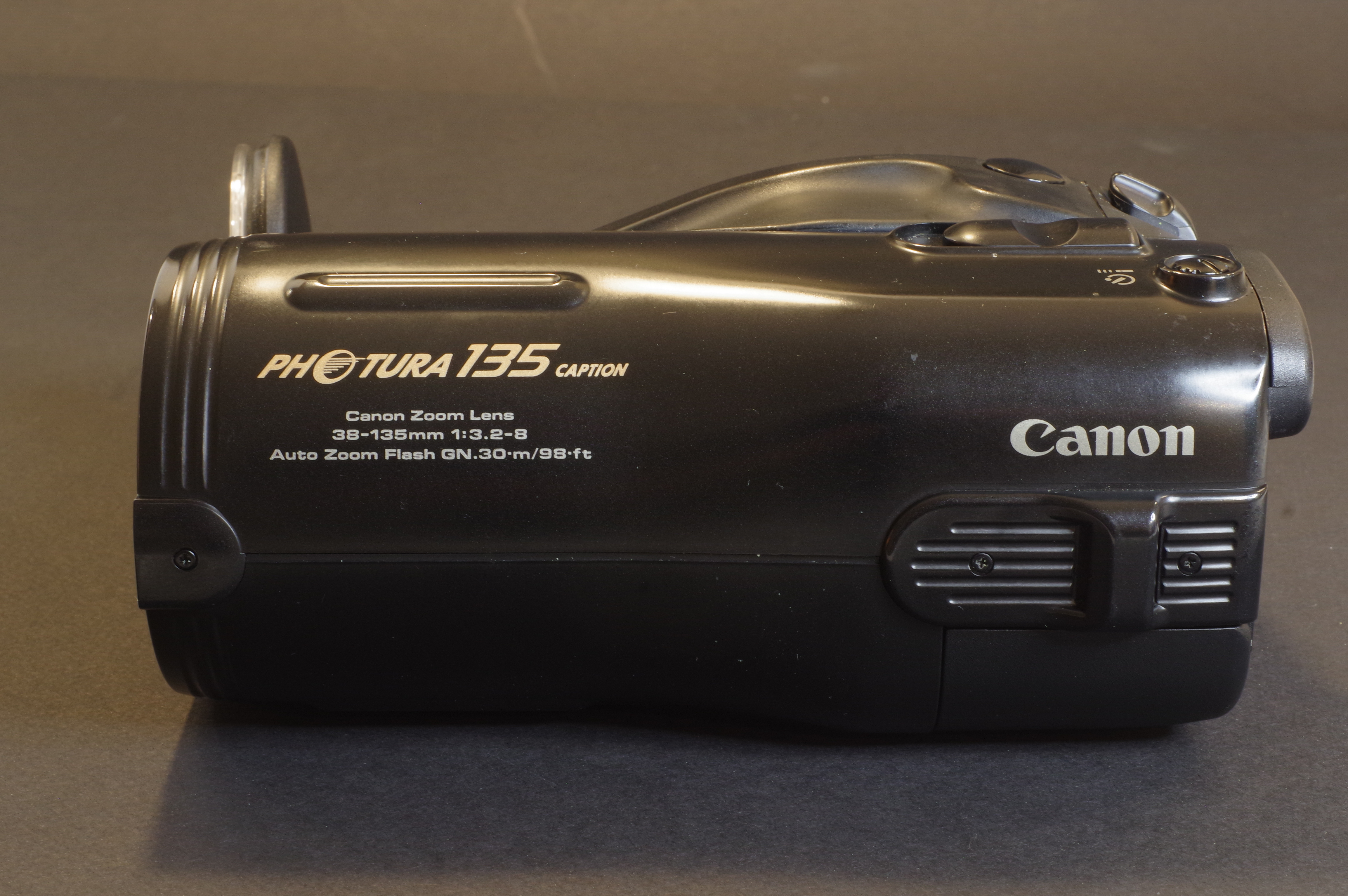
Canon Photura 135 – the specs are listed on the body of the camera

The Photura 135 is marginally longer than the 105, no doubt because of its longer zoom. I’m not sure that extending the longer focal length is a benefit, though, as we’re losing a bit on the wide angle side (38mm instead of 35mm) and a lot when it comes to luminosity – the largest aperture of the lens varies between 1/3.2 at 38mm and 1/8 at 135mm – which makes shooting with 400 ISO film almost mandatory.

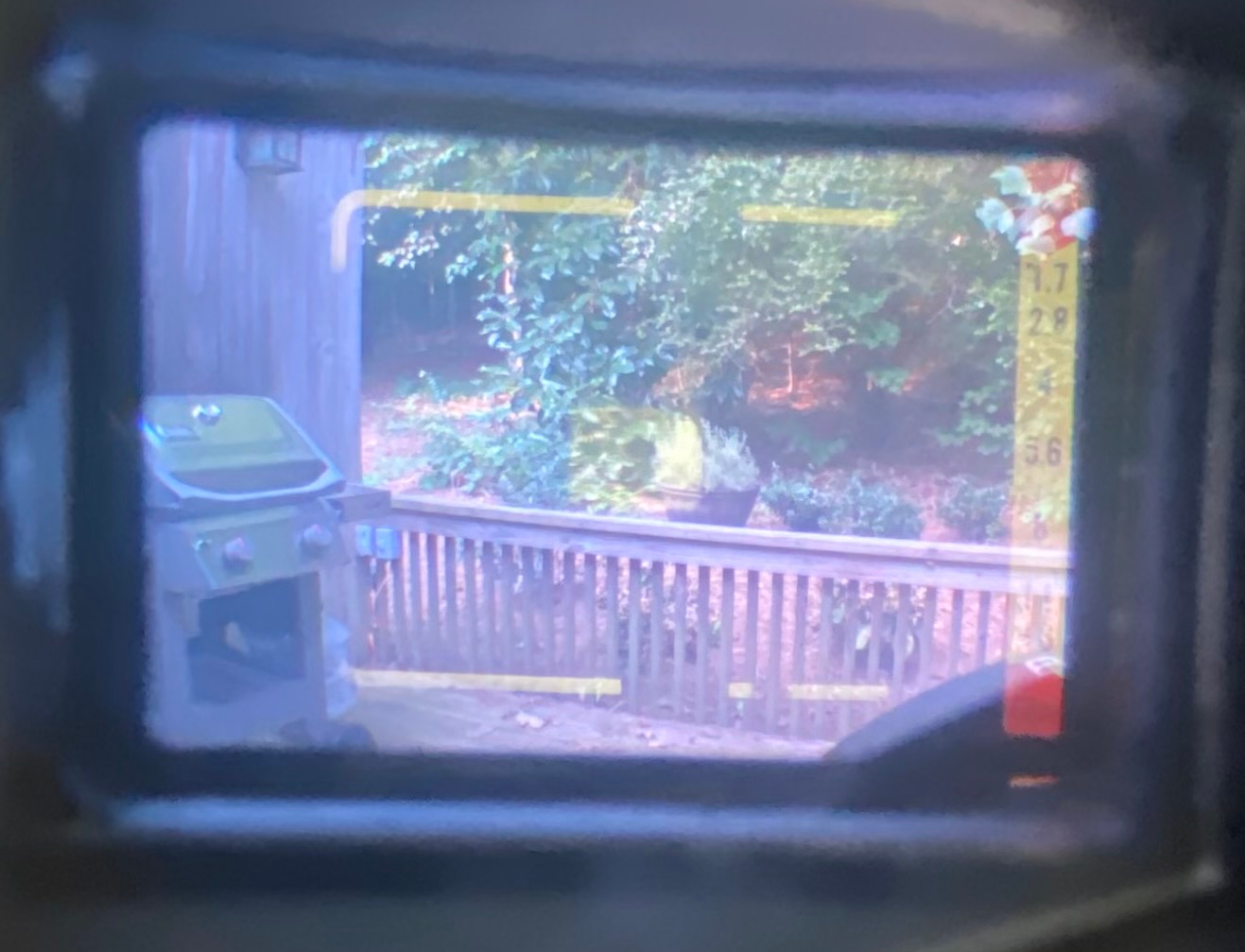
The autofocus system seems to have been improved : the AF frame is visibly larger in the viewfinder, the button to force the focus to infinity has disappeared, and according to the documentation, it now relies on 5 infra red detection beams (!).
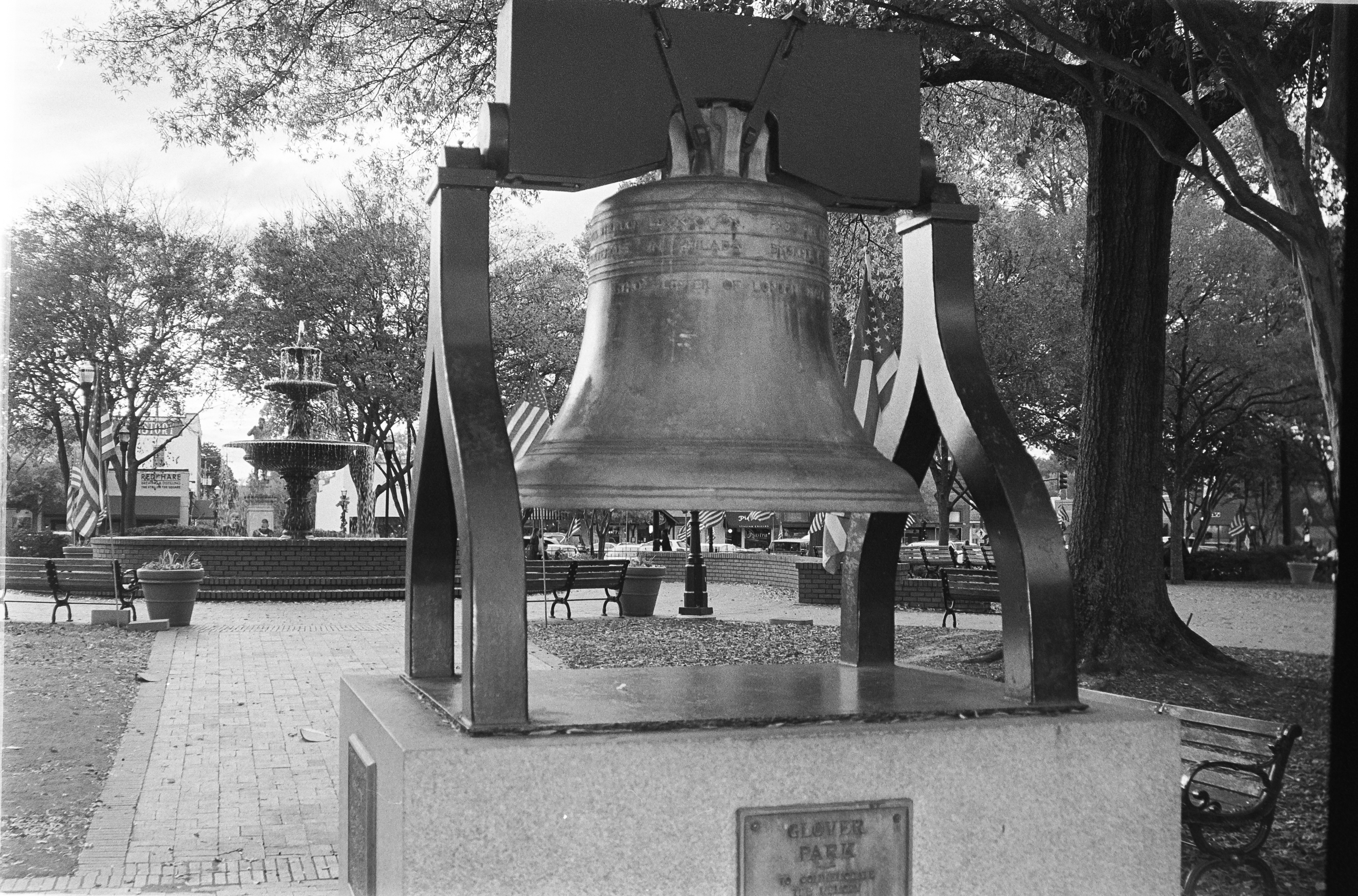
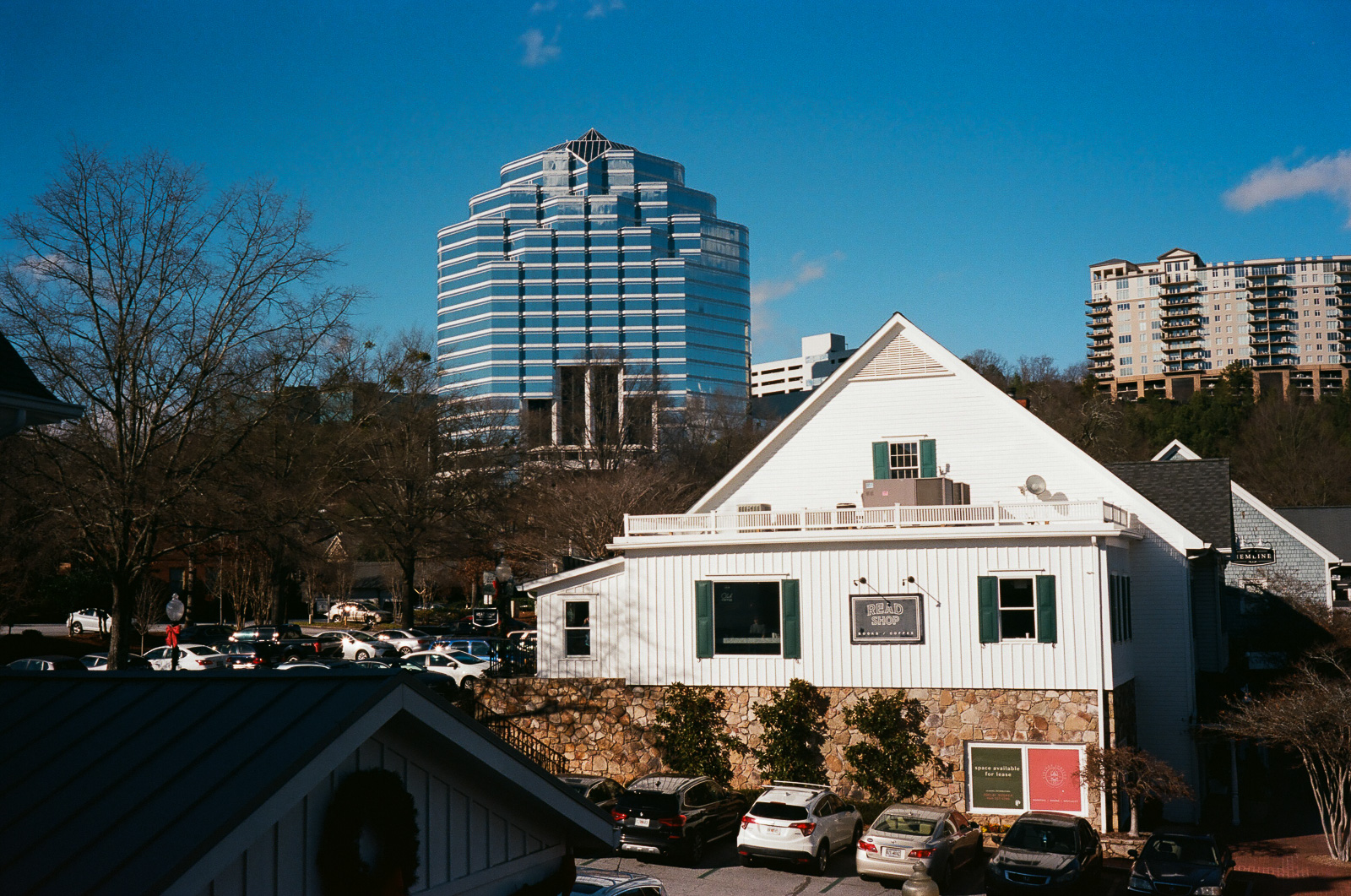
Marietta, Veterans Day 2025 – Canon Photura 135 – Ilford HP5 I was facing the November sun and the camera nailed down the exposure – Clear improvement over the first gen. Photura

The user manual is not very clear but I assume that focus and exposure are pre-determined on a central area of the scene when the photographer presses the shutter release half way and then evaluated again on a larger area when the shutter release button is fully depressed. On the 135 models, a “real-time” feature has been added (the lag time of the shutter release is reduced to 0.018 sec.), and the user manual recommends to use it to memorize the focus point, in particular when composing an image vertically (in “portrait mode”). The real-time mode skips the second focus determination step and only relies on what the central autofocus sensor has detected during the focus “pre-determination”, which acts as a sort of selective AF lock.
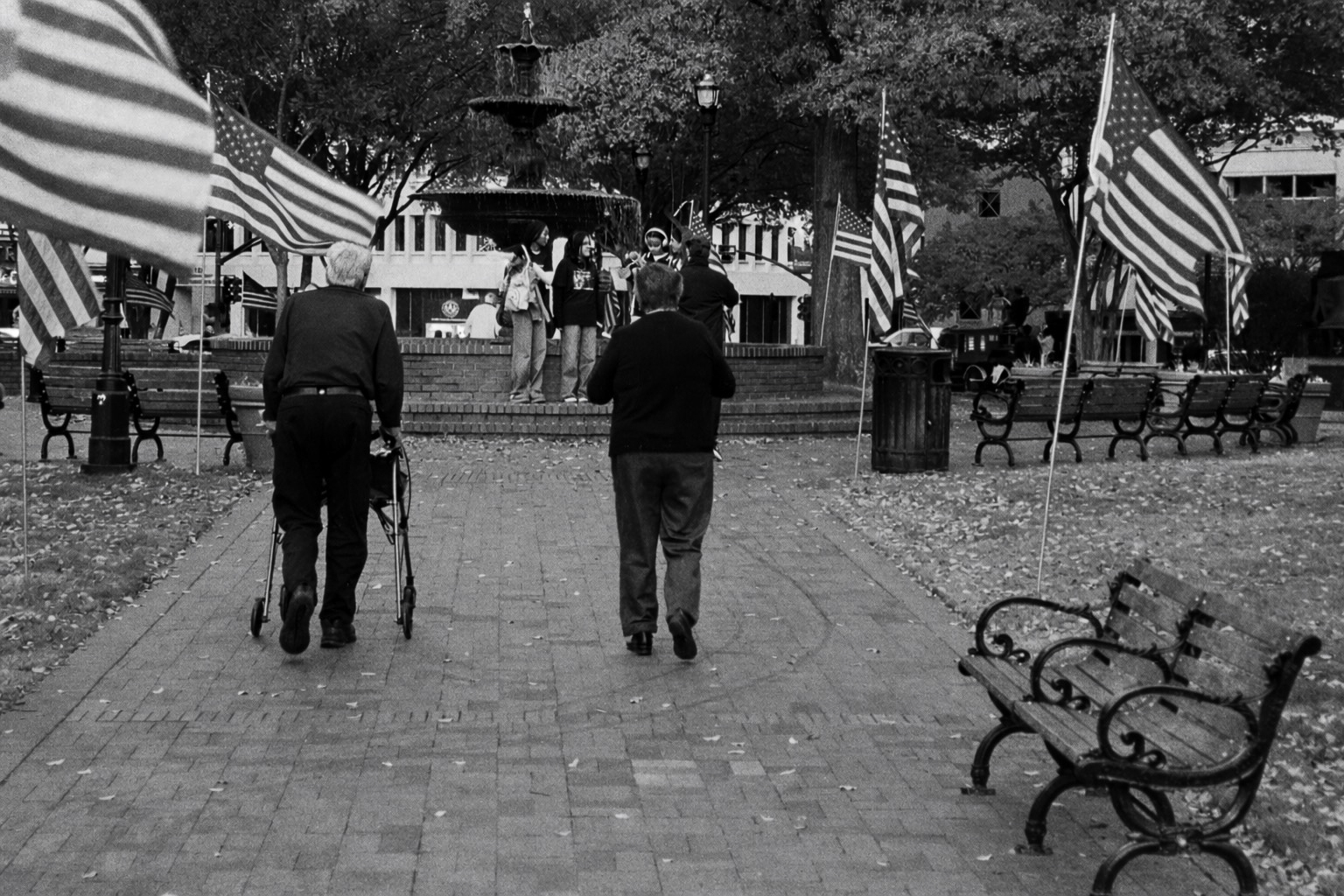
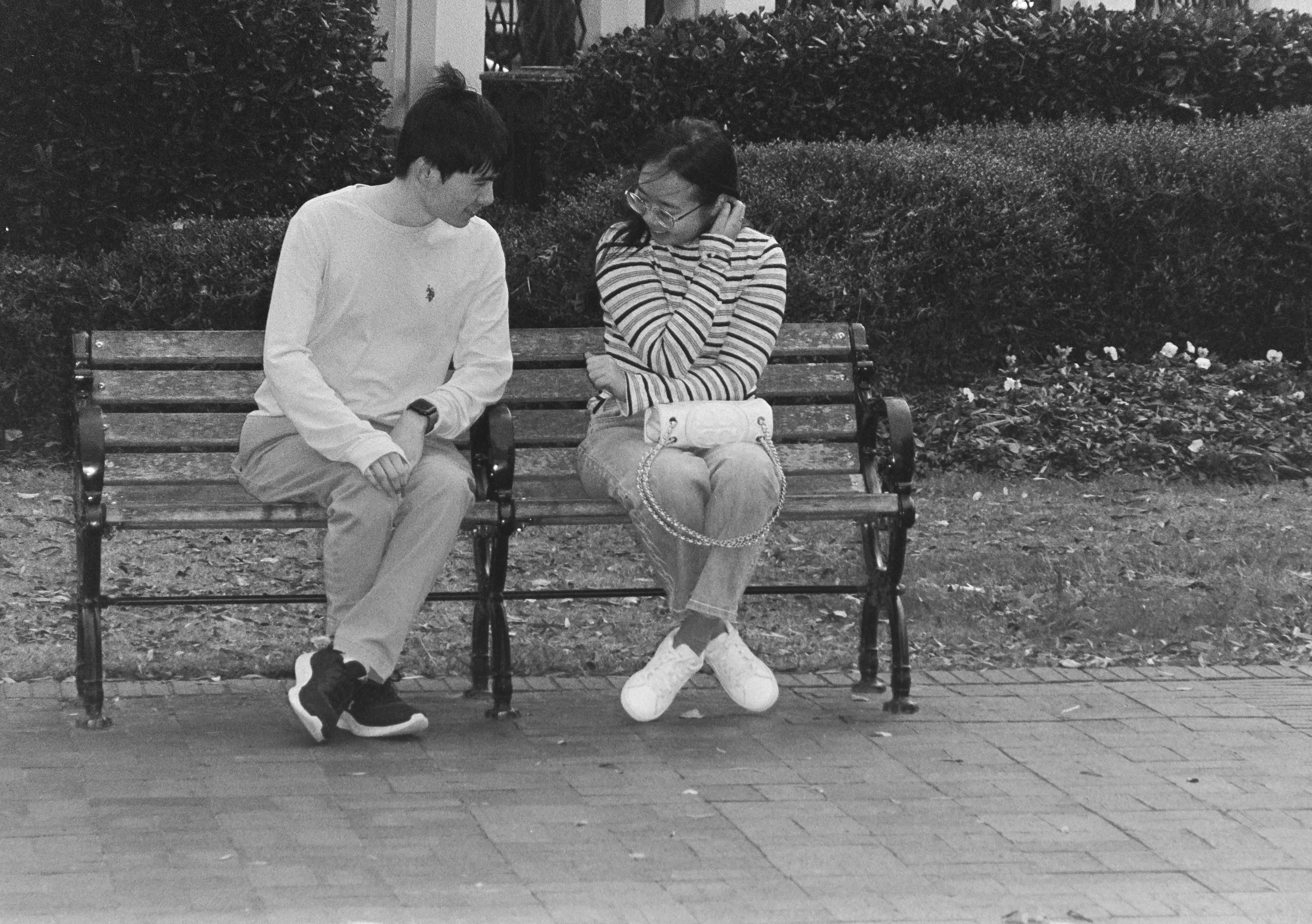
Marietta Town Square – Veterans Day – The tone of the shirt of the man on the left was changed in ChatGPT

The exposure determination also seems to have evolved positively with a three-zone evaluative system replacing the centered metering of the Photura 105. There is no exposure memorization and no magic +2EV button, but the evaluative metering of the “135” should perform better when the subject is backlit than the simpler system of the first Photura.
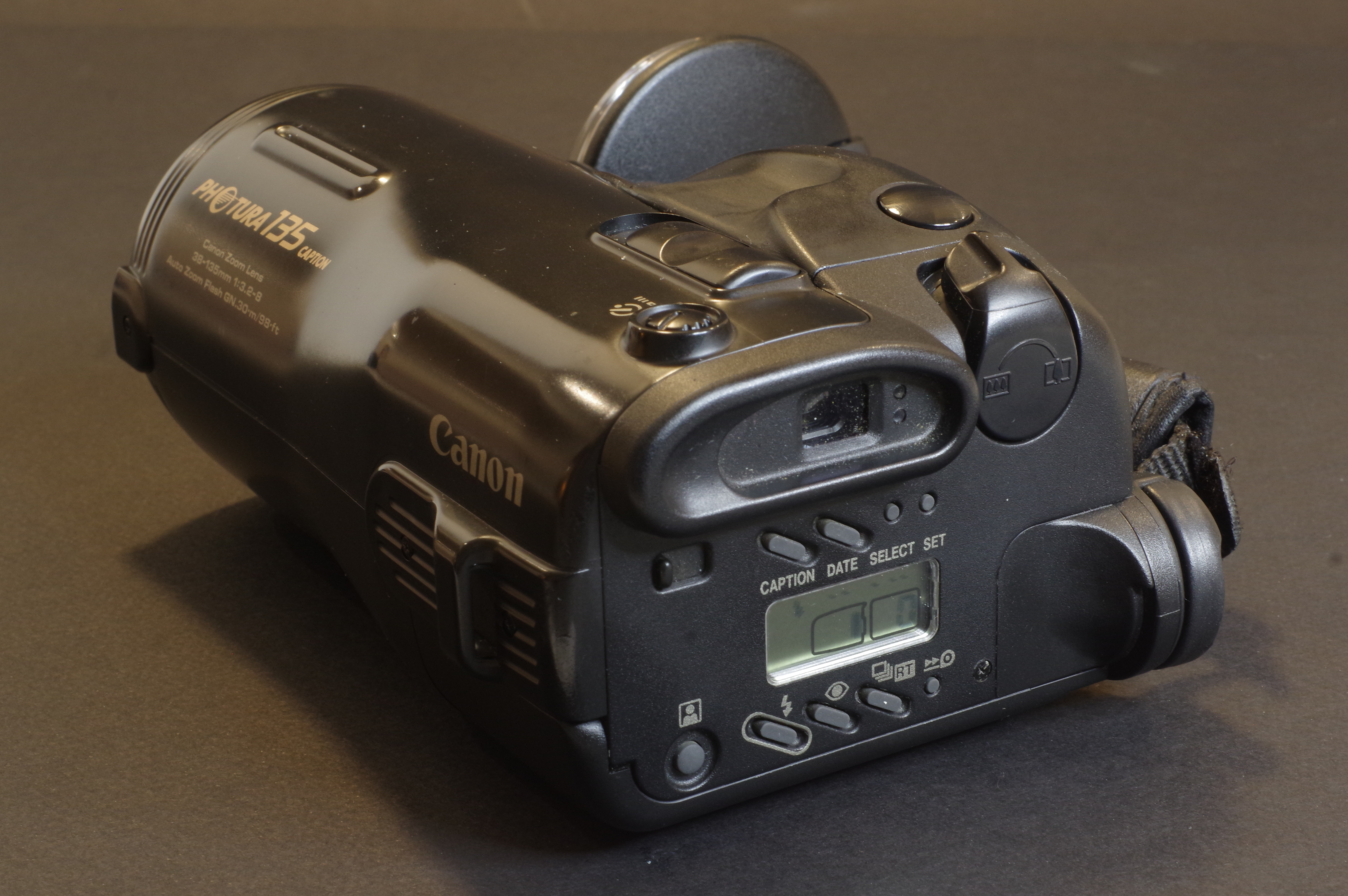
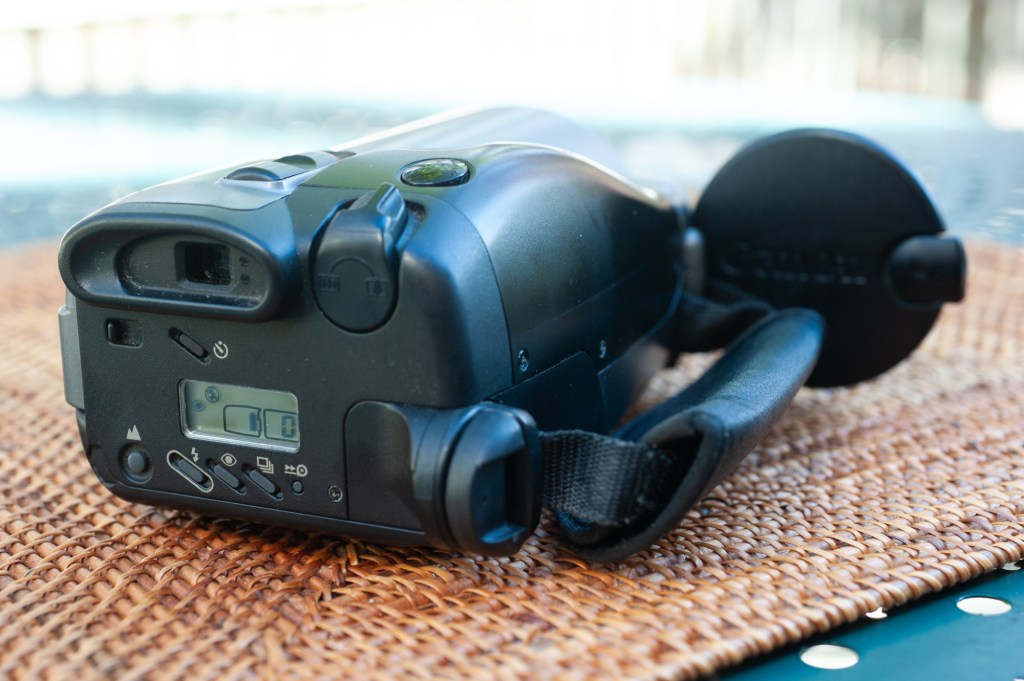
Canon Photura 135 Caption – Caption, Autozoom and Real Time buttons have been added.

Like the older Photura, the 135 Caption only operates under a single programmed auto-exposure mode, and is deprived of any “scene mode”. Being a camera from the nineteen nineties it does not offer any subject or face recognition capability. But like the Photura (and many Minolta cameras of the same vintage), it uses its power zoom to offer a sort of auto-framing capability, that ensures that in a series of shots, your human subject always occupies the same proportion of the image irrespective of its distance to the camera. I’m not sure I understand what the benefit is, but it seemed important enough to Canon’s engineers, who assigned a dedicated button to this function.

Lastly, the “Caption” version of the 135 gets a bigger self timer button, and the shutter can be fired remotely. The wireless remote controller and the extra strap that came with it originally must have been lost on my copy. Too bad.
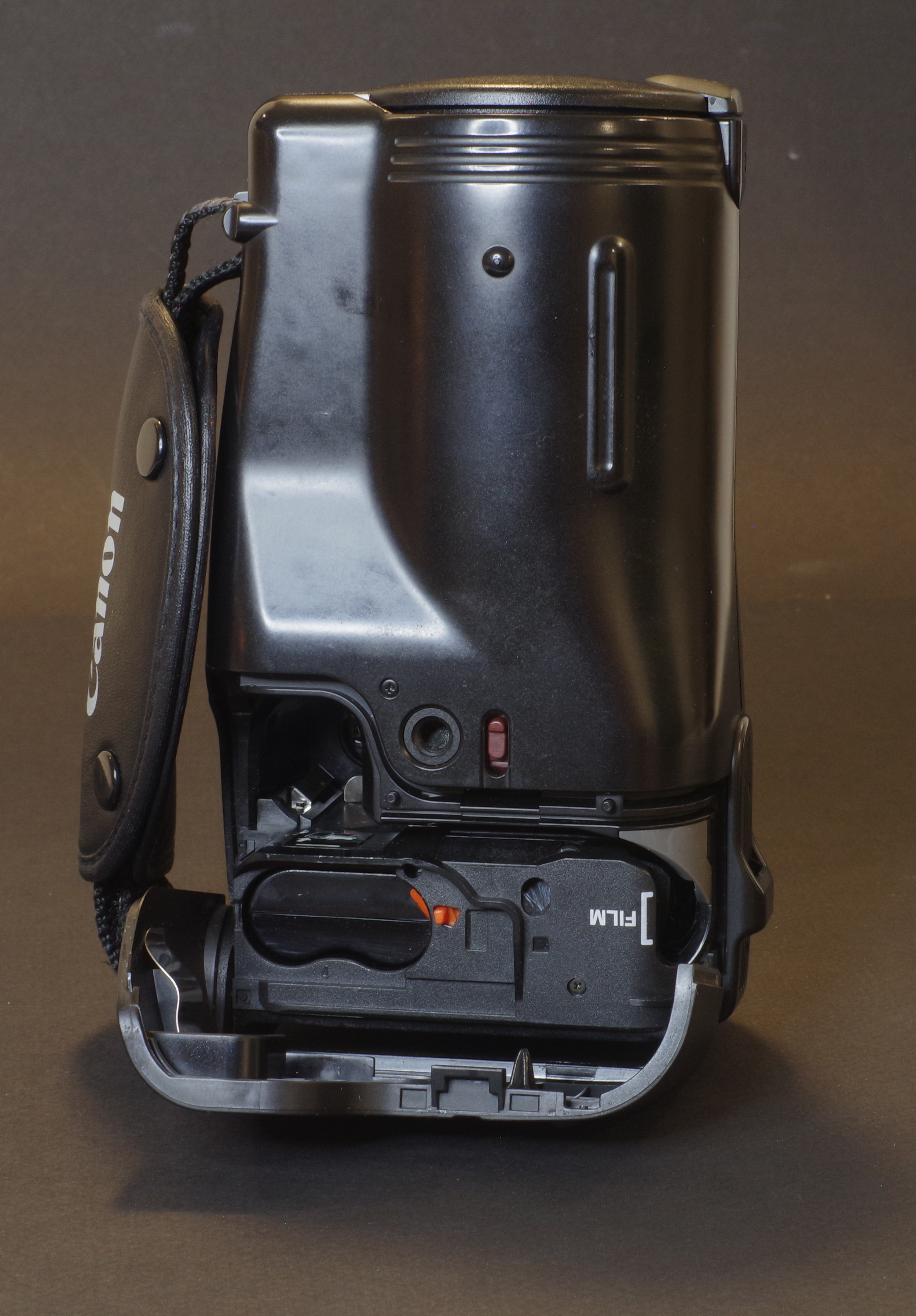
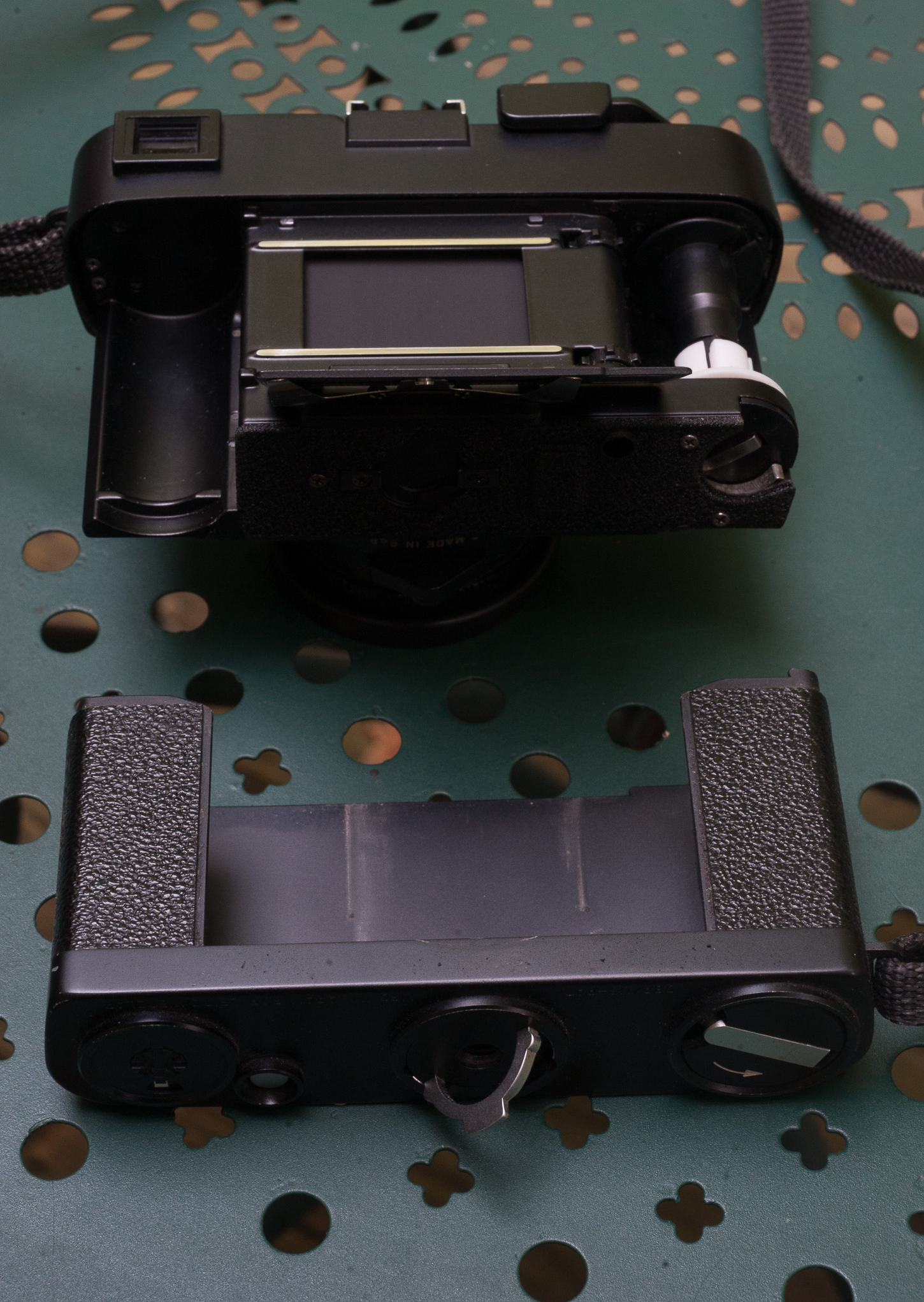
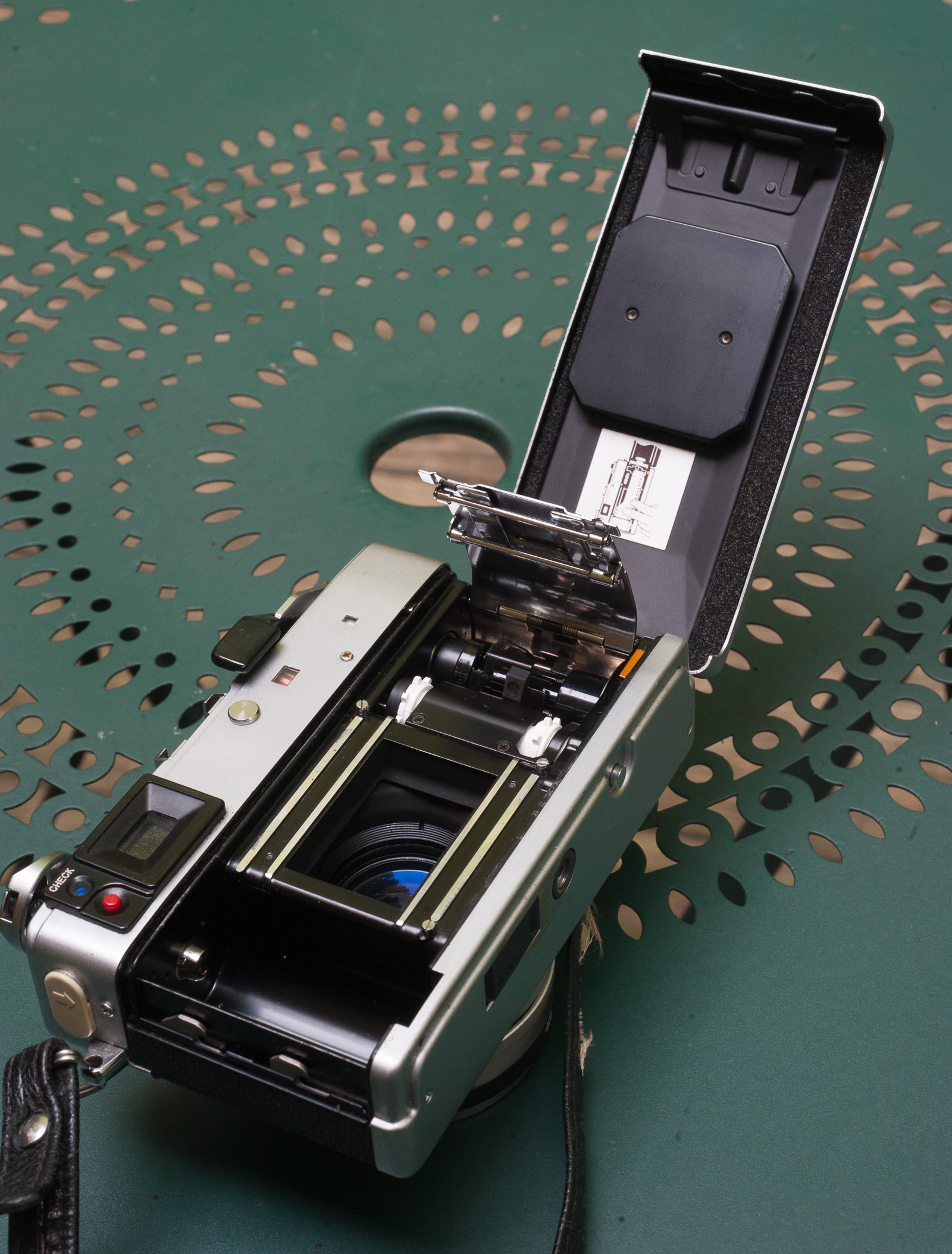
Canon Photura 135 – to load the camera, simply drop the film and pull the leader to the zone marked “film”.

Testing the Photura 135 Caption on Veterans Day in Downtown Marietta, GA

The square at the center of downtown Marietta is one of my favorite spots – Marietta is a big and modern city 15mi from Atlanta, but the square still has this unique “small town America” feeling. Even more so on Veterans Day.

I was impressed by the Photura 135. The first Photura (let’s call it the 105) was already a good camera, but the 135 is significantly improved – the autofocus is much more capable, and it’s really better at determining the exposure, even in tricky situations.

It’s not a Leica M for sure, but it can be used for street photography, with interesting results. Interior photography is still not its forte – the flash flattens the image – but when this camera was launched, no compact-zoom camera was good at that.
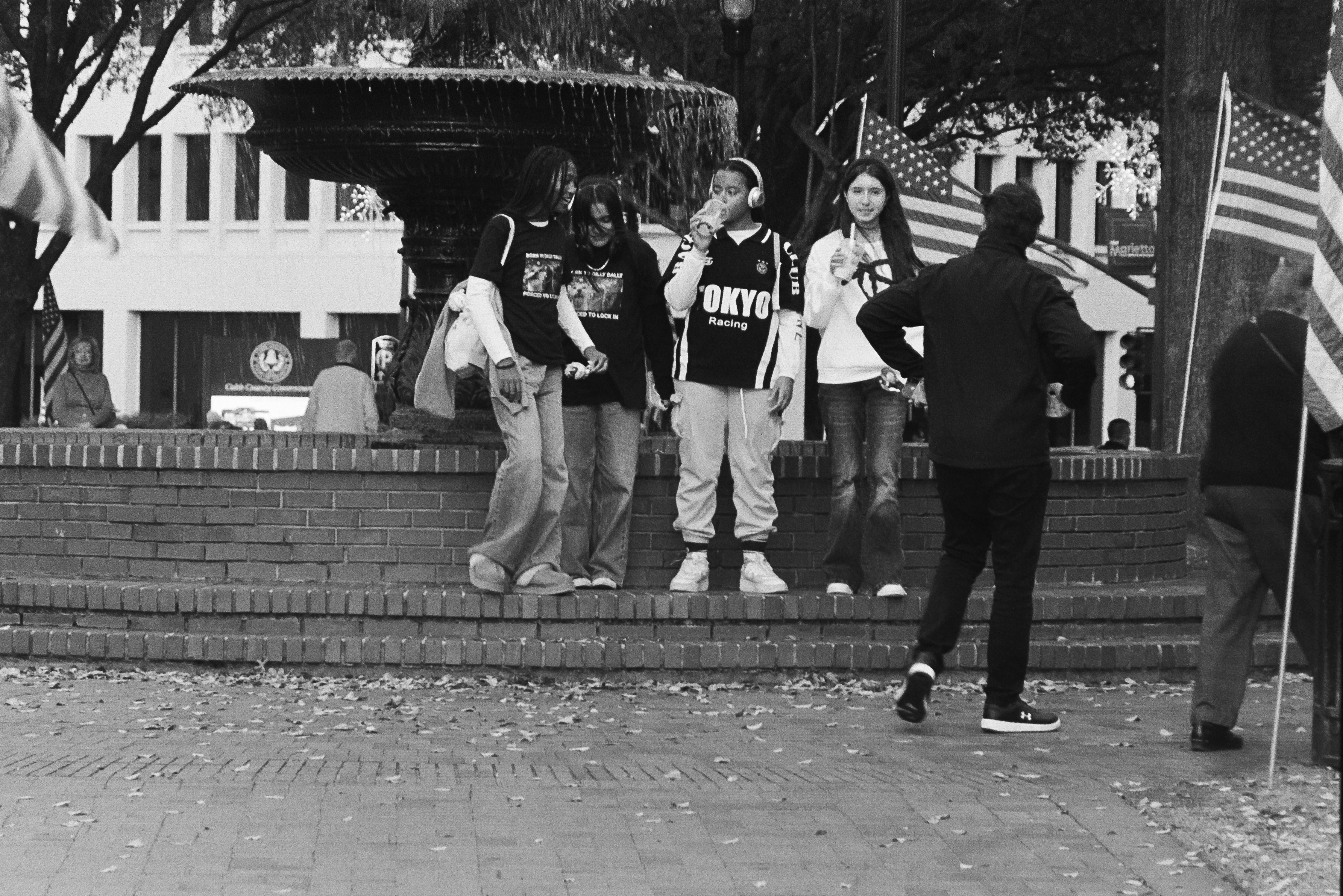
Canon Photura 135 – Ilford HP5 – Marietta, Veterans Day 2025

The biggest limitation of this camera is its zoom – or to be precise, its very narrow aperture, in particular at the long end. With a zoom opening at f/8 at the longest focal length, 400 ISO film really looks like a minimum, and at the end of my Marietta escapade, I wished I had loaded the camera with something faster than Ilford’s HP5 (on the Photura there is no way to override the DX coding and push film).

Would I bring this Photura 135 to my next travel destination? Yes, definitely. But I would also bring some 800 ISO film, just in case. The Photura 135 is not as easy to find as the first generation “Photura 105”, but if you’re interested in shooting with a bridge camera, I would recommend you make the effort of locating the “135” – it’s a case of version 2.0 fixing most of the issues of version 1.0.
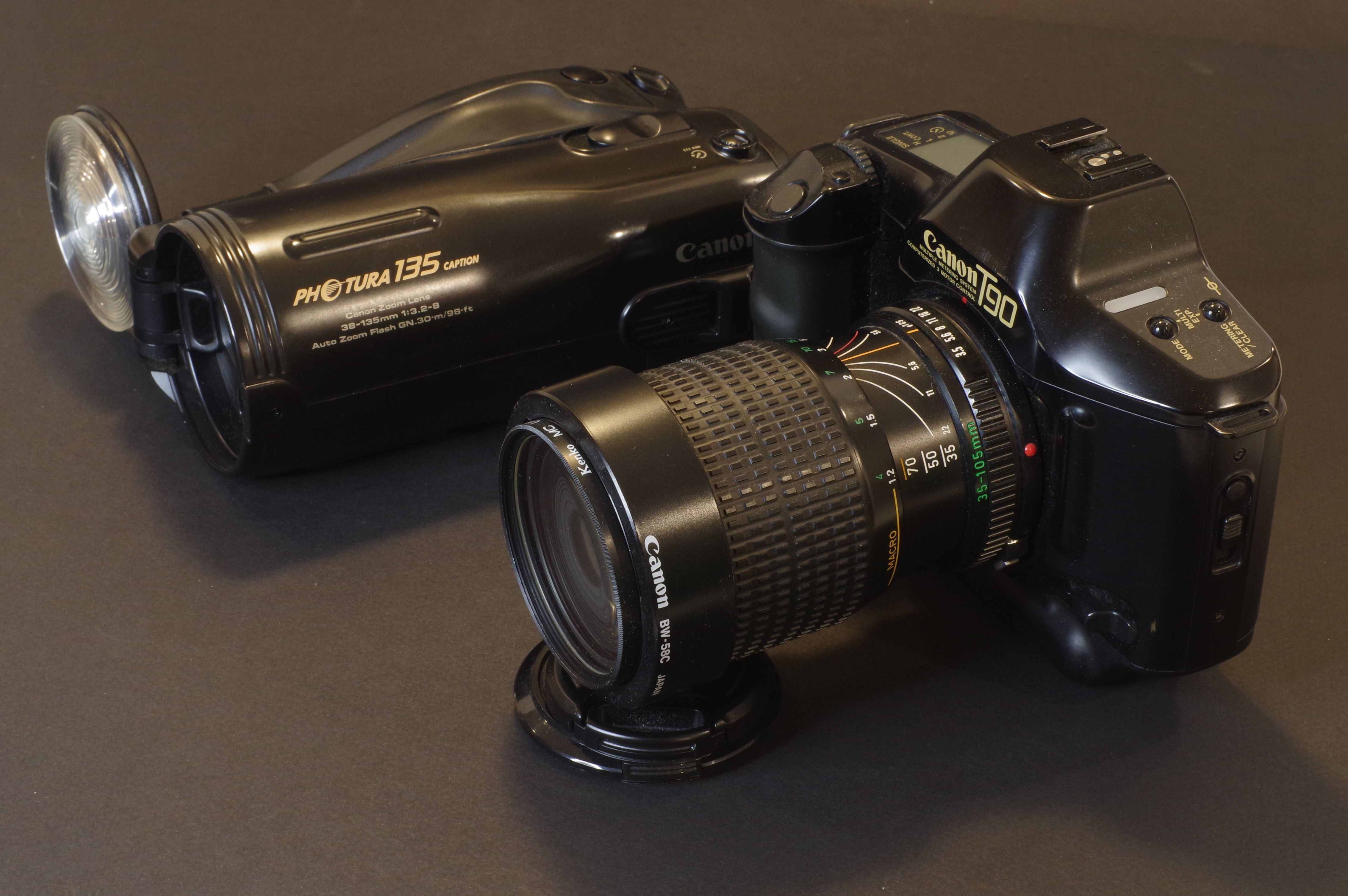
Canon Photura 135 and Canon T90 – a family reunion of sorts the Photura is shaped like a tube and much easier to carry in your luggage than a more conventional camera
Marietta, Veterans Day 2025 – Canon Photura 135 – Ilford HP5 – S curve and micro contrast improved on ChatGPT

About asking ChatGPT to “Heal” my pictures – I submitted two of the pictures of this series to ChatGPT – for the first one (the man on the left with the walker) it simply changed the color of the shirt (it was bright white and too distracting). The picture of the two kids on the bench was taken at the end of the afternoon, at the long end of the zoom, and was a bit too soft (it lacked contrast and sharpness). I asked ChatGPT to increase the contrast of the image selectively, without touching the mid tones. It played on the two ends of the S curve and then increased the micro-contrast locally. And gave me a one page long explanation of what it had done and why. Everything it did I could have done with Photoshop if I had a Photoshop license, and was skilled enough to pull it off. I’m normally using Lightroom’s “Heal” functions, but in this case, I could not get the result I was expecting and I had to ask ChatGPT for help.

The originals:
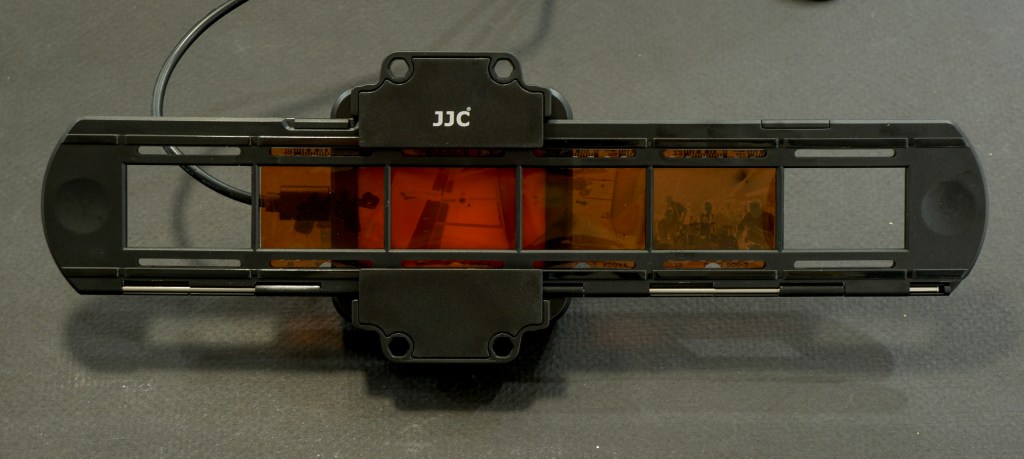
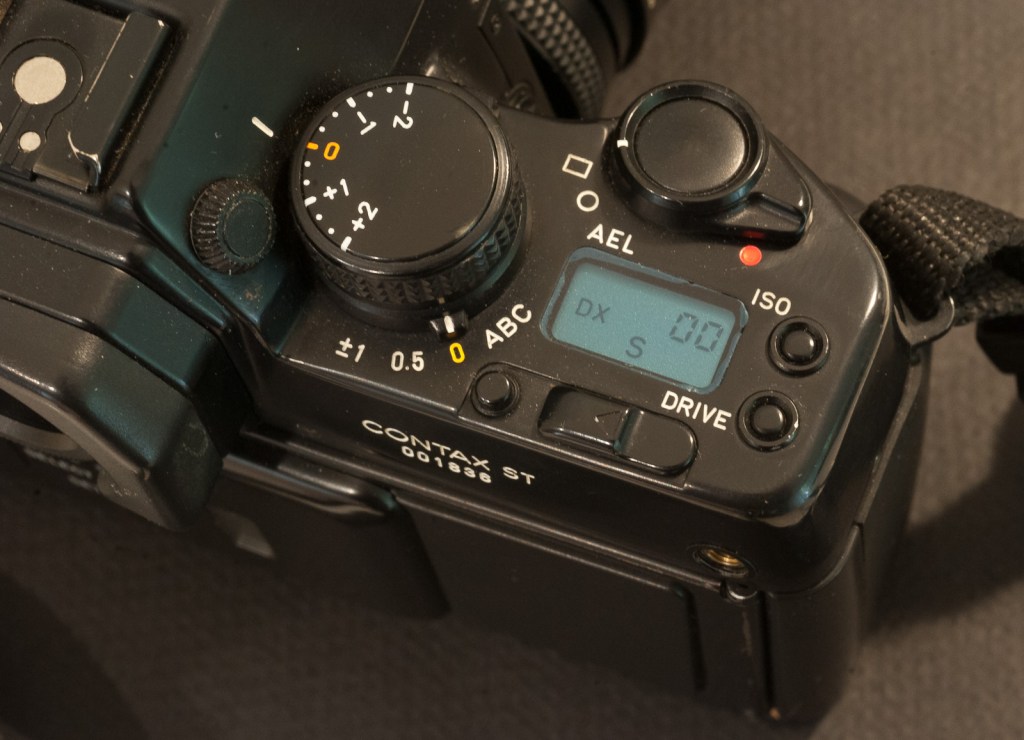
Old gear, B&W film and AI – a match made in heaven? I’m sure we’ll have more opportunities to discuss the issue along the year.

Canon Powershot s400 Digital Elph – when old gear is still pretty good

A few weeks ago I tested a Pentax *ist DS, and I was not thrilled with the experience. Another *ist DS had been my first dSLR in 2005, and at the time, I had been pretty satisfied with my purchase. But if I was disappointed by the *ist, what would I think of its predecessor in my equipment bag, a 4 Megapixel Canon digital point and shoot camera, if I tried to use it now?

Canon Powershot S400 – the finish is impeccable and resisted the test of time

I finally located my old Powershot S400 last week. The camera was in a very good shape, but the battery was definitely dead. It was to be expected – it was a 22 years old item, and it had probably not been recharged since 2010. I ordered a new compatible one on Amazon, and just received it. Under its newfound power, the camera started immediately, ready for new adventures.

Back then

The Canon PowerShot S400 Digital Elph (sold in Europe as the Ixus 400), was launched at the beginning of 2003. The review DPReview published in April of that year was very positive (with a “Highly recommended” rating) and I followed DPR’s advice and bought one for Christmas 2003. At $500, it was as expensive as a middle of the range film SLR, but offered a convenience that a film camera could not beat.

Shot in Miami Beach in 2004 – Canon Powershot S400 – it almost looks like the stage of a movie – where are Barbie and Ken?

With a ceramic coated metal body, a 36-108 (full frame equivalent) zoom opening at f/2.8, an optical viewfinder and a 1.5in color display, it was very well spec’d. It captured images with a four megapixel 1/1.8in CCD sensor (and produced only JPEGs, not RAW files), that it stored on a CF card. Very compact, beautifully built and finished, and delivering best in class pictures, it was flying off the shelves.

There are approximately 350 pictures shot with the S400 in my Lightroom library (in the early days of digital, we were still remembering the cost of film processing and we were shooting with restraint) – and I’m still impressed by how nice some of them looked.

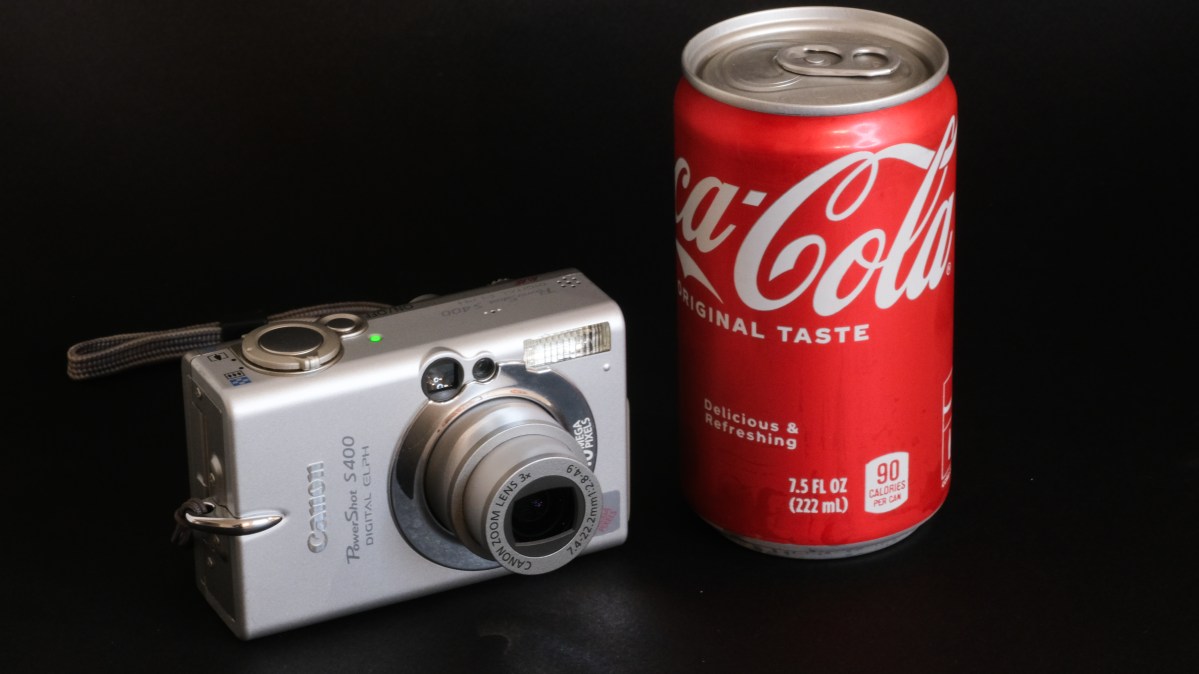
Canon Powershot S400 ready to shoot – the Coca-Cola can is one of the “mini” 7.5 FL OZ cans – the camera is really compact.

We never took the conscious decision to “decommission” the S400, we just used it less and less (as our phones were getting better at taking pictures with every new version) and we finally forgot about it. The last time we moved, I had packed it under bubble wrap with a much larger film camera, and found it by chance while de-cluttering a closet a few days ago.

Rediscovering the Powershot S400

What’s immediately surprising with this camera is the quality of the finish – it looks like a luxury object – and its small size, it’s not really bigger than a pack of cigarettes. One of the selling points back in the days was the “Cerabrite” coating of its metal body, and the truth is that it shows no scratch and no stain.

Atlanta Aquarium – Canon Powershot S400 (summer 2008)

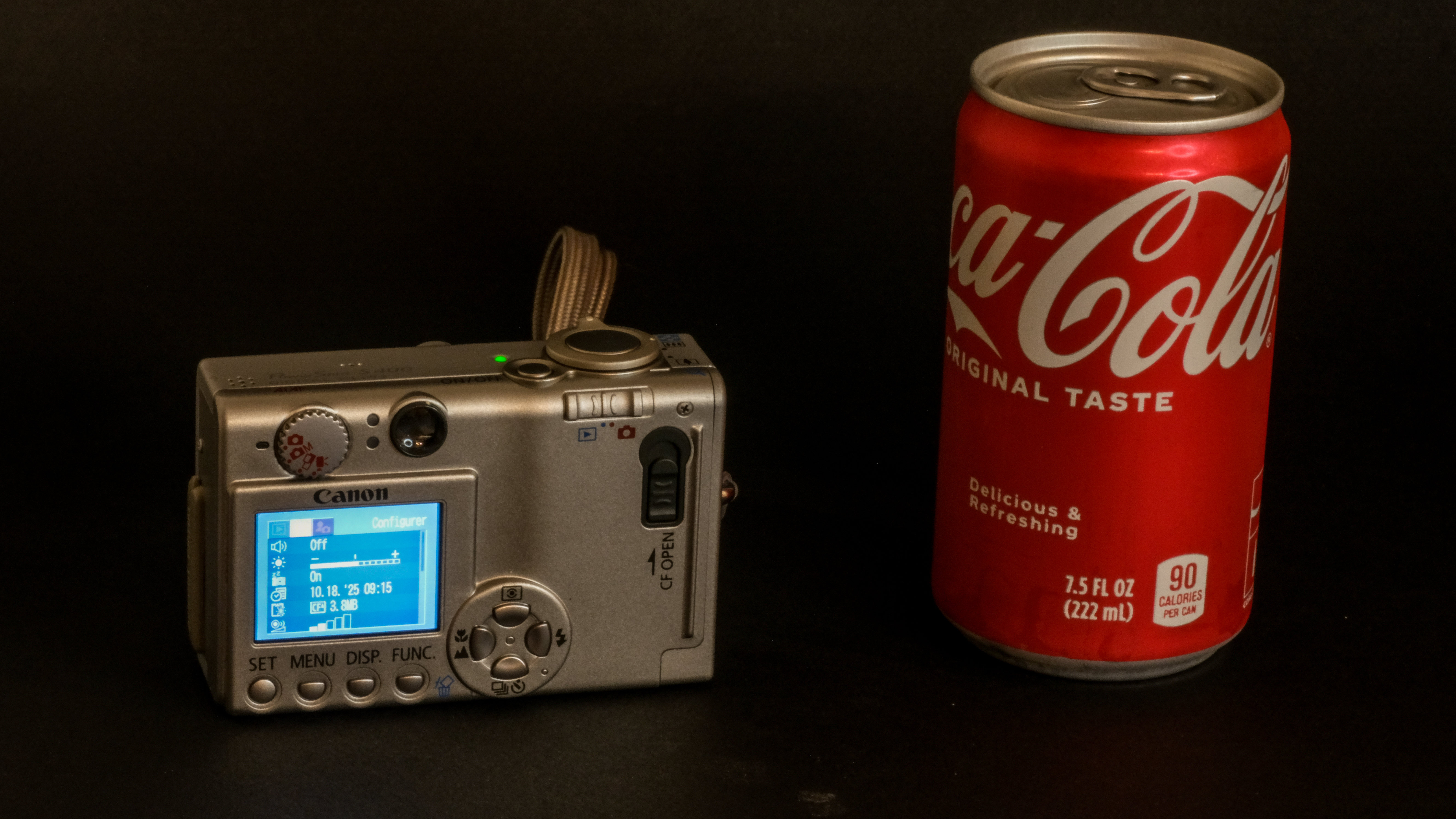
Contrarily to more modern cameras, there is a physical switch on the back of the S400 to set it in “shooting” mode (the other position is for image playback), in addition to the traditional on-off button. But apart from that, the camera’s commands are more or less identical to what we would find today in an entry level camera. There is also an optical viewfinder, but I surprised myself by framing most of the pictures on the small color display at the back of the camera – it’s smaller than the display of a smart watch but it’s responsive and its resolution is pretty high (relative to its diminutive size), and it’s good enough as long as the sun is not too bright.

Miata is always the answer… the interior of this MX-5 was fairly cramped – not enough room to store a dSLR – and the Powershot saw service as the onboard camera for the trips to the beach

The default sensitivity is 50 ISO, and it can peak at 200 ISO, at the cost of some noise, of course.

It’s a camera designed by photographers for photographers, who can chose between three metering modes (spot, average and matrix), and can memorize the focus or the exposure with AE and AF lock capabilities for situations when the automatism can not be trusted. A very limited movie mode has been implemented (at best, 320×240 pts at 15 frames per second for 3 minutes).

Canon Powershot S400 – the rear display is quite small but very legible.

Contrarily to what we find on current point and shoot camera, there is no image stabilization, no scene mode and of course no subject or face recognition. Let’s not forget that this camera was launched in 2003.

Image quality

Many photographers are nostalgic of the look of pictures shot by early digital cameras – they don’t like the surgical precision of the images taken with today’s high resolution CMOS sensors, and prefer images captured by the relatively low-res CCD sensors found in the compact cameras of the first decade of the 21st century.

Self portrait. Summer 2007.

I’m not sure that CCDs on their own were so great (the *ist DS also had a CCD sensor and did not deliver images that nice out of the box). A lot must have been related to the settings of the image processing engine. And to Canon’s magic touch.

And today?

This camera is surprising. Shooting JPEGs at 50 ISO with a 4 Megapixel camera launched in 2003 would have seemed like a punishment. But the Powershot S400 is surprisingly pleasant to use – it’s very reactive, and leaves some control to the photographer (simply press the shutter release button half way to memorize the exposure). I suspected that the dynamic range would be very limited, and it is, but if you set the exposure on the highlights, high contrast images can be saved in an image editing application like Lightroom.

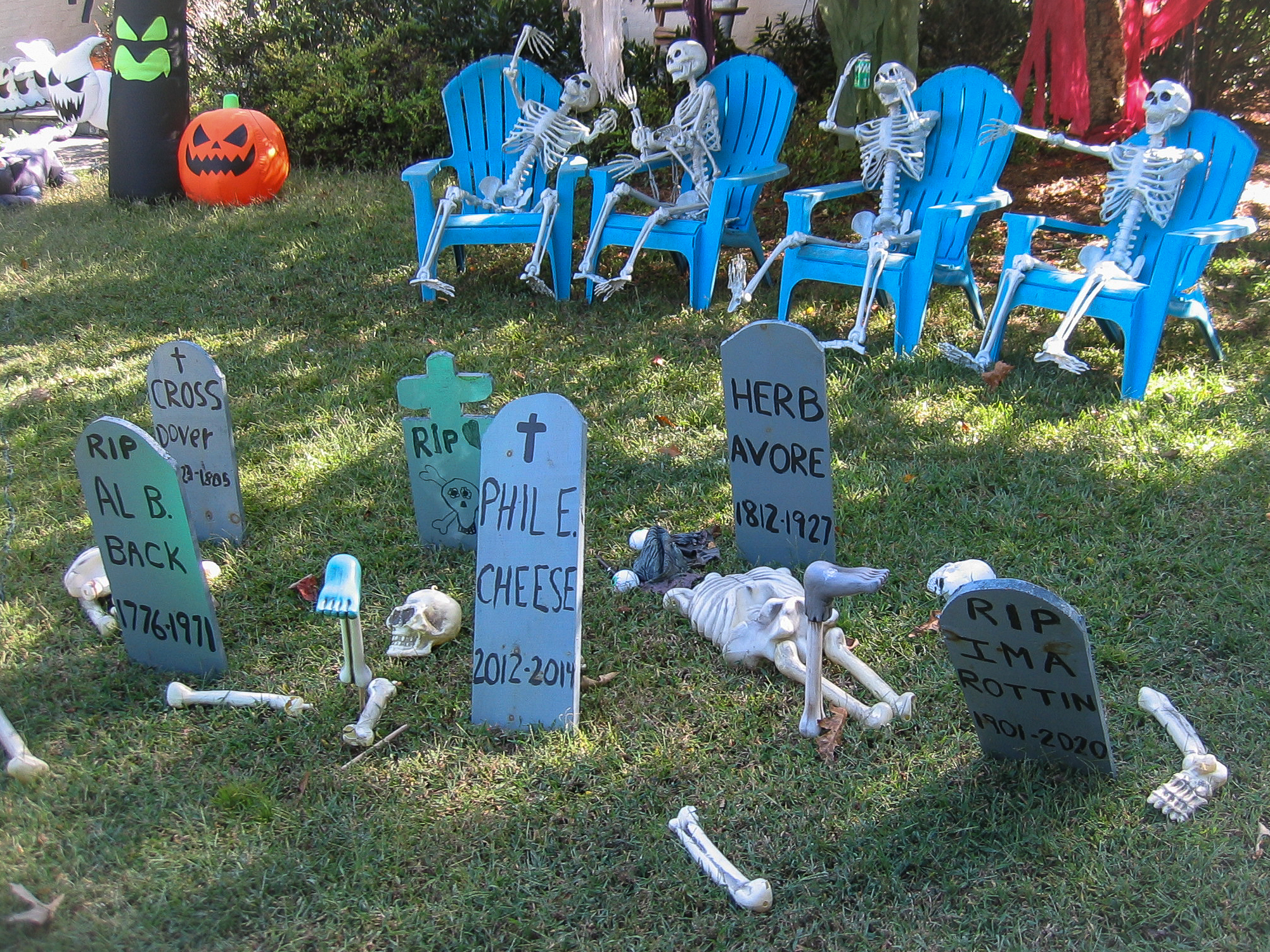
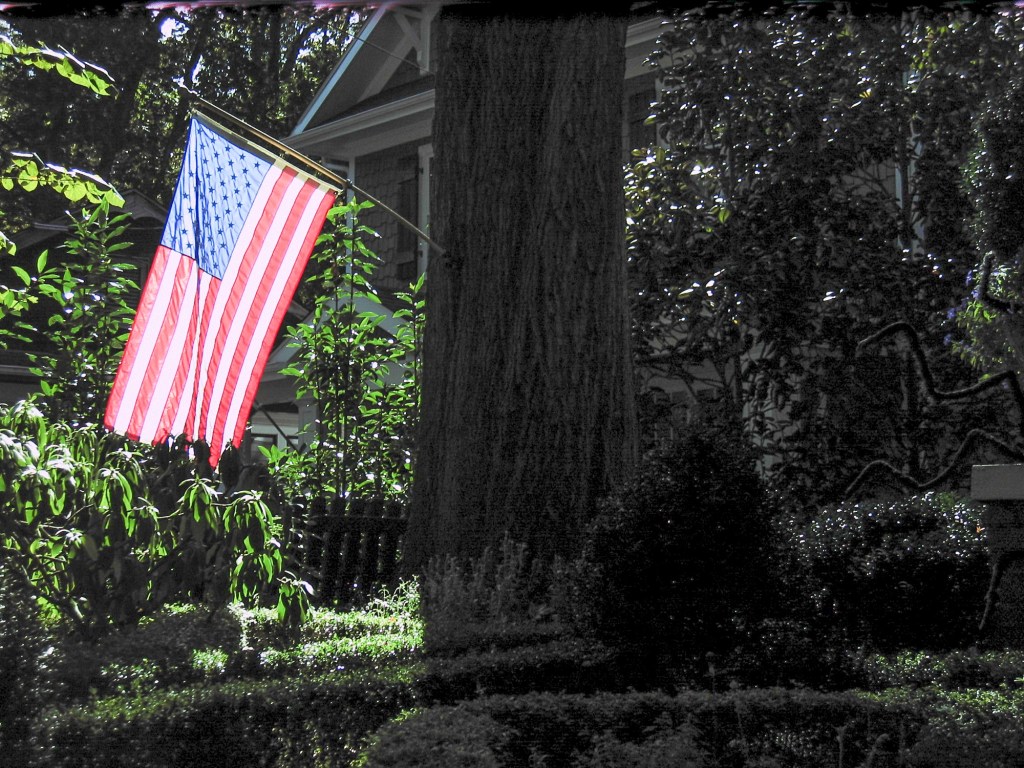
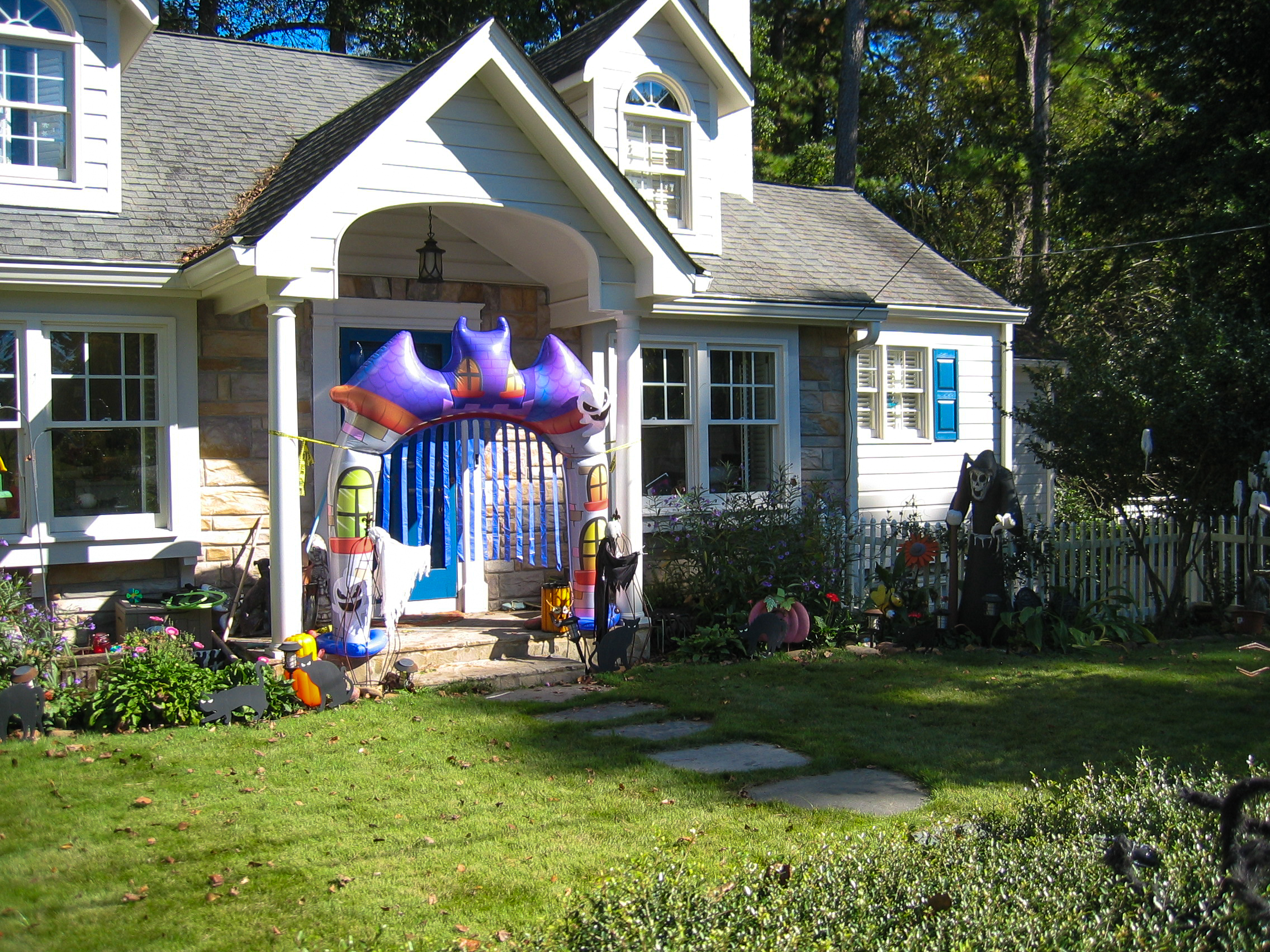
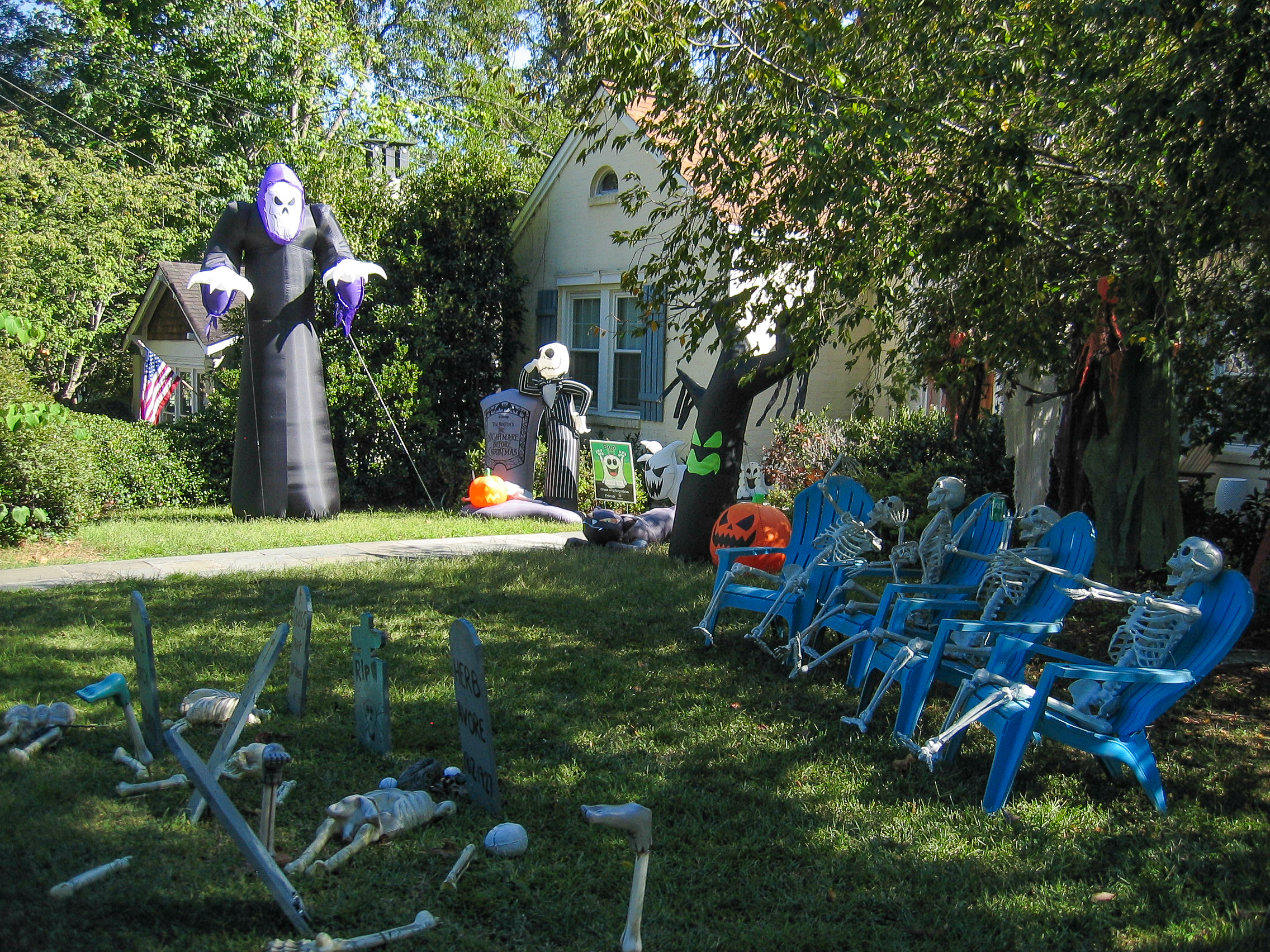
Atlanta – Halloween decorations – Canon Powershot S400. (Oct 2025)

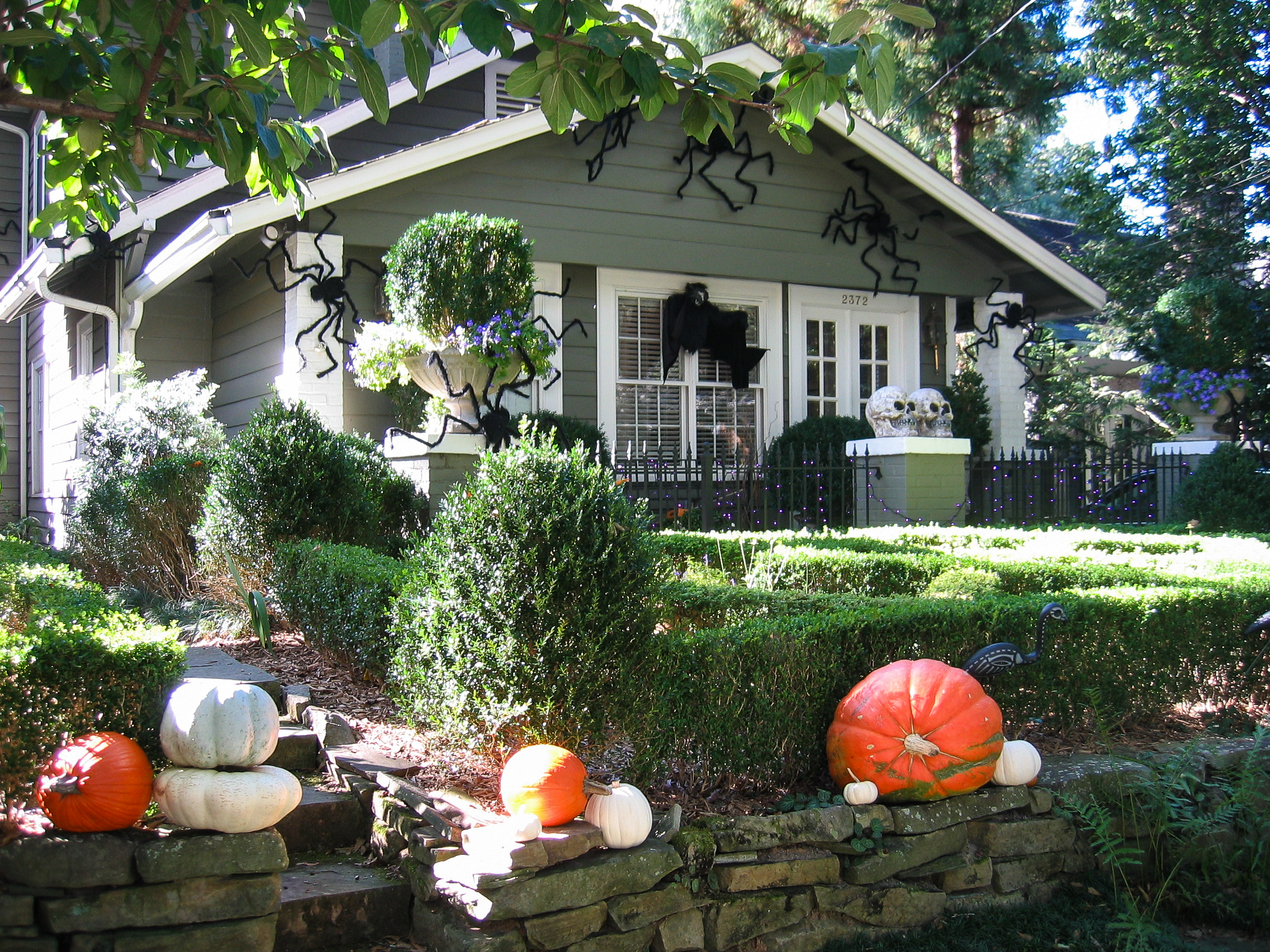
DPReview testers had been impressed in 2003 by the quality of the JPEGs (not excessively sharpened, and preserving a lot of details), and even in 2025 you can’t help being pleasantly surprised – I took a series of pictures of the Halloween decorations in my neighborhood without paying too much attention to the settings of the camera (shooting with the sensitivity set to 50 ISO was probably a bit over optimistic, it forced the camera to operate at relatively low shutter speeds and wide aperture) – but the images required little work in Lightroom to be good enough to be shared here.

Testing the dynamic range – if you set the exposure on the back-lit flag, you can somehow save some details in the shadows in post-processing.

As a conclusion

Two things are very clear regarding this Powershot S400 Digital Elph:

  • Canon was obviously intending on solidifying its position as the market leader in an early digital photography world, and had spared no effort to be the top dog. They had put all their considerable know-how in designing and manufacturing a camera which was impressively good at delivering pictures, solidly built and esthetically beautiful.
  • When I look today at pictures taken during the same period with other digital cameras (even early dSLRs), I can’t help being impressed by the Digital Elph’s JPEGs: color balance, control of highlights, skin tones – they had nailed it – no need to shoot RAW and spend hours fixing imperfections on Photoshop – the images were great out of the camera.

The S400 is only a 4 Megapixel camera, best used at 50 ISO (flash mandatory inside, and even outside under overcast weather). A recent smartphone will outperform it (but it would also outperform any recent point and shoot camera, except maybe in the long telephoto range). This Canon Powershot S400 is a small and beautiful object that can still take good pictures, and as a whole, it definitely shoots far above its weight. Old, beautiful, and still usable.


Atlanta – Halloween decorations – Canon Powershot S400. (Oct 2025)

Canon Photura (Epoca) – a strange looking point and shoot camera of the film era.

This is the other cheap camera I bought on Xmas eve on shopgoodwill.com. I paid less than $14.00 for it. The 2Cr5 battery it needed cost me more.

Launched in 1990, it was known to the North American public as the Photura, in Europe as the Epoca and in Japan as the Autoboy Jet. That’s the first generation model, and the one I bought.

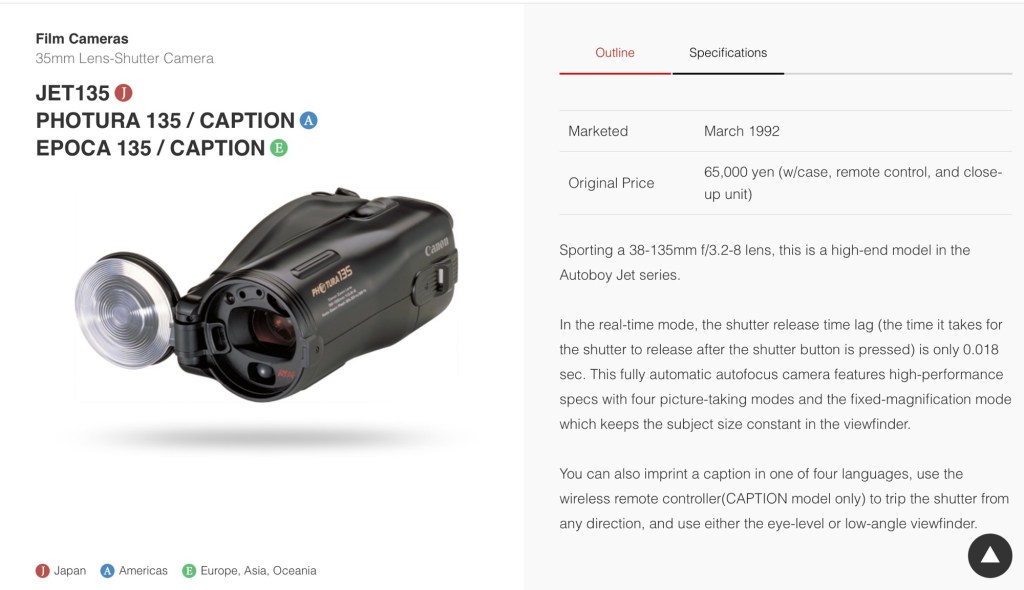
A second model (the Photura 135) was released 2 years later, with a zoom offering longer reach (38-135) instead of 35-105 for the original model and a darker body color. That’s the one presented in Canon’s virtual museum.

Because my copy of this camera was bought in the US, it’s a Photura, and that’s what we’ll call it it for the rest of this blog entry.

Screenshot from Canon’s virtual museum pages

To this day, Canon’s official litterature still presents it as a top of the line camera.

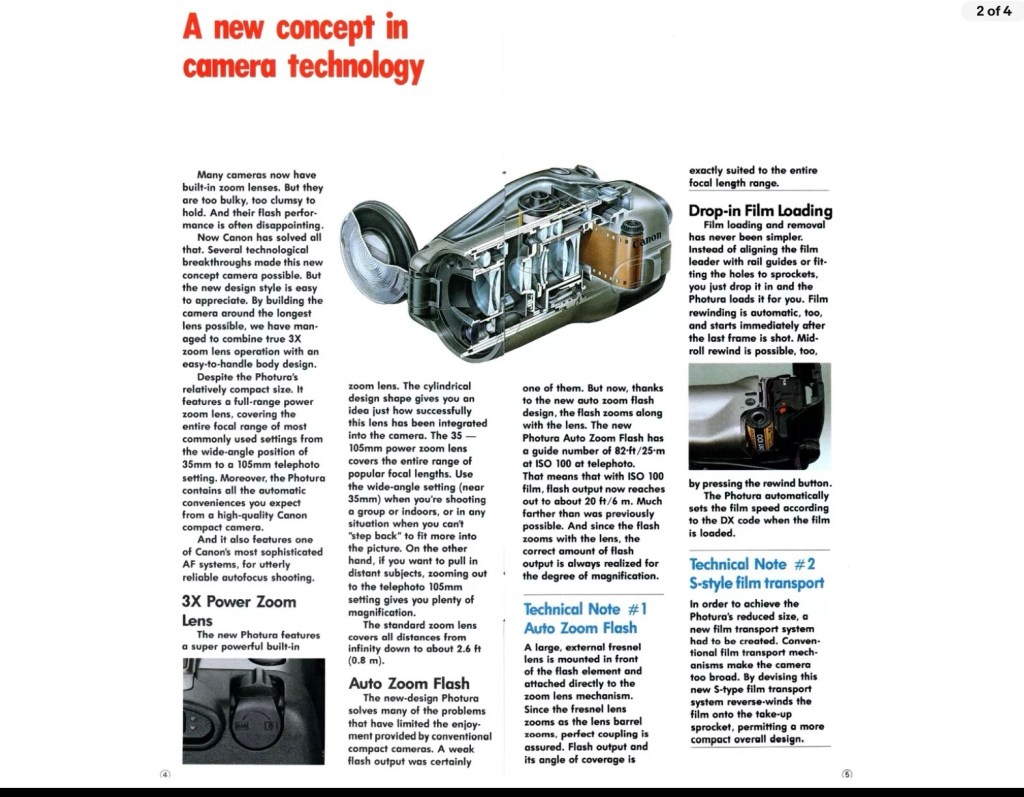
Top of the line, for a point and shoot camera of its day: motorized 35-105 zoom, infra-red based autofocus, motorized film advance, drop in film loading, DX coding, dioptric correction, and all sorts of override modes for the autofocus – nothing’s missing.

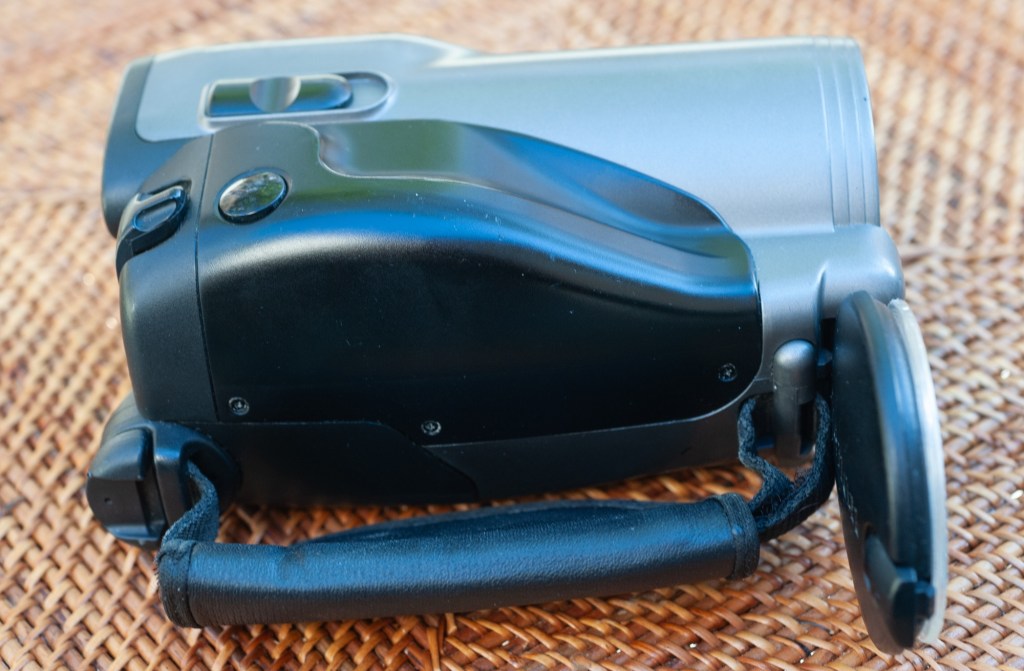
Viewed from the back now.

The bridge cameras

In the late nineteen eighties (because they had missed the boat of the autofocus SLRs) , Ricoh, Olympus and Chinon started pushing cameras of a new type, that “bridged” the gap between conventional Point and Shoot cameras and Single Lens Reflex (SLR) . Like a Point and Shoot, they had a non removable zoom, and like SLRs, image framing was done through the lens. A flash was also built-in. It made for a large and heavy combo, but in the mind of the people who designed them, those all-in-one bridge cameras were supposed to be cheaper, less intimidating and easier to carry around than an autofocus SLR with an equivalent 35-135 zoom and a big cobra flash.

Because they tried to combine all the features of an autofocus SLR and its accessories (zoom and flash) in one compact design, the bridge cameras looked strange – and their form factor would not be widely accepted by the buying public before the beginning of the digital camera era – when the smaller size of the image sensor made much smaller lenses (and therefore much smaller cameras) easier to design.

The Photura was Canon’s late entry in the bridge camera category – except it was not really a bridge camera. Like a bridge camera it was designed around a 35-105 zoom, with an electronic flash (hidden in the front lens cover in this case) and a hand strap, but it was not a single lens reflex camera – the viewfinder was a simple Galilean design with variable magnification, similar to what you would have found on a point and shoot camera of that era. And the photo cell used for metering did not operate through the zoom lens, but through a separate tiny lens next to it. So did the infra-red autofocus system. Like on a point and shoot camera.

The Photura as it’s generally represented, from the lens side.

First impressions

The biggest surprise is how heavy (600g without its disposable 2CR5 battery), and how big the Photura is. Even considering that the zoom has a relatively broad range and that it’s rather luminous at the wide end (f/2.8 at 35mm), it’s shocking. It’s not as if Canon had integrated a constant aperture zoom in the camera – the aperture at the long end is only f/6.6, and and the reason why Canon recommended using 200 or 400 ISO film. To Canon’s defense, the (real) bridge cameras proposed by Ricoh, Olympus and Chinon were even bulkier and heavier, the Ricoh Mirai tipping the scale at more than one kilogram (2.2 lbs), with a lens less luminous than the Canon’s.

The second biggest surprise is that you don’t hold the Photura like you would hold any other camera. At least when you’re keeping the frame horizontal (shooting a landscape, for instance) and at the wide end of the zoom range, you simply insert your right hand between the body of the camera and the hand strap, and access the zoom rocker switch and the shutter release button with the tip of your fingers. Like you would do with a video camera. It’s not unpleasant, it’s just strange and a bit disconcerting.

The first experience is positive: the camera is reactive, the viewfinder is rather large, and it’s fun to use – for a point and shoot camera. Even if it’s bulky and heavy compared to most compact cameras, it’s still light enough that you can walk for one hour with your hand wrapped around the camera, which makes it a surprisingly discreet and convenient tool for street photography.

Lefties beware…

Unfortunately, the unconventional design doesn’t work as well if you’re a leftie, or if you shoot at the tele end of the zoom, or if you’re shooting a portrait and keep the frame vertical – you’ll need to hold the camera with two hands.

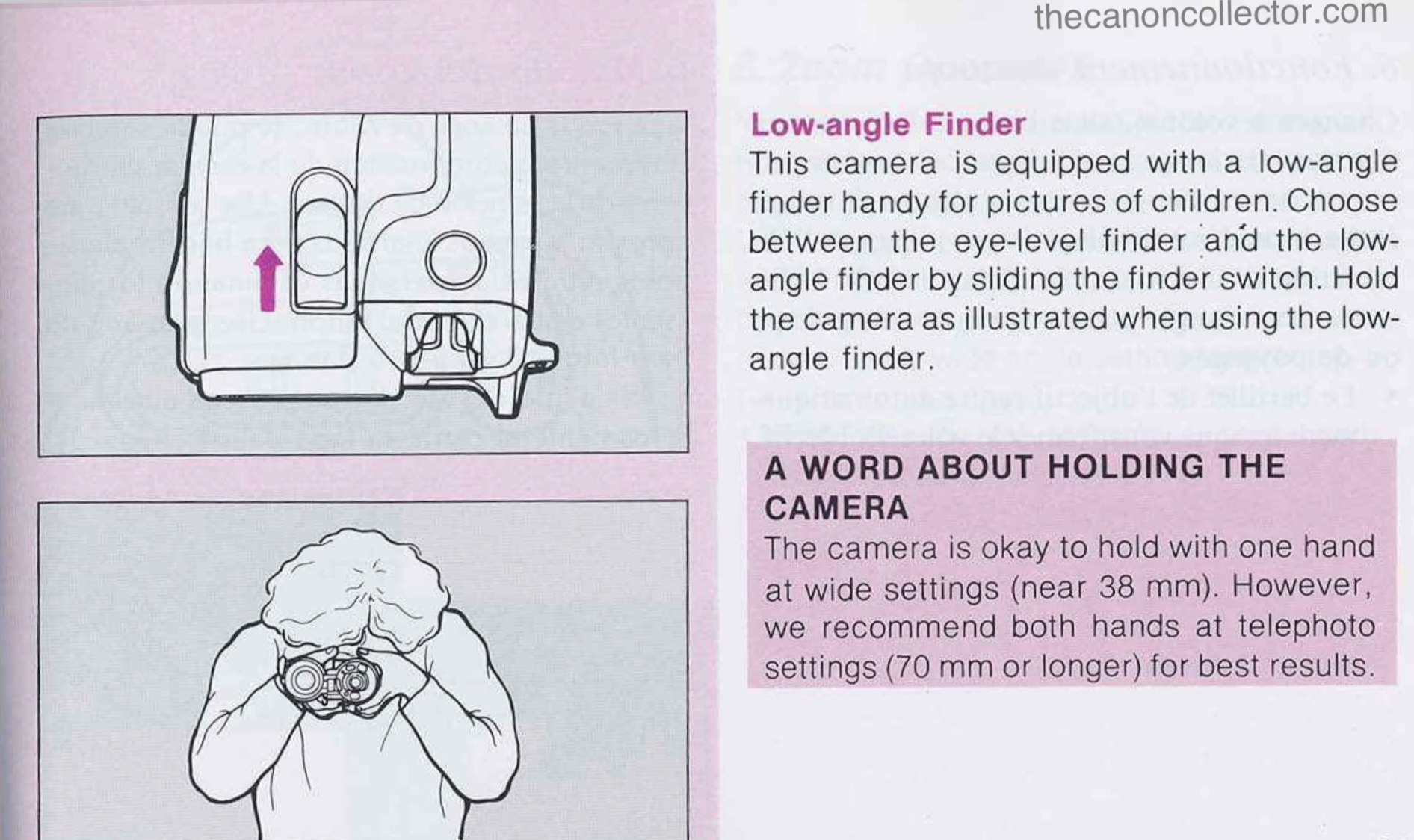
Another thing that does not work at all is what Canon calls the low angle viewfinder – it’s a second and very small viewfinder located at the top of the camera’s body – it’s so small you have to have your eye just above it (less than a centimeter) or you don’t see anything. In their user manual, Canon write that it’s to take pictures of children. Look at the posture of the photographer shown in Canon’s own user manual – the kids will laugh at the poor guy and will be gone before he can take the first picture. But it works if you’re kneeling, and trying to shoot something very close to the ground, like a very calm dog sitting in his bed.

Photura user manual – courtesy of thecanoncollector.com – note the very unnatural posture of the photographer trying to use the “low angle viewfinder”

Lastly, and maybe it was unavoidable with the technology of the day (and the price point being targeted), the autofocus system still seems to require a lot of work from the photographer: it can not focus to the infinite on its own – you have to force it by pressing a tiny button; it can not focus on tiny objects, and, because its detection zone is a rather small area at the center of the frame, you have to use an early form of AF lock if your subject is off center. Which is often the case if you shoot a portrait and want the focus on the eyes of your subject – not very amateur friendly.

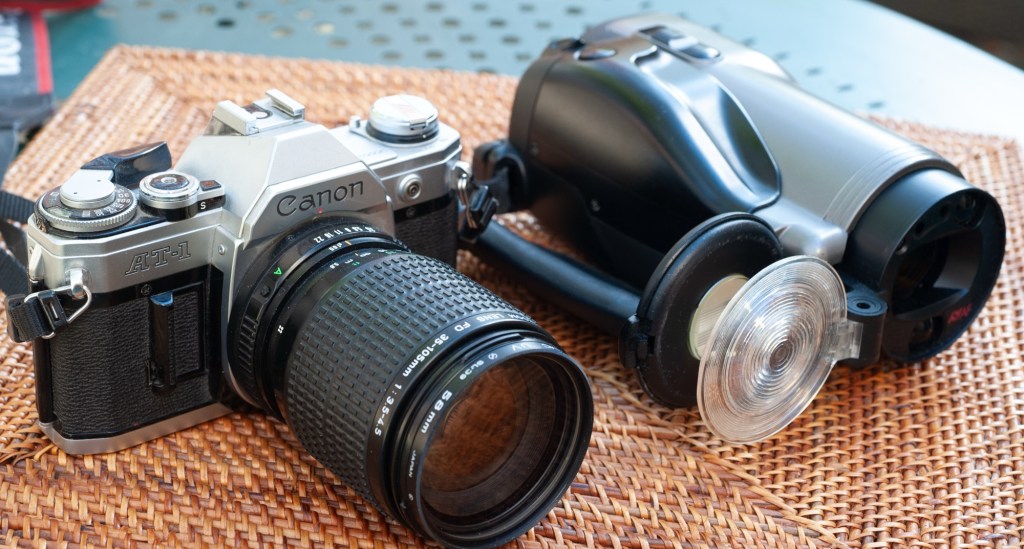
The Photura is very large for a “compact” camera. A zoom of similar range is mounted on the AT-1.

That’s my biggest gripe with this camera – when it was launched in 1990, very good motorized autofocus SLRs were already available from Canon, Minolta, Nikon, Pentax and a few others, and their phase detect autofocus was already more efficient and reliable than what we have here. Their reflex viewfinder was incomparably better than what the Photura could offer – and you could see directly whether your subject was in focus or not (on the Photura you have to rely on a green/red LED that will simply confirm that it did focus on… something). And they also provided more control over the exposure. A Canon Rebel of the same vintage (with its 35-80 kit zoom) was not that much more expensive (only 10% more), was not that much heavier (if it even was), and would have been my choice without any hesitation if I had been looking for my first “serious” camera.

As can be expected, the Photura line stopped at the 135 model. Canon’s next big hit in the compact camera sector would have to wait for a few years, with the very small Elph/Ixus – one of few good APS cameras of the late nineties, which later morphed into the digital Elph, one of the first really good digital compact cameras in the early years of this century.


Canon Photura brochure
Even next to an autofocus SLR it’s not really smaller.

What about the pictures?

I loaded the Photura with a roll of UltraMax 400 and spent a few hours walking in an area of Atlanta named Cabbagetown. Its population has almost fully completed the transition from “working class” to “young urban professional” – Teslas, Porsches and Volvos are more common in the streets than old American iron.

I already mentioned that the Photura is a pleasant camera to carry around, and the images it captures are generally very good – sharp enough and correctly exposed – very few are technically deficient. I simply boosted vibrance and clarity to add punch to the pictures shown below. On the other hand, close-ups and interior scenes can’t be shot without the flash, which tends to over-expose massively subjects located at less than 4 ft.

All in all, I was pleasantly surprised by the Photura. I bought it as a curiosity, but the quality of the images it delivered impressed me. It’s an almost entirely automatic camera, with comparatively simple auto exposure and autofocus systems, and it works very well. Modern cameras will yield much better results indoors, but as a street and travel photography camera, it’s very efficient and a pleasure to shoot with. A keeper. Who would have guessed it?

Continue reading

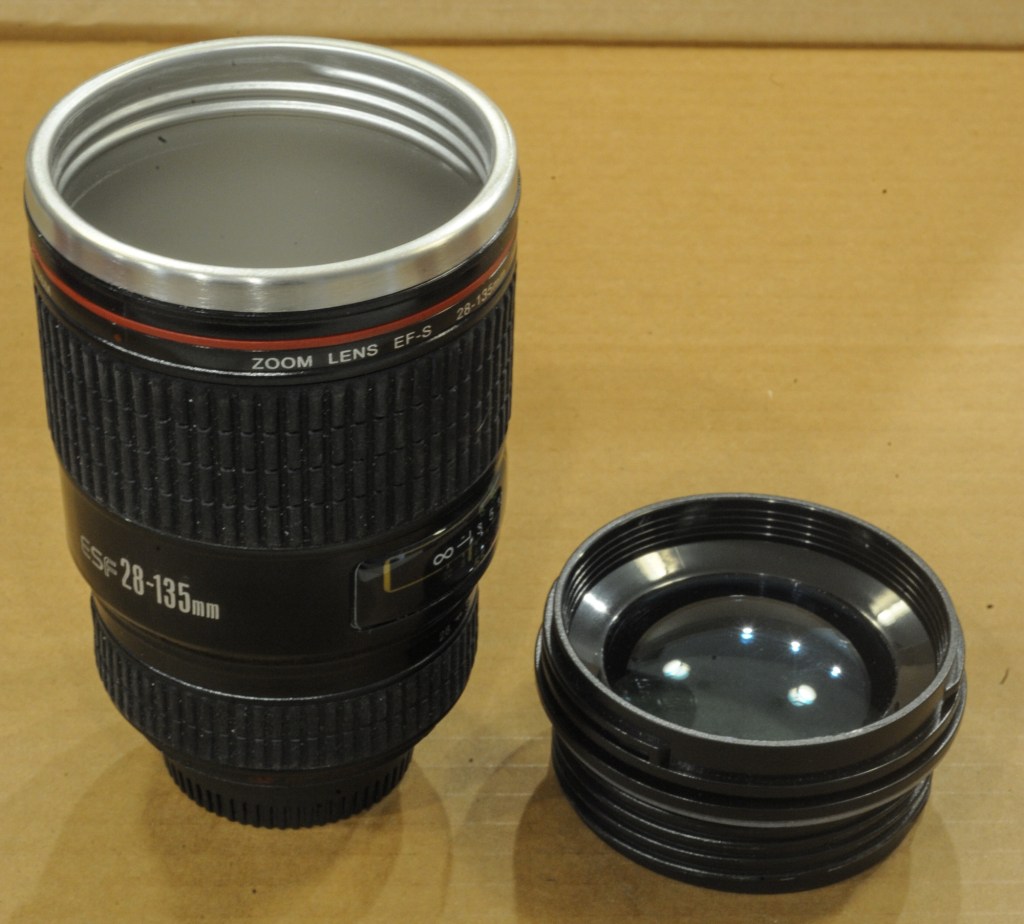
The camera lens coffee mug review – inspired by Canon’s EF-S 28-135mm

I don’t remember who gave it to me – because I for sure did not buy this thing – it was probably purchased for a few bucks in a thrift store. But since it’s here, let’s use it.

There are multiple variants of this mug. The most current today is the Canon 24-105mm f/4 USM, but mine is an older 28-135 EF-S L II USM. If it was a real lens, it would be a pretty good one, with L glass and image stabilization.

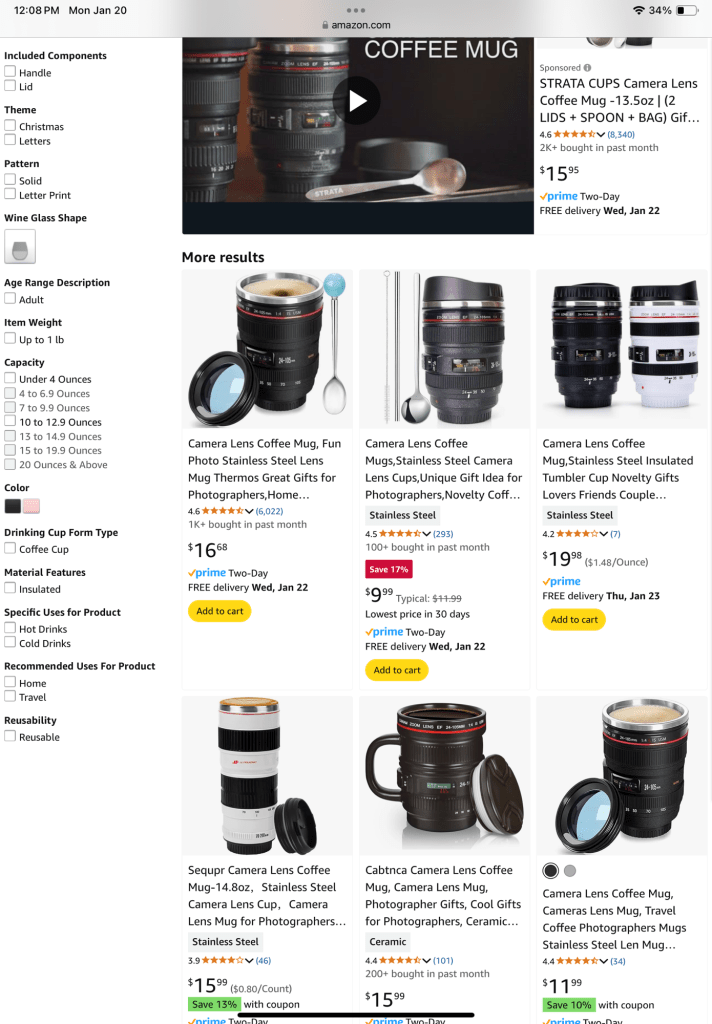
On Amazon.com this morning – all big box retailers propose them on their on-line stores.

Specifications

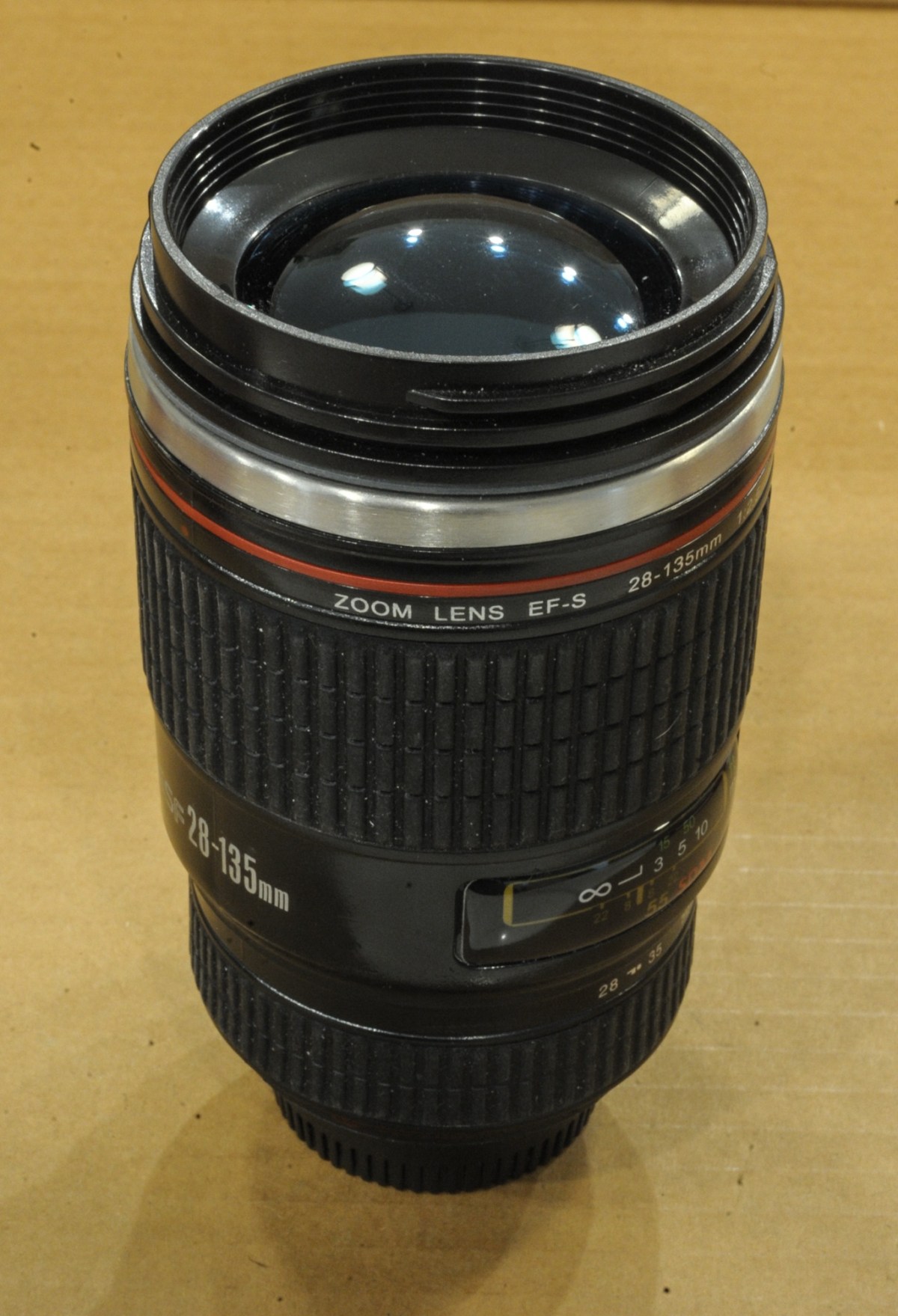
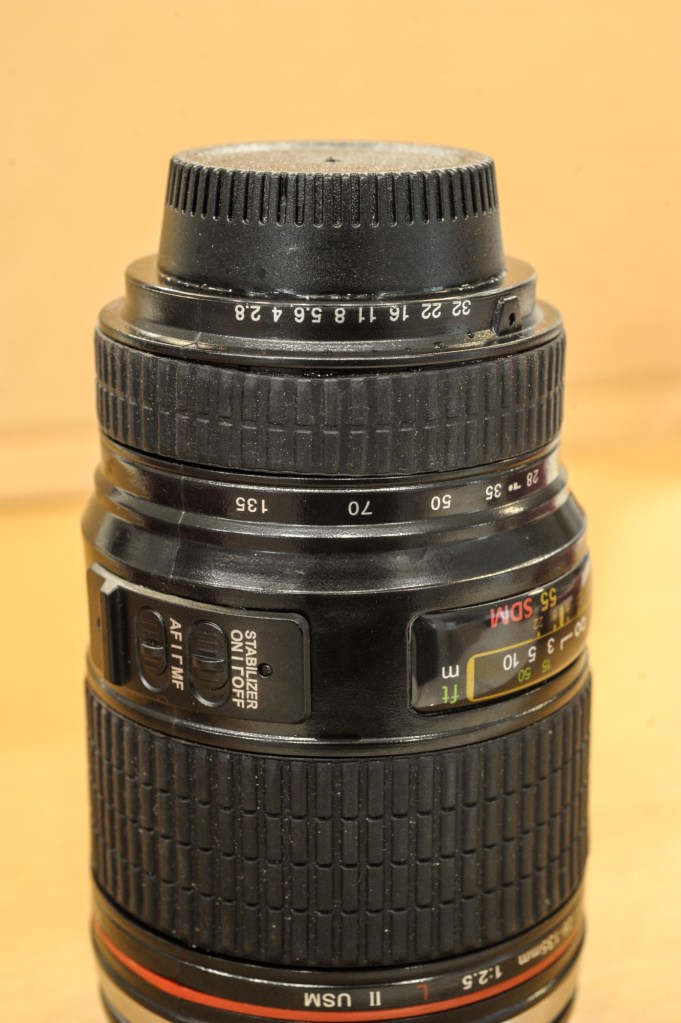
From a distance, it looks like a real zoom lens – the size is right, the AF/MF and Stabilization On/Off switches are realistically rendered, and the markings look like they were applied in a Canon factory. The screw-on lid is shaped like the front end of a zoom, with a large domed lens to justify the f/2.5 maximum aperture.

According to the description of the current 24-105 zooms available in 2025, the tumbler is insulated and works like a thermos. The lining is BPA-free stainless steel, and the lid is leak proof. I measured the capacity of my 28-135 zoom at approximately 10oz (0.3l).

It’s a real mug.

How does it work as a coffee mug?

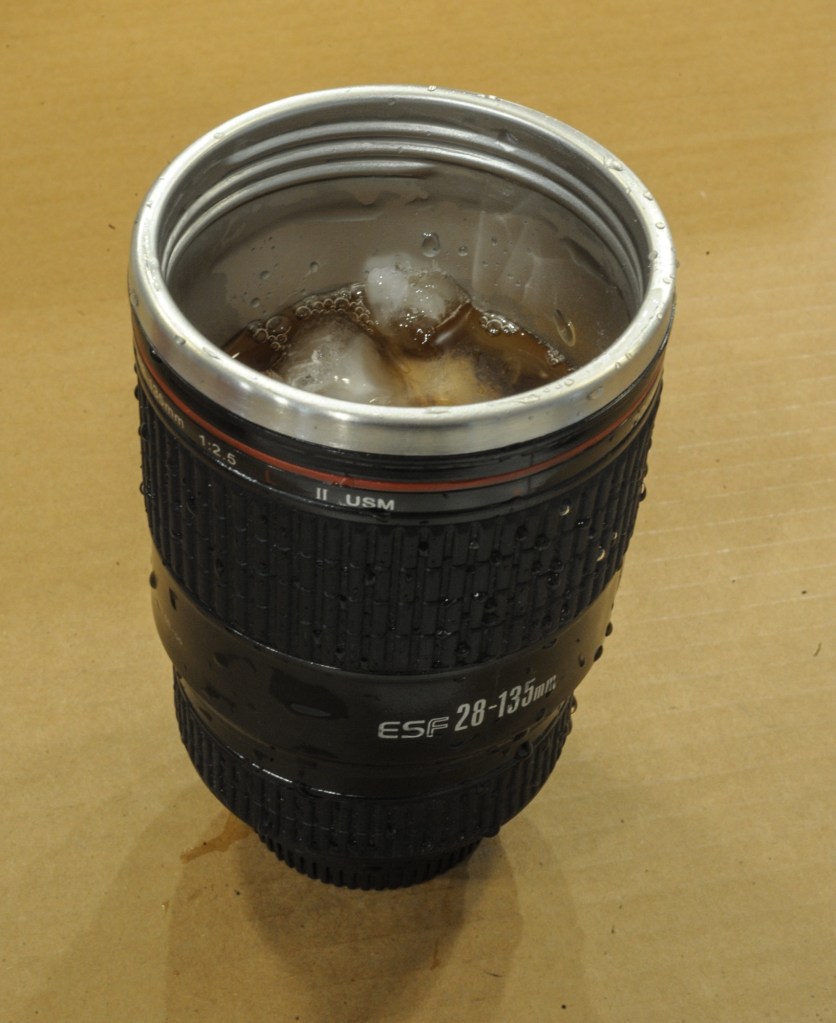
I tested it with coffee, and with cold drinks.

For an insulated thermos coffee mug, it’s not very good at insulating. It’s still better than a paper cup, but not as good as a Yeti or an Igloo tumbler. If you need more than a few minutes to drink 10oz of hot coffee, the mug will become pleasantly warm, and the coffee unpleasantly colder.

The screw-on lid is problematic – first, it’s not leak proof, and, after some hot coffee has found its way out, the mug becomes sort of vacuum sealed, and the lid becomes really difficult to un-screw.

it works better as a tumbler to enjoy cold drinks

How to tell for sure it’s not a Canon lens?

The question sounds stupid – and anybody who has an opportunity to hold one in their hands knows immediately it’s not a Canon lens. Canon zooms are not that light, they’re much better finished, and their front can’t be unscrewed to give access to their stainless steel innards. But if you’re only being shown a small, low resolution picture, it may not be that easy.

There are three tell tales:

1/ even though it’s sold as a Canon zoom lens replica, the mug does not correspond exactly to a specific Canon model.

2/ even on a low res picture, you may be able to see the marks left by the mould during the manufacturing process. Canon lenses don’t have those marks.

3/ there are obvious inaccuracies – my 28-135 zoom has an aperture ring, like a Nikon AF lens. I don’t know of any Canon EF lens with an aperture ring. And “SDM” is a Pentax acronym for “Supersonic Drive Motor”.

Two hints it’s a mug and not the real thing: the aperture ring – the Canon EF lenses never had one, and the mark of the mould above the AF cursor.

Could it fool anybody?

Maybe…I found this listing on ShopGoodwill.com recently. It was a bundle of “two vintage Canon film bodies and multiple lenses” – no mention of a mug, that sold for $167.00.

As a conclusion

It’s a gadget. Not very good as a coffee mug. But if you have a couple of old Canon EOS cameras in a showcase, you’ll be happy to add this Canon’s EF-S 28-135mm replica to your cabinet of curiosities.


Barcelona – Nikon FM

Canonet GIII QL17 – better than the Leica CL?

DSC_6942
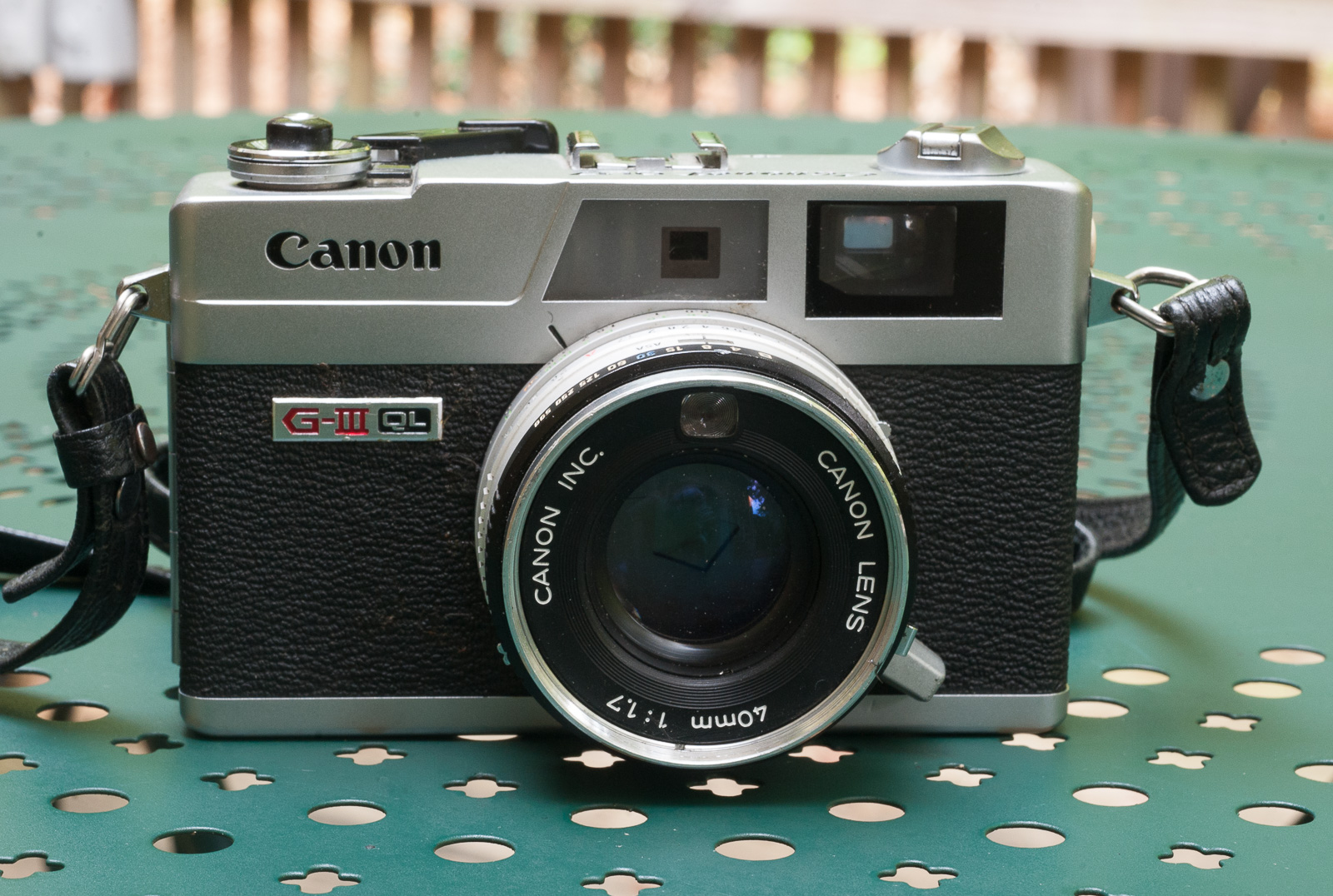
Canon “Canonet” QL17 GIII

At the beginning of the seventies, every camera maker had to have a super-compact camera in its line-up. They were designed for the amateurs who did not want to carry a heavy, expensive and complex single lens reflex, but were still looking for good quality camera offering more control than a Kodak Instamatic.

The most successful camera of this category was Canon’s Canonet series (which sold in the millions), but German camera makers also tried their luck – in cooperation with Minolta in the case of Leitz.

Manufactured in Japan by Minolta, the Leica CL was a sort of mini-Leica M5, with a similar semi-automatic exposure system, the same M bayonet, and a large viewfinder equipped with a coupled rangefinder. The CL was much smaller than the rather bulky M5, the base of its rangefinder was much narrower than the M5’s, and it only accepted two specifically designed interchangeable lenses (a 40mm and a 90mm), as well as the standard 50mm Leica lenses. The CL had a short sales career, but its general design was refreshed by Minolta a few years later, when they launched the Minolta CLE, which supported a dedicated 28mm Minolta Rokkor lens (in addition to the 40mm and 90mm lenses), and offered Minolta’s first flash system with on the film (OTF) metering.

DSC_6955
The Leica CL with its standard 40mm lens is a tad smaller than the Canon.

Apart from having interchangeable lenses and a Leica price tag, the CL’s characteristics were pretty much in line with what the other manufacturers of compact cameras were offering.

Canon  was the undisputed leader of the “super-compact” camera category, with its highly successful line of “Canonet” cameras. The GIII is the last iteration of the Canonet series, and the QL17 (named for its impressive 40mm f/1.7 lens) formed the top of the line. Let’s compare the Leica CL (from 1973) with the GIII QL17.

What they have in common :

  • rangefinder compact camera
  • focal length = 40mm
  • Fast Maximum aperture: F/1.7 (Canon); F/2 (Leica)
  • Size/Weight: Canon: 120 x 75 x 60 mm / 620g / Leica: 120x 76 x 32 (no lens)/400g without the  lens; 510g with the lens
  • Same PX625 battery (unfortunately)
  • CdS cell
  • both can work without a battery
DSC_6956
Both cameras are rangefinders with very good 40mm lenses.

There are significant differences though:

  • the Leica has a curtain shutter and offers a range of interchangeable lenses. But the Leica only supports 3 focal lengths (40mm, 50mm, 90mm) – it does not have the viewfinder markings needed to support Minolta’s Rokkor 28mm.
  • The Canonet has a central shutter, and a fixed lens (40mm F/1.7 in our case, but cheaper versions of the cameras were equipped with a slower lens). A big plus of this super-compact is Canon’s exclusive Quick film Loading system (hence the “QL” acronym), which is so much better than Leica’s film loading process  – which at best can be described as acrobatic (it requires a table, a chair and 2 hands, at a minimum).
  • Canon is either auto (shutter speed preferred) or fully manual (the meter is off if the camera is set to manual); the Leica is a semi auto camera (the well known matching needle arrangement).
IMG_7981
the viewfinder – in yellow – the frames, the rangefinder patch at the center, and the aperture scale on the right.

Metering

Both cameras use CdS sensors for metering, and because they were using Mercury batteries producing 1.35v (the PX625 model)  which are now absolutely unavailable, workarounds are necessary. The Leica only seems to work with Wein’s 625 Zinc-Air cell. The Canon seems to be a bit more tolerant, but I still recommend using a Zinc-Air battery, as they provide the same voltage as the original PX625 Mercury battery.

To tell the truth, I don’t really trust the exposure system of any of the cameras, and I use an app named Pocket Light Meter on an iPhone to determine the best exposure. With a tolerant film, the exposure will be OK.

DSC_6953
QL stands for Quick Loading – the mechanism works extremely well.

Hands-on with the Canonet GIII QL17

I bought this camera at an antique market, from a specialist who used to own one of the two or three remaining photo equipment stores in Atlanta, and was dispersing what was left of his inventory – he said he had completely reconditioned the camera (the combo lens-shutter in particular) but that he could not guarantee that the metering and the auto-exposure system would work.

The camera was expensive (at the top of the range for such a model) – but when I received the scans, I was happy I had spent my money on it: the optical quality of the images was really impressive – it’s difficult to beat a well-designed 40mm prime lens. 

Being small, silent and graced with a good viewfinder, it’s a good camera for street photography, provided the subject is not too mobile and leaves you all the time you need to set the focus and the exposure.   

DSC_6947
The QL17 seen from the top – it’s a “shutter speed” priority camera, that can also be operated in manual exposure mode. All the controls are on the lens.

I was very favorably impressed by the technical quality of the pictures I shot with the Canonet – obviously the film plays a role here (I like Kodak’s Ektar 100 for its color rendering and high definition) but this 40mm f/1.7 is definitely a great lens, and the mechanical shutter/iris combo is accurate enough for the shots to be correctly exposed (I was using an external light meter, though).

Would have the pictures been better if shot with the Leica CL? Probably not. The lens of this Canon camera is that good.   

DSC_6950
The black ring controls the shutter speed, the silver ring the aperture (it can be set to A) and the guide number for the flash.

Buying

  • Leica CL : it sold well, aged well, and does not seem to be in high demand. In addition, even if the CL’s Summicron-C 40mm lens can be physically mounted on the full size M cameras (M5, M6 and the like), there is no corresponding frameline in their viewfinder, limiting the practical interest of the lens for the other Leica photographers. Therefore,  the CL and its 40mm lens form the most accessible combination to enter the Leica M system. Interestingly, the non-Leica alternatives supporting the 40mm lens  (Minolta CLE, Voigtlander Bessa R3) are all more expensive than the CL. Expect to spend at least $300.00 for a nice body and $400.00 for the lens.
  • Canon – the Canonet line was sold over almost 15 years, and specific models like the GIII QL f/1.7 are rather sought after. Most of the copies are either “untested”, or “cosmetically perfect”, but  few vendors promise that the metering system and the shutter are going to work, let alone be accurate. You can find a nice “untested” copy for $50.00. Fully functional cameras are more expensive (typically above $150.00).

Conclusion

I’ve never been much of a rangefinder guy – I like the clear view and the fact that the viewfinder shows more than what will be captured on the film, but I always tend to forget to set the focus – or if I set it right at the beginning of a series of pictures, I forget to adjust it if my subject moves or if I change the angle of view. My success rate at that exercise is abysmal.

The rangefinder of the Leica CL tends to be easier on the eyes than the Canon’s (the focus zone is significantly more luminous than the rest of the viewfinder and pops out, as opposed to the Canon where it’s simply a yellow patch). But the Summicron-C  lens on the Leica is smaller and its focusing ramp stiffer than the lens of the Canonet, so it’s more difficult to operate for the casual photographer.

DSC_6957
The back of the Leica CL – loading the film is a cumbersome process

All in all, the Canon is definitely easier to use than the Leica, and the quality of the images roughly equivalent. But just a few years after those two cameras were released (in the second part of the seventies), automatic exposure SLRs had become so small and light (think Olympus OM-2, Pentax ME or Nikon EM) that provided you paired them with a tiny pancake 35 or 40mm lens, they were almost as compact as those two rangefinders, and so much easier to use. 

At least for me, SLRs will produce better results, with more consistency and a lower effort. Rangefinder cameras of the film era require a lot of practice and muscle memory to produce images of quality – and in the hands of a casual photographer who simply shoots a few rolls of film per year, I feel that they simply leave too much to chance.  Truth to be told, the only camera equipped with an optical finder that I can really live with is the Fujifilm X100t – it gives you the best of what the Canonet and the Leica CL offer (image quality, direct optical view, compactness, silence), but has enough automatic systems (reliable auto-focus, reliable auto-exposure, switchable digital viewfinder) to overcome the lack of practice of the occasional user.


Atlanta – Piedmont Park – Canonet GIII QL 17 – Kodak Ektar 100 – Piedmont Park is where all semi-pro photographers bring their clients for outdoors pictures, and where lovers spend quality time together.
Atlanta – Piedmont Park – Canonet GIII QL 17 – Kodak Ektar 100
Atlanta – Vinings Jubilee – Canonet G III QL 17 – Kodak Ektar 100 – you can see the limits of the lens – the signage of the shops is barely readable.

DP Review’s preferred “analog gems”

After Thom Hogan’s list of Nikon Classics, another list, this time coming from no other than dpreview.

The “DP” in dpreview stands for “Digital Photography” of course, and the site was launched in 1998, at the beginning of the digital camera craze. And they’ve never reviewed a film camera. As far as I know. But over the years, they compiled two lists of recommended,  “excellent and affordable” film cameras, the first one in 2017, with a follow up in June 2019.

A few of the cameras listed as “analog gems” by DPreview have been presented in this site over the years (the Nikons FE2, N90, the Olympus OM-1 and the Canon T90). Very often, my preference goes to other models of the same family (I prefer the Olympus OM-2 to the OM-1 because its battery is much easier to find, the Canon AT-1 to the AE-1 because I’m not a fan of shutter speed priority automatism, and the EOS-620 to the EOS-5 for its simplicity).

Nikon FM
Nikon FM

I’ve never been a fan of compact cameras in the days of film (poor viewfinder, not enough controls for the photographer). Their only advantages were their small size and their ease of use, but a film SLR with a pancake lens was not much larger and delivered much better images. And today, why would you spend money on film and processing to use a compact camera which will give you less control over your images than a good smartphone?

My absolute favorite? The ones I would bring on the proverbial desert island (assuming the desert island has no electricity, no Internet access but a huge stack of film cartridges waiting for me)?

Canon-T90-6241
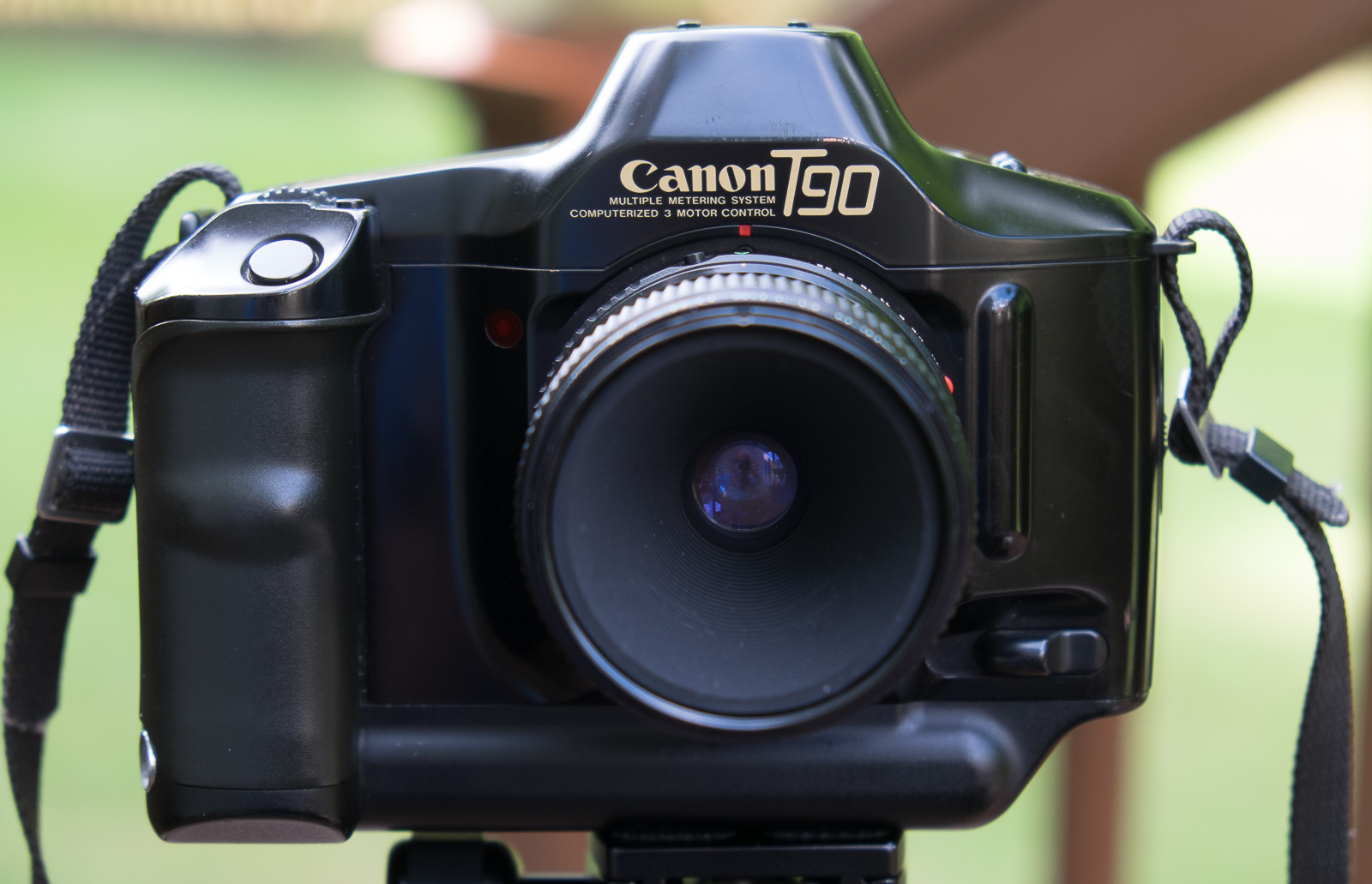
Canon T90 – the ergonomics of an EOS camera with an FD lens mount

  • a compact, mechanical, semi-auto SLR – not the Olympus OM-1, not the Pentax MX, but the rugged and supremely reliable Nikon FM. The FM2 is probably an even better camera, but it’s also more expensive.
  • the most elaborate pre-autofocus SLR, the Canon T90, for the looks, the ergonomics, the crazy exposure system, with no concern for its questionable reliability or its mass, because I would always have the Nikon FM as a backup.

And of course, when I would be back from the desert island, I would reconnect with my cherished Nikon FE2…


summer2017-R4---12

“La Maison aux Bambous” – Bed and Breakfast – Vinay (France). Canon T90 – Canon FD 24mm – Fujicolor 400.

Canon AT-1 – the polycarbonate FTb?

Something strange happened to the Canon AT-1 recently – it has become sought after.

When the AE-1 was establishing sales record for reflex cameras, its little brother, the AT-1, was struggling on the marketplace (Canon did not even bother selling it in Japan) and it remained until recently an under-appreciated camera.

The AE-1 was the undisputed star of the new Canon A line-up, the real successor of the FTb. The AT-1 was a bit of an afterthought, developed for cost conscious photographers who did not trust auto-exposure systems. With the same shell, the same electromagnetic shutter command and the same accessories as the AE-1, the AT-1 had some of the attributes of a modern camera, but its CdS meter (as opposed to the Silicon cell of its siblings) and its semi- auto exposure system with matching needle inherited from the FTb anchored it in the past. Contrarily to the FTb (and to almost any other semi-automatic camera), it could not operate at all without batteries – because of its electromagnetic shutter command.

Canon_cameras-6371
The large shutter speed selector and the shutter release are very smooth.

The electromagnetic shutter has its advantages (soft shutter release, smooth shutter speed knob, automatic selection of flash sync speed when a Canon Speedlite is mounted on the camera), but the ability to operate without batteries has always been a huge selling point with users of semi-automatic cameras. The AT-1 was not meeting this basic requirement, and it could explain why it remained under appreciated for so long.

Canon_cameras-6372
the timer of the shutter release is electronic – much more reliable than the fragile mechanical timer of conventional semi-auto cameras.

Before buying a good copy recently on eBay, I never had  used one. When I bought my first semi-auto SLR a long time ago, I only had eyes for the Nikon FM and for the Pentax MX – for the record that’s the Pentax I ended up buying, the Nikon was far too expensive. At that time, Canon’s marketing pressure was completely focused on the AE-1 and as far as I can remember, I did not even look at the AT-1. In any case, in comparison to the Nikon and the Pentax (with their LEDs and GASP metering cells),  the AT-1 would have looked too primitive to me.

  • Weight, Size and ergonomics
    The AT-1 shares its general dimensions and layout with the AE-1. The construction is similar (with some components like the prism housing using a mixed polycarbonate and copper plating construction). It’s not the most compact camera of its generation (the honor goes to the Olympus OM-1) but it’s not significantly larger or heavier – all the cameras of this generation (1975-1980) are more or less the same size. The AT-1 is one of the simplest conventional cameras you can find – the on/off switch on the left, the large and smooth shutter speed dial on the right, a large shutter release button – that’s all.
  • Viewfinder
    The viewfinder is relatively large with enough eye relief for photographers wearing glasses (larger than on a Nikon FM/FE, for instance). And because the viewfinder does not provide any information about the shutter speed or the aperture at the periphery of the frame, the eye of the photographer can remain focused on the center of the frame, which makes the viewfinder seem larger than it is. The focusing screen is not as clear as what you find on a comparable Nikon camera, but it’s fine enough. The split-image telemeter and the micro-prisms are present, and focusing is easy. The two needles of the metering system are located at the bottom right angle of the viewfinder, and are easy to read as well.

IMG_3388
Very simple viewfinder – and a perfect implementation of the old “matching needle” semi-auto metering.

  • Metering system
    Based on a CdS cell, it’s one generation behind the Silicon or GASP cells that Fujica, Nikon or Pentax were installing on their semi-auto cameras in the second half of the Seventies. CdS cells are supposed to be less sensitive in low light, and to suffer from a memory effect (they need 30 seconds to adjust when you move to a low light scene immediately after a bright scene). The matching needle mechanism is very easy to read (when there is enough light) but is not as easy to read as LEDs if the scene is dark.According to Canon, the camera uses some form of average/center weighted metering (I could not find any further explanation).  In my experience, it does not seem to be as selective as the cell of a FTb (or of a T90 in the “partial selective” mode), and most of the images, including those with a large bright blue sky, are correctly exposed.
  • Battery
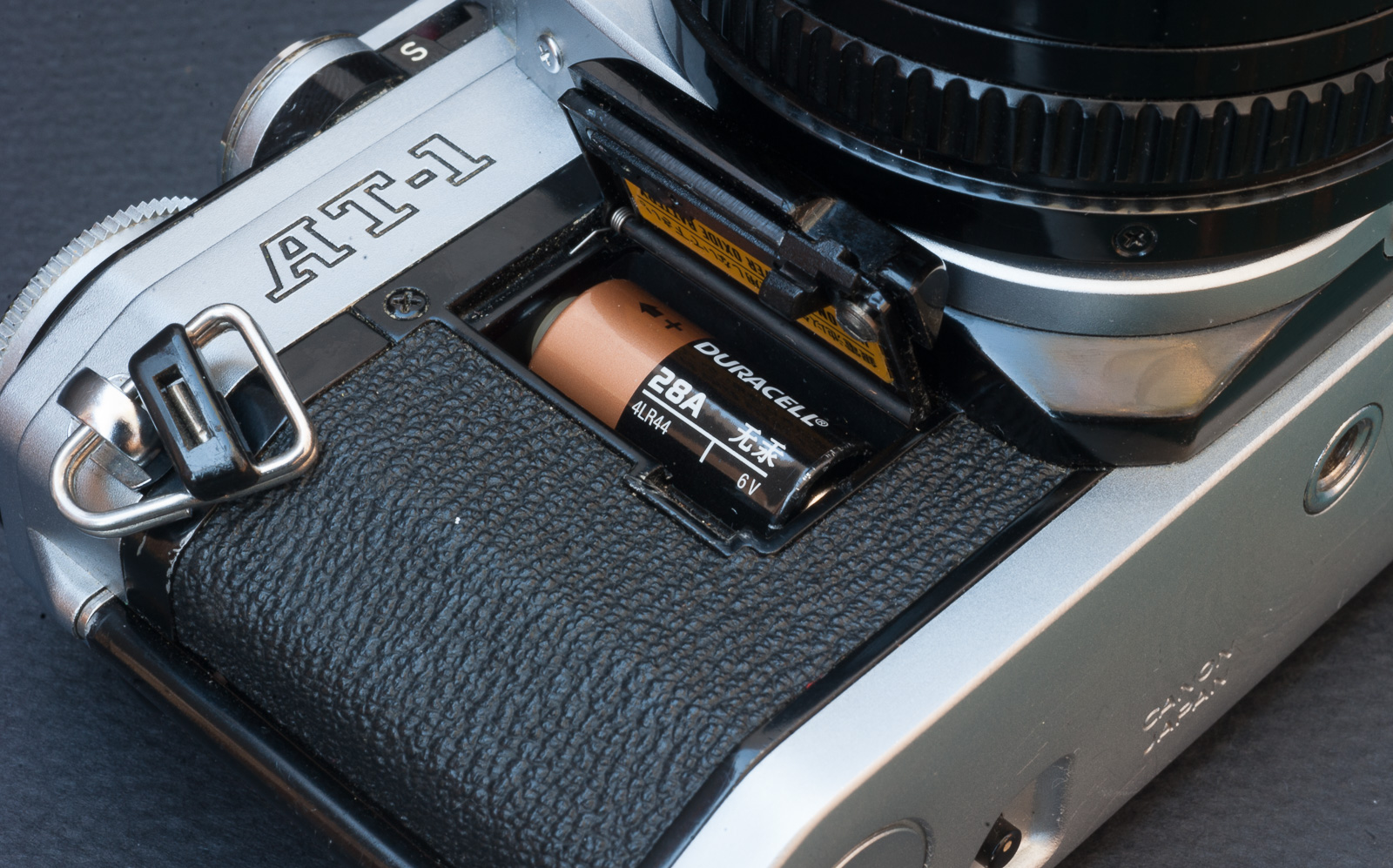
    Like all the cameras of the A series (AE-1, A-1, AL-1,…), the AT-1 relies on a relatively easy to find (and cheap) 6v battery. This battery is available in an alkaline and in a silver oxide version. As explained before, the camera can’t operate without a battery.

Canon_cameras-6374
The AT-1 does not work without this battery.

  • Compatibility
    Canon manufactured tens of millions of FL and FD lenses, that the AT-1 will happily support. FD lenses used to be cheap until the advent of mirrorless cameras and the development of FD to Sony FE lens mount adapters made them popular again. Truly exceptional lenses (the L series) are now seriously expensive, but cheaper alternatives abound. Most of the Canon accessories (winder, flash) can be shared with the AE-1 or A-1 models.
  • Reliability
    Compared to the multi-auto-exposure and auto-focus cameras launched in the following decade, the AT-1 is a very simple machine. With the A series, Canon had introduced new design and manufacturing methods, with significantly more plastic and electronic components that before, but Canon’s engineers did a good job and the cameras of that family don’t have a bad reputation when it comes to reliability. Over time, cameras of the Canon A family can be affected with the squeaky shutter syndrome, but I’ve not found anything on the Internet showing that the AT-1 is affected (my copy is not). In any case, the AT-1 was not designed for war correspondents or National Geographic photographers taking tens of thousands of photos per year in impossible situations; it was an entry level camera designed for cost conscious amateurs, and it does not seem to have betrayed its targeted audience.

Canon_cameras-6378
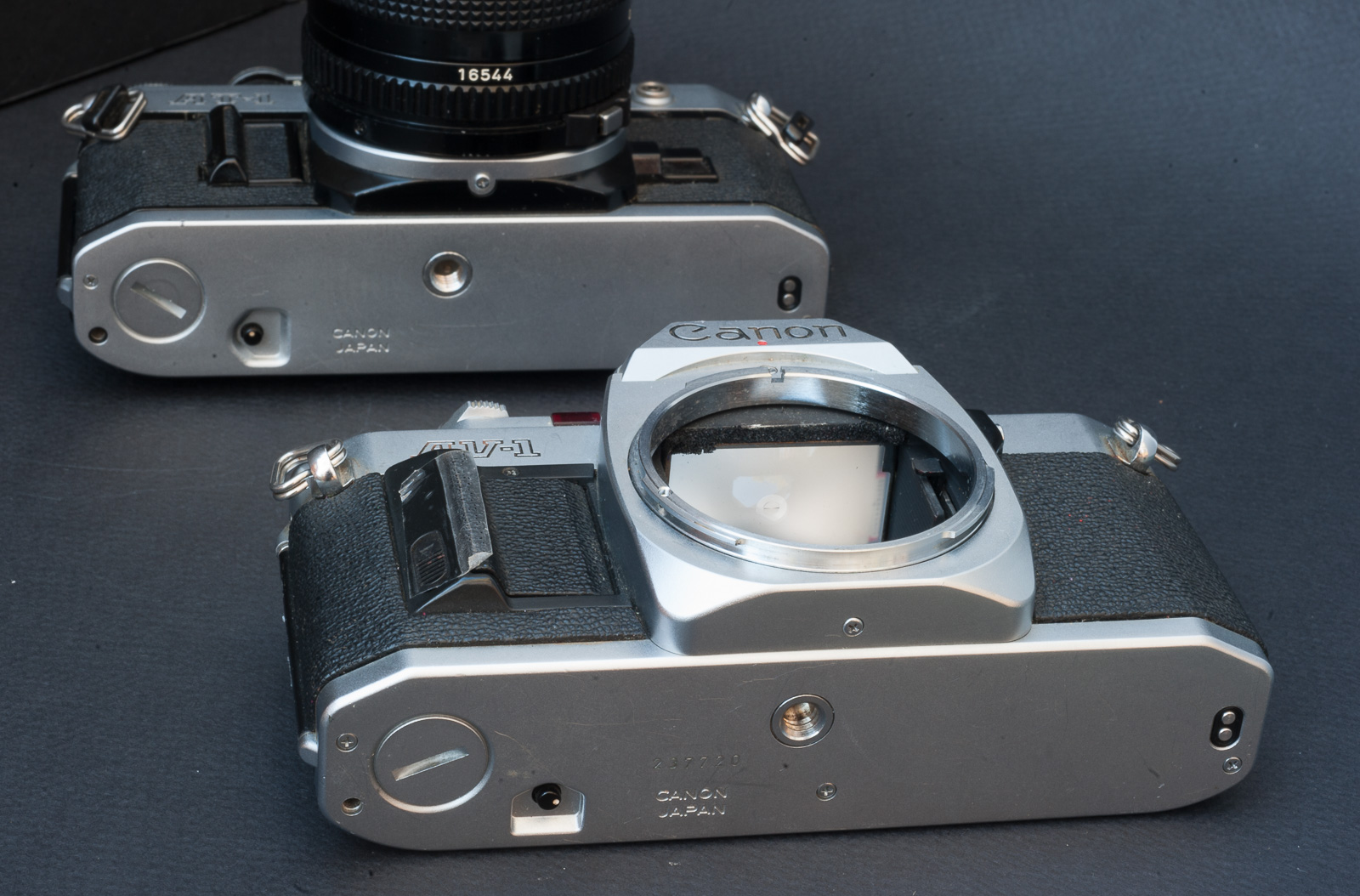
Canin’s platform strategy – in the foreground the Canon AV-1 (automatic, aperture preferred), the AT-1 (semi-auto) in the background. Both were positioned under the flagship AE-1 model and share their chassis with their bigger brother.

  • Scarcity and price
    With only 520,000 copies manufactured between Dec 1976 and 1985 (to be compared with 9,700,000 AE-1/AE-1 Program during the same period), the AT-1 was not very popular – for a Canon SLR, that is.  Today, with the AE-1 and the AE-1 Program becoming seriously expensive (for mass market SLRs of the early eighties), the AT-1 suddenly becomes a sort of next best option for people eager to use Canon FD lenses, and not willing to spend more than $50.00.

2019-01-Narbonne15
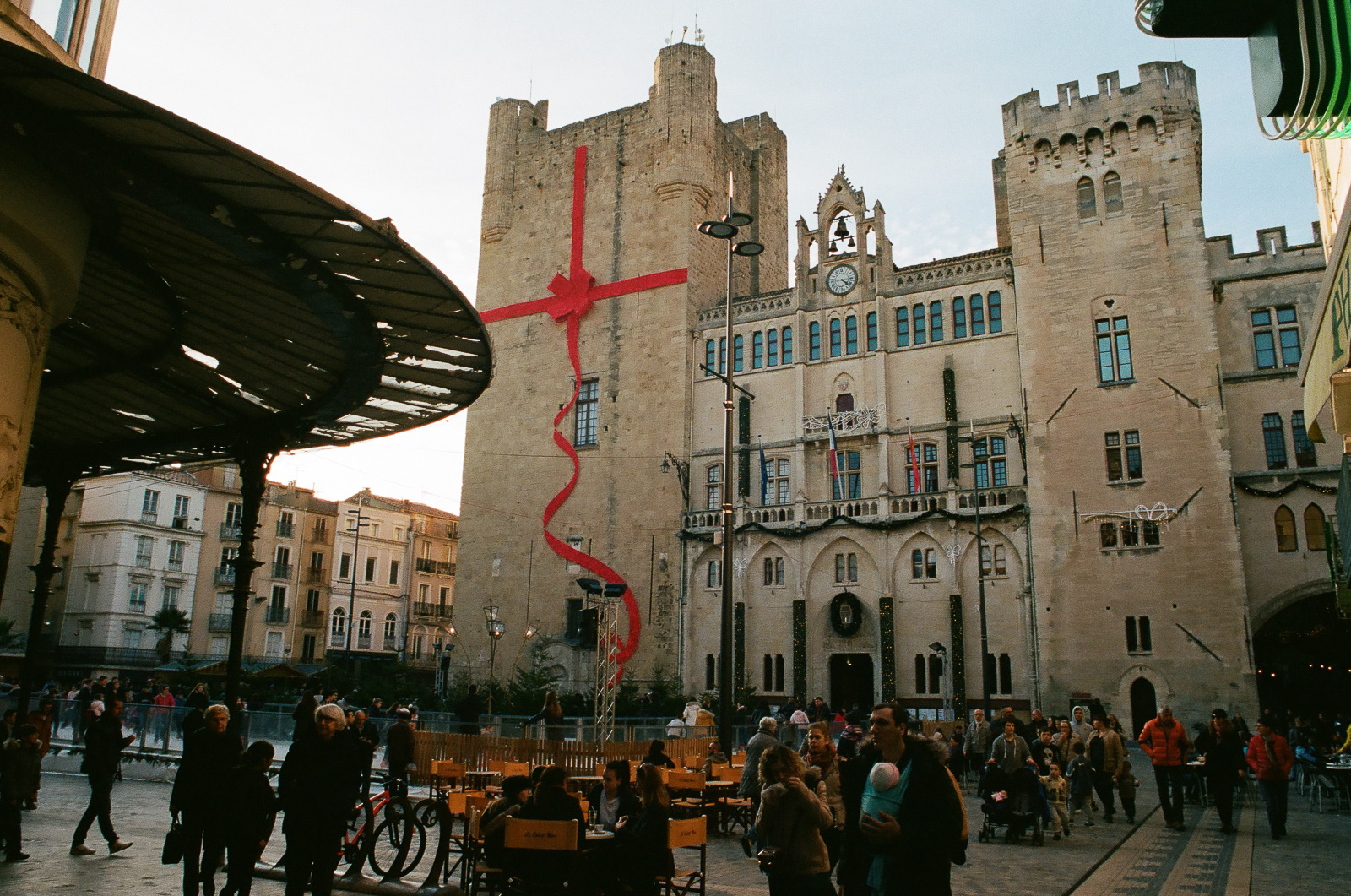
Narbonne (France) – Christmas market – Canon AT-1

Conclusion

Compared to its more expensive siblings of the Canon A family (AE-1, AE-1 Program, A-1), the AT-1 is a very simple camera – but to my surprise, it did not feel like an excessively spec’d down camera, and happened to be very pleasant to use.

The viewfinder is large and bright, and focusing is easy thanks to a combination of micro-prism and split image telemeter. The shutter speed dial is large and smooth, which makes it easy to adjust the exposure by changing the shutter speed (the shutter speed dial is generally very stiff on semi-auto/mechanical cameras, but the AT-1 benefits from its electromagnetic  shutter command).

Nothing important is missing (it has an electronic timer for “selfies” and a depth of field preview button) and little details taken over from the AE-1 make the life of the photographer easier. Even though it retains the metering and the on/off switch of the FTb, it feels like a much more modern camera than its famous ancestor, its only limitation being the lack of any information about shutter speed or aperture in the viewfinder.

In the Canon family, there are more elaborate cameras for users of Canon FD lenses. Their performance may be better (more precise metering, faster shutter, larger viewfinder), but they’re also less flexible and – for some of them – not as reliable. Simpler and offering more control over the exposure than the AE-1, lighter and not as expensive as the A-1, more reliable than the T90, it’s a very good camera to go back to the basics.


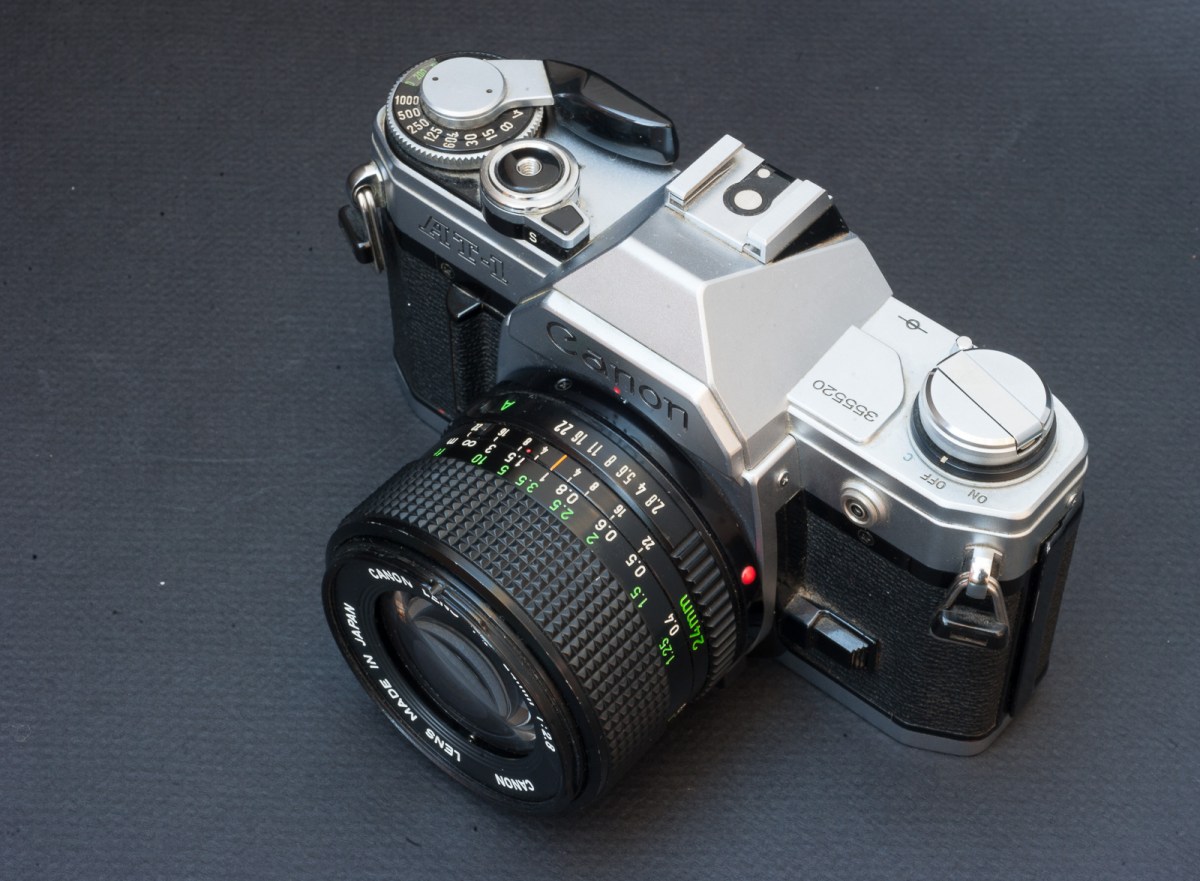
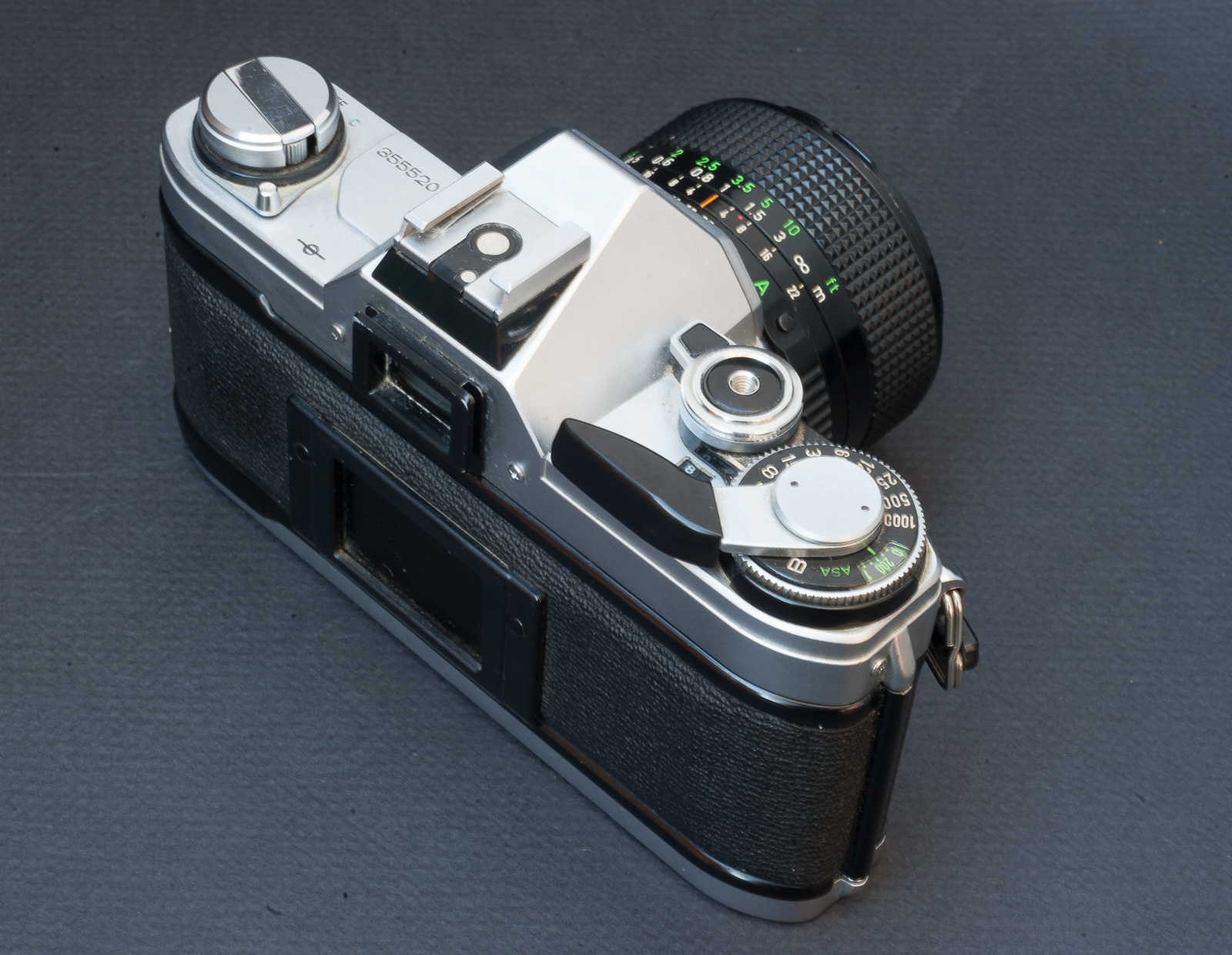
MIR – Canon AT-1 Specs


2019-01-Narbonne23
Narbonne (France) – Christmas decorations – Canon AT-1

2019-01-Narbonne34
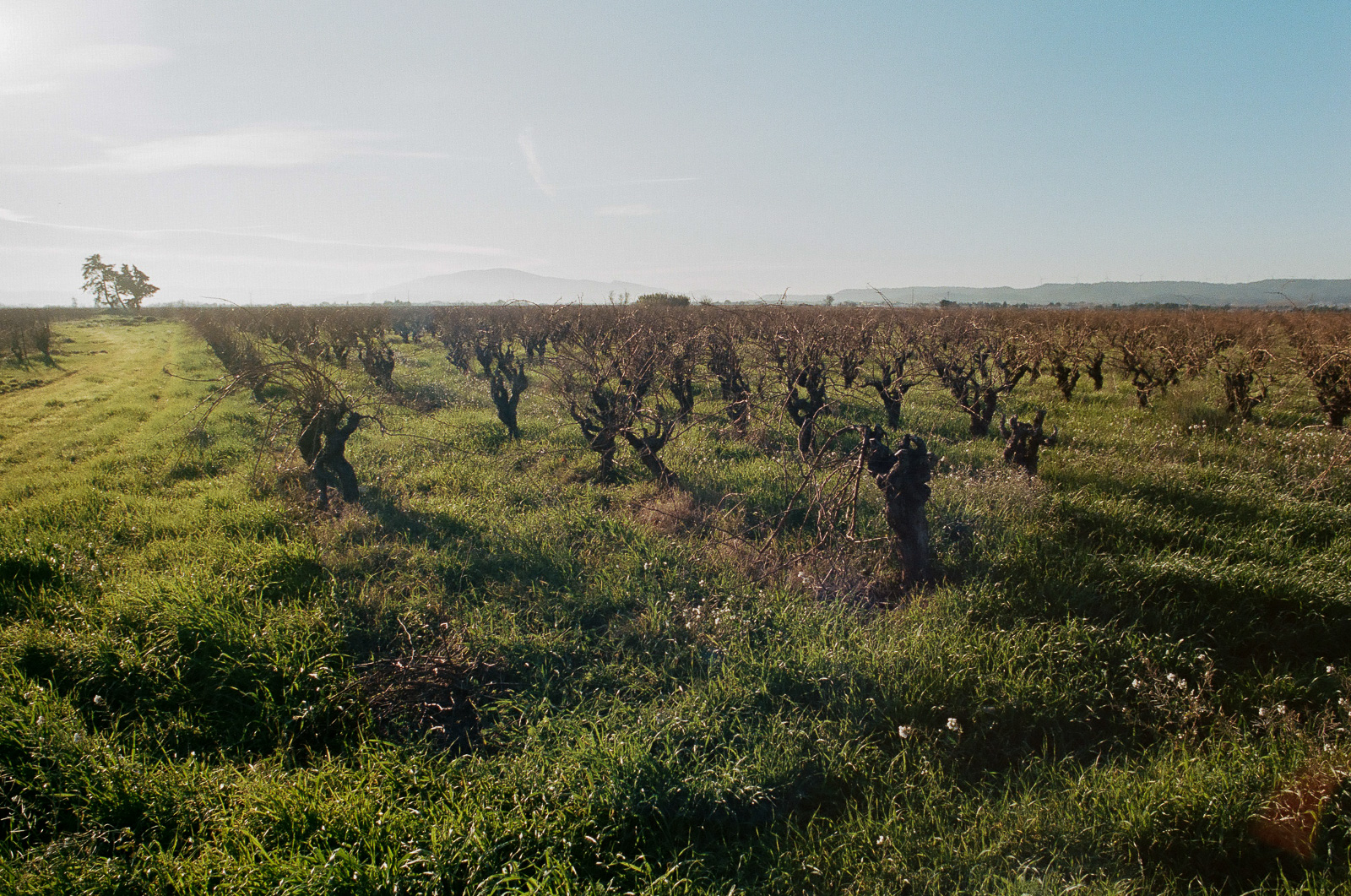
Landscape of the Corbieres (France). Canon AT-1

2019-01-Narbonne2
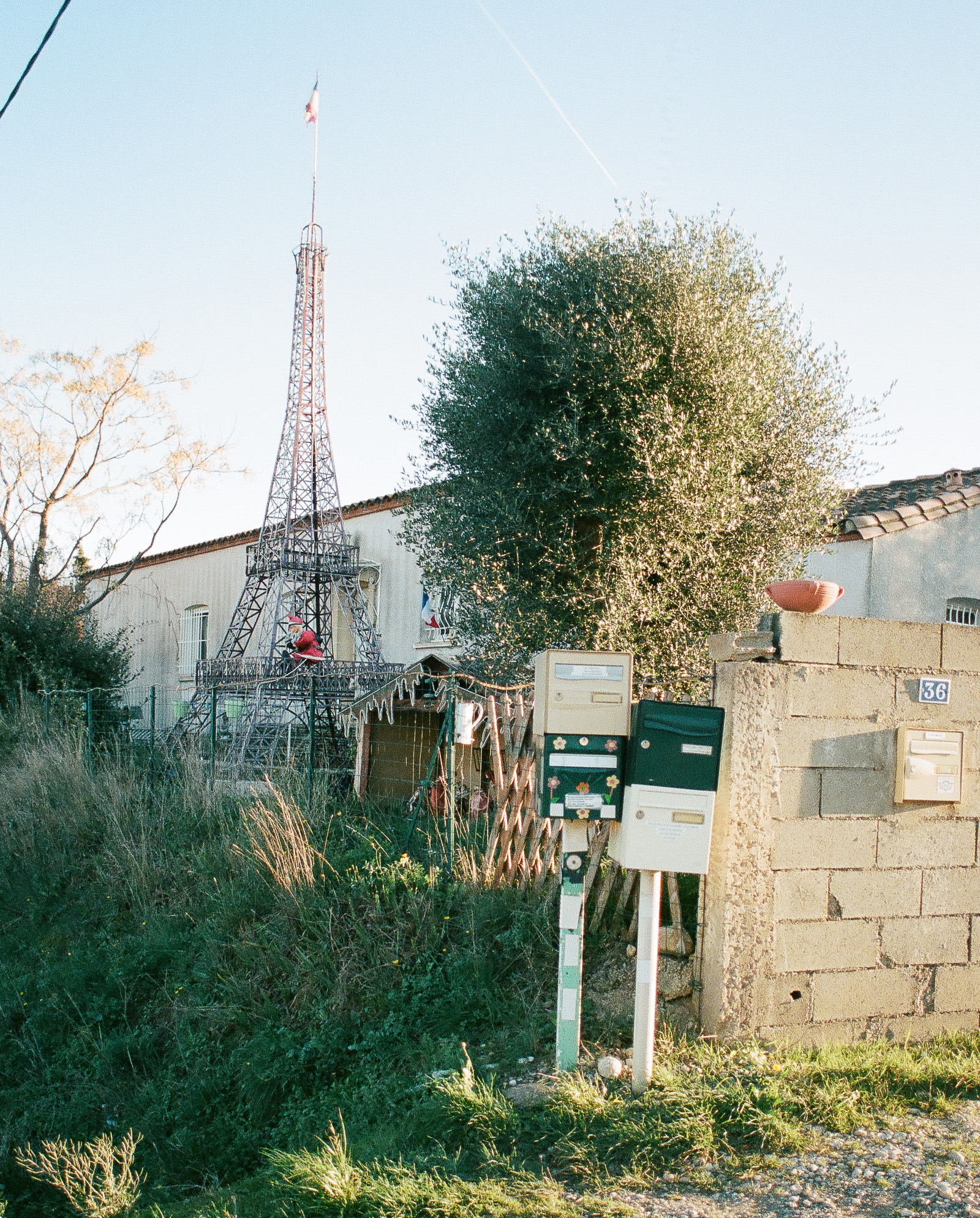
The Eiffel Tower in the backyard – Lezignan-Corbieres (France). Canon AT-1, FD 24mm lens.


Canon EOS 620/650 – was the first EOS already the best of them all?

The first pair of Canon EOS bodies (the “enthusiast” EOS 650 and the “prosumer” EOS 620) came relatively late to the autofocus SLR party (2 years after the Minolta 7000 and one year after Nikon F501/N2020), but they were already very mature cameras – when you shoot with one of those early EOS cameras today, they seem so easy to use and so modern that you don’t even notice you’re shooting with 40 year old gear.

Before launching the EOS series, Canon had tried to convert its FD mount to auto-focus, but their first AF SLR, the T80, had been a technical and commercial failure. Canon had  no choice but to adopt a more radical approach, and used their  top of the line T90 body as the starting point for the development of two new revolutionary auto-focus cameras, the EOS 650 and 620. A new lens mount and a new line of lenses were launched at the same time. Contrarily to Minolta, Nikon and Pentax, Canon installed the auto-focus motor inside the lens. Most of the new Canon EF lenses launched at the time were equipped with  a conventional micro motor, but the top of the line USM lenses were designed around a new type of motor, which promised incredible AF speed and total silence (it reads like an ad for Tesla ;-).

Canon_cameras-8210
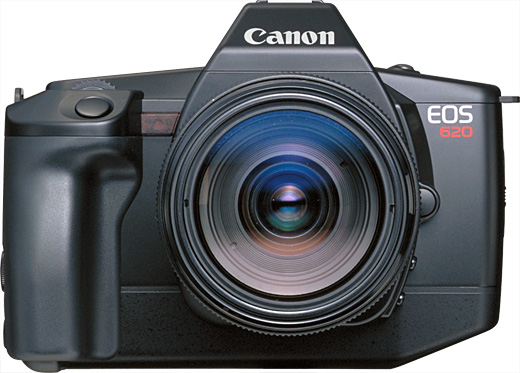
The design of the EOS cameras of 1987 is closely derived from the T90 from 1986. The T90 is larger, and much heavier.
It was its USM technology that made Canon the leader of the photo equipment industry at the end of the eighties: it all started at the Seoul Olympic games in 1988: Nikon had planned to make a big splash with Pro Photographers with the introduction of the first modular Auto-Focus camera ever,  the brand new F4. Canon had nothing comparable to show yet (their EOS 1 camera was still one year away), so they brought the most advanced body they had at the time, the EOS 620, and paired it with an EF 300mm f/2.8L USM lens. The Canon auto-focus combination ran circles around the conventional AF architecture of Nikon’s AF 300 f/2.8, and the pro market rapidly shifted towards Canon. Canon would retain its dominance in the pro market to this day.

Canon_cameras-8211
EOS 620 on the foreground, T90 in the background.

Both cameras do most things right, without being encumbered by a litany of settings and options. Of course the models that followed brought improvements to the autofocus performance and to the ergonomics (the famous Canon wheel at the back of the film door), but the EOS 620 and 650 set the standard for what a modal interface SLR should look like, and they were already so good that it can be argued that Canon had to fall into gadgetry (Eye Control Focus and Bar Code readers, remember ?) to keep the public interested in the EOS line over the following decade.

559376140028_28
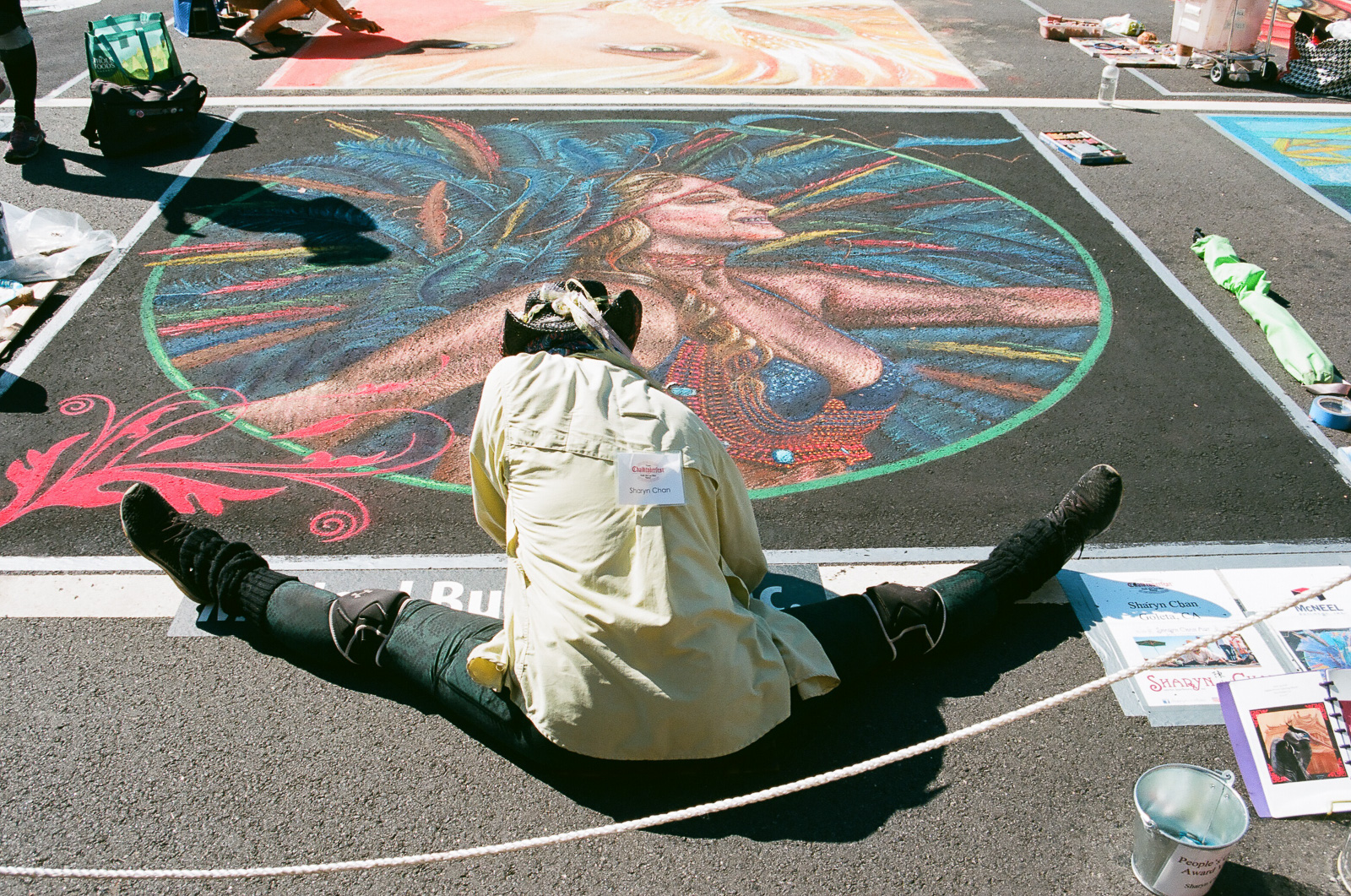
Series of pictures shot at the Marietta Chalktober Fest, around the town square. The artist here is Sharyn Shan. (Canon EOS 650, EF 28-70 f/3.5-4.5, Kodak Ektar 100)

The two EOS models are differentiated primarily by their shutter (the EOS 650 has a conventional 1/2000 shutter with 1/125 flash sync speed, while the EOS 620 has a 1/4000 shutter with 1/250 sync speed). The EOS 620 also benefits from a backlit LCD on the top plate, its Program mode is “shiftable”, and it manages multiple exposures.

Canon_cameras-6366
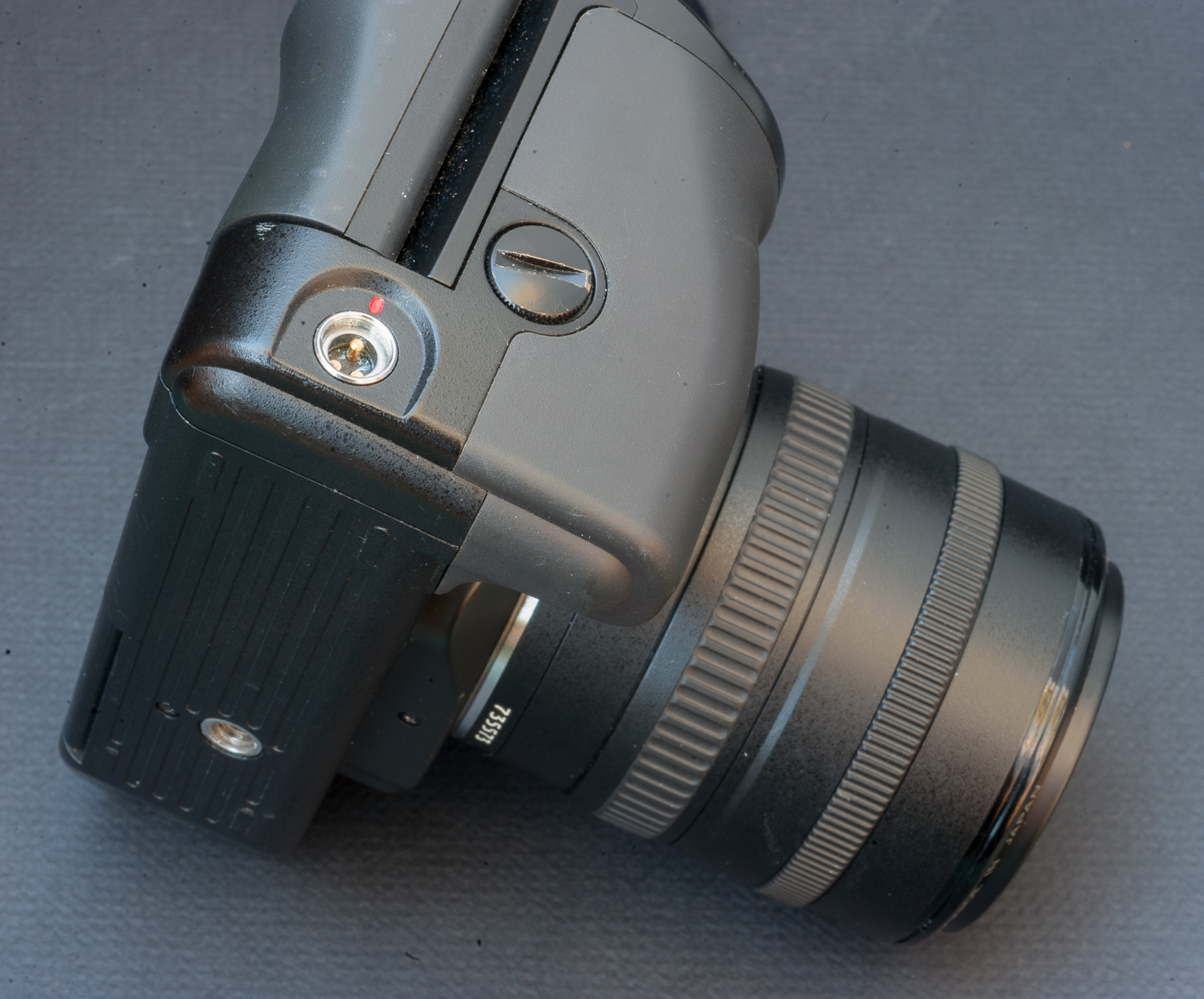
The handgrip-battery holder of the EOS 650 – this camera is very well built, with high quality plastics and a great care for details. The battery is the expensive (and not that easy to find anymore) Lithium 2CR5.

Surprisingly, and considering Canon’s reputation of superiority in the early auto-focus days, the EOS AF performance is not that great – probably because the 28-70mm lens I bought with one of the cameras was an early non-USM lens. The tiny,  single zone auto-focus sensor is not very sensitive in low light, and the camera tends to hunt if it can not find vertical lines in the subject. Canon’ s USM technology can help with reactivity but won’t enlarge the sensor or make it better in low light.

Canon_cameras-6367
Only the Canon EOS 620 has a remote control connector at the bottom of its handgrip

On the other hand, Canon’s first implementation of matrix metering was a success – and you can leave the camera in auto-exposure mode most of the time. Interestingly, none of those cameras has a true semi-auto exposure mode (in the “M” mode, you can set  the shutter speed and the aperture any way you want, but the metering system of the body is inoperant).

The cameras are  built out of good quality plastic – they feel substantive – even if  they’re much lighter than the T90, in part because they’re using a lithium 2CR5 battery instead of heavier AAs of the T90. They have a pretty good viewfinder, large enough, clear enough, OKish for bespectacled photographers, have very few knobs or buttons but a large grip, and are easy to control.

They accept any Canon EF Lens made to this day, and thanks to adapters, can even work with older m42 screw mount lenses (they don’t work with Canon’s own FD lenses though).

They were produced in large quantities, and many seem to have survived. Because nobody loves early autofocus cameras, they’re extremely cheap ($5.00 to $7.00) and if you consider their performance, they offer an unbeatable price/performance ratio.

559376140026_26
Another artist at work in Marietta: Raziah Roushan

Conclusion: will I use them?

If you’re looking for an easy introduction to film photography, and want to be able to reuse the modern Canon EF lenses and accessories that you may already own, the Canon EOS 650 and 620 are great cameras. The 620 is marginally more capable, and since all early EOS cameras are now selling for the same low price,  that’s the EOS 620 I would pick.  You won’t find a better camera to shoot with film in that price range, and you will love the results. The camera is surprisingly competent and  mature for a 1.0 version, and I’m not sure the gadget laden models that followed (EOS-10S with bar code readers, EOS 5/A2 with Eye Control focusing) will yield better results in the real life.

The Japanese camera industry has a tendency to work in cycles, with a big innovation every ten to fifteen years, followed by years of incremental improvements – until the next big thing makes the previous generation obsolete, and opens a new cycle of incremental improvements.  Generally, during the first years following a big innovation, progress is rapid and the improvements really significant. And generally, after a few years, the pace of the changes slows down, the manufacturers end up promoting all sorts of useless features to keep the public interested in their products, until the next big thing arrives.

IMG_3390
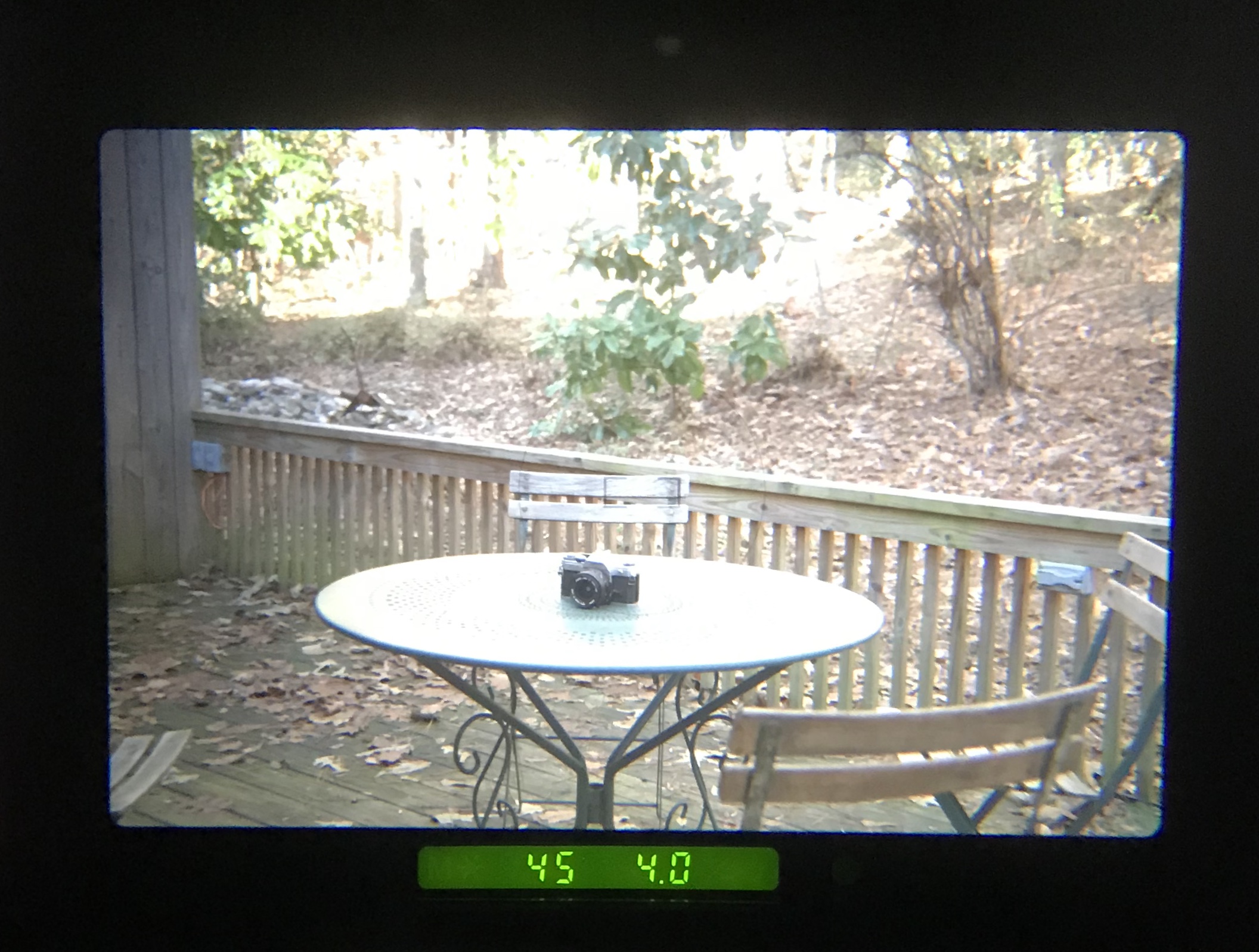
EOS 650 viewfinder – shutter speed, aperture, and two brackets engraved on the focusing screen to show the tiny central AF zone – very simple.

Normally, it takes more than a few years to reach the peak – but in the case of autofocus film SLRs, I’m wondering whether it was reached with the EOS 620,  just two years after the launch of the Minolta Maxxum 7000. Of course, Canon (and others) would launch cameras with better autofocus systems (more zones, better low light sensitivity) and with a useful built-in flash, but the newer products were more complex, often fell into gimmickry, and were not always as well built. Few enthusiast autofocus SLRs are as easy to use as those early EOS cameras.  You should try one.

Happy Holidays.


More about the early Canon EOS cameras:

Ken Rockwell’s very detailed analysis of the EOS 650, and his take on more modern autofocus cameras – “Im ashamed that newer cameras seem to offer so little that matters compared to Canon’s very first AF SLR. I’m ashamed that I’ve fallen for all the marketing pitches that made me think I need whatever useless newer features have come out since 1987; I haven’t needed any of these features.

The Canon Museum – 1986-1991


559376140029_29

559376140011_11

559376140020_20

Reaching new lows on Shopgoodwill.com


New lows like in “new low prices“.

I published a blog entry on $5.00 cameras a while back, and now I have two extra SLR bodies and a lens to add to my league of fivers. I recently became the proud owner of a Canon EOS 620 for $4.95 (nobody seems to like first generation auto-focus SLRs) and of a nice Canon EF 28-70 F3.5-4.5 zoom, (the hidden part of a bundle with the very first generation EOS camera, the EOS 650: $8.95). They both seem to work well and the lens is …pristine.

canon_eos620
My newly purchased EOS 650 – the pictures of the items for sale on Shopgoodwill are getting better. And this camera works as well as it looks.

Generally there is not much in terms of a bargain on shopgoodwill.com : as opposed to eBay where the sellers are independent entrepreneurs competing for your dollar, Shopgoodwill is a sole source marketplace.

On eBay, sellers have to describe the piece of equipment they’re offering in detail and the buyers are protected by the feedback mechanism. On Shopgoodwill, item descriptions are minimalist, and the equipment for sale is almost always “untested, sold as-is”.

I suspect that because purchases at Goodwill can be easily disguised as tax deductible charitable contributions, lots of buyers are not really sensitive to prices, and end up paying a lot for a poorly described and untested piece of equipment. As much as they would pay on eBay for an equivalent camera, but without  the implied warranty of a seller or the support of eBay if things go south.

Lastly, considering that cameras and lenses are sold “untested and as-is”, the risk of buying a lemon is pretty high – if a camera is known for a weak point (fragile shutter curtains, short lived capacitors, temperamental electronic shutter release, for instance), it’s safe to assume that the item for sale will be plagued with it. Even if it looks “pristine” cosmetically.


I would not buy a camera from a series with a known weak point on Shopgoodwill – far too risky. I would buy it from a seller with a great reputation on eBay. 

In my opinion, there are only two ways to score a good deal at Shopgoodwill: buy for cheap something that absolutely nobody wants but that has value for you (a first generation AF cameras for instance if that’s your fancy), or buy a poorly documented bundle, whose perceived value is dragged down by a very disserving description. Imagine an item advertised as “Nikon N4004 + Sears lens” or “Olympus film camera with broken lens”. Nothing to grab the attention of the casual browser. But if you look carefully at the pictures, you notice that only the lens cap is from Sears, and that the lens looks like … a recent Nikon AF-S lens. Or that the Olympus camera sold with the broken lens is a rather rare (and sought after) OM-2000 in seemingly pristine condition.

cameragx-6593
Nikon N90s (aka F90x) and Minolta 9xi – solid cameras with a solid reputation – both were Shopgoodwill purchases and happened to work perfectly.

How is it possible? With a few exceptions, the people who write the item descriptions at Goodwill know nothing about photography, and don’t have time to check or research.

More about my first Canon EOS cameras and how they compare to Nikon’s best in a few weeks.

559376140034_34
Seen in Marietta, GA – Canon EOS 650 – Canon EF 28-70 3.5-4.5 – Kodak Ektar – the camera is a pleasure to use and the lens is pretty good – not bad for $8.95.


The Ultimate film cameras

Ultimate: “last in a progression or series : final” (Source: Merriam-Webster)

Film cameras stopped selling in any significant quantity in the first years of this century – and the production of film cameras had almost completely ceased by 2008. But almost until the end, Canon, Minolta and Nikon kept on launching new models.

Most of those cameras were forgettable entry level models (their main justification was to occupy a lower price point than digital cameras), but a few high end models were nonetheless introduced.

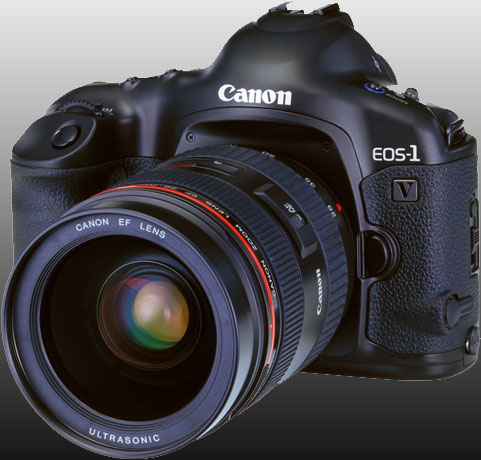
The Canon EOS 3 (launched in 1998), the Minolta Maxxum 9 and the Nikon F100 (1999), the EOS-1v and the Maxxum 7 (2000), and last but not least the Nikon F6 (2004), were all at the pinnacle of film camera technology, and there will probably never be any new film camera as elaborate as they were.

Minolta+Maxxum+7+_+Dynax+7+_+Alpha+7+-+Meta35
Minolta Maxxum (alpha) 7 – Source: Meta35

They did not sell in large numbers. But they kept their value remarkably well, much better than the autofocus SLRs of the previous generation, and than the first mass market digital SLRs that replaced them in the bags of photographers.

Today, if you exclude the limited editions models that Minolta and Nikon had sometimes added to their product lines, it seems that for each of the big three Japanese camera manufacturers, the most expensive film camera on the second hand market is always their most recent high-end autofocus model.

Let’s look first at models launched at the very end of the film era, between the end of 1998 and 2004:

(source: eBay “sold” listings, body only, for a used camera in working order – I did not include “new old stock”, “Limited Editions”, “as-is”, “please read” and “for parts” listings.)

Canon

  • EOS1-V                   $350 to $800         launched: March 2000
  • EOS-3                      $150 to $700         launched: November 1998

Minolta (excluding “Limited  Series”)

  • Maxxum 9             $200 to $470         launched 1999
  • Maxxum 7             $150 to $230         launched 2000

Nikon

  • F100:                        $200 to $400         launched 1999
  • F6 (second hand): $600 to $1,300      launched 2004

Canon_eos_1_v

And let’s compare them with cameras of the generation that came just before

  • EOS 1n                     $100 to $300        launched November 1994
  • EOS Elan II              $40 to $100          launched September 1995
  • Minolta 800si         $45 to $60             launched 1997
  • Nikon F5                 $150 to $300         launched 1996
  • N90S/F90x              $40 to $150           launched 1994

cameragx-6593
Nikon N90s (aka F90x) and Minolta 9xi – the unloved auto-focus cameras of the early to mid-eighties

The “ultimate” models sell for 3 to 5 times more than models that used to occupy the same place in the brand’s line-up, one generation before. Clearly for autofocus cameras, the most recent is also the most sought after, and the most expensive. A few reasons:

  • They have the highest usage value
    • Better performance – cameras of the ultimate generation are better machines – they focus faster and more accurately, the exposure is on the spot in more situations, under natural light and with a flash
    • Better compatibility with the current line of products of the brand (for example the Maxxum 7 accepts current Sony A lenses with ultrasonic motorization (Sony SSM lenses), and  the Nikon F100 can work with lenses deprived of an aperture ring (Nikon AF-S lenses). Older models can’t.
    • There is an expectation that the cameras will be more reliable (they’re more recent,  probably have been through fewer cycles, and their electronics components are most certainly better designed than they were in cameras of the previous decade).
  • Highest potential in collection
    • For bragging rights: “the most advanced film camera – ever”
    • For nostalgia: “the last film camera made by … Minolta”
    • Rarity: cameras launched in 1999 or in 2000 had a very narrow window of opportunity on the market – Nikon D1 launched mid 1999, the Fujifilm S1 Pro and the Canon D30 in the first months of year 2000 – and from there on the writing was on the wall. When the Maxxum 7 or the EOS-1V were launched in 2000, most enthusiast and pro photographers were already saving money for a future (and inevitable) Maxxum 7d or Canon EOS-1d. The last high end film cameras must not have sold in huge quantities.

How are the “ultimate” film cameras doing compared to the first digital models? 

The ultimate film cameras are more expensive than corresponding digital cameras sold in the first years of the 21  century – remember, those were dSLRs with 6 MPixel APS-C sensors at best, with mediocre low light capabilities and a narrow dynamic range. They  have a relatively limited usage value today (a smartphone does much better in many situations).

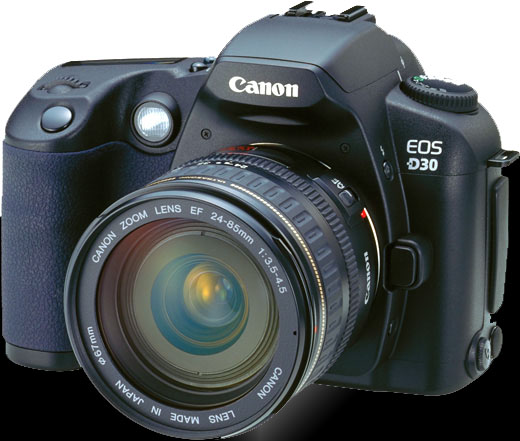
canon_d30
Canon EOS d-30 from Year 2000 – a dSLR with a 3.25 million pixel CMOS sensor. Working copies can be found for $40 on eBay. (source: “Canon Museum”)

Are buyers of manual focus cameras also looking for the “ultimate”?
No. Not really.

Canon

  • T90                           $60 to $250             launched 1986
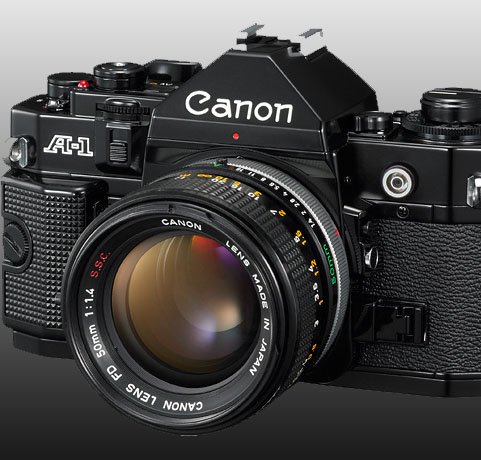
  • A-1                            $60 to $250             launched 1978
  • EF                             $90 to $140             launched 1973

Canon-T90-6226
Canon T90 from 1986 – far superior technically to the Canon A-1 from 1978 – but sells for the same price on the second hand market.

Nikon

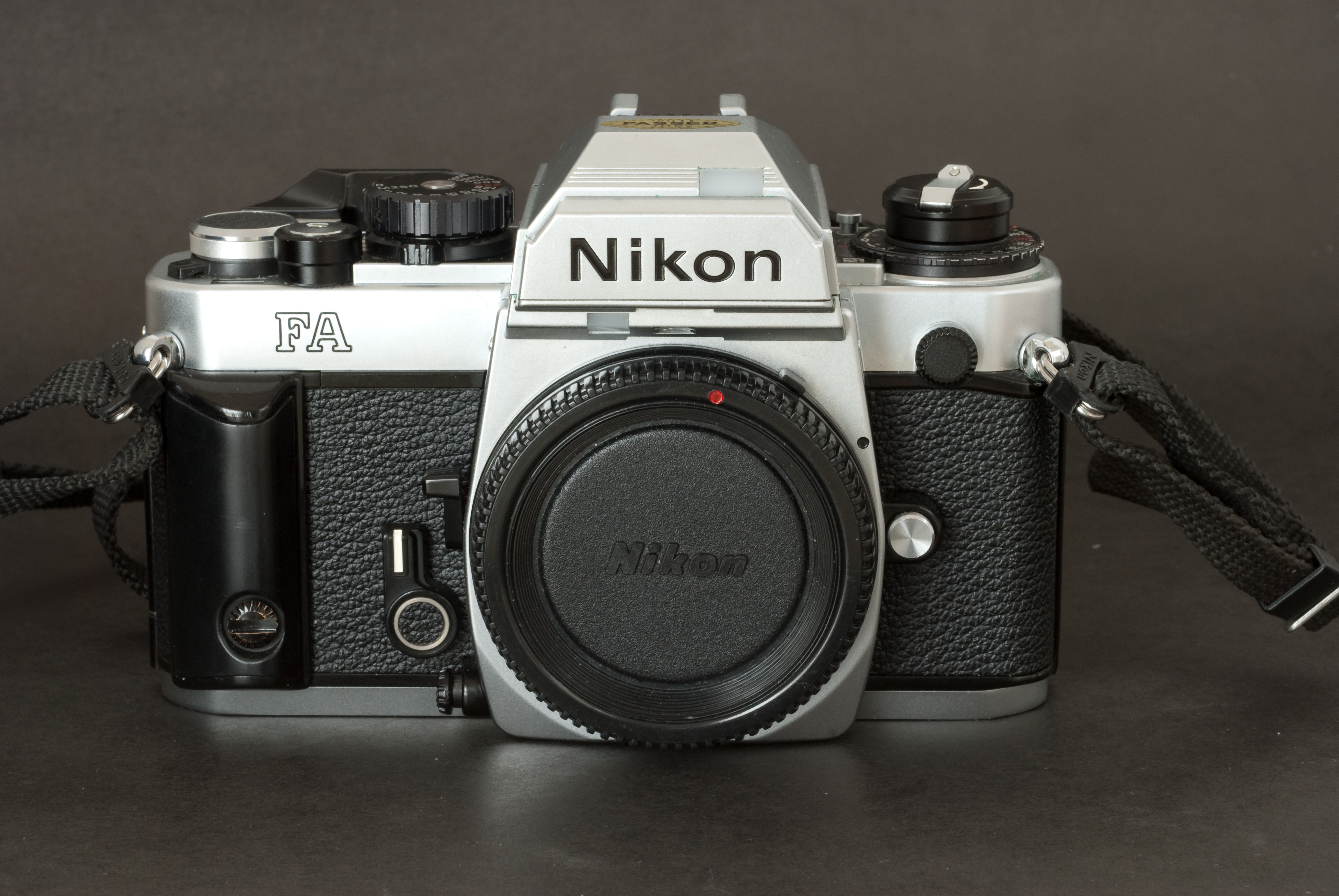
  • FA                              $50 to $350            launched 1983
  • FE2                            $70 to $400            launched 1983
  • F3                              $120 to $1,000       launched in 1980
  • Nikon EL2                $60 to $275            launched 1977

Nikon FA with handgrip
The “ultimate” multi-automatic manual focus SLR from Nikon – it does not sell for more than a simpler aperture priority FE2

To my taste (and for many lovers of film cameras), manual focus film SLRs reached their peak sometime between 1977 and 1983 – before the massive introduction of electronics, motors and poly-carbonate led to the monstrosities such as the Canon T50. What contributes to the value of manual focus SLRs today?

  • Usage value
    • Models produced around the turn of the eighties still have a real usage value.
    • Buyers of manual focus cameras tend to value simplicity and direct control of exposure parameters over complexity and automatism – semi auto exposure cameras often sell for more than auto-exposure cameras.
    • They also value the beauty of machines built out of brass and steel, using cogs and springs rather than integrated circuits and solenoids.
    • The reliability of the electronics integrated in the final manual focus cameras is a concern – the electronic components did not always age well, and engineers made bad decisions (like soldering capacitors or batteries on printed circuits or using magnets instead of springs to control the shutter or the aperture).
    • Therefore, the very last manual focus cameras are often not as well regarded as the generation just before. In spite of being massively superior technically and much more pleasant to use, the T90 is not valued more than its predecessor the A-1 because of concerns over its excessive complexity and questionable reliability. Similarly, Nikon’s FA does not extract any premium over the simpler FM2 and FE2, because its embryo of matrix metering is perplexing. And I won’t mention the Canon T50 or the Pentax a3000, which can not stand the comparison with the AE-1 or the ME Super, if only for esthetical reasons.

canon_A-1
Canon A-1 (1978) – Source:  “Canon Museum” –

  • Potential in collection
    • Manual focus cameras from the big camera brands were often produced by the millions (Canon AE-1, for instance). Other models sold in smaller numbers but over a very long production run (Olympus OM-4t, Nikon F3, for example). The usual law of supply and demand applies, but generally speaking, rarity is not a significant factor in the value of most of those cameras.
    • Only special edition models in pristine condition can be expected to be worth more than a few hundreds dollars – for the foreseeable future.


cherokee--24
Cherokee – Nikon N90s (aka F90x). Fujicolor 400

SaveSaveSaveSave

SaveSave

SaveSave