The Voigtlander 90mm f:3.5 SL II, as presented on CameraQuest's Web site.
Voigtlander is an old brand of German origin, now belonging to Cosina.
Cosina is a Japanese contract manufacturer – their 35mm cameras were adopted and sold successively by Canon, Olympus, Nikon, Contax and Zeiss, and they are one of the few companies still producing 35mm film cameras today. A few years ago, they started manufacturing manual focus prime lenses, available in the Canon EF, Pentax K and Nikon F (AI-S) mounts under the Voigtlander brand.
The lenses made for Nikon cameras had one limitation, though. While perfectly compatible with manual focus SLRs, they did not have the electronic chip and the electrical contacts needed to communicate with recent autofocus bodies. Like Nikon’s own AI-S lenses, they could be mounted on mid-level dSLRs like the Nikon D80 or D90, but they were not recognized by the camera, which disabled its exposure metering circuit and forced the photographer to use a hand-held exposure meter, or to rely on the analysis of the histogram, after the picture was taken. The lens mount of higher end Nikon models such as the D300 or the D700 still has the pins, levers and springs needed to be fully AI-S compatible.
The new generation of Voigtlander SL II lenses has the right chip and the right electrical contacts, and is now compatible with any Nikon autofocus SLR or dSLR (the photographer still has to focus manually, of course).
A few days before the PMA, Cosina presented the APO-Lanthar 90mm f:3.5 SL II Close Focus lens (yes, that’s its name), a compact close focus lens. It targets a small niche of photographers who still want to buy new manual focus equipment. With a maximum aperture of F:3.5, it’s pretty slow compared to Nikon’s 85mm f:1.4 prime, and will not compete in the “portrait lens” category. With a magnification ratio of 1/3.5, it’s not a macro lens either. It’s available in Nikon and Pentax mounts, but non in Canon’s EF.
A product for a niche within a niche, obviously.
More about the Voigtlander APO-Lanthar 90mm f:3.5 SL II Close Focus
A large proportion of photographers wears prescription glasses – I know, I’m one of them – and almost everybody wears sun glasses occasionally. But surprisingly, until high eye point or high eye relief viewfinders appeared – on the Nikon F3 HP in the early eighties, photographers with glasses could not see the integrality of the scene – let alone the aperture or speed information on the LED displays surrounding the view of the scene- without having to move their eye balls up and down and left to right.
As far as viewfinders are concerned, some cameras are better than others, though. The quality of the viewfinder of a manual focus camera is influenced by three factors:
Coverage: It’s the percentage of the image captured through the lens which is going to be shown in the viewfinder. 100% coverage is desirable – but expensive to manufacture, and only top of the line cameras (the real “pro” models) show the integrality of the scene in the viewfinder. Most SLRs show between 85% and 95% of the scene. Point and shoot cameras, (more precisely the few P&S which still have an optical viewfinder) are much worse. The best of them, the Canon G11 only shows 77% of the scene that will be captured through the eye piece.
Magnification: If the magnification was equal to 1, an object seen through the viewfinder would appear to be the same size as seen with the naked eye (with a 50mm lens on a 35mm camera). The photographer could even shoot with both eyes open. If the magnification ratio is lower than 1, then the object will appear smaller in the viewfinder than seen with the naked eye.Magnification has an impact on composition and focusing. If the magnification ratio is very low (below 0.4) the image becomes so small that it’s difficult to compose the picture. Magnification is also a critical factor for picture sharpness on manual focus cameras: the accuracy of the focusing is directly related to what the photographer can see on the matte focusing screen, and the higher the magnification, the easier it’s going to be for him or her to focus accurately.On a 35mm single lens reflex camera, the magnification is measured with a 50mm lens, and varies between 75 and 95%. Full frame digital SLRs have viewfinders offering comparable magnification values. dSLRs with so-called APS-C sensors advertise very high magnification ratios, but after the crop factor of the small sensor is taken into consideration, the real magnification value lies between 0.46 and 0.62. Read Neocamera‘s article for more information about the real viewfinder magnification ratio of dSLRs.
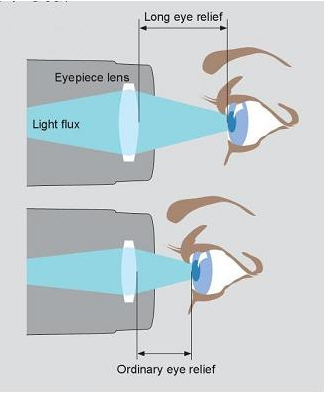
Eye relief: “The eye relief of a telescope, a microscope, or binoculars is the distance from the last surface of an eyepiece at which the eye can be placed to match the eyepiece exit pupil to the eye’s entrance pupil.” (Wikipedia, eye relief entry).The longer the eye relief, the more comfortable the camera is going to be for a photographer wearing glasses, but the smaller the focusing screen is going to look.A photographer wearing glasses will need an eye point of approximately 20mm (depending on the dimensions of the frames and the thickness of the lenses of the glasses) to be able to see entire the viewfinder image, plus the exposure information without having to move his eye balls left to right and up and down. Camera manufacturers describe them as “High eye Point” or HP viewfinders.
A comparison between a few 35mm cameras
As is often the case with engineering, a good design is the result of a successful compromise between conflicting requirements. Most photographers desire a long eye relief, but at the same time want a magnification ratio high enough, so that they can compose their image with precision and focus accurately. With the F3, Nikon offered 2 versions of its standard viewfinder. The DE-2 of the original F3 had an eye relief of approximately 20mm, and a magnification of 80%; the DE-3 viewfinder of the F3 HP had a much longer eye relief (25mm) but a smaller magnification ratio of 75%. The market decided in favor of the longer eye relief and the DE-3 became the standard viewfinder of all subsequent versions of the F3. The advent of autofocus SLRs accelerated the trend towards longer eye relief and lower magnification ratios.
Subjective results
The experience confirms the figures. The Nikon F3 has by far the best viewfinder, followed by the tiny Olympus OM-1. The Nikon FM-FE-FA are far behind.
Nikon launched the F3 with a standard viewfinder (model DE-2) which offered 100% coverage and already had a relatively long eye point. The standard F3 can comfortably be used by photographers wearing glasses. A few years later, Nikon introduced another version of its flagship camera, the F3 HP, which was the first to offer a viewfinder with the very long eye point of 25mm (one inch). The long eye point came at the cost of a lower magnification (down to 75%) and an higher weight. The F3 HP was a sales success, and all subsequent F3 cameras would come from Nikon with the HP viewfinder (the DE-3).
The Olympus OM-1 has an incredible viewfinder, with a very high coverage and a very high magnification. The viewfinder does not offer any exposure information besides the match-needle arrangement at the right of the image, and even if the eye point is rather short, the photographer has the impression he’s watching all of the scene. Subsequent OM models offered a little more information at the periphery of the viewfinder and a little less magnification, and in a world where hi-point viewfinders were becoming the norm, they were far less remarkable than the OM-1.
The Nikon FM, FE and FA provide more exposure information than the Olympus cameras (the selected aperture, in particular). Compounded with the very short eye relief (14mm), it makes it impossible for a photographer wearing glasses to see the whole scene and the exposure information at the periphery without some eye movements. While similar on paper to the other compact Nikon SLRs, the viewfinder of the Nikon FG fares worse than its stablemates in real life.
Rangefinder cameras work by different rules. Their viewfinder covers far more than what will be captured on the film, and very little exposure information is displayed in the viewfinder. Even if the Leica M offers an eye relief of only 15mm, a photographer wearing glasses will not have any problem visualizing the image in the viewfinder.
With a few exceptions such as the Canon G11, Point and Shoot digital cameras don’t offer optical viewfinders anymore. The G11’s may be used as a last resort in a very bright environment, (when using the LCD is not an option), but it’s very small and very unpleasant to use. Low end digital SLRs with small sensors (Four Thirds or APS-C) are equipped with very low magnification viewfinders, and have a very pronounced tunnel effect. Manual focusing is not an option, and composing an image with precision can be challenging. Mid-level dSLRS (like the Canon 7D or Nikon’s D90 and D300) have much better viewfinders, with relatively long eye relief (22 and 19.5mm respectively) and real magnification ratios of approximately 0.625.
Foca *** with a Foca turret viewfinder / Olympus OM-1n. The Foca is a French rangefinder camera from the late forties, and its viewfinder is unusable if you wear glasses. And hardly usable even without them.
Model
Coverage
Magnification
Eye Point
Comment
Nikon F3 HP (DE-3 finder)
100 %
75%
25mm
The camera that introduced Hight Point viewfinders to the public.
Nikon F3 with the standard DE-2 viewfinder
100 %
80%
Not known. Probably 20mm
The original pre-HP viewfinder. Even with glasses one can easily see all of the scene and the little LCD display.
Olympus OM-1
97%
92%
Not known. Probably 15mm
Incredible. How can such a small camera deliver such a large image? Short eye point, but since the viewfinder does not provide any exposure information at the periphery of the frame, not much of a problem.
Nikon FM, FE, FE2, FA
93%
86%
Not known. Probably 14mm
Short eye point, plenty of information at the periphery of the viewfinder. Not the best recipe for photographers wearing glasses.
The automatic bodies of the early seventies still required some input from their users: they could only determine the shutter speed (or the aperture in the case of Canon cameras) after the photographer had set an aperture (or a shutter speed) compatible with the film speed, the intensity of the light and the characteristics of the scene (portrait, action shots, macro, and so on).
If the aperture set by the user was too low or too high, a matching shutter speed could not be selected by the camera and the picture was hopelessly under or over exposed.
Similarly, if the photographer let the camera select a very slow shutter speed with a long tele-lens, the picture would be blurry and unusable. Trained photographers knew that. But a better automatic exposure solution had to be found for the photographers who did not want to be bothered with technical details.
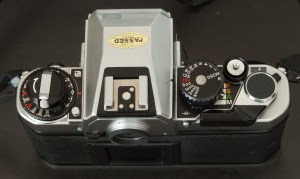
Nikon FA (1984) – the command for the multi-mode exposure automatism (PSAM) is in front of the shutter speed knob
Inspired by the program modes already available in point and shoot cameras, Canon launched the A-1, a new SLR with programmed exposure modes in 1978. Practically, it meant that the auto exposure system of the body had to simultaneously command the shutter speed and the aperture of the diaphragm.
Canon did not have to change anything on the FD mount, which had been created for full aperture shutter priority exposure.
Nikon introduced the “AI-S” generation in 1979 when the mount was modified to support a linear command of the diaphragm. The first Nikon cameras to take advantage of the AI-S lenses and to offer a program mode and shutter priority were launched in 1982 and 1984 respectively. Because the camera body was informed of the focal length of the objective, it could choose automatically between two aperture-speed combinations when configured in program mode, one for wide angle and normal lenses, and one for lenses of 135mm and longer .
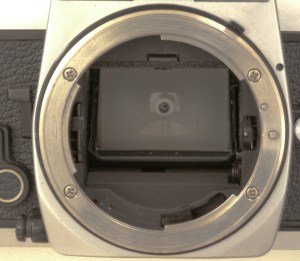
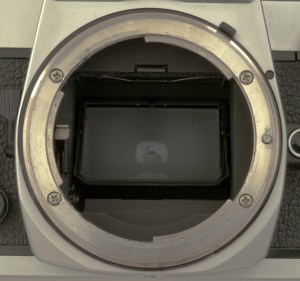
The AI-S variant of Nikon F mount, shown here on the Nikon FA. Compared to the lens mount of the FE2, the FA’s is using three more sensors: a small pin above the lens lock – which informs the body that the lens is of the AI-S type, a larger sensor inside the reflex chamber (right of the picture, in the middle) which is used to transmit the focal length of the lens to the body, and a slider at the bottom of the reflex chamber, used to transmit the maximum aperture of the lens to the body. The use of mechanical sensor had reached its limits. It was time to adopt electrical contacts instead.For reference, the much simpler design of the AI mount (Nikon FE2). The stop down lever controlling the diaphragm is on the left side on the picture. You can still find it on current Nikon digital cameras.
Still trying to catch up with Nicanolta, Pentax adopted a brand new bayonet mount, the K mount, in 1975. The first K mount, however, did not support shutter priority or program modes. Electric contacts would have to be added with the KA declination of the K mount in 1983 to make it possible. Its close derivatives are still used today on Pentax DSLRs.
The state of the art between 1971 and 1985
Pentax: Aperture priority automatic cameras launched in 1971 with modified 42mm screw mount lenses supporting full aperture metering.
Change from the 42mm screw mount to a new Pentax K bayonet in 1975 (automatic pre-selection, full aperture metering, transmission of the pre-selected aperture value from the lens to the body);
Shutter priority and program mode introduced in 1983 with the KA version of the K mount.
Canon: The FD breech mount introduced in 1971 was ready for the Shutter priority cameras launched in 1973 (Canon EF) and for the program mode (Canon A1, 1978).
Minolta: MD declination of the SR Mount (one pin added for the support of the Shutter priority mode) to support the Shutter priority mode in 1977.
Nikon: Aperture priority cameras available since 1971 (Nikon EL) with the manual indexing F mount. Launch of the AI version of the F mount in 1977 to improve the ease of use. Progressive adoption of the AI-S declination of the F mount in 1979 to prepare for the arrival of cameras offering a program mode (Nikon FG, 1982) and a shutter priority automatic exposure (Nikon FA, 1984).
Olympus: the OM mount was introduced in 1971, and was ready to support programmed exposure from the beginning.
A large proportion of photographers wears prescription glasses – I know, I’m one of them – and almost everybody wears sun glasses occasionally. But surprisingly, until high eye point or high eye relief viewfinders appeared – on the Nikon F3 HP in the early eighties, photographers with glasses could not see the integrality of the scene – let alone the aperture or speed information on the LED displays surrounding the view of the scene- without having to move their eye balls up and down and left to right.
As far as viewfinders are concerned, some cameras are better than others, though. The quality of the viewfinder of a manual focus camera is influenced by three factors:
Coverage: It’s the percentage of the image captured through the lens which is going to be shown in the viewfinder. 100% coverage is desirable – but expensive to manufacture, and only top of the line cameras (the real “pro” models) show the integrality of the scene in the viewfinder. Most SLRs show between 85% and 95% of the scene. Point and shoot cameras, (more precisely the few P&S which still have an optical viewfinder) are much worse. The best of them, the Canon G11 only shows 77% of the scene that will be captured through the eye piece.
Magnification: If the magnification was equal to 1, an object seen through the viewfinder would appear to be the same size as seen with the naked eye (with a 50mm lens on a 35mm camera). The photographer could even shoot with both eyes open. If the magnification ratio is lower than 1, then the object will appear smaller in the viewfinder than seen with the naked eye.
Magnification has an impact on composition and focusing. If the magnification ratio is very low (below 0.4) the image becomes so small that it’s difficult to compose the picture. Magnification is also a critical factor for picture sharpness on manual focus cameras: the accuracy of the focusing is directly related to what the photographer can see on the matte focusing screen, and the higher the magnification, the easier it’s going to be for him or her to focus accurately.


 CamerAgX - a new life for old gear