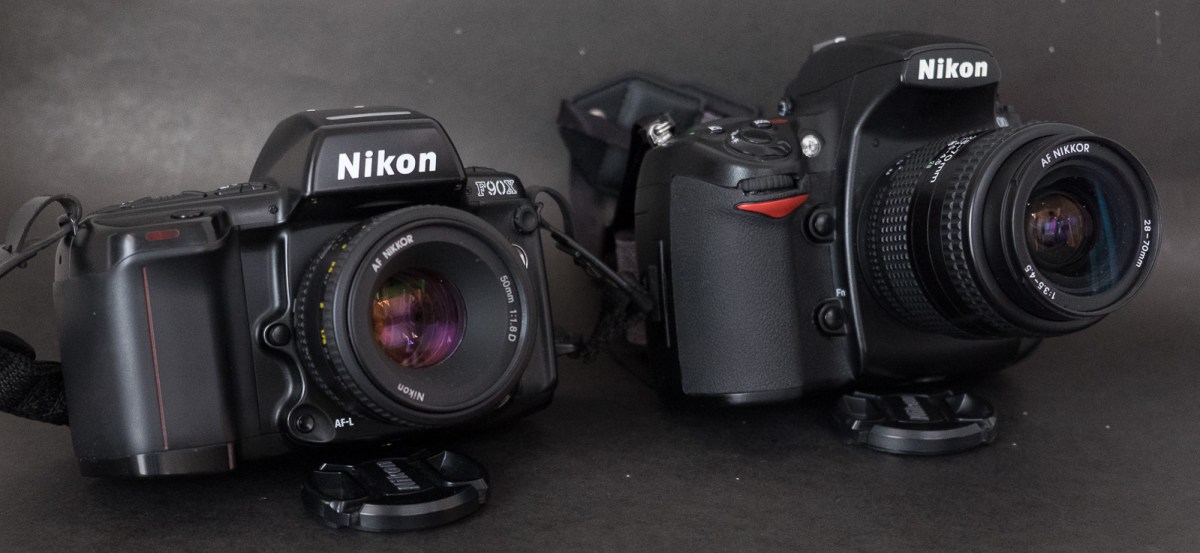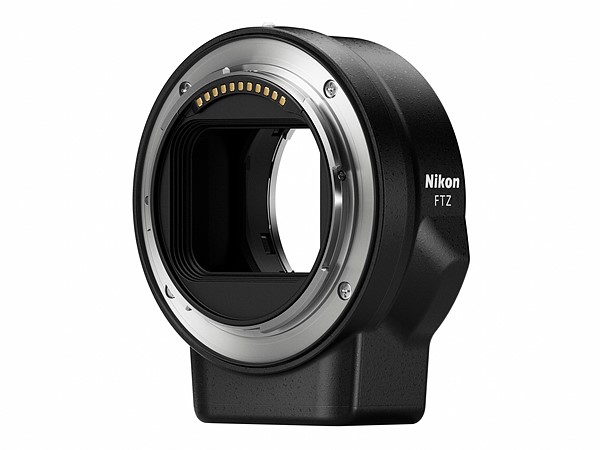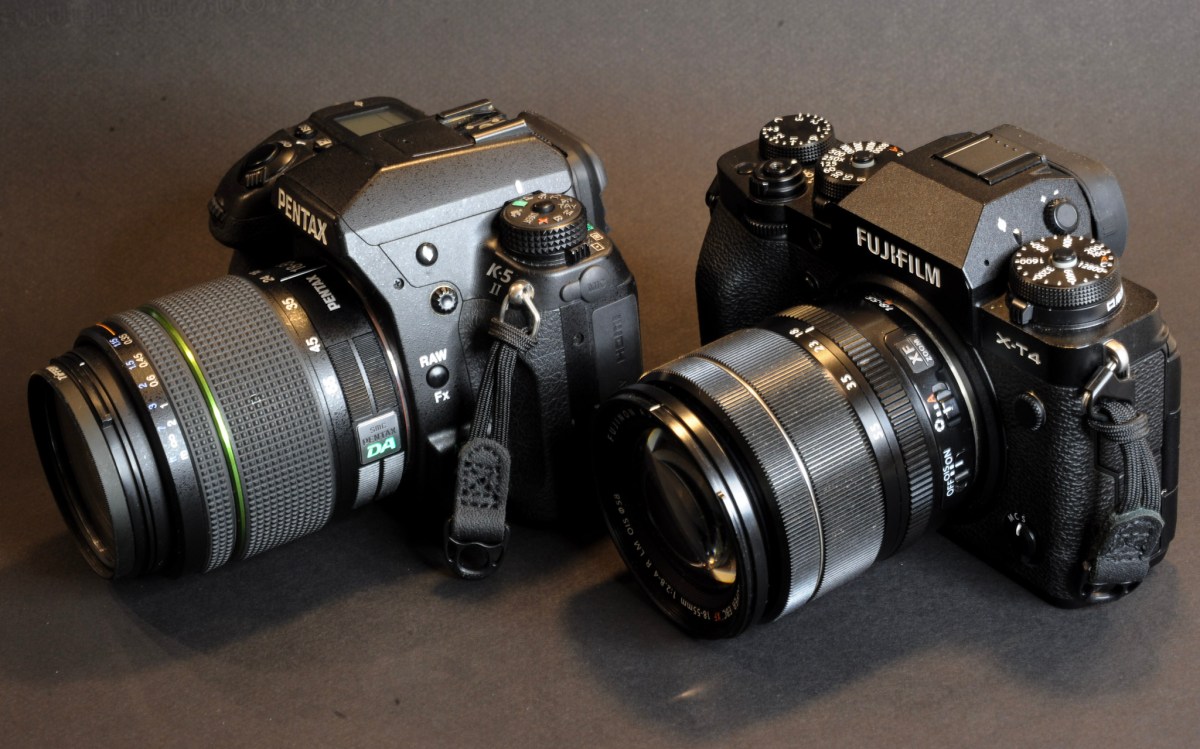
Selling your mirrorless kit and going back to a digital SLR?

I’ve bought a few old Pentax cameras recently, film and digital, and out of curiosity I’ve started following what’s happening in the world of Pentax aficionados.

There was a passionate discussion recently on Pentaxforums.com, started by a photographer who was disappointed by his recent mirrorless camera system, and was considering selling everything to go back to a Pentax dSLR (he was balancing between a K-1 Mark II and a K-3 Mark III).

I am not going to pronounce him right or wrong – what he likes to shoot with or how he spends his money is his business, not mine. But not that many photographers are still interested in new dSLRs.

The fact is that digital single lens reflex cameras (dSLRs) form a rapidly receding niche, and that in the battle for the dollars of photographers (enthusiast amateurs, influencers, vloggers and pros alike), mirrorless cameras have won. A few data points to illustrate it.

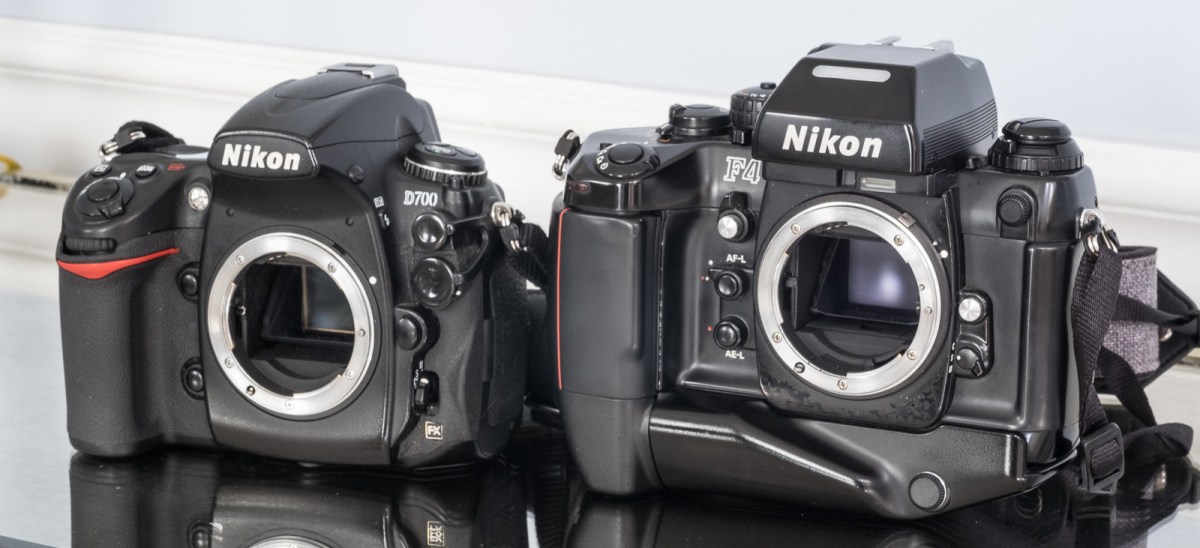
Panasonic G2 and Nikon D700 – mirrorless cameras can be made small

When were the last dSLRs launched?

Olympus stopped selling dSLRs in 2013, and Sony officially discontinued their SLR and dSLR “A” Mount in 2021 (their last dSLR was launched in 2016). Canon’s most recent dSLR is the Rebel 8 from 2020, Nikon’s latest is the d780 from 2020, and Pentax’s is the K-3 Mark III, introduced in 2021. A variant of the K-3 with a monochrome image sensor was introduced in 2023, so that would make the K-3 III Monochrome the most recent of them all.

Canon and Nikon have not shared any plan to launch a new dSLR in the future (it’s likely they won’t), but since the launch of the Rebel 8 and d780, they have launched 14 and 11 mirrorless interchangeable lens cameras, respectively.

A very compact APS-C setup – Egypt – Abu Simbel – Fujifilm X-T1 – Fujifilm 15-45mm lens.

Who is still manufacturing dSLRs?

It’s difficult to know for sure what is still being manufactured – what we see on the shelves of the retailers may be New Old Stock or the output of small, infrequent production batches. Some models (like the Nikon D6 or the Pentax K-3 Mark III) have been withdrawn from some markets already, and other models – while not officially discontinued – may not be manufactured “at the moment”.

I checked the Web site of B&H, and here’s what’s still available new in the United States (with the official warranty of the manufacturer).

  • Canon still have six dSlRs on their US catalog, ranging from the Rebel to the 1Dx (three APS-C cameras, three full frame)
  • Nikon are proposing four models: the APS-C d7500, and three full frame models: the d780, d850, and D6,
  • As for Pentax, they are still proposing three cameras with an APS-C sensor, the KF, the K-3 Mark III and the K-3 Mark III Monochrome, and a full frame camera, the K-1 Mark II.
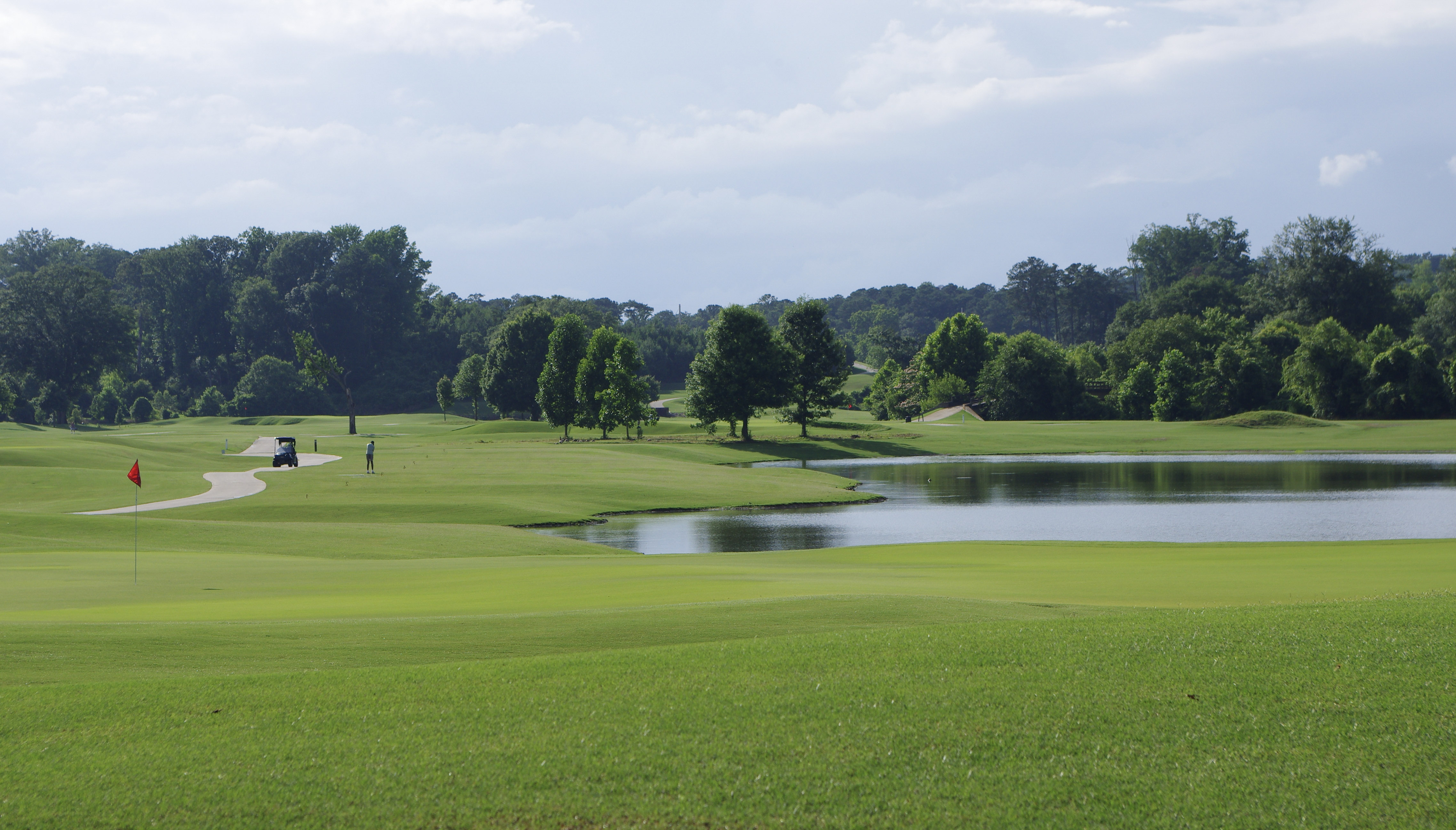
Shooting with a old APS-C dSLR last week – Atlanta – Bobby Jones Golf Course. Pentax K-5 Mk II – Pentax lens 18-55 f/3.5-5.6 AL WR

Why did mirrorless win in the first place?

The Nikon D90 from 2008 was the first SLR capable of recording videos. But the architecture of a single lens reflex camera (with a flipping reflex mirror and an autofocus module located under the mirror) forced Nikon to design a camera that operated differently when shooting stills and videos.

For stills, the D90 worked like any other dSLR ( with a through the lens optical viewfinder and phase detection AF). When shooting videos, the reflex mirror was up, and the viewfinder could not be used. The operator had to compose the scene on the rear LCD of the camera. The phase detection autofocus system was also inoperant. A second system, based on contrast detection, had to be implemented, and could only be used before the videographer started filming.

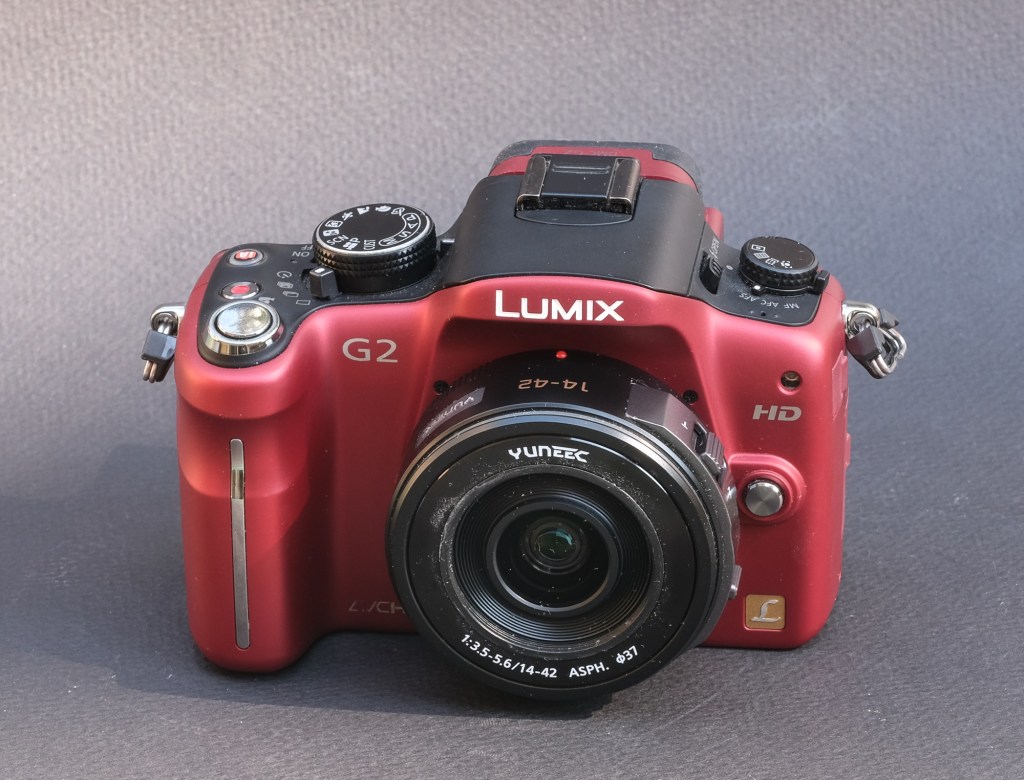
The obvious next step was to replace the flipping mirror and the optical viewfinder with an electronic viewfinder fed directly by the image sensor of the camera, and to improve the contrast detection autofocus to make it as reactive as a phase detection system, and available during the video shoot. Panasonic was the first to do it with the Lumix G2 in 2010. Almost everybody else would soon follow.

  • The obvious advantage of a mirrorless ILC is that it can shoot indifferently photos and videos – the camera works exactly the same way. It’s a big plus for all the pros and content creators who have to deliver a full set of images (stills and videos) when they film weddings or corporate events.
  • Mirrorless cameras, being deprived of the mirror box and of the optical viewfinder of a SLR can be made smaller, lighter, and probably cheaper because they are simpler mechanically.
  • The absence of a mirror box also reduces the lens flange distance, and lenses can be made shorter. Because there is no need for aperture pre-selection and full aperture transmission mechanisms, lens mount adapters are extremely simple to design and manufacture. Practically, almost any lens designed for an SLR or a dSLR can be physically mounted on a mirrorless camera.
Leica Summicron C (40mm f/2) mounted on Sony NEX 3 with Metabones adapter. Mirrorless cameras are more flexible.

Early mirrorless were handicapped by relatively poor electronic viewfinders (lacking definition, reactivity and dynamic range) and a limited battery life. Over time, mirrorless ILCs have made a lot of progress in those two areas – recent prosumer and pro ILCs have really impressive electronic viewfinders.

Electronic viewfinders show the image exactly as the image sensor is “seeing” it. If the viewfinder is good enough, it’s even possible to evaluate in real time the exposure of a scene – and play with the exposure compensation dial to adjust it: what you see is really what you’re going to get.

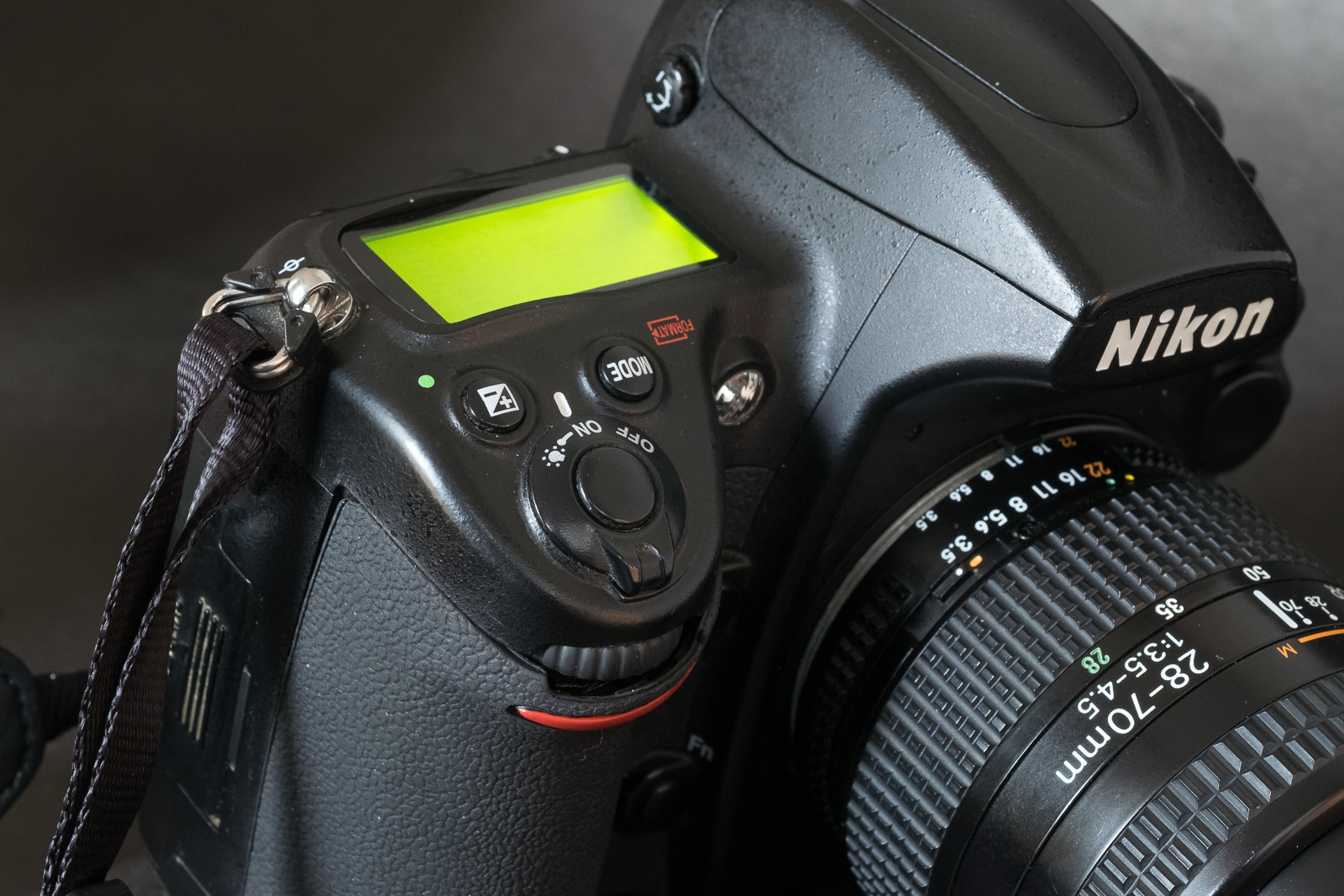
Pentax K-5 Mk II – very few APS-C mirrorless cameras have a top plate LCD and that many dedicated keys.

Advantages of recent dSLRs

The most recent dSLRs were launched between 2020 and 2021, and their capabilities are at best in line with what was the state of the art four to five years ago.

Those dSLRs offer bluetooth and Wifi, and are as easy to connect to a mobile device as modern ILCs.

They keep the traditional advantages of dSLRs: an optical viewfinder, and longer battery life, but as a consequence remain larger and heavier than ILCs.

The native support of lenses designed for the brand’s SLRs and DSLRs over the past decades looks like an advantage, but older lenses may only be partially compatible, and they may lack the resolution required to take advantage of recent image sensors.

As for newer lenses – they’re increasingly difficult to find now that the industry leaders have redirected their R&D and manufacturing efforts towards ILCs.

Bringing a Nikon D700 to a race – because the only tele lens I had was an old Tamron in F Mount. US Formula One Grand Prix – Austin TX

Switching back to a dSLR?

I wrote earlier I would not be judgmental, but I’m still struggling to understand why somebody would take a significant financial hit to move from a very recent, top of the line mirrorless camera system to a dSLR released eight years ago.

Even though I like shooting with dSLRs and older film cameras (they can be more pleasant to use than some mirrorless ILCs) I believe that using a recent mirrorless camera will increase my odds of capturing a technically good image (the artistic value is a totally different story).

Mirrorless cameras are more flexible and will be within their performance envelope in more situations. If the shooting opportunity is unique and I need to deliver – if only for my pride as an amateur photographer – I’ll bring my mirrorless kit with me.

The Nikon D700 remains a fantastic camera. If only it was not so heavy and so big.

As a lover of old gear – even digital – I’d like to offer a suggestion: very nice “prosumer” 16 or 20 Megapixel APS-C reflex cameras from the early 2010s can be found for $150; a “classic” like the Nikon d700 from 2008 (12 Megapixel, full frame) is more expensive, but not by that much if you pick a camera that has been used by professional photographers and has shot hundreds of thousands of pictures.

So, if you feel the dSLR hitch from time to time, my recommendation would be to keep your mirrorless system, and simply augment it with an old dSLR for the days when the call of nostalgia is too strong to resist.


More in CamerAgx about mirrorless and reflex digital cameras

When a recent mirrorless camera shines….

Casa Mila – Barcelona – Fujifilm X-T4-Fujifilm 10-24mm lens
Hand held, 1/25sec, 3200 ISO. Modern cameras are fantastic. Casa Mila – Barcelona – Fujifilm X-T4-Fujifilm 10-24mm lens

Nikon EM or Pentax ME – Are ultra light SLRs a good choice for beginners?

What camera to pick when you’re new to film photography and want to shoot with something a bit better than a point and shoot camera? The question is still bugging would-be film photographers in 2025. In the late nineteen seventies, Japanese camera manufacturers were trying to attract new categories of users to their single lens reflex systems, and started launching small, light and cute SLRs, easier to use and less intimidating than the big, heavy, complex and expensive best sellers of the time.

In order to make those cameras easy to use, they embraced the KISS principle (keep it simple, stupid) and deprived those entry level cameras from features and controls that seasoned photographers were taking for granted – they only operated in automatic mode, and generally did not even have a shutter speed dial.

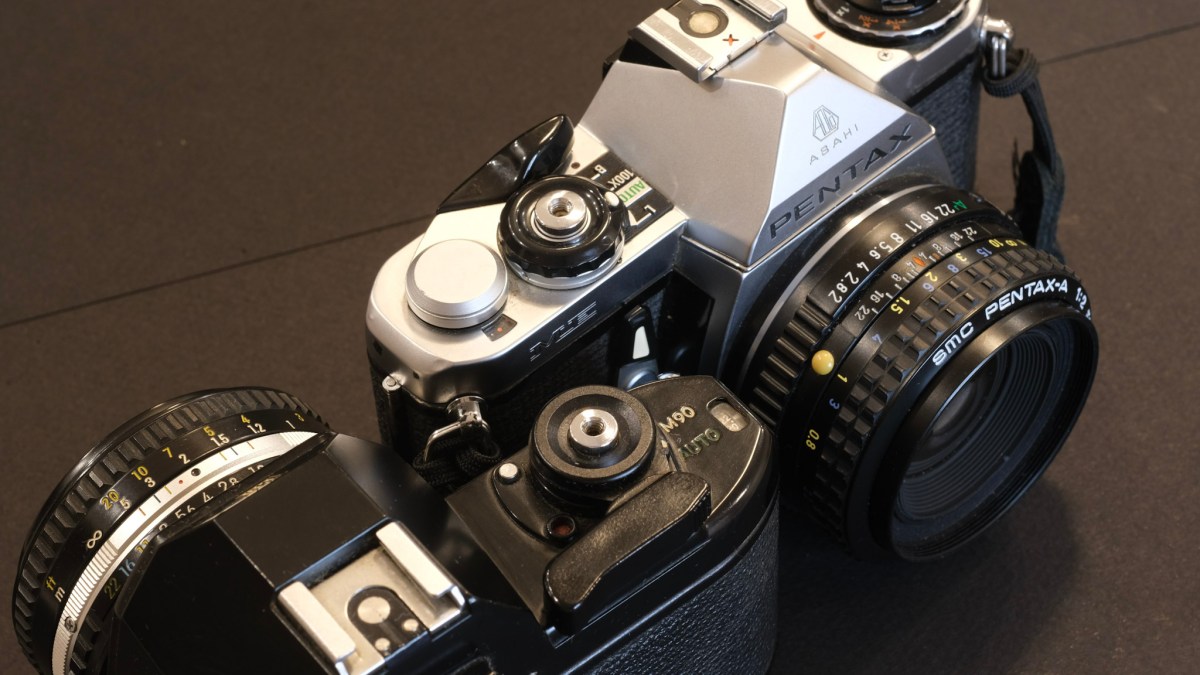
Nikon EM and Pentax ME – very similar specs

Pentax opened the way with the ME in 1976, followed (in no specific order) by Olympus (with the OM-10), Canon (with the AV-1), Fujica with the AX-1, and least but not least, Nikon. Until that point, Nikon had always tried to convey the image of a manufacturer of high quality products, sold at a premium over the models of its competitors. The Nikon EM from 1979 was a big shift – the privilege of shooting with a Nikon SLR was being made available in a simple camera, at a price point in line with the competition.

Almost 50 years later, cameras like the Nikon EM or the Pentax ME are among the cheapest SLRs manufactured by a first tier brand. Good copies typically sell between $50 and $100, when cameras generally recommended for beginners, like the Pentax K1000 or the Canon AE-1, can command prices above $100, and really nice cameras of the same vintage like the Nikon FE2 routinely reach prices in excess of $300.

The Nikon EM

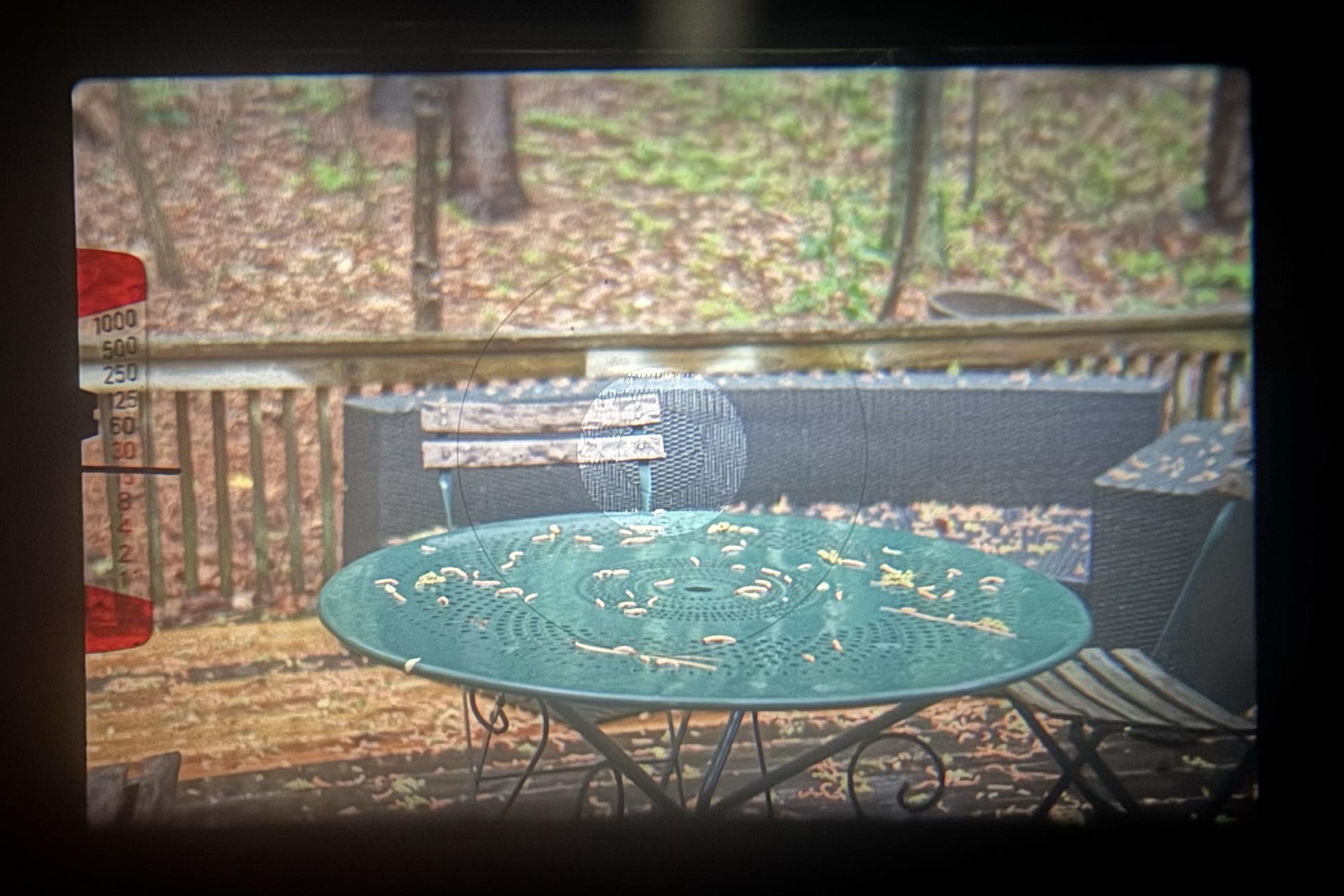
Like the Pentax ME, the EM is an ultra-compact camera, operating only in aperture priority mode, and deprived from a shutter speed dial and from a depth of field preview lever. Besides the logo on the front of the prism and the bayonet mount, the biggest difference betwen the two is that the shutter speed selected automatically by the camera is indicated by a needle moving on a scale at the left of the viewfinder on the EM, while the ME relies on red LEDs.

Following the example of Pentax with their M series lenses, Nikon developed a line of more compact and lighter lenses for this model (the E series lenses). The 50mm is almost a pancake lens – with an excellent image quality in spite of its really small size (the E series 35mm f/2.5 is also one of my favorites).

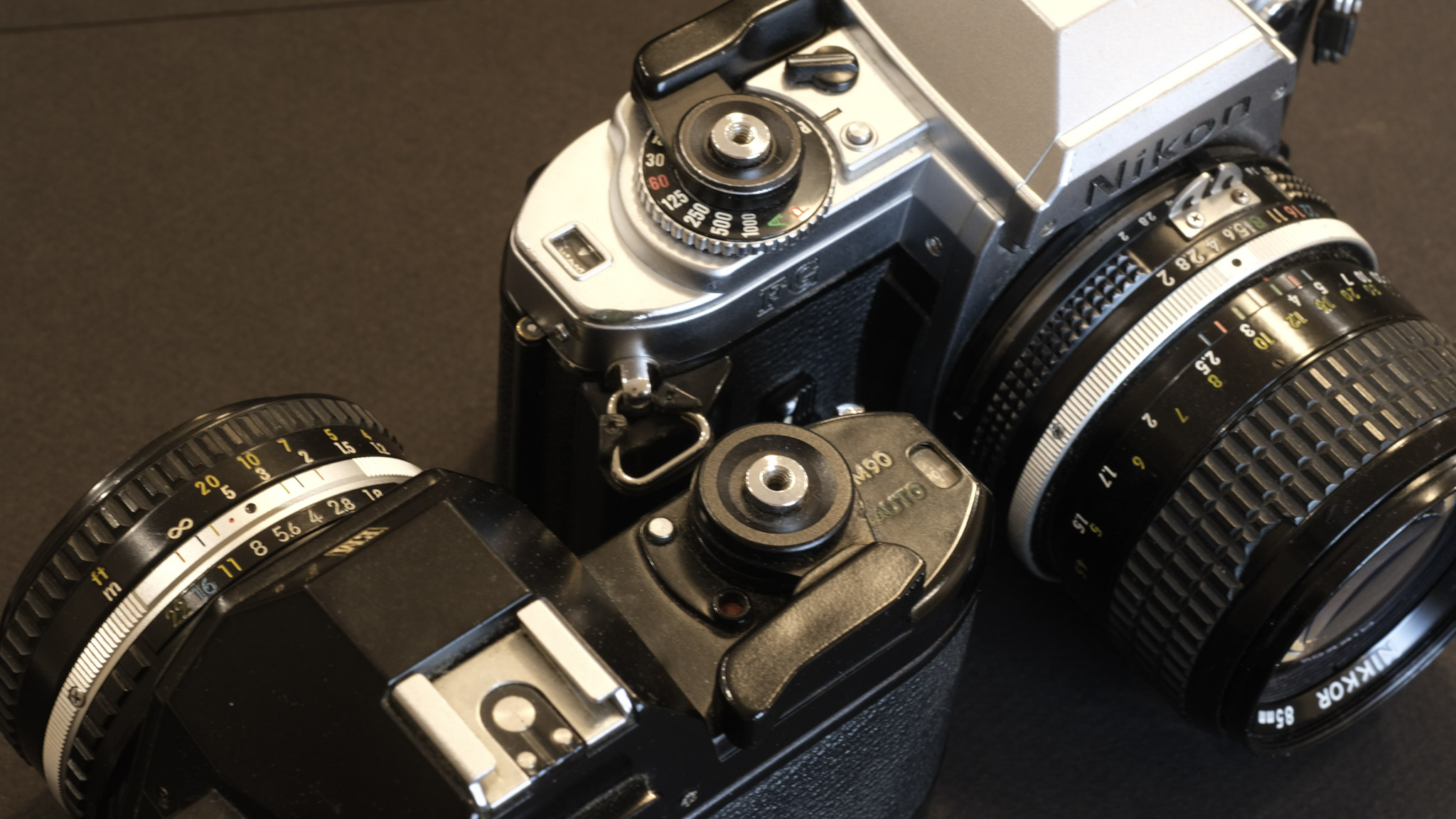
Pentax had launched the ME Super and the Super-Program for the photographers who expected more controls on a SLR. Similarly Nikon derived the FG from the EM, with a shutter speed dial and a program auto exposure mode.

The lineage of the ME stopped with the Super-Program and Program-A , the EM’s with the FG20.

The Nikon FG offers a semi-automatic exposure control mode, and a switch to disable the “beep”

Comparing the EM with the ME

The ME and the EM have 4 things going for them today:

  • they’re incredibly small, in particular with an “almost” pancake lens like the Nikon Series E 50mm or the Pentax M 28mm lens.
  • they’re nicely finished, – the EM was only available with a black finish, and although the external shell is made of polycarbonate, it still looks cool today, while the ME – still built entirely in metal, has a few clever details (such as the film advance indicator) and a nice detailing.
  • Almost any lens made by Nikon or Pentax between (roughly) 1975 and the first years of this century can be mounted, including autofocus lenses.

Above all, they’re simple – you set the aperture, place the subject in the frame, adjust the focus, and shoot. Even simplified, they’re still real cameras – with a good viewfinder with precise focusing aids, a direct control of the aperture and an indirect control of the shutter speed.

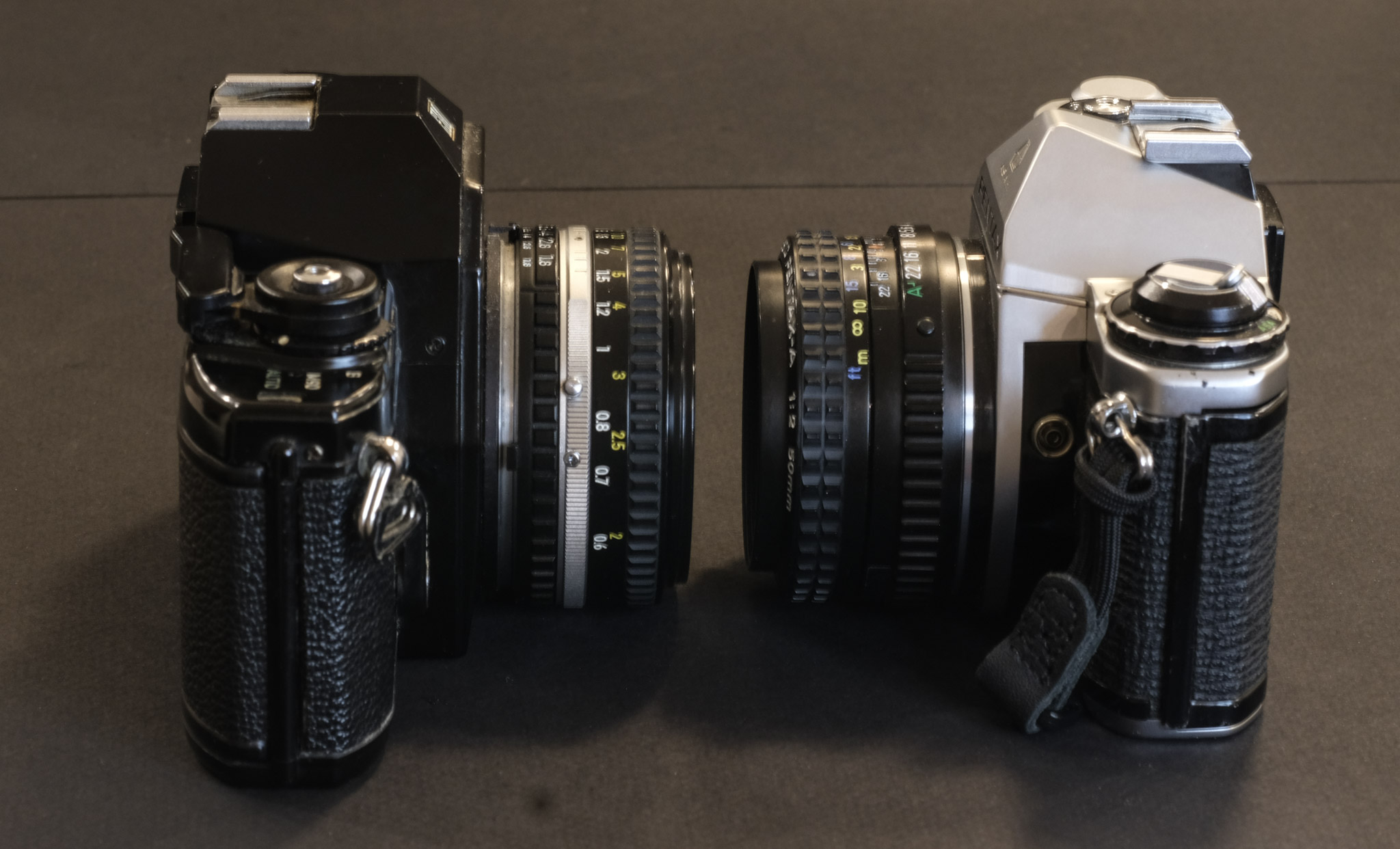
Nikon EM with 50mm E series lens, Pentax ME with a 50mm f/2 A series lens.

They have a few things going against them as well:

Because they’re somehow over simplified, they are more difficult to bring to do exactly what you want than a semi-auto camera or a camera with multi-mode automatism. An experienced photographer will be able to work around it, but beginners will be limited in their progression:

  • the control of shutter speed is indirect only (you have to adjust the aperture so that the automatism reacts by adjusting the shutter speed – there is no shutter speed dial and therefore no semi auto mode).
  • there is no exposure memorization either, only primitive exposure compensation systems. The exposure compensation for backlit subjects is either too simple (-2 EV at the push of a button is the only option on the EM) or too complex for beginners (expo compensation dial on the film sensitivity dial for the ME).
  • there are some irritating quirks – the EM beeps all the time (every time it believes the exposure is going to be under 1/30sec or reach 1/1000 sec). On the ME (and all the ME derivatives up to the Super Program), the control knob around the shutter release button is difficult to use unless you have the fingers of a garden fairy.

The real issue with those two cameras is that in the same price range you can buy the follow up models (Nikon FG, Pentax Program-A and Super Program) that keep most of the good points (small size, beautiful finish, choice of lenses) but are even simpler to use (there is a program mode) and simpler to over-ride (there is also a semi-auto mode).

Pentax Super Program – in some exposure control modes, the shutter speed is selected with the two push buttons and shown in the viewfinder and in the small LCD at the right of the prism

In summary

The EM does not cut it for me. It may be marginally more capable than the Pentax ME (the exposure compensation button is convenient), but the beeps are too irritating. On the FG there is a switch to silence the beeper, but not on the EM. The EM and the FG also seem more fragile than their bigger brothers in the Nikon range. The real problem with the EM (and the FG to a lesser extent) is that they were stepping stones in a range of cameras which included real gems. In the Nikon line-up of the late seventies/early eighties, the FM and the FE offer more flexibility, and a more robust built. Admittedly these two are a tad more expensive and a bit heavier than the EM, but not much larger and nicer to use. As for the FM2 and the FE2, they’re in another league altogether.

On the other hand, the Pentax ME and its descendants were not a low cost point of entry in the Pentax family, they were all that Pentax had to propose if you wanted to use Pentax SMC lenses. I like the Pentax ME – it’s nicely built and refreshingly simple – I even prefer it to the Super-Program, which is more capable but also more complicated to use, and requires even smaller fingers to change the settings. In the Pentax family, I still have to put my hands on the Program-A – it’s a slightly decontented Super-Program (no shutter speed priority mode) and it may be marginally simpler and easier to operate than its “Super” brother.

Nikon EM and Pentax ME – Both deprived of a shutter speed selector

As a conclusion – which one is the best for a beginner?

For a beginner, what makes the difference between two cameras should be the availability of good lenses, and any Nikon and Pentax SLR of that vintage will accept an extremely broad selection of very good prime and zoom lenses, manual focus as well as autofocus.

As cute, easy to use and cheap as they are, the EM and the ME will not be as flexible as a Nikon FG or a Super Program, and the cost difference between those cameras and a Nikon FE amounts to the cost a few lattes at Starbucks.

If you choose Camp Nikon, my recommendation will be to brew your coffee at home for a few days and use the cash you save for the FE. And if you still want your coffee at the drive-thru window, buy a FG rather than an EM. It will let you grow higher as a photographer than the EM.

For Pentaxists, it’s not as clear cut. There is no visible difference in build quality between a ME and a Super Program, and some features present in a Nikon FE and important for an enthusiast photographer (exposure memorization) are still absent from the Super Program. Simply avoid the models with a bad reliability record (ME Super?) and only buy cameras thoroughly tested by their seller.

As a final note, if you’re looking for the absolute bargain in the Nikon world, I suggest you also look at successor of the FG, the Nikon N2000 (F301 in the rest of the world). It’s the twin brother of the better known autofocus N2020 (aka F501), but without the autofocus mechanism, and with a ground glass designed for manual focus operations. With the N2020, it shares the motorized film advance, the semi-auto, program and aperture priority modes, an AE lock button and a great viewfinder. It’s a bit larger than cameras like the EM or the ME (and not as cute for sure), but it runs on AAA batteries that you can find anywhere, and it’s so cheap….one of my preferred $20.00 cameras.

Pentax Super Program and ME – the former benefits from an electronic self timer, a depth of field preview, and a removable grip.

More about cameras I recommend for beginners to film in CamerAgX:

In addition to some of the cameras mentioned above, there are a two other cameras I would recommend for beginners, and if you need more information, the full list of cameras reviewed in this blog since the beginning.


In the meantime….
I’ve not had time to finish (and process) the rolls of films I loaded in the ME and the EM. So far, I tend to prefer the ME, because it does not beep like crazy, and also probably because it’s in a better shape than the EM, which is a bit scruffy. I find the LEDs indicating the shutter speed in the viewfinder of the ME easier to read than the needle of the EM, whose movements tend to be erratic – but again it may be a reflection of the better state of conservation of the ME.
Two pictures shot with cameras of the same family – the Super Program and the FG.

San Antonio – the Japanese Tea Garden. Shot with a Pentax Super Program and the Pentax SMC A 35-70 f/3.5-4.5. The zoom did not age well, or a previous owner had covered the front lens with vaseline, but it gives an eerie look to the picture.
The Nikon FG - a light SLR for mountain hikes
from my archives – a photo taken with a Nikon FG on the trails of Kennesaw Mtn.

Digitizing negatives with the JJC Adapter

If you ask a lab to develop your film (I’m using https://oldschoolphotolab.com/), they will scan it for a modest extra fee ($6.00 per film). And if you send them already developed film strips, they will charge you anything between $1.00 and $4.50 per frame, depending on the quantity and on the desired output quality. The scans are made on Fuji or Noritsu machines, and the result is top notch – you just have to be prepared to wait – typically for two weeks – before you can access the files on Dropbox.

But there may be situations when you can’t wait, or you don’t want or are not permitted to send the negatives through the postal service at the other end of the country. There are also cases when the sheer volume of images to scan (and the expected low keep rate of the scanned images) makes using a specialized lab financially impractical.

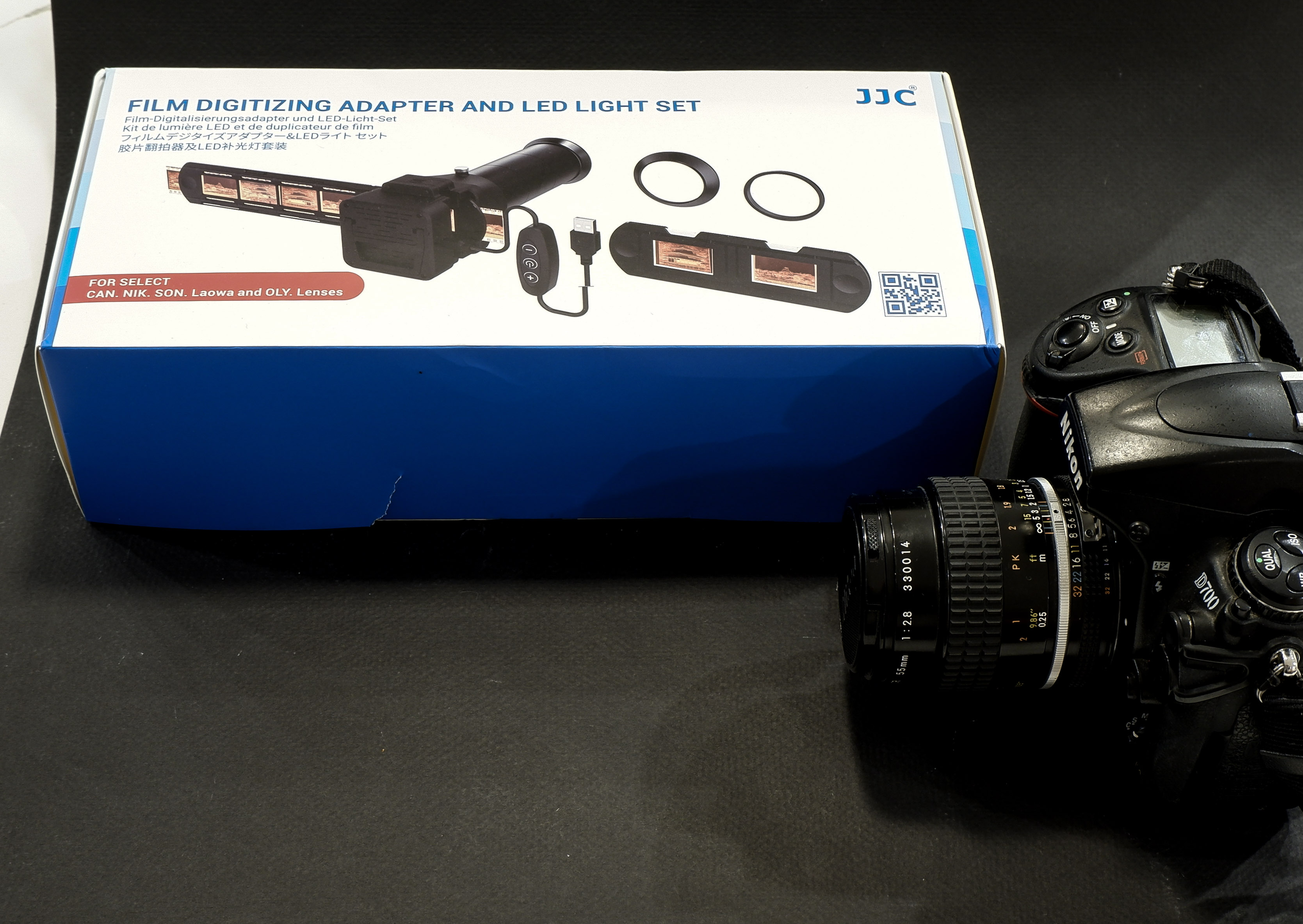
JJC Kit in its box, Nikon D700 ready for action

You can invest in your own scanner – or – taking advantage of the high resolution sensors of modern digital interchangeable lens cameras (dSLRs or mirrorless), shoot the negative frames (or the positive slides) with your camera, and simply upload the resulting files to Lightroom for a final edit.

Nikon were the first to package the necessary hardware in a single product (the Nikon ES-2 adapter, tested in The Casual Photophile: solving scanning with the nikon ES-2 film digitizing kit ). The Nikon kit is dedicated to Nikon cameras and lenses (and only a very limited list of Nikon Macro lenses are supported).

The JJC FDA-S1 Digitizing Kit

JJC have developed a clone of the ES-2, and have opened it to more lenses (they have added support for Canon, Sony, Laowa and Olympus lenses). Regular visitors of CamerAgX may know that when I’m shooting digital, it’s primarily with Fujifilm X cameras (X-T4 and X-A5) but I also have an old Nikon D700 and a much older 55mm Micro-Nikkor AI lens on a shelf, and that’s the gear I used to test the JJC “Film Digitizing Adapter Set”, Ref: FDA-S1.

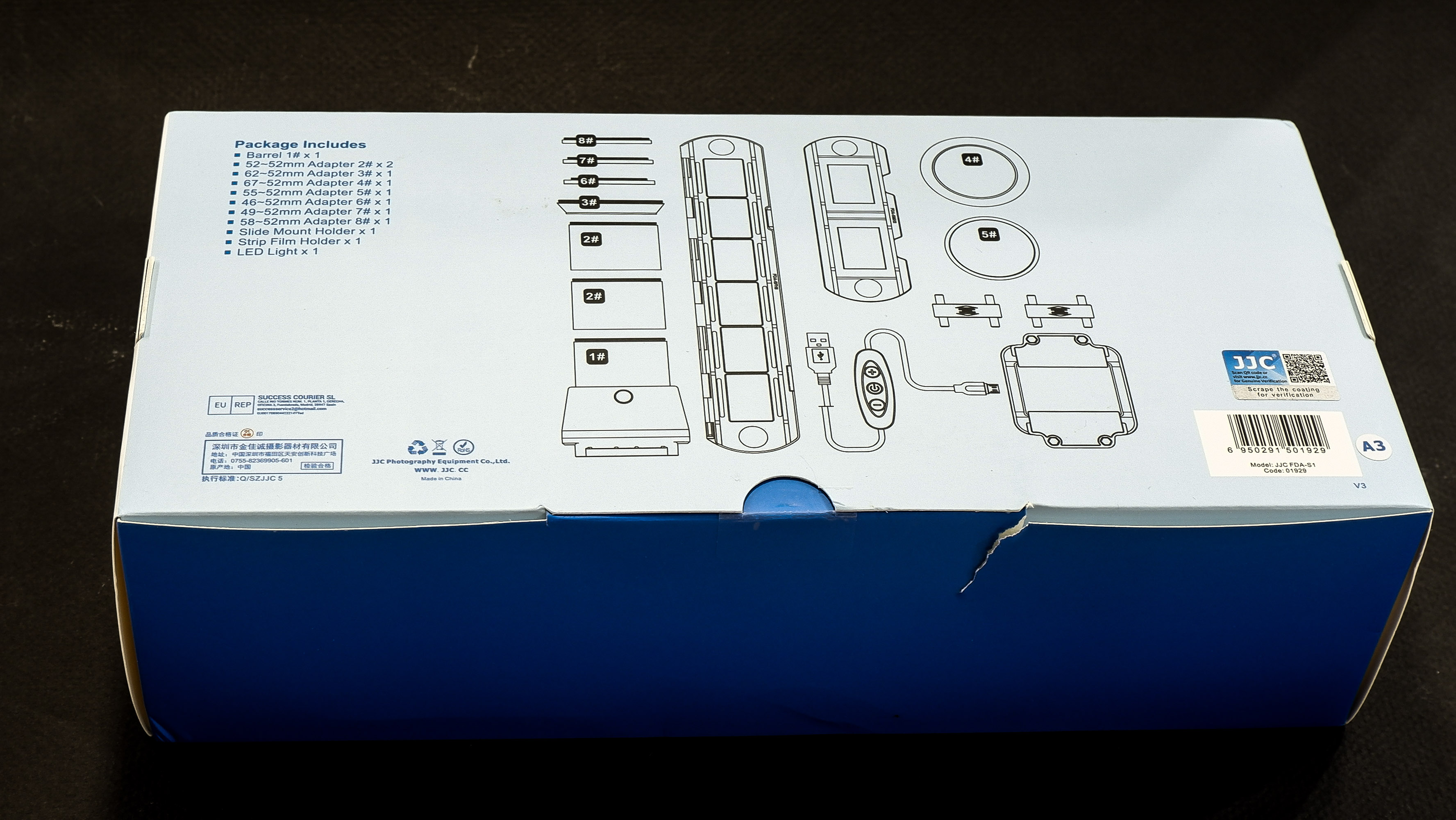
The kit is composed of 8 adapter rings, a slide mount holder, a negative film strip holder and (the unique selling proposition as far as I’m concerned), a USB powered light box. The whole set is well packaged, seems to be made of good quality materials (metal and plastic), and everything works as expected.

First attempt: Scanning with the Nikon D700 and the Nikon Micro Nikkor 55mm f/2.8 AI

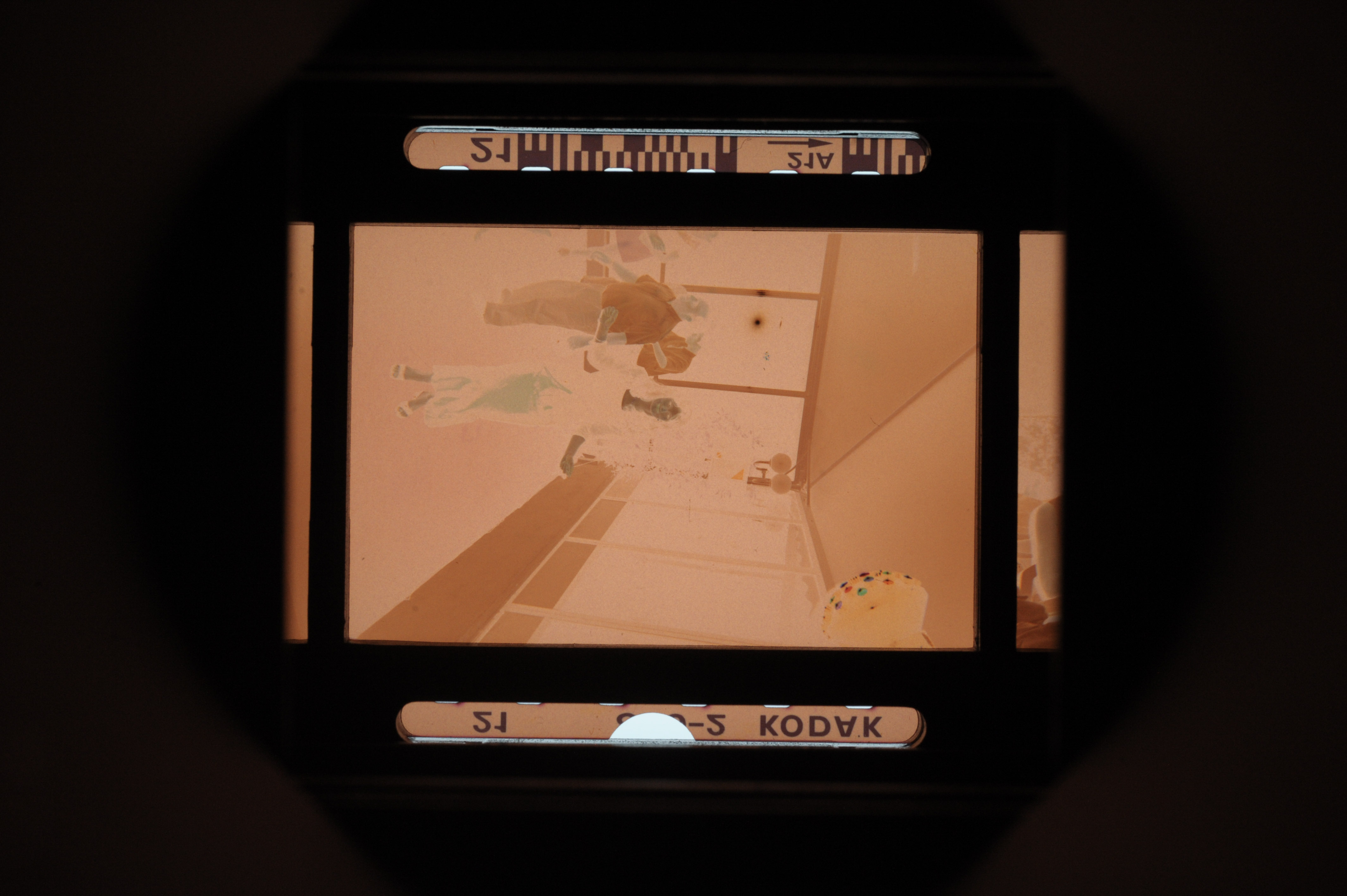
The Micro Nikkor 55mm AI is only offering a 1/2 repro ratio when shooting macro. As a result, the image of the negative is only using the central area of the frame of the D700. Not good. It’s made worse by the small resolution of the D700’s sensor – 12 Mpix – over here, we’re only using 3 Million pixels. The scans look blurred and lack detail.

As shot with the D700 – the Micro Nikkor 55mm lens is not a good fit for the JJC adapter

Second attempt: Scanning with an APS-C camera (the Fujifilm X-T4) and Nikon Micro Nikkor 55mm f/2.8 AI

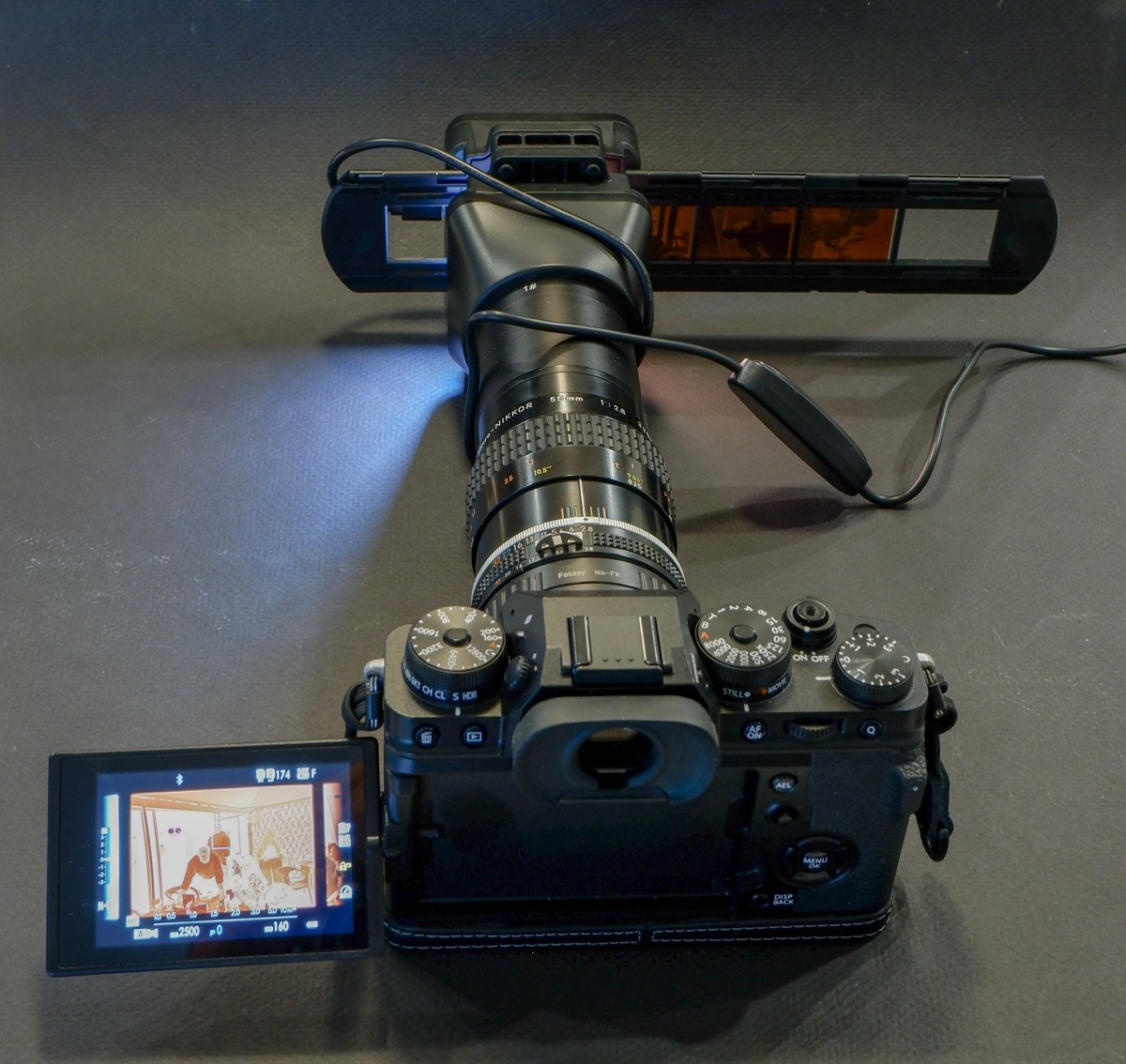
One of the benefits of “mirrorless” cameras is that they can accept all sort of lens adapters. I happen to have a Fotasy adapter which will attach the Nikon AI lens to my Fujifilm X-T4. And the articulated display fo the mirrorless camera is much more comfortable to use than the optical viewfinder of the Nikon D700 for this type of work.

In action – Fujifilm X-T4, Fotasy Adapter, Nikon Micro-Nikkor 55mm, JJC kit

The “scan” fills the frame and is much more detailed.

Much better with the Fujifilm X-T4 – the “cropped sensor” is a good fit for the 1/2 repro ratio of the 55mm Micro-Nikkor AI.

Inverting the scanned image

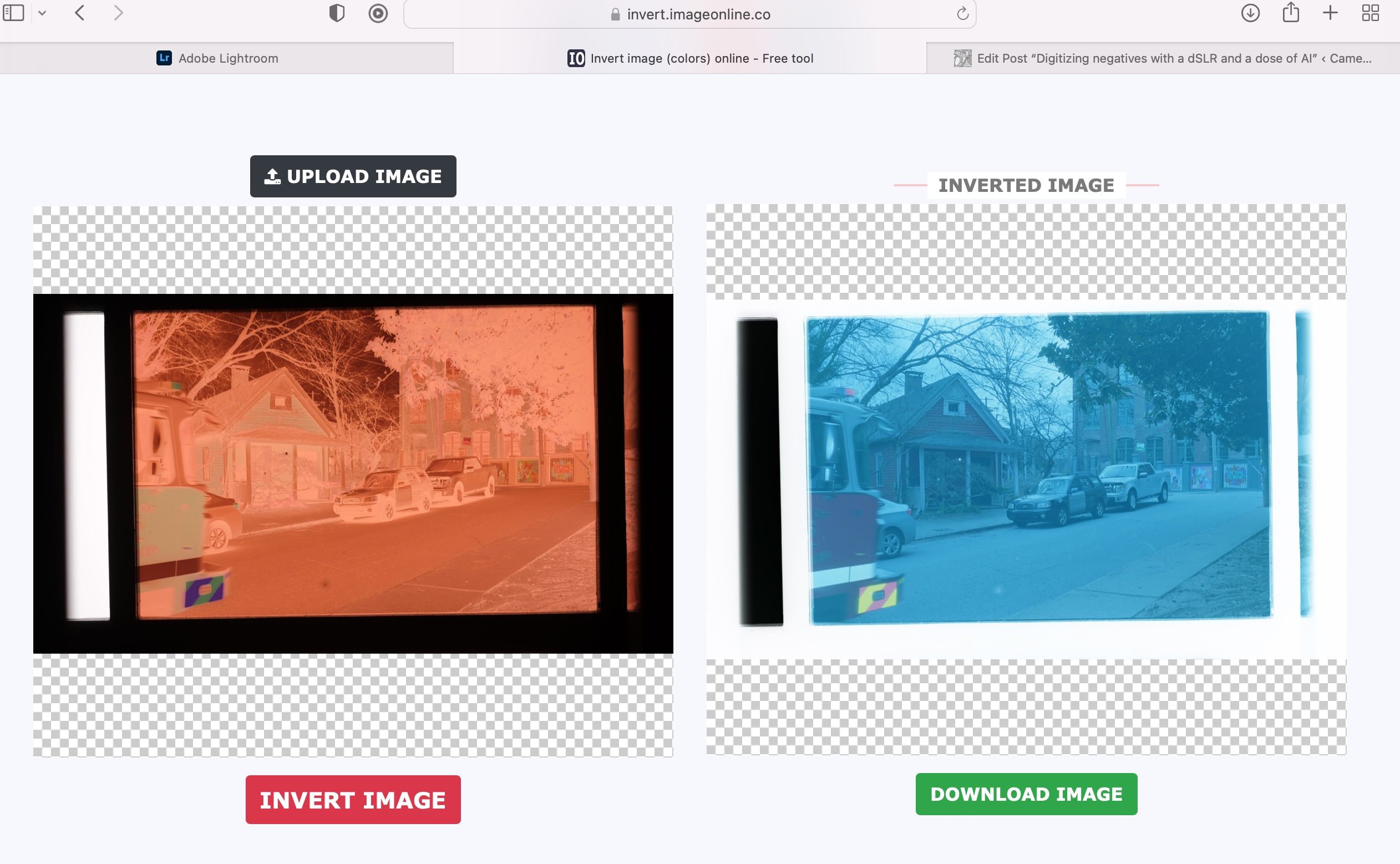
If you were starting from a negative, you have to convert it to a positive image. I tried this free online service (invert.imageonline.co). Better equipped pros will use Photoshop or Lightroom Plug-Ins.

Inverting the image with imageonline.co

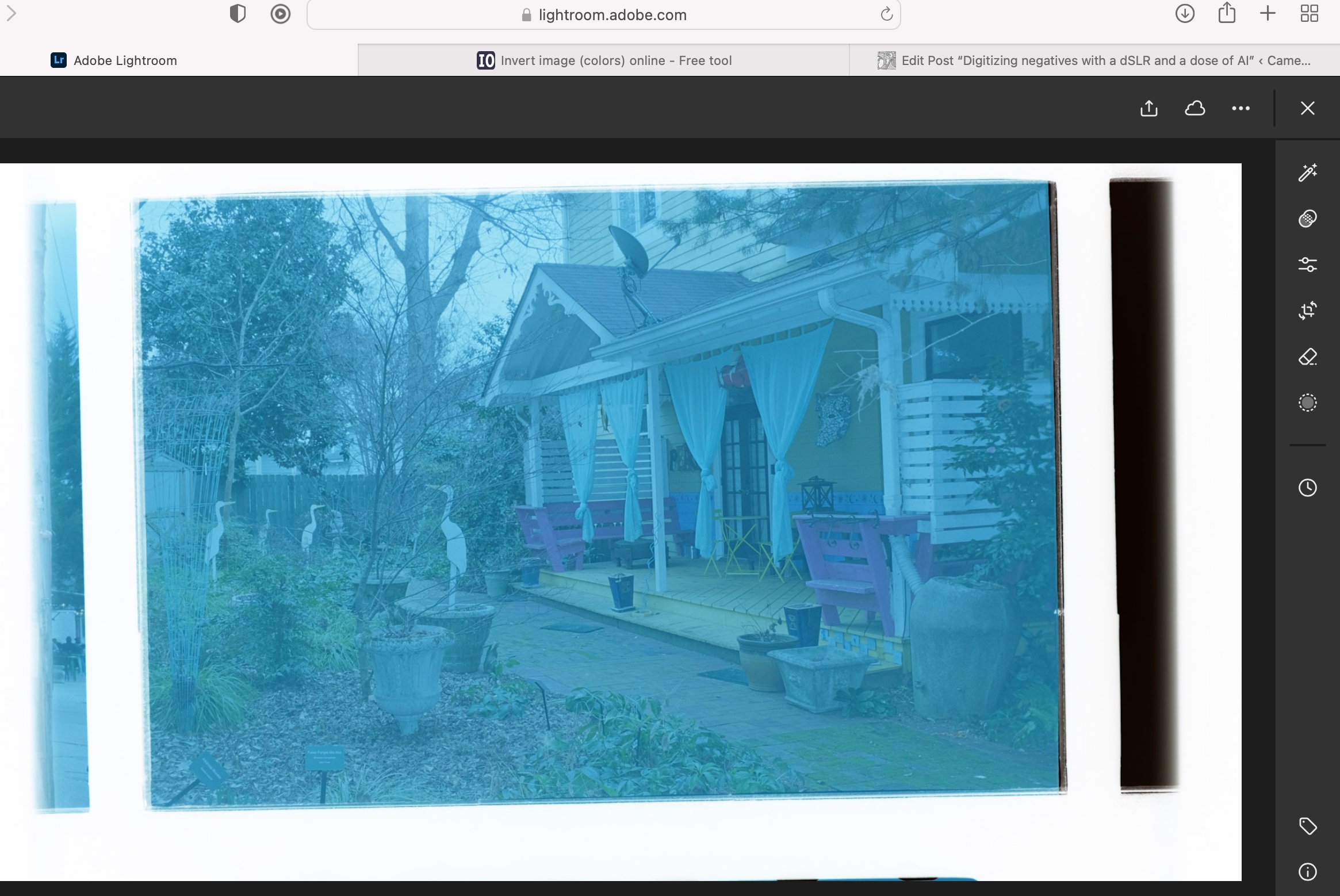
Final touch in Lightroom Mobile

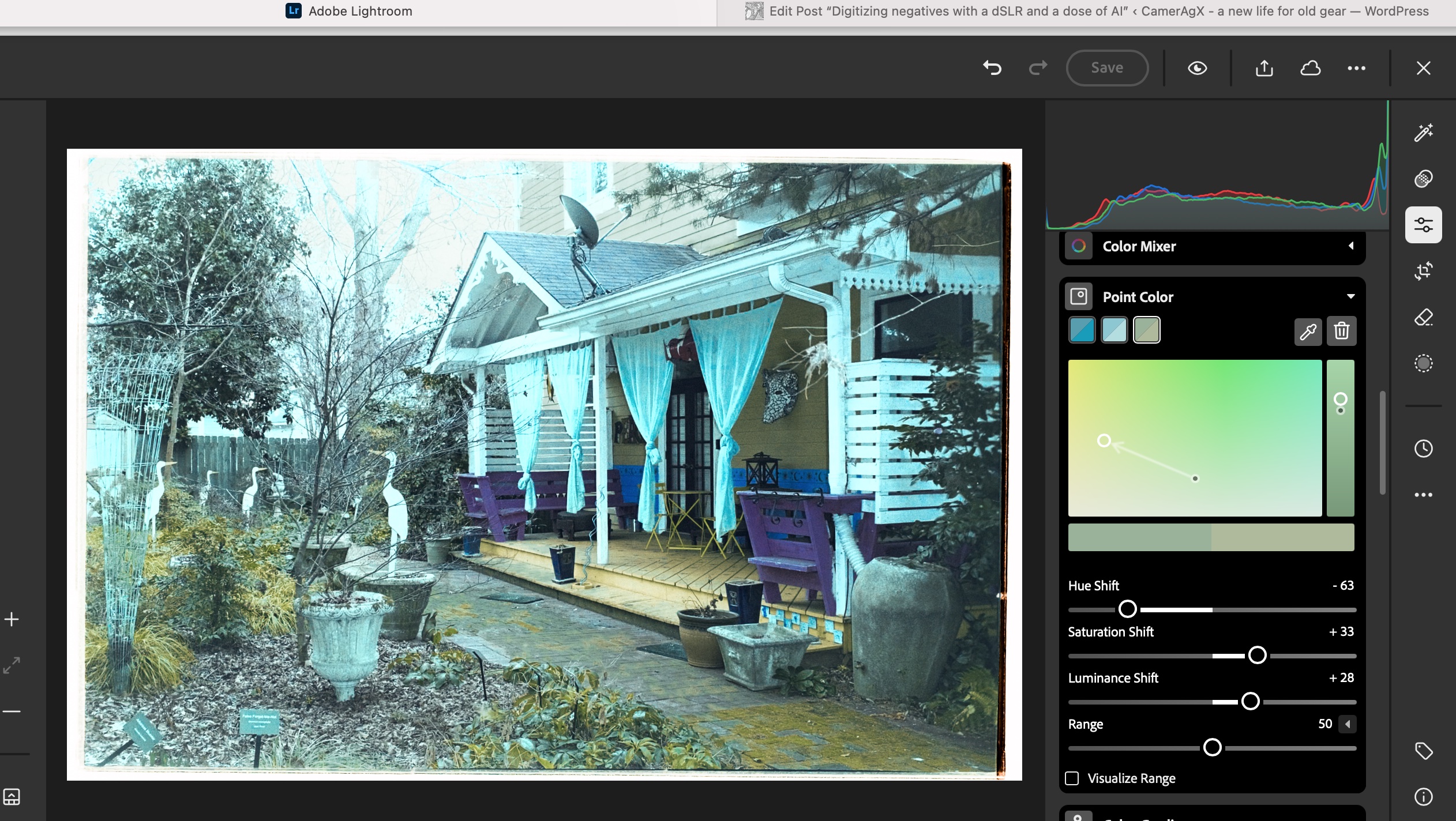
Depending on the pictures, it’s more or less labor intensive. It involves playing with the white balance, the different exposure sliders, and the color channels.

As imported in Lightroom from imageonline.co
Playing with the sliders in Lightroom with this picture I could not approach the colors of the lab’s scan.

Let’s compare a JJC scan with a pro medium resolution scan

The default resolution of scans performed by the Old School Photo Lab is 2048×3072, delivered as JPEG files. Higher resolution scans can be ordered at an extra cost (resolution: 4492×6774) and they can be delivered as TIFF files.

I’m generally happy with their standard resolution scans (I’ll call them medium res as some labs offer lower res scans as an option) and would only request High Resolution for exceptional pictures I’d like to print in a large format.

Shot with Kodak Ultramax on a Canon Photura, processed and scanned by the Old School Photo Lab

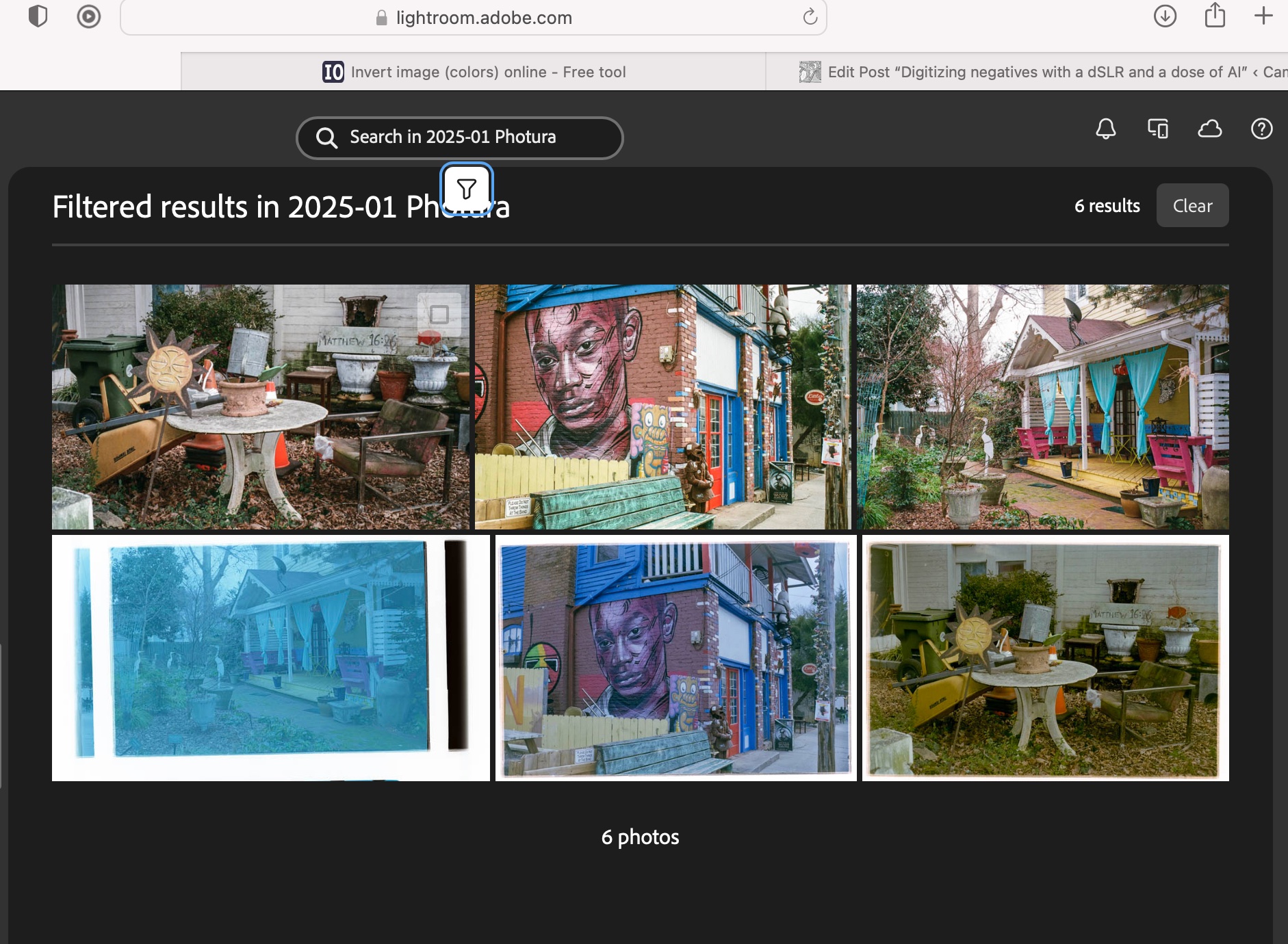
I just received the negatives of a film roll I shot with the Canon Photura a few weeks ago (the scans are made available online as soon as the film is processed, and the negatives returned to you one week later). Let’s compare a scan from a professional lab with an image captured on an APS-C camera with the JJC kit.

Scanned on a Fujifilm X-T4, inverted by imageonline.co and adjusted in Lightroom Mobile.

With the JJC kit and my amateur workflow, getting “good enough” results is easy and fairly quick. The DIY scans are very detailed but the colors still a bit off. Getting something as good as a scan on a Noritsu machine requires precision – the focus on the camera has to be perfect, the color balance has to be exact – but with practice and dedication I’m sure it’s possible to get “pretty close”. At the moment, I’m “pretty close” on some pictures, and totally off on others. Practice makes the master, and I lack practice, for sure.

Conclusion

I did not invest a lot in this test (the FDA-S1 kit cost me less than $100.00), I used an undocumented and unsupported setup, I relied on a free online service to invert the scanned negatives, and I edited the pictures with Lightroom Mobile. Enough to give me a feel for the practicality of the solution, but not enough to get the best possible results. I don’t think using an APS-C camera is an issue (the 26 Mpix of the X-T4’s sensor are more than enough to render a 35mm negative), but photographers who digitize their negatives “seriously” use the personal computer version of Lightroom (Lightroom Classic), with a plug in provided by Negative Lab Pro.

Scans from the lab (top row) vs DIY scans (lower row – the image on the bottom left has not been processed yet).

As a conclusion

The great thing about the JJC Digitizing kit is that it’s an all inclusive hardware solution, which is flexible enough to be used on cameras and lenses not explicitly supported. The USB powered lightbox is a significant plus, which is missing from the Nikon ES-2 kit.

The two main benefits of a scanning workflow starting with the JJC kit are speed – you can scan hundreds of pictures in an hour – and resolution. The biggest limitation is what comes after – inverting the negative and playing with the contrast slider, the color channels and the S curve to make the image usable. In order to get the best possible results at scale, using Lightroom Classic on a PC or a Mac, with a dedicated plug-in is probably the way to go, but it’s a spend I can’t justify – I’m just an amateur photographer, not a pro.

I’ll use the JJC Digitizing adapter as a quick way to reference hundreds or thousands of negatives, and, to share the ones that matter to them with family and friends, on the messaging apps of their smartphones. If I need a high quality scan of one of those pictures, I will still rely on a pro lab.

My most satisfying DIY scan so far.

(*) More about the different versions of Lightroom (Classic, Mobile, Mobile with Premium Features)

Js and Vs – Nikon’s first attempt at mirrorless

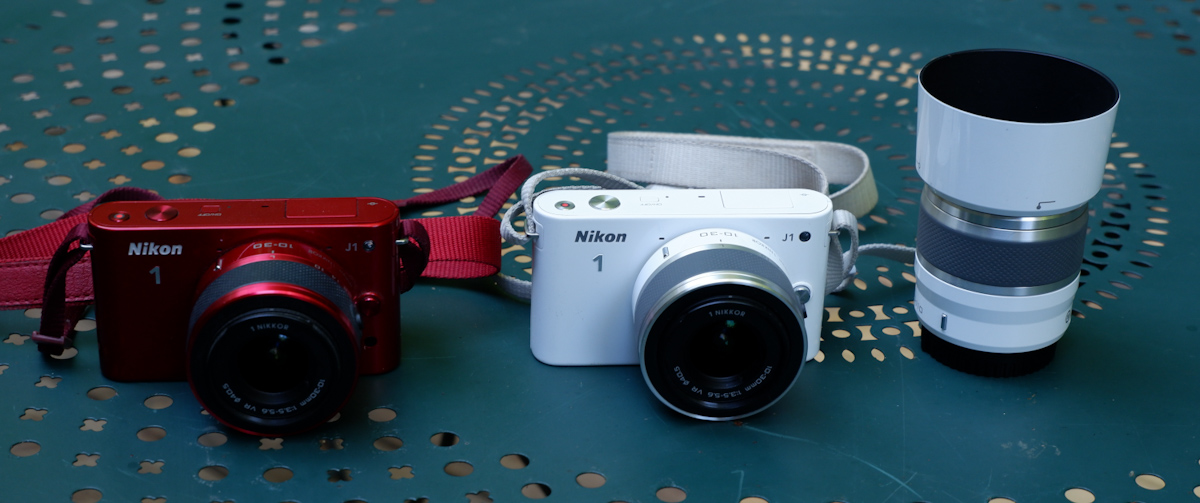
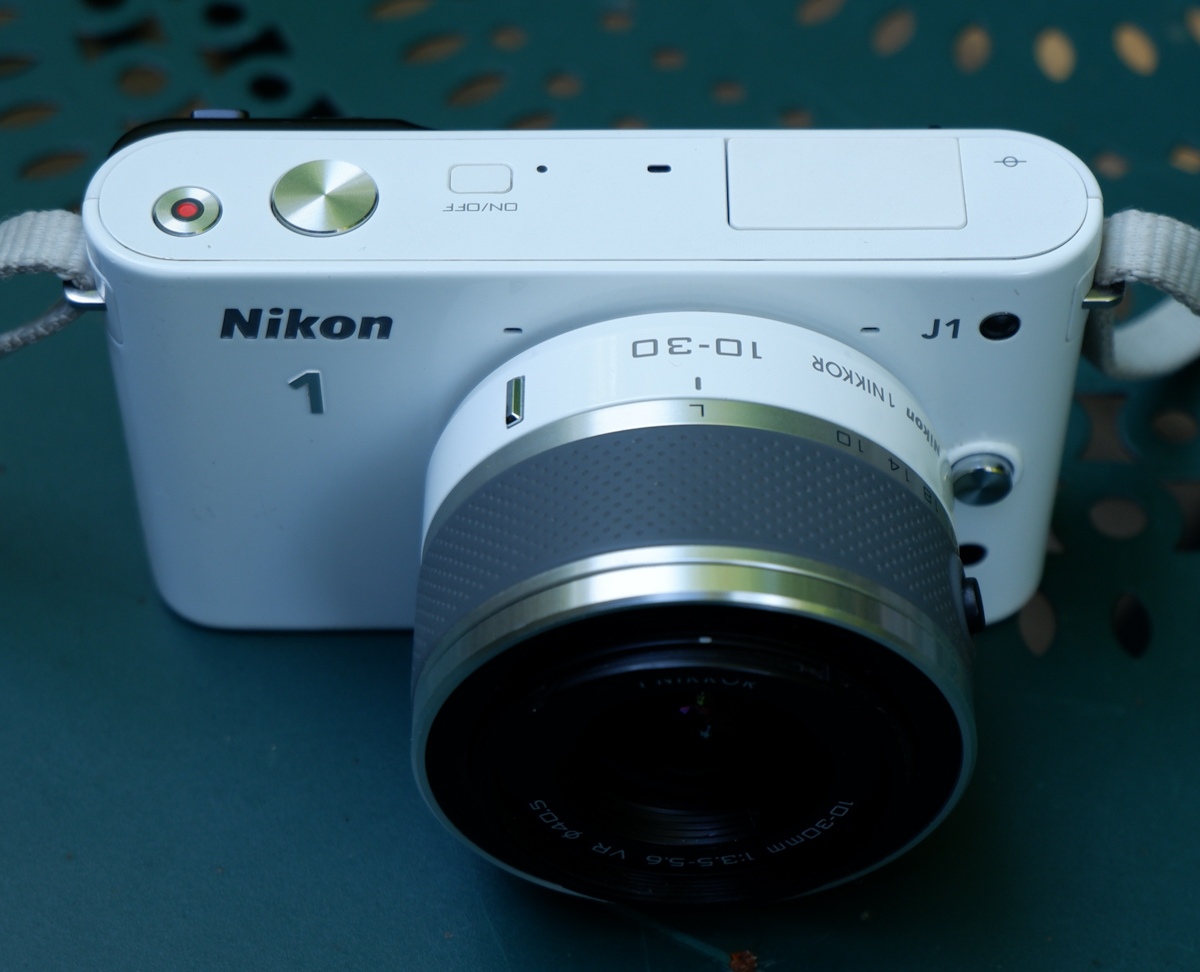
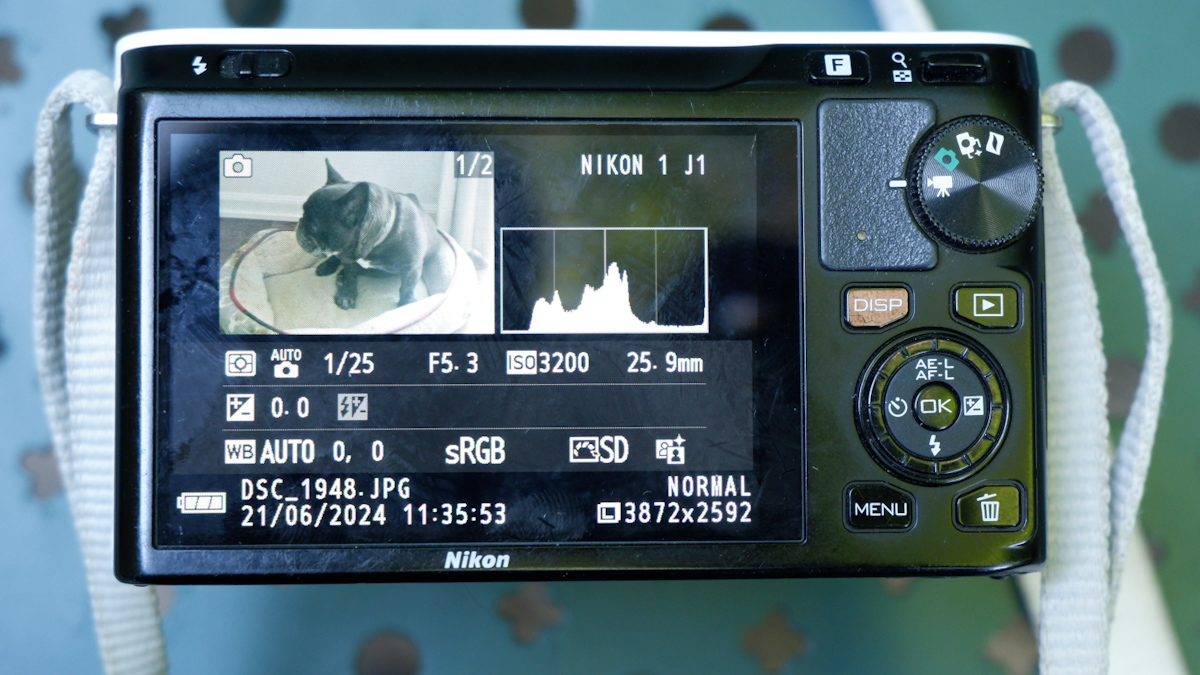
The J1 was the first member of the Nikon 1 family of cameras, a very compact 10 Megapixel camera with a small 1 inch sensor, interchangeable lenses but no viewfinder, and very few of the physical controls that expert photographers expect. Its sibling the V1 had an electronic viewfinder, but for the rest was more or less identical to the J1.

The Nikon One project was largely managed as an independent initiative – there were little technical commonalities between the Nikon One cameras and the point and shoot Coolpix, on the one hand, and the conventional dSLRs, on the other hand. It was also an opportunity for Nikon to test the image sensors of a new manufacturer (Aptina, instead of Sony) and to validate some technologies that would be integrated in the Z6 and Z7 full frame mirrorless cameras at a later stage.

I had bought a V1 when it was launched, and had been deeply disappointed by the image quality – the V1 did not cut it for me.

The controls: an intermediate step between a point and shoot and a dSLR.

When the J1 was new, the reviews were rather positive – photographers loved that it was a very reactive camera with a quick autofocus and a better than average build quality. Only the high ISO/low light performance was a disappointment – and the subsequent iterations (J2, J3, J4, V2 and V3) never really addressed the problem. Until Nikon switched to a sensor provided by Sony (for the final model of the series, the J5 of 2015) – image quality (too aggressive noise cancellation, so-so colors, limited dynamic range) remained markedly inferior to what you could get with a micro 4/3rd or an APS-C camera – and partially explains why – as a whole – the Nikon 1 series was deemed a failure on the marketplace.

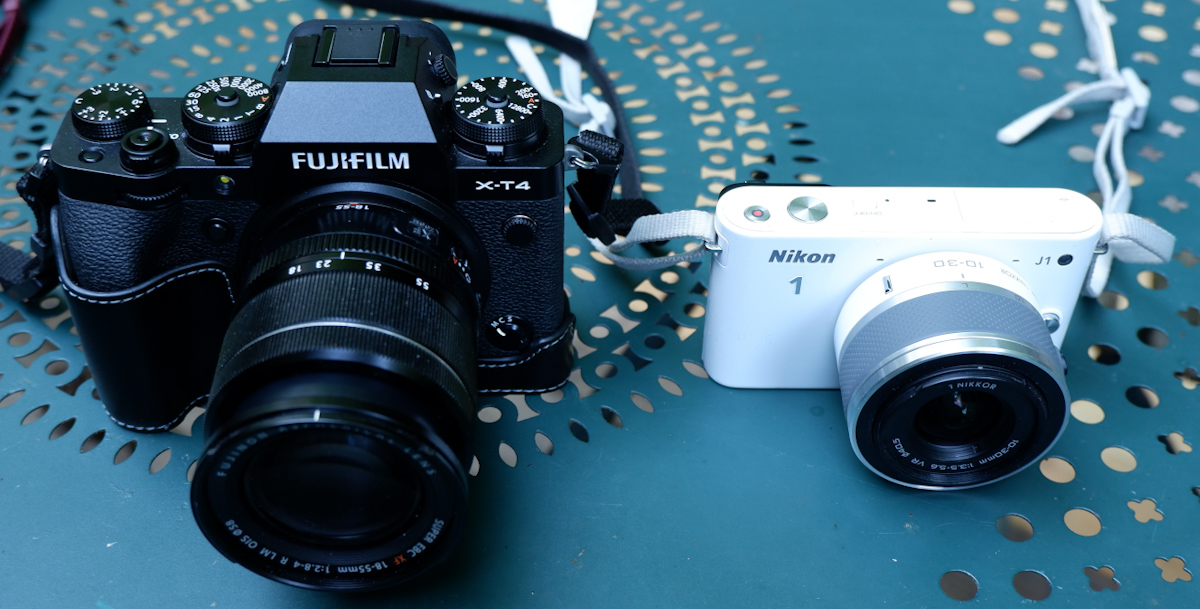
Compared to a modern APS-C mirrorless camera – playing in a different ball park entirely.

If image quality (in low light in particular) was already disappointing in 2010, it’s obviously very far from what a good smartphone can deliver today. Shooting in RAW and post-processing in Lightroom really improves the results, but even in RAW I was not convinced by the results – some images are good (well lit subjects at relatively close range), but most of them lack punch.

The J1 at its best – well lit subject, at relatively close range

A J1 still has two major advantages over a phone: the long tele range, and the ergonomics.

Conceptually, the J models were point and shoot compact cameras with interchangeable lenses. The standard zoom was a 10-30mm affair (equivalent to a 28-80 on a full frame camera), but longer range zooms (a 30-110 and an extra-long 70-300 – equivalent to 80-300 and 190-800 respectively) were available, and if it was not enough, an adapter was available to mount a Nikon F telephoto lens. Some wildlife photographers were big fans of the Nikon 1 series, because it gave them a very long range with a reactive autofocus in a very light and compact setup.

An old inn in Vinings, GA – they built small at that time – Nikon J1

As for ergonomics, I would say that anything is better than a smartphone. Smartphones need to be operated with two hands (one to hold the phone, one to play with the controls on the screen), and pinch to zoom is not as easy or direct as rotating a ring on a lens. Even if it’s shaped like a bar of soap, the J1 is still easier to hold than a phone, and has more physical controls.

What about the colors? The J series cameras were available in a wide variety of colors, with coordinated lenses. White, Black and Silver were always available, but each iteration also benefited from not so common colors (Dark Red and Light Pink for the J1, Orange and  Dark Pink for the J2, Beige and Wine Red for the J3, Tangerine for the J4). Only the final model (which is also technically the best, by far) bowed to convention, and was only available in an “all black” pro attire, or with a “retro-look” silver with black leatherette.

Processed in Lightroom – the RAW files of the J1 respond well to post processing

The J1s are apparently reliable, but the lenses are not. The lenses (all models except for the 6.7-13mm and the 70-300 zooms) rely on very small plastic cogs to open the diaphragm to the requested aperture, and those little cogs may become brittle over time, then break and make the lens unusable. If you buy a lens, ensure that it has been tested by the vendor – you can be sure that “untested” just means “not working or for parts”.

A Nikon J1 is still a pleasant camera to shoot with, provided it’s outdoors and under a nice weather. It’s very reactive and much more usable than micro 3/4rds or APC-C cameras of the same vintage, which were still relying exclusively on contrast detection for autofocus. It’s just a tad too big to fit in a pocket, but with its small size and its funky colors, it does not scare people like more serious looking cameras tend to do nowadays.

The dollar tree – RAW file processed in Lightroom – Nikon J1 – 10-30 lens
The same dollar tree – shot a few months earlier with an iPhone 15 Pro. The contrast and the resolution are much better.
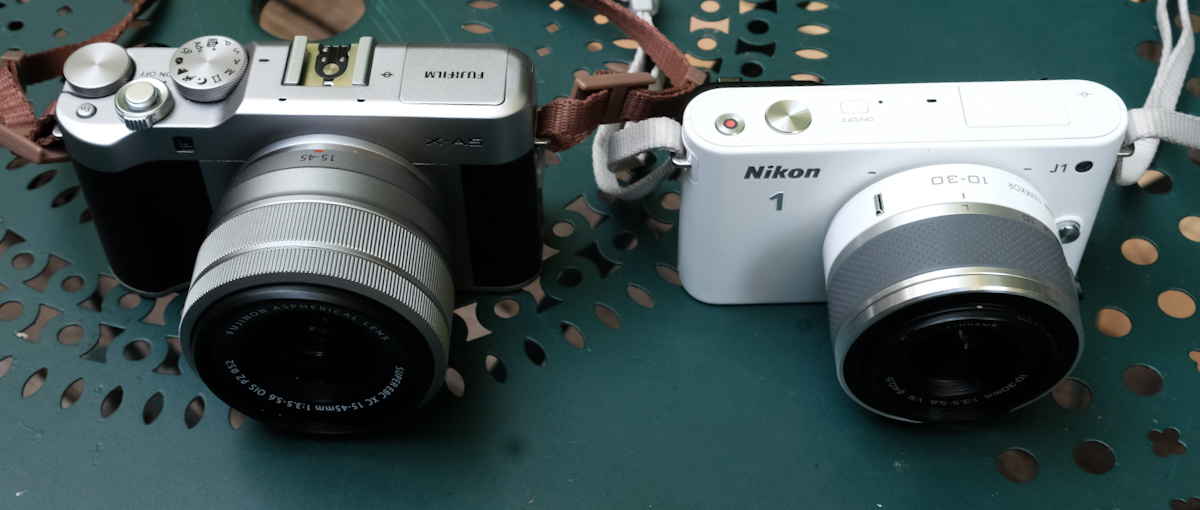
A Nikon 1 next to the smallest mirrorless ILC from Fujifilm (here the X-A5). The X-A5 is larger but produces much nicer pictures, out of the camera.

The J series are fun and cute cameras, let down but insufficient image quality – the J5 apart – and by unreliable lenses. A J1 in working order can be had for far less than $100 with a standard zoom, and a body only J5 can not be found at less than $200. Non standard lenses (tested, and in good working order) are more expensive ($100 to $400 depending on the model).

Well lit, close up – another good picture – at least technically.

Photos taken in Vinings and in the Coalmont OHV Park (TN) where dollars grow on trees.

/

Air Travel with photo equipment in the smartphone era…

And other ramblings…

Have you noticed? Everybody’s shooting with a smartphone, anytime, anywhere, and nobody seems to be objecting or even paying attention. But pull a conventional, dedicated camera from a photo equipment bag, and people start freaking out.

And suspicious neighbors or passersby are not the only ones panicking at the sight of a camera.

US Formula One Grand Prix – Austin – Nikon D700

Two weeks ago I was stopped for a good 20 minutes at a TSA checkpoint at the Atlanta airport, because the agents were intrigued by the camera I was carrying (a Nikon D700 with a 28-70 f/2.8 zoom lens). Admittedly, it was a relatively bulky camera + lens combo, but I’ve also been stopped when I was carrying a much smaller Nikon FM with a 35mm fixed focal lens. It’s just that photography as we knew it – with dedicated cameras – has to a large extent left the mainstream. Shooting with film cameras was already an oddity, but it increasingly looks as if shooting with DSLRs is following the same route.

You can see from time to time, typically in touristy areas, a young person carrying a film camera strapped to his or her neck (a Canon AE1 in most of the cases), but I don’t see them actually taking pictures (they wear a camera like you would wear jewelry) and I don’t see film making a come back. Not with those prices, for sure. Film is getting expensive, and the cost of processing and scanning has gone to the roof during the COVID years. My favorite color film is Kodak’s Ektar 100, and it’s now costing $15.00 a roll. Fujifilm are raising their prices massively as well. Processing and scanning are now around $20.00 per roll – which brings the total cost of a scanned image to more than $1.00.

Of course, users of digital cameras don’t have to pay the Kodak or Fujifilm  « tax », but cheap cameras have almost totally disappeared from the new equipment market. And even the best dedicated digital cameras are still miles away from the convenience of smartphones: what the software engineers manage to do with  « computational photography » on modern smartphones never ceases to impress me, and the simplicity of the integration of the iOS or Android native photo apps with all forms of image sharing services is something a dedicated camera user can only dream of: if you’re happy with the resolution of a 12 Mega Pixels image, and with a focal range equivalent to a 13 to 75mm lens on a full frame camera, the smartphone is hard to beat.

Soap Creek Park – Marietta, GA – iPhone 15 Pro – Straight out of the camera

Beyond the obvious (launching cameras with higher resolution sensors and long range zoom lenses that don’t have an equivalent in the smartphone world), the historical camera manufacturers are working at slowly transposing in the dedicated camera world advances we’ve enjoyed on smartphones for years (“global” electronic shutters and the near real time upload of the pictures to the cloud is the most recent example). They’re also working at making the conventional digital workflow of the pros and enthusiasts (shoot in RAW, post-process in Adobe Lightroom, and export to JPEG for social media consumption) less of a given – with film simulations and picture control modes, images can be shared “straight out of the camera”.

Marietta (GA) – the square – JPEG “straight out of the camera”

Lastly, there seems to be a renewed interest for compact digital cameras. Since nobody manufactures them anymore, the second hand market is the only option. And (for no reason I can think of), the Nikon Coolpix seems to be the hottest item – in particular if it’s painted in a striking “velours red”. Maybe it’s the color? Modern dedicated cameras are high end products built out of magnesium, and they would not convey the same image of competent seriousness if they were pink or yellow.

Nikon Coolpix S6900 – pretty in pink

After a long pause, I’m returning to this blog. With a pink compact camera (not a Nikon), a full frame DSLR (a Nikon), and a best of breed mirrorless camera. Stay tuned.

Dia de los muertos 2023 – Atlanta – Shot with a Nikon D750 in RAW and post processed in Adobe Lightroom

The Nikon F3

(originally published in Sept 2009 – I did not change a word – just added a comment at the bottom of this post)

Nikon’s F3 was the “pro” camera of the early eighties, but it kept on selling until 2001. A dwarf compared to current mid-level digital SLRs, not to mention monsters like an EOS 1DS or a D3. Incredibly simple to use compared to anything digital sold these days. Aperture Priority Automatic or Semi-Auto exposure. Center weighted metering. That’s all. It worked. And it still works today.

Consider all the changes that took place in the SLR design between 1980 and 2001. Multi mode exposure, spot and matrix metering, integrated motors, autofocus, DX coding, the F3 had none of that, but it outlived two or three generations of newer-better-faster pro bodies from Nikon or Canon. The F3 had the elegance to hide its real technical advances under a classical skin, and to let the photographer communicate his instructions through smooth and oversized controls. Of all the pre-autofocus SLRs of Nikon, the F3 is the most pleasant to use, and probably the one which will yield the best results.

Olympus OM-1 / Nikon F3 – larger than the OM-1, but not by much – it’s significantly heavier, though.

The F3 is an exception in the Nikon F lineup. It’s compact, smaller than its predecessors, and way smaller than its successors, the F4 and F5. In fact, its size is very comparable to that of the FM, itself hardly bigger than the yard stick of compact SLRs, the Olympus OM-1. The F3 is also easy to use, without the idiosyncrasies of the F and F2s with their Photomic finders and manual aperture indexing, and without the myriads of commands of an F4 or the menus and submenus of an F5.

Nikon F3: a very simple interface

The F3 is much more modern and usable in everyday life than a semi auto camera like the FM: its commands are larger and smoother, and the automatic exposure system is faster to operate; thanks to the center-weighted metering and a memory lock button, it does not deprive the photograph of his control on the exposure . When a flash is needed, the FM still requires the user to concern himself with Guide Numbers. The F3’s flash system is modern: following the path opened by the Olympus OM2, the SPD (silicon) cell is housed under the main mirror, and provides On The Film flash metering. But the Nikon engineers avoided loading the F3 with complications like multi-mode auto-exposure or multiple metering patterns. The F3 has few commands, and they’re so easy to understand that no manual is needed.

Nikon F3 – the standard viewfinder can be replaced with the “High Point”.

All the commands are generously sized, and very smooth to operate (the film advance mechanism is mounted on ball bearings). The view finder is wide, bright and clear, making focusing easy. After a few years of production, Nikon replaced the viewfinder with a high eyepoint (HP) model, which could be used more easily by glass wearers. The viewfinder is the only part of the camera which is really larger than what you would find on contemporary advanced-amateur SLRs.

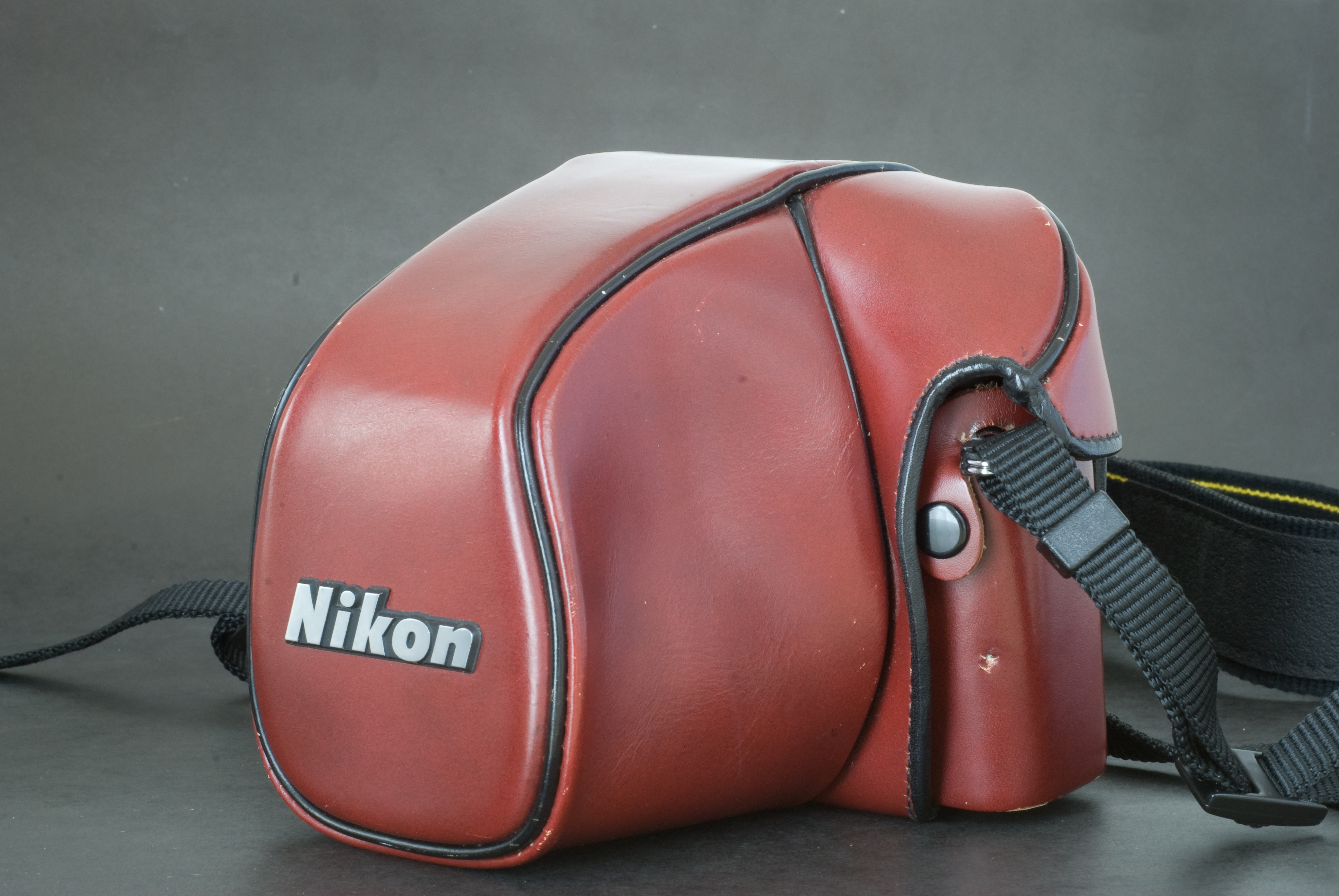
Nikon F3 in the CF-22 bag (Red)


Of course, the F3 is not perfect. It may be compact, but it’s heavy (approx. 750g). Its OTF flash system may have been advanced for its time, but the shutter only syncs at 1/60sec, and none of the viewfinders of the F3 system has a standard flash hot shoe: the F3 requires a specific flash adapter, to be inserted at the top of the rewind lever. But if I had to own and use only one film camera, that would be the F3, without any hesitation.

Cameras like this Nikon F3 have a removable prism. With the prism removed, one can see the image as formed on the ground glass (the focusing screen). At this stage, it is still inverted right/left you have to keep the camera at waist level to see the image of the subject.

My 2021 take on the Nikon F3 – over the last twelve years, I’ve had the opportunity to shoot with almost every Nikon SLR manufactured between 1970 and 1995, and I still hold the F3 in very high esteem. There are a few other Nikon bodies that would compete in the “desert island camera” category – I can only see the FE2. The FE2 is much lighter, it’s easier to read what shutter speed the auto-exposure system has selected, but its viewfinder is very narrow compared to what the F3 (even in its non-HP version) offers, and it’s probably not as solid as its “pro” sibling.


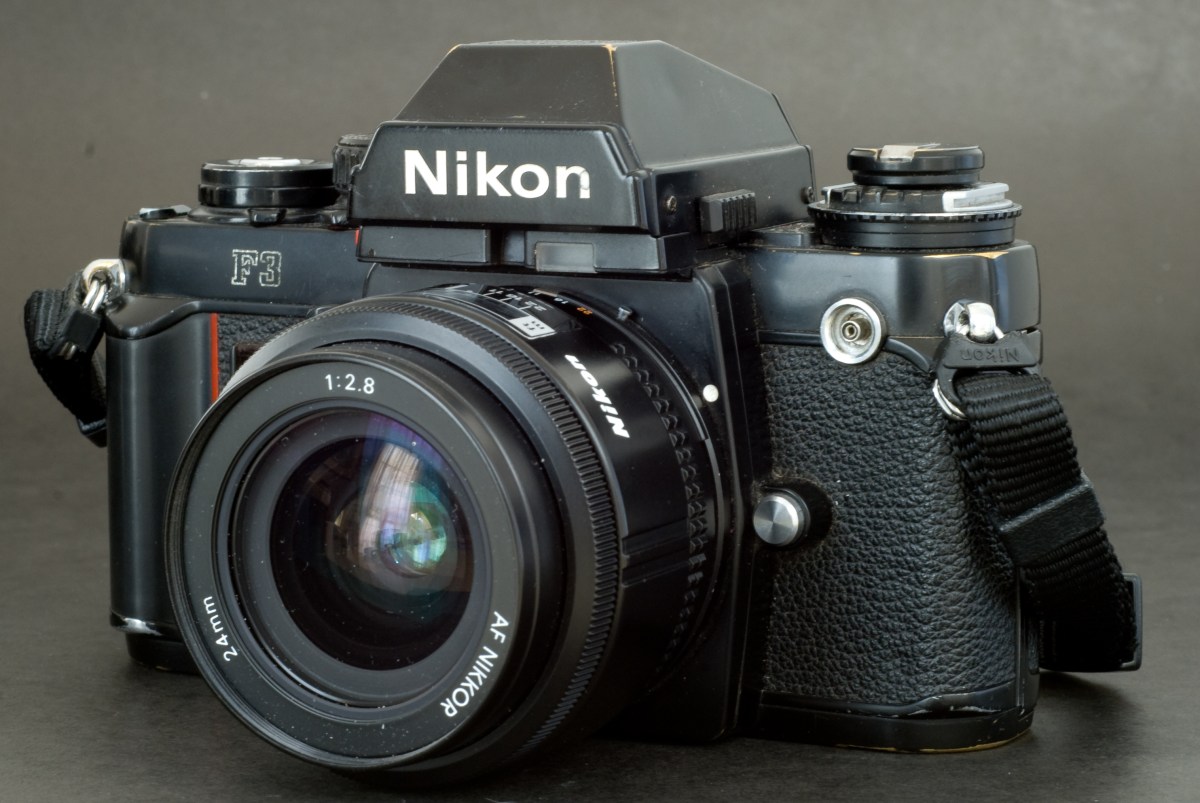
Nikon F3 – Nikkor 24mm AF – lunch break along the Seine – at that time Notre Dame cathedral still had its original roof.

Paris, Place de l’Hotel de Ville (City Hall) – Nikon F3 – 24mm Nikkor AF
Triel s/Seine - Dec 25th, 2010
Triel s/Seine – Dec 25th, 2010 – Nikon F3 – Nikkor 135mm F:3.5 – Kodak CN 400

More pictures shot with this Nikon F3 on CamerAgX’s Flickr gallery

DP Review’s preferred “analog gems”

After Thom Hogan’s list of Nikon Classics, another list, this time coming from no other than dpreview.

The “DP” in dpreview stands for “Digital Photography” of course, and the site was launched in 1998, at the beginning of the digital camera craze. And they’ve never reviewed a film camera. As far as I know. But over the years, they compiled two lists of recommended,  “excellent and affordable” film cameras, the first one in 2017, with a follow up in June 2019.

A few of the cameras listed as “analog gems” by DPreview have been presented in this site over the years (the Nikons FE2, N90, the Olympus OM-1 and the Canon T90). Very often, my preference goes to other models of the same family (I prefer the Olympus OM-2 to the OM-1 because its battery is much easier to find, the Canon AT-1 to the AE-1 because I’m not a fan of shutter speed priority automatism, and the EOS-620 to the EOS-5 for its simplicity).

Nikon FM
Nikon FM

I’ve never been a fan of compact cameras in the days of film (poor viewfinder, not enough controls for the photographer). Their only advantages were their small size and their ease of use, but a film SLR with a pancake lens was not much larger and delivered much better images. And today, why would you spend money on film and processing to use a compact camera which will give you less control over your images than a good smartphone?

My absolute favorite? The ones I would bring on the proverbial desert island (assuming the desert island has no electricity, no Internet access but a huge stack of film cartridges waiting for me)?

Canon-T90-6241
Canon T90 – the ergonomics of an EOS camera with an FD lens mount

  • a compact, mechanical, semi-auto SLR – not the Olympus OM-1, not the Pentax MX, but the rugged and supremely reliable Nikon FM. The FM2 is probably an even better camera, but it’s also more expensive.
  • the most elaborate pre-autofocus SLR, the Canon T90, for the looks, the ergonomics, the crazy exposure system, with no concern for its questionable reliability or its mass, because I would always have the Nikon FM as a backup.

And of course, when I would be back from the desert island, I would reconnect with my cherished Nikon FE2…


summer2017-R4---12

“La Maison aux Bambous” – Bed and Breakfast – Vinay (France). Canon T90 – Canon FD 24mm – Fujicolor 400.

Thom Hogan’s preferred Nikon “classics”

Thom Hogan has been on the Web forever, it seems. He’s a pro photographer, has a background in marketing and product planning, and he also teaches, I believe. He’s been  publishing very detailed user guides for Nikon cameras for ages, and his collection of Web sites (www.bythom.com; www.dslrbodies.com, www.sansmirror.com) is always an interesting read, not only for users of Nikon equipment, but also for anybody who wants to understand the market forces shaping the photo equipment industry.

A few months ago, Thom wrote a short piece about future Nikon classics (collectible cameras that are still usable and will hold their value in the future): https://dslrbodies.com/newsviews/nikon-2019-news/april-2019-nikon-canon/camera-classics/.

He has much more experience of Nikon cameras than I do, and my tastes have been – at least in part – formed by what I read in his books and Web pages over the years. So I won’t say “I’m right, he’s wrong”. Let’s be honest: if there’s such a thing as being right in photography, the odds that he is are much higher than mine. But sometimes I simply beg to differ.

Film Era:

Thom’s list includes some cameras that grace my personal collection, even if they’re not my preferred in Nikon’s range. The F90/N90 is extremely efficient, but a bit too automatic for me, and the F4 is really too heavy to be used anywhere but in a studio. I never used the F100 or a F5 (too modern for me – I tend to like my film cameras with a conventional user interface – you know, knobs instead of LCDs and control wheels).

Which leaves us with the last entry of his list, the FM3A.

The FM3A is an evolution of the FM2/FE2 cameras, with a dual shutter control mechanism (electronic and mechanic) – which offers the best of what the FM2 (mechanical) and the FE2 (electronic with On the Film TTL flash control) can offer. I don’t own a FM3A, but two of its direct ancestors are at the top of my list: I use my old FM relatively often – because it’s a rugged camera and I know it’s going to work no matter what. The FE2 is a peach (it oozes quality, and it’s so pleasant to use) – one of the  very best film cameras ever.

Nikon FE2
Nikon FE2

Digital Era

You can collect “classic” cameras for their beauty and  for their importance in the history of the industry or a brand, but to me, a camera I can’t use to take pictures doesn’t qualify as a classic – it’s at best a “curiosity”.

In my opinion, early digital cameras are not really usable anymore, primarily because of their very limited dynamic range and very low resolution. If I brought one to cover a photo opportunity, I would most probably end the day disappointed and frustrated for having missed what could have been a great shot because of the technical limitations of the camera. Or I would have put it back in the bag, and used an iPhone instead. That’s why there is no early digital camera in my collection.

I recognize the importance of cameras like the D1h or the D100 in the evolution towards modern digital photography, but I will not add them to my collection. On the other hand, I believe that cameras like the D3 and D3X are still perfectly usable, but because they’re so big and heavy, I would ignore them, and buy their little brother,  the D700 instead. Admittedly it’s still a big and heavy camera,  but its performance is still exceptional, and with it I can use all the  Nikon (and Nikon-compatible) lenses I own.

Because I’ve been using Nikon cameras for so long, I find the D700 very intuitive and rewarding to use, and even today, the quality of the pictures that the 12 Mpixel sensor produces is incredible (in particular in low light or high contrast situations).

Nikon_D700-7253
Nikon D700 – a classic

It may be too early to add a D850 to a collection of classics, but it will most probably be the last enthusiast / pro DSLR from Nikon – the future is clearly mirrorless. They may launch a D6 for the Olympic Games next year (who knows) but I doubt they will keep on developing the D800 series beyond the D850.


Atlanta_Midtown-6344
Atlanta – World of Coke – Nikon D700

dogs-Xmas--6078
My always available and patient models – the performance of the camera in low light and with multiple light sources of different color temperatures is simply incredible. Nikon D700 – Nikkor 28-70 f/3.5-4.5 AF – 3200 ISO.

Nikon N2020 – the design philosophy of the F4 in a smaller package ?

The N2020 (F-501 outside of the US) was Nikon’s first mass market auto-focus SLR. It was an upgrade of the N2000 (F-301 “in the rest of the world”), Nikon’s first SLR with an integrated motor. They inaugurated a new type of laser etched focusing screen, and a new camera naming scheme based on numbers. Because they had the two lowest numbers in the hierarchy, they were often mistaken for low performance entry-level models.

NikonF501-6353
Nikon F-501/N2020 with a Nikon E Series 35mm f/2.5 – note the convenient AE-Lock and AF-Lock buttons next to the lens flange. The recessed red button starts the self-timer.

It’s obviously a wrong perception: just consider the price of the N2020 – a few years after being launched, it was still more expensive than Minolta’s enthusiast oriented Maxxum 7000, in the same ballpark as the ground breaking Canon EOS 650, itself derived from the very high-end and very expensive Canon T90.

Like the Nikon F4 that would follow two years after (and contrarily to the Minolta and Canon auto-focus cameras), the N2020 retained conventional commands (shutter speed knob, aperture ring, ISO speed dial), and, as a true high-end Nikon, protected the photographers from unfortunate lapses of attention with all sorts of locks and flashing red LEDs.

Nikon’s transition to auto-focus

At the end of 1985, Nikon was apparently not certain that their (generally technically conservative) customers would enthusiastically embrace auto-focus, and they edged their bets. They first launched a manual focus version of their new body, the N2000 (*), and took their time to fine tune the auto-focus version, the N2020, finally presented in April 1986. They were not certain that the photographers would adjust to motorized film advance either, so they kept a conventional rewind crank.  The N2000 and the N2020 could read DX coding, but still had a conventional film sensitivity selector. Just in case. This prudent approach extended to the design as well. Nikon did not go for a full poly-carbonate body with rounded edges, they kept an hybrid metal/plastic construction with a design language based on sharp angles. Do you start seeing a pattern here?

NikonF501-6352
Nikon N2020/F501 – the focus mode selector is still the same on current Nikon dSLRs.

Yes, the auto-focus of the N2020 is primitive – with only 96 photosites (the following generation launched in 1988 with the N8080 and the F4 had a new sensor with 200 photo sites). Strangely enough, the auto-focus area at the center of the viewfinder does not feel as narrow as it does on the F4, but it’s far less sensitive in low light, making it almost unusable indoors.

IMG_2896
Very simple viewfinder – the selected speed on the right, and the AF guides at the bottom.

By today’s standards, it’s more of a focus-assist system than a true auto-focus, but because there was a version of the same camera without auto-focus, the viewfinder retains the characteristics of  manual focus cameras (92% coverage, 85% magnification, precise and relatively grainy focusing screen). It is still suited to manual focusing, even though the default focusing screen of the N2020 is deprived of a micro-prism ring. Other focusing screens (including the very sought after K type with a micro-prism ring surrounding a split image telemeter spot) may still be available – but as far as I know the model is specific to the N2020 and I could not find any on eBay.

NikonF501-6358
Nikon N2020/F501 – this one is equipped with a AA battery holder. Note that the tripod socket has been pushed to the left of the camera to make room for the batteries, and that the camera has the full featured AI-S mount with the focal length sensors (on the right side of the lens mount on the picture)

NikonF501-6359
The F601/N6006 – the successor of the F501/N2020 – The battery its now in the ergonomic handle, the tripod socket sits under the axis of the lens, and the lens mount has been simplified (the sensors and pins specific to the AI-S declination of the Nikon F lens mount are gone).

Everyday use

The N2020 (in fact, mine is a “rest-of-the-world” F501) is the camera that I had brought with me – virtually untested – to a long trip to Israel, Jordan and France. The camera did not miss a beat, and fulfilled its mission brilliantly.

Minerve_2
The village of Minerve, (departement de l’Herault, France) – Nikon N2020 – Nikon E 35mm f/2.5 – Kodak Ektar 100

It does not exude from the N2020 the impression of quality that emanates from a Nikon FE2, a F3 or a F4,  but it still feels less of an amateur photographer camera than the Nikon FG. Compared to the FG, it’s larger and heavier, and receives a faster shutter (1/2000sec) and an exposure memory lock button (more useful than the +2EV button of the FG). Like the current pro cameras from Nikon, it can be controlled via a wired remote. The back has a window showing the film cartridge, a film advance indicator, and a red LED warns the photographer if the DX sensitivity coding can not be read. Clearly not a body for the experts or the pros (roles that would be fulfilled in Nikon’s product range by the N8008/F801 and the high-end F4 respectively), but not a simplified or spec’d down entry level camera either.

NikonF501-6362
The F601/N6006 (1991) next to the F-501; the interface design of the F-601 is an intermediate step between the classical interface of the F-501, and the full modal interface of the F100.

If you don’t forget it’s a very early auto-focus camera, and don’t expect it to behave like a Nikon F6, it’s a pleasant camera to use. On the plus side:

  • the ergonomics – simple, easy to learn, no menus, no hidden functions, just conventional knobs and rings
  • the conventional Nikon average weighted metering – that is to say: accurate and predictable (at least as long as the cell is not blinded by the middle-eastern sun)
  • its relatively compact size
  • it works with any Nikon AI, AI-S, AF or AF-D lens without any limitation (the lens mount has all the sensors and pins of a true AI-S camera).
  • Exposure determination can be left to one of the three program modes, or controlled more directly by the photographer (aperture preferred auto-exposure and manual modes)
  • It runs on standard AAA or AA batteries (the AA battery tray was optional)
  • it’s reliable – it simply works, with no known mechanical or cosmetic issues.

Not everything is perfect: the viewfinder is informative, bright, but rather narrow,  with a relatively short eye-point (the same as the FG or FM-FE),  the winder is rather loud, and of course its auto-focus system dramatically lacks sensitivity in low light – it is almost unusable indoors if the scene is not lit like a studio. But it’s not too much of an issue today : even with its standard focusing screen, the N2020 is one of the few auto-focus SLRs that can still really be used with manual focus lenses – at least with wide angle lenses.

NikonF501-6360
One year separates the two cameras – the F501/N2020 was launched in the spring of 1986, and the Canon EOS620 in the spring of 1987 – the Nikon is still a classical camera, the Canon is already fully motorized, with a large information LCD and a modal interface.

How much?

Today, early auto-focus cameras are dirt cheap, and this one is not different. Very nice copies can be had for $35.00 in specialized second-hand photo equipment stores, and will not fetch more than a few dollars on eBay or at Goodwill.

As a conclusion

Like the F4 in the “pro” market, the N2020 is at the same time Nikon’s last “enthusiast” body with a conventional user interface, and the first of a long line of auto-focus and motorized SLRs.

Its conventional user interface is well thought and makes for a pleasant experience, and its high-magnification viewfinder is better suited than the F4’s for manual focus operations. The N2020 is also reasonably light and compact (half the weight of the F4 with its MB-21 grip), but of course you can’t compare a camera designed for amateurs with a high-end professional rig.

France-8165
Homps (Departement de l’Aude, France). Homps is a harbor on the Canal du Midi in the south of France. Nikon N2020. Nikon E 35mm f/2.5 – Kodak Ektar 100

It would not be reasonable to buy a N2020 and expect it to deliver the performance of a more modern auto-focus SLR. With its simple and narrow auto-focus sensor, its limited processing power and its weak focus motor, it can’t even compete with a F4, let alone a N90s or any auto-focus film SLR manufactured in the mid to late nineties. But if you see it as a manual focus camera with a focus-assist system, it becomes much more enjoyable.

The manual focus E Series lenses are a very good fit for the N2020. Designed originally for the EM, the lenses are built out of plastic with a simplified optical formula (to save on weight and contain cost), but some of the E lenses (the 50mm f/1.8 or the 35mm f/2.5 for instance) are probably as good optically as the metal-built Nikkor lenses of equivalent aperture. Nikon’s first consumer grade (sliding aperture) 35-70mm auto-focus  zooms have a bad reputation, but the 28-70 AF f/3.5-4.5 that followed a few years later  is very compact and sharp – a little known gem.

With a manual focus prime lens or a small auto-focus zoom (like the 28-70 F/3.5-4.5 mentioned above), the N2020 will form a cheap, reliable, compact and highly capable set, to be used to learn the basics of photography, or as a second body for the occasions when a more expensive camera can not be risked.


(*) In 1990, Nikon did it again- they replaced the F301-F501/N2000-N2020 series with two cameras – one with an improved auto-focus system (the F601/N6006), one with manual focus (F601m, N6000).


Another opinion (not that different, in fact) about the N2020: http://randomphoto.blogspot.com/2018/03/nikon-took-af-mainstream-n2020-slr.html

An interesting perspective: a comparison of the Nikon ELW, N2020 and N90s: http://www.mikeeckman.com/2017/01/three-decades-of-nikons/

To learn more about the theory of auto-focus: http://www.exclusivearchitecture.com/?page_id=980

Our best source (bar Nikon themselves) about the Nikon system in the 1970-1990 era has very little about the N2020/F-501, but there is one interesting page dedicated to the 28-70 AF zoom: Photography in Malaysia (MIR): a page about the Nikon 28-70 AF f/3.5-4.5


Minerve (Hérault, France) - the church plaza
Village de Minerve (Hérault, France) – the church plaza.  The flying bird carved in the stone (on the right) is a memorial to the “Cathars”, local heretics from the XIIIth century annihilated by the Albigensian crusade.  Nikon N2020 – Nikon E 35mm F/2.5 – Kodak Ektar 100.


59 years after, a new Nikon mount…

I don’t want this blog to turn into a Nikon fansite. But Nikon related pages are now the most read: the Nikon D700 and FE2 entries have been the two most visited pages lately, leapfrogging the pages related to the Angenieux 28-70 f/2.6 zoom, which had been the readers’ favorite for years. And I can’t hide that Nikon film cameras are those I prefer, and that I’ve put my money where my mouth was.

Interesting things are happening at Nikon’s. On August 23rd, they will unveil a new full frame mirrorless digital system, launch a new lens mount and at least one lens.

nikon-mirrorless-brightened-620x465
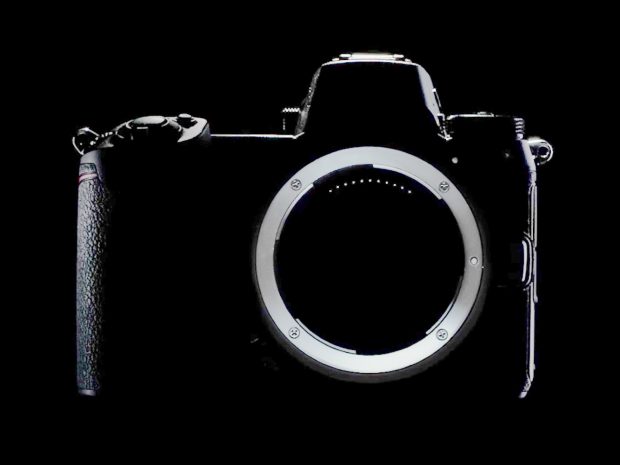
Teaser from Nikon: the silhouette of Nikon’s new mirrorless body, and its huge lens mount. It looks much simpler than the Nikon F mount below,

The new lens mount will be typical of modern mirrorless cameras (short flange distance, and, I assume, no mechanical interface at all – autofocus and aperture control being all electric ), but its diameter will be unusually large – much larger in any case that the Sony E lens mount.

Nikon’s micro site presenting the new lens mount: https://www.nikonusa.com/en/nikon-products/mirrorless-is-coming.page

Over its 59 years of commercial life (so far), the Nikon F mount has gone through many revisions to support successively aperture indexing, automatic aperture indexing, matrix metering, auto-focus, silent wave auto-focus motors, and more recently, electronic diaphragm control.

Because Nikon has made a core business principle to guarantee at least a modicum of compatibility between its older lenses and its newer generation of bodies (particularly for high-end cameras sold to professionals), the new full frame mirrorless body will accept Nikon F lenses, via an adapter. But Nikon has not shared any detail about this adapter yet.

Nikon_F4-7507
Nikon F mount – clockwise from top, on the mount’s flange : the meter coupling lever used for aperture indexing, the lens type signal pin, the lens release pin, the auto-focus shaft. On the inside of the exposure chamber: the electrical contacts used by AF lenses (top), the focal length indexing pin (right) and the aperture stop-down lever (left).

  • The adapter could be made simple, with no electrical contact and no mechanical linkage to the lens. Generally speaking, mirrorless cameras are not dependent on the automatic aperture pre-selection capabilities of the lens, so it’s likely that any Nikon F lens old enough to have an aperture ring will not only physically mount on the adapter, but will somehow work when the camera is set to semi-automatic exposure and manual focus mode. But recent lenses deprived of an aperture ring (or with an electronic control of the aperture) would not work with such a simple adapter. Which would go against Nikon’s tradition of preserving compatibility in priority for recent and/or expensive pieces of equipment.

canon_adapt-7378
2 very simple adapters: Canon FD to Fujifilm X (left), Nikon F to Fujifilm X (right). In both cases the mirrorless body does not control the aperture on the lens (no pre-selection, no shutter priority or program automatism).

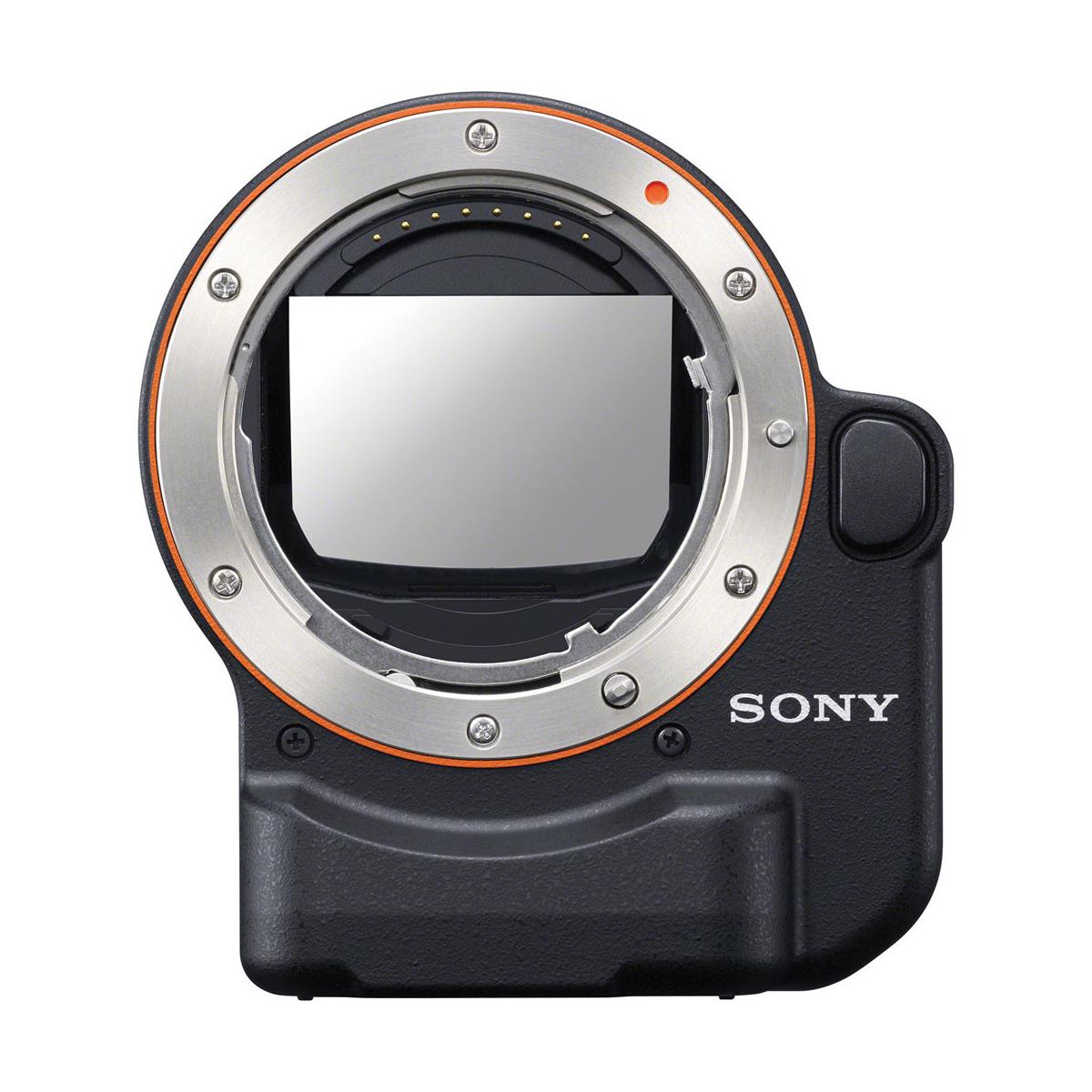
  • The adapter could be made very complex. Sony supports Minolta/Konica-Minolta/Sony A mount lenses on its E Mount mirrorless bodies thanks to two models of adapters. The most complex of the two, the LA-E4, has its own autofocus motor in order to provide support and adequate AF performance for screw-drive autofocus lenses (which still constitute the majority of the Series A lenses offered by Sony today). Sony’s adapter also has a Phase Detection AF module, probably because its A series lenses were not designed for the contrast detection auto-focus system of its NEX mirrorless bodies.Nikon’s original AF and AF-D lenses (the screw drive lenses without an auto focus motor) could be supported using a similar setup if Nikon really wanted to, but I doubt they’ll have any appetite for such a solution (one of the reasons being that professionals have been buying AF-S lenses with a built-in auto focus motor for almost 20 years now – and probably don’t use many screw-drive auto-focus lenses anymore).

    sony_LA_EA4
    Sony LA-E4 A NEX Camera Mount Adapter (Source: Adorama). With its built-in auto-focus motor, it accepts any Minolta/Konica/Sony A lens (with the AF drive shaft), and its Phase detection AF module behind a semi-transparent mirror offered better performance than the contrast detection AF of the early Sony Nex bodies.
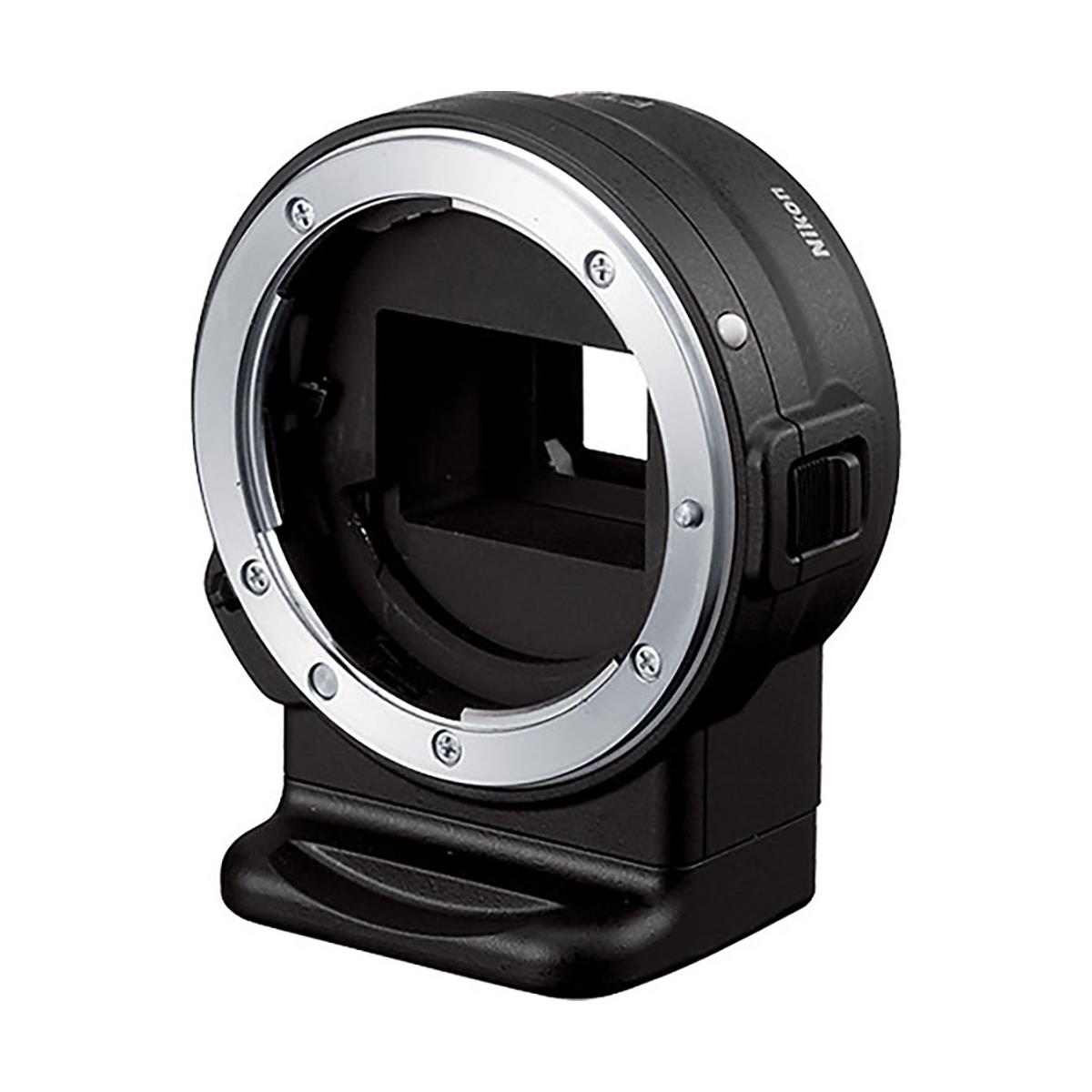
  • Nikon’s now defunct One series (J1 to J5 viewfinder-less cameras and V1 to V3 SLR like models) could accept F mount lenses thanks to an adapter. With the FT1 adapter, auto-focus lenses with a built-in auto-focus motor (AF-S lenses, with or without an aperture ring) are fully supported (all auto-exposure modes, vibration reduction and auto-focus, of course).
    Older auto-focus lenses (the AF and AF-D lenses) can be used in all the auto-exposure modes but don’t auto-focus. Lastly, AI and AI-S manual focus lenses will only be usable in Manual or Aperture Priority Auto Exposure modes.

Nikon FT1: compatible modes: https://imaging.nikon.com/lineup/acil/lenses/mount_adapter_ft1/restrictions.htm

Nikon_ft1_adapter

Nikon FT1 adapter (Nikon F to Nikon One lens mount adapter) – the adapter is seen from the front (where the F lens will be mounted).  Source: Adorama

My bet is that the new adapter will offer the same functions as the FT1. It will fully support any lens introduced in the market since the last years of the XXth century (AF-S, AF-S G, VR, AF-P), and with reduced capabilities, most of the older lenses.

Will there be a penalty in terms of auto-focus performance for users of AF-S lenses ?

That’s the real question.

First answers on Aug. 23rd…


Update: Aug 24th, 2018

So.. Nikon had a busy day yesterday: they launched a new Z series of bodies with 2 cameras, the Z6 and the Z7, 3 lenses of a new S series, and a F to Z adapter.

3875164987
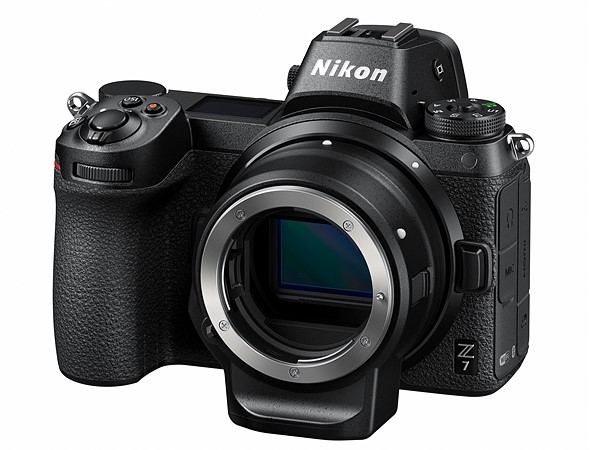
Nikon Z7 body with the adapter in place – it’s the only official picture of the adapter seen from the front of the camera. The mechanical actuator operating the aperture is visible on the left, inside the lens mount. Source: Nikon.

In the picture above, the Nikon F to Z adapter looks very similar to the FT1 adapter – no built-in auto-focus motor, no auto-indexing mechanism to support full aperture metering for AI or AI-S lenses, but “a mechanical actuator to operate the aperture on the lens you mount to it” (according to DPREVIEW)

ftz_adapter
Nikon F to Z adapter – What you see here is the back of the adapter – which will be attached to the Z6/Z7 body. The diameter of the back of the adapter is larger than the front – the new Z mount is definitely huge. (Source: Nikon)

As I expected last week, lenses released during the last 18 years (AF-S, AF-S G, VR, AF-P) are fully supported, and the VR lenses gain 5 axis image stabilization in the process.

Older lenses (AF, AF-D) will not auto-focus but will still access all the auto-exposure modes of the Z bodies. Older manual focus lenses will mount but will have more limited exposure control capabilities.

For more (and in particular an opinion about the auto-focus performance), you can check DPREVIEW’s very interesting first take on the F to Z adapter.


israel_--101
Massada (Israel) – Kodak CN400, Nikon F501 – Nikon E series 35mm f/2.5 lens.