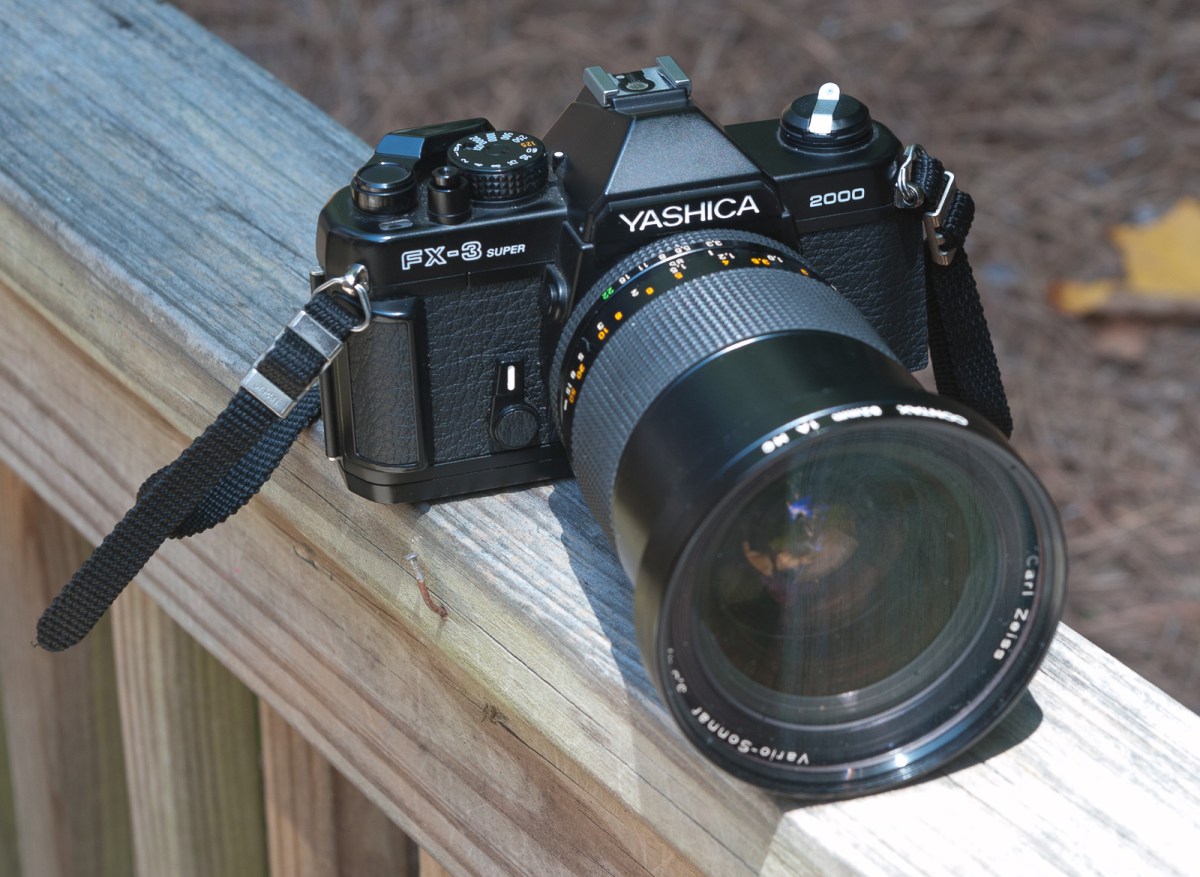
Yashica FX-3 Super 2000 – of the need of a hair dryer in a photographer’s repair kit

I know. It’s provocative. But don’t buy a Yashica FX-3 without ensuring first that you have a good hair dryer in one of your bathroom cabinets.

Google and a hair dryer to the rescue

When I received the FX-3, the camera seemed to work perfectly with no lens mounted, but as soon as a lens was in place, the reflex mirror was refusing to return into its normal position at the end of the shutter release cycle, making the camera unusable. But as soon as I was removing the lens, the mirror was returning back into its normal position.

Google is my best friend, and I rapidly learned that the Yashica FX-3s are renown for their sliding mirror problem. Over time, the mirror (which is glued to a part I’ll call the hinged mirror holder) tends to slide forward, and after some time (years? months? weeks?) it has moved so much that it hits the back of the lens, preventing the shutter release cycle from completing. The solution? Use a hair dryer to soften the glue, and gently push the mirror a few tens of a millimeter back, to the top of the mirror holder. I tried, and it worked. I can now use the camera – I just don’t know how long this fix will operate, and how often I’ll need to give the camera a hair do.
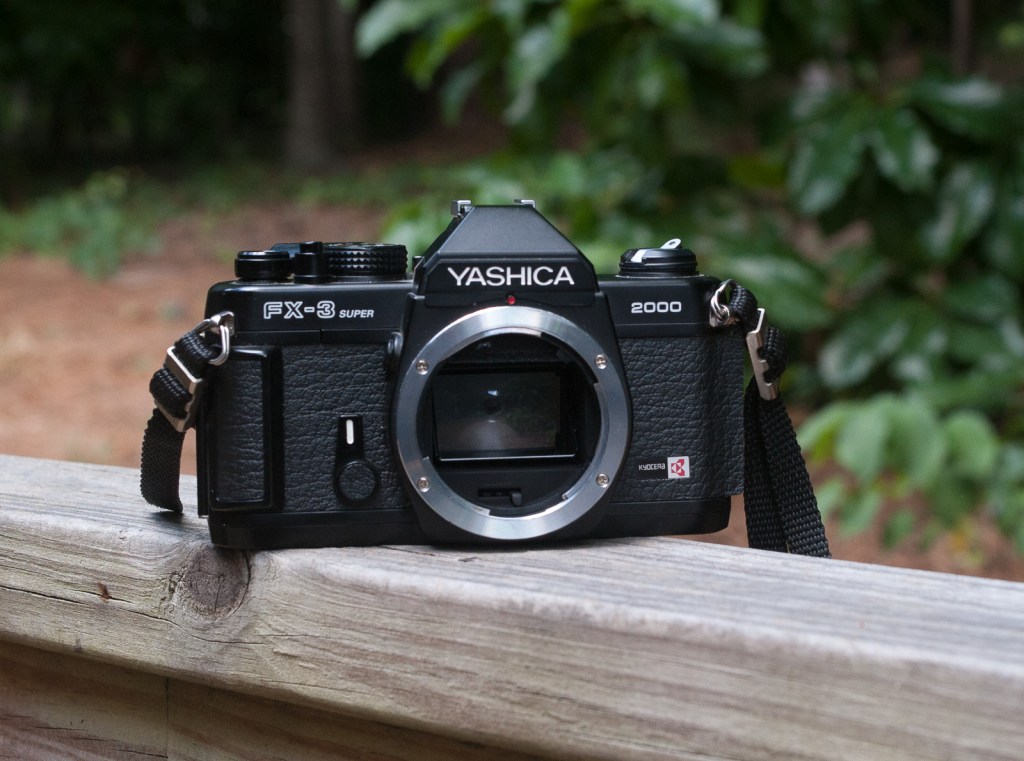
Yashica Super 2000 – a very compact (and very light) camera of very conventional design.
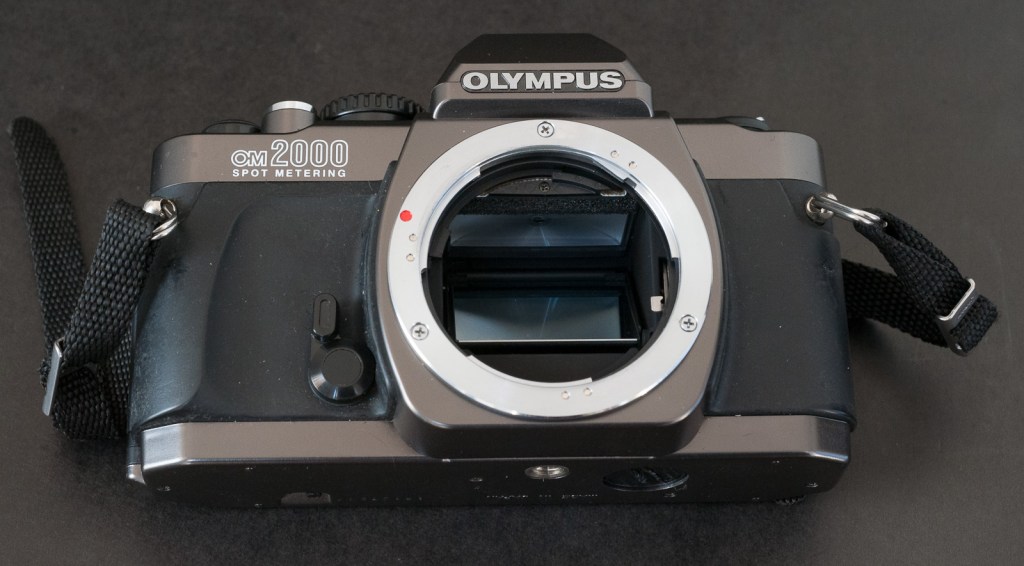
Olympus OM 2000 Spot Metering – very similar to the Yashica Super 2000.

Yashica’s FX-3 series

The FX-3 Super 2000 is the final declination of a line of simple semi-automatic, manual focus cameras, released by Yashica between 1979 and 1986. Before the FX-3, Yashica had launched two FX models, but they don’t belong to the same technical family – the early FXs were largely derived from cameras sold before Yashica adopted the Contax/Yashica bayonet mount: the FX-1 from 1975 (an aperture priority automatic camera), and the semi-automatic FX-2 from 1976 still incorporate CdS cells for metering and require mercury oxide batteries. The FX-3, like the FX-3 Super and the FX-3 Super 2000 that followed, incorporates a silicon cell and is powered by a pair of ubiquitous SR 44 silver oxide batteries.

FX-3, FX-7, FX-3 Super, FX-7 Super and FX-3 Super 2000: the differences

The black bodied FX-3 and its chrome finished sibling, the FX-7, are semi-automatic SLRs, with a silicon cell meter activated by a dedicated push button at the back of the body – in the Yashica tradition. Their fastest shutter speed is 1/1000s, and their meter is coupled from 12 to 1600 ISO. Exposure information is communicated to the photographer by 3 LEDs in the viewfinder. And thanks to their Contax Yashica bayonet lens mount, they accept any Yashica lens from the ML, MC, YUS and DSB series, as well as Contax Carl-Zeiss lenses. Older screw mount Yashica lenses can probably be used, provided you can locate a 42mm Universal to C/Y mount adapter.

On the “Super” versions, the meter is activated by a light press on the shutter release button, and a (very) small vertical grip has been added on the front right side of the body.

The Super 2000 is only available in black, its shutter speed now peaks at 1/2000 sec, and the meter is coupled from 25 to 3200 ISO.

Considering that old lenses tend to be more luminous than the zooms we use today (manual focus 50mm f/1.4 lenses are very affordable) and that 400 ISO film is often easier to find than 100 ISO stock, having a faster shutter speed is an important plus – I picked the Super 2000 for that reason.

Is it another derivative of the Cosina CT-1?

Check Wikipedia and similar sources – you’ll see the FX-3 is generally presented as a Cosina-designed and manufactured camera.

Before they bought and relaunched the Voigtlander brand, Cosina was selling is own line of compact cameras and SLRs, but was primarily known as a sub-contractor of the big camera makers – at some point, Canon, Nikon and Olympus were all selling, under their own brands, cameras that were manufactured (and to a large extent) designed by Cosina.

The fact is that Cosina was very good at deriving unique designs from a common base – the Cosina CT-1 semi-auto SLR is generally seen as the common basis for cameras as different as the Canon T-60, the Nikon FM10, the Olympus OM-2000, and Cosina’s own line of rangefinder products (the Voigtlander Bessa R series).
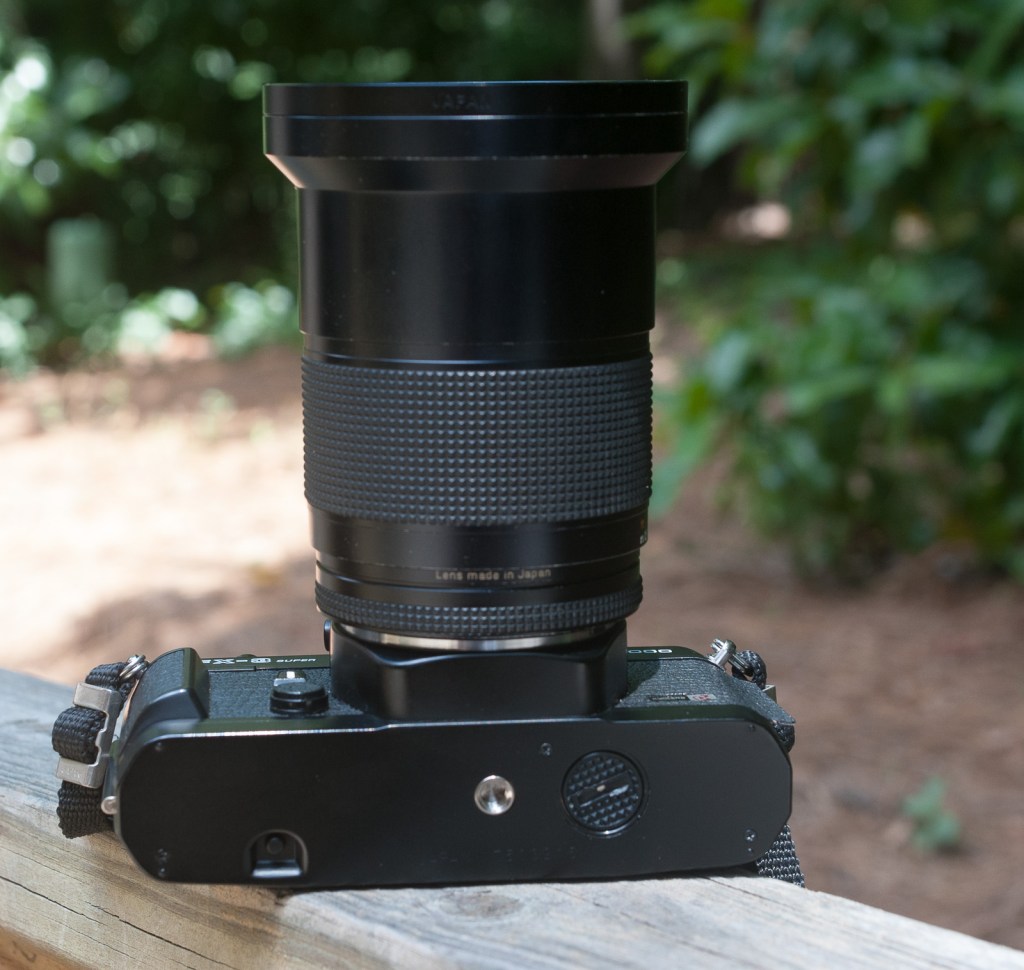
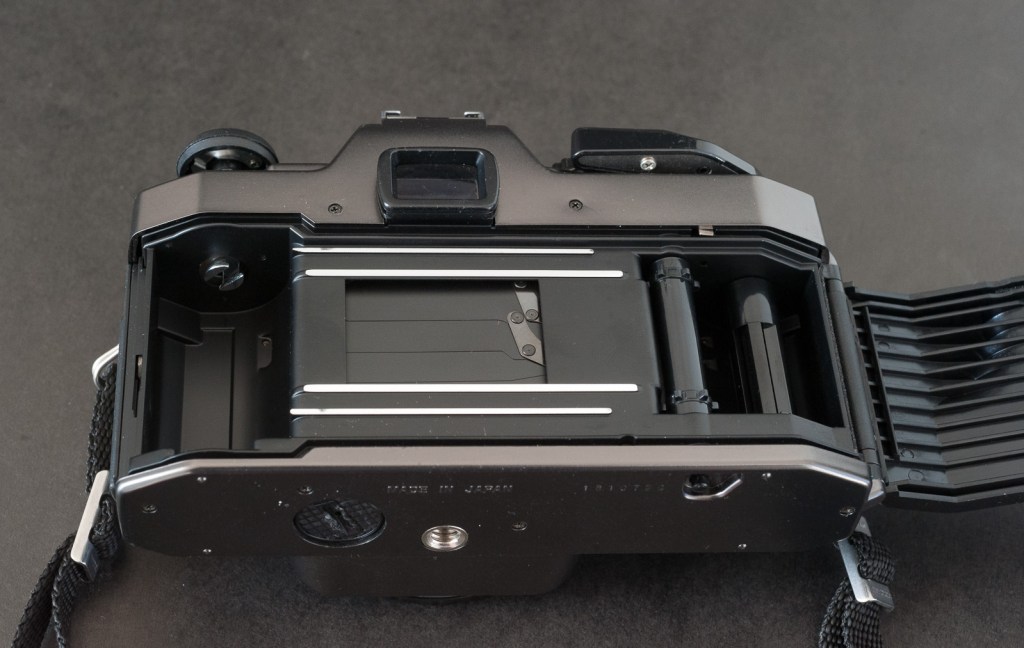
the bottom plate looks very similar to the OM-2000’s
Olympus OM 2000 – the fastest shutter on any Olympus SLR (1/2000sec, Flash X sync up to 1/125)

As far as Yashica is concerned, it is not absolutely certain that the cameras of the FX-3 series were made or designed by Cosina, and if they were, I doubt that were CT-1 derivatives: as we’ve seen, some of the quirks of the FX3 (the sliding mirror syndrome) seem to be unique to Yashica – I’ve never read of a Nikon FM-10 or an Olympus OM-2000 misbehaving in such a way.

The lenses

Contax Carl-Zeiss lenses share the same C/Y bayonet as Yashica’s own lenses, and they’re without a doubt the best lenses you can mount on the FX-3. They tend to be on the expensive side, though. Yashica ML (multi-coated) lenses generally have a good reputation – which reflects in their price on the second hand market. The Yashica DSB and YUS series were designed for “price conscious amateur” – a polite way to say they should be avoided if possible.

Lastly, the C/Y mount of the FX-3 is totally different from the Yashica AF lens mount (a screw drive autofocus mount similar to Minolta’s) and from the Contax N lens mount of the early 2000s (an all electric autofocus mount very similar to Canon’s EF).
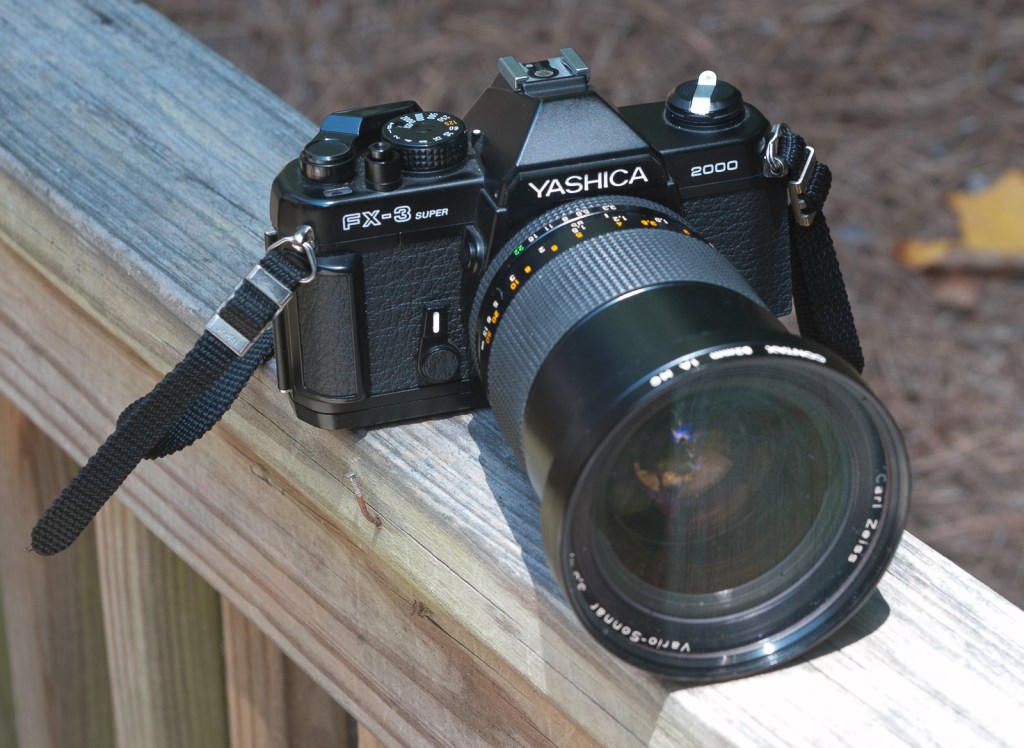
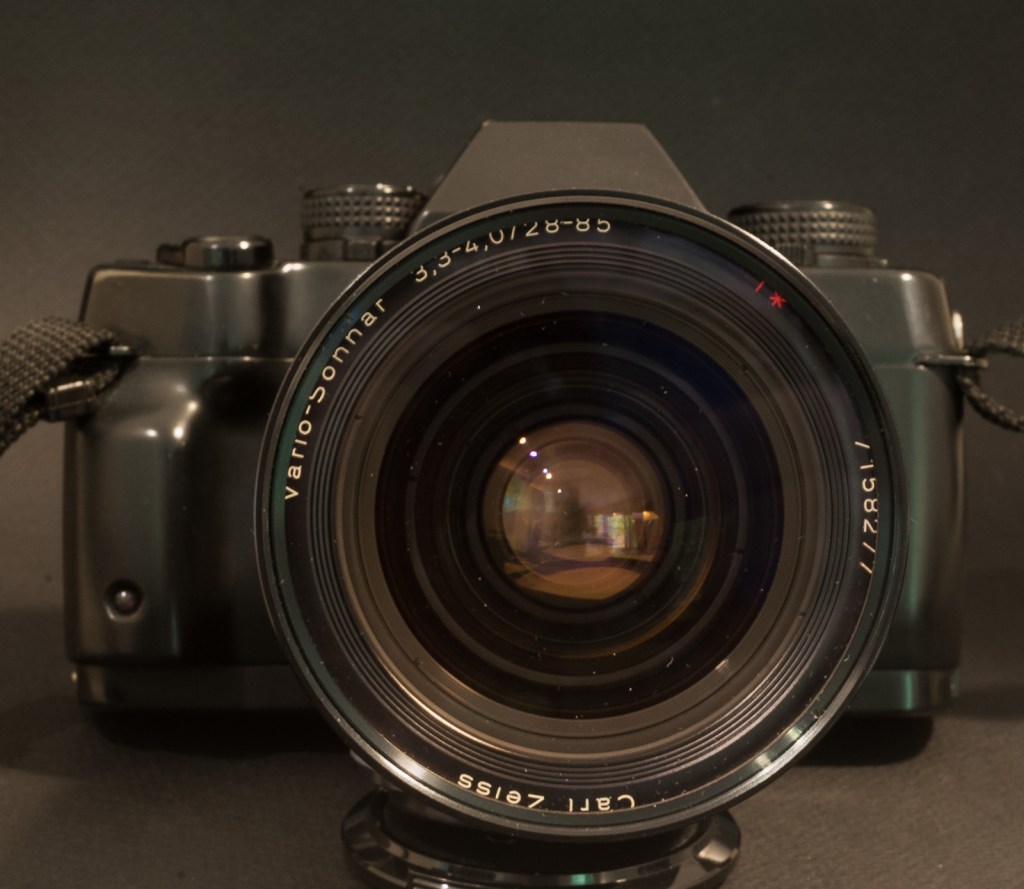
Yashica Super 2000 – here with a Carl Zeiss Vario Sonnar – the main reason for buying this camera today

Shooting with the FX-3 Super 2000

The first thing you notice about the Super 2000 is its cheap construction – the lens mount and the back of the camera are made of metal, but all the other components that photographers will touch are made of plastic. As a result, the camera is light, but it does not feel reassuringly solid. The commands (wind lever, rewind crank, shutter release button) are obviously not mounted on ball or bronze bearings – you can feel the friction between the parts inside the camera.

The viewfinder is rather dim, with a short eye relief (roughly similar to the Nikon FM/FE series, which means not that great). I was disappointed not to find a depth of field preview lever, or a shutter release lock: the camera can’t be turned off.
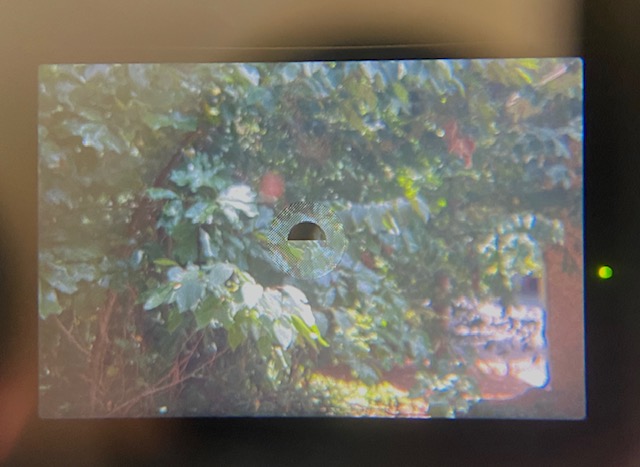
Yashica Super 2000 – a conventional viewfinder – a split image telemeter, a ring of micro-prisms, and 3 LEDs for the exposure

All in all, it feels like a cheap (really cheap) camera, not quite as bad as the horrible Fuji AX Multi or STX-2, but still miles away from equivalent models from Canon (AT-1) or Nikon (FM, FM2), or from automatic SLRs designed for amateurs like the Pentax P30. Compared to other cameras attributed to Cosina, the FX-3 does not look as nice as the Olympus OM-2000 but the quality of the mechanics of the OM-2000 had not impressed me either. Interestingly, the FX-3’s reflex mirror does not seem to generate the same strong vibrations as the OM-2000’s at long shutter speeds – it’s probably usable hand-held down to 1/30s – a feat that the OM-2000 is incapable of.

Contax or FX-3 Super 2000?

The FX-3 Super 2000 is a very simple entry level camera, made out of plastic, and designed to a very low manufacturing cost point. It’s very light – that’s its saving grace – and that could somehow justify carrying an FX-3 in a photo-equipment bag next to a Contax SLR, as a backup. But buyers of Contax cameras or lenses were people of means, who had spent a serious amount of money for the privilege of mounting high quality lenses on a well thought and beautifully designed camera – it’s difficult to imagine them happy with a FX-3.
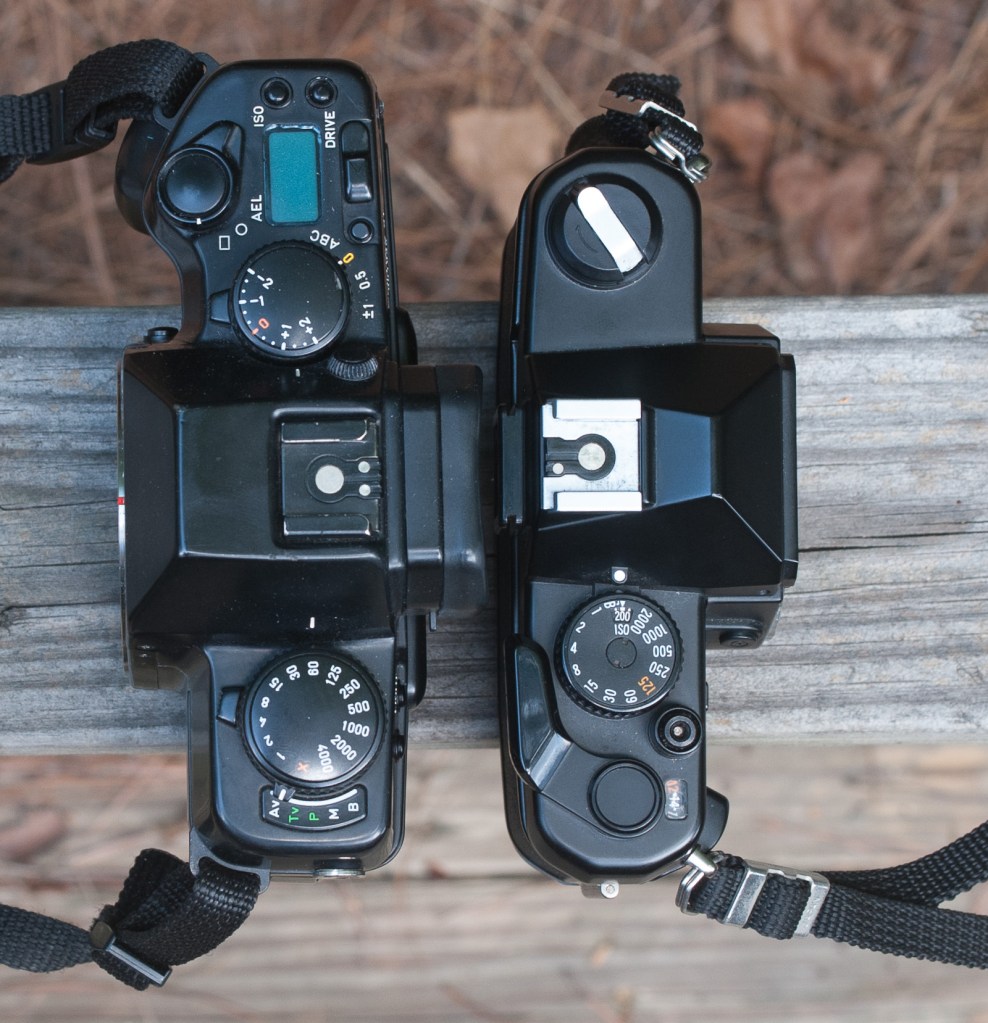
Next to a Contax ST – the Contax is larger, and probably twice has heavy.

Conclusion

Honestly, I’m not a fan of this camera, and it’s definitely not one of my keepers. To my taste, it’s too plasticky, technically too limited, and this sliding mirror issue is simply unacceptable. Even for a backup camera.

Place a FX-3 next to a Canon AT-1 or a Nikon FM, and you’ll immediately see and feel the difference. Place it next to a Contax camera, and you can’t believe they were designed and manufactured under the control of the same corporation.

Does it make sense to buy a FX-3?

  • As a backup camera? Maybe – compared to a high end Contax camera (RTS I, II or III, ST, RX, AX), the FX-3 Super 2000 is much smaller, lighter, and although it’s not as elaborate or pleasant to use (by a wide margin), it does the job when you still want to shoot with Zeiss glass, but can’t carry a very large and very heavy rig.
  • As a primary camera? Sorry, I don’t think so. Zeiss lenses have an undisputed appeal, but they’re expensive, and even Yashica ML lenses are not exactly cheap. So, if I started from scratch and wanted a good quality set to shoot film for not too much money, I would probably pick another system (Canon FD, Nikon F, Pentax K) with a wider and cheaper supply of great camera bodies and lenses. And if the lure of Zeiss lenses was too strong, and I was to spend serious money on lenses of the Contax/Yashica family, I would also spend a little more on the body, and pick Contax 139 Quartz, or a late Contax model such as the S2, the S2b or the Aria – they’re compact and hopefully devoid of too many technical issues.
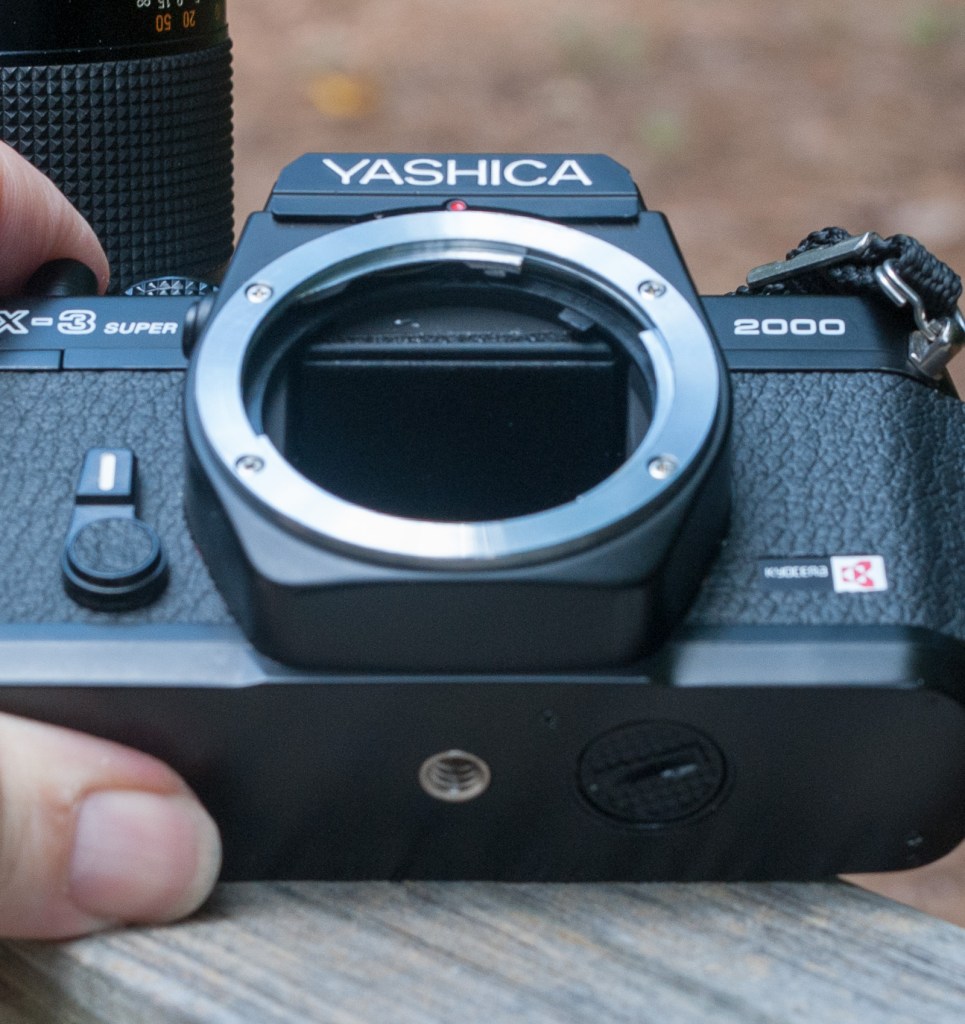
You can see the mirror protruding from the hinged mirror holder. When it protrudes too much, the mirror can’t go back to its normal position and the camera becomes inoperable.

How much?

A semi auto camera from the mid-eighties, with a fast shutter and a lens mount accepting lenses known for their high quality, the FX-3 Super 2000 is not going to be cheap: its price is influenced by the current Contax-mania, and by the preference of film photographers for simple semi-automatic, manual focus cameras.

It’s obviously not in the same category (build quality, performance) as “high-end” semi-auto cameras such as the Contax S2, the Leica R6.2, the Nikon FM2, or the Olympus OM-3, but it often sells for more than Cosina CT-1 derivatives like the Olympus OM-2000 or the Canon T-60: a patient and lucky photographer can probably find a working FX-3 Super 2000 for less than $50.00, but I’ve seen ugly copies proposed for more than $100.00, with the nice ones approaching $200.00.

A few (final) words about the FX-3 Super 2000 – (June 2025) – I never warmed up to this camera, and ended up selling it. I must admit that the hair dryer fix had stood the test of time – when I last used it (6 years after I wrote this blog entry), the camera was still working perfectly.


More about the FX-3:

Solving the mirror problem: https://www.thephotoforum.com/threads/yashica-fx-3-super-mirror-problem.293840/page-2


of the need of a hair dryer (courtesy of Jorgo Photography)

Woman with hair dryer Photograph by Jorgo Photography – Wall Art Gallery

https://fineartamerica.com/featured/cute-brunette-retro-woman-with-hair-dryer-jorgo-photography-wall-art-gallery.html


More about Contax and Yashica cameras in CamerAgX

The Contax ST – first impressions

A compact point of shoot camera from the late eighties, the Contax T2, is currently red hot, selling for obscene amounts of money (well above $1,000). We’re observing here the manifestation of a new trend – a few film cameras have suddenly reached stardom – and make you pay dearly for them –  while the mass of the point and shoot and SLRs from the nineties still languish in the $5.00 bargain bin.

In the world of manual focus SLRs, Contax bodies and Contax Carl Zeiss lenses, while not exactly cheap, can still be had for a small fraction of the cost of this T2.

2020-04-Contax-6668
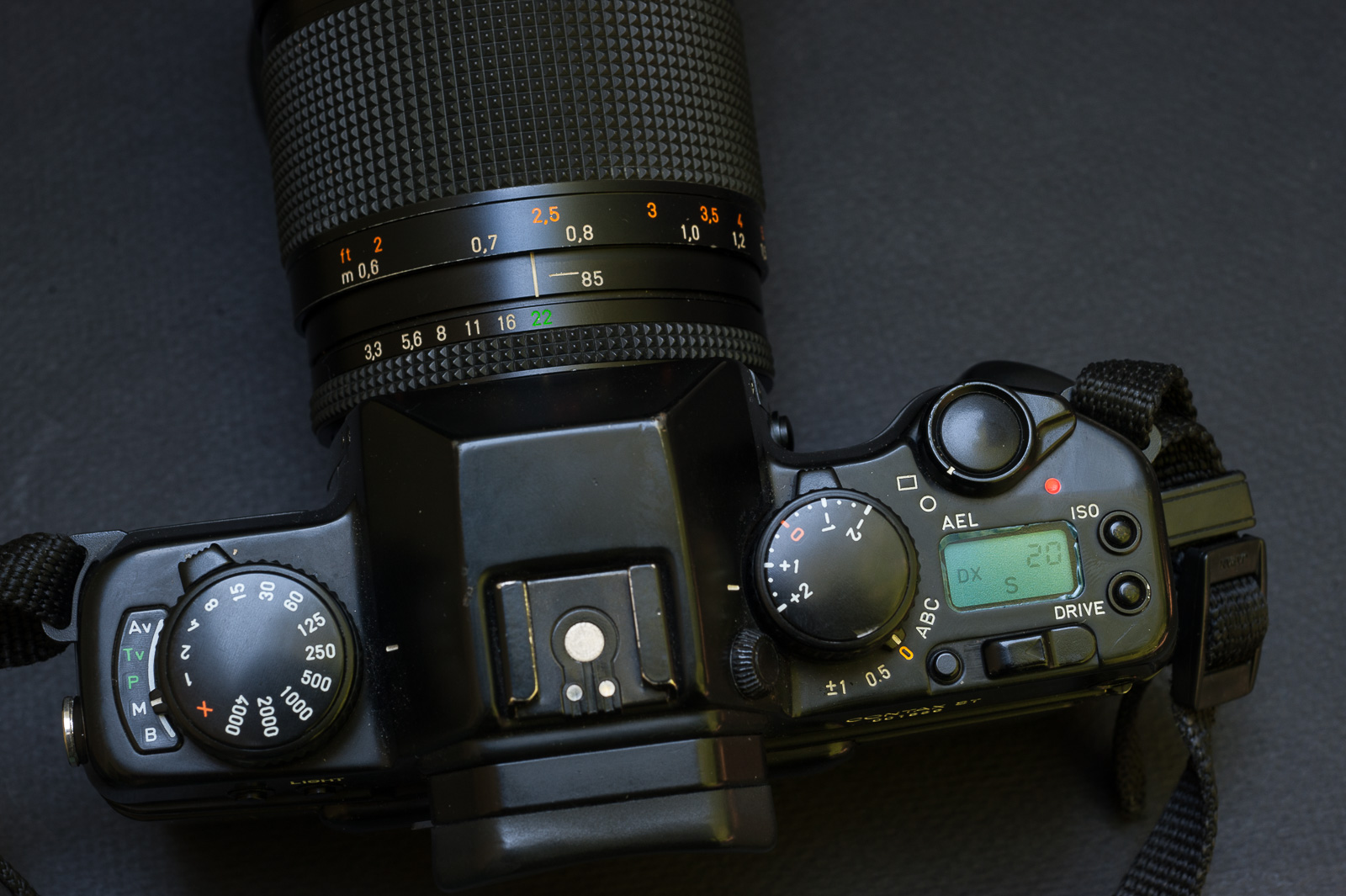
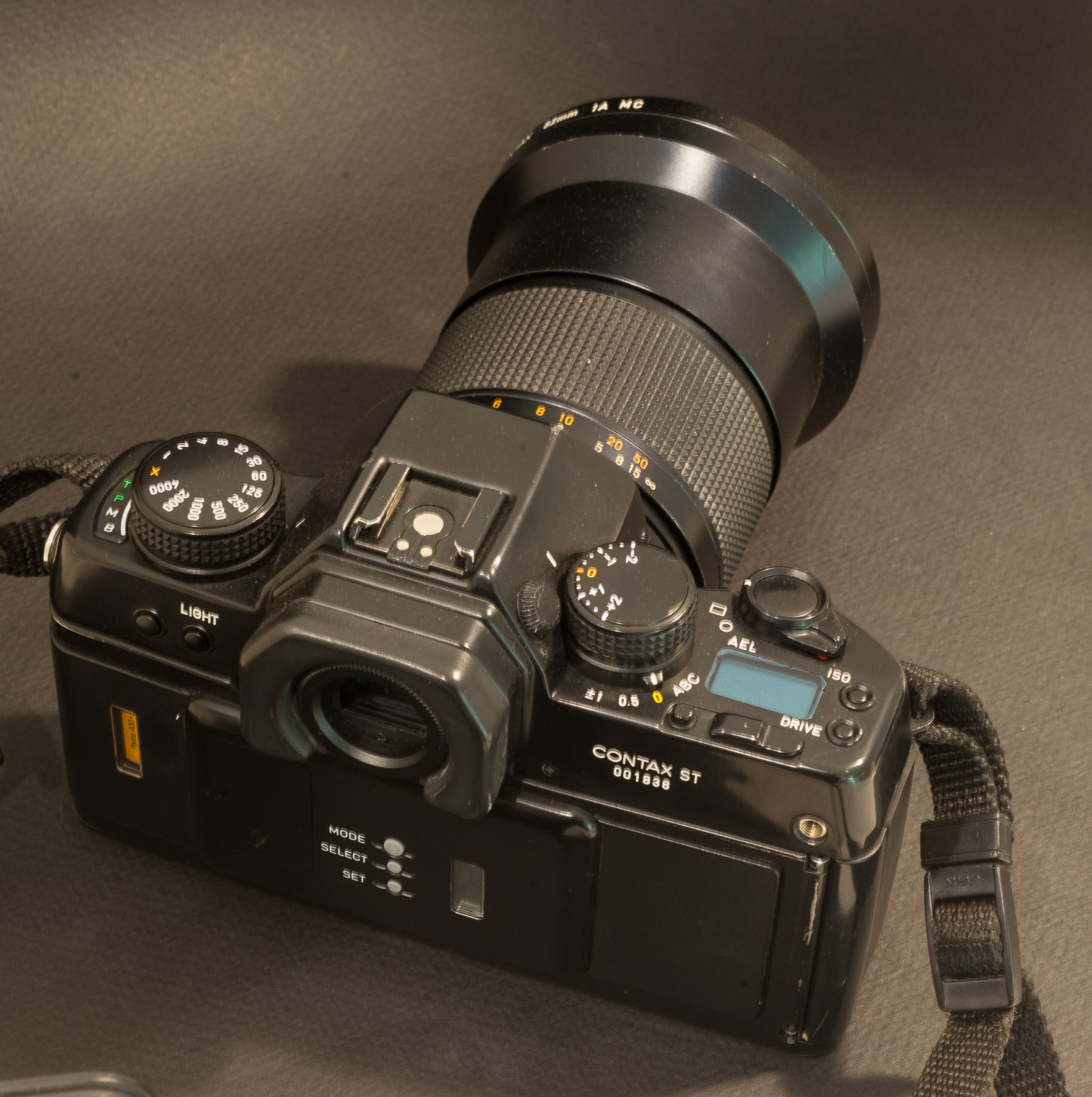
Contax ST and Carl-Zeiss Vario-Sonnar zoom – 28-85 f/3.3-4.0

Zeiss and its sub brand Contax have a very long history – Carl Zeiss founded the company that bears his name in 1846 in Jena (Germany) and Zeiss launched their first Contax camera in 1932.

In the seventies, Zeiss signed a licensing agreement with Yashica (the Japanese company subsequently became part of the Kyocera group). Contax and Yashica never said much about the role split in their joint venture, and most of what we know is an educated guess. High level, the “Contax” branded cameras of the Yashica/Kyocera era were designed and manufactured in Japan with some input from Zeiss. The F.A. Porsche  studio (*) was in charge of the industrial design of some models. Yashica and Contax SLRs shared the same bayonet lens mount, and Contax cameras could be paired with Contax as well as cheaper Yashica branded lenses.

The “Contax Carl Zeiss” lenses were named after famous Zeiss lens designs (Distagon, Planar, Sonnar, ..) and benefited from Zeiss’ excellent multi-layer coating. Some of them were made in Germany, but the majority were manufactured in Yashica’s Japanese plants.

2020-04-Contax-6641
Not as well considered as the 35-70 of the same series, the 28-85 is still an impressive piece of glass.

Because of their Zeiss and Porsche lineage, their beautiful industrial design and their advanced technical content, the Contax cameras of the Yashica era could be sold as premium products, for much more than what Yashica could have extracted from  their own line of SLRs.

In Contax’s product range, the top of the line was always occupied by a camera of the RTS family, and the bottom by derivatives and successors of their original entry level camera, the Contax 139Q (137 MA, 137 MD, 159MM, 167 MT). There was room in between for what we would now call a line of “prosumer” cameras.

Contax’s middle of the range cameras were a motley crew of SLRs addressing the needs of different niches – the S2 and S2b were semi-auto mechanical cameras, the RX had “a focus assist” system, the AX was an autofocus SLR designed for manual focus lenses (the lens had to be set to the infinite, and the film chamber was moving to adjust the focus).

2020-04-Contax-6639
a very well equipped camera with a conventional user interface (continuous drioptric corrector, date back, illumination of the command dials, and locks everywhere)

Among them, my pick, the Contax ST,  was launched in 1992. It’s a somehow simplified and less bulky derivative of the RTS III, a full featured, motorized, manual focus camera with a large viewfinder, a bit like the Canon T90 from 1986. Its unique selling proposition was that the film pressure plate was made of ceramics rather than steel or aluminum (hint: the CERA in KYOCERA stands for Ceramics). I’m not sure that this ceramics pressure plate brought any real benefit to the photographer, but it spoke to the imagination.

2020-04-Contax-6664
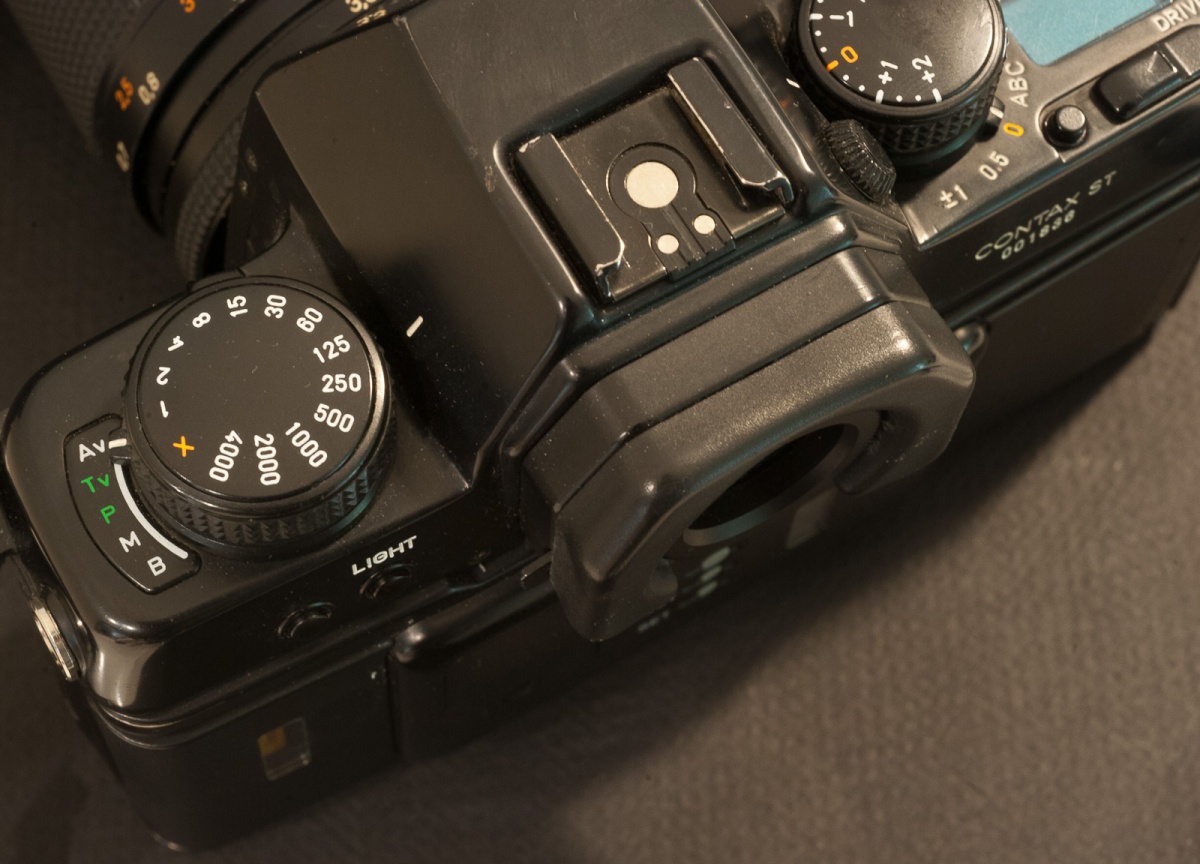
The four conventional exposure modes and the shutter speed dial on the left.


Of course, at the time the camera was launched, all major  manufacturers (Canon, Nikon, Pentax) had followed Minolta’s example and converted their whole SLR range to autofocus, so the manual focus ST is a bit of the odd man out.(**)

Very first impressions

It’s a beautiful,  very traditional SLR which exudes quality, with no autofocus, no modal interface, no menus, no control wheel, no matrix metering, no lithium battery, and a limited use of plastics.

2020-04-Contax-6665
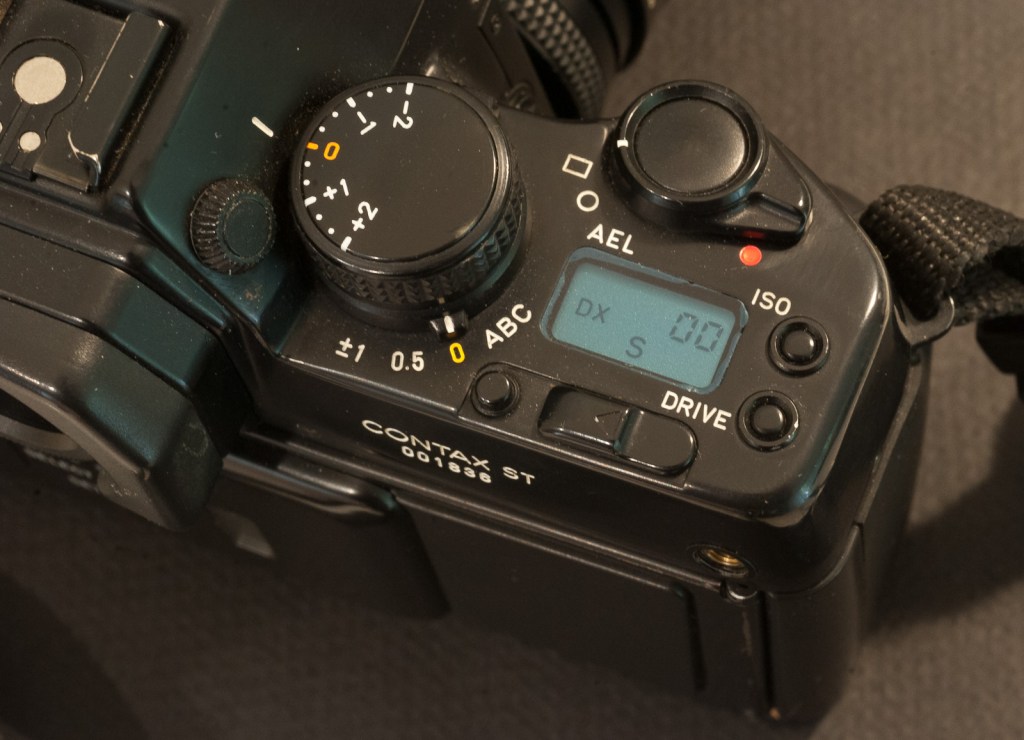
the exposure compensation dial, the metering selector and the electro-magnetic shutter release on the right. AEL (auto-exposure lock) is only available with spot metering.

The ST feels dense (heavy, but not too much) and falls very well in the hands. The commands are conventional, with an aperture ring on the lens, and a large shutter speed knob and an exposure compensation dial  on the top plate. Almost all controls (except for the shutter speed and exposure compensation knobs) are  secured by locks (like they are on a Nikon F4). There is only a tiny LCD (view counter and ISO display) at the right on the top plate.

2020-04-Contax-6644
Sticking similarities – the importance given to the exposure compensation dial, selectors at the base of the big dials on the left and on right, and a common design language (on the right, Fujifilm X-T1)

For the anecdote, the body of today’s Fujifilm X-T3 looks very much like a small Contax ST, at the 2/3 scale, that is.  Even the location and logic of the commands is strikingly similar – with the emphasis given on exposure compensation over any other control –  you don’t need to search any longer where the designers of Fujifilm got their inspiration from.

The viewfinder is exceptional. Combining a high enlargement (0.8) and a long eye point (I don’t have the figure, but by comparison with other cameras, it’s really long), it offers a cinematic view of the scene. But at the same time, it’s old school – it’s graced with red LEDs, and the focusing screen does not seem to be one of those ultra fine and ultra luminous Acutemate or BriteMate laser etched screens – as a result the image is a bit darker than what you would see on a Nikon FE2, for instance (not by much, maybe 1/2 stop). The ST is also one of the few manual focus cameras with a continuously adjustable dioptric correction – all in all one of the best viewfinders of its time.

2020-04-contax-viewfinder
A beautiful viewfinder – on the right the shutter speed, at the bottom-right the aperture, and the exposure counter on the left (it show 00 because the film is fully exposed)

Lesser Contax SLRs have a rubberized skin. that degrades over time – it’s not the case for the STs – they still look pristine 28 years  after leaving the assembly shop.

The lens mounts and lens mount adapters

Contax and Yashica had abandoned the 42mm screw mount in 1975 with the introduction of  the Contax/Yashica (C/Y) mount on the Yashica FX-1 and Contax RTS.

The original Contax Carl Zeiss lenses belong to the AE series. The design of the lenses was modified in 1985 to support the Program mode and the Shutter priority modes introduced on the 159MM – therefore the modified lenses are part of the MM series (for Multi-Mode). The two versions of the lenses are inter-compatible – you just don’t get the Program mode or the Shutter priority mode if you mount an AE lens on a body like the ST.

Other lens options

Contax Carl Zeiss Lenses in C/Y mount are rather expensive, even now. There are three alternatives if you don’t want to pay hundreds or even thousands of dollars for a lens:

  • Yashica lenses: Some models have a  very good  reputation (the prime lenses in the ML series, generally) – they were manufactured in the same plants as the Carl Zeiss series, but were not built to Zeiss specs and did not benefit from Zeiss lens treatment. People who have tested them next to Contax lenses say the color rendering and the micro contrast are different (which makes sense – each lens manufacturer has its “signature”).  Other series of Yashica lenses (DSB, YUS) are not necessarily that good –  do you research.
  • Third party lenses: very few independents offered lenses in the C/Y mount. Tamron and Vivitar had C/Y adapters for their respective universal mount systems. But does it really make sense to mount a Tamron or a Vivitar lens on a Contax camera?

Last but not least, you can also mount older 42mm screw mount lenses (from Yashica, Contax or other defenders of the Universal mount such as Pentax) thanks to an adapter proposed by Yashica. You can still find those adapter rings on eBay.

The elephant in the room – made in Japan or in Germany? 

There is no doubt where the bodies were manufactured – my ST proudly bears its “Kyocera-Japan” signature. The Contax Carl Zeiss zoom (the 28-85 f/3.3-4.0) that came with the camera was also made in Japan (no mention of Kyocera, though).

2020-04-Contax-6672
No doubt – it’s a Kyocera (Yashica) camera and it was manufactured in Japan. (interestingly the lens shows absolutely no mention of Yashica or Kyocera)

In the early years of the Zeiss / Yashica collaboration, a lens could originate from the German workshops of Zeiss or from the Japanese factories of Yashica (even for a given model – some were produced simultaneously in Europe and in Asia). Over the years, the manufacturing activities were increasingly concentrated in Japan. I did not find any evidence that lenses made in Asia were better or worse than the lenses made in Europe – and I don’t think it matters:  they were all designed and manufactured to Zeiss’s specs with Zeiss’s T* multi-layer coating.

Buying Contax cameras and lenses today

In the nineties, Contax cameras were positioned and priced as premium products, a big notch under Leica, but in the same ballpark as Nikon’s or Canon’s Pro cameras.

Today,  their high-end bodies hold their value very well even if Leica R products remain more expensive.

The Contax magic percolates to Yashica ML lenses and to certain Yashica bodies (like the FX-3 Super 2000), which are also  sold at a premium, for products of a second tier brand, that is. The 21mm and 28mm wide-angle lenses are particularly sought for, selling for at least $350.00.

2020-04-Contax-6645
On the right the Canon T90 from 1986 – like the Contax, a very elaborate manual focus camera. The User Interface is totally different, though.

The least expensive Contax SLRs are the entry level models (139, 137, 167) at less than $100.00 for a nice copy. Really sought after models like the RTS III, the S2 (the semi-auto camera) or the Aria (a compact SLR, the last camera in the Contax manual focus line and the only one with matrix metering) typically sell in a $350.00 to $600.00 bracket. The rest of the products (ST, RX, RTS I or RTS II) sell for approximately $150.00.

2020-04-Contax-6646
They were competing on the shelves of the photo equipment stores in the early nineties – the Nikon N90x (right) represents state of the art (modal interface, matrix metering, autofocus, f/2.8 constant aperture zoom). The Contax ST, on the other hand, was spec’d like a pro-camera of the early to mid eighties.

But be cognizant that in order to enjoy the full Contax experience, you’ll need Contax Carl Zeiss lenses. It’s very difficult to find anything (even a very common Planar 50mm f/1.7) at less than $150.00, and really interesting lenses (the 21mm wide-angle for instance) can cost well over $1,000.

More about the Contax ST and the Vario-Sonnar 28-85mm f/3.3-4.0 in a few weeks, after a few rolls of film.  


The Contax brand has been dormant since 2005, and there is relatively little information about their products on the Web.

The best source is a site maintained by Cees de Groot: http://cdegroot.com/photo-contax/

Apart from that, you have Wikipedia (of course): http://camera-wiki.org/wiki/Contax/Yashica_lenses and a few sites compiling user reviews of SLR lenses.


(*) Porsche used to be a family business. And  everybody in that family seemed to be named “Ferdinand”. Because it was a family business, the eight grand-sons of Ferdinand Porsche, (the engineer who had founded the company and designed the original Beetle) ended up working at the Porsche car company under the direction of Ferdinand “Ferry” Porsche, who had taken over the business from his father Ferdinand after WW2. When the conflicts between the most talented of the cousins reached dangerous levels, Ferry asked them to leave. Ferdinand Piech, who had designed the engine of the 911, left to start a new career at Audi, and ended his professional life as the chairman of the Volkswagen Group. The other cousin, Ferdinand Alexander Porsche, who had designed the body of the original 911, started his own design studio. And one of the first clients of the studio was… Contax.

(**) – Contax launched its first autofocus film SLRs (the N1 and the NX) in 2000 with a new lens mount and a new series of lenses – roughly 15 years after anybody else. And followed up with the first full-frame dSLR in 2002, the Contax N Digital.  The products did not sell well and were rapidly withdrawn from the market, and Kyocera left the photography market for good in 2005. The Contax brand has been kept dormant ever since.

The lens mount of the Contax N, N1 and Nx of the early 2000s was totally different from the C/Y mount of this ST.  From an engineering point of view, the new lens mount was so close to Canon’s EOS that conversion jobs were possible. You can read a test of a converted lenses in Optical limits

More about the N series:

https://sunrise-camera.com/the autofocus-slr-camera-contax-n1

Luminous Landscape on the Contax N Digital


From the Contax ST brochure (available at: https://panchromatique.ch)

grande_arche
La Grande Arche (Paris). From the Contax ST brochure (no photo credit). The brochure has been posted on https://panchromatique.ch