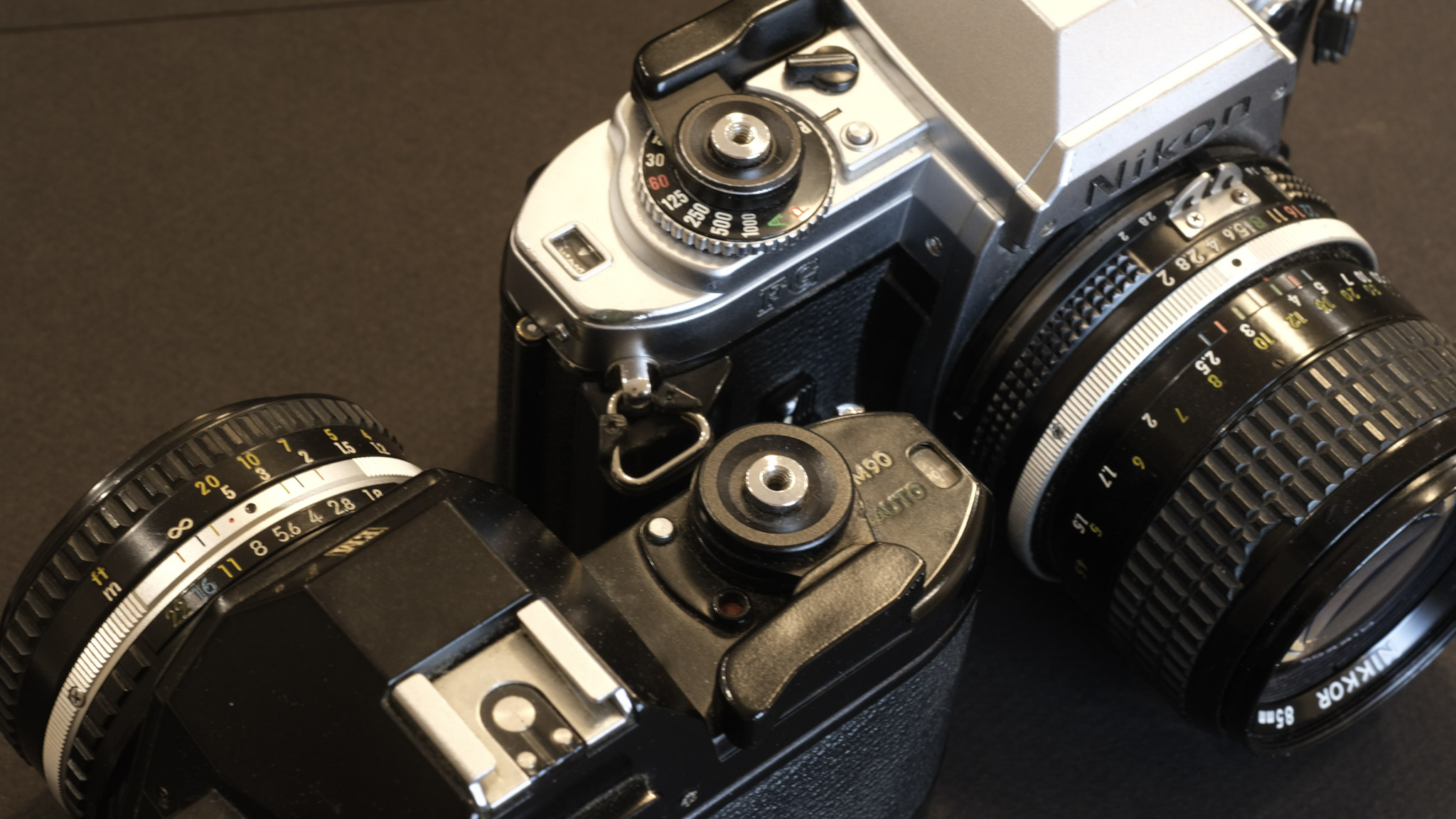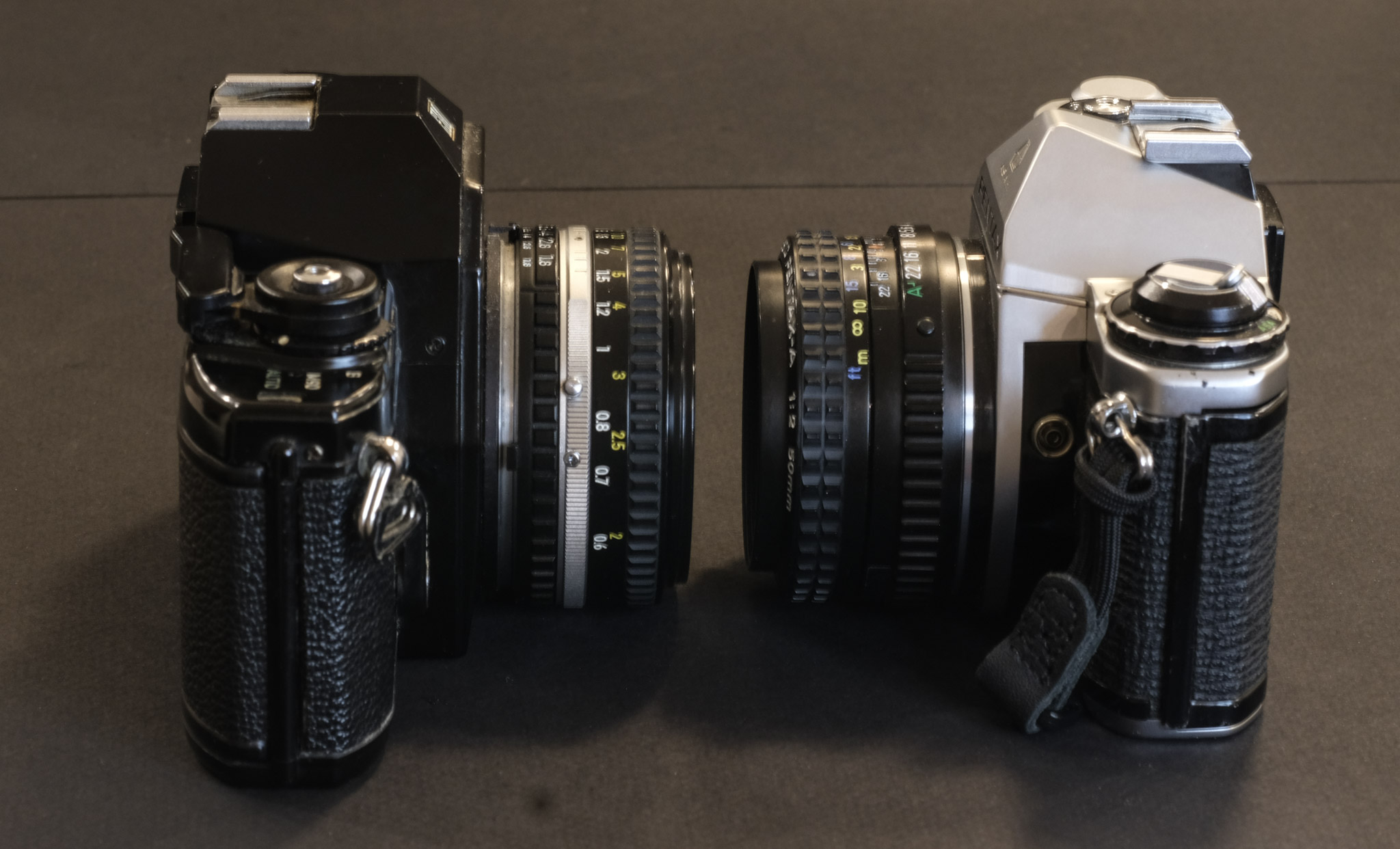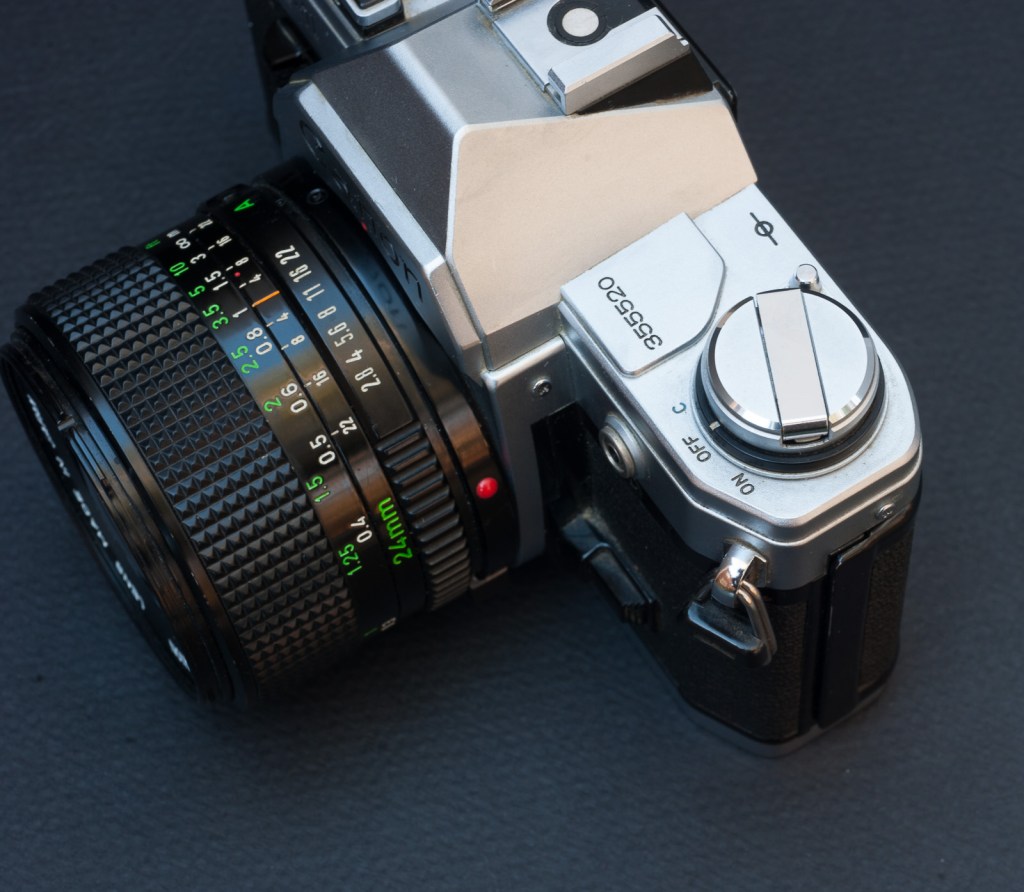
The Pentax P30 – the last mass market manual focus SLR

With 3 million units sold between 1985 and 1997, the Pentax P30 (known as the P3 in the “rest of the world”) is the last mass market manual focus SLR to come from a major manufacturer (*). Originally designed as a simple entry level tool for amateurs, it was rapidly upgraded to support more auto-exposure modes, and became the go-to camera for a generation of learners and enthusiasts, who wanted to grow their skills but were not ready to purchase an expensive and overly complex auto-focus camera.

In this blog entry, I’ll use indifferently the names P3 and P30 – even if in theory the American models were P3s, Pentax also sold P30s in the US.

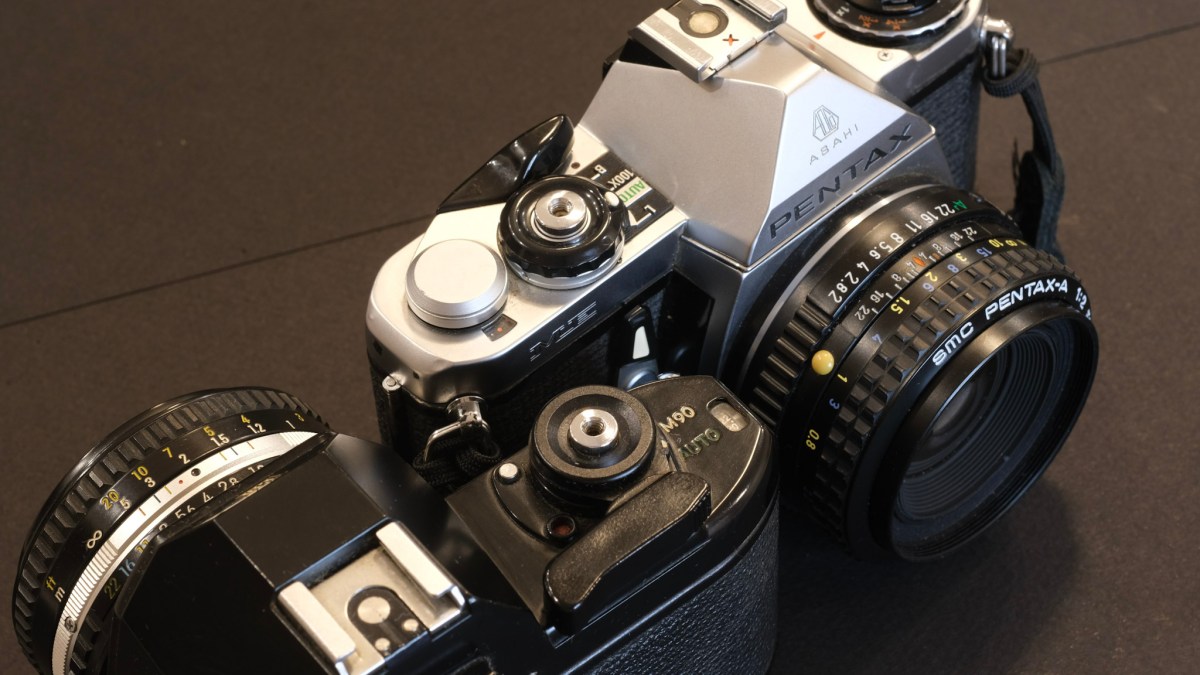
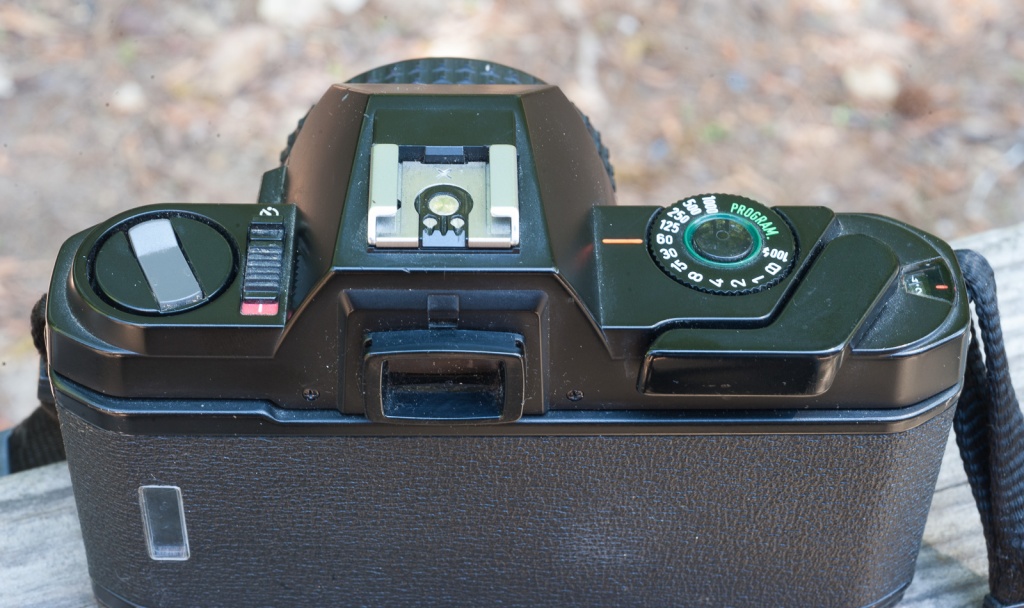
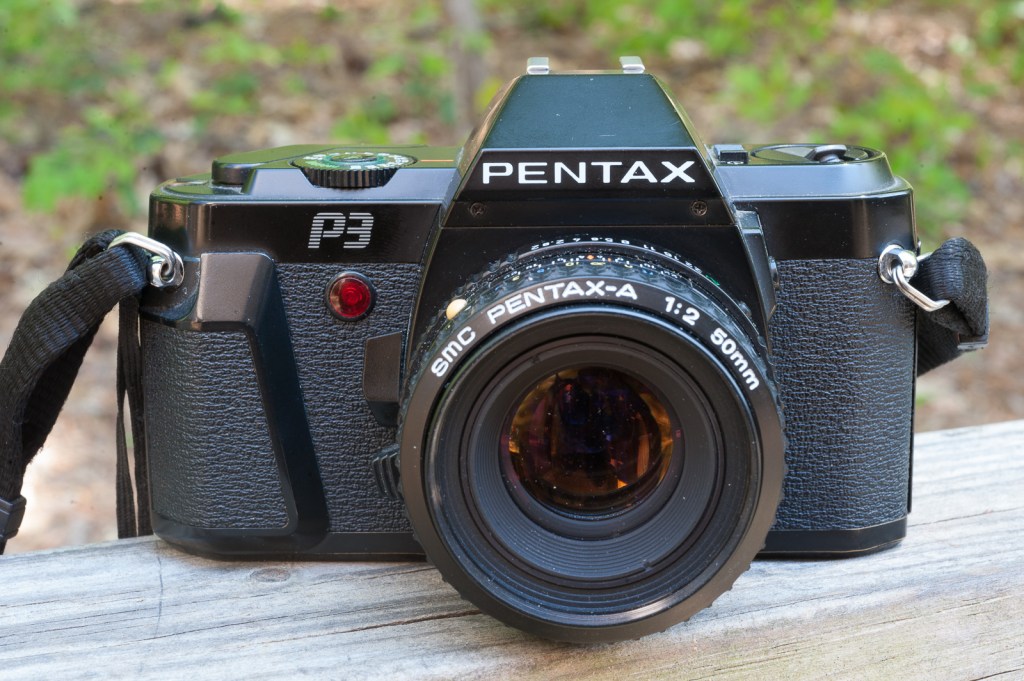
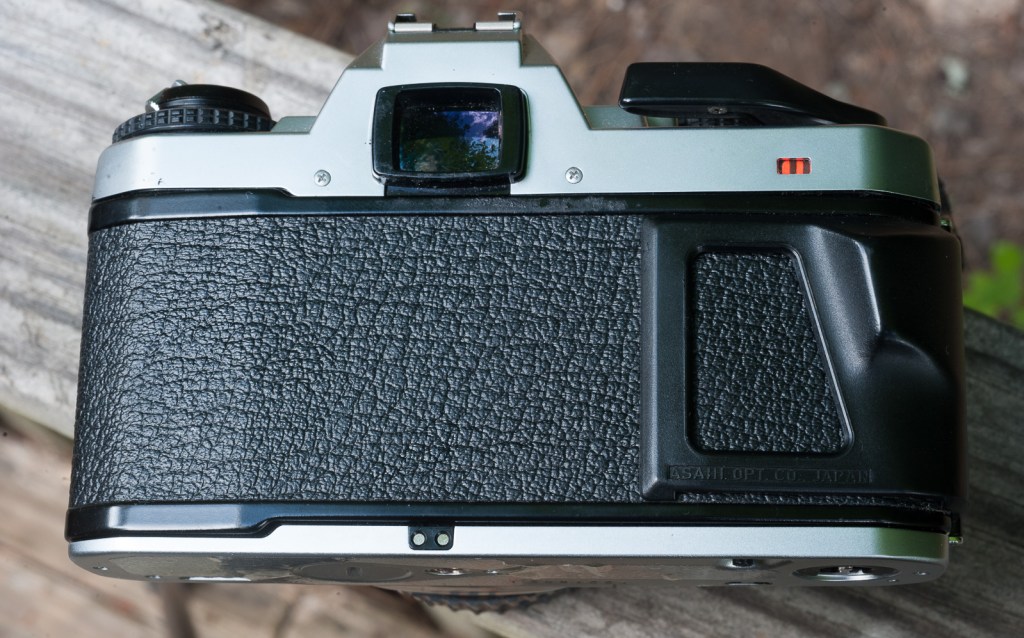
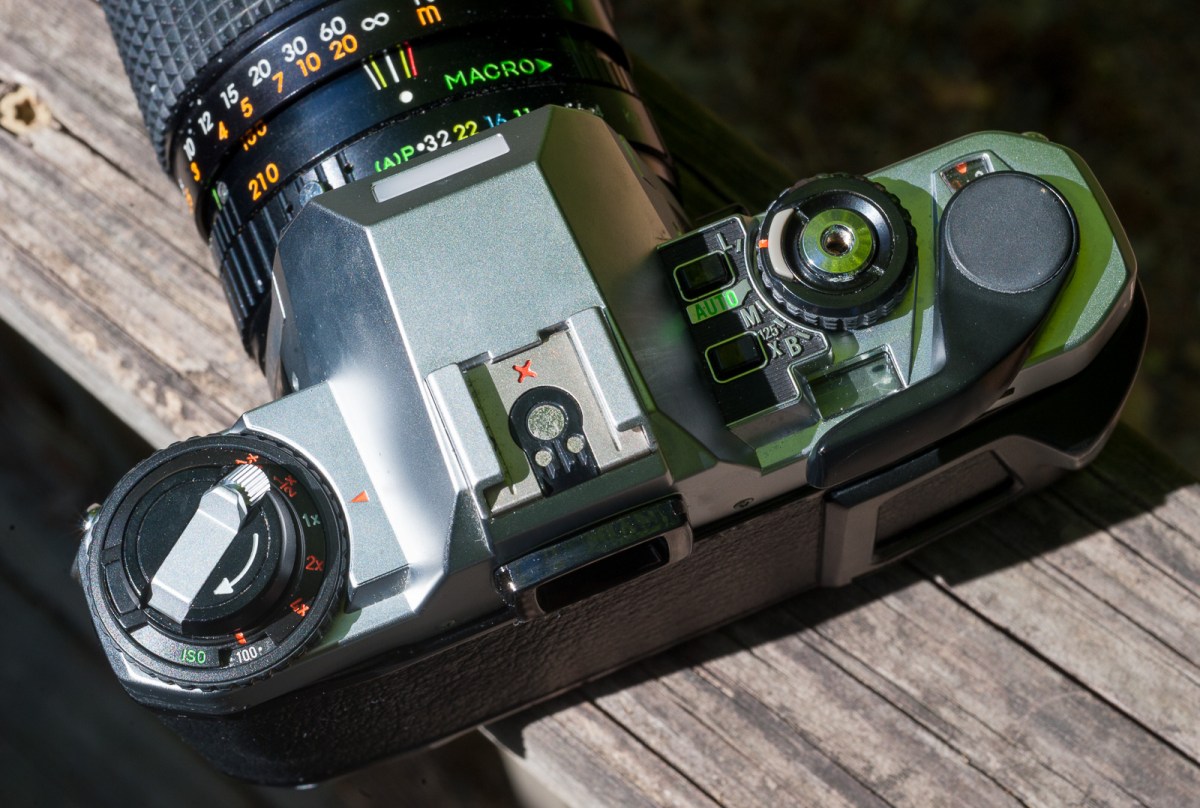
On the P3, film winding and rewind are manual, but the winding lever and the rewind crank are recessed and from a distance one could believe the camera is motorized. Note the very large on-off switch (left).

In parallel, Pentax was still selling another manual focus SLR, the K1000, whose technical roots went as far back as 1964 (the first Spotmatic camera), and the production of both cameras was stopped in 1997 to make room for a much more modern model, the ZX-M.


Contrarily to many previous entry level SLRs from Canon, Fujica or Nikon which were excessively simplified, even the first version of the P30 was a well specified model, at the same time easy to use for casual photography (it had a reliable Program Mode and a good viewfinder), and capable enough for the enthusiast or the motivated learner (it could also be operated in semi-auto mode, and had easy to use exposure lock and depth of field preview commands). It was also pleasantly designed, and better built than many cheap entry level SLRs from lesser brands.

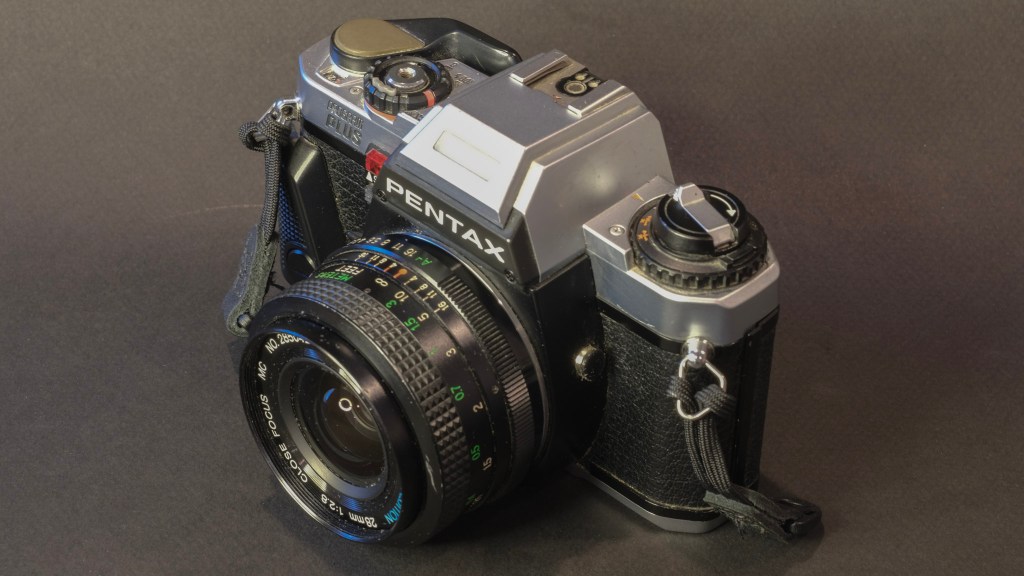
Pentax P3 – all controls are well positioned and large enough, even for photographers with big hands

The original P30 had two big weaknesses:

  • even if it did its best to hide the film rewind crank and the shutter lever, it was still a non-motorized camera, when some of its direct competitors (other entry level cameras operating primarily in Program mode like Canon’s T50) were relieving the photographer from the chore of loading and unloading the film.  Even though the film loading process was greatly simplified (you align the end of the film with a red marker and the camera takes care of the rest), you still have to rewind the exposed film (press the rewind button, pull the rewind crank, and turn and turn until all the film is safely back into the cartridge). I assume it was a trade-off (non motorized cameras are smaller, lighter, quieter and cheaper, and they don’t need expensive and short lived lithium batteries)  but cameras with motorized film loading and rewind are much easier to use for a true amateur.
  • It only worked in the Program mode with the (by then) relatively new Pentax KA lenses (manual focus with electrical contacts to control the aperture), and Pentax users upgrading from a K1000, KM, KX, MX, ME, MG, MV who had bought Pentax K lenses a few years earlier were condemned to the Manuel (semi-auto) exposure mode.

The first weakness was inherent to the base design of the camera and not much could be done – but that second weakness was easier to fix: in 1988 Pentax added an aperture priority auto-exposure mode to the P30n. The camera would remain virtually unchanged from thereon, except for the color of the body and the orientation of the split screen telemeter when it became the P30t in 1990.

A few months ago, I bought a P30 (a first generation model, still made in Japan) for the lens that came with it (on auction sites, it’s often cheaper to buy a lens with a camera attached to it, than the lens alone). I needed the lens for a Pentax Super-Program I had just bought. But I ended liking this P3 more than the Super-Program, and those cameras are so cheap that I rapidly purchased a P30n and a P30t – the aperture priority automatic exposure versions of the camera. In retrospect, that was a bad idea. But more about this later…

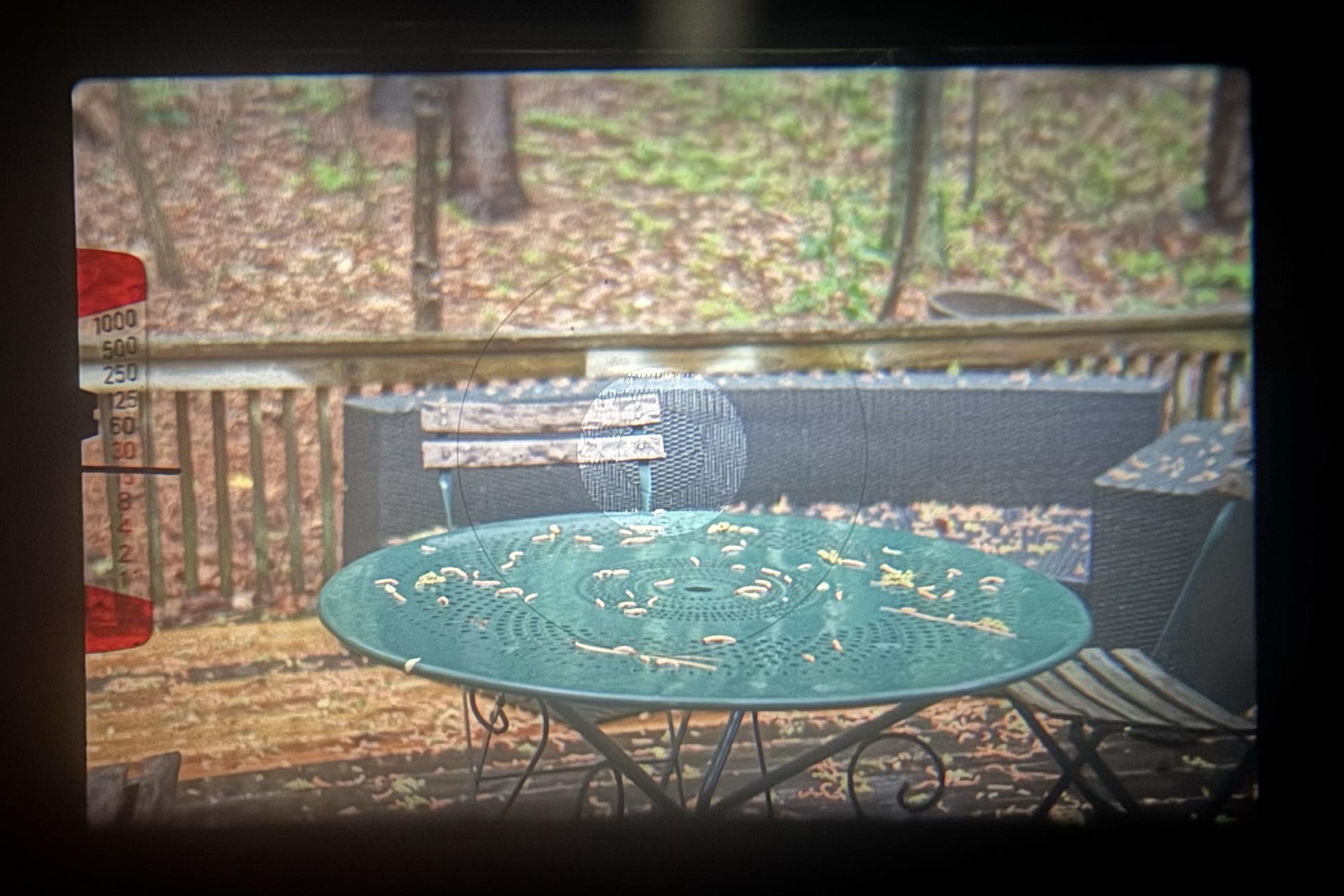
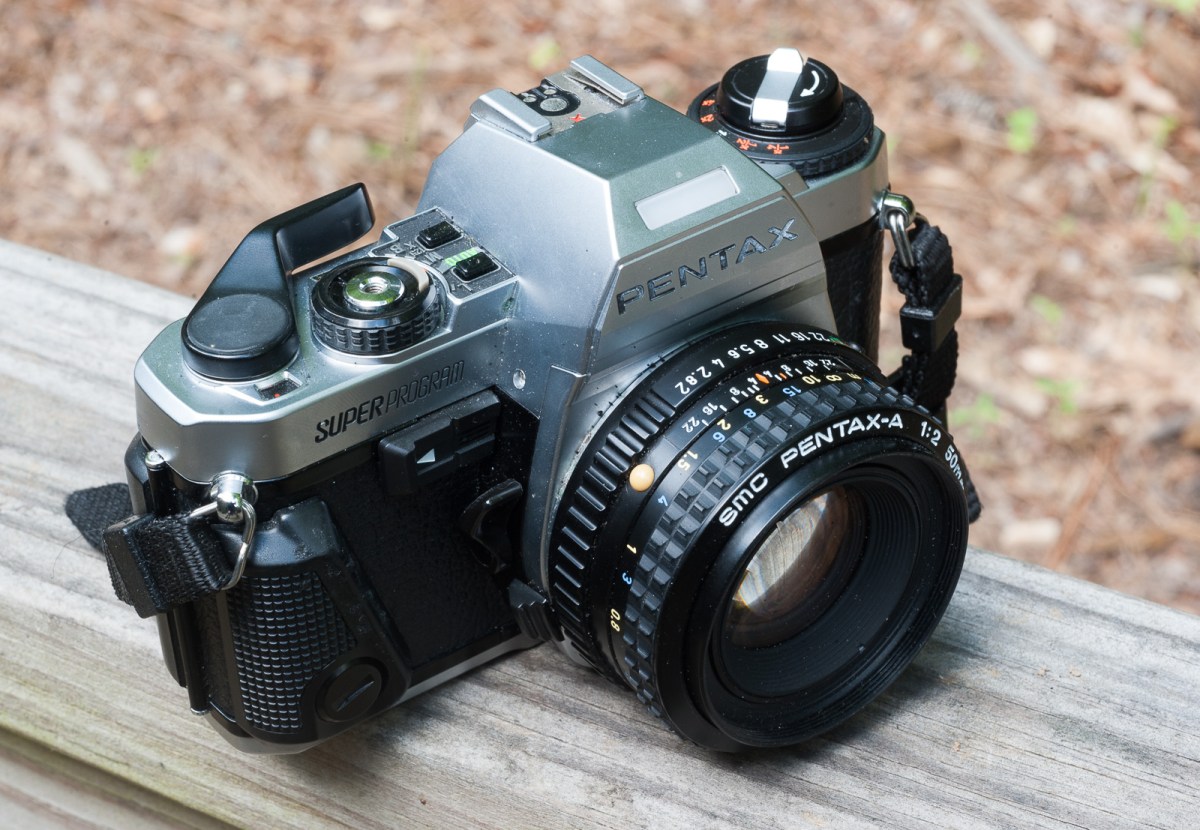
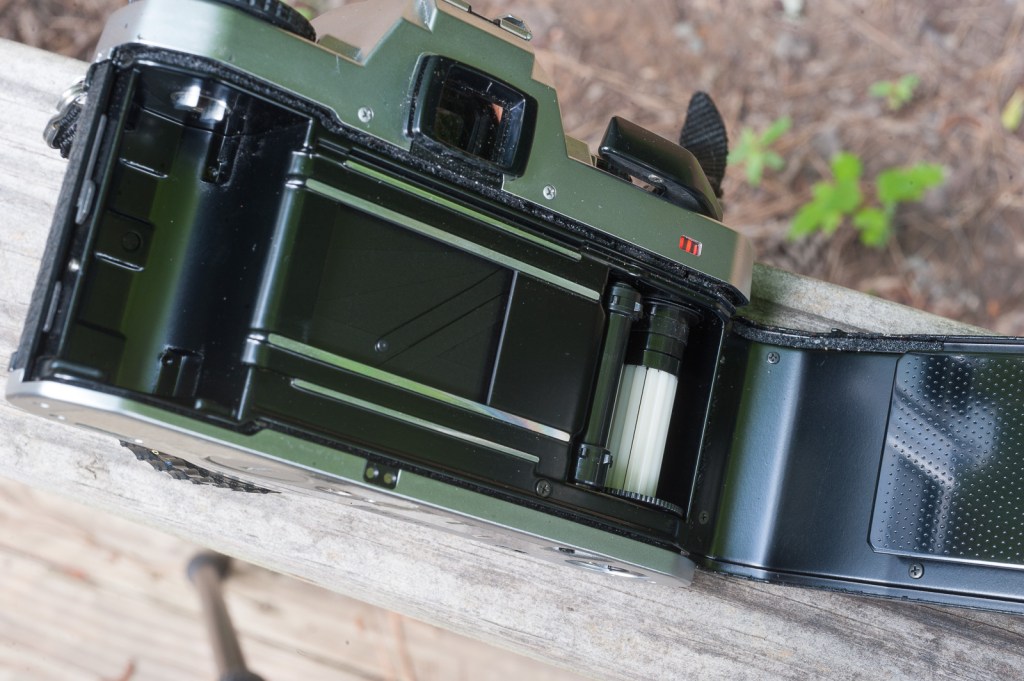
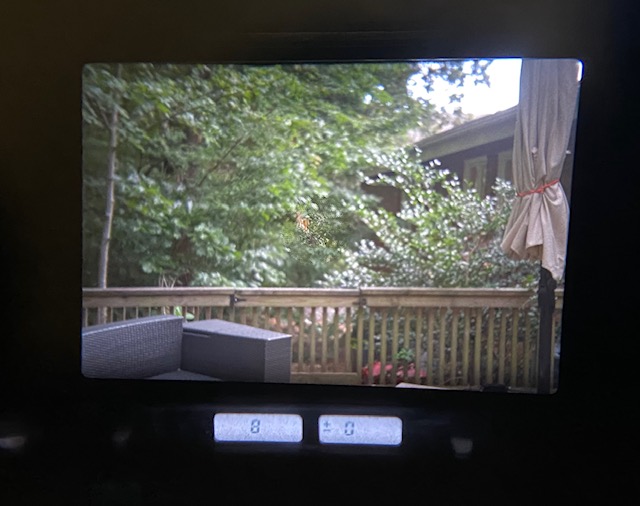
The P30 is a bit larger than the Super-Program, which leaves enough room for a conventional shutter speed dial, it is also easier to load with film, and it’s one of the first SLRs to have adopted DX coding. There is no exposure compensation dial, (just a very useful exposure lock button, which I tend to prefer), the shutter is a bit slower (1/1000 sec only), and the viewfinder is not as informative (only the shutter speed is indicated, there is no way to know the aperture selected by the camera in program mode) – but the column of bright LEDs at the left of the viewfinder is easier to read than the two small and dark LCD displays at the bottom of the Super-Program’s focusing screen .

Pentax P3 (first generation)

Where was it made?

The P30 proudly shows it’s made by Asahi Pentax in Japan. The P30n shows it’s manufactured by Asahi Pentax Co in an undisclosed country (some copies have an “assembled in China” sticker, so there’s no real doubt about its provenance), while the P30t is simply “assembled in China, under license and supervision of Asahi Pentax” – which means that manufacturing had been outsourced to a local Chinese partner.

P30, P30n, P30t – the differences

On the outside, not much. There’s more metal in the P30 – the film door, the bottom plate, which are replaced with good quality plastic molded components on the P30n and P30t. There may have been variations during the long production run of the P30n/t, bu they all share the same plastic bottom plate with its new and improved battery compartment door.

Technically, the major difference is that the P30n and P30t have an extra position on the shutter speed dial: a big green “A” for aperture – the cameras offer Aperture Priority Auto-exposure – with any Pentax K lens: the photographer selects the aperture, and the camera picks the right shutter speed, which is indicated by a LED on a scale at the left of the viewfinder. The other modes (Programmed auto-exposure and semi-auto) are still available.

Reliability?

Pentax P30 – the part in the background in the yellow circle acts as a sort of ratchet when the photographer pulls the winding lever to advance the film and cock the shutter. On broken cameras, it takes multiple actions on the winding lever to fully lock the ratchet in place.

It’s a light camera designed for amateurs – it’s not a tank guaranteed for 250,000 exposures. But, normally, a well preserved copy gently used by amateurs should be expected to work. It’s not exactly the case here.

I had no problem initially with the P30, but the P30n and the P30t I bought afterwards have the same issue: a single action on the winding lever is not enough to cock the shutter: the P30n generally requires two very slow actions (which means every other frame is wasted), and the P30t only cocks the shutter after multiple and extremely slow actions on the winding lever, when it does at all.

  • it makes the cameras unusable in the real life.
  • it’s not uncommon for the P30 – there are multiple messages in Pentax forums about this issue
  • I removed the bottom plate of both cameras, and could very distinctly see the culprit – a lever in the shutter mechanism that doesn’t engage completely (too much friction in the assembly or a spring too weak to pull the lever to the “cocked” position). Two suggestions on the forums: lubricate the assembly with silicon, or cock the shutter a few hundreds times to loosen the assembly – I’ve tried the hundred times method (as well as my tried and tested “hair dryer” method) with no success so far. And buying $20.00 worth of specialized lubricant to fix a $10.00 camera looks pretty much like throwing good money after bad.
  • The P30 that I considered immune to the quirks of the P30n/t has also started misbehaving – it did not let me rewind the film to the end, I had to wait for my return home to open the film door of the camera in a dark room, and push the last 10 inches of film in the cartridge manually. And my dark room being what it is, I probably lost 15 shots in the process, if not more.
  • Three cameras, three issues, all related to the shutter cocking and film advance and rewind mechanisms – that’s too much for bad luck – there is something intrinsically flawed with this line of cameras – they don’t age gracefully and can’t be relied upon.

How much?

There is little love for the P30 – postage often costs more than the camera itself – and I’m talking standard domestic US Postal Service rates here. The reliability issues mentioned above probably play their part here.

As a conclusion

Two non functioning cameras out of three, and a third that misbehaved while I was trying to rewind the film – that’s a major disappointment – I’ve never experienced such a thing with any camera maker before, even with the Fujica AX series which have a pretty bad reputation.

When it works, it’s a very pleasant camera. But the risk that is does not is simply too high. My verdict: avoid.


(*) – After the P30 was retired from the market in 1997, a few manual focus SLRs kept on being released and manufactured by other major camera makers (the Nikon FM3a, the Contax Aria and the Leica R9 come to mind) but they were more expensive niche products made in small quantities (a total of 112,000 copies for the FM3a, and 8,000 for the R9, for instance); they did not address the “mass market”.


More about Pentax (and other) cameras in CamerAgX


Out of the three P30s I recently purchased, only one was usable. It made the trip to Savannah in my photo equipment bag. But after it refused to fully rewind the roll of film I had just exposed, it also found itself out of commission, leaving me with no choice but to finish the week-end with the excellent (and so far, reliable) Fujifilm X-100t.

Savannah, GA – Wormsloe Plantation – Fujifilm X-100t – the gate was built in 1913, the live oak trees were planted in the late 1800s, but the plantation itself has been occupied by the British colonists and their remote descendants since 1733.
Wormsloe Plantation – the oldest remaining structure built by British colonists in Georgia (1736)
Wormsloe Plantation – the Salt Marsh – one of the functions of the plantation was to control the access to the city of Savannah through the Marsh – an English military outpost was located nearby.
Live Oak – Spanish Moss – Savannah as you’ve always imagined it…

The Pentax Super-Program: the most elaborate manual focus Pentax SLR

After the Super-Program, Pentax released a few other manual focus single lens reflex (SLRs), but targeting the beginners, learners  or  photographers who want to keep it cheap and simple: the P30 (P3 in the US) and very late in the game, the MZ-X (ZX-M in the US). But the Super-Program will remain known as the last manual focus Pentax camera aiming squarely at the “expert” or “enthusiast” photographer market.

Pentax Super-Program – the right of the top plate is pretty cramped. The small display next to the winding lever shows 1000 until the photographer has taken enough blank shots to reach the first frame on the film roll.

Launched in 1983, it was followed one year later by the Program-Plus, a marginally simplified version deprived of shutter priority mode, of TTL/OTF Flash and equipped with a cheaper shutter (1/1000 sec instead of 1/2000).

As was customary for Pentax at the time, the camera was sold under a different model name in Asia (Super-A), in Europe (Super-A “European Camera of the Year”), and in North America (Super-Program). The North American models had a silver body, while in the rest of the world the camera was sold in a nicer all black version.

Typical Pentax – the take up spool with its white “magic needles”.

The Super-Program came to life as Pentax’s competitors were accelerating the introduction of innovations in an attempt to re-animate a depressed SLR market. That year, Canon and Konica introduced SLRs with automatic film loading and motorized film advance (a real simplification for the occasional photographer), Nikon launched the FA with Matrix Metering (a major innovation), and almost everybody released an experimental auto-focus camera.

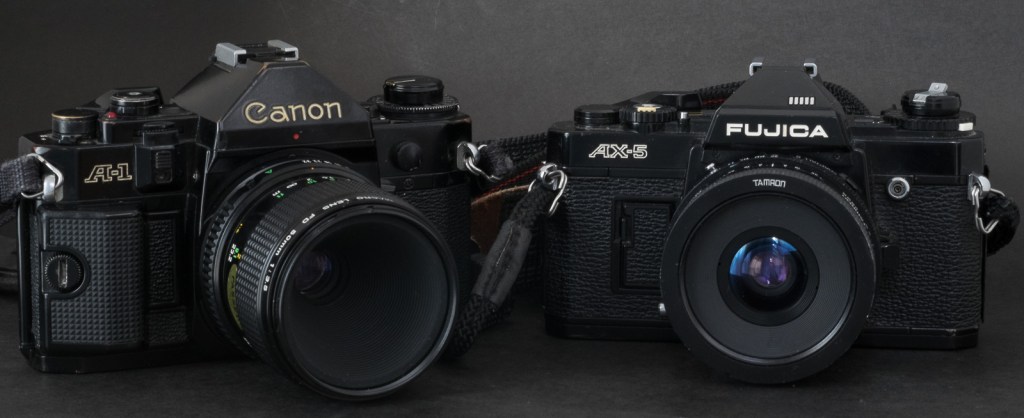
Canon A-1 vs Fujica AX-5 – two multi-automatic cameras, launched a few years before the Super-Program (1978, 1979 and 1983 respectively)

In this context, the Super-Program was a very conventional camera – its only “innovation” being the addition of a very small LCD display showing the selected shutter speed at the right of the top plate, almost under the winding lever. It was a well designed and pleasant to use camera (we’ll come to it), but not different on paper from many other multi-automatic cameras launched a few years before (Minolta XD-7, Canon A-1, Fujica AX-5, to name a few).

Typical Pentax – the orange-black signal is set in motion by the take up spool when the photographer cocks the shutter – it does not move if the film is not properly attached to the spool.

The Super-Program was apparently built around the chassis of the ME (same dimensions, same motor drive options, same absence of a shutter speed knob) and as a result was among the smallest and lightest 35mm SLRs ever made in the pre-polycarbonate era (it competed with the Olympus OM series and the Nikon EM/FG for that distinction).

For the camera to support the Program Auto-Exposure mode (and, for the Super-Program, the Shutter priority mode), it had to be fitted with one of the new Pentax-A lenses (the ones with electrical contacts). The camera was still compatible with the older K lenses, but only in aperture priority and semi-auto exposure modes.

Pentax Super-Program in Auto-exposure, shutter priority mode – the mode selector is on “M”, and the shutter speed selected by the photographer is 1/15 sec.
Pentax Super-Program in Auto Exposure – aperture priority mode – the photographer has selected an aperture of f/2.8 – the camera’s metering system has chosen a shutter speed of 1/15sec.
  • Weight, Size and ergonomics
    Derived from the successful Pentax ME series, the Super-A is a very compact and very light camera. There is probably more plastic used in its construction than in the first models of the ME series (the prism housing is clearly made out of polycarbonate), but the chassis is still made of metal and the camera feels pleasantly dense.

    As with cameras of the Pentax ME generation, there is no shutter speed dial on the Super-A, just two up and down buttons. On the ME Super, the only way to know what shutter speed had been selected (either by the auto exposure system or by the photographer in manual mode) was to look through the viewfinder.

    On the Super-A, the selected shutter speed is also shown on a very small LCD display next to the film wind lever, which is convenient (the Program-Plus is deprived of this small LCD), and makes the lack of a proper shutter speed knob more acceptable. Film loading is still a manual process, but Pentax has tried to make it as easy and reliable as possible, with multiple safeguards – for instance, the camera will not operate and will simply display 1000 on the shutter speed display until the film has been advanced to the first frame.

    The camera falls in the hands nicely, with a small removable grip and a thumb rest on the right side of the body, and an easy to access depth of field preview lever.  That being said, people with large hands would be better off with a larger camera: you really need small fingers and long nails to unlock and move the main mode selector from Lock to Auto or Manual, and the two push buttons that control the shutter speed are also tiny.

  • Viewfinder
    Derived from the M series, the Super-Program inherited some of their qualities – the viewfinder is large, wide, with a reasonably long eye-point (you can still see the whole frame if you wear glasses). The focusing screen is fine and luminous, with a split image telemeter surrounded by a ring of micro-prisms.

    The shutter speed and aperture information is displayed at the bottom of the viewfinder, on a grey LCD. The LCD is backlit – a window at the top of the prism collects the ambient light, and a push button on the left side of the lens mount flange turns on a rather faint light – so that the displays can be seen in when there is not enough ambient light.
    Honestly, this setup is far less legible than the green displays we’re used to if we shoot with dSLRs, or than the red LEDs used by the Canon A-1. But the camera only needs two small SR44 batteries (as opposed to the larger 6 volt battery of the A-1 or the large lithium batteries of modern cameras).
  • Metering system
    The Super-Program is very conventional: a center weighted average metering system, that’s all. No spot metering, no matrix metering (not invented yet…), and no DX coding (not invented yet).
    The camera obviously was designed for knowledgeable amateurs and enthusiasts, but surprisingly there is no exposure memory lock push button.
  • Battery:
    The Super-Program does not work – at all – without batteries. But it seems to manage them very carefully, and lets the photographer know in advance when the batteries will need to be changed. It simply needs a pair of the very easy to find Silver Oxide 1.5v batteries (SR44) that you can buy in any pharmacy or drugstore in the US.
  • Compatibility:
    Designed for the new KA mount (with electrical contacts to control the aperture), the Super-Program also works with any Pentax K compatible lens (SMC-Pentax, Pentax-M) as well as with the auto-focus FA lenses that followed. Considering the very long production run of the K mount family (available under one form or another since 1976), the wide adoption of the Pentax K bayonet mount amongst second tier camera makers, and the relative broad diffusion of Pentax branded lenses, finding a lens that fits the Super-Program is not an issue.

    Most of the accessories (winder, in particular) are shared with the previous ME generation.Pentax only released two manual focus cameras with TTL/OTF flash metering (Through The Lens, On The Film), the high end, modular LX and the Super A. Of course, specific flash units are needed to take advantage of the TTL mode, but at least the LX and the Super-A are using the same line of TTL flash guns. Other Pentax (or third party) flash units can be used, but won’t support TTL (*)
  • Reliability
    Electronic cameras from the mid-seventies-mid eighties have a bad reputation when it comes to reliability or battery management, in general. In certain cases, it’s totally justified (Fujica AX-3, AX-5, OM-2sp, Canon T90). I’ve not heard or read about any recurring horror story about the Super-A.
    That being said, if you shun electronics and want to use a relatively recent mechanical camera, there are not many alternatives in the Pentax family: the K1000 is about the only option – it was manufactured until 1997, and it’s possible to find fairly recent copies.
  • Scarcity and price – the Super-Program, and its little brother the Program-Plus were widely distributed (a total of 2 million cameras sold), and enough of them were treated with respect that good copies are easy to find on eBay, ShopGoodwill.com, and with resellers of second hand equipment. So, they’re not scarce, but not cheap either. The Super-Program is one of those cameras whose value is going up at the moment: it meets the criteria of a new-classic: it’s a manual focus, full featured and at the same time easy to use camera that will satisfy beginners and enthusiasts. You can find nice copies between $50.00 and $100.00 – and if you like your cameras all black, you’ll have to buy a Super-A from European or Japanese sellers, at roughly the same prices.
Pentax Super Program in… Program Mode (P). 1/30 sec; f/2
Pentax Super-Program – semi-auto exposure (the camera will operate at 1/8sec and the exposure is as determined by the metering system (at zero)

As a conclusion

It’s a nice little camera – for people who, in 1983, wanted “everything” – a relatively fast shutter (1/2000 sec), three automatic and a manual exposure mode, a good viewfinder with depth of field preview, exposure compensation, TTL Flash, and the ability to mount a winder.

It can draw from a very large range of Pentax K compatible lenses, and is still very affordable.

Doing “everything” in a non-motorized camera of such a small form factor leads to pretty cramped top plate, and difficult to operate controls for people with large hands or short nails.

Those who need “everything” and don’t mind shooting with a bigger/heavier camera can pick the Canon A-1, or the T90. The Nikon FA is also an option – although it shares some of its limitations with the Super-Program (no exposure memory lock, small and dark LCDs in the viewfinder **)

In the Pentax family of cameras, the P3 of 1985 is an alternative to consider [please read the update below] – a bit larger, it’s easier to use (with a large shutter speed knob and a large on-off switch, and easier to read information in the viewfinder). Sold as an entry level camera, it only has a 1/1000s shutter, can not be motorized, does not support TTL flash, and only offers a semi-auto mode in addition to the default Program mode. Its successors, the P3n and the P3t,  add an Aperture priority mode. All have a good viewfinder and the very useful (for me) exposure lock function. They’re cheaper and even easier to find than the Super-Program, have everything a film photographer may need today, and are good cameras to discover film photography.

a June 2025 update: I can’t recommend the P3 (also known as the P30) as an alternative to the Super Program. I bought three P3s at different times in the past five years, and all failed me. And a quick Google Search will return pages and pages about failures of the film winding mechanism. To be avoided.

Google Search also returns a suspiciously high number of hits about issues with the Pentax ME Super. On the other hand, the Super-Program and its marginally simplified sibling, the Program-Plus, seem to be immune from major reliability issues. I tend to prefer the Program-Plus – but the differences between the two cameras are marginal, and all things considered, the Super Program is still a very good film camera.


More about Pentax film cameras in CamerAgX


(*) flash – I’m not sure that flash control is an issue now – considering 1/ the high fail rate when shooting with flash with old cameras and old flash units, and 2/ how quick it is to check the quality of the lighting if you shoot with a flash mounted on a digital camera, you would have to be more of a purist than I am to shoot with a flash on a film camera.

(**) I’ve never used Minolta’s manual focus SLRs and can’t really comment on them – but there are good cameras in Minolta’s line-up obviously.


Pentax Program-Plus (top) and Super-Program – Minor differences.

Pictures taken recently with a Super-Program on my Flickr account.


Sorry, no picture taken with the Super-Program this time (I don’t travel much because of Covid – and the opportunities for interesting shots are pretty limited in my backyard…)

The three pictures below were taken with another member of the Pentax family, the *ist DS, twelve years ago, in Georgetown.

Georgetown – the original workshop where the company that would become IBM started was in a street like this one.
Right here…
Georgetown (DC) – the plaque at the place where IBM started…

Another approach to the “learners camera” category: Pentax MZ-M / ZX-M

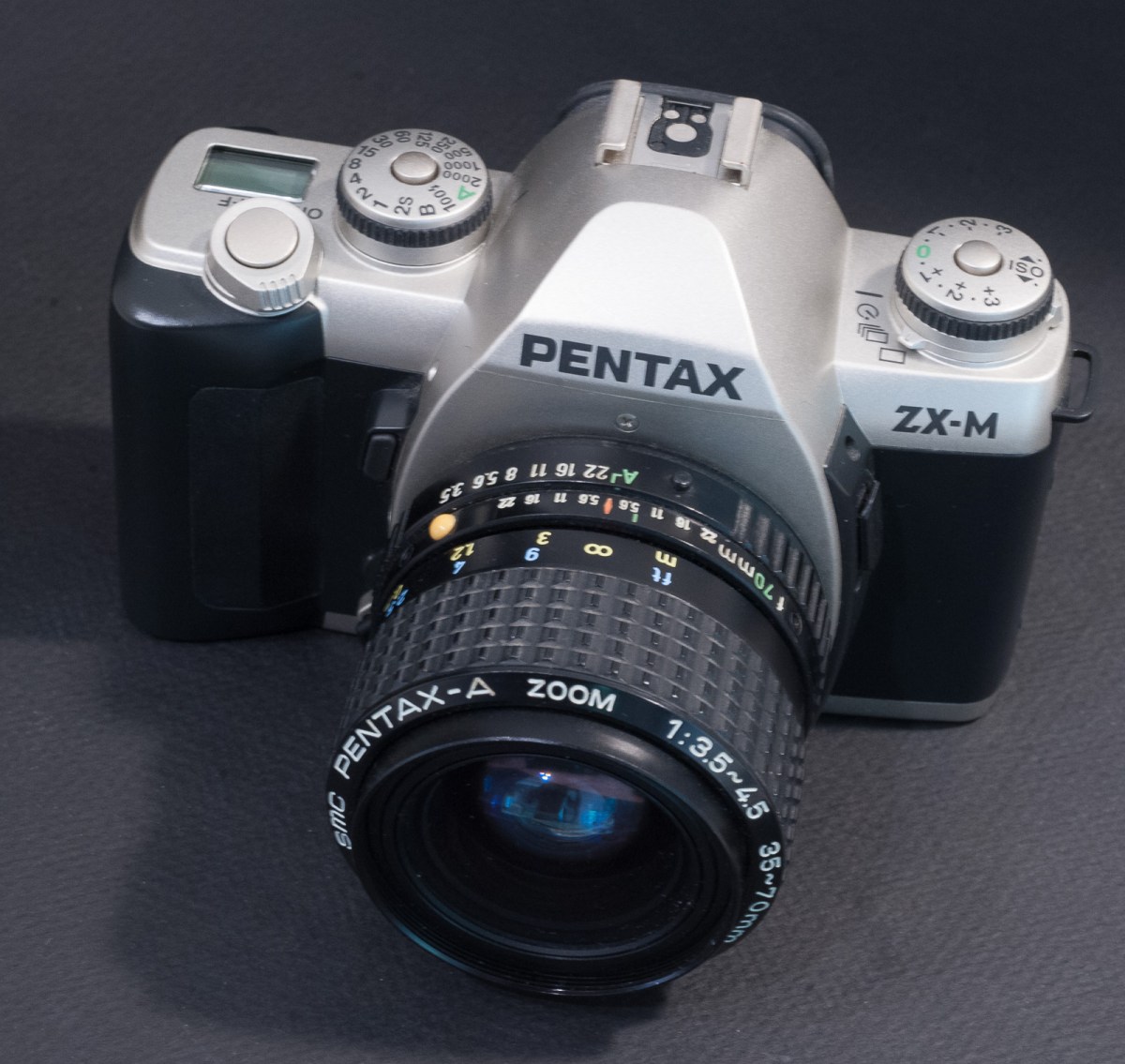
The Pentax ZX-M

Nikon and Canon had already tried the formula with the Nikon F-601/N6006 and the Canon EF-M: take an autofocus camera and derive a flash-less and autofocus-less version of it. The goal was at the same time to please conservative clients adverse to auto-focus and to offer a cheaper entry to their line of modern cameras by removing the hardware associated to the autofocus system and the built-in flash.

Pentax had different motives. Their two entry-level manual focus SLRs had been on the market for a very long time (20 years for the K1000 and 12 years for the P3/P30) and were badly in need of a replacement. Technically, they had nothing in common with the Pentax autofocus cameras of the time, and even though they were now made in China, those very conventional all-metal, all glass cameras were probably more expensive to manufacture than modern entry level auto-focus cameras made out of plastic and relying heavily on electronics.

The ZX-M was the response to Pentax’s problem. Derived from the middle of the range auto-focus ZX-5 (*), the camera was not a stripper – in fact, it supported the usual PASM exposure modes and it offered all the functions needed by a photographer (exposure compensation dial, depth of field preview and exposure lock). Of course, it was motorized, but it was still incredibly compact, and at 305g, it will be remembered as the lightest 35mm film SLR ever, autofocus or not.

Pentax ZX-M-6698
Pentax ZX-M – Aperture Ring on the “A” position, Shutter speed knob on 1/125 – logically the camera will operate in “Shutter Priority” mode (TV on LCD display).

Its low weight was the result of the extended use of plastics (only the shutter blades are in metal), and of the adoption of a penta-mirror instead of the more conventional (but heavier) all glass pentaprism. Penta-mirrors are shunned by enthusiasts, because they make for less luminous viewfinders. In the case of the Pentax, the viewfinder is not only darker, but also narrower than its predecessor in the P3 – but it’s still usable.

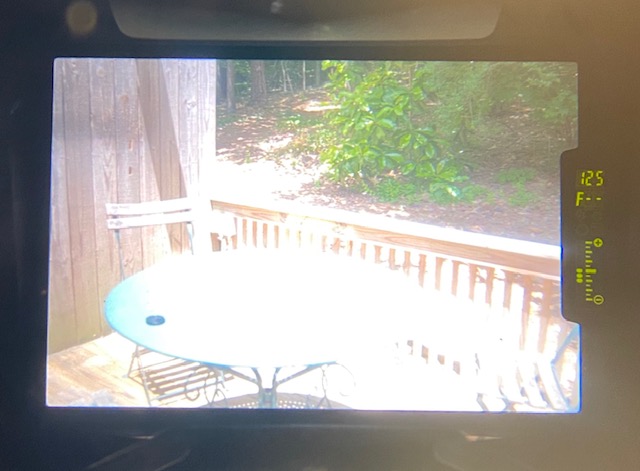
As a true manual focus camera, the ZX-M also benefited from a relatively coarse grain focusing screen, with a ring of micro-prisms around a small split screen telemeter – which is more than the K1000 ever offered. A small greenish LCD display at the top right of the viewfinder showed the exposure parameters chosen by the automatism, and a bar graph to help determine the right exposure in semi-auto mode.

Pentax ZX-M-6697
Pentax ZX-M – Shutter Speed knob on the “A” position. Aperture ring on F/11 – the camera will operate in Aperture Priority mode (Av on the LCD display).

Ideally, it should be paired with Pentax’s KA manual focus lenses (the first evolution of the K lens mount, with electrical contacts to control the aperture), but it nonetheless offered the Aperture preferred automatic and semi-automatic exposure modes with older K lenses. It also works with more recent Pentax F and FA lenses, as long as they’re designed to cover the “full-frame”, and not the cropped sensor of most dSLRs.

In the field…

Paired with a lens like the Pentax-A 50mm f/2 or the Pentax-A 35-70 f/3.5-4.5, it forms an extremely light and compact combo, that the photographer can carry all day without any risk of back or neck pain.

The camera is small but all the commands are logically placed. The logic of the command is reminiscent of cameras of the early eighties – there is no PASM selector (for the auto-exposure mode) and the interface remains analog – the shutter speed knob and the  aperture ring are fully functional, each with a green “A” position to set the camera in Aperture Priority, Shutter Priority, Program or Semi-Auto modes.

Metering did not convince me: it’s an area where the ZX-M is not aligned with the ZX-5, and where in my opinion de-contenting went too far: with KA, F and FA lenses the ZX-M relies on a very simplified matrix system with 2 zones only (there are 6 on the ZX-5), and with the original K lenses, it reverts to central weighted average metering. There is no way for the photographer to select the average metering mode, other than using a lens with the Pentax K original mount.

pentax_ZX-M-22
The exposure is far from perfect – the picture was to a large extent saved by the exposure latitude of the film (and the sliders in Lightroom). Shot at the Lake Ste Claire sweat lodge – Atlanta.

In my experience with other cameras (Nikon and Minolta in particular), matrix metering is extremely reliable, in part because it’s based on at least five metering zones. In the case of the ZX-M, I’m not sure that 2 zones are enough, and will provide anything different from a more conventional average center metering (some of the pictures I took with it were saved in post-processing by the exposure latitude of the Fujifilm 400 stock I was using, and a Nikon or a Minolta SLR of the same vintage would probably have done much better).

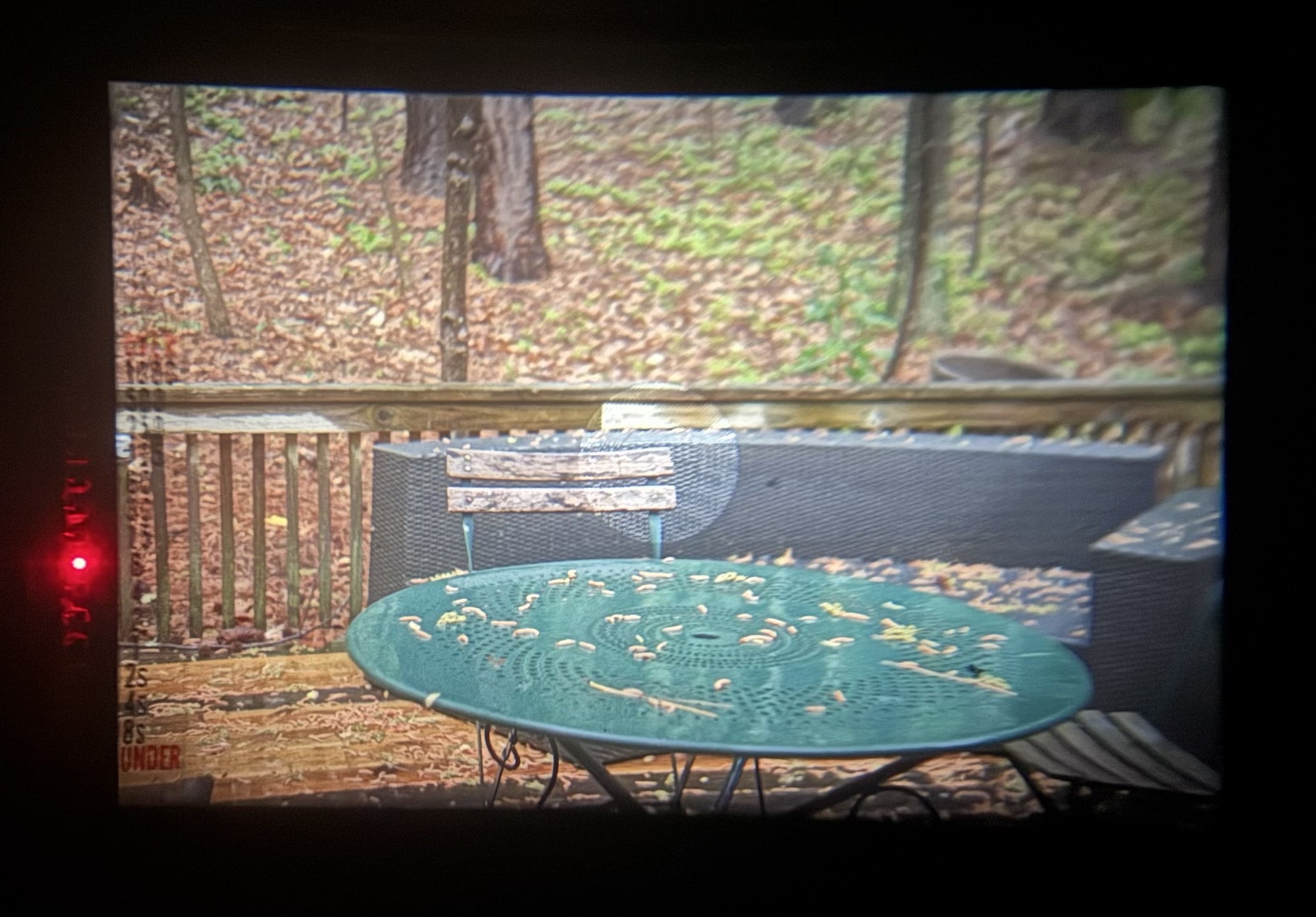
Now let’s talk about what really hurts: the viewfinder. It’s narrow and not as luminous as the competition’s. If we compare it to the viewfinder of cameras of a similar size, like an Olympus OM-2, a Canon AT-1, or even its predecessor the Pentax P3/P30, it’s clearly not in the same category (**). At the top of that, if your eye is not positioned correctly, you will be distracted by unpleasant reflections or aberrations. Very disappointing.

IMG_6013
Pentax ZX-M – any auto exposure mode

image0
Pentax ZX-M – Semi-auto exposure mode

How much?

Plastic construction, lithium battery, so-so reputation – logic says it’s going to be cheap. And it is… It’s one of those cameras you can still get for less than $20.00.

Interestingly, the cameras for sale seem invariably to be in a very good condition – my bet is that having been bought at the very end of the film era, they were only used for a very short time before being replaced by digicams in the bags of photographers, and saw little use, or abuse.

pentax_ZX-M-7
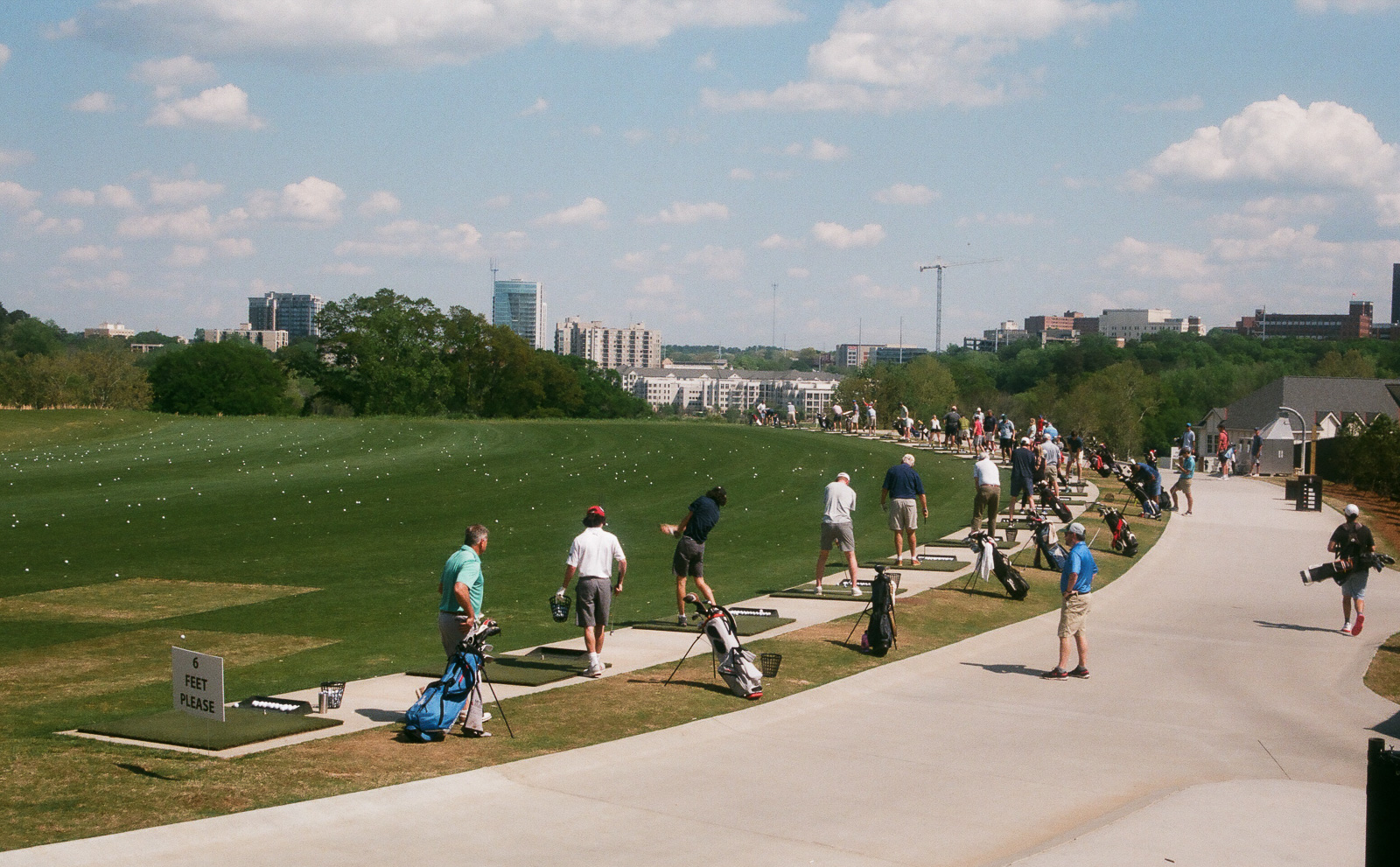
Social distancing the Georgian way…(Really ?)  Bobby Jones Golf – Mid April 2020 – Pentax ZX-M – Pentax SMC-A 35-70 F/3.5-4.5 – Fujicolor 400

As a conclusion

Its two predecessors – the K1000 and the P3, had been sales successes, with more than 3 million copies sold for each, over up to two decades. I could not find any figure for the ZX-M, but my guess is that it was not that successful.

On paper, the ZX-M has most of what an aspiring photographer needs. And contrarily to the previous generation of “learners cameras” (like its predecessor the K1000), it will let  new photographers play with multiple auto-exposure modes and with a well implemented exposure lock. In the field, it’s not a bad camera – it’s super compact and super light, easy to use (because film loading and rewinding are taken care of by the camera’s motor), and will take good pictures with the right lens – provided you pay a little attention to the exposure.

The problem starts if you compare it with the P3n or the P3t, or in fact with any good “enthusiast oriented” SLR of the late seventies/early eighties. Those cameras are not motorized, they’re most probably missing the shutter preferred and the program auto exposure modes of the ZX-M, they’re slightly heavier, and they may be a few dollars more expensive on the second hand market. But they  have a real pentaprism viewfinder, they’re still built primarily out of metal, they use very easy to find batteries, and the pictures they take will be at least as good. All in all, they’re more pleasant to use.  In the Pentax family, the P30n or the Super-Program (Super-A) would be my choice. Sorry, ZX-M.


(*) in those days Pentax, like its three big competitors, was selling the same camera under different model names – depending on the geography. The ZX-M (US model) was known as the MZ-M in the rest of the world. Similarly, the P3 was the US name of the P30, ZX-5 the american name of the MZ-5. The cameras were otherwise identical.

One can assume it was being done to protect the local importers by making grey imports more visible.

(**) If I rank the viewfinders of manual SLRs from worst to best, the Fuji STX-2 ranks at the bottom, by far, followed by cameras of the sixties or early seventies. The ZX-M is much better than those ancient SLRs, but not as pleasant as the viewfinder of some cameras sold in the late seventies-mid eighties. If you exclude from the comparison the High Eyepoint viewfinder of the very large and very heavy “pro” cameras from Nikon, Canon or Contax ( F3, T90 and ST respectively), the Olympus OM-1 and OM-2 sit at the top of the list. The Canon A series (AT-1) and the Pentax P3 fare particularly well considering their size and their price when new. The focusing screen of the Nikon FE2 (and similarly spec’d Nikon cameras like the FA or the FM2) is finer and more luminous than what Canon and Pentax were proposing, but it’s narrower and more difficult to use for bespectacled photographers.


More about the Pentax MZ-M/ZX-M

https://lewiscollard.com/cameras/pentax-zx-m-mz-m/

More about Pentax cameras (including current digital SLRs):

http://www.pentax-slr.com/71760564


Shooting under lock-down….

The stay at home and lock down orders in Georgia have not been very stringent. Public parks were closed, but people could still walk freely on the streets, or play golf on greens like Bobby Jones’, which is located right in the middle of mid-town.

Having film processed took longer than usual (3 weeks), primarily because the US Postal service is slower than normal. But the film rolls did not get lost and were processed with the usual care by my go-to lab,  the Old School Photo Lab.

pentax_ZX-M-5
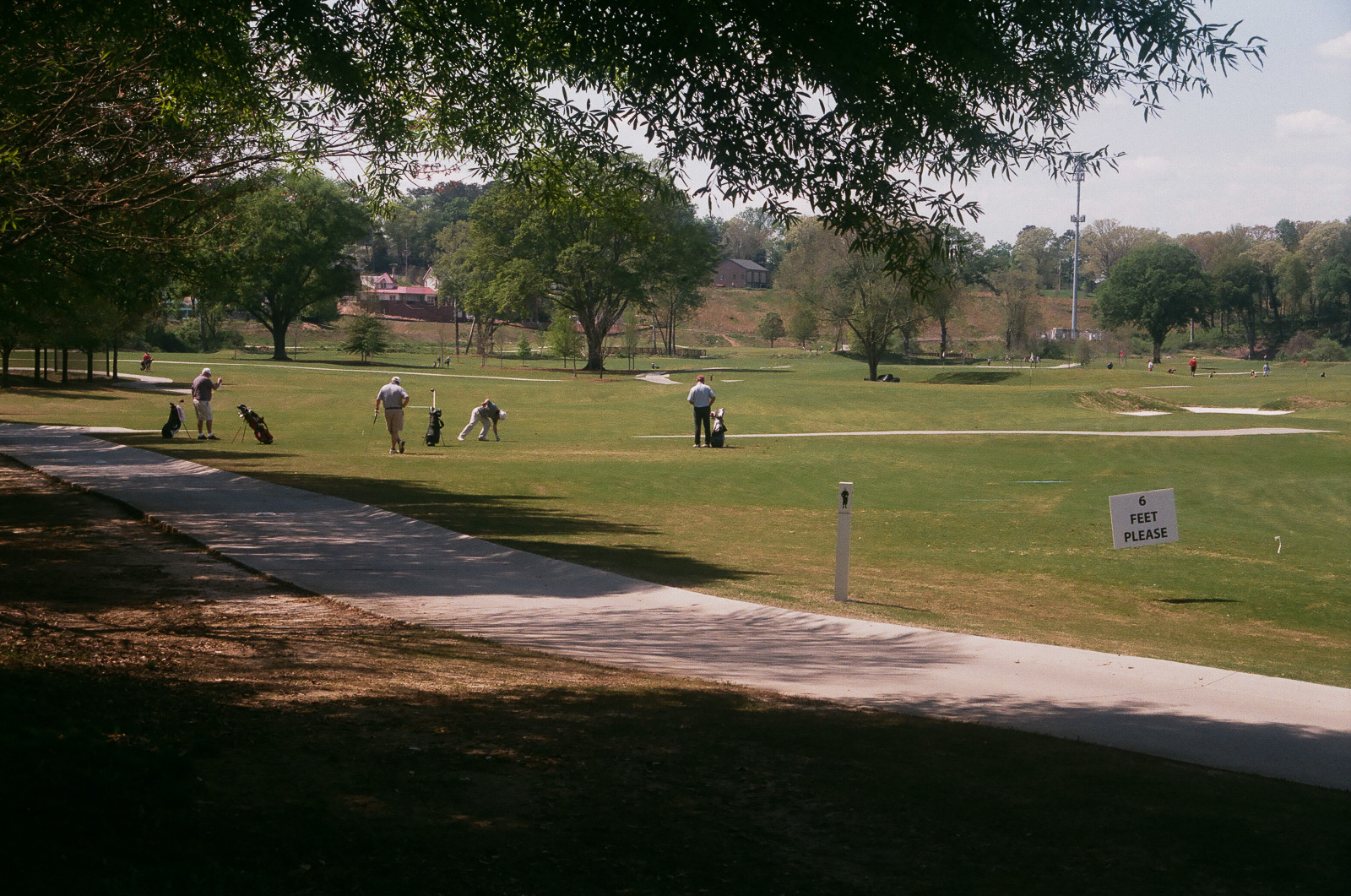
Social distancing (?) Bobby Jones Golf – April 2020 – Pentax ZX-M – Pentax SMC-A 35-70 F/3.5-4.5 – Fujicolor 400

pentax_ZX-M-4
Atlanta, Colonial Homes – April 2020 – Pentax ZX-M – Pentax SMC-A 35-70 F/3.5-4.5 – Fujicolor 400

pentax_ZX-M-23
Lake Claire Community Land Trust – The sweat lodge – I’ll have to give a good cleaning to this lens – it looks as if it was covered with a thin layer of vaseline. I’ll also have to put a lens hood on the 35-70 zoom.

pentax_ZX-M-20
I’m not a big fan of the color rendering of the Fujicolor 400. Nothing to do with the camera or the lens,  in this case. Lake Claire Community Land Trust – April 2020 – Pentax ZX-M – Pentax SMC-A 35-70 F/3.5-4.5

Pentax’s last manual focus SLRs

I’ve a sort of on and off relationship with Pentax – a MX was my first serious camera a long time ago, and a *ist DS was my first dSLR in 2005, but they were replaced by non-Pentax cameras after a few years of service. I’ve bought a few Spotmatic cameras  during the last decade,  and I’ve not had much luck with them except for a late Spotmatic F. Recently, I gave it a go again, and I’ve just added no less than four Pentax manual focus SLRs to my collection: a P3, two ZX-Ms (an accident – two very low bids on eBay and both went through), and a Super-Program. So far, so good. They work and they’re pleasant to use. An opportunity to  look at the last of the manual focus Pentax SLRs.

The K, the M and the A – a new line of lenses for each generation of camera

The 1975-1977 years were pivotal for Pentax. In 1975, they finally removed the m42 screw mount from life support, retired the 12 year old Spotmatic product line,  and started fighting back.

Their first generation of bayonet mount cameras (the KM, KX and K2) was simply a refresh of  their screw mount predecessors. The KM was a very close derivative of the Spotmatic F, and the K2 a limited upgrade of the ES2.  Only the KX (an enthusiast oriented semi-auto camera) had no direct screw mount predecessor. The three models only stayed under the spotlights for one year, and as a consequence, did not reach large production numbers (approximately 750,000 cameras for the KM-KX-K2 trilogy – the only really successful model of this generation is the K1000, but it came to the market a bit later).

pentax_launch_1975
The original K bodies (KM, KX, K2) – courtesy of Pacific Rim Cameras

The K lenses were for the most part bayonet mount adaptations of the most recent SMC Takumars. They were simply known as Pentax SMC lenses: the “Takumar” name had been dropped (*)

The real innovation came one year  later, with two genuinely new models, the MX and the ME,  launched with a new generation of downsized M lenses known as the Pentax SMC M lenses. Very light and compact, with an up to date metering system and LED indicators in the viewfinder, they could  both be fitted with a winder.

  • the semi-auto camera with a mechanical shutter, the MX, came when this type of camera was beginning to be a thing of the past for the amateur photographers, and it had to face the competition of the brand new Nikon FM (whose specs sheet looked pretty similar, and benefited from Nikon’s professional aura and build quality). Impressively Pentax still managed to sell more than one million of them.
  • the auto-exposure camera, the ME, was attacking the heart of the amateur market. Deprived of  a conventional shutter speed knob and of a depth of field visualization lever, it was not an enthusiast oriented camera. Pentax rapidly started deriving even simpler models (the MV and MG)  as well as a more elaborate variant (the ME-Super) to broaden its appeal on the market. It also provided the base over which the Super-Program and Program-Plus of 1983 were developed.

pentax_MX_ME_catalog
Pentax MX and ME – from the sales brochure (1976) – Courtesy of Pacific Rim Cameras

The ME and its derivatives were a sales success (approximately 6 million sold – to be compared with 10 millions of Canon AE-1 and AE-1 Program) between 1976 and 1987, but they were Pentax’s swan song.

The Super Program and Program Plus cameras that replaced them were technically competitive, but they were launched in a period when SLR sales were at their lowest, and they sold in much smaller numbers (approximately 1 million units total).

The Super Program and Program Plus (known in the rest of the world as the Super-A and the Program-A) offered programmed auto exposure with a new line of Pentax SMC A lenses, equipped with a new KA variant of the K  mount with electrical contacts.

Pentax_sup-6688
Pentax Super-Program (here with a Sears 70-210 F/4 lens. The lens is made in Korea and was sold with the Ricoh SLRs that Sears was reselling. Ricoh was using Pentax’s KA mount.

They were the last technically advanced manual focus SLRs from Pentax. Following Minolta’ successful introduction of the Maxxum series, Pentax made the transition to auto-focus cameras, and only kept on selling two manual focus cameras for learners and cost conscious amateurs, the K1000 (a stripped down version of the KM of 1975, with its roots in the Spotmatic of 1964), and the P30 (known as the P3 on the US market) a simple program-mode-only entry level SLR.

2020-04-Pentax-6673
Pentax P3 – a simple camera with long sales career (1985-1997)

Both cameras were successful (more than 3 million copies sold for each of the two models), and had a long commercial life: the K1000 and the P30 were both retired from the market in 1997, to make room for the ZX-M.

2020-04-Pentax-6660
The last one…sold until the very end of film camera manufacturing, around 2004

Pentax’s last manual focus SLR, the ZX-M (on the US market, MZ-X in the rest of the world) was a manual focus version of the middle of the range ZX-50 autofocus camera of the time, with a so-so pentamirror viewfinder, and without a built-in flash. It was sold until 2004 and is one of the very last manual focus SLRs ever manufactured (**)


(*) The Takumar name did not stay unused for long – at least on the US market – it was given to a line of entry level non-SMC lenses – generally kit lenses, sold as Takumar-A lenses. Obviously they don’t benefit from the multi-layer lens coating of their SMC siblings.

(**) The Nikon FM3A was manufactured until 2006, and is definitely the last manual focus SLR from a major vendor. The Nikon F6, the Leica M-P and a few Lomo models are still in production, but the F6 is an autofocus SLR, the Leica M is a rangefinder camera, and Lomo camera are…Lomo cameras.


All sales statistics from: Knippsen.blogspot.com

Old Pentax catalogs: Pacific Rim Camera – the flyer from the importer presenting the new Pentax K bodies

Pacific Rim Cameras – the MX and ME catalog (1976): https://www.pacificrimcamera.com/rl/00040/00040.pdf

More about the Pentax K series: https://www.678vintagecameras.ca/blog/those-paragons-of-pentax-the-k-series-slrs


sahara_1991_oct
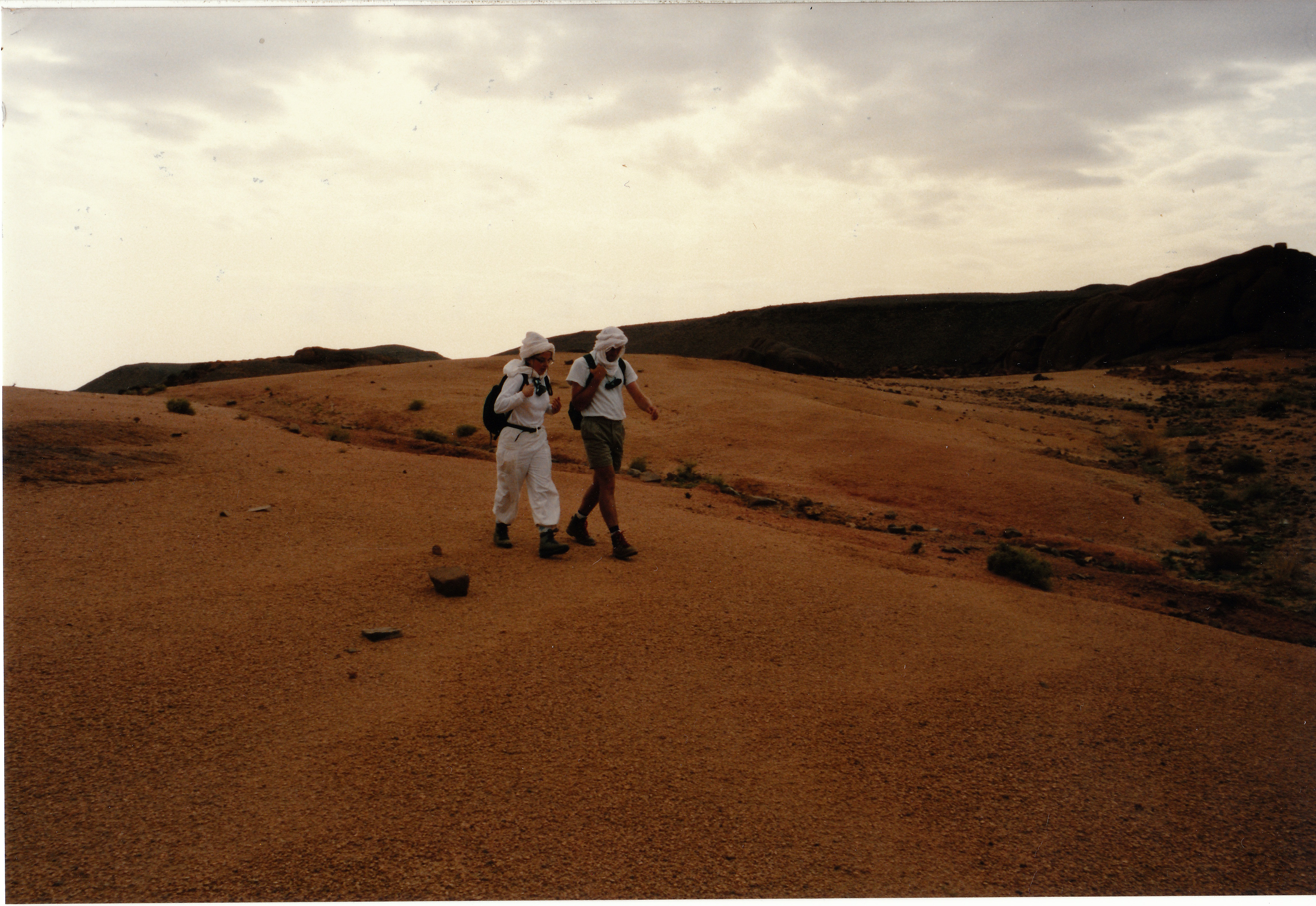
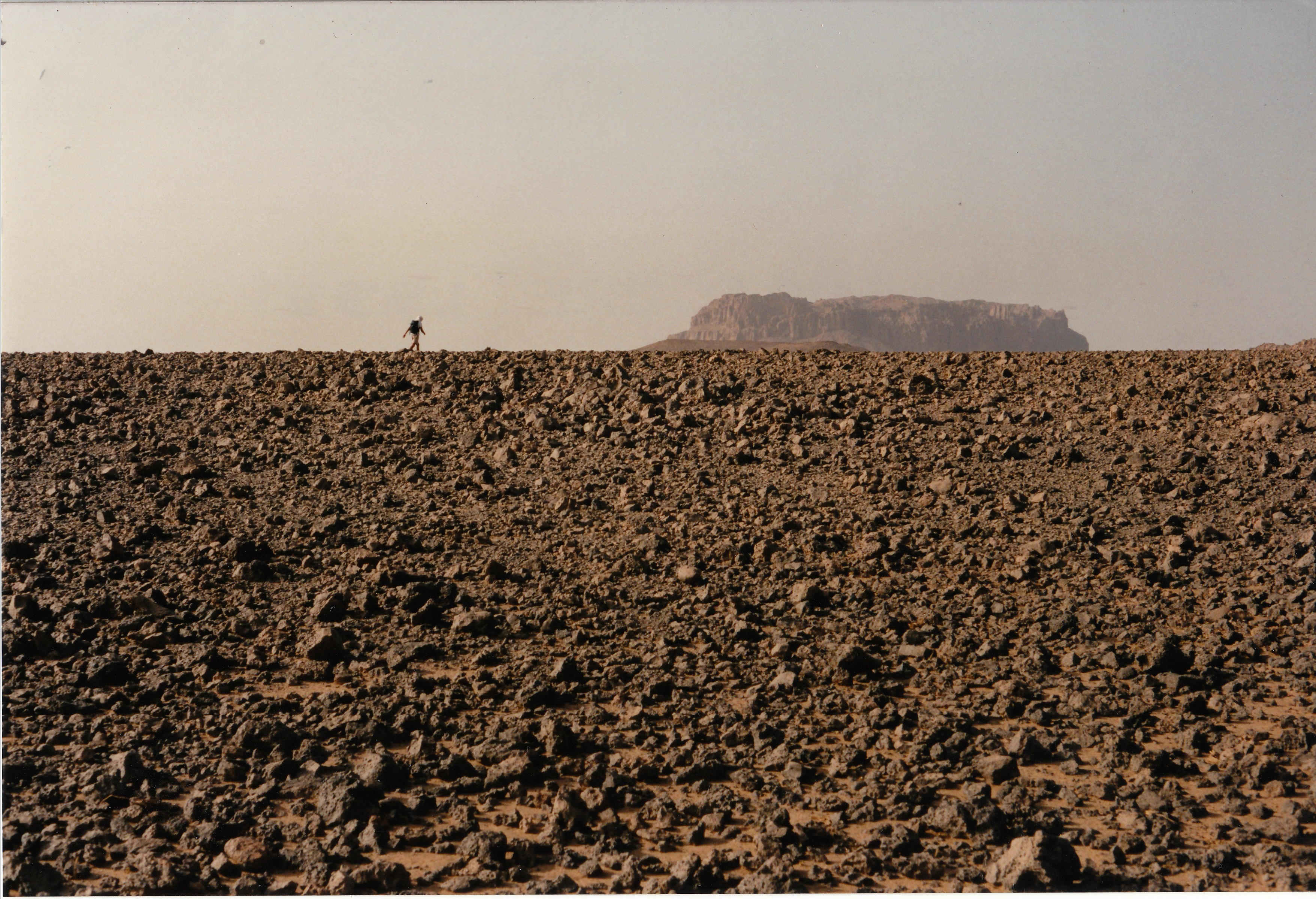
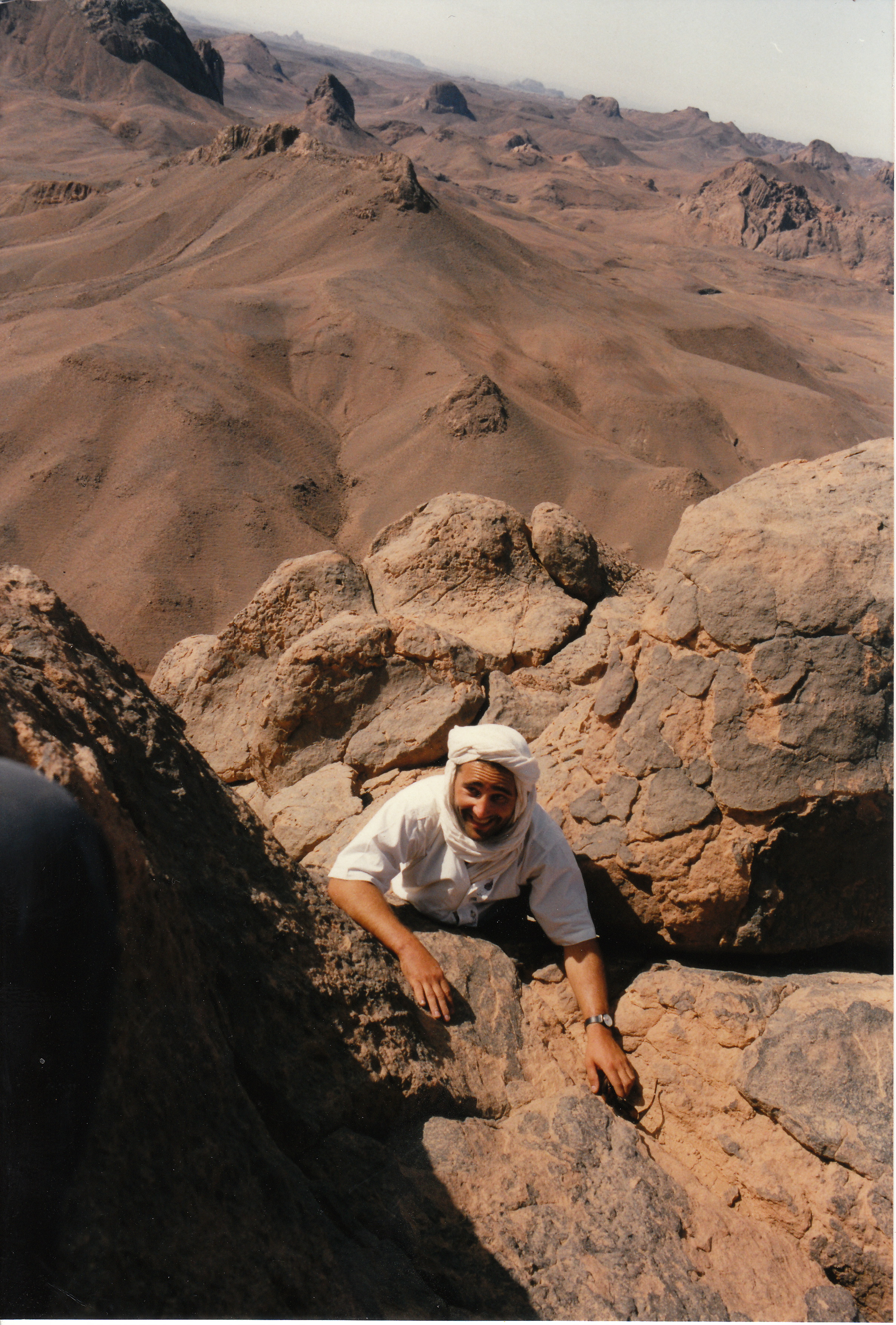
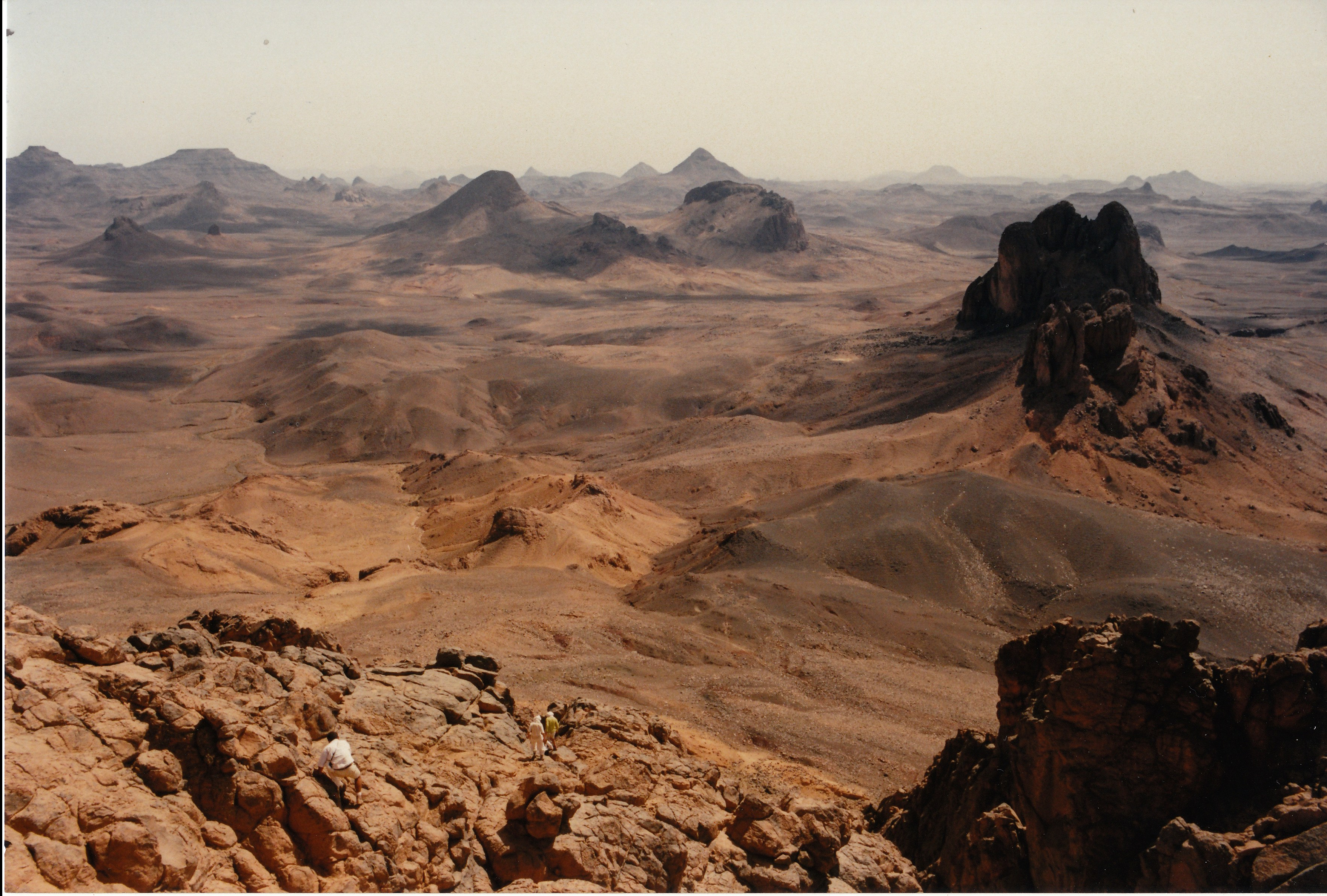
Walking through the Hoggar Mountains (Algeria) – Fall 1991 – Pentax MX – it was my last trip with the Pentax – the light meter did not work anymore (not a real problem in the desert where sunny 16 rules, but anywhere else)

sahara_oct_1991
Walking through the Hoggar Mountains- Fall 1991 – After a few days in the desert, you become much more comfortable with being at a distance from your fellow walkers

hoggar_fall_1991
Hoggar Mountains – 1991 – Pentax MX

the hoggar 1991
Hoggar Mountains (Algeria) – 1991 – Pentax MX

sahara_Nov_1991
Walking through the Hoggar – Fall 1991 – Pentax MX – Pentax SMC 35-70 lens (all pictures in this series scanned from prints – no idea where the negatives can be)


Pentax – the road to insignificance

It’s a bit early to write Pentax’s obituary. But there’s no denying that the company (now a subsidiary of Ricoh) is  a mere shadow of its former self.

Pentax--6056
The Spotmatic – a great camera in the sixties – but Pentax should have replaced it earlier than 1975

From the mid fifties to the early seventies, the Asahi Optical Corporation  was an innovator. They scored an impressive number of “first” :

  • First Japanese single lens reflex camera to enter production (Asahiflex – 1952)
  • First reflex camera with instant return mirror (Asahiflex II b – 1954)
  • First modern single lens reflex (SLR) camera,  with a pentaprism at the center of the top plate, a winder arm and shutter speed knob on the right side, and a folding rewind crank to the left (the “original” Pentax of 1957). This was to be the model for all other reflex cameras for the next 20 years. The camera was so important for Asahi that the whole corporation became later known as “Pentax Corp”.
  • First SLR with Through the Lens (TTL) metering on the market  (Pentax Spotmatic – 1964)
  • First automatic exposure SLR with an electronic shutter (Pentax Electro Spotmatic – 1971)
  • First multi layer coated lens  (or at least the first manufacturer to communicate about multi-layer coated lenses to the public at large – 1971)

As a result, Asahi Pentax was a sales leader in the sixties and early seventies: for example, it was the first Japanese camera company to sell over one million SLRs.

Pentax lost its supremacy during the first half of the seventies

  • they stuck to the Spotmatic form factor until 1975
  • they stuck with stopped down metering on their line of bread and butter Spotmatic cameras until the launch of the Spotmatic F in 1973, and to the m42 screw mount until far too late. Because they had adopted a proprietary bayonet early on, Minolta and Nikon had been able to offer full aperture metering (a major comfort improvement for the photographer) since 1966, with Canon and Olympus following in 1971.
  • As a result, Pentax was out-innovated by new entrants:  Olympus OM-1 (the first ultra-compact SLR and camera system); Fujica ST-801 and ST-901 (first use of Silicon metering cells and of LED displays in the viewfinder); Olympus OM-2 (first implementation of On The Film (OTF) real time flash metering).

The Pentax Spotmatic F (1973) with a Pentax specific version of the universal 42mm screw mount – designed  for full aperture metering.

The second half of the seventies was not better:  Pentax was in reactive mode and started progressively being pushed to the bottom of the market :

  • Changes to their lens mount are always very risky for camera manufacturers. It may not bother the beginner or the amateur who are only going to shoot with the kit lens they bought with the camera, but it’s an invitation for enthusiasts and pros to reconsider their aleigence to the brand.  Between 1971 and 1976, Pentax changed the lens mount of its cameras twice.
  • Pentax could not compete with Canon and Nikon in the “pro” market because they did not have a modular camera to offer until they launched the LX in 1980, and after they did, they lacked some of the specialized lenses and the support network that the pros required,
  • they were out-innovated in the heart of the enthusiast market: Canon with cheaper to manufacture and feature rich micro-processor driven cameras such as the AE-1 and the A-1, Minolta with multi-mode SLRs.
  • they had to face new competitors in the “amateur” segment of the market with  Nikon and Olympus successfully entering the broader consumer market with cameras such as the EM and the OM-10 in 1979.

By the end of the eighties, Pentax had been relegated to the 4th position on the photo-equipment market, behind Canon, Minolta and Nikon. They had completed the transition to auto-focus SLRs, but were primarily known for their two remaining manual focus SLRs (the K1000 and the P3) and their water-resistant point and shoot cameras.

2020-04-Pentax-6673
Pentax P3 – a camera for beginners – very successful on the market (3 million sold between 1985 and 1997)

They survived until the advent of digital photography. Konica-Minolta’s deep troubles gave them one last chance of resurgence in 2003-2004. They recovered the #3 position on the market for a while. But after early successes – their first dSLRs, the *ist D and *ist DS were good cameras, technically on par with contemporary Canon and Nikon offerings –  they did not (or could not) keep up with the pace of their competitors, and let their market share decline to the point where their presence is hardly noticeable today.


More about Pentax’s last manual focus cameras in a few weeks with reviews of the Super-Program (Super-A),  P3 (P30) and ZX-M.

2020-04-Pentax-6660
Pentax’s last manual focus SLR – 1997


IMGP0885
Haleakalā volcano, Maui, Hawaii – Pentax *ist DS – Pentax 18-55mm lens.

IMGP0993
Hawaii – Big Island – Pentax *ist DS

IMGP0968
Hawaii – Big Island – Pentax *ist DS

Pentaprism, Contax, Pentax and Pentacon

Who created the first 35mm camera, or the first 35mm single lens reflex camera?

Difficult questions. First, you would have to agree on what constitutes exactly a “real” 35mm camera, or a “real” 35mm SLR, and then, you would have to determine what really counts: is it presenting a prototype at a trade show, applying for a patent, launching a limited series production, or inundating the world with tens of thousands copies of a “game changing” camera?

It is generally recognized that with the Leica, Leitz created the first commercially successful 35mm camera in the early twenties, and but it was not until 1932 when they launched the Leica II that the rangefinder camera with interchangeable lens had found its “real” final form.

Foca *** / Olympus OM-1n
Foca *** with a Foca turret viewfinder (left) / Olympus OM-1n (right) The Foca, a French derivative of the pre-war Leica, is a good example of what a rangefinder camera with interchangeable lenses looks like. With its pointy prism housing, the Olympus illustrates the typical SLR shape.

The Contax S

1932 is also the year when Zeiss launched Leica’s most serious pre-war competitor, the Contax.

Zeiss was at that time the largest manufacturer of cameras in the world. They had a long tradition of innovation and a great team of engineers; conscious of the limitations of the rangefinder formula, they kept on working on a better solution until, after the war, they finally presented the Contax S, one of (if not the first) modern 35mm single reflex lens camera.

With its pentaprism, its horizontal curtain shutter and its 42mm screw lens mount, the Contax S was very close to the typical 35mm SLR design, and should have been commercially successful.

contax-S-1950-Pentax-SLRdotcom
Contax S – (second series from 1950). Courtesy of Pentax-SLR.com – the best source of information about early SLRs (not only Pentax)

But at that time, the Zeiss factories were in the Russian occupation zone (soon to become the German Democratic Republic) and all sorts of issues slowed down the roll-out to production: the Contax S only started to be mass produced at the very end of 1949. The launch of the Contax S also coincided with the start the Cold War – products from communist countries were not always welcome on the more affluent markets of the West – and to make the matters worse, the East German entity of Zeiss lost the rights to the Contax name in 1956. After considering multiple options (including apparently the “Pentax” name), the East Germans rebranded their cameras “Pentacon” (a portmanteau for Pentaprism and Contax) and the Contax S line of SLRs was abandonned.

Why is a pentaprism so important, that Zeiss and (later) Asahi changed the name of their cameras to include “Penta”? 

Ground-Glass
On the ground glass of a plate camera, the image is reverse (top/down, left right) – image courtesy of http://www.michaelstricklandimages.com/

Composing a picture on a piece of ground glass located behind the lens is nothing new (plate cameras have been following that model forever), but the image is reversed top-bottom and left-right, which makes the composing process very slow and totally unsuitable to candid photography.

If a mirror inclined at 45 degrees is placed behind the lens, and the image projected on a piece of ground glass, it is not reversed top/bottom anymore, but is still reversed left/right. The photographers has to shoot from waist level, after having used a magnifying glass for focusing. It’s workable, but not the best formula for action shots,  journalism or simply spontaneous family photographs.

IMG_5841
Nikon F3 with the pentaprism viewfinder removed: the image formed on the focusing screen is reversed laterally.


IMG_5839
Left is right, right is left and of course the Coke and Powerade labels are also reversed

The pentaprism addresses all those issues – and as we all know from experience  with SLRs, the image is fully redressed, focusing is easy, and eye-level composition makes action photography intuitive even for beginners.

IMG_5838
Nikon F3 – The view of the same scene from the eye-level pentaprism viewfinder

Asahi Optical Co

Asahi started manufacturing lenses in Japan in 1919, and launched the first Japanese 35mm single lens reflex camera – the Asahiflex – in 1952. It was inspired by the pre-war German Praktiflex, but brought some improvements:  it had two finders: a waist level through the lens viewfinder (for focusing)  and a smaller eye level optical viewfinder to be used when taking candid snapshots.

In two critical areas, the Asahiflex was not as advanced as the Contax S:  it did not have a pentaprism viewfinder, and it used a narrower 37mm screw mount.

Asahi’s first major innovation came two years later with the introduction of the instant return mirror on the Asahiflex IIb (1954). The IIb was without equivalent for a while, but the step forward it represented was nothing compared to Asahi’s next giant leap, with the “Pentax” of 1957. The first (mass produced) Japanese camera with a pentaprism, it combined for the first time in a compact, elegant and well made camera the instant return mirror, the film advance lever, easy film loading with a hinged back, and the 42mm screw mount.

img_asahi_pentax
The original Asahi Pentax camera from 1957 (source: official Pentax Web site).

The Pentax line of cameras sold by the millions and became the model that all other manufacturers would copy in the subsequent years. The Pentax name became so well known that the Asahi Optical Co. decided to sell all its products (including its line of medical equipment) under the name Pentax, before it finally changed its own name to Pentax Corporation in 2002.

Spotmatic_NikFM-15
Pentax Spotmatic F from 1973 (left) and Nikon FM from 1977 (right). More than 15 years after its launch, the design of the “original” Pentax was still the model that all camera manufacturers were following

It is widely assumed that  “Pentax” is also a portmanteau for Pentaprism and Contax. According to Wikipedia, the name was purchased  by Asahi from the East German Zeiss  company just before the launch of the original Pentax SLR in 1957.

pentax ap_top_plate
Asahi Pentax – the top plate of the original model (1957) – source: eBay

cameras--6630
The Pentax Spotmatic F on 1973 – still true to the model defined by the “original” Pentax of 1957

Today, the single lens reflex formula is on its last breath – superseded by mirrorless cameras where the pentaprism has been replaced with a high resolution LCD – the Contax brand is dormant, and Pentax, as a subsidiary of Ricoh, is in life support with a line of three rather old dSLRs and no plan to launch a mirrorless system.

Sic transit…


More about

By far the most comprehensive source about Pentax cameras, as well as early SLRs of all makes: Pentax-slr.com

Asahi Optical Historical Club 

The official corporate history of Pentax (the Ricoh-imaging-co Web site)

The Asahi Pentax original (AP) from 1957 – CameraQuest


From a Pentax to another Pentax…

2017-11-spotmatic--20
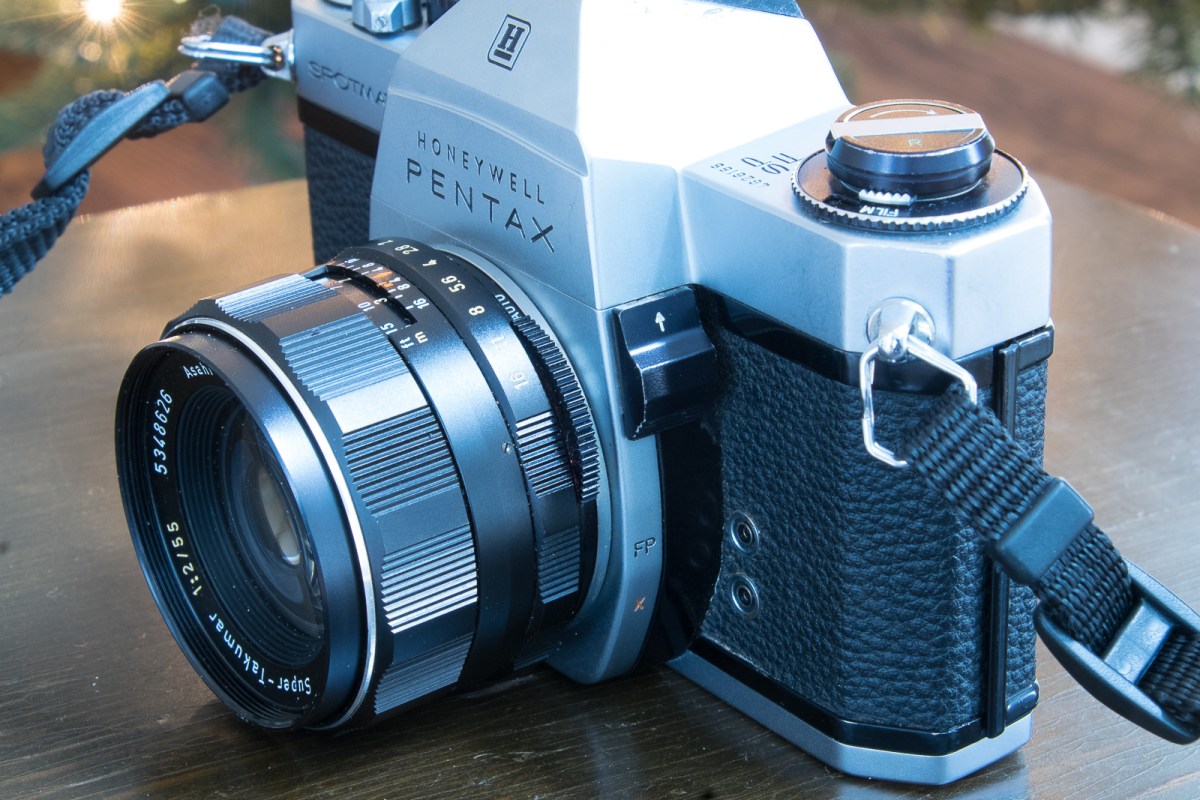
Big Birds – Mableton, GA – Pentax Spotmatic F. Lens Pentax Super-Takumar 55mm f/2

IMGP1654
Cumberland Island National Seashore (GA) –  Some of the islands of the national park are limited to 50 visitors/day and have to be vacated before sunset. Pentax *ist DS – Lens Pentax 18-55mm

IMGP1668
Cumberland Island National Seashore (GA) – The Cumberland forts were built by the British in 1733 to protect their most southern colonies from the Spaniards. The forts were abandoned after the final defeat of the Spaniards at the Battle of Bloody March in 1742. Pentax *ist DS. Lens Pentax 18-55mm

DP Review’s preferred “analog gems”

After Thom Hogan’s list of Nikon Classics, another list, this time coming from no other than dpreview.

The “DP” in dpreview stands for “Digital Photography” of course, and the site was launched in 1998, at the beginning of the digital camera craze. And they’ve never reviewed a film camera. As far as I know. But over the years, they compiled two lists of recommended,  “excellent and affordable” film cameras, the first one in 2017, with a follow up in June 2019.

A few of the cameras listed as “analog gems” by DPreview have been presented in this site over the years (the Nikons FE2, N90, the Olympus OM-1 and the Canon T90). Very often, my preference goes to other models of the same family (I prefer the Olympus OM-2 to the OM-1 because its battery is much easier to find, the Canon AT-1 to the AE-1 because I’m not a fan of shutter speed priority automatism, and the EOS-620 to the EOS-5 for its simplicity).

Nikon FM
Nikon FM

I’ve never been a fan of compact cameras in the days of film (poor viewfinder, not enough controls for the photographer). Their only advantages were their small size and their ease of use, but a film SLR with a pancake lens was not much larger and delivered much better images. And today, why would you spend money on film and processing to use a compact camera which will give you less control over your images than a good smartphone?

My absolute favorite? The ones I would bring on the proverbial desert island (assuming the desert island has no electricity, no Internet access but a huge stack of film cartridges waiting for me)?

Canon-T90-6241
Canon T90 – the ergonomics of an EOS camera with an FD lens mount

  • a compact, mechanical, semi-auto SLR – not the Olympus OM-1, not the Pentax MX, but the rugged and supremely reliable Nikon FM. The FM2 is probably an even better camera, but it’s also more expensive.
  • the most elaborate pre-autofocus SLR, the Canon T90, for the looks, the ergonomics, the crazy exposure system, with no concern for its questionable reliability or its mass, because I would always have the Nikon FM as a backup.

And of course, when I would be back from the desert island, I would reconnect with my cherished Nikon FE2…


summer2017-R4---12

“La Maison aux Bambous” – Bed and Breakfast – Vinay (France). Canon T90 – Canon FD 24mm – Fujicolor 400.

Semi Auto SLRs for beginners: Pentax Spotmatic F or Nikon FM ?

The Pentax Spotmatic F and the Nikon FM were probably never on the shelves of photo equipment stores at the same time – when Nikon launched the FM in 1977, Pentax had stopped selling their Spotmatic line of cameras and their m42 screw mount Takumar lenses one year earlier, and were promoting the more compact MX (semi-auto) and ME (automatic) SLRs and their new bayonet lens mount instead.

Logically, the Spotmatic F should be compared with cameras such as the Canon FTb, and the FM with the Pentax MX. But shooting with the Spotmatic F and the FM side by side is a good way to measure the progress made in usability and performance in a just few years.

  • Size, Weight, Features and Ergonomics
    Looks can be deceiving. The two cameras are roughly the same size and both weight approximately 600g, but the Spotmatic looks taller and feels heavier.
    The ergonomics and the organization of the commands are very similar. Both cameras offer semi-automatic exposure – the Spotmatic F needs the SMC Takumar lenses (sold after 1971) to offer full aperture metering, while the FM needs Nikkor AI lenses (sold after 1977) or older lenses modified for Aperture Indexing to provide the same capability.

Spotmatic_NikFM-1
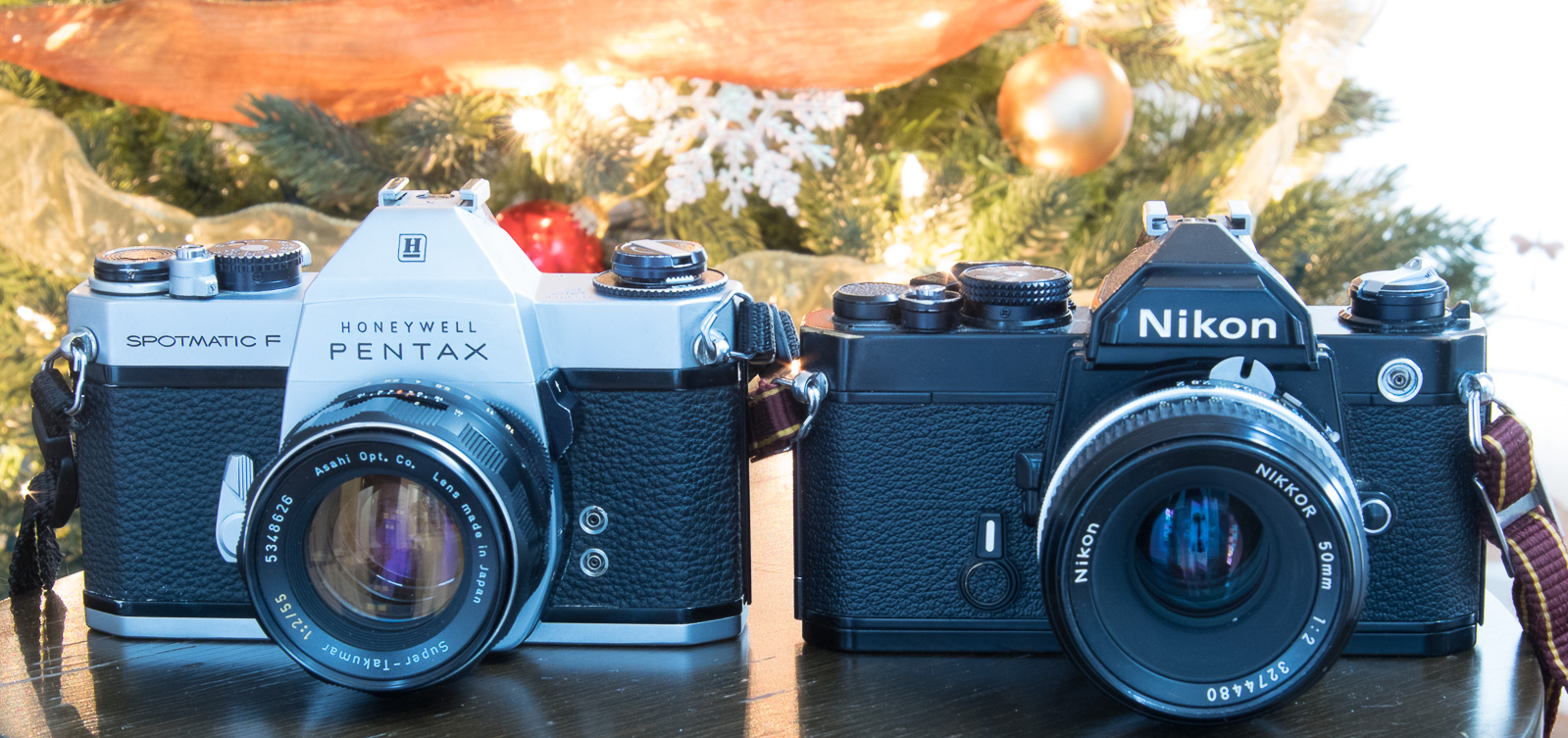
Pentax Spotmatic F and Nikon FM – almost exactly the same footprint – surprising…

The shutter of the FM has metallic blades traveling vertically, while the SPF uses a conventional horizontal textile shutter, with a slower electronic flash sync speed (1/60 sec instead of 1/125 sec), and – in my experience at least – a more questionable  reliability after a few decades of use.
Lastly, the FM can be equipped with a motor drive, which enables continuous film advance at 3.5 frames per second.

Spotmatic_NikFM-2
Pentax Spotmatic F and Nikon FM – a very similar organization of the commands

  • Viewfinder
    That’s where the progress made in a few years is the most…visible. The focusing screen of the FM has a much finer grain, it’s significantly more luminous, and thanks to the combination of a split screen telemeter and a ring of bright micro prisms, focusing is much easier and therefore faster than on the Spotmatic.
    The viewfinder of the FM is also more informative –  it shows the selected aperture and shutter speed.

IMG_1084 (1)
Pentax Spotmatic F – just the matching needle for the exposure on the right, and a small area of micros prisms at the center

On the other hand, I could not have imagined that getting the focus right on the Spotmatic F would require such an effort – even with relatively luminous lenses – the focusing screen is dark, and there is no split screen telemeter to help the photographer when the micro-prism ring is not working. Cameras from the late seventies-early eighties are so much better in that regard – that alone is a reason to shoot with the Nikon FM rather than with the Spotmatic.

IMG_1087
Nikon FM – 3 LEDs to help with the semi-auto exposure, a split-image and a ring of micro prisms at the center, a disk showing the shutter speed on the left – a fine and luminous focusing screen.

  • Metering system
    The metering system of the Spotmatic F is derived from the first Spotmatic, and like almost all the cameras from the late sixties and early seventies, it’s build around a CdS cell and communicates the exposure value to the photographer with the needle of a galvanometer. CdS cells tend to react slowly to changing lighting conditions (they have memory) and the needle of the Spotmatic is not very precise. Move the aperture ring one stop up or one stop down, and the needle hardly moves. It’s accurate enough for negatives. Not sure it would be precise enough for slide film.
    The Nikon FM has a much faster GASP cell (they were all the rage in the late seventies, they were supposed to be better than Silicium cells – the Pentax MX had such a cell too). The right exposure is communicated to the photographer through a set of three red LEDs. The setup is very reactive, and more accurate than the needle of the Spotmatic F.

Spotmatic_NikFM-5
The big black lever with the white arrow is used for depth of field control with Full Aperture Metering lenses, and for metering on conventional m42 screw mount lenses

  • Battery
    The Spotmatic F still came with Mercury batteries (which have been outlawed in the western world for decades). But it’s very tolerant with the non-Mercury-based replacement batteries available today in every drugstore. The FM works with conventional 1.5v Silver Oxide batteries. They also are widely available.

Spotmatic_NikFM-6
The rotating lock on the shutter release, and the red dot showing that the shutter has been cocked and the camera is ready to fire.

  • Reliability
    The Spotmatics are easy to repair – there are still  a few specialists who can service them in the US, and based on my personal experience, they’re not going to be out of work any time soon: it seems that the Spotmatics need more tender love and care than more recent cameras.  On the other hand, the FM inherited from the robustness and reliability of its older brothers in the Nikon family. Even if it was not considered a “pro” camera in its heyday, it was very often used by professional photographers (war correspondents in particular), as their primary cameras when light, compact and very solid gear was needed, or as a backup camera – in case their big Nikon F2 (or later F3) got into trouble.

Spotmatic_NikFM-8
Typical view of the film chamber of a Spotmatic – textile shutter, and the label of a Pentax service center (maybe somebody should start collecting those labels).

  • Scarcity and price
    Both cameras belonged to the best selling category of their time – semi-automatic exposure SLRs designed for enthusiast amateurs and professional photographers, they were sold by leading manufacturers with a wide distribution network, and hundreds of thousands (Spotmatic F) or even millions (Nikon FM)  were manufactured.  Lots of them have survived. The Spotmatic F is older, and finding a good copy is more difficult than locating a good FM. There is relatively little demand for the FM (less than for the more recent FM2 with its 1/4000 sec shutter or for the Cosina-manufactured FM10) and supply visibly exceeds demand, which reflects on prices: the FM tends to be cheaper than the Spotmatic F on eBay ($25.00 vs $50.00 for a camera in working condition).

Spotmatic_NikFM-15
Same overall size for the camera bodies, but the Pentax lens’ diameter is narrower than the Nikon’s and makes the camera look taller

  • Lens mount and lenses
    The Takumar lenses of the Spotmatic have an excellent, and in my experience, deserved reputation. The “entry level” 55mm lens I used with the Spotmatic F produces contrasty pictures, and the older Super-Takumar 35mm f/2 produces creamy pictures with a fabulous bokeh (it also works very well with mirrorless cameras).

Spotmatic_NikFM-10
The internals of the Pentax ES mount – Pentax added a lever to transmit the pre-selected aperture value and a pin to lock the lens in position.

Takumar lenses with the m42 screw mount are abundant on the second hand market, as are third party lenses – but they have to be operated stopped down. Full aperture metering is only possible with the more recent (1971-1975) S-M-C Takumar lenses with their modified m42 lens mount (they can easily be found on the second hand market), but there is next to no offer from third party vendors.Only Tamron seems to have offered lenses supporting  full aperture metering on the Spotmatic F. I’ve tried a 28mm f/2.5 wide angle and a 35-70mm f/4 Tamron Adaptall lens, and they both seem to lack contrast compared to Pentax or Nikon original lenses.

The Nikon FM was launched the same year as the “AI” version of the Nikon F bayonet mount, and as usual with Nikon, some level of compatibility exists with prior and subsequent versions of the lens mount.

Spotmatic_Nik-6997
Nikon FM with an AI (or AI-S) lens.

  • The “FM” is one of the “most compatible” of the Nikon bodies –  it’s sometimes called the Rosetta Stone of Nikon cameras-  and it can be used (with various restrictions) with lenses made from the very beginning of the F mount (1958) until today: Nikon still have AI manual focus lenses in their catalog, and some of their current auto-focus lenses can also be mounted on the FM, provided they have an aperture ring and a mechanical diaphragm control mechanism.

Spotmatic_NikFM-12
Nikon FM with a non-converted pre-AI lens – the grey metallic tab has to be lifted (you press the shiny mushroom like button below it)

  • The offer of second hand lenses (Nikon branded or compatible) is also abundant.

Conclusion

When working with old cameras, we all place the bar of the required level of performance at different positions – it’s a function of our experience, and of the type of scenes we tend to shoot.

The Spotmatic F, although a very good camera in its own right, is too much of an antique for me. Its base design is rooted in the sixties (if not earlier) – it’s the last evolution of the m42 Pentax line. Focusing is the biggest issue – you really have to pay attention to it, and it slows me down to the point I feel I’ll miss too many opportunities when I shoot mobile subjects. It still has a real usage value (on relatively static subjects) and can draw from a large supply of very good lenses, but it’s an antique first and foremost.

2017-11-spotmatic--20
Big birds – Thompson Park – Mableton – Pentax Spotmatic F – Super Takumar 55mm f/2. Fujicolor 400. Great camera for relatively static subjects.

Only 4 years younger, the Nikon – although not that different on paper – feels like a more modern camera (lower profile, much better focusing screen, more precise exposure determination). I expect it to be more solid and more reliable too. Like the SPF, the FM is compatible with earlier versions of the brand’s lens mount, but unlike the Pentax, it’s also compatible with the manual focus and with some of the auto-focus lenses still sold by Nikon today.


2017-11-SF--33
American White Sheperd – Nikon FM – Nikon 28-70 f/3.5-4.5 AF zoom. Not sure the dog would have left me enough time to get the focus right on the Spotmatic.

When kids ask me to let them use an old camera to learn the basics of photography or for an art project at school, I pick the FM with a Nikkor E Series lens – it’s a cheap and very efficient combo and I’m confident they won’t break it.

And the FM – along with its aperture-preferred auto-exposure sibling the Nikon FE2 – is also the camera I bring with me when I need a break from modern, computerized digital cameras – without sacrifying the results.

One last word: the Nikon FM10 has very little in common with the rest of the FM and FE series – it’s a camera manufactured by Cosina, at a time when all manufacturers believed they needed a sub $150.00 manual focus/semi-auto SLR in their product line. The FM10 shares its chassis and its kit lens (except for the lens mount, of course) with the Olympus OM-2000 and with other cameras manufactured by Cosina, and is not a “true” Nikon.


2017-11-SF--32
American White Sheperd. Nikon FM-Nikon 28-70 f/3.5-4.5 AF zoom.

The Pentax m42 lenses – meet the Takumars

The Asahi Optical Corporation (known for its Asahi Pentax and Pentax cameras) was founded by a gentleman named Kumao Kajiwara. The brother of the founder was a painter of some fame named Takuma Kajiwara, and in his honor, Asahi named its lenses “Takumar”. We’ve seen stranger things in the past: in the thirties, Leica had named a line of lenses “Hektor”, for Oskar Barnack’s dog, and in 1901, Daimler cars had been re-branded  “Mercedes” after the daughter of their main car dealer on the Cote d’Azur.

Takumar lenses still enjoy a very good reputation, and some of them are highly sought after and sell for hundreds of dollars.

Pentax Spotmatic
Pentax Spotmatic SP with a 35mm f/2 Super-Takumar lens

With most vendors (Canon or Minolta, for instance), the different generations of lenses are named for their mount (a Canon FL lens has a so called FL mount and works stopped down, while a Canon FD lens has the so called FD mount that enables full aperture metering).  No such thing with Pentax. The name of the lens (Super-Takumar as opposed to Super-Multi-Coated Takumar or SMC Takumar) relates to the coating of the lens. The most recent lenses (Super-Multi-Coated or SMC) are generally the ones with the updated lens mount supporting Full Aperture metering, but there are exceptions both ways. The only way to determine for sure that a Pentax screw mount lens can meter at full-aperture is to have a good look at the mount.

Coating and Multi-Coating – what is it about?

When it comes to the optical lenses used with cameras, flare is the enemy. And reducing light reflections also improves the contrast (the images look sharper). That’s why lens coatings were developed.

A coating treatment is engineered to block the reflections in a given wavelength. Multi-coating treatments block reflections in a wider range of wavelengths.

Lens coating was a process unknown to the public until Pentax and Fuji started using it as a differentiator in their advertising campaigns in the early seventies (it had been invented before WWII in Germany and had long been considered a military secret).

The 42mm Pentax lens series  – an over-simplified summary…

Auto-Takumar: 42mm lens mount, with aperture pre-set: the photographer has to cock the spring loaded aperture mechanism of the lens after each shot, and will compose and focus at full aperture. The lens will automatically stop down to the pre-set aperture when the shutter release is pressed. The pre-Spotmatic cameras of the late fifties-early sixties (Model K, Model S) came with Auto-Takumar lenses.

Super-Takumar: 42mm lens mount. Automatic pre-selection lens for stopped down metering cameras. They were released in the early sixties and their long sales run more or less corresponds to the Spotmatic’s. The aperture pre-set mechanism does not need to be cocked by the photographer anymore. And the lenses benefit from some form of single layer coating.

cameras--6634
The mount on two Super-Takumar lenses: on the left, the Pentax ES variant of the m42 screw mount with the prong transmitting the aperture value to the camera (generally found on S-M-C and SMC lenses) , on the right a Super-Takumar with the conventional m42 mount.

Super-Multi-Coated Takumar: Introduced with the Electro-Spotmatic of 1971, they provide full aperture metering on the ES, the ES II and the Spotmatic F cameras – the lens mount was modified and now transmits the pre-selected aperture value to the camera via a prong (because it made its first appearance with the Pentax Electro-Spotmatic, this variant of the m42 Universal mount is sometimes named Pentax ES mount).

Super-Multi-Coated Takumars remain compatible with the cameras with stopped down metering like the original Spotmatic and the  Spotmatic II (although compatibility issues arise when mounted on cameras of other brands and with some modern lens mount adapters). Obviously, they get their “Super-Multi-Coated” name from Pentax’s multi-coating.

SMC Takumar: Minor cosmetic differences with the “Super-Multi-Coated” Takumar. Same full aperture metering capabilities and same Pentax ES mount. Introduced with the Pentax ES in 1972.

To the despair of Zeiss and Nikon who had been manufacturing multi-coated lenses for years without letting it known, Pentax  decided to use “multi-coating” as a marketing differentiator – and using a short acronym such as SMC probably helped convey the message to the consumers.

In any case, Pentax’s SMC multi-coating was more than a marketing ploy: when Popular Photography tested the multi-coated lenses of Pentax against their competitors, the SMC coating proved to be the best by a wide margin.

The bayonet mount lenses launched with the KM, KX and K2 bodies of 1975 are simply named SMC Pentax.

Are they radio-active?

Some of the high-end (F/1.2, F/1.4) Super-Takumar  are radio-active- as are other ultra-luminous lenses from other vendors like Canon. Because the optical glass contained Thorium. The use of Thorium was banned at a later stage because of the harm it could do to the workers in the glass foundries.

I’m not an expert in this field – what I’m reading is that the lenses are not very radio-active (they would veil the film if they were), and that unless you grind the lens, and ingest or inhale the dust, you should be safe. (more about the issue: http://www.orau.org/ptp/collection/consumer%20products/cameralens.htm).

What to buy?

The Super-Takumar are probably the most common of all (thanks to their long production run), but even the shorter lived S-M-C and SMC Takumars are easy to find. Lenses compatible with the “universal” m42 mount abound, but there are very few third party lenses compatible with the Pentax ES variant. If you want a lens that does not exist in the Pentax SMC line-up (a trans-standard zoom, for instance), Tamron Adaptall lenses are the best option.

More about the Pentax 42mm lenses: http://www.klassik-cameras.de/Pentax_Takumar_e.html


Pentax--6088
Horace – French bulldog – shot with Pentax 35mm f/2 lens (attached to a Fujifilm X-T1)

Mounting a Pentax 42mm screw mount lens or a Nikon F lens on a Canon T90

Mirrorless cameras have made us familiar with the concept of mounting old manual focus lenses manufactured many decades ago on a modern camera. A little known fact is that Canon’s T90 (their top of the line manual focus SLR in the eighties) can work in a full featured semi-automatic mode with Pentax screw mount AND Nikon F lenses, thanks to adapters which were at some point sold by Canon themselves.

Canon-T90-6566
Canon T90 with Asahi Pentax Super Takumar (35mm f/2)

How is it even possible?

The Canon FD mount has one of the shortest flange to film distances of all 35mm SLRs at 42mm. On the other hand, the Nikon F flange distance is one of the longest, at 46.5mm (source:  Wikipedia – Flange focal distance). The “universal” 42mm screw mount (used by Asahi Pentax and the East German offspring of Zeiss until the mid seventies) is close to the Nikon’s flange distance at 45.6mm. Therefore, if a lens mount adapter can be made less than 4.5 mm thick, it will be possible to mount a Nikon lens on a Canon camera without losing the ability to focus to the infinite (and 3.6mm is the right thickness for a 42mm screw mount adapter).

The difficult part of course is to transmit aperture information to and from the lens – but if the camera is designed to work – at least in one specific mode –  without having to exchange information with the lens (semi-automatic exposure with stopped down metering and no aperture pre-selection, for instance), a very simple lens mount converter will be able to do the job.

Such adapters can be found on eBay for less than $10.00 (recent Chinese manufacturing). More surprisingly, it appears that Canon used to sell Canon branded, made in Japan adapters in the sixties (source: Cameraquest, Pacificrim).

canon_sales_catalog_1969_lens_adapters
Canon Lens Mount Converters – from Canon’s 1969 System Equipment catalog (courtesy: Pacificrim.com)

42mm screw mount lenses

I recently found one of those 42mm screw mount to FD adapters, (it does not look like the genuine Canon item shown in the picture below, but it’s made in Japan) and decided to test it with a Pentax Super Takumar 35mm F/2 on a Canon T90.

The T90 is an interesting camera – while it does not offer a true semi-automatic metering mode at full aperture with Canon’s native FD lenses, it simply has to be set to stopped down metering to gain a fully functional semi-automatic exposure mode, non only with Canon FD and FL lenses, but also with “adapted” screw mount lenses.

canon_lens_mount_Converter_P_box
Canon Lens Mounter Converter P (Credit: origin of photography unknown)


The main mission of a lens mount adapter is to position the guest lens (the Pentax 35 mm f/2 in our case) so that its flange will sit at precisely 45.6mm from the film plane – as if it was mounted on an Asahi Pentax camera.

The converter does not provides any mechanical linkage between the adapted lens and the camera, and it has no mechanism to force the lens to stop down to the pre-selected aperture when the photographer presses the shutter release. Therefore, it can only work with lenses with no automatic aperture pre-selection, or lenses where the aperture pre-selection can be switched off to force the lens to always keep the iris at the value shown on the aperture ring.

Not all 42mm screw mount lenses are created equal

Lenses deprived of such a switch can only be operated at their maximum aperture – which makes them mostly unusable. Lenses (such as the Fujinon screw mount lenses) designed to support full aperture metering add another constraint – they typically use a non-standard derivative of the 42mm lens mount (with a protruding pin in the case of the Fujinon) and can not be physically mounted on this adapter (I tried).

Nikon lenses

Nikon has been using the same F bayonet layout for 60 years, but had to go through many iterations of its lens mount to stay current (support of through the lens metering (TTL), introduction of program modes, of matrix metering, and many variants of autofocus).

Canon-T90-6586
Pixco Nikon AI to FD adapter (bought on eBay)

Genuine and Canon-branded Nikon AI to FD adapters are rare and very expensive (I saw one selling for $150.00 on eBay under the name “MC-N Lens Mount Converter”). I bought  a Chinese one, for a fraction of the cost.

Being devoid of any aperture transmission mechanism, the converter is compatible with any Nikon lens AI, AIS, AF, AF-D lens, and I don’t see why it could not also accept pre-AI lenses.

Does it work? 

Yes. With the right adapter, a 42mm Screw Mount lens set in “manual” (no aperture pre-selection) will work on the T90 the same way a Canon FL lens (set in “manual”) would.

  • screw the adapter on the lens

Canon-T90-6585
The screw mount to FD adapter.

  • Mount the lens on the Canon T90
  • Set the lens to “M”

Canon-T90-6571
Asahi Pentax Super Takumar lens – it has to be set to “manual”

  • push the stopped down metering lever

Canon-T90-6574
The stopped down metering / depth of field preview lever has to be pushed towards the lens.

  • turn the camera ON
  • set the Exposure Mode to “T” (for shutter priority exposure)

Canon-T90-6570
Canon T90 – the settings for shooting stopped down in semi-auto exposure mode

  • turn the aperture ring or the control wheel (controlling the shutter speed) to adjust the exposure as if it was a Canon FL lens used stopped down (the “OP” message on the viewfinder’s LED panel means “Open the iris”, “CL” stands for “close the iris” and “oo”  for “you nailed it”.

untitled shoot-0519
T90 – semi-auto mode – stopped down. Correct exposure – (cursor and triangle aligned on bar graph, “oo” message)

  • Of course, you operate stopped down – but it’s not so much of an issue:
    • the viewfinder of the T90 is very bright and the matt screen very fine, you can focus accurately up to f/8 if you shoot outside on a sunny day,
    • photographers are unlikely to mount slow lenses on the camera, or to shoot at F/16. They will most probably use the converters to mount old and ultra-luminous lenses on the T90, for the bokeh, and for the way the pictures shot with old lenses look.

With screw mount lenses, the T90 is as easy to use as any other semi auto camera, and exposure seems accurate (I obtained the same recommended aperture with the Pentax lens, the FL and the FD lenses, and on a Nikon camera I used as a benchmark).

Canon-T90-6576
Canon T90 with a Nikon 50mm AF lens. It can be physically mounted but the exposure is off by at least 1 stop (compared to FL or FD lenses)

With Nikon lenses, I observed multiple issues: with some lenses, the aperture ring of the lens does not seem to control the aperture, and with some lenses, the exposure is off (1 to 1 1/2 stop) compared with FD, FL or Pentax screw mount lenses. I suspect it’s because the lever controlling the aperture on a Nikon lens is normally pushed to the preselected aperture by a spring loaded lever on a Nikon camera’s body. With this adapter, the spring loaded lever is missing.

Does it make sense?

Owners of 42 mm screw mount lens with manual preselection don’t have many options if they want to use their lens “natively” on modern cameras: Pentax stopped selling screw mount cameras in 1975, Fujica at the end of the seventies, and Cosina briefly sold a Voigtlander Bessaflex SLR in small volumes at the beginning of this century. Nothing recent or widely available. The best they can do is use adapters, to mount their lens on Pentax K SLRs and dSLRs, or of course on many mirrorless cameras. In that perspective, if you’re a T90 enthusiast and still own a few very good 42mm lenses it could  make sense to look for a 42mm to FD adapter.

I’m less convinced it makes sense for owners of old Nikon lenses to mount them on a T90.  Nikon lenses don’t like to be mounted on an adapter that does not control their aperture lever. And if you have old Nikkor lenses that you love, there is no shortage of good film and digital Nikon cameras which still accept them, and will offer full aperture metering and more auto exposure options than an adapted lens on the T90 .

Canon-T90-6591
Canon FT with Nikkor AI lens – it’s not because it’s possible that you should do it.

Other Canon bodies

Any Canon body which can operate stopped down with Canon FL lenses can in theory work with the 42mm screw mount or the Nikon F adapter.

  • Canon AV-1: being an “aperture priority” auto-exposure camera,  it works stopped down with Canon FL lenses and adapted screw mount lenses.
  • Canon FT: a semi-automatic camera operating natively with FL lenses, it also works with adapted screw mount lenses.

summer2017-10
Plancy l’Abbaye – France – Canon T90 – Canon FD 24mm lens – Kodak Ektar 100. I was surprised by the way the Ektar film rendered the colors – pretty different from the reality.


SaveSave