Panasonic G1, G2 and G3 – how good were the early mirrorless digital cameras ….

I’ve always been intrigued by the first G series micro four third (m43) cameras of Panasonic – and I’ve always found the red ones particularly cute and desirable. But never enough to buy one, until today. Another eBay find.

Launched between 2008 and 2011, the G1, G2 and G3 now qualify as “old gear” and deserve a place in those pages. Whether one of those cameras, which were once revolutionary, will find a new life in my camera bag – is another story, and that’s what we’re going to determine.

Those early G models look like a dSLR shrunk to 1/2 scale, and were available in three body colors (black of course, but also red and blue) in the Western markets (*). Because they were the first representants of a totally new category of cameras, Panasonic did not seem to have a clear positioning for the G Series – were they targeting novice photographers or enthusiasts, and at what price point?
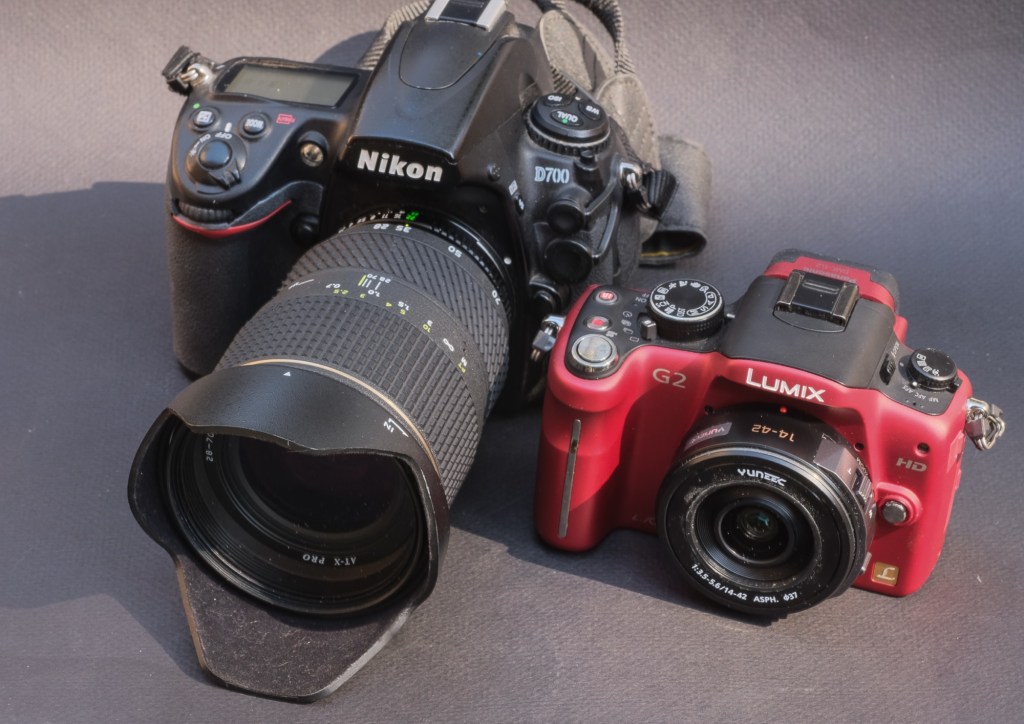
Panasonic G2 and Nikon D700 – two interchangeable lens cameras with 12 Megapixels sensors with a trans-standard zoom. The size difference is striking.

By 2010, they had made up their mind, and started launching smaller and simpler GF models to encourage smartphone and compact digicam users to step up to Interchangeable Lens Cameras (ILCs), while the subsequent G Series models became larger and more serious looking. The current models look no different (and are not really smaller) than conventional APS-C dSLRs.

Why mirrorless?

It all started when the image sensors used in dSLRs became capable of capturing video in addition to still images.

With the D90, Nikon were the first to propose a dSLR that could also shoot HD videos, but the architecture of single lens reflex cameras (with their flipping mirror located between the lens and the image sensor) is not video-friendly; when it was capturing videos, the D90 was reconfigured to operate like a compact digital camera, forcing the videographer to forget about the optical viewfinder, and compose from the LCD at the back of the camera. To make the matters worse, the very efficient phase detect autofocus system of the photo section of the camera could not be used when shooting videos (the flipping mirror again), and after some trial and error, the manufacturers had to implement a second autofocus system in the video section of their new dSLRs, contrast based this time. Two cameras in one.

With no legacy in the SLR and dSLR space, and access to state of the art electronic components, Panasonic was in an ideal position to propose a simpler and more elegant solution to the photo/video hybrid challenge. Their new “mirrorless” photo/video hybrids would not be based on a “reflex” camera anymore (no flipping mirror, no optical viewfinder) – their electronic viewfinder and their LCD display would both be fed directly by the image sensor – and a single autofocus system (contrast based) would be implemented. For the operator of the camera, there would be no difference between shooting still images and videos.
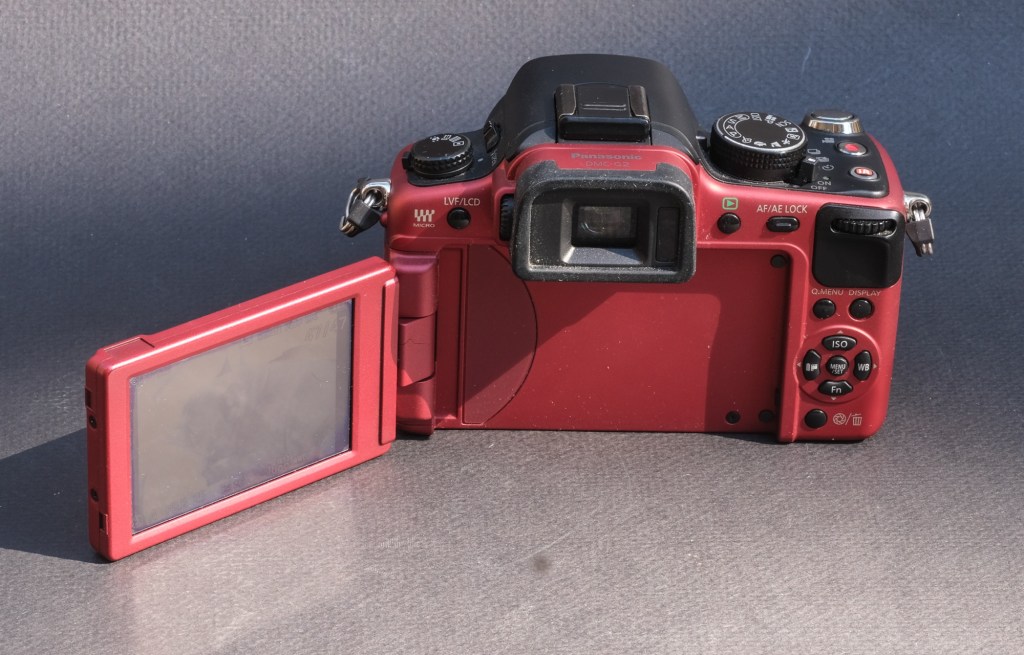
Panasonic G2 – the fully articulated display is great for selfies and for videos. The touch screen is not very reactive, there’s only one control wheel but the presence of the AF/AE lock is a nice touch.

The mirrorless architecture had another significant advantage – because they were not built around the constraints imposed by the mirror box of a dSLR, the cameras and their lenses could be made significantly smaller.

It was a small revolution (and it was perceived as such by the press when the G1 was launched). Sony and Olympus followed rapidly, then Fujifilm, then finally Canon and Nikon.

For the anecdote, the G1 – in spite of being architected as the perfect photo-video hybrid, could only shoot still images. All the models that followed, starting with the GH1 of 2009, shoot stills and videos, the GH models being more video-oriented than the G models, but we’re talking nuances here – nothing fundamental.

Shooting in 2025 with the Panasonic DMC-G2

In the early G series line-up, the G2 looks like a good pick. It addresses most of the limitations of the G1, and its user interface is more enthusiast oriented than the G3’s (more physical controls). The sensor is still a 12 Mpixels unit (the GH2 and the G3 made the jump to 16 Mpixels a few months later) but on a 15 year old camera the performance of the jpeg processing engine, the way it manages noise and the dynamic range are more of a concern than the resolution of the sensor.
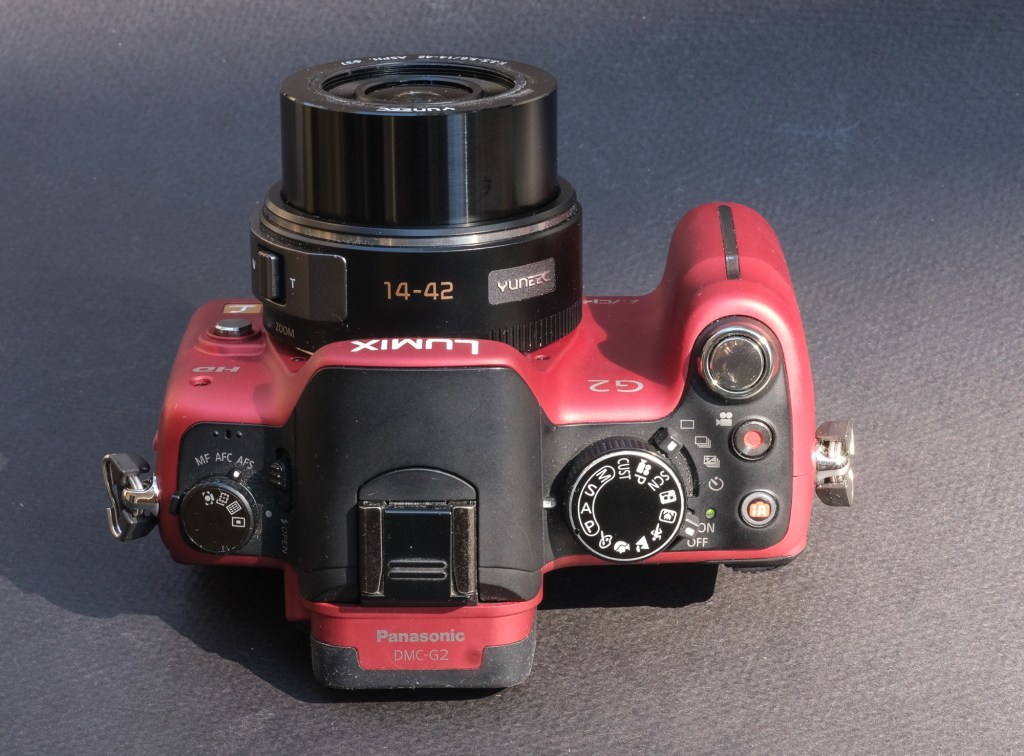
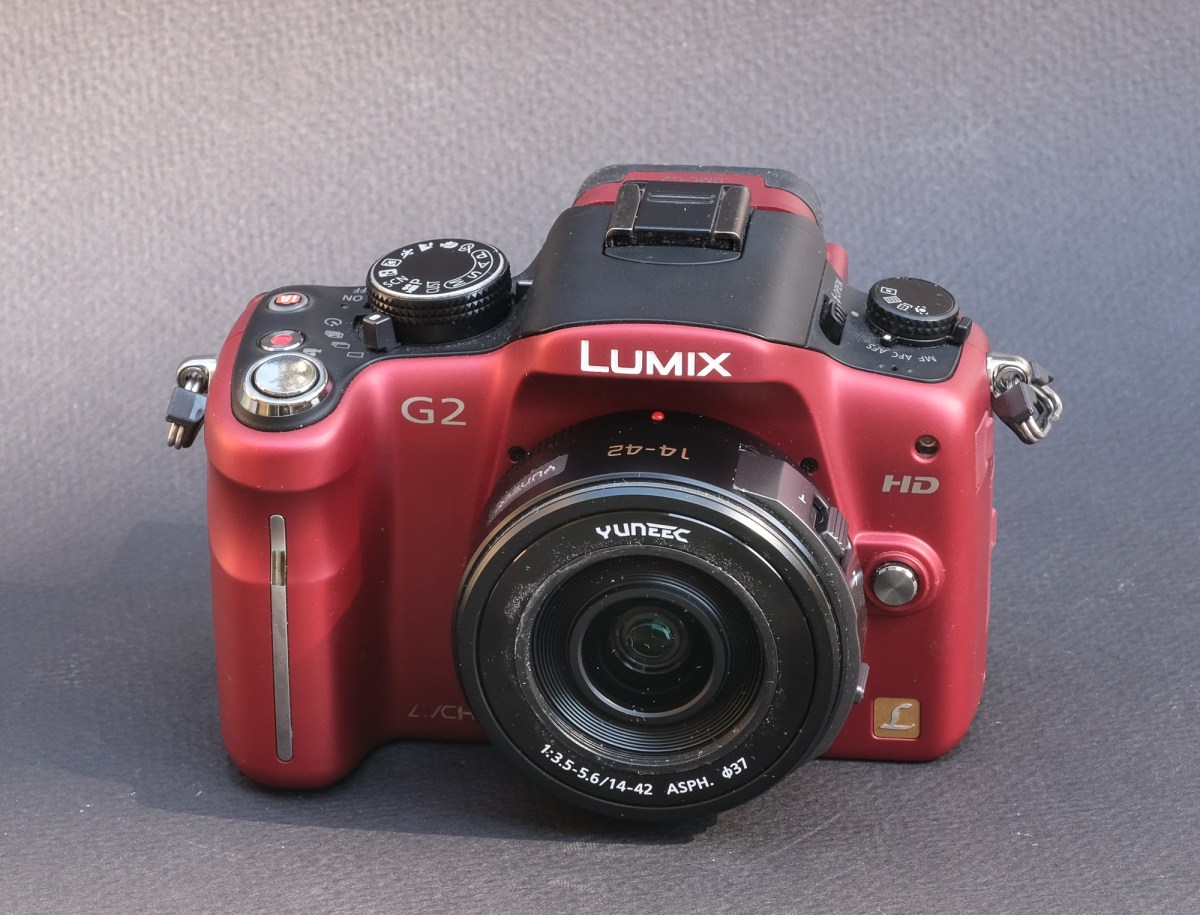
Panasonic G2 and Yuneec 14-42 pancake zoom – more physical controls than on an entry level ILC.

Using the G2 today, you understand why the press was so impressed with Panasonic’s new mirrorless cameras. They had nailed the essentials – offering a very compact, well rounded, pleasant to use camera, seamlessly integrating an excellent electronic viewfinder and a fully articulated rear display to shoot stills and movies without the acrobatics needed to do the same with conventional DSLRs. Even the autofocus is (relatively) fast and accurate. The fast movers among the competitors (Olympus, Sony, Fujifilm) would need three good years to catch up.

On a spec sheet, the G2 has everything an amateur will need – multiple exposure modes, including “intelligent” modes that recognize the scene for the photographer and adjust the parameters accordingly, multiple autofocus modes, and a very informative viewfinder.

Atlanta, Piedmont Park – Jpeg Straight out of the camera – note the 4×3 proportions of the picture.

Once you get used to its menus, the camera is easy to configure to one’s desires, and does not get in the way. It’s so light you don’t feel its weight, and wakes up quickly if it had entered a sleep mode. Only the operation of the touch screen leaves to be desired – it’s unresponsive and requires a significant pressure from the finger – and can’t be compared to the responsiveness of a modern smartphone in that regard.

Atlanta, Piedmont Park

What about the pictures?

There are cameras from the same vintage that immediately impress you with the quality of their JPEGs – you shoot with them for the first time and are like “wow!” – I’ve had that sort of moment with my first Fujifilm camera, the original X100. No such thing with the G2. You look at the pictures and you simply think – “not bad, but it needs some post-processing to show the scene like I really saw it”.

Sweetwater Creek Park – GA – jpeg image boosted by Lightroom AI

The JPEGs are generally pleasant to look at but lack punch, and will benefit from some limited post processing (with the G2, I tend to systematically add vibrance and clarity in Lightroom). In some of the landscapes I shot (facing the sun, admittedly), the images seemed to be rendered in a scale of grey, with almost no color – which points to dynamic range limitations.

Fishing – Shot in RAW. Processed in Lightroom Mobile

Photographers willing to spend more time on their images will shoot in RAW, and spend a few minutes adjusting each picture in Lightroom. The files respond well to post-processing, which tends to indicate that the potential of the sensor is hindered by the JPEG rendering engine of the camera.

As a conclusion

Shooting with a great film camera from the nineteen seventies or eighties is an experience to be relished. It’s so different from shooting with a modern digital camera. Cameras like the Canon AT-1/AE-1, the Nikon FM/FE or the Olympus OM-1/OM-2 series reconnect you with the basics of photography. Even if you own a state of the art digital camera, you will still feel the need to shoot with a FE2 or an OM-2 from time to time, because they’re such great instruments and using them is so rewarding.

Wildlife on the Chattahoochee River. Shot in RAW. Processed in Lightroom Mobile

You can’t say the same of the Panasonic G2 – it’s a modern digital camera, but not as advanced as the most recent models from Panasonic and all other major camera makers. In 2010, it was an impressive tour de force, already very mature for a 1.1 release. Today, it’s still remarkably compact, but the Jpeg processing engine, the sensor, the viewfinder – although usable – are 15 years behind the current best of the bunch.

The G2 is a cute and easy to use oldie, but if you also own a more modern, more enthusiast oriented ILC, you will not be tempted to shoot with the G2 when you could be shooting with a more recent, more flexible camera that will deliver better pictures in more situations, straight out of the camera.

Or you will be looking for a camera as compact and pleasant to use as the G2, but more modern.
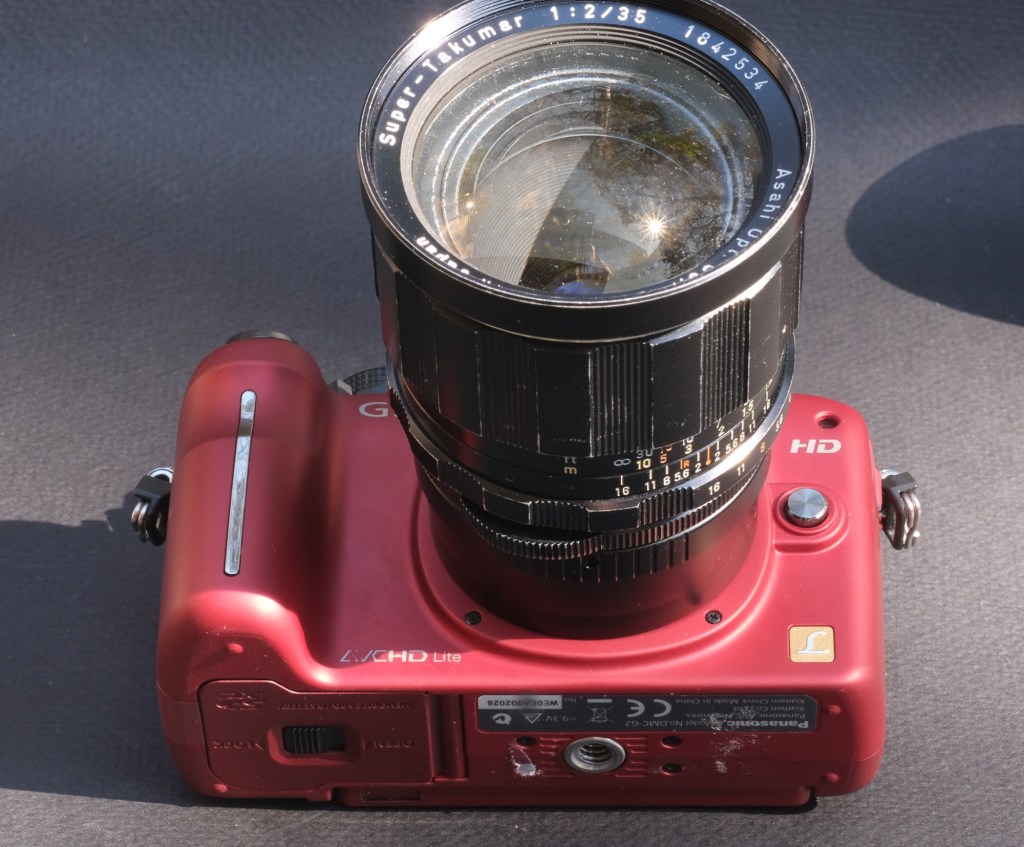
Panasonic G2 with Pentax 35mm f/2 lens and Fotasy adapter – Mirrorless cameras (in general) can easily work with vintage lenses. There is an adapter for almost every lens mount ever made (here, 42mm to m43).

On the other hand, if you’ve only shot photos and videos with a smartphone so far, a Panasonic G2 is a good stepping stone into the world of dedicated cameras. With a Yuneec 14-42mm power zoom (**), it forms one of the cheapest ways to get a taste for what shooting with a good interchangeable lens camera really is about.

You will have to shoot RAW to get the best results, and will have to learn about the S curve and the histograms. But it’s a knowledge worth acquiring.

The m43 system is still alive with Panasonic and Olympus keeping on developing new cameras and new lenses, and when you will feel the desire for a more recent camera, all the experience you will have accumulated shooting with the G2 – and the money you’ll have eventually spent on extra m43 lenses – will not be lost.

Tree – shot in RAW in the Chattahoochee River National Park. Processed in Lightroom Mobile

(*) Panasonic also shipped the early G models in other color combinations, but primarily on the Japanese Domestic Market (JDM). Cameras sold on the Japanese domestic market very often have a Japanese language-only firmware, and can’t be reflashed to show menus in other languages than Japanese. This situation is not specific to Panasonic – all Japanese cameras manufacturers have had (and some still have) references in their line-up which are strictly reserved for their home market and only support Japanese. Generally the ones with the fancy colors. Too bad.


(**) Yuneec is a Chinese manufacturer of drones and electrically propelled aircraft. At some point they used to integrate Panasonic m43 cameras and lenses in their drones – simply relabeling them. The Yuneec 14-42 power zoom is assumed to be identical to its Panasonic branded equivalent. The drones have probably reached the end of their life a long time ago, but enough lenses seem to have survived them, and there is a significant supply of Yuneec branded zooms on the second hand market. The Yuneec-labeled 14-42 mm zoom is identical and – in my experience – fully compatible with its Panasonic branded sibling.

A refurbished Yuneec zoom typically sells for a bit less than $100.00, a nice second hand G2 can be had for less than $150, making the G2+Yuneec 14-42mm combo one of the cheapest way to shoot with a good mirrorless interchangeable lens camera today. Not a penalty camera by any mean…



Sweetwater Creek State Park – straight out of the cameraI was facing the sun when I shot this picture.
Sweetwater Creek State Park – GA – image settings optimized by Lightroom AI. This image is closer to what I had in mind when I pressed the shutter.
Sweetwater Creek State Park – Straight out of camera.
Sweetwater Creek State Park – vibrance and clarity boosted in Lightroom

50 Years of Lens Mount Evolution: Part VI of VI


The last 10 years – digital cameras and image stabilized lenses


The massive adoption of digital cameras has not led – so far – to a dramatic change of the design of the lens mount of the cameras. Canon, Nikon, Pentax and Sony (aka Konica Minolta) did not design specific lens mounts for digital cameras, even if they designed specific series of lenses adapted to the smaller size of the digital “APS-C” sensors.


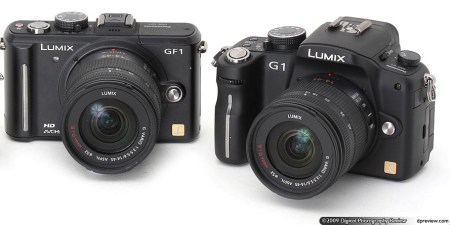
Panasonic GF1 and G1
Panasonic GF1 and G1 - the most radical development in interchangeable lens cameras since the Contax S and the Leica M3 (Photo courtesy of DPReview)


Only camera makers which had been absent from the 35mm Autofocus SLR market and had no installed base to please had the liberty to start from a clean slate. In 2003, Panasonic and Olympus launched the “Four Thirds” format, combining a relative small size sensor with a large all-electric mount. Last year, Panasonic finally presented the Micro Four Thirds G1, a camera with an electronic viewfinder and interchangeable lenses (EVIL), the first digital camera to really depart from the conventional SLR design of the Contax S of the late forties.


Why did the camera manufacturers keep the same bayonet mount for digital?


When the first digital SLRs from Nikon and Canon were presented in 2000, large imaging sensors were so difficult to manufacture and therefore so expensive that the camera makers settled for a form factor smaller than the 36x24mm dimensions of 35mm film (23.7mmx15.6mm for Nikon, 22mmx14.9mm for the Canon EOS-D30).


This form factor was dubbed “APS-C“, because it was close to the dimensions of an APS picture, shot with the “Classic” image format (25.1×16.7mm) of the APS cameras. The sensor being smaller than a 35mm negative (the diagonal of 35mm film is 1.5 times larger than the diagonal of an APS-C imager), the camera makers had an opportunity to design a new series of smaller bodies and lenses, but they all decided to stick to their legacy lens mounts and to design digital SLRs at least as large as their film counterparts.


Being the undisputed leaders of the film camera market, Nikon and Canon in particular had no interest in starting a new incompatible product line, at the risk of alienating their large user base; it would have leveled the playing field, and offered an easier entry in the dSLR market to companies like Panasonic or Sony. Nikon and Canon also wanted to limit the cost and the technical risk of going digital by reusing most of the components of their film cameras in their first generations of dSLRs. And they may have anticipated that one day, with the help of Moore’s law, cameras using full size digital sensors would become affordable for their professional and enthusiast customers, making their large F or EF bayonets more relevant than ever.


For a few years, however, dSLRs with APS-C sensors were the only game in town. Canon and Nikon both developed specific lenses for their small sensor bodies. Canon decided to modify the EF mount so that the EF-S lenses designed for the small sensor cameras can not be mounted on full frame SLRs or dSLRs. Nikon did not change the F bayonet – small sensor DX lenses can also be mounted on full frame (or FX) bodies, but being designed for the APS-C sensor size, they do not cover the full format of the FX sensors and the image is automatically cropped.


The Four Thirds and Micro Four Thirds formats


In 2003, Olympus and Panasonic launched the “Four Thirds” format. At that time, Canon had already started producing the first full frame 35mm digital camera (the EOS 1D), and was preparing much more affordable 35mm digital SLRs like the EOS-5D for the enthusiast photographer market. A large sensor was still complex and expensive to manufacture, but getting high quality pictures out of it would prove much easier than with a small sensor, in particular in low light situations.


The Olympus Four Thirds system was based on design decisions completely opposed to Canon or Nikon’s . The sensor size chosen for Four Thirds cameras is very small (its diagonal is only half of the diagonal of a 35mm sensor), but at the same time the lenses and bodies are designed around a large diameter bayonet mount (44mm, the same as Nikon’s F), with a relatively long focal flange distance (38mm). When the system was designed, it was believed that a large diameter lens and a long focal flange distance were required to get optimal results from the imaging sensor, but the Leica M8 and M9 have since proven that it was not the case.


On the positive side, the relatively large dimensions imposed by the Four Thirds mount gave the engineers more freedom to design high quality lenses with very fast apertures, but on the negative side the body & lens combination could not be made significantly smaller than the more conventional APS-C cameras of their competitors. To add insult to injury, the relative small size of the sensor proved a handicap in low light situations (all things being equal, small sensors are more subject to noise than larger ones), and steered most of the enthusiast photographers away from Four Thirds cameras. Four Thirds only got traction on the low end of the market.


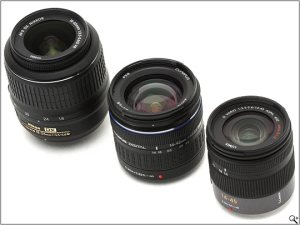
Size comparison: Nikon 18-55 DX, Olympus 14-42, Panasonic 14-45 Micro 4/3
Size comparison: Nikon 18-55 DX (APS-C), Olympus 14-42 (Four Thirds), Panasonic 14-45 (Micro Four Thirds) - Image courtesy of DP Review


Failing to make a significant impact on the mid-level dSLR market, and completely barred from the professional market dominated by new full frame cameras with extraordinary low light capabilities, Panasonic and Olympus decided to create a new niche for themselves, and launched Micro Four Thirds cameras. Using the same sensor as the “Four Thirds” dSLRs, the Micro 4/3rd cameras have abandoned the reflex mirror chamber and the pentaprism viewfinder of conventional dSLRs for an electronic viewfinder. They are designed for a much shorter focal flange distance (approx. 20mm instead of 38mm, and the mount diameter is also smaller (32mm approx. instead of 44mm).
As a result, the body+lens combination is much more compact than any other dSLR on the market. It’s still difficult to predict how this new category of cameras will fare in the future, but they finally bring something new to the table.


Image Stabilization

The migration from film to digital is without a doubt the most significant evolution of photographic equipment in the last ten years. Image stabilization gained acceptance during the same time, and is now a feature expected by amateurs using digicam as well as enthusiasts and pros using expensive large aperture teles. The objective of image stabilization systems is to compensate automatically the involuntary movements of the photographers, and to produce sharper pictures even at slower shutter speeds.


Canon, Nikon and Panasonic adopted relatively similar systems, all based on the controlled movement of optical modules installed inside the lenses. Minolta, Pentax and Olympus opted for in-camera systems compensating the movements of the photographer by moving the image sensor itself. Apparently both systems produce good results. In-camera image stabilization systems do not require any change to the lens mount, but in-lens systems need to be managed from the body, and require a few more electric contacts. Most of the current lens mounts are all-electric now, and adding a few contacts is an easy done job.


The state of the art in 2009


Pentax: Progressive introduction of the KAF3 version of the K bayonet mount, with autofocus motor in the lens. The majority of the lenses in the product line still need an autofocus motor in the camera body.


Canon: No change to the EF mount of the EOS cameras. Starting with the Rebel and the 20D cameras, Canon used a specific variant (EF-S) of the mount for lenses dedicated to the APS-C format. Canon dSLRs all work with EF lenses, but only the Rebel and 20D, 30D, 40D and 50D cameras can use the EF-S lenses.


Minolta, Konica Minolta and Sony: Progressive introduction of SSM lenses, with the focusing motor inside the lens. The majority of the lenses in the product line still need an autofocus motor in the camera body.


Nikon: Multiple variants of the F mount were used during the last 15 years:
– AF-D: no mechanical difference with the AF mount, the D lenses transmit the focusing distance value back to the body for 3D Matrix Metering
– AF-I: focusing motor in the lens – used for tele-lenses between 1992 and 1996;
– AF-S lenses: ultra-sonic (“Silent Wave”) autofocus motor built into the lens. Most of Nikon’s zoom lenses are now AF-S, and the conversion of prime lenses has started a few years ago.
– The new PC-E (perspective control electromagnetic) lenses now use an electromagnetic diaphragm command. All the other Nikon lenses still use the mechanical stop down mechanism introduced with the F mount in 1959.


Olympus & Panasonic started promoting the Four Thirds format in 2003. Four Third lenses use an all electric bayonet mount. The Micro Four Thirds are more compact, and use 11 electrical contacts instead of 9 for regular Four Third lenses. Thanks to the very short focal flange distance of Micro Four Third cameras, it is easy to develop adapters for Canon EF, Nikon F, Olympus OM or Leica M or R lenses.


Gull in Essaouira (Morroco)
An exception on this blog: a digital picture (Nikon D80) taken in Essaouira - Morroco