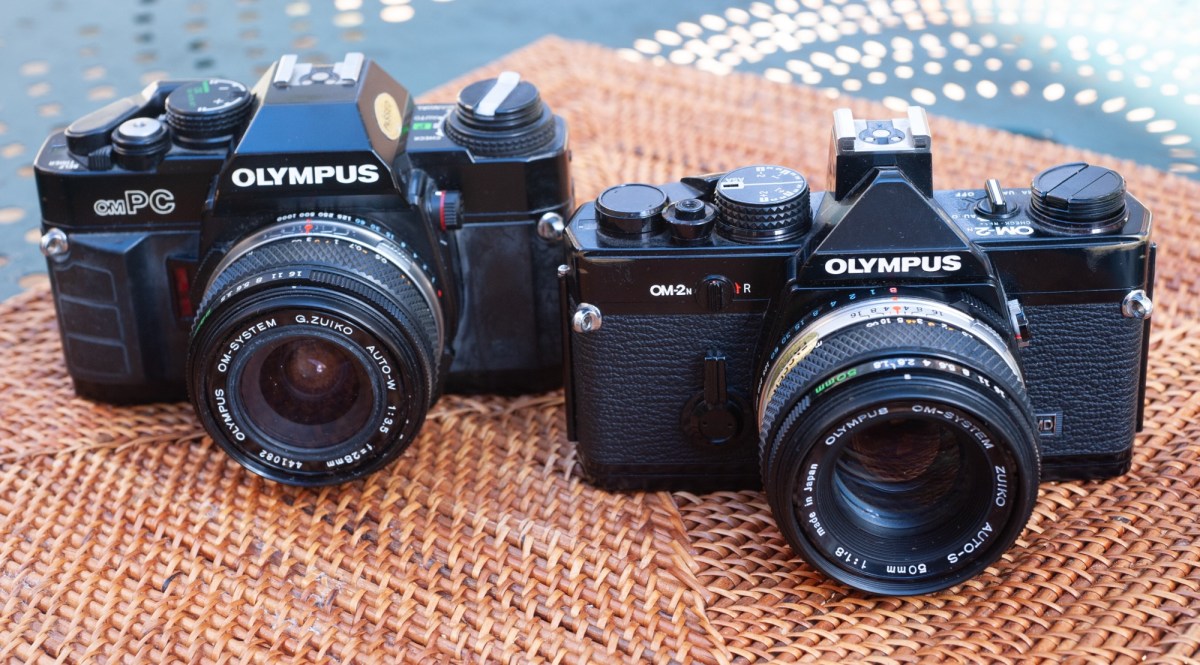
Olympus OM-40 / OM-PC : the ugly little duckling

In the times of manual focus (film) cameras, Olympus followed a pretty simple rule to name its SLRs – there was a line of one digit OM bodies (OM-1, OM-2, OM-4, OM-2SP, OM-3, OM-4ti, OM-3ti) for the enthusiasts and the pros –  those cameras were very compact, very well built, and fairly innovative. 

And a second line of “two digit” models (OM-10, OM-20, OM-30, OM-40) – designed for amateurs –  not as compact, with more plastic and fewer innovations. Obviously, the “two-digit” models were also much cheaper than their “one-digit” siblings. 

As often, some of the amateur models went by a different name on the US market: the OM-20 was sold as the OM-G, and OM-40 as OM-PC – all leading Japanese cameras makers were using US-market specific model names in the eighties and nineties – probably as a way to fight grey market imports.

Miami – Olympus OM-2

OM-40 / OM-PC

The OM-PC was launched in 1985, at the very end of the manual focus era (the revolutionary Minolta AF 7000 was launched in January that same year, and nothing would be the same afterwards).

Typically for an Olympus SLR from the eighties (like the OM-2SP or the OM-4), it has no on-off switch – and therefore tends to depletes its batteries rapidly.

Also typically for an Olympus of the eighties, its exposure metering system is  a bit “different”:  like the Nikon FA, it offers some primitive form of matrix metering (called ESP in this case).

  • Like the OM-2, the OM-40 determines the exposure by measuring the light reflected on the curtains of the shutter or on the film when the picture is being taken (they call that “OTF” for “on the film”, of course). OTF follows the conventional center weighted pattern. 
  • In addition to OTF, Olympus also designed an “Electro-Selective Pattern” or “ESP”. It’s an embryonic evaluative system, which compares the luminosity of the center of the image with the periphery, and follows a clever algorithm to determine the right exposure (more detailed explanations on the OM-40 user manual, that can be downloaded from Buktus’ excellent site).

The user manual leaves no doubt that using the ESP in conjunction with the Program mode is what Olympus recommends, but an Aperture Priority and a manual modes are also available.
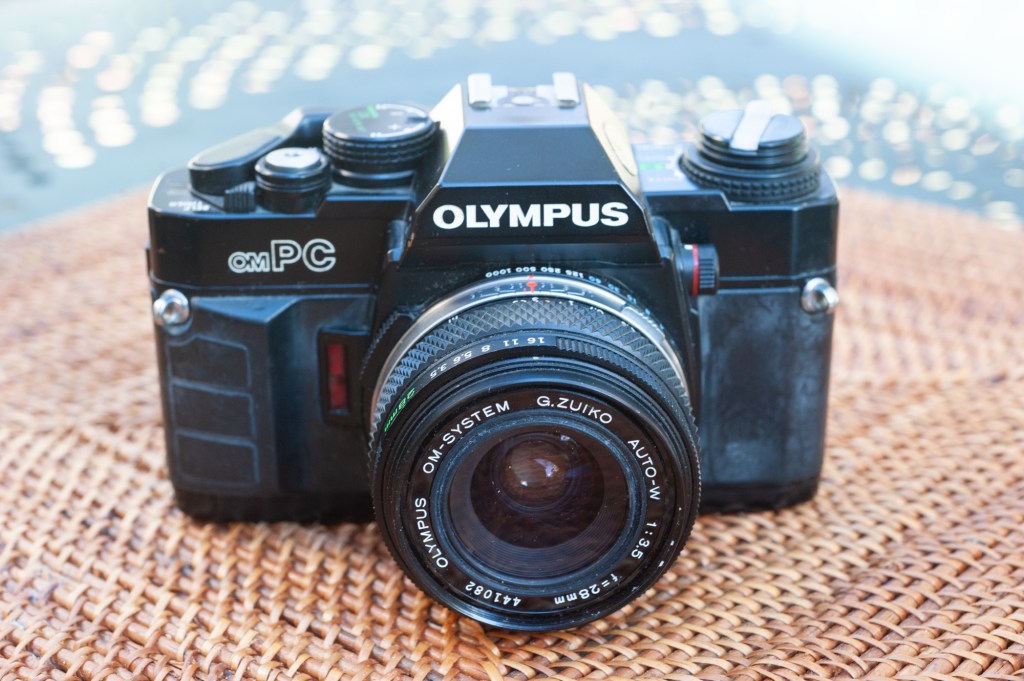
The black plastic did not age well – note the white residue.

The OM Zuiko bayonet mount remained the same all along the production run of OM cameras, which may explain why the implementation of the Program auto-exposure mode is also different from what is done by all other camera makers, and why there never was an Olympus OM camera with “Shutter Priority” auto-exposure.

Most camera makers had to create a new version of their lenses in order to support multiple auto-exposure modes: some have a lock on the smallest aperture (Nikon), some have a specific  “A” position added to the aperture ring (Canon), and some needed a new version of their bayonet mount, with a proportional control of the iris (Yashica-Contax) or with electrical contacts (Pentax KA).

Olympus did not create a new line of lenses or modify their bayonet mount – they simply expected the photographer shooting with the OM-PC to select the narrowest aperture of the lens (generally f/16 on an Olympus Zuiko lens) when operating the camera in Program mode.

But Olympus being Olympus, there’s a catch: selecting the smallest aperture is not mandatory: if the photographer sets the aperture ring to another value (f/8 for example), the “program” will try and find the right shutter speed/aperture combination without going beyond the aperture selected on the aperture ring (f/8 in our case). Interesting, if not perfectly intuitive for the beginner, who is at risk of hitting the fastest shutter speed of the camera (1/1000 sec) on a bright sunny day without understanding what’s happening. 
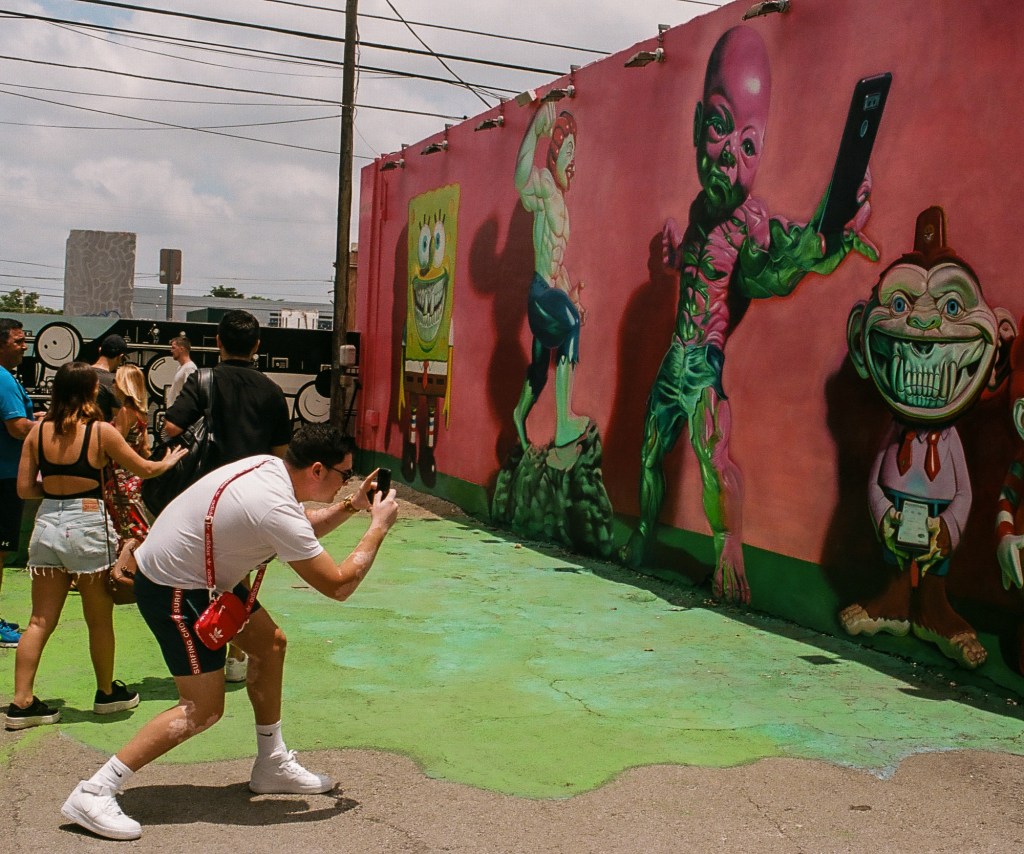
Miami – Olympus OM-2

The ergonomics of the OM-PC is also typical of Olympus OM bodies, with the shutter speed ring at the periphery of the bayonet lens mount. It works great with Olympus Zuiko prime lenses (which have their aperture ring at the front of the lens, not at the back): the right hand holds the camera and presses the shutter release, and the left hand takes care of the shutter speed, the aperture and the focusing, with enough distance between each ring to avoid confusion.

Contrarily to most of their competitors, Olympus did not have a cheap line of lenses for amateurs, a line of better lenses for enthusiasts, and a “pro” line for… pro photographers. All OM Zuiko lenses were supposed to be of equal build quality and performance, the only technical differentiation between lenses of a given focal length being the maximum aperture. Therefore, for a given focal length, Olympus was typically proposing 3 models with a  maximum aperture of f/3.5, f/2.8 and f/2.0, at different price points.

 All lenses were very compact, with their own depth of field preview lever, and the aperture ring pushed at the front of the lens. Today, Olympus OM Zuiko lenses are easy to find, and the f/3.5 version of most lenses is the most common and very affordable.
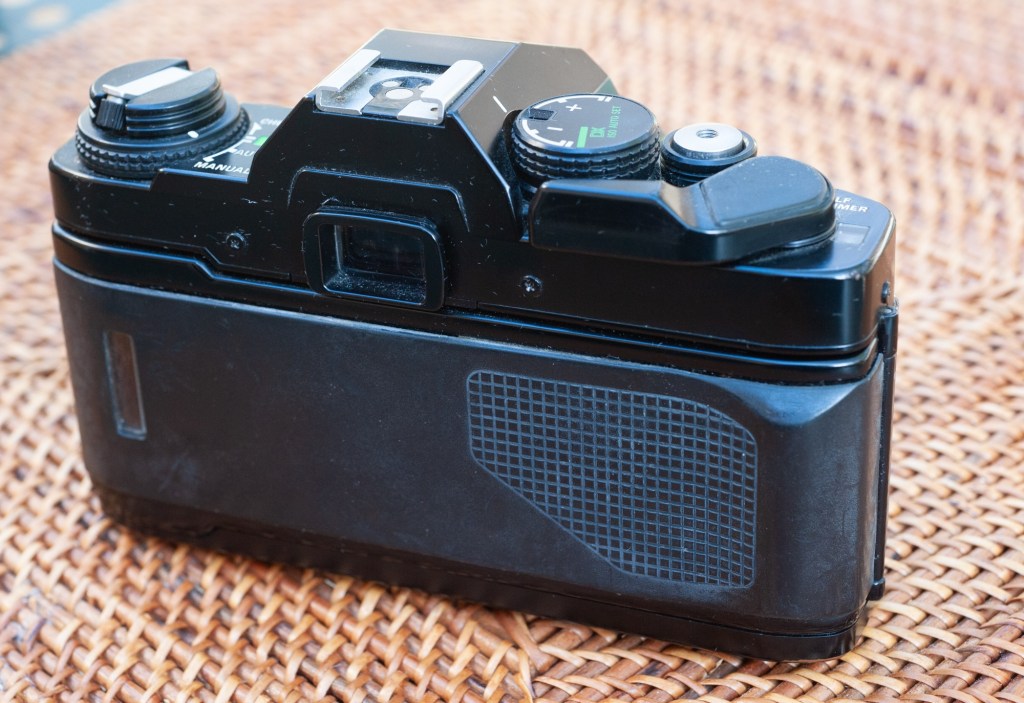
Maybe it looked modern in 1985 – lots of black plastic

The so-so and the ugly

The viewfinder of the OM-PC is nowhere as good as what you find in a one-digit OM, but correct for a camera designed for the budget of amateurs. All the information is provided in a column at the left of the viewfinder (shutter speed, metering mode), but – as usual for cameras of this era, the photographer has no information about the aperture selected by the camera when operating in Program Mode.

Untypical for an Olympus OM camera, the OM-PC is ugly, and did not age well – it’s built of black plastic covered with a sort of artificial rubber, which tends to exude a white residue over time. And at the top of that, all this rubber cladding makes the camera bulky. Ugly and bulky, nothing of the grace of an OM-1 or OM-2. 

Miami – Calle Ocho – Olympus OM-2

As a conclusion

It’s difficult to love this camera – it’s not bad, it’s not expensive, the metering system is innovative, and I’ve no doubt it will produce nice pictures most of the time. But an OM-2 is in the same price range on the second hand market, and will be  as good of a tool in the hands of a knowledgeable photographer. The OM-2 is so much more beautiful. And with such a great, wide and luminous viewfinder!

Like the “amateur-oriented” manual focus SLRs of the other major brands, the OM-PC was made obsolete by the Minolta AF-7000 and its cheaper derivatives, and rapidly disappeared from the market. Contrarily to the  other four big Japanese camera makers, Olympus failed at launching an attractive autofocus camera system, and aimed their subsequent efforts at the point of shoot and bridge cameras markets, simply keeping two titanium clad and very expensive “single-digit” OM cameras (the OM-4ti and the OM-3ti) in their product line until the end of the century. 

Olympus would only return to the interchangeable lens camera market after the switch to digital (with the E1 Four-Thirds camera of 2003). They followed up with an innovative and attractive line of Micro-Four-Thirds cameras in 2009, but lost momentum – and after suffering large financial losses year after year, they finally sold their camera business to a private equity firm a few years ago. We don’t know what the new owner will do with the brand, but considering they won’t have the profits made by Olympus with their medical equipment business to keep them afloat, it’s likely they will focus their diminished resources on fewer models and fewer markets. Sic Transit Gloria Mundi. 
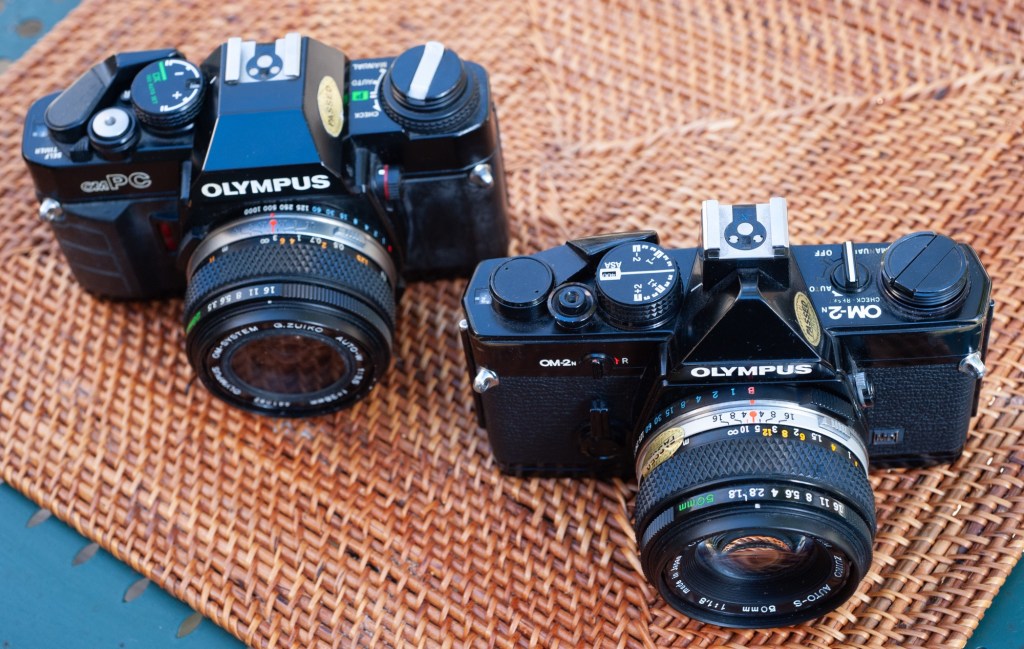
The commands are organized in a very similar “Olympus” way

One of the rules I had set when I started this blog fifteen years ago was that I would not write about a camera I had not tested with at least one roll of film. This post is one of the rare exceptions – there is no photo taken with the OM-PC. Because I could not resolve myself to shoot with an OM-PC, when I had an OM-2 waiting at my disposal.


Miami – Olympus OM-2.

The best OM (film) camera?

“Single digit” OM manual focus SLRs are some of the most beautiful and rewarding cameras of the film era – but some models are specially desirable:

  • OM-2 – it’s really two cameras in one – set it to manual, and you could believe you’re shooting with a semi automatic OM-1; push the selector to Auto, and a shutter speed scale shows up in the viewfinder, making it an aperture priority auto exposure camera. In my personal opinion, the OM camera to buy – not too complex, very compact, beautifully designed, and graced with an incredible viewfinder. The OM-2n is almost identical. Both run with easy to find SR44 batteries. You can find a good one for as little as $50.00.
  • OM-4t/OM-4ti – the t and the ti are the same camera – but with different names depending on the geography where they were sold, and on the finish of the top and bottom plates: made of titanium, some were painted black, some wore a more natural “champagne” color. Technically the OM-4t/ti is similar to the OM-4, except for the circuitry controlling the flash, which supports a “high speed sync” function. On those models, Olympus also fixed the battery drainage issue seen on the OM-2SP, OM-3 and OM-4. All the OM-4s have a very elaborate multi-spot metering option, and two high key and low key exposure compensation buttons on the top plate. The exposure values sampled (up to eight) are shown on a small LCD bar graph display at the bottom edge of the viewfinder. To me, it’s far too complex, but some photographers swear by it (and Canon shamelessly copied the multi-spot and high key/low key features on their T90). The champagne finish tends to be fragile and the cameras often look scruffy, but the black models are to die for if you like compact, all metal cameras. The scruffy ones sell for at least $250.00, nice copies can go up to $1000.00.
  • The OM-3ti was produced in very small volumes (assembled by hand – they were built using freshly manufactured OM4ti models as donor cameras). Not surprisingly considering how it was manufactured, the OM-3ti was also extremely expensive – in Leica M territory. Used copies are currently selling for anything between $1,500 and $3,000.

I would avoid: the OM-1 (because it needs mercury oxide batteries, which are impossible to find), the OM-2SP, OM-3 (non-t or non-ti models), and OM-4 (non-t or non-ti) because they all deplete their batteries extremely quickly due to issues with the design of their electronic circuits. Those issues were addressed with the t or ti versions of the OM-3 and OM-4.


More about Olympus cameras in CamerAgX
More pictures on CamerAgx.com Flickr Gallery
Learners cameras

Not totally happy with the pictures you get from a smartphone? Do you want more reach, do you want to capture fast moving action, or on the other hand, are you looking for more control over the depth of field, over the exposure? Do you want the images to be really yours, instead of leaving software developers in Cupertino or Mountain View decide for you how the pictures you’re taking should look like?  You need a “real camera” and you have to learn how to use it.

sony-nex3-and-leica-m-lens
A manual focus lens  mounted with an adapter on a mirrorless camera (Sony NEX 3 with Metabones adapter). A way to learn more about the technique of photography without making the jump to film cameras.

Obviously, nowadays, your first “learner” camera will be digital – digital accelerates the learning process – you can see immediately the result of changes in the settings, you can re-take the shot until the results corresponds to the scene you’ve seen with the eyes in your mind: remember, your eyes capture the information, but the processing is done in your brain.

But at some point, you may get tired of modern digital cameras as well. While not as automated as a smartphone, they still decide a lot of things behind the scenes (they set the focus, the exposure, they enhance the dynamic of the image, they sharpen) and it’s not always easy (or even possible) to take control back from them. Maybe you’re ready for something more demanding, but also more gratifying: film photography.

There are so many ways to shoot with film. If you don’t have the time (or the space) to deal with film processing, you can buy color film and have it processed and scanned by a lab – not exactly cheap (at least $0.50 per picture) but not too difficult.

Nikon_F4-7475
Don’t start with a camera like this one – too complex, too heavy (Nikon F4)

If you want the ultimate silver halide experience, you can set you own dark room, and process film yourself (Black and White, let’s keep it simple). The difficulty will be to scan it – unless you go completely analog, buy an enlarger and make your own prints like they used to do in the old days.

But in any case, you’ll need one (or a few) cameras.

Almost nobody makes new film cameras anymore. So your camera will be an “old” one, bought on eBay, at Shopgoodwill, or from the stores specializing in analog cameras.

If you ask Google about learners film cameras, most of the articles they reference will suggest a manual focus camera from the mid seventies to early eighties – like the Canon AE-1, the Minolta X-700, the Nikon FM, or the Pentax K1000.

Pentax--6054
This Pentax Spotmatic SP can’t be recommended either – too old (1964), too primitive technically. Pick a camera from the mid-seventies or later.

For a reason. Older cameras (let’s say pre-1975) are generally bulkier, have a more primitive exposure metering system (when they do have one at all) and require batteries which are impossible to find today. They often use textile (silk) in their shutter mechanisms, and tend to be fragile. On the other hand, most of the cameras sold after 1990 are not that different from the autofocus, motorized monsters we use today in the digital world.

  • why manual focus? The assumption is that if you shoot film, it’s because you’re not in a hurry and therefore can take the time to set the focus on your own. Personally I like to focus manually, it leaves me more time and opportunities to look at the image and consider the composition, the depth of field and the exposure.
  • Focusing manually lets you determine what part of the picture will be 100% in focus, and with the help of the aperture ring and of a depth of field lever, determine what will be out of focus and pleasantly blurred.

2020-04-Pentax-6660
For learners, Pentax launched in 1997 a manual focus version of the ZX-5. Canon and Nikon also had previously created “autofocus-less” versions of their autofocus cameras. The focusing screen of the ZX-M is designed for manual focusing (split image telemeter and ring of microprisms) but the viewfinder is on the narrow side.

  • Using a camera with an easy to use semi-automatic exposure system (matching needle or LEDs), you can take all the time you need to determine the perfect settings, or in doubt, take multiple shots at different settings. You can also more easily compensate for the limitations of the metering system (average weighted metering can be easily fooled by a bright sky – but it’s also easy to understand how it’s being fooled and take countermeasures).
    Interestingly, you don’t necessarily need a semi-auto camera – some automatic cameras like the Nikon FE are absolutely great when used in semi-auto mode (better than most native semi-auto SLRs).
  • one camera or more? considering you can get film cameras for a few dollars, why buy only one? Just remember that experience and muscle memory play a role – the more you shoot with a particular camera (or with cameras of the same generation and from the same manufacturer), the higher your chances of catching the “decisive moment” and get the picture of your life.
  • Lenses – not as cheap as cameras (at least, the good ones). You can buy prime lenses, you can buy zoom lenses (if they were released in the late eighties or later and come from one of the great camera manufacturers, they’re generally good enough). Canon, Minolta, Olympus have all abandoned their old FD, MD or OM mounts when they introduced their autofocus cameras, but Nikon and Pentax have been using the same family of bayonet mounts since 1959 (Nikon) and 1976 (Pentax). You have more options with those two brands even if the compatibility between different generations of camera bodies and lenses is somehow limited.
  • Film – I know it’s fashionable to use bad film (expired stock, film engineered to look like stock from the 60s, not to mention monstrosities like pre-scatched film …). I believe my images deserve better than that and I buy the best film I can find. The choice is up to you.

So, what camera?

This list is about cameras I know – for having burned at least a few rolls of film with them, and which meet my definition of a learners camera. There are other good manual focus cameras that make great learning tools (the Minolta X series for instance) but I never tested them, and interesting cameras (Nikon F3, Canon A-1 or T90, the rangefinder Leicas, the Contax ST) that are a bit too complex and expensive to make it to this list.

I did not include any Fujica, Contax or Mamiya SLR in this list, a learner will need a set of lenses (a couple of wide angle lenses, a short tele, maybe a zoom) and they tend to be difficult to find (and expensive) if you leave the usual gang (Canon-Minolta-Nikon-Olympus-Pentax).

The list….

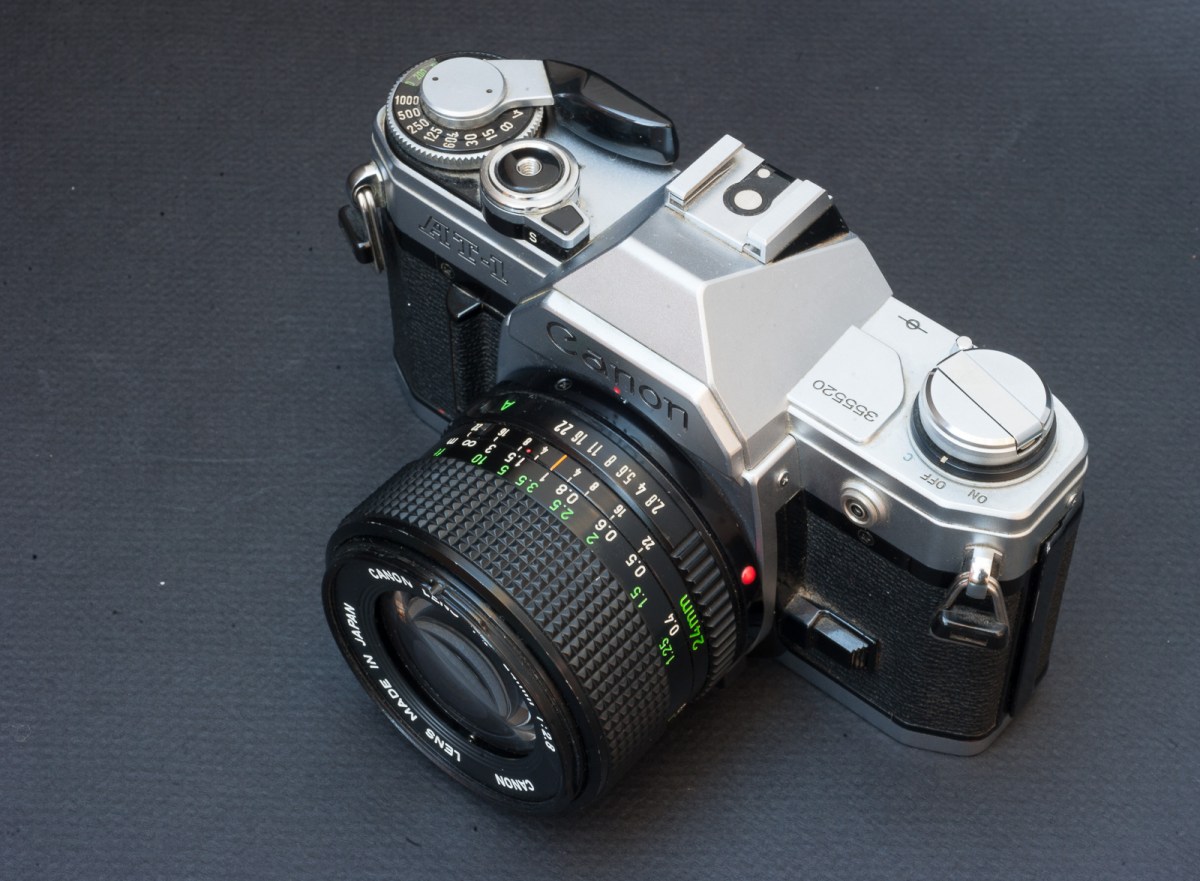
  • if you love Canon, you can go with the AT-1 (instead of the AE-1 or the AE-1 Program): it’s half the price, and easier to use in manual (semi-auto) mode. All right, it needs an easy to find battery to operate. But it has a good viewfinder and you can’t beat its simplicity.

Canon_cameras-6372

  • if you love Nikon (and in particular if you’re using a full frame Nikon dSLR), go with the FM or the FE, or for a little more money, for the FM2 or the FE2. Avoid the EM, FG or FA – they’re too automatic, and don’t leave you enough control on your images. You can also pick an early autofocus camera like the N2020 (F501) and use it with manual focus lenses. It works very well.

Nikon FE2

  • If you love Pentax, don’t follow the crowd and don’t buy a K1000. Far too primitive (it’s a derivative of the Spotmatic F of 1973, itself derived from the original Pentax camera of 1957). Similarly, be prudent with Pentax cameras of the late seventies/early eighties: in my experience, they tend to be a bit fragile.
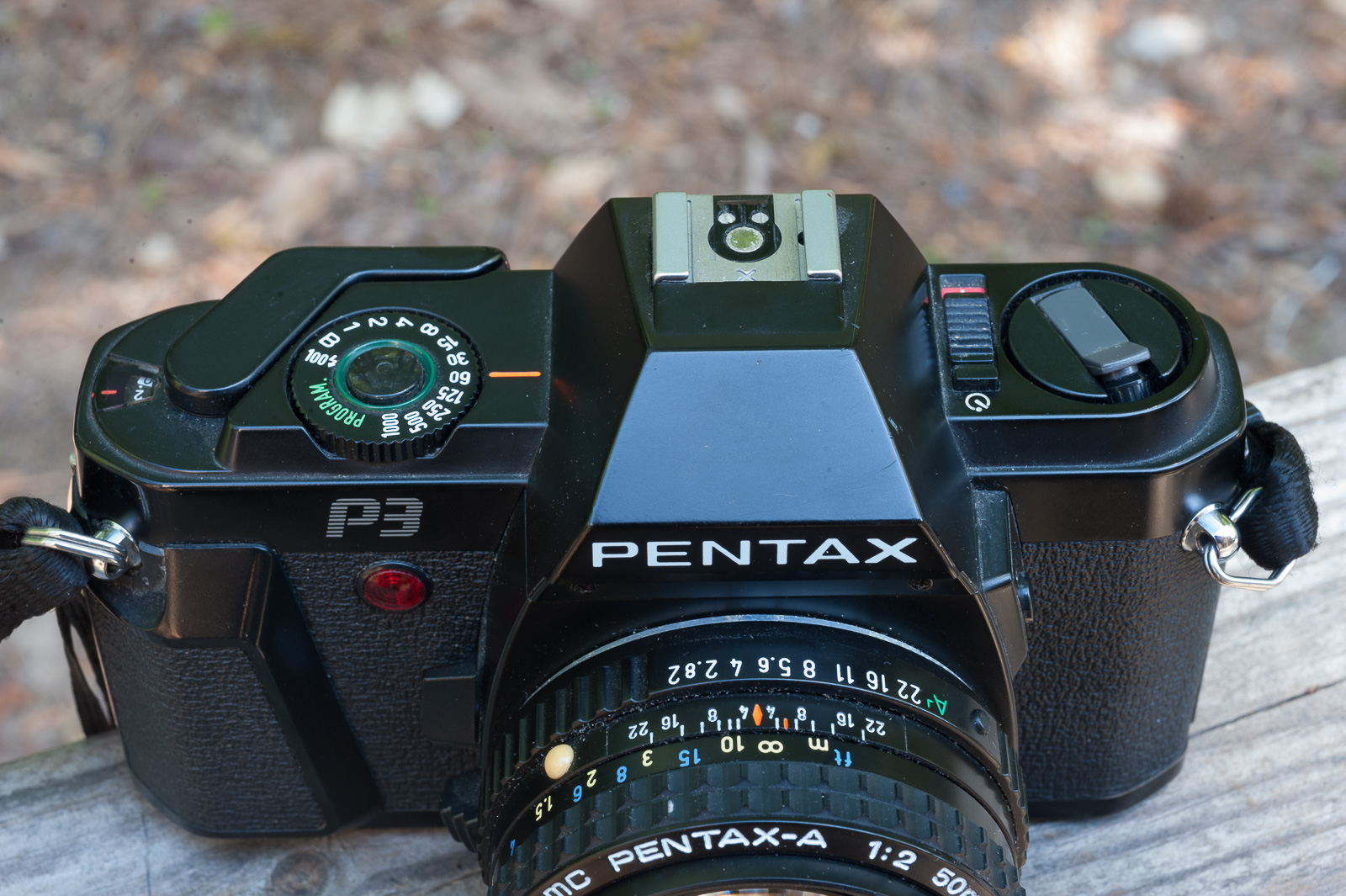
    The P3 from 1985 was not really designed as a learners camera (more as an affordable and easy to use manual focus camera) but it’s not artificially spec’d down and that would be my choice in the Pentax family. When the K1000 and the P3 needed a replacement, Pentax created a camera designed specifically for learners, the XZ-M and sold it until 2004. It’s a modern autofocus motorized camera with 4 exposure modes (PASM) – but without the autofocus system and the built-in flash. It’s built out of plastic therefore feather light, but Pentax also saved weight and money on the viewfinder which is narrower than the norm.
    The ZX-M is an interesting camera, but the P3 (P30 in the rest of the world) is probably a better choice. By default it operates in program mode, but the semi-auto mode works very well, the viewfinder is large, and the build quality is good (the camera were still made of metal at that time).

2020-04-Pentax-6677
The Pentax P3 – a long production run – and one of the last mass market non motorized SLRs. It’s designed to work in Programmed Auto exposure mode, but if the aperture ring of the lens is not set in the A position, it becomes a semi-auto camera. It is the same camera as the P30 (Pentax used different model names for the US market).

  • Olympus – don’t go for the OM-1 – it needs 1.35v batteries which are a pain to find and use. Go for the OM-2 – it’s automatic, but you can use it as a semi-auto camera. Smooth as a peach, great viewfinder, ideal if you shoot in places where you can’t use a tripod or a flash. The best of both words. Later models are either plagued by battery management problems (OM-2sp, OM-4), or extremely expensive (OM-4ti).

Olympus OM-2s and Olympus OM-2n
Olympus OM-2n and Olympus OM-2S program – the OM2n (left) is the one to pick

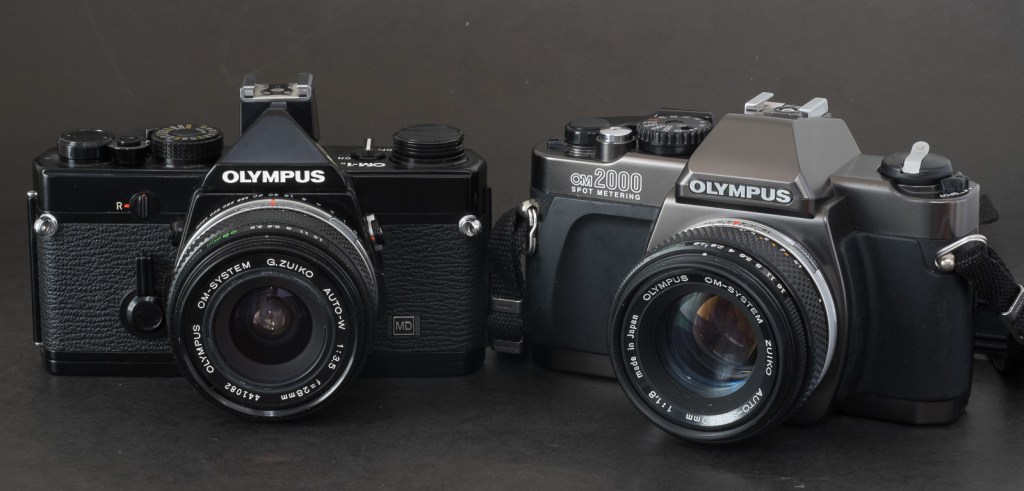
  • The Canon T60, Nikon FM10, Olympus OM-2000, Yashica FX-3 2000 and a few other Vivitar cameras were designed and manufactured by Cosina in the nineties to be sold as gateway and learners cameras under the label of the big brands – they’re not identical – but they’re built on the same technical platform. They all work OK as learner cameras, but the genuine Canon, Nikon or Olympus cameras are much nicer objects, much better built, and will provide more satisfaction (even if the results should be more or less equivalent).

OM-2000-6206
Same lens mount – totally different cameras – Olympus OM-1 and OM-2000

  • Autofocus SLRs are cheap, and the early ones are dirt cheap. But if you use an autofocus SLR in full auto mode to shoot color print film and download the scans after the Noritsu and Fujifilm processing machines have played their magic on your negatives, how different is the experience going to be from shooting with a digital SLR? Admittedly, some early autofocus SLRs are still relatively simple and easy to use and will increase your success rate, but you won’t learn as much as with an older manual focus camera.

Come on. Shoot with film. It’s not that hard. In fact, it’s a lot of fun.


Venice - gondoliers
Venice – Gondoliers in the sun set. Nikon FE2. Fujicolor 400 film