I have too many cameras and my recent interest for Pentax film cameras means that my small Contax collection must go – splendid cameras, superb lenses, but I don’t use them enough.
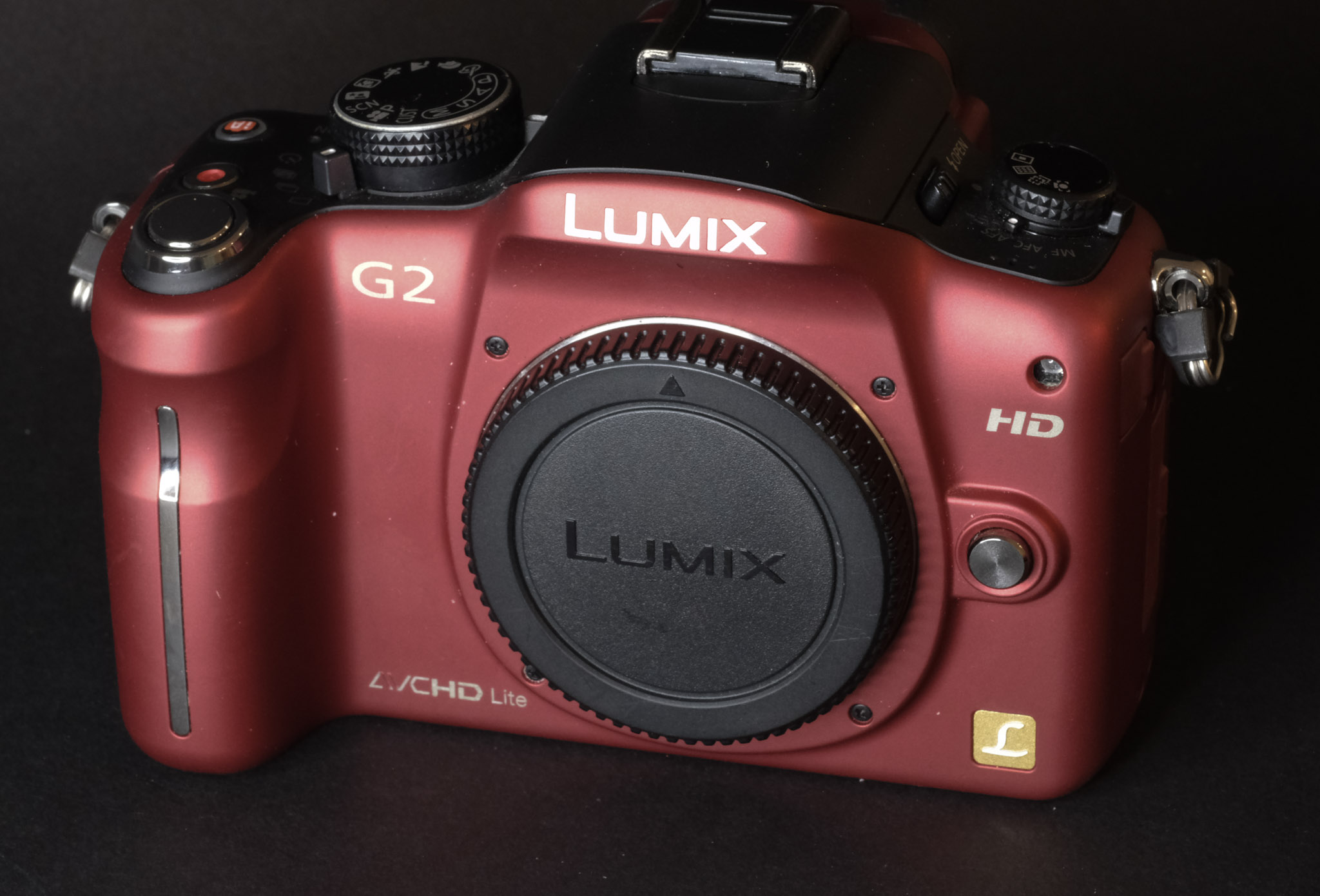
As for the Panasonic G2, it’s cute but too close in size and weight to my current Fujifilm equipment, and I know I won’t use it.
A prestigious sub-brand of the famous Carl Zeiss company, Contax had stopped manufacturing its own cameras when it licensed the use of its brand name to Yashica in 1975.
Contax’s unique selling proposition: the Carl-Zeiss lenses
Along the seventies and the eighties, Yashica developed two lines of Contax SLRs: a line of pro-models (the RTS followed by RTS II), and a line of more consumer oriented products (137, 139, 159, 167) for well heeled enthusiasts who did not want to pay for and carry around a large, heavy and very expensive pro camera. Without reaching the production volumes of Canon or Pentax, the Contax cameras of this era still sold in respectable numbers (200,000 units for the Contax 139, for instance).
The Contax SLRs of the nineties all follow the same design language, and the organization of the commands is almost identical.
The cameras were technically on par with the competition and benefited from a very attractive design, but their real differentiator was their access to a line of interchangeable lenses carrying the Carl Zeiss brand.
With the advent of autofocus systems (Minolta opened the fire in 1985 with the Maxxum, soon to be followed by all other major Japanese camera makers), manual focus cameras found themselves rapidly relegated to two niches: cheap entry level / learners cameras on the one hand, and high end products for traditionalist photographers who preferred a conventional user interface and a full metal construction, on the other hand.
Contax RTS from 1975 – the first fruit of the cooperation between Yashica, Carl-Zeiss, and Porsche Design – Photo Courtesy Jean-Louis Beek
Contax, having declined to adopt autofocus, did not have products for the heart of the market anymore, and had no interest in selling entry-level models. They focused on the high-end of the market, trying to create cameras for each of the many small niches composing the “traditional, manual focus cameras” market.
Aside of the Contax ST already reviewed in those pages, what was Contax selling in the nineties?
RTS III – the “pro” camera of the Contax family – with more or less the same specs as the ST, but with a unique flash metering system, a faster motor, more “pro” features such as mirror lock-up and a unique vacuum back to keep the film flat during the exposure, but also more heft and much more weight,
S2 and S2b – semi-auto only, with spot meter only (S2) or average (S2b) metering only – two very spartan cameras at the polar opposite of the RTS III – for a totally different – and minimalist – experience,
RX – the successor of the ST, launched 2 years after. Most people posting in forums tend to prefer the RX to the ST, because of its focus assist and a lower weight. But it needs Lithium batteries (lighter than the AAA batteries of the ST, they are expensive and difficult to find nowadays) and its lower weight is due to a more liberal use of plastics in its construction, which is not to everybody’s taste. It was succeeded by the RX II, almost identical cosmetically but deprived of the focus assist system.
AX – its absolutely unique autofocus system (where the photographer sets the (manual focus) lens to the infinite, and the whole film chamber of the camera moves forward or backwards to adjust the focus) makes for a very large SLR (it looks more like a medium format camera, actually) – a curiosity.
Aria – the last of the Contax manual focus line – launched in 1998, with a set of specs similar to the ST’s, but in a smaller body, and with matrix metering. Some people like it for its reduced weight and size, other photographers hate that it’s built (at least in part) of painted polycarbonate (plastic). I still have to test one, but that’s the only one I would consider as a substitute to the ST.
Contax Aria – the last 35mm manual focus SLR from the brand – the design and the general disposition of the controls are almost identical to the ST’s, but the camera is lighter and smaller. (Source: Ground-Glass.net)
In addition to its line of 35mm SLRs, Contax also launched an autofocus, modular medium format camera, the 645 in 1999, a well received line of autofocus rangefinder cameras (G1, G2), and many “premium” compact cameras – which are highly sought after today.
The last years
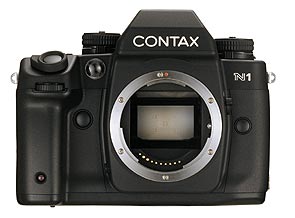
Contax finally launched their first autofocus 35mm SLR, the Contax N1, in 2000, but it came far too late to make an impact on a market already moving to digital. To add insult to injury, the autofocus lens mount was not compatible with the C/Y mount of Yashica’s and Contax manual focus cameras, or with Yashica’s own autofocus lens mount – in fact, it had more in common with Contax’s own medium format camera system, and was technically very close to the mount designed by Canon for its EOS cameras.
Contax N1 – the autofocus SLR – apart from the industrial design and the general organization of the controls, very little in common with the manual focus SLRs of the brand. (Source: Contax)
The digital version of that camera, launched in 2002, was the first attempt by a major vendor at selling a full-frame 24x36mm dSLR, but the sensor they were using was simply not good enough and the camera made a flop.
Contax N Digital (Source: Contax UK). The first dSLR with a 24x36mm full frame sensor.
Kyocera (the Japanese ceramics giant that had bought Yashica in 1983) – finally pulled the plug on all its photographic activities in 2005, and the Contax brand has not been used since. At the time it left the photography market, Contax was still selling 35mm film SLRs (the Aria, the RX II and the RTS III, and the autofocus N1 and NX), a medium format film camera system (the 645), a line of expensive compact point and shoot cameras (film and digital) and its full frame 35mm digital SLR, the N Digital.
More about it:
The Web site of Contax-UK (frozen in 2005) – surprisingly it’s still up, 15 years after Contax withdrew from the photo equipment market:
Atlanta – Centennial Park – Contax ST – Carl-Zeiss Vario Sonnar 28-85 f/3.3-4.0 – Kodak Ektar 100Atlanta – Contax ST – Carl-Zeiss Vario Sonnar 28-85 f/3.3-4.0 – Kodak Ektar 100
Today I received the scans of two series of pictures I had taken in the Atlanta area at the height of the Covid-19 pandemic (which explains that the parks and the streets look empty).
Over the last couple of months, I’ve used alternatively my most recent acquisitions, a Contax ST with its very (very) large Contax-Carl Zeiss Vario Sonnar 28-85 f/3.3-4.0 lens, and a Pentax P3 with its very (very) small Pentax SMC-A 35-70 f/3.5-4.5 zoom.
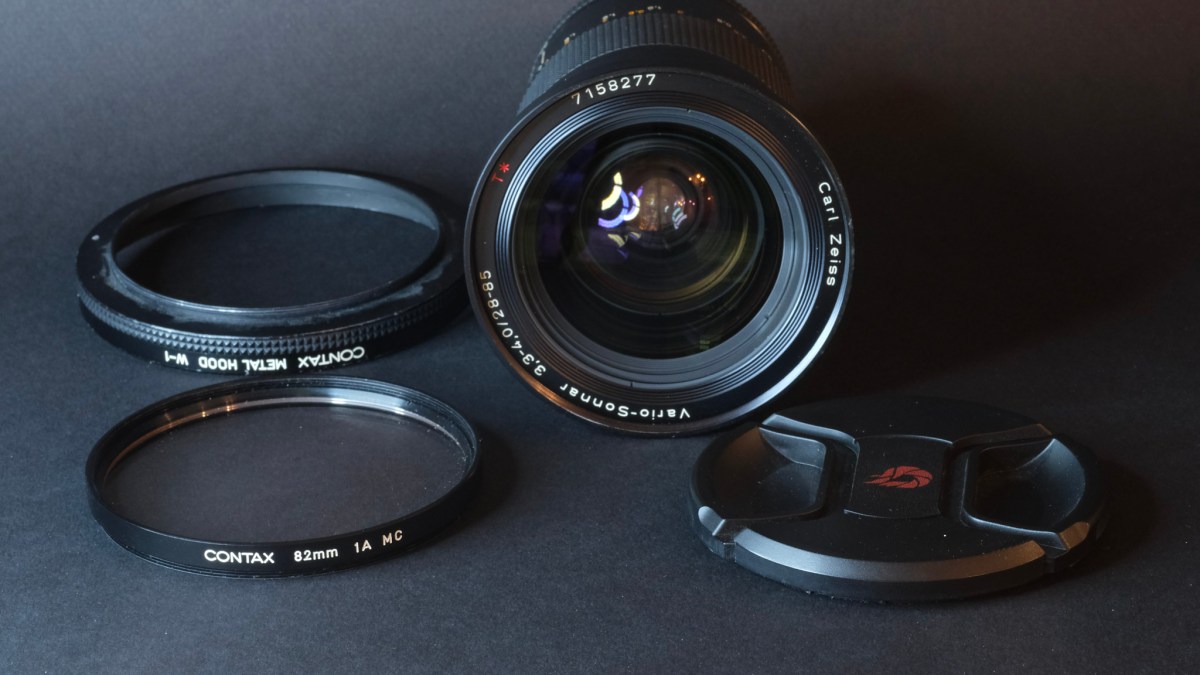
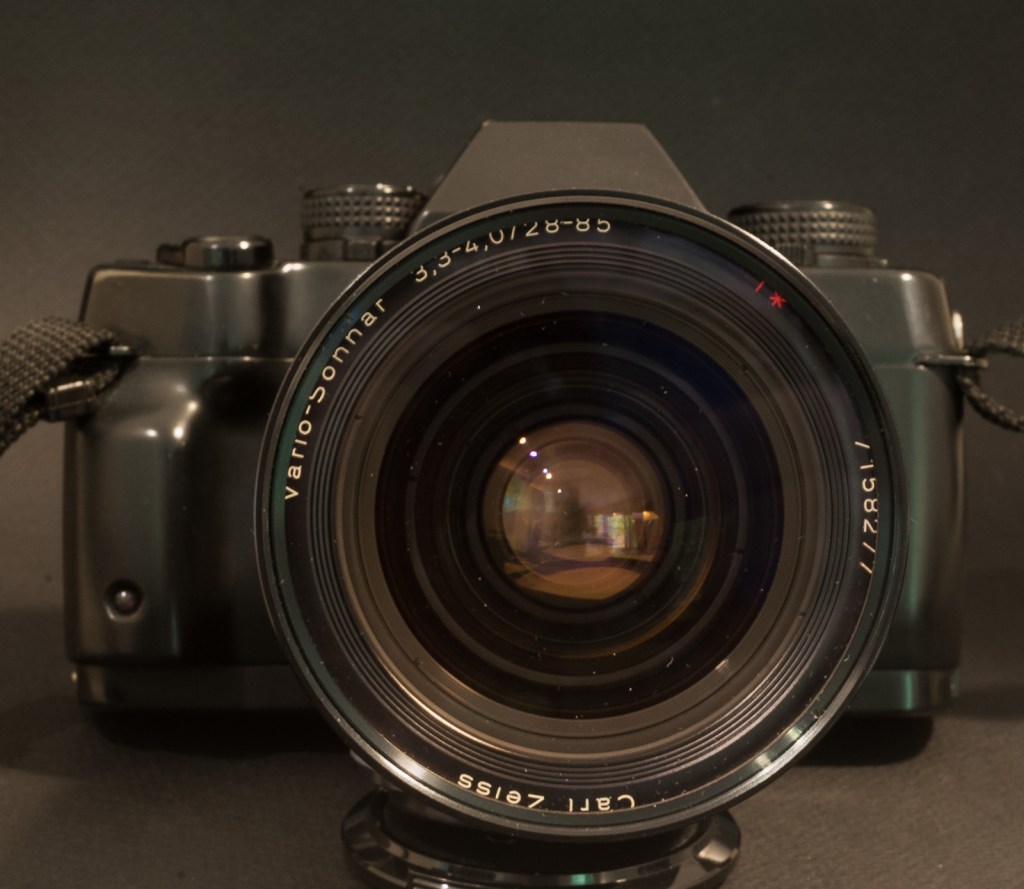
Contax ST and Carl-Zeiss Vario-Sonnar zoom – 28-85 f/3.3-4.0
First observation – almost all pictures are usable – correctly exposed, with the subject in focus. No major flaw with any of the cameras or zooms.
Second observation: I knew that this Contax ST had an issue with the transmission of the value of the aperture selected on the lens to the body, and I set it with a permanent correction of +1.3 EV to counterbalance it. It’s probably too much – I’ll reduce the correction to +0.5 EV in the future. I experienced difficulties with the film rewind on the P3 (I had to open the film door in a dark room and push maybe 6 inches of film back into the cartridge) but only one frame was lost in the process. I suspect the issue to be related to the film receiving spool. Both cameras are approximately 30 years old, they can be temperamental.
Third observation: both cameras have all the features I need (aperture priority auto mode, semi-auto mode, exposure memorization) and a good viewfinder (the Contax’s is fantastic, the Pentax’s is very good considering the original target audience of the camera). Both are really pleasant to use. The Contax is definitely a big and heavy camera, and the lens is even larger and more ponderous. When you use the Contax combo, you get noticed, and you make some people nervous (carry it in a bag, and don’t shoot with it in an area where people tend to be very concerned for their privacy – that would be asking for trouble). The Pentax set, on the other hand, is compact and light, and does not draw attention. But there is a trade off to compactness: image quality.
Pentax P3 – all controls are well placed and large enough, even for photographers with big hands
Which bring us to our fourth observation. My intent was not to perform a scientific comparison between the Zeiss and the Pentax zooms. I shot the pictures on different days at different locations, but since it was in the same type of urban settings, and with the same type of film (Kodak Ektar 100), we can somehow compare the pictures and draw some conclusions. Sorry Pentax fans, the difference is extremely visible. I may have bought a bad copy of the lens, the front element may be dirty (I did my best to clean it, though), but in any case there’s a world of difference between pictures shot with the Vario-Sonnar and the SMC-Pentax-A zoom, in particular when it comes to contrast and sharpness. Thirty years ago, I was using a Pentax KA 35-70 zoom on my Pentax MX (I don’t remember if it was the same f/3.5-4.5 version of the lens, or the constant F/4 model) and I was pleased with the results, so not all Pentax zooms are bad, and I’ll shoot with another Pentax lens as soon as I can.
After I imported the scans in Lightroom, I made adjustments to the exposure and the highlights (the sky was over exposed by both cameras), and I tried to increase (massively) the contrast on the images taken with the Pentax lens, but Lightroom sliders can only do so much if the original picture is too soft. See for yourself.
A word of caution: you won’t see much of a difference if you look at the pictures on a good smartphone – the screen is small and smartphones are very good at enhancing images – but it’s more visible on a tablet, and pretty obvious on the monitor of a full size personal computer. Also, remember that WordPress displays the images of this blog at a relatively low resolution (width: 1024 points) – to really visualize the difference in image quality, click on the images and you will see them full size(they were scanned at 3130 x 2075 points).
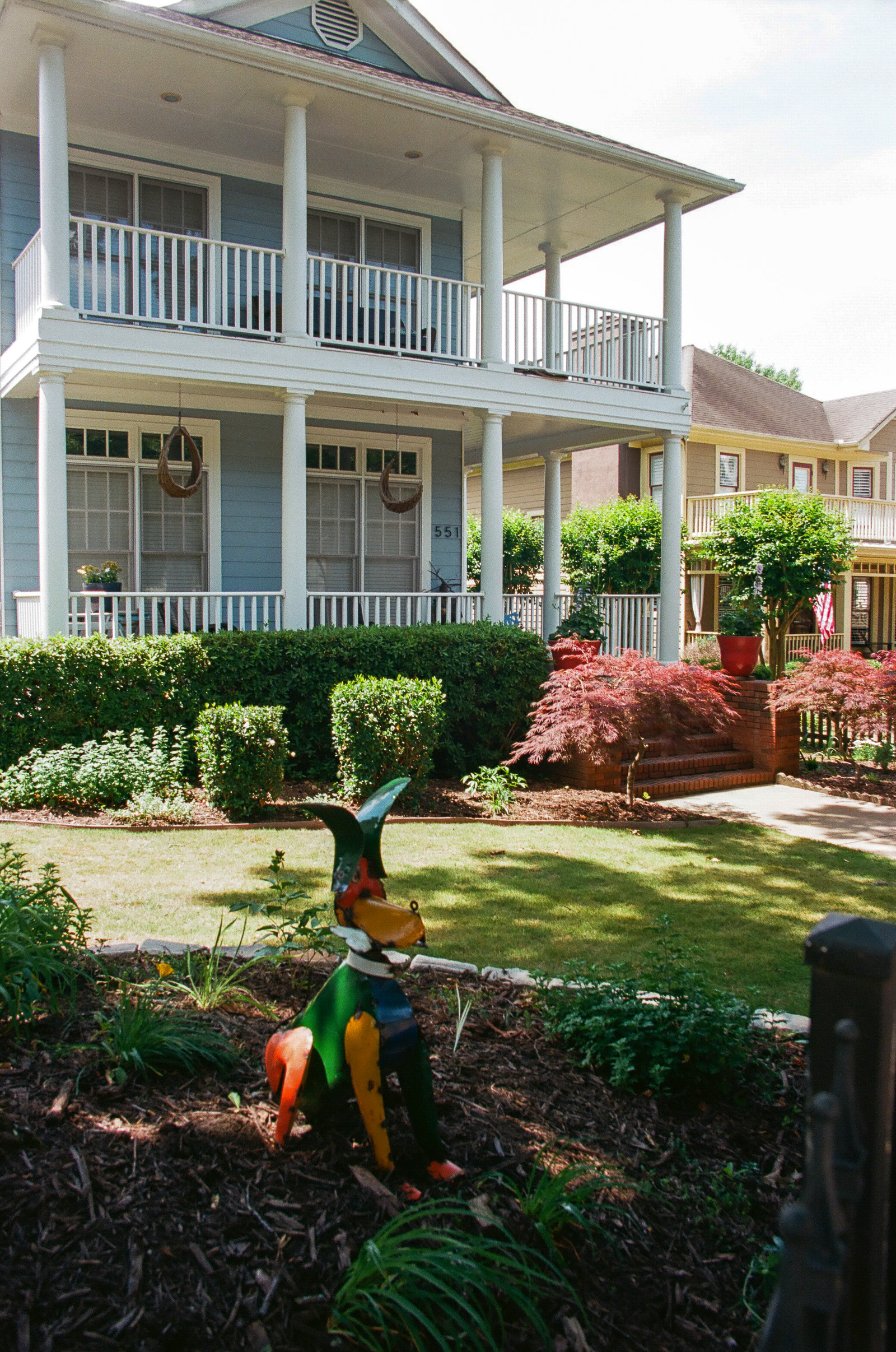
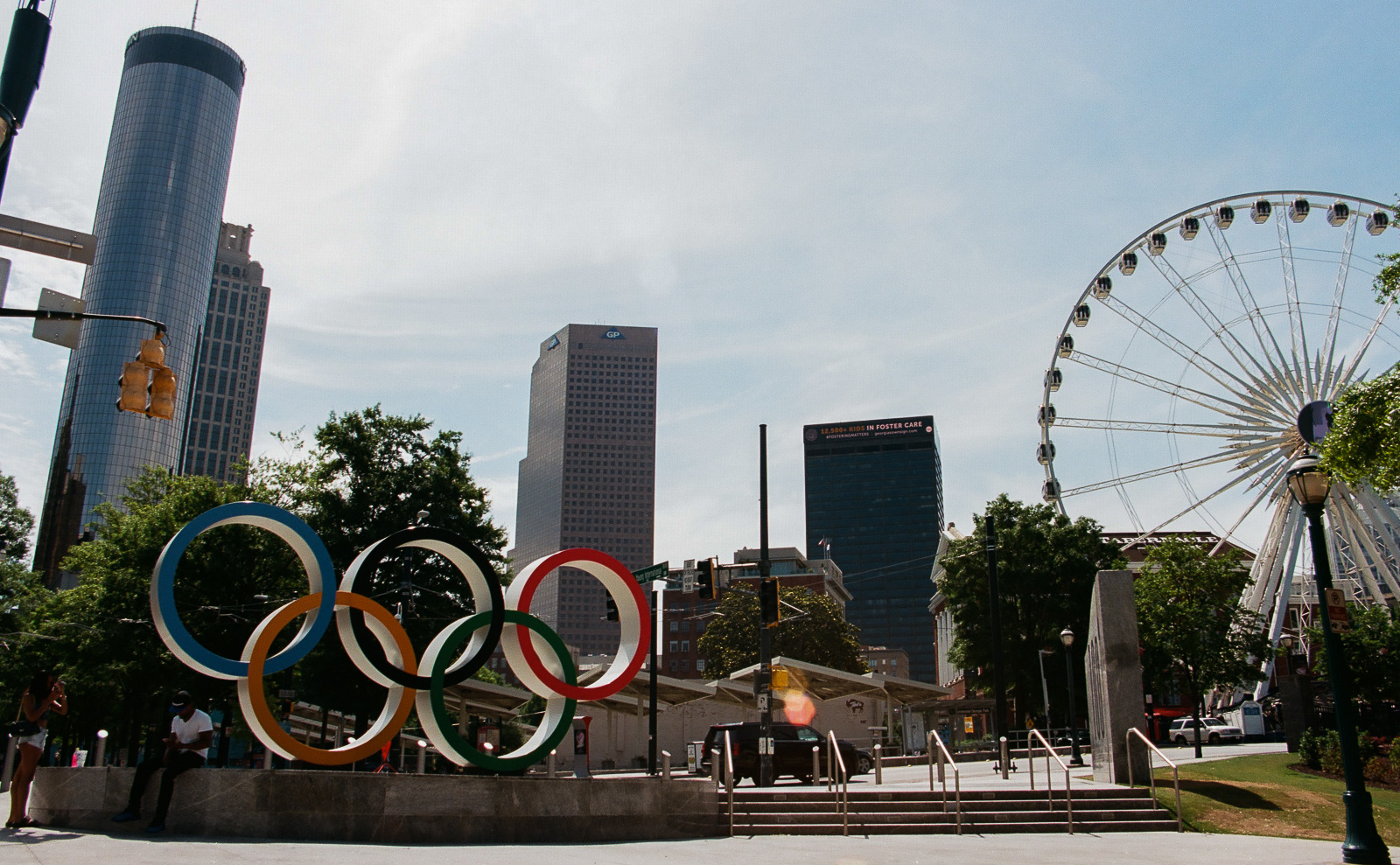
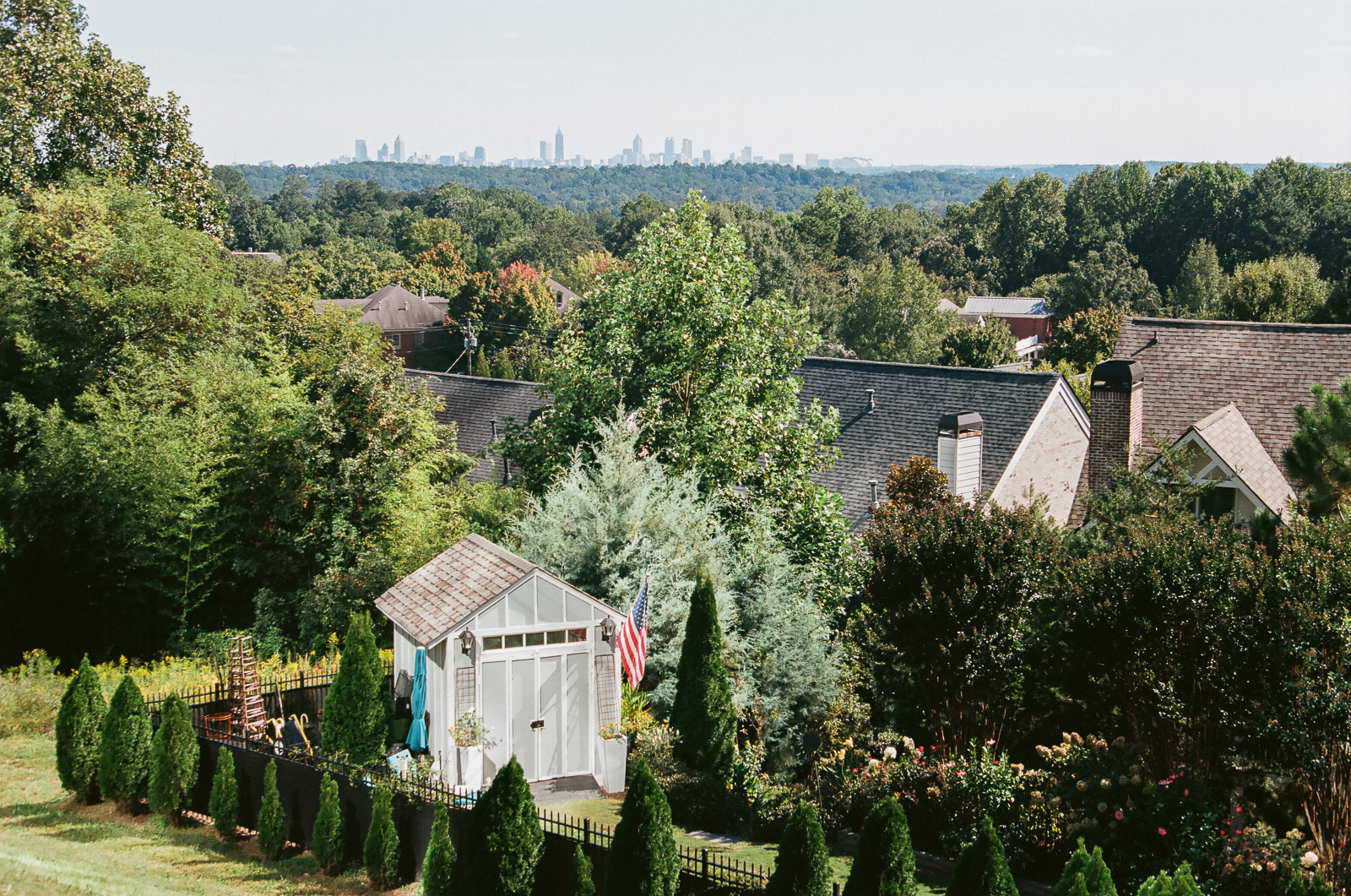
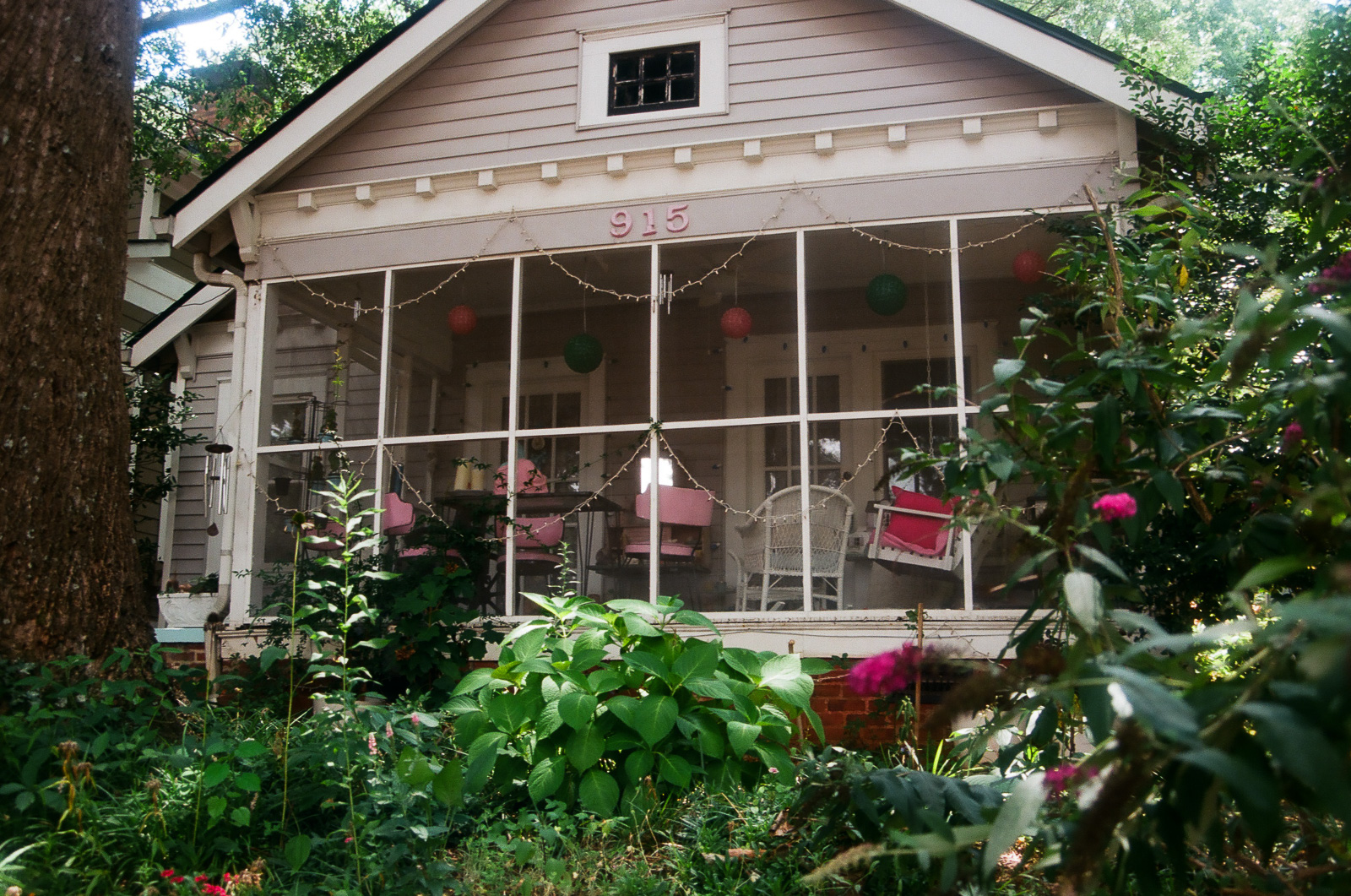
Atlanta – Krog Street – Contax ST with Vario-Sonnar 28-85 f/3.3-4.0 – Kodak Ektar.Atlanta – Centennial Park – Contax ST with Vario-Sonnar 28-85 f/3.3-4.0 – Kodak Ektar.Atlanta skyline from the Vinings Mountain – Contax ST with Vario-Sonnar 28-85 f/3.3-4.0 – Kodak Ektar.Atlanta – Old Vinings Inn – Contax ST with Vario-Sonnar 28-85 f/3.3-4.0 – Kodak Ektar.Lely Freedom Horses – Naples, Florida – Pentax P3 – Pentax SMC-A 35-70 f/3.5-4.5 – Kodak EktarLely Freedom Horses – Naples, Florida – Pentax P3 – Pentax SMC-A 35-70 f/3.5-4.5 – Kodak EktarAtlanta – Yellow Bronco Violet House – Pentax P3 – Pentax SMC-A 35-70 f/3.5-4.5 – Kodak EktarAtlanta – Pink house- Pentax P3 – Pentax SMC-A 35-70 f/3.5-4.5 – Kodak EktarAtlanta, Little Five Points – Pentax P3 – Pentax SMC-A 35-70 f/3.5-4.5 – Kodak Ektar
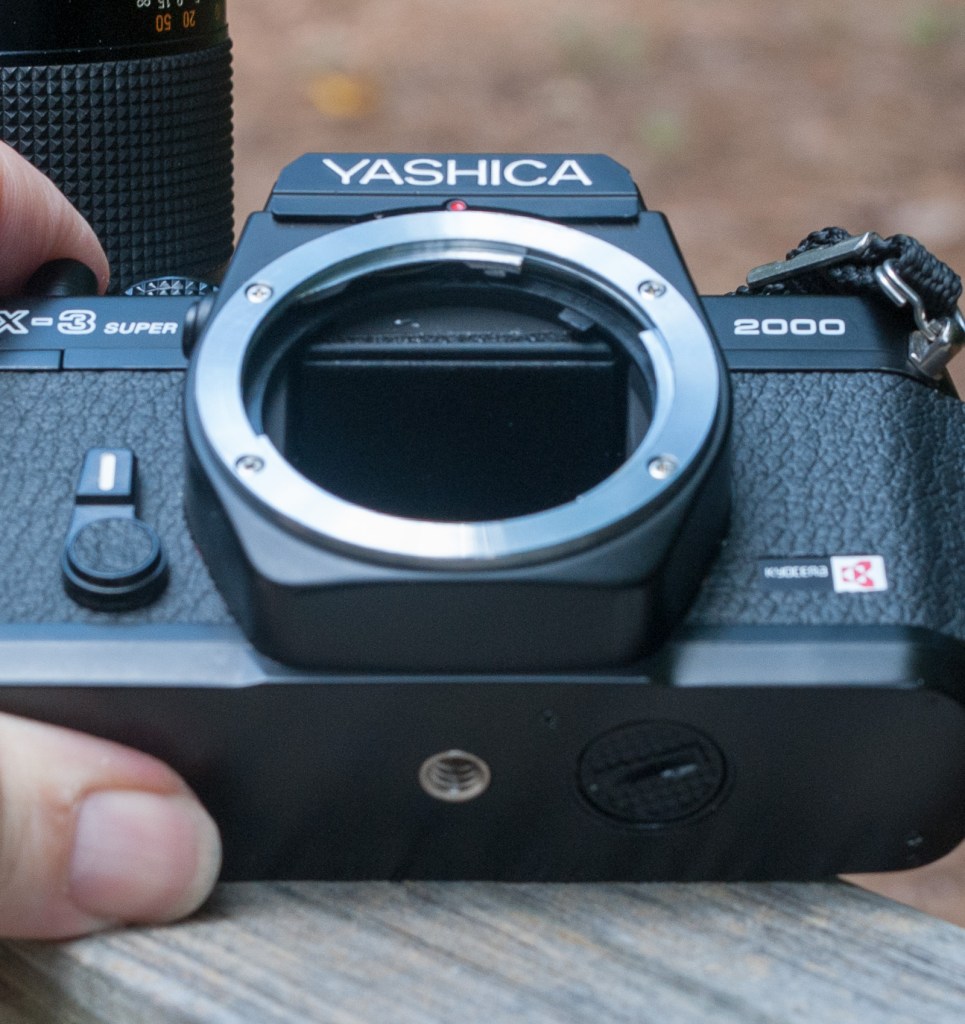
I know. It’s provocative. But don’t buy a Yashica FX-3 without ensuring first that you have a good hair dryer in one of your bathroom cabinets.
Google and a hair dryer to the rescue
When I received the FX-3, the camera seemed to work perfectly with no lens mounted, but as soon as a lens was in place, the reflex mirror was refusing to return into its normal position at the end of the shutter release cycle, making the camera unusable. But as soon as I was removing the lens, the mirror was returning back into its normal position.
Google is my best friend, and I rapidly learned that the Yashica FX-3s are renown for their sliding mirror problem. Over time, the mirror (which is glued to a part I’ll call the hinged mirror holder) tends to slide forward, and after some time (years? months? weeks?) it has moved so much that it hits the back of the lens, preventing the shutter release cycle from completing. The solution? Use a hair dryer to soften the glue, and gently push the mirror a few tens of a millimeter back, to the top of the mirror holder. I tried, and it worked. I can now use the camera – I just don’t know how long this fix will operate, and how often I’ll need to give the camera a hair do.
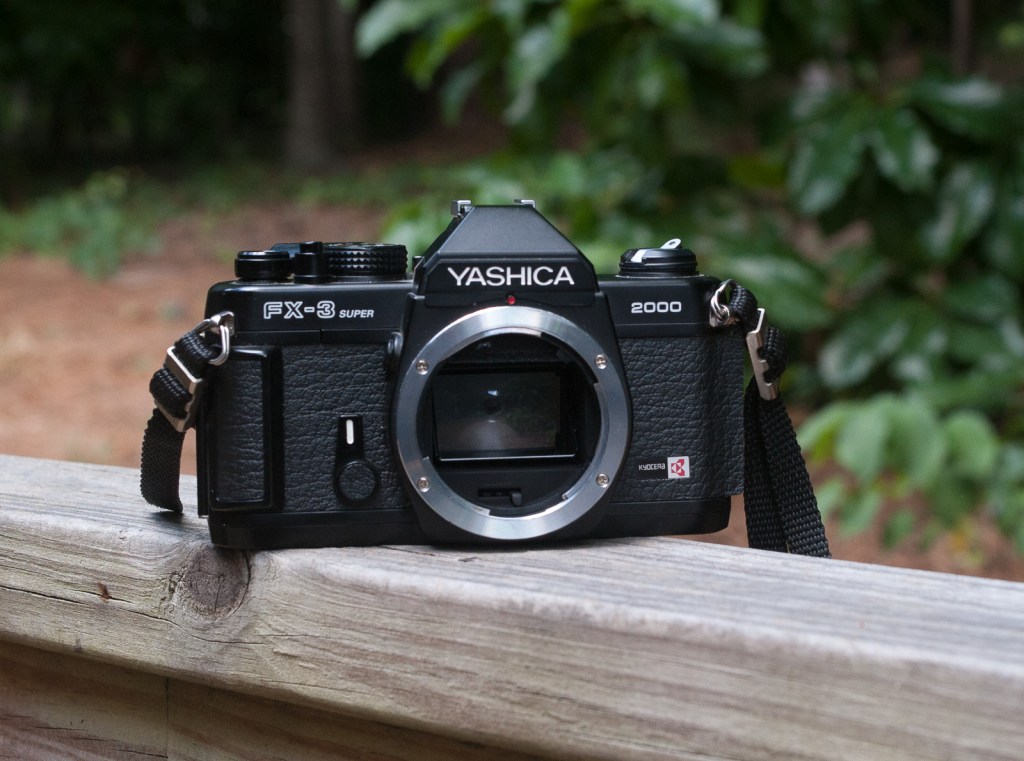
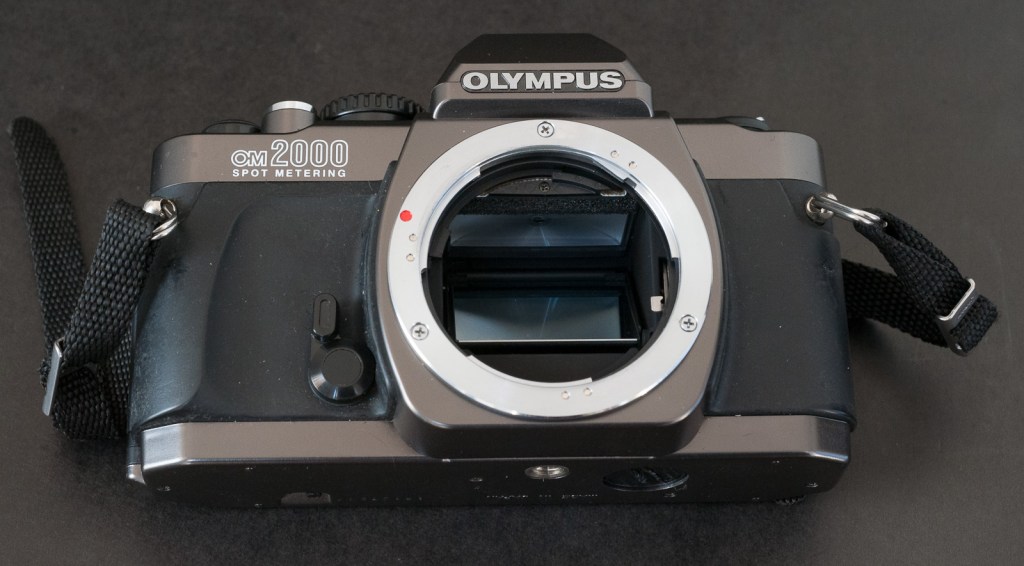
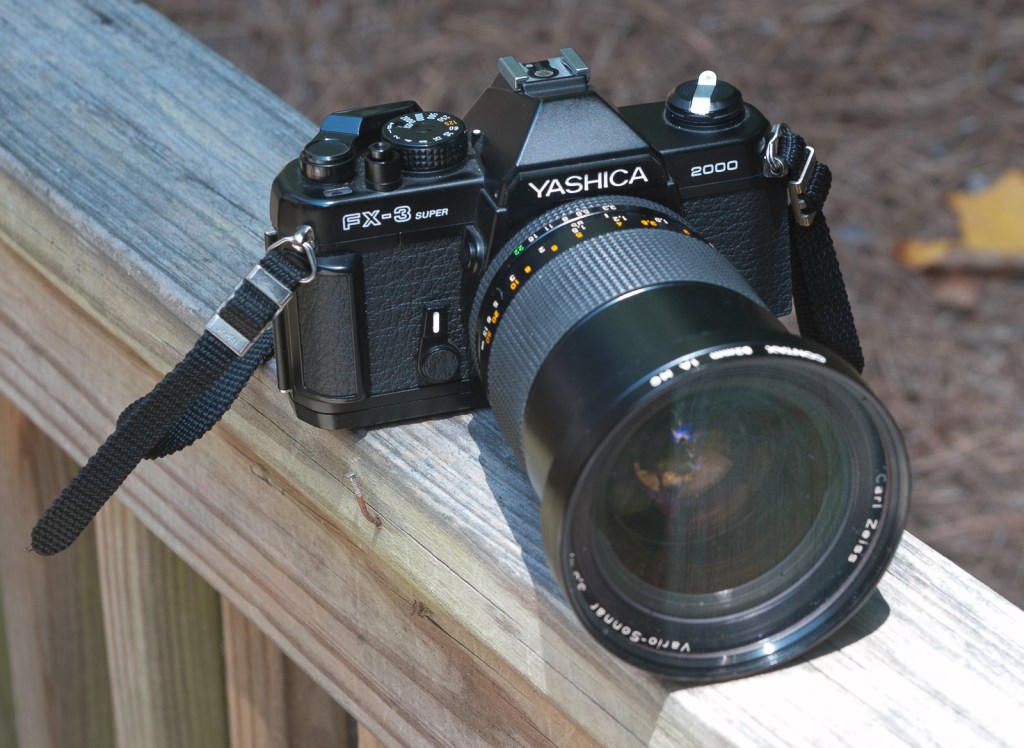
Yashica Super 2000 – a very compact (and very light) camera of very conventional design.Olympus OM 2000 Spot Metering – very similar to the Yashica Super 2000.
Yashica’s FX-3 series
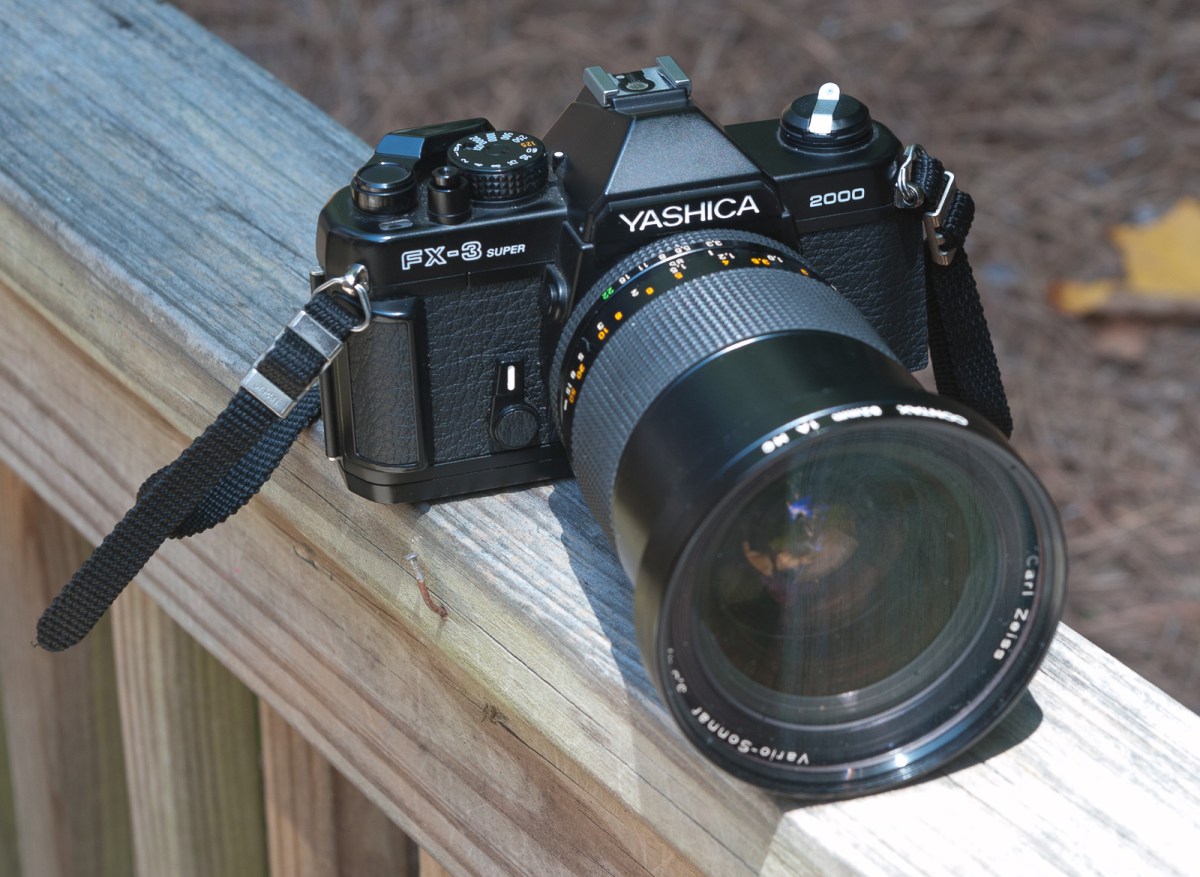
The FX-3 Super 2000 is the final declination of a line of simple semi-automatic, manual focus cameras, released by Yashica between 1979 and 1986. Before the FX-3, Yashica had launched two FX models, but they don’t belong to the same technical family – the early FXs were largely derived from cameras sold before Yashica adopted the Contax/Yashica bayonet mount: the FX-1 from 1975 (an aperture priority automatic camera), and the semi-automatic FX-2 from 1976 still incorporate CdS cells for metering and require mercury oxide batteries. The FX-3, like the FX-3 Super and the FX-3 Super 2000 that followed, incorporates a silicon cell and is powered by a pair of ubiquitous SR 44 silver oxide batteries.
FX-3, FX-7, FX-3 Super, FX-7 Super and FX-3 Super 2000: the differences
The black bodied FX-3 and its chrome finished sibling, the FX-7, are semi-automatic SLRs, with a silicon cell meter activated by a dedicated push button at the back of the body – in the Yashica tradition. Their fastest shutter speed is 1/1000s, and their meter is coupled from 12 to 1600 ISO. Exposure information is communicated to the photographer by 3 LEDs in the viewfinder. And thanks to their Contax Yashica bayonet lens mount, they accept any Yashica lens from the ML, MC, YUS and DSB series, as well as Contax Carl-Zeiss lenses. Older screw mount Yashica lenses can probably be used, provided you can locate a 42mm Universal to C/Y mount adapter.
On the “Super” versions, the meter is activated by a light press on the shutter release button, and a (very) small vertical grip has been added on the front right side of the body.
The Super 2000 is only available in black, its shutter speed now peaks at 1/2000 sec, and the meter is coupled from 25 to 3200 ISO.
Considering that old lenses tend to be more luminous than the zooms we use today (manual focus 50mm f/1.4 lenses are very affordable) and that 400 ISO film is often easier to find than 100 ISO stock, having a faster shutter speed is an important plus – I picked the Super 2000 for that reason.
Is it another derivative of the Cosina CT-1?
Check Wikipedia and similar sources – you’ll see the FX-3 is generally presented as a Cosina-designed and manufactured camera.
Before they bought and relaunched the Voigtlander brand, Cosina was selling is own line of compact cameras and SLRs, but was primarily known as a sub-contractor of the big camera makers – at some point, Canon, Nikon and Olympus were all selling, under their own brands, cameras that were manufactured (and to a large extent) designed by Cosina.
The fact is that Cosina was very good at deriving unique designs from a common base – the Cosina CT-1 semi-auto SLR is generally seen as the common basis for cameras as different as the Canon T-60, the Nikon FM10, the Olympus OM-2000, and Cosina’s own line of rangefinder products (the Voigtlander Bessa R series).
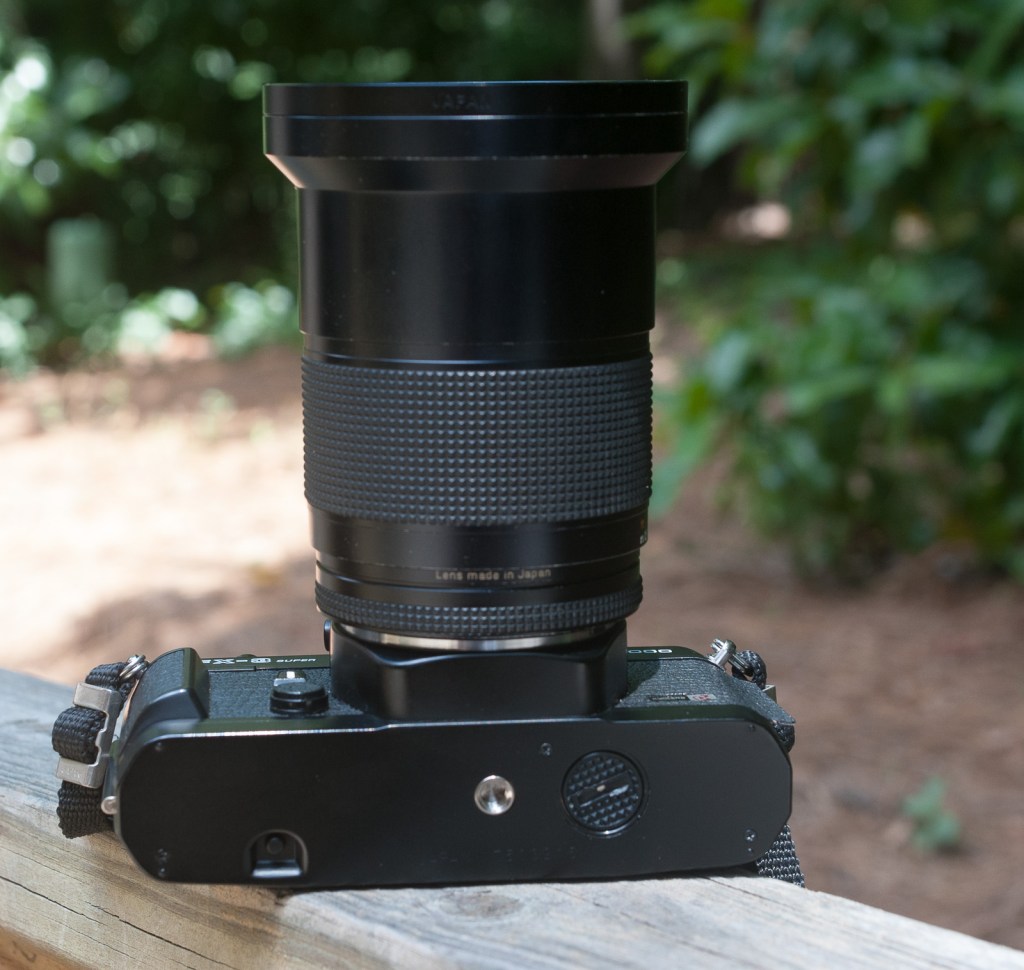
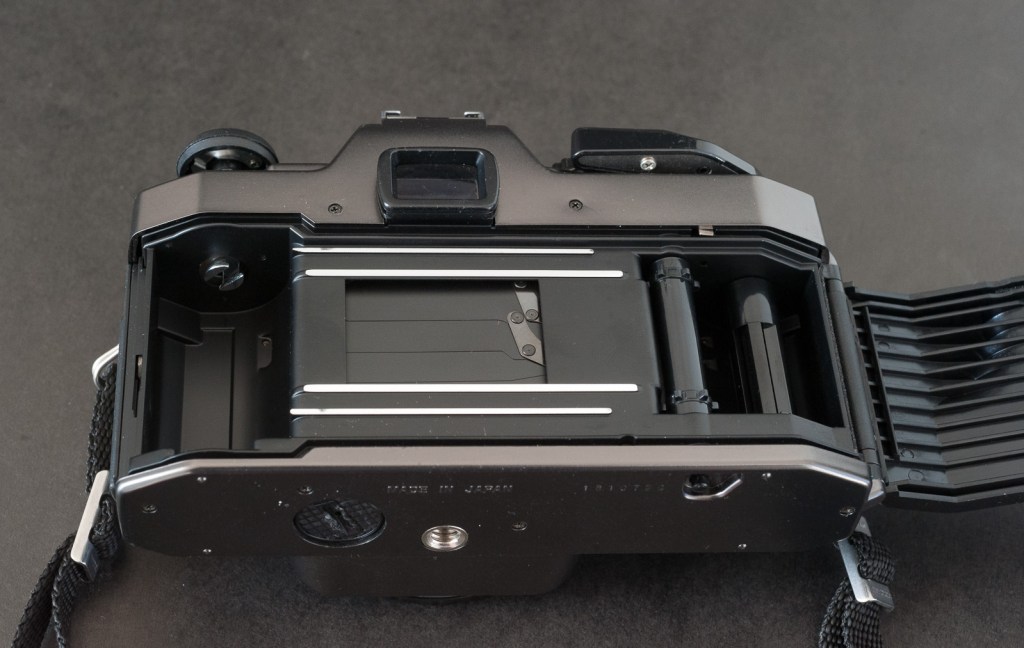
the bottom plate looks very similar to the OM-2000’sOlympus OM 2000 – the fastest shutter on any Olympus SLR (1/2000sec, Flash X sync up to 1/125)
As far as Yashica is concerned, it is not absolutely certain that the cameras of the FX-3 series were made or designed by Cosina, and if they were, I doubt that were CT-1 derivatives: as we’ve seen, some of the quirks of the FX3 (the sliding mirror syndrome) seem to be unique to Yashica – I’ve never read of a Nikon FM-10 or an Olympus OM-2000 misbehaving in such a way.
The lenses
Contax Carl-Zeiss lenses share the same C/Y bayonet as Yashica’s own lenses, and they’re without a doubt the best lenses you can mount on the FX-3. They tend to be on the expensive side, though. Yashica ML (multi-coated) lenses generally have a good reputation – which reflects in their price on the second hand market. The Yashica DSB and YUS series were designed for “price conscious amateur” – a polite way to say they should be avoided if possible.
Lastly, the C/Y mount of the FX-3 is totally different from the Yashica AF lens mount (a screw drive autofocus mount similar to Minolta’s) and from the Contax N lens mount of the early 2000s (an all electric autofocus mount very similar to Canon’s EF).
Yashica Super 2000 – here with a Carl Zeiss Vario Sonnar – the main reason for buying this camera today
Shooting with the FX-3 Super 2000
The first thing you notice about the Super 2000 is its cheap construction – the lens mount and the back of the camera are made of metal, but all the other components that photographers will touch are made of plastic. As a result, the camera is light, but it does not feel reassuringly solid. The commands (wind lever, rewind crank, shutter release button) are obviously not mounted on ball or bronze bearings – you can feel the friction between the parts inside the camera.
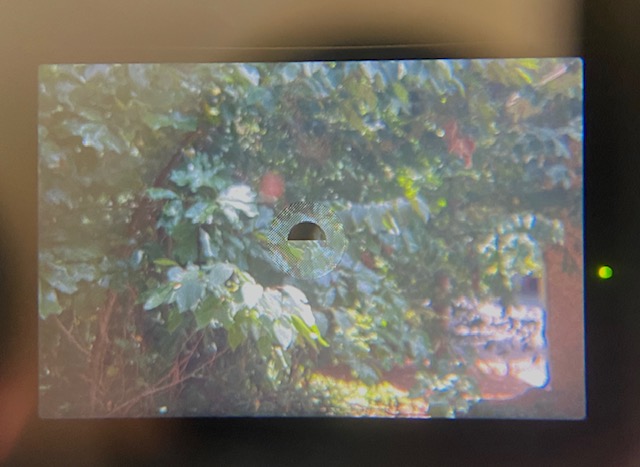
The viewfinder is rather dim, with a short eye relief (roughly similar to the Nikon FM/FE series, which means not that great). I was disappointed not to find a depth of field preview lever, or a shutter release lock: the camera can’t be turned off.
Yashica Super 2000 – a conventional viewfinder – a split image telemeter, a ring of micro-prisms, and 3 LEDs for the exposure
All in all, it feels like a cheap (really cheap) camera, not quite as bad as the horrible Fuji AX Multi or STX-2, but still miles away from equivalent models from Canon (AT-1) or Nikon (FM, FM2), or from automatic SLRs designed for amateurs like the Pentax P30. Compared to other cameras attributed to Cosina, the FX-3 does not look as nice as the Olympus OM-2000 but the quality of the mechanics of the OM-2000 had not impressed me either. Interestingly, the FX-3’s reflex mirror does not seem to generate the same strong vibrations as the OM-2000’s at long shutter speeds – it’s probably usable hand-held down to 1/30s – a feat that the OM-2000 is incapable of.
Contax or FX-3 Super 2000?
The FX-3 Super 2000 is a very simple entry level camera, made out of plastic, and designed to a very low manufacturing cost point. It’s very light – that’s its saving grace – and that could somehow justify carrying an FX-3 in a photo-equipment bag next to a Contax SLR, as a backup. But buyers of Contax cameras or lenses were people of means, who had spent a serious amount of money for the privilege of mounting high quality lenses on a well thought and beautifully designed camera – it’s difficult to imagine them happy with a FX-3.
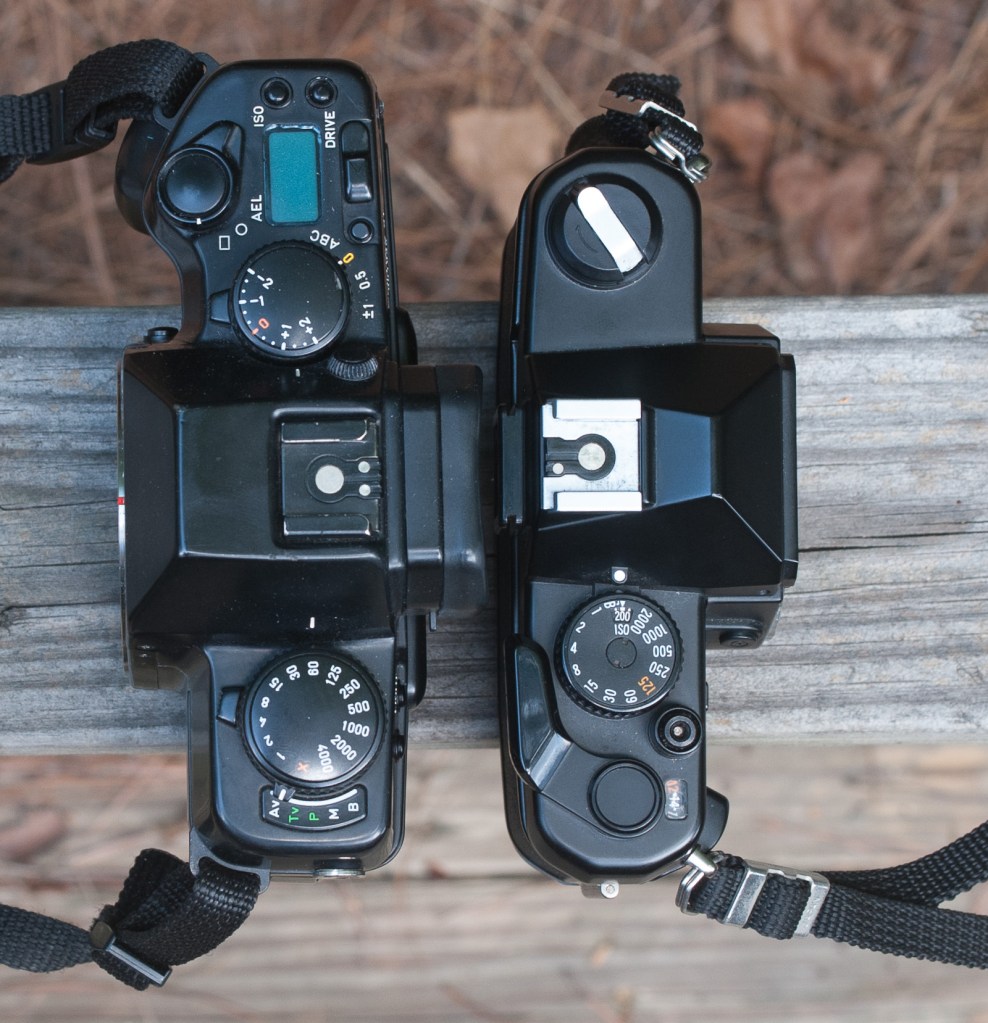
Next to a Contax ST – the Contax is larger, and probably twice has heavy.
Conclusion
Honestly, I’m not a fan of this camera, and it’s definitely not one of my keepers. To my taste, it’s too plasticky, technically too limited, and this sliding mirror issue is simply unacceptable. Even for a backup camera.
Place a FX-3 next to a Canon AT-1 or a Nikon FM, and you’ll immediately see and feel the difference. Place it next to a Contax camera, and you can’t believe they were designed and manufactured under the control of the same corporation.
Does it make sense to buy a FX-3?
As a backup camera? Maybe – compared to a high end Contax camera (RTS I, II or III, ST, RX, AX), the FX-3 Super 2000 is much smaller, lighter, and although it’s not as elaborate or pleasant to use (by a wide margin), it does the job when you still want to shoot with Zeiss glass, but can’t carry a very large and very heavy rig.
As a primary camera? Sorry, I don’t think so. Zeiss lenses have an undisputed appeal, but they’re expensive, and even Yashica ML lenses are not exactly cheap. So, if I started from scratch and wanted a good quality set to shoot film for not too much money, I would probably pick another system (Canon FD, Nikon F, Pentax K) with a wider and cheaper supply of great camera bodies and lenses. And if the lure of Zeiss lenses was too strong, and I was to spend serious money on lenses of the Contax/Yashica family, I would also spend a little more on the body, and pick Contax 139 Quartz, or a late Contax model such as the S2, the S2b or the Aria – they’re compact and hopefully devoid of too many technical issues.
You can see the mirror protruding from the hinged mirror holder. When it protrudes too much, the mirror can’t go back to its normal position and the camera becomes inoperable.
How much?
A semi auto camera from the mid-eighties, with a fast shutter and a lens mount accepting lenses known for their high quality, the FX-3 Super 2000 is not going to be cheap: its price is influenced by the current Contax-mania, and by the preference of film photographers for simple semi-automatic, manual focus cameras.
It’s obviously not in the same category (build quality, performance) as “high-end” semi-auto cameras such as the Contax S2, the Leica R6.2, the Nikon FM2, or the Olympus OM-3, but it often sells for more than Cosina CT-1 derivatives like the Olympus OM-2000 or the Canon T-60: a patient and lucky photographer can probably find a working FX-3 Super 2000 for less than $50.00, but I’ve seen ugly copies proposed for more than $100.00, with the nice ones approaching $200.00.
A few (final) words about the FX-3 Super 2000 – (June 2025) – I never warmed up to this camera, and ended up selling it. I must admit that the hair dryer fix had stood the test of time – when I last used it (6 years after I wrote this blog entry), the camera was still working perfectly.
A motorized, multi-automatic, manual focus, metal built camera with a conventional user interface, the Contax ST had no real equivalent when it was launched in 1992. The Leica R7 and the Olympus OM-4ti were not motorized, and the rest of the cameras targeting the high-end of the market were auto-focus SLRs with a modal user interface.
In fact, there are very few other motorized, multi-automatic, manual focus 35mm SLRs I can think of – the most interesting of them being Canon’s T90.
In 1985, the arrival of the Minolta 7000 AF had caught the industry leaders by surprise: Minolta was the first to launch a brand new – and totally coherent – autofocus system.
At that time, Canon’s engineers were working on a top of the line manual focus camera with a revolutionary modal interface – the T90 – that was launched in 1986, and whose design and ergonomic study Canon would make to good use on their first successful autofocus SLRs, the new EOS 620 and 650, that they launched one year later.
Contax, on the other hand, did not even try its hand at an autofocus SLR until the AX of 1996 (which still used the Contax Carl Zeiss manual focus lenses), and did not launch a real 35mm autofocus camera system until Year 2000. The Contax ST of 1992 is therefore a very conventional manual focus camera.
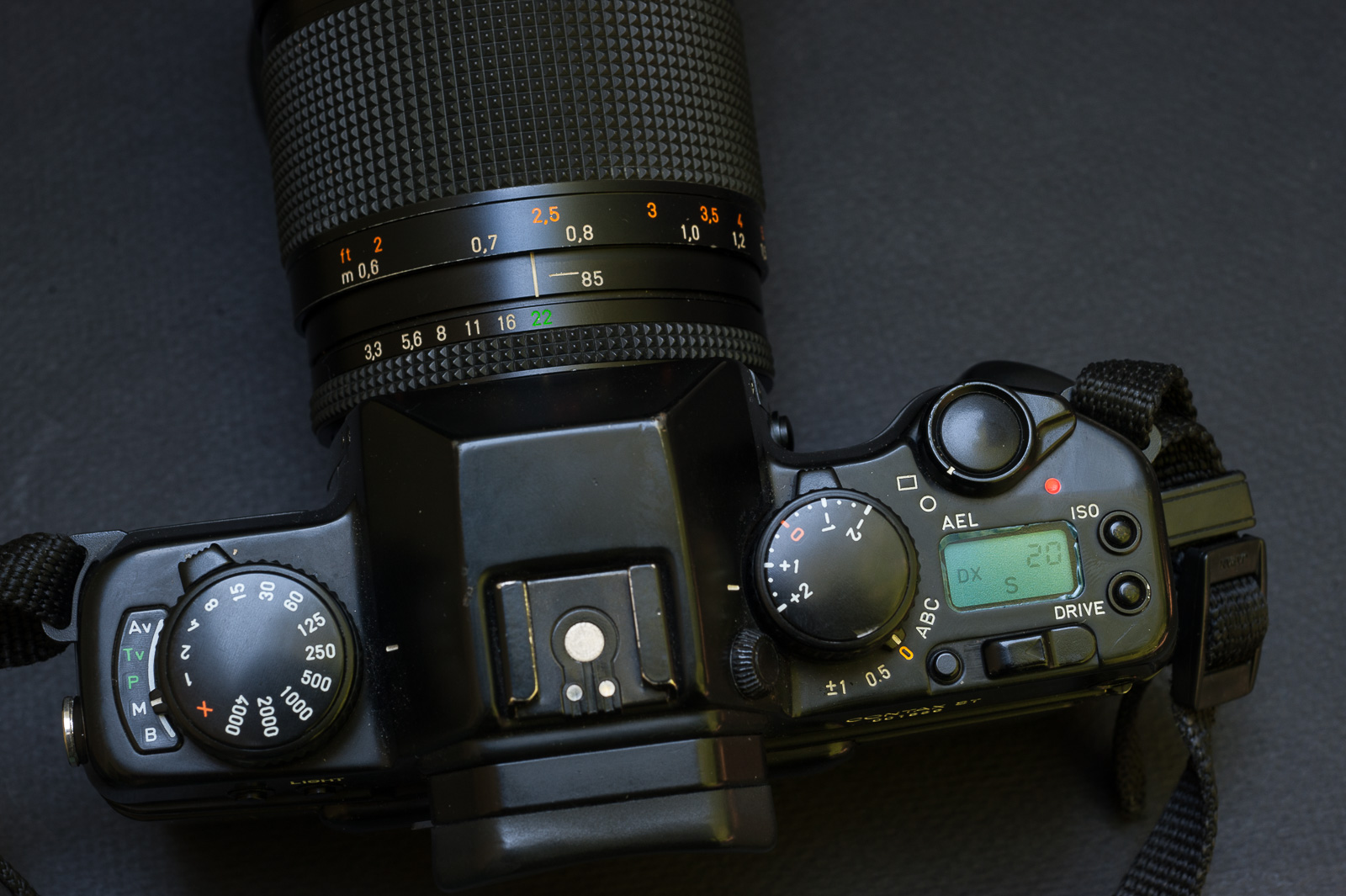
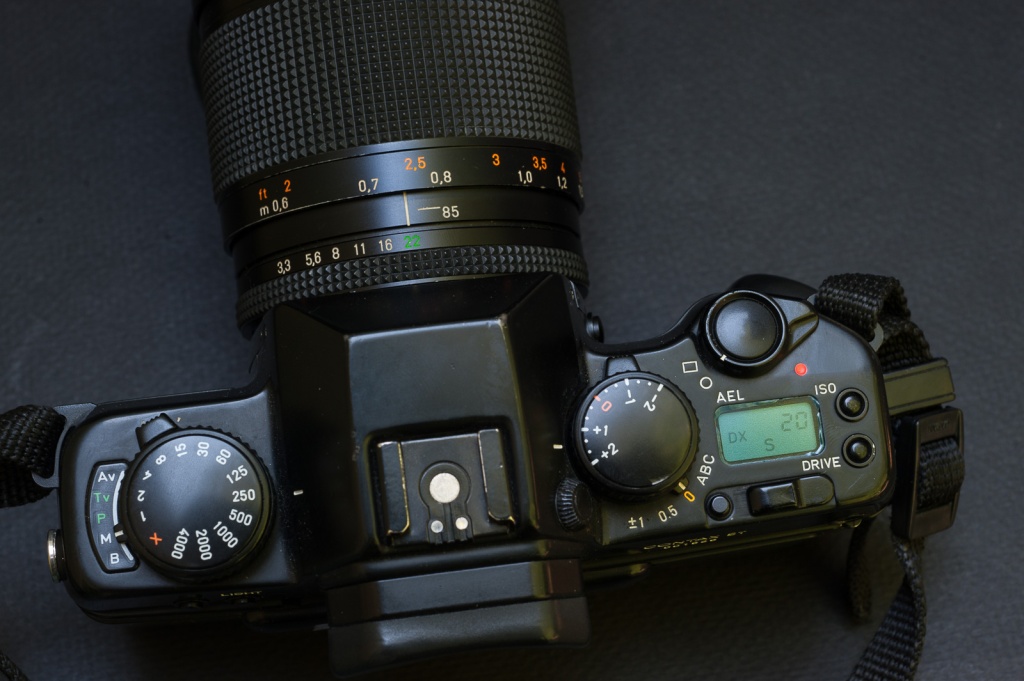
Manual exposure mode, Aperture: F/22, Shutter: 1/250th, exposure compensation at +1.3, spot metering – you read the information directly on the knobs and rings (the view counter and the single/continuous shot mode are shown on the small LCD)
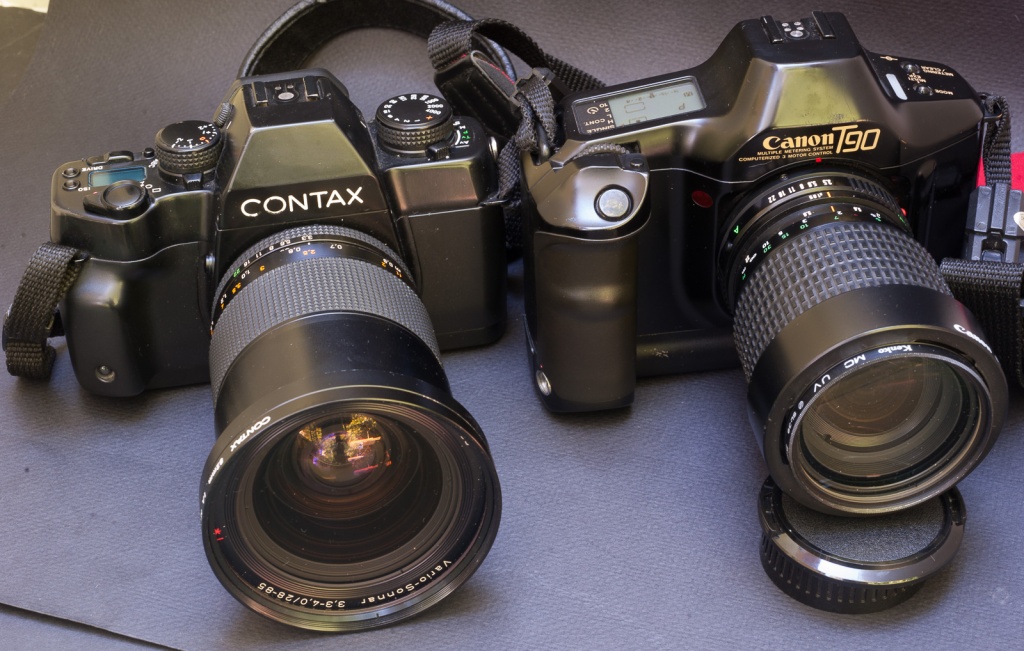
The T90 and the ST have a lot in common – they’re positioned one step under the real professional cameras of their respective brand (the F1 and the RTS III) and boast similar characteristics: they’re large, manual focus, motorized SLRs, with a big high eye point viewfinder, with multiple auto-exposure modes and multiple metering patterns (variants of average and spot metering), LED displays in viewfinder, and they are powered by alkaline AA or AAA batteries.
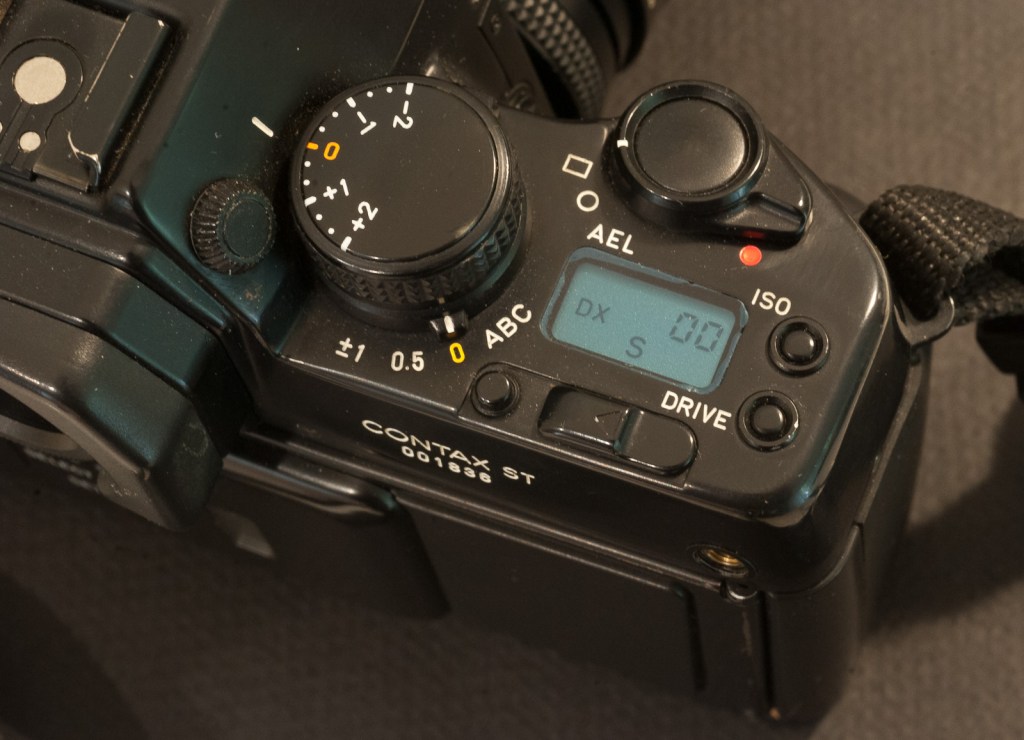
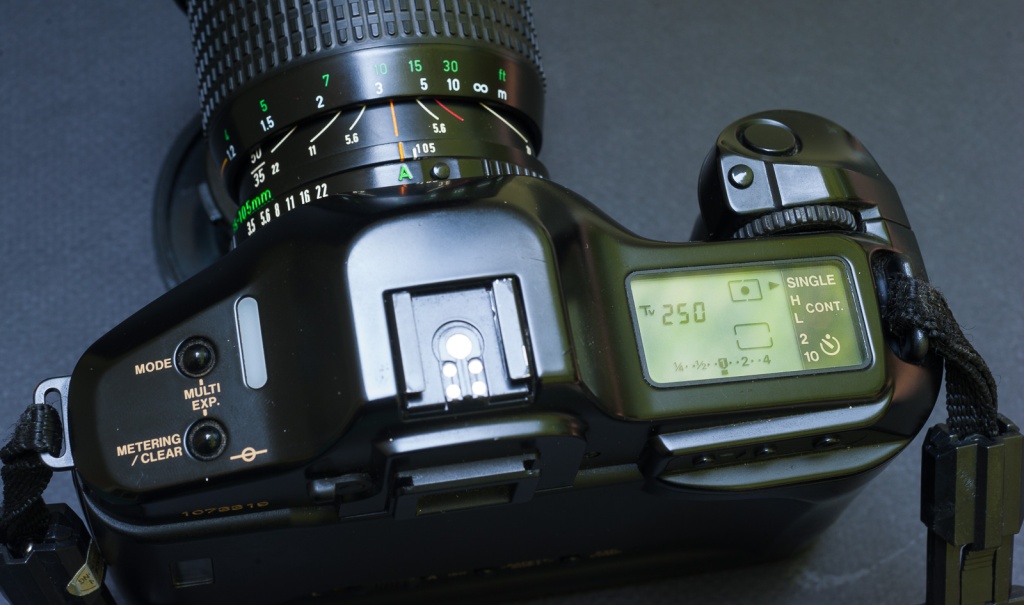
Comparing the interfaces – Tv (Shutter priority), 1/250th, spot metering, single shot, no exposure compensation – everything can be read on the large LCD.
Back then, and today, there are two main justifications for buying one of those cameras:
they are high quality instruments, with a very good viewfinder, great ergonomics, and lots of control options for the photographer who wants to remain totally in charge of focusing and exposure,
they are backed by a renown line of manual focus lenses.
There is one big drawback – of course: those systems are anchored in the past. Canon lost interest in the T90 and in the FD line of lenses as soon as the EOS hit the market, 33 years ago. The last new Contax manual focus 35mm SLR (the Aria) was released in 1998, and Kyocera has stopped providing any type of support a long time ago.
Whether you prefer the ST to the T90 comes down to lenses (the ones you own and the ones you would like to buy), ergonomic preferences, and your expectations regarding reliability.
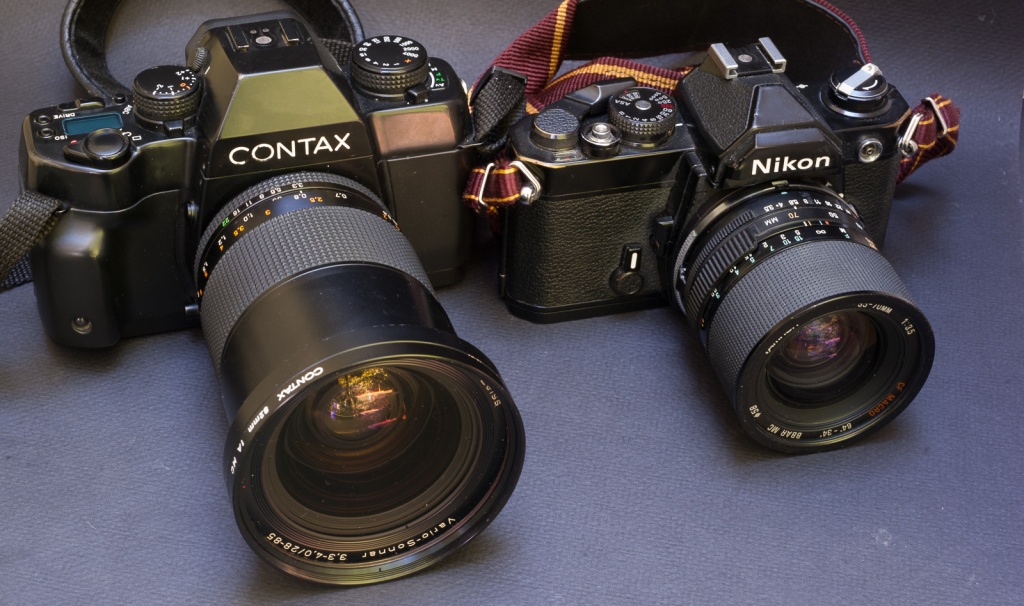
15 years apart: a motorized SLR with a huge 28-85 f/3.3 zoom (1992, left), a non motorized SLR with a tiny 35-70 zoom (body: 1977, lens: 1982, right).
Back then: how did the two cameras compare?
Cost and Availability: having been launched 6 years apart, the two cameras never really competed for space on the shelves of the retailers. The T90 was manufactured for less than a year, but remained on Canon’s catalog until the launch of the EOS-1, in 1990. It was a very expensive camera – in the same price range as the Olympus OM-4ti – only professional cameras such as the Nikon F4 and of course the Leica R series were more expensive. The Contax ST became available at the end of 1992. It also had a very high list price (in the same bracket as the Canon New-F1 or the EOS-1) but cameras were heavily discounted in those days and it’s difficult to know how much people were really paying (and whether Contax cameras were more discounted than Canon’s).
Size, Weight, Features and Ergonomics – The T90 (nicknamed the “tank” in Japan) is not that heavy after all – at 800g, its weights is the same as the ST’s (without batteries) but the Canon uses AA cells which are heavier than the AAAs of the ST. Because of its smaller dimensions (height and depth), the ST looks denser and feels heavier. One of the best examples of “bio-design” the T90 falls naturally in the hands, with all the command easily accessible. It’s also the first example of totally modal interface (I press a key to call a menu, and I rotate the control wheel to select the setting which is shown on a large LCD display on the top plate). The ST offers a very conventional user interface, with one knob, one ring or one switch per command. Because the analog commands are designed to be smooth, the knobs are susceptible to changing position in the bag of the photographer, and the Contax’s commands are protected by a series of locks – it’s useful, but it slows the photographer down until the position of the locks is memorized by the muscles of the hands. More than 30 years later, the market has still not decided which UI it likes best – Canon, Nikon and Sony are committed to the modal interface, while Fujifilm is selling cameras whose command organization is very similar to the ST’s. Both cameras are motorized – but not as fast as the Nikon F4 or the EOS-1 (3 frames / sec for the Contax, 4 frames / sec for the Canon). And both are loud – you can’t shoot unnoticed indoors.
Viewfinder – They’re very comparable on paper – the T90’s viewfinder covers 94% of the actual picture area, with a magnification of 0.77 and an eye point of 19mm. The ST’s viewfinder, on the other hand, covers 95% of the actual picture, with a magnification of 0.8. The eye point is not documented but feels longer than the T90’s.
Practically, the viewfinder of the ST is cinematic, and next to it, the T90 looks narrower, as if affected by tunnel vision.
The viewfinder screens look equally luminous (which means not as luminous as what you would find on a Nikon camera of the same era). The micro prism ring on the T90 is made of coarser elements, and is easier to the eyes than the very fine prisms of the ST, which are very difficult to see, even with the dioptric correction of the viewfinder carefully adjusted.
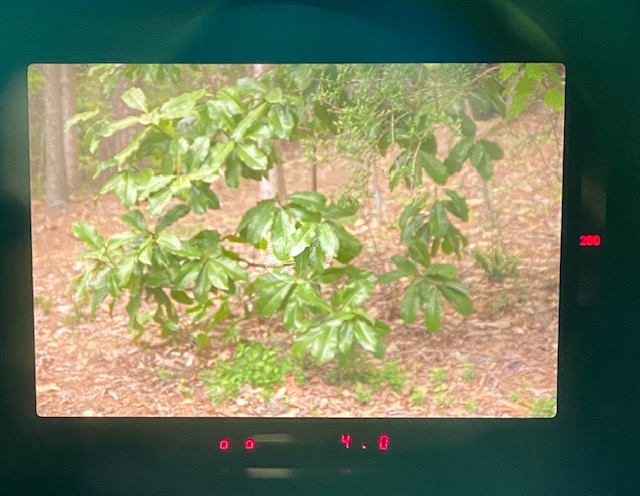
Both provide information at the bottom and on right side of the viewfinder – the Contax is using only red LEDs, and the T90 a combination of LEDs and of LCDs. Both viewfinders are informative, easy to read, and don’t overload the photographer with useless information.
Shutter and metering system: The T90’s shutter was the absolute best of what was available in 1986 – with a flash X sync speed of 1/250s and a top speed of 1/4000. The Contax ST offers similar performances (it can go up to 1/6000sec, but that shutter speed is not user selectable – practically, 1/4000 is the limit). The Canon T90 is probably the most complex SLR ever designed when it comes to exposure control.
First, it offers no less than four metering patterns: central weighted average, selective (a sort of ultra large spot, for the nostalgics of the Canon FTb), Spot, and last but not least, Multispot. In addition, you can also adjust the exposure for the highlights or the shadows by pushing two small buttons to change the exposure value by increments of 0.5IL. Honestly, it’s a bit too much.
The Center Weighted Average metering (the one you use for casual or travel photography) gives more importance to the sky than I wish, but because you can’t lock the exposure with the camera set for center weighted average, you have to let the camera do what it wants, and it under-exposes a bit. The Multi-Spot is gimmicky, the “Highlight and Shadows” correction is extremely powerful but very difficult to use unless you’re fluent with the theory of exposure. Lastly, only the older FL lenses offer a real semi-auto exposure mode, but you have to operate stopped down.
Compared to the T90, the ST is a model of simplicity – if offers only two metering patterns (center weighted average and spot). Like the T90, you can only lock the exposure in spot, but at least you can work with a real semi-auto mode at full aperture.
None of those cameras offer “matrix metering” – they’re definitely “old-school” in that regard.
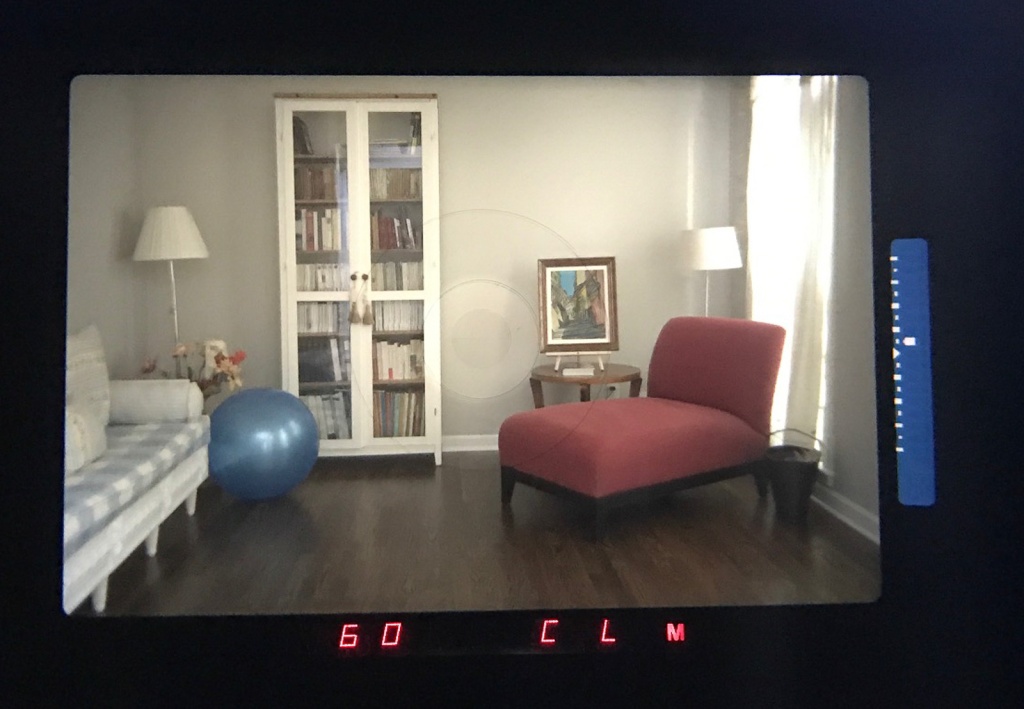
T90 – Semi-auto exposure – stopped down – over exposure (cursor above triangle on bar graph, “CL” message (for
CLose)Contax ST – Viewfinder – the selected shutter speed is shown on the right, the aperture and the view counter at the bottom.
And now
Reliability: “the tank” may have been solidly built, but when trying to innovate with the design the camera, Canon’s engineers went a bit too far, and introduced some weaknesses. With the benefit of hindsight, some of the design decisions look outright stupid (soldering lithium batteries to the circuit board or replacing springs with magnets in the shutter, for instance). The second issue in particular impacts reliability, and it’s the reason the value of the T90 on the second hand market is so low.
The ST is not without flaws either – it seems that Contax cameras of that generation (the RTS III, ST and AX) need the aperture command lever to be re-calibrated every now and then, and the process requires access to a workshop manual and a Contax Planar F/1.4 lens. I could not find a copy of the manual workshop on the Internet so far, and having to buy a Zeiss 50mm f/1.4 lens just to be able to calibrate a camera is not a very palatable perspective (the workaround is to play with exposure compensation dial). Apart from this non trivial issue, I’ve not found or read much (positive or negative) about the Contax ST’s reliability. As far as I know, the only real troubled child of the Contax-Yashica family is the 159MM.
Scarcity: both cameras were very expensive high end machines – which limited their sales volumes – but also ensured that most of their owners did not consider them disposable, and took good care of them.
Most of the interest for the Contax cameras seems to be concentrated in Japan – I could not find any in the US and finally bought my ST on eBay from a Japanese reseller (buying from Japan is generally a very pleasant experience – the cameras are in top condition and you get yours in less than a week through the Postal Service). It’s easier to buy a T90 from a domestic reseller, even if there are only a handful on sale at any given time. And because of the potential reliability issues, I would only buy a T90 from a seller with a very good reputation, who has really tested the camera, preferably with film.
Battery: Contrarily to many autofocus SLRs of the same vintage, the T90 and the ST don’t require expensive and difficult to find single use Lithium batteries. They simply need a few AAA or AA batteries.
Lens selection: The T90 was designed for Canon’s FD lines of lenses, but also works very well (in particular in semi-auto exposure mode) with older FL glass. Canon also sold for a while an adapter for 42mm screw mount lenses. If you add the lenses sold by third parties, the offer is limitless.
There are two issues with Canon FD lenses: the interesting ones (the luminous wide angle lenses in particular) were purchased en masse by users of Sony’s A7 series mirrorless cameras (who use them with an FD to Sony E adapter), which raised the price level on the second hand market. And since production ceased more or less with the launch of the EOS series in 1987, there are relatively few good zooms in the catalog (and in any case none of those f/2.8 constant aperture zooms preferred by the pro photographers).
Contax lenses have a great reputation – and Contax used to cover any need from the 15mm ultra-wide angle to the 600mm telephoto lens, with specialty items such as the 35mm shift lens or the medical lens also represented.
Outside of the 28, 35 or 50mm glass which sell for reasonable prices ($150.00 to $200.00), Contax branded lenses are much more expensive than Canon’s. But since Contax kept on releasing new Carl Zeiss manual focus lenses until 1998 (the last one was a compact zoom for the Aria), the lens designs are a bit more modern than with Canon, which could be good if you’re looking for a zoom.
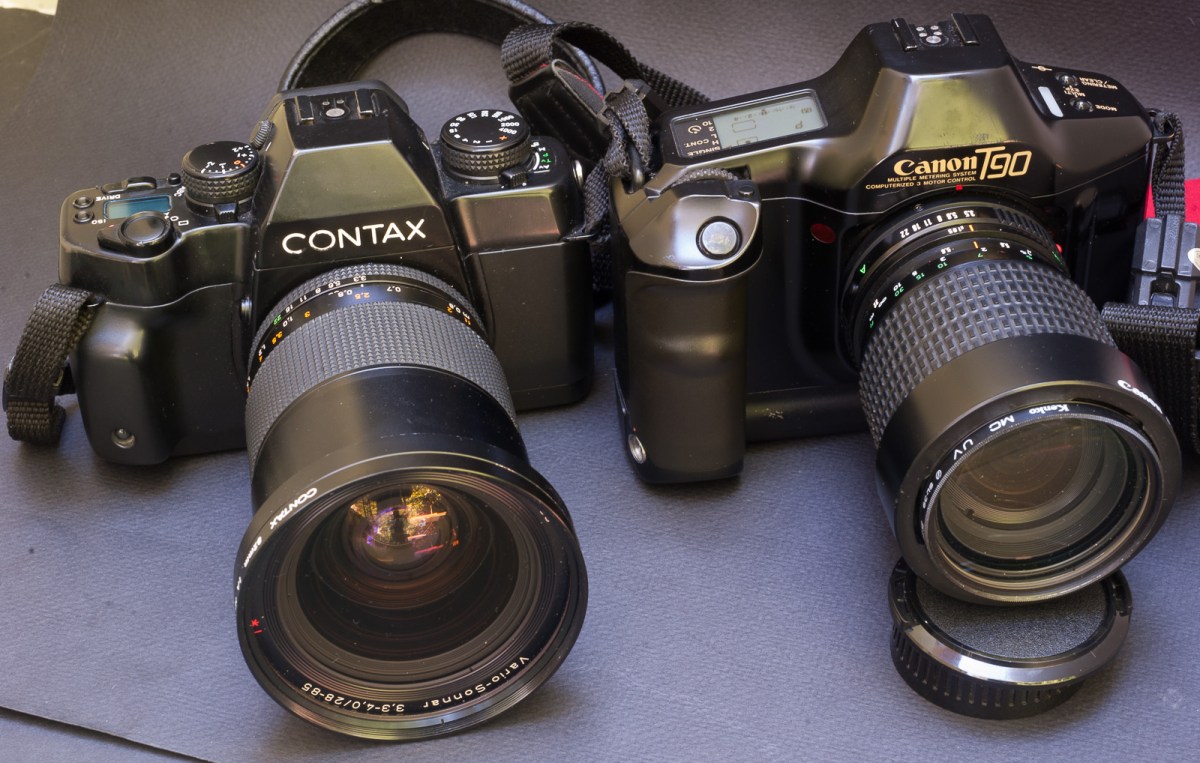
The Canon T90 is higher than the Contax ST and can’t lay flat on a table (it tips forward). Not an issue, just bizarre. Canon’s 35-105 zoom looks small, in particular when compared to the massive Contax 28-85 Vario-Sonnar
How much? Not much. Probably because of its reliability issues, the Canon T90 is not in high demand and can be found for less than $100.00; the Contax ST is also relatively cheap (approx $150 if you buy it from a Japanese reseller). In the Contax family, the S2, the RX II and the Aria are more sought after, and sell for two to four times the price of the ST.
Conclusion
The Contax ST and the T90 have a lot in common on paper, but are very different cameras in day to day use:
ergonomics – Contax has a conventional user interface, the T90 is modal. Both are extremely pleasant to use and a photographer will enjoy working with each of them – it’s really a matter of taste.
exposure determination – in this specific area, the Contax is more limited, but easier to use, while the Canon is much more complex and sometimes gimmicky. Honestly, none of them is a perfect fit for me: ideally, I would simply like to use the central weighted average metering with an auto-exposure lock – an option none of them offers. A matrix metering option would also have even valuable – but no manual focus Canon camera ever offered it, and Contax fans had to wait for the last manual focus SLR of the brand, the Aria, to benefit from it.
A huge viewfinder – the ST’s most striking characteristic.
Is one of those two the ultimate manual focus 35mm SLR?
Besides the ST and the T90, there are few cameras that can legitimately compete for the distinction: a few Leica R models, the Olympus OM-4ti, a few other Contax cameras, maybe.
The Contax ST is a high quality, carefully designed and nicely built manual focus SLR for photographers who prefer their cameras full featured, but also easy to use and unobtrusive. A very nice tool. But it lacks this ounce of folly and excessiveness that graces the T90.
The Canon T90 is far from perfect – even if its limitations in the exposure department are inherited to a large extend from the FD lens mount’s shortcomings – and it has its own reliability issues. But it was a revolutionary camera in its time: there’s no manual focus SLR like it, and there’s still something magic in the simplicity of its user interface.
Just before the lock-down was implemented in Georgia, I shot a roll of film with my newly acquired Contax ST, and it took a long time for the film to get processed and the scans to be made available on line (blame the postal service).
So, here we are…
The camera is pleasant to use in the field (large viewfinder, logical commands, convenient exposure memo lock (associated with Spot metering only). It’s heavy, and the Zeiss 28-85 f/3.3-4 Vario Sonnar zoom makes for a very bulky and ponderous combo (more than 1.6 kg/ 3.5 pounds with batteries and strap). You can’t carry it with the strap wrapped around the wrist for too long – you need a backpack for any photo expedition longer than 30 min.
The zoom is sharp, but it’s a one ring design (you rotate the ring to focus, and you pull or push it to zoom in and out), and of course, the front element tends to slide out under its own weight.
Two Paddle Boarders – Whitewater Creek – Atlanta – Contax ST – Vario-Sonnar F/3.3-4.0 – Kodak Portra 400.
Some of the pictures are correctly exposed, but the majority seem over-exposed, by 0.75 EV up to 1.5 EV.
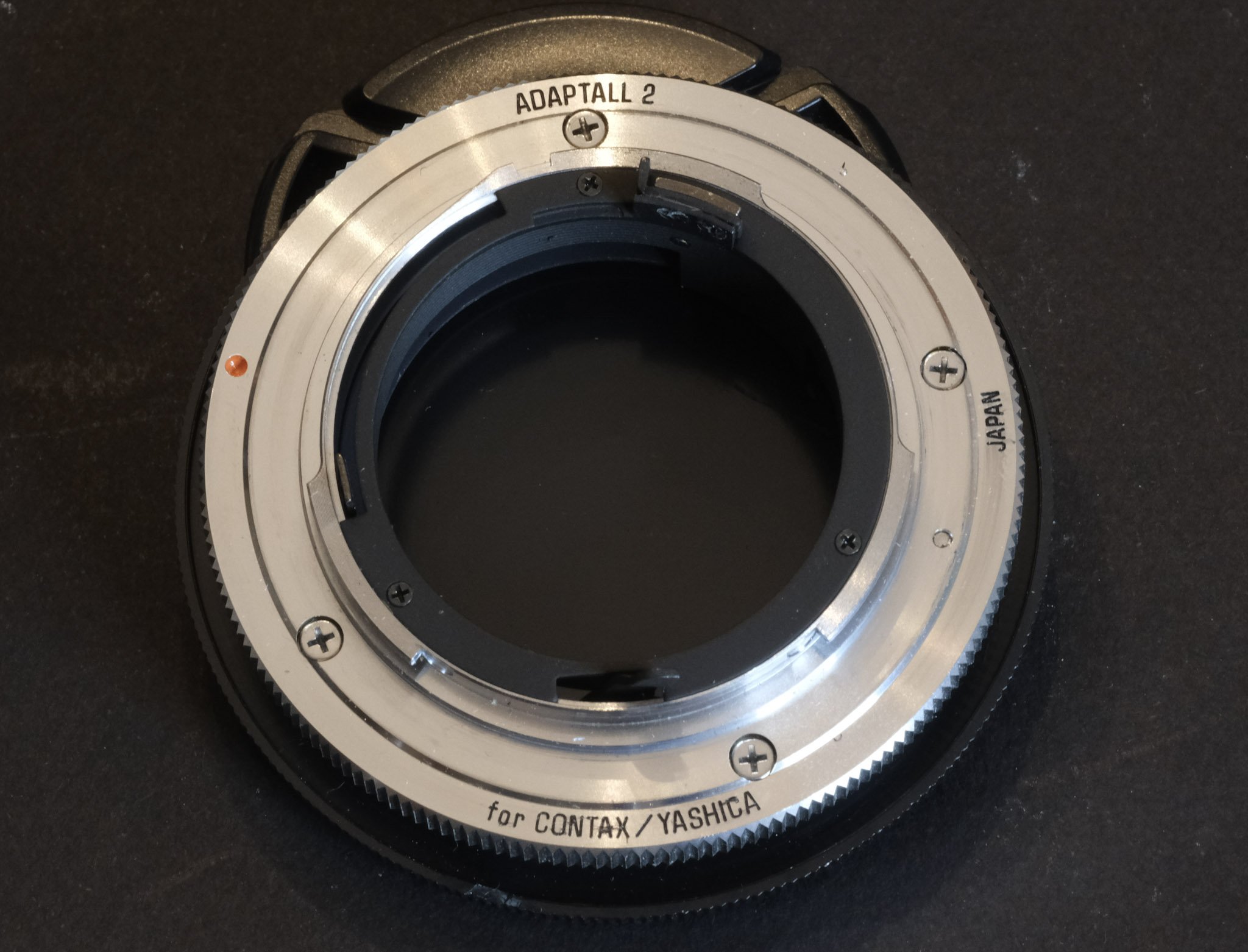
I had not noticed it when I received the camera, but the aperture information displayed in the viewfinder does not correspond to the values on the aperture ring of the lens: at full aperture, the aperture ring shows f/3.3, but the viewfinder LEDs show f/2.8; at F/8 (on the lens), the LEDs show f/4.5; at f/22, the LEDs show f/13. Roughly 1.5 EV off except at full aperture, where the two values are closer. I tried another lens (a Tamron 28mm f/2.5 with the Adaptall II ring) – same issue. When I googled it, I found out that it’s (probably) a rather common problem related to the calibration of the “aperture linkage lever” of the bayonet mount, on the camera’s side (*).
The Contax workshop manuals describe in detail the process to follow to re-calibrate the aperture linkage lever (some people call it the “feeler”) on the body’s lens mount. Unfortunately, the process is different with each model (you need to perform an obscure sequence of key presses to access the maintenance mode of the camera), I have not found a Contax ST workshop manual yet, and it apparently requires a rather expensive Contax Planar 50mm f/1.4 as a benchmark for the calibration.
Until I find a way to fix the issue, I’m simply going to use the exposure correction dial and hope of the best.
(*) I exchanged a few emails with Peter Robinson, who repairs and reconditions a few specific Contax models in the UK, and maintains the Contax139 blog (very nice guy, btw).
According to him, the aperture transmission from the lens to the body is “analog” on models like the RTS III or the RX, but encoded (I translate it by “digital”) on the 167. I suspect the ST, being a derivative of the RTS III, and the predecessor of the RX, also falls into the “analog” category. Peter posted a few workshop manuals on his Website, and the recalibration process is described in detail for each model of camera, unfortunately there are variations in the key presses from model to model, and without the workshop manual corresponding to the exact model you own, fixing the aperture transmission lever is an impossible task.
I don’t know what percentage of film cameras collectors actually use them. But the value of a camera is at least in part related to its capacity to be used … as a camera, and help the photographer shoot good, beautiful, interesting pictures. Without film, film cameras are little more than paper weights.
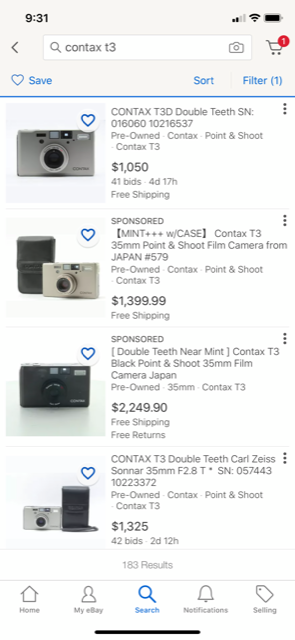
Contax T3 – cameras proposed for sale on eBay 0n 4/24/2020
So if film was to become unavailable, the value of film cameras would change. I don’t believe it’s going to happen anytime soon – Kodak (Altaris) and Ilford (Harman) are still committed to film because it’s their core business, and Fujifilm will keep one or two film plants running, if only for sentimental reasons. The rebirth of the Polaroid instant film packs (the Impossible Project) and the success of Lomography are also showing that when the big players disengage, boutique producers step in and fill in the void.
Contax T2 – a bit cheaper than the T3. The “completed” listings on eBay show that even if sellers ask for prices in excess of $2,000, the cameras that actually sell are priced a bit more reasonably.
So, let’s assume that film remains available and affordable, and that 35mm film cameras keep a certain usage value. And let’s forget about those commemorative editions, cameras with remarkable serial numbers or other gold plated models, that Leica (and to a lesser extent Nikon), release from time to time for avid collectors. They are destined to be kept forever in their original packaging and in a safe, with no concern for their potential usage value.
In the realm of cameras that actual photographers use to take pictures, Leica cameras hold a special place. They’re “classics“.
On eBay, the price of Leica’s rangefinders has been remarkably stable over the years, with the M5 and the M4 at the bottom of the ladder (around $800), followed by the M2 and M3 a bit above $1,000 (depending on condition, of course). The more modern Leica M (M6, M6 TTL, M7) are selling for two or three times more, reflecting their comparatively higher usage value.
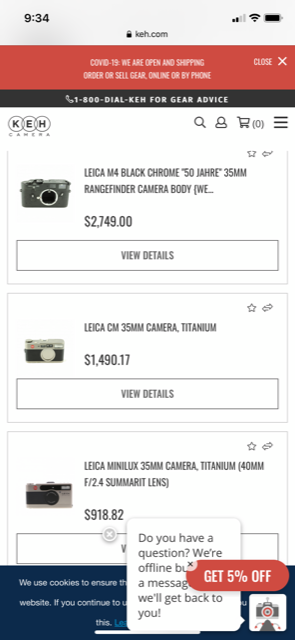
KEH app – the price asked for the T2 is a bit more reasonable – but still in Leica M territory
Manual focus SLRs designed for enthusiasts or pros, and known to be at the same time simple to use and reliable have seen their value rise spectacularly (Nikon FM2, FE2, FM3a or F3, Canon AE-1, Pentax Super Program or LX), while more complex or less reliable models don’t attract the same high prices (Nikon FA, Canon T90). Those new classicswere launched between 1975 and 1985, a decade which is increasingly being seen as the golden age of film SLRs.
Entry level manual focus SLRs with lots of polycarbonate (Canon T50), or amateur-grade autofocus cameras – nobody wants them and the prices reflect that.
At the other end of the price scale, cameras that did not do very well on the second hand market a few years ago are doing even worse now. The list includes any entry level model from any manufacturer if it was launched after 1980, and almost any autofocus SLR except for the very last enthusiast and pro models, probably because of their good compatibility with the current digital offerings of their respective manufacturer (Nikon F100 and F6, Minolta Maxxum 9 and 7, Canon EOS-3).
Photographs don’t like that those cameras were built out of plastics, with a bizarre feature set (often deprived of useful functions – reserved for the “pro” models – and at the same time loaded with useless gimmicks and encumbered by unconventional controls). And many of them require expensive and hard to find single use Lithium batteries. They have little appeal for today’s would-be film shooters, and can be had for a few dollars, even from specialized stores.
“La Mode, c’est ce qui se démode”*
What’s hot? Any luxury compact (point and shoot) camera, with a titanium body and a lens with a famous name: the top of the top is occupied by Contax with the T2 and T3: the craze started with a few actors and celebrities in Hollywood posting pictures of themselves shooting with their T2 on Instagram), but similarly positioned models such as the Leica CM and Minilux or the Nikon 35ti also command big bucks (they’re all in Leica M territory).
Cameras like the Olympus XA, and even the Cosina CX-2**, which were far cheaper than the luxury cameras from Contax or Leica in the eighties, have also been contaminated – with sellers asking for hundreds if not thousands of dollars for a somehow basic camera.
The Cosina CX-2 – the ancestor of the Lomo LC-A – a cheap camera in its heyday. Prices are all over the map now ($240 to $1,250 for what looks like two cameras in the same condition)
As a conclusion:
Old classics hold their value, new classics are on the rise: if you buy one of those, you may not win big, but you won’t lose money if you decide to resell it after a few years.
Contax luxury compacts are reaching insane values. They’re nice cameras, with a great little Zeiss lens, and demand currently outstrips supply. But those luxury compact cameras (Contax’s and the others) rely heavily on electronics and generally can’t be repaired if a component goes bad. If you don’t have one already, you missed the boat, and I would not spend thousands of dollars trying to get one. You can also wonder how long will celebrities be seen playing with their T2, pushing demand and prices to the sky? Prices could very well go back to more normal levels in a few years.
Two other Titanium-clad point and shoot cameras (Leica CM and Leica Minilux) selling for more than old Leica M3s
There are still bargains to be found if you’re not obsessed with shooting with a “classic” : the Canon AT-1 has not reached the “new classic” level of the AE-1 and AE-1 Program, and sells for half the price. But in my view, it’s a better camera for an enthusiast photographer. Early Canon EOS cameras (650, 620) are solid, very pleasant to use (a T90 with matrix metering and without the bugs), and dirt cheap. An entry level camera from the mid eighties, the Pentax P3n, is at least as competent as its more expensive Super Program predecessor, but can still be had for next to nothing. Nikon’s partially motorized N2000/F301 (the manual focus version of the N2020/F501) is also a great buy. So is the Olympus OM-2. Future classics? I don’t think so. But great everyday cameras at a great price, for sure.
(*) “La Mode, c’est ce qui se démode” (Literally, “Fashion, that’s what going out of fashion” or “Fashion is made to become unfashionable”) – the aphorism is generally attributed to Jean Cocteau and Coco Chanel. Coco Chanel famously added that “Fashion fades, only style remains the same”.
(**) Cosina CX-1 and CX-2 – those cute and very small point and shoot cameras sold reasonably well in the early eighties. With their tiny wide-angle lens they were subject to severe vignetting but they offered more controls to the photographers than the other ultra-compact P&S cameras. A few years later, an almost identical camera was launched as the Lomo LC-A by the LOMO PLC in Saint Petersburg (Russia). The little Lomos were adopted enthusiastically by a group of photographers in Austria, and it started the Lomography movement. But that’s a whole other story.
The Olympus OM-2n – a “new classic” – in my opinion the best camera of the Olympus OM single digit series (OM-1,OM-2, OM-3, OM-4, OM-4ti) for everyday use. Photos shot a few years ago at the Universal Studios in Burbank, CA.
Universal studios – Burbank CA – the Studio tour – here the house from Psycho. Olympus OM-2n.
Universal Studio (Burbank, CA) – the set of the movie “Waterworld”. Olympus OM-2n
Who created the first 35mm camera, or the first 35mm single lens reflex camera?
Difficult questions. First, you would have to agree on what constitutes exactly a “real” 35mm camera, or a “real” 35mm SLR, and then, you would have to determine what really counts: is it presenting a prototype at a trade show, applying for a patent, launching a limited series production, or inundating the world with tens of thousands copies of a “game changing” camera?
It is generally recognized that with the Leica, Leitz created the first commercially successful 35mm camera in the early twenties, and but it was not until 1932 when they launched the Leica II that the rangefinder camera with interchangeable lens had found its “real” final form.
Foca *** with a Foca turret viewfinder (left) / Olympus OM-1n (right) The Foca, a French derivative of the pre-war Leica, is a good example of what a rangefinder camera with interchangeable lenses looks like. With its pointy prism housing, the Olympus illustrates the typical SLR shape.
The Contax S
1932 is also the year when Zeiss launched Leica’s most serious pre-war competitor, the Contax.
Zeiss was at that time the largest manufacturer of cameras in the world. They had a long tradition of innovation and a great team of engineers; conscious of the limitations of the rangefinder formula, they kept on working on a better solution until, after the war, they finally presented the Contax S, one of (if not the first) modern 35mm single reflex lens camera.
With its pentaprism, its horizontal curtain shutter and its 42mm screw lens mount, the Contax S was very close to the typical 35mm SLR design, and should have been commercially successful.
Contax S – (second series from 1950). Courtesy of Pentax-SLR.com – the best source of information about early SLRs (not only Pentax)
But at that time, the Zeiss factories were in the Russian occupation zone (soon to become the German Democratic Republic) and all sorts of issues slowed down the roll-out to production: the Contax S only started to be mass produced at the very end of 1949. The launch of the Contax S also coincided with the start the Cold War – products from communist countries were not always welcome on the more affluent markets of the West – and to make the matters worse, the East German entity of Zeiss lost the rights to the Contax name in 1956. After considering multiple options (including apparently the “Pentax” name), the East Germans rebranded their cameras “Pentacon” (a portmanteau for Pentaprism and Contax) and the Contax S line of SLRs was abandonned.
Why is a pentaprism so important, that Zeiss and (later) Asahi changed the name of their cameras to include “Penta”?
Composing a picture on a piece of ground glass located behind the lens is nothing new (plate cameras have been following that model forever), but the image is reversed top-bottom and left-right, which makes the composing process very slow and totally unsuitable to candid photography.
If a mirror inclined at 45 degrees is placed behind the lens, and the image projected on a piece of ground glass, it is not reversed top/bottom anymore, but is still reversed left/right. The photographers has to shoot from waist level, after having used a magnifying glass for focusing. It’s workable, but not the best formula for action shots, journalism or simply spontaneous family photographs.
Nikon F3 with its HP Viewfinder
Nikon F3 with the viewfinder removed
the (huge) prism of the Nikon F3’s viewfinder
Nikon F3 with the pentaprism viewfinder removed: the image formed on the focusing screen is reversed laterally.
Left is right, right is left and of course the Coke and Powerade labels are also reversed
The pentaprism addresses all those issues – and as we all know from experience with SLRs, the image is fully redressed, focusing is easy, and eye-level composition makes action photography intuitive even for beginners.
Nikon F3 – The view of the same scene from the eye-level pentaprism viewfinder
Asahi Optical Co
Asahi started manufacturing lenses in Japan in 1919, and launched the first Japanese 35mm single lens reflex camera – the Asahiflex – in 1952. It was inspired by the pre-war German Praktiflex, but brought some improvements: it had two finders: a waist level through the lens viewfinder (for focusing) and a smaller eye level optical viewfinder to be used when taking candid snapshots.
In two critical areas, the Asahiflex was not as advanced as the Contax S: it did not have a pentaprism viewfinder, and it used a narrower 37mm screw mount.
Asahi’s first major innovation came two years later with the introduction of the instant return mirror on the Asahiflex IIb (1954). The IIb was without equivalent for a while, but the step forward it represented was nothing compared to Asahi’s next giant leap, with the “Pentax” of 1957. The first (mass produced) Japanese camera with a pentaprism, it combined for the first time in a compact, elegant and well made camera the instant return mirror, the film advance lever, easy film loading with a hinged back, and the 42mm screw mount.
The original Asahi Pentax camera from 1957 (source: official Pentax Web site).
The Pentax line of cameras sold by the millions and became the model that all other manufacturers would copy in the subsequent years. The Pentax name became so well known that the Asahi Optical Co. decided to sell all its products (including its line of medical equipment) under the name Pentax, before it finally changed its own name to Pentax Corporation in 2002.
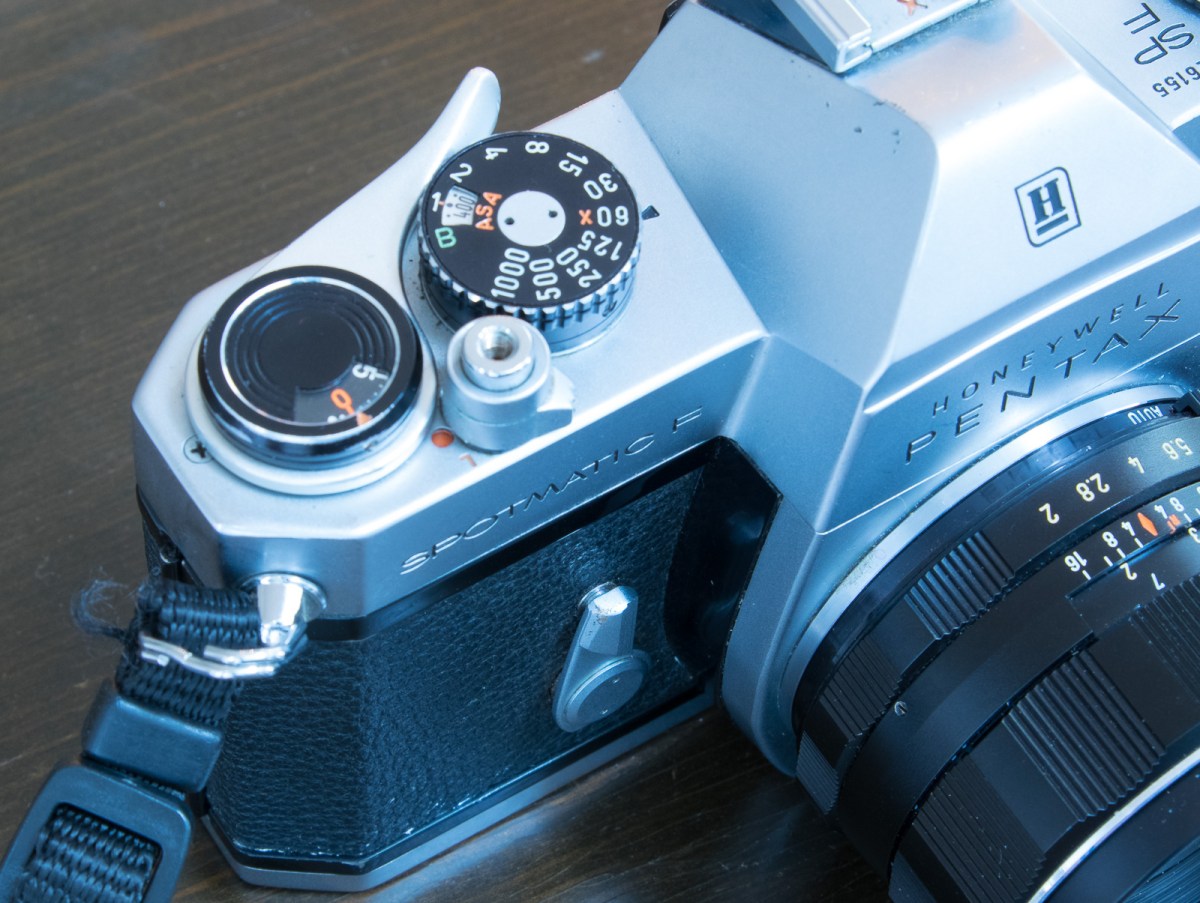
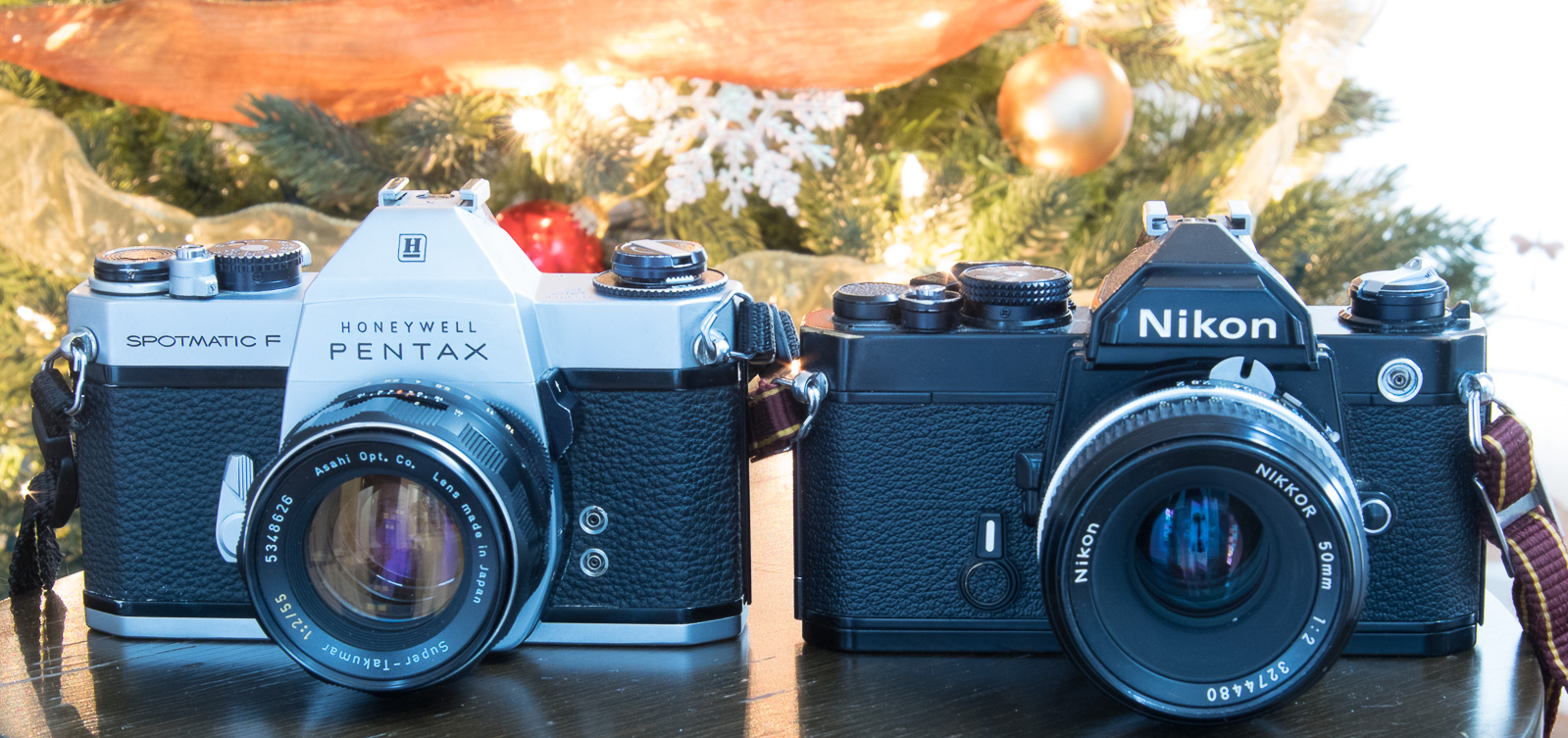
Pentax Spotmatic F from 1973 (left) and Nikon FM from 1977 (right). More than 15 years after its launch, the design of the “original” Pentax was still the model that all camera manufacturers were following
It is widely assumed that “Pentax” is also a portmanteau for Pentaprism and Contax. According to Wikipedia, the name was purchased by Asahi from the East German Zeiss company just before the launch of the original Pentax SLR in 1957.
Asahi Pentax – the top plate of the original model (1957) – source: eBay
The Pentax Spotmatic F on 1973 – still true to the model defined by the “original” Pentax of 1957
Today, the single lens reflex formula is on its last breath – superseded by mirrorless cameras where the pentaprism has been replaced with a high resolution LCD – the Contax brand is dormant, and Pentax, as a subsidiary of Ricoh, is in life support with a line of three rather old dSLRs and no plan to launch a mirrorless system.
Sic transit…
More about
By far the most comprehensive source about Pentax cameras, as well as early SLRs of all makes: Pentax-slr.com
Big Birds – Mableton, GA – Pentax Spotmatic F. Lens Pentax Super-Takumar 55mm f/2
Cumberland Island National Seashore (GA) – Some of the islands of the national park are limited to 50 visitors/day and have to be vacated before sunset. Pentax *ist DS – Lens Pentax 18-55mm
Cumberland Island National Seashore (GA) – The Cumberland forts were built by the British in 1733 to protect their most southern colonies from the Spaniards. The forts were abandoned after the final defeat of the Spaniards at the Battle of Bloody March in 1742. Pentax *ist DS. Lens Pentax 18-55mm
A compact point of shoot camera from the late eighties, the Contax T2, is currently red hot, selling for obscene amounts of money (well above $1,000). We’re observing here the manifestation of a new trend – a few film cameras have suddenly reached stardom – and make you pay dearly for them – while the mass of the point and shoot and SLRs from the nineties still languish in the $5.00 bargain bin.
In the world of manual focus SLRs, Contax bodies and Contax Carl Zeiss lenses, while not exactly cheap, can still be had for a small fraction of the cost of this T2.
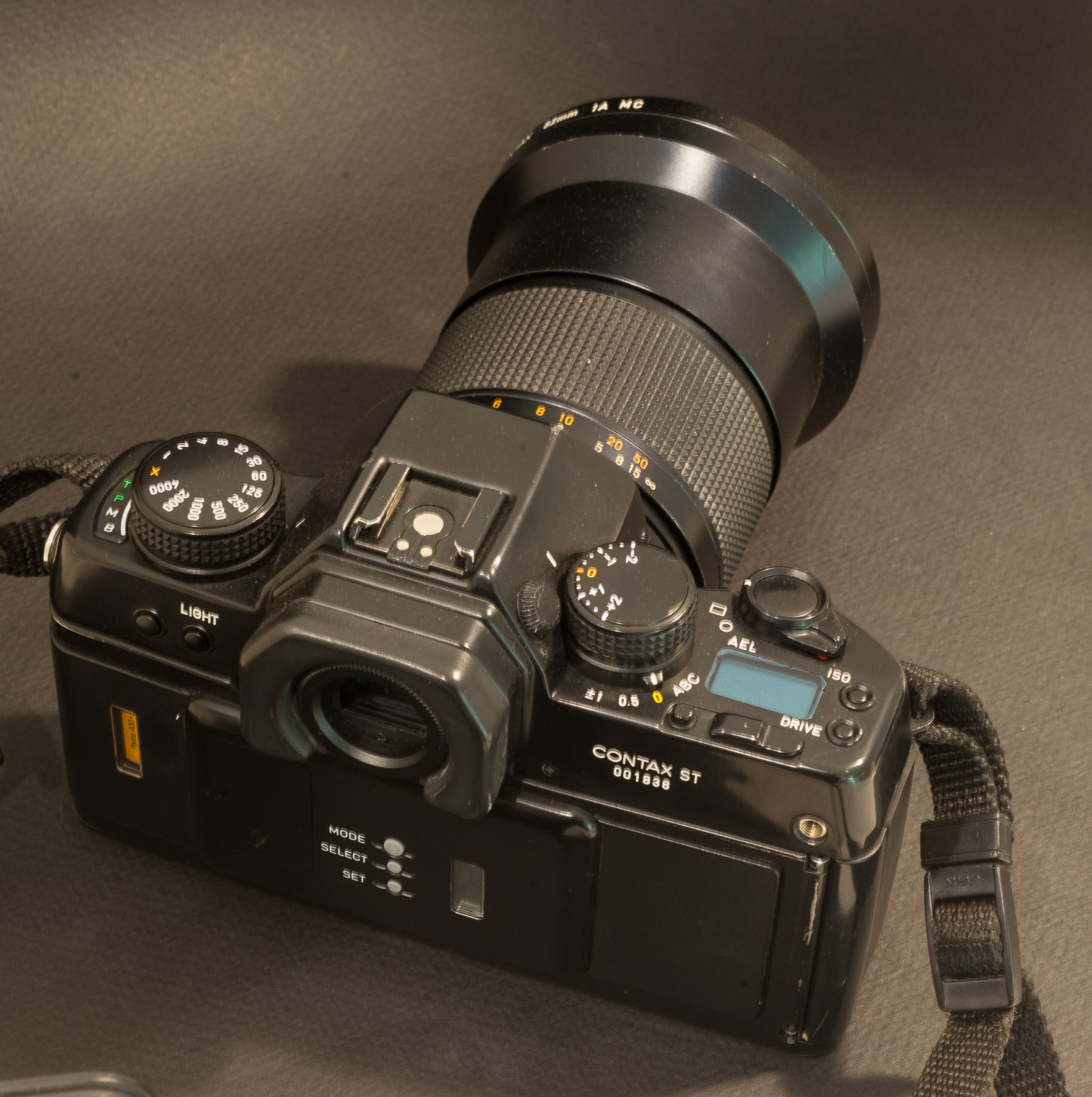
Contax ST and Carl-Zeiss Vario-Sonnar zoom – 28-85 f/3.3-4.0
Zeiss and its sub brand Contax have a very long history – Carl Zeiss founded the company that bears his name in 1846 in Jena (Germany) and Zeiss launched their first Contax camera in 1932.
In the seventies, Zeiss signed a licensing agreement with Yashica (the Japanese company subsequently became part of the Kyocera group). Contax and Yashica never said much about the role split in their joint venture, and most of what we know is an educated guess. High level, the “Contax” branded cameras of the Yashica/Kyocera era were designed and manufactured in Japan with some input from Zeiss. The F.A. Porsche studio (*) was in charge of the industrial design of some models. Yashica and Contax SLRs shared the same bayonet lens mount, and Contax cameras could be paired with Contax as well as cheaper Yashica branded lenses.
The “Contax Carl Zeiss” lenses were named after famous Zeiss lens designs (Distagon, Planar, Sonnar, ..) and benefited from Zeiss’ excellent multi-layer coating. Some of them were made in Germany, but the majority were manufactured in Yashica’s Japanese plants.
Not as well considered as the 35-70 of the same series, the 28-85 is still an impressive piece of glass.
Because of their Zeiss and Porsche lineage, their beautiful industrial design and their advanced technical content, the Contax cameras of the Yashica era could be sold as premium products, for much more than what Yashica could have extracted from their own line of SLRs.
In Contax’s product range, the top of the line was always occupied by a camera of the RTS family, and the bottom by derivatives and successors of their original entry level camera, the Contax 139Q (137 MA, 137 MD, 159MM, 167 MT). There was room in between for what we would now call a line of “prosumer” cameras.
Contax’s middle of the range cameras were a motley crew of SLRs addressing the needs of different niches – the S2 and S2b were semi-auto mechanical cameras, the RX had “a focus assist” system, the AX was an autofocus SLR designed for manual focus lenses (the lens had to be set to the infinite, and the film chamber was moving to adjust the focus).
a very well equipped camera with a conventional user interface (continuous drioptric corrector, date back, illumination of the command dials, and locks everywhere)
Among them, my pick, the Contax ST, was launched in 1992. It’s a somehow simplified and less bulky derivative of the RTS III, a full featured, motorized, manual focus camera with a large viewfinder, a bit like the Canon T90 from 1986. Its unique selling proposition was that the film pressure plate was made of ceramics rather than steel or aluminum (hint: the CERA in KYOCERA stands for Ceramics). I’m not sure that this ceramics pressure plate brought any real benefit to the photographer, but it spoke to the imagination.
The four conventional exposure modes and the shutter speed dial on the left.
Of course, at the time the camera was launched, all major manufacturers (Canon, Nikon, Pentax) had followed Minolta’s example and converted their whole SLR range to autofocus, so the manual focus ST is a bit of the odd man out.(**)
Very first impressions
It’s a beautiful, very traditional SLR which exudes quality, with no autofocus, no modal interface, no menus, no control wheel, no matrix metering, no lithium battery, and a limited use of plastics.
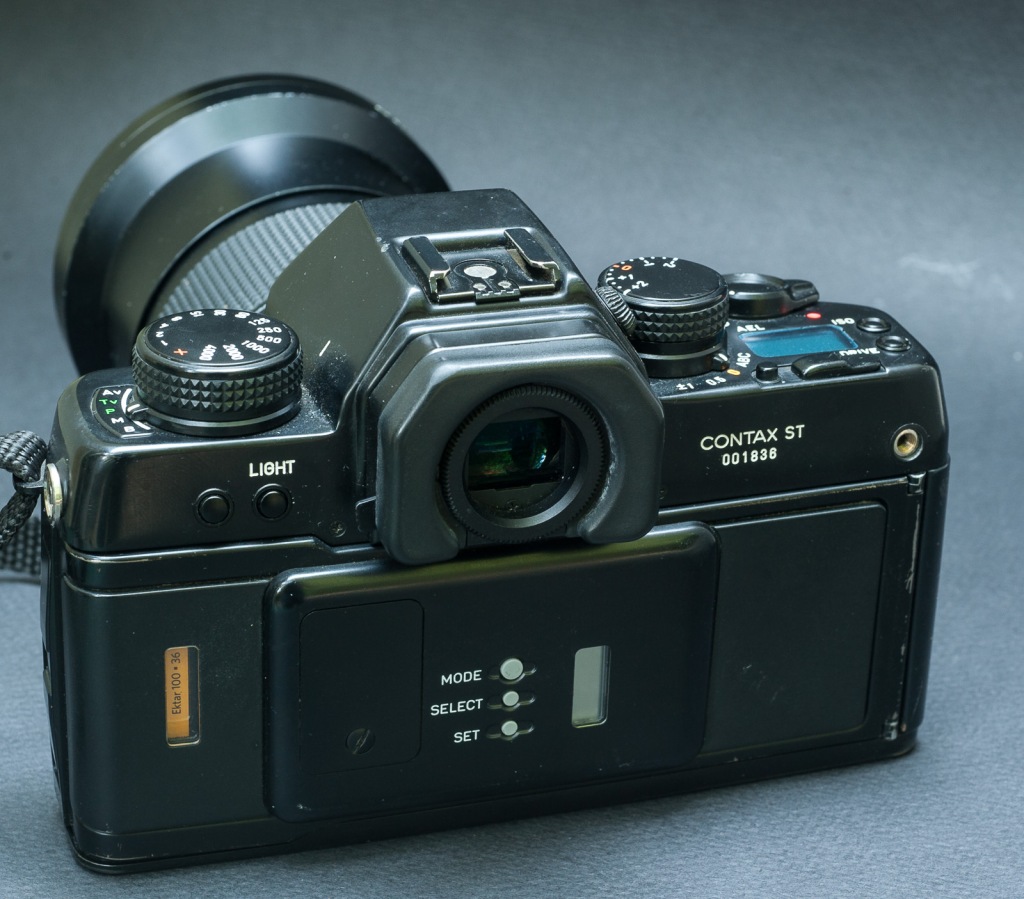
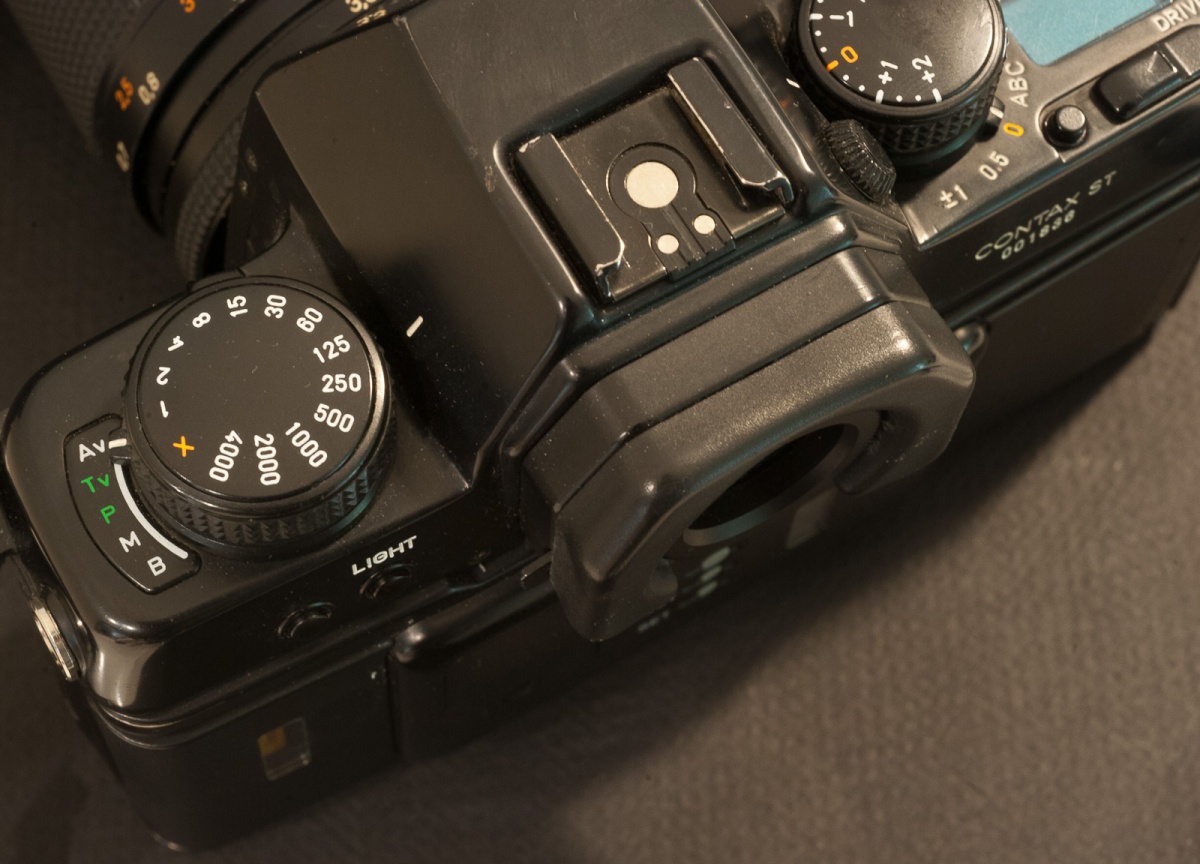
the exposure compensation dial, the metering selector and the electro-magnetic shutter release on the right. AEL (auto-exposure lock) is only available with spot metering.
The ST feels dense (heavy, but not too much) and falls very well in the hands. The commands are conventional, with an aperture ring on the lens, and a large shutter speed knob and an exposure compensation dial on the top plate. Almost all controls (except for the shutter speed and exposure compensation knobs) are secured by locks (like they are on a Nikon F4). There is only a tiny LCD (view counter and ISO display) at the right on the top plate.
Sticking similarities – the importance given to the exposure compensation dial, selectors at the base of the big dials on the left and on right, and a common design language (on the right, Fujifilm X-T1)
For the anecdote, the body of today’s Fujifilm X-T3 looks very much like a small Contax ST, at the 2/3 scale, that is. Even the location and logic of the commands is strikingly similar – with the emphasis given on exposure compensation over any other control – you don’t need to search any longer where the designers of Fujifilm got their inspiration from.
The viewfinder is exceptional. Combining a high enlargement (0.8) and a long eye point (I don’t have the figure, but by comparison with other cameras, it’s really long), it offers a cinematic view of the scene. But at the same time, it’s old school – it’s graced with red LEDs, and the focusing screen does not seem to be one of those ultra fine and ultra luminous Acutemate or BriteMate laser etched screens – as a result the image is a bit darker than what you would see on a Nikon FE2, for instance (not by much, maybe 1/2 stop). The ST is also one of the few manual focus cameras with a continuously adjustable dioptric correction – all in all one of the best viewfinders of its time.
A beautiful viewfinder – on the right the shutter speed, at the bottom-right the aperture, and the exposure counter on the left (it show 00 because the film is fully exposed)
Lesser Contax SLRs have a rubberized skin. that degrades over time – it’s not the case for the STs – they still look pristine 28 years after leaving the assembly shop.
The lens mounts and lens mount adapters
Contax and Yashica had abandoned the 42mm screw mount in 1975 with the introduction of the Contax/Yashica (C/Y) mount on the Yashica FX-1 and Contax RTS.
The original Contax Carl Zeiss lenses belong to the AE series. The design of the lenses was modified in 1985 to support the Program mode and the Shutter priority modes introduced on the 159MM – therefore the modified lenses are part of the MM series (for Multi-Mode). The two versions of the lenses are inter-compatible – you just don’t get the Program mode or the Shutter priority mode if you mount an AE lens on a body like the ST.
Other lens options
Contax Carl Zeiss Lenses in C/Y mount are rather expensive, even now. There are three alternatives if you don’t want to pay hundreds or even thousands of dollars for a lens:
Yashica lenses: Some models have a very good reputation (the prime lenses in the ML series, generally) – they were manufactured in the same plants as the Carl Zeiss series, but were not built to Zeiss specs and did not benefit from Zeiss lens treatment. People who have tested them next to Contax lenses say the color rendering and the micro contrast are different (which makes sense – each lens manufacturer has its “signature”). Other series of Yashica lenses (DSB, YUS) are not necessarily that good – do you research.
Third party lenses: very few independents offered lenses in the C/Y mount. Tamron and Vivitar had C/Y adapters for their respective universal mount systems. But does it really make sense to mount a Tamron or a Vivitar lens on a Contax camera?
Last but not least, you can also mount older 42mm screw mount lenses (from Yashica, Contax or other defenders of the Universal mount such as Pentax) thanks to an adapter proposed by Yashica. You can still find those adapter rings on eBay.
The elephant in the room – made in Japan or in Germany?
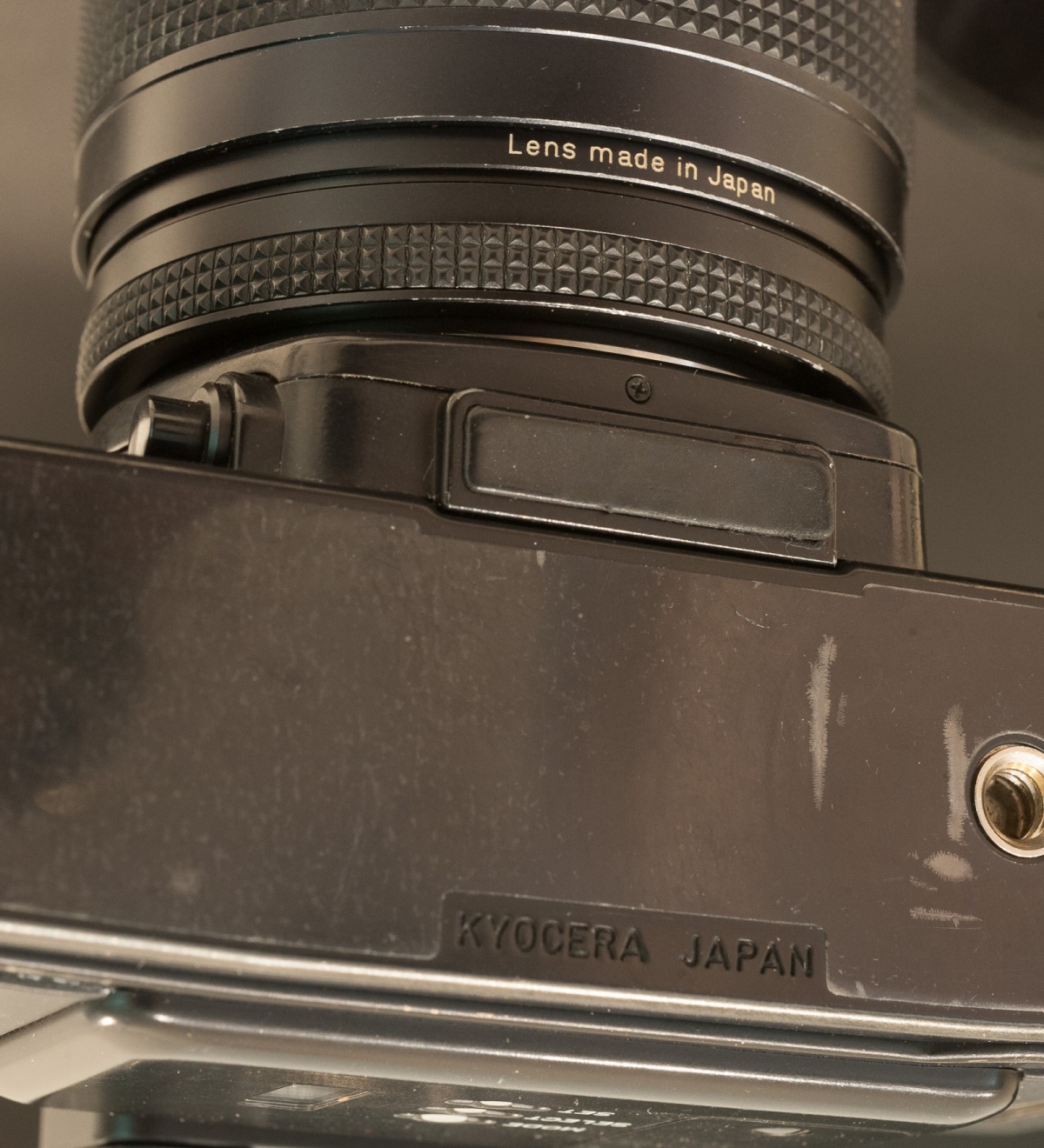
There is no doubt where the bodies were manufactured – my ST proudly bears its “Kyocera-Japan” signature. The Contax Carl Zeiss zoom (the 28-85 f/3.3-4.0) that came with the camera was also made in Japan (no mention of Kyocera, though).
No doubt – it’s a Kyocera (Yashica) camera and it was manufactured in Japan. (interestingly the lens shows absolutely no mention of Yashica or Kyocera)
In the early years of the Zeiss / Yashica collaboration, a lens could originate from the German workshops of Zeiss or from the Japanese factories of Yashica (even for a given model – some were produced simultaneously in Europe and in Asia). Over the years, the manufacturing activities were increasingly concentrated in Japan. I did not find any evidence that lenses made in Asia were better or worse than the lenses made in Europe – and I don’t think it matters: they were all designed and manufactured to Zeiss’s specs with Zeiss’s T* multi-layer coating.
Buying Contax cameras and lenses today
In the nineties, Contax cameras were positioned and priced as premium products, a big notch under Leica, but in the same ballpark as Nikon’s or Canon’s Pro cameras.
Today, their high-end bodies hold their value very well even if Leica R products remain more expensive.
The Contax magic percolates to Yashica ML lenses and to certain Yashica bodies (like the FX-3 Super 2000), which are also sold at a premium, for products of a second tier brand, that is. The 21mm and 28mm wide-angle lenses are particularly sought for, selling for at least $350.00.
On the right the Canon T90 from 1986 – like the Contax, a very elaborate manual focus camera. The User Interface is totally different, though.
The least expensive Contax SLRs are the entry level models (139, 137, 167) at less than $100.00 for a nice copy. Really sought after models like the RTS III, the S2 (the semi-auto camera) or the Aria (a compact SLR, the last camera in the Contax manual focus line and the only one with matrix metering) typically sell in a $350.00 to $600.00 bracket. The rest of the products (ST, RX, RTS I or RTS II) sell for approximately $150.00.
They were competing on the shelves of the photo equipment stores in the early nineties – the Nikon N90x (right) represents state of the art (modal interface, matrix metering, autofocus, f/2.8 constant aperture zoom). The Contax ST, on the other hand, was spec’d like a pro-camera of the early to mid eighties.
But be cognizant that in order to enjoy the full Contax experience, you’ll need Contax Carl Zeiss lenses. It’s very difficult to find anything (even a very common Planar 50mm f/1.7) at less than $150.00, and really interesting lenses (the 21mm wide-angle for instance) can cost well over $1,000.
More about the Contax ST and the Vario-Sonnar 28-85mm f/3.3-4.0 in a few weeks, after a few rolls of film.
The Contax brand has been dormant since 2005, and there is relatively little information about their products on the Web.
(*) Porsche used to be a family business. And everybody in that family seemed to be named “Ferdinand”. Because it was a family business, the eight grand-sons of Ferdinand Porsche, (the engineer who had founded the company and designed the original Beetle) ended up working at the Porsche car company under the direction of Ferdinand “Ferry” Porsche, who had taken over the business from his father Ferdinand after WW2. When the conflicts between the most talented of the cousins reached dangerous levels, Ferry asked them to leave. Ferdinand Piech, who had designed the engine of the 911, left to start a new career at Audi, and ended his professional life as the chairman of the Volkswagen Group. The other cousin, Ferdinand Alexander Porsche, who had designed the body of the original 911, started his own design studio. And one of the first clients of the studio was… Contax.
(**) – Contax launched its first autofocus film SLRs (the N1 and the NX) in 2000 with a new lens mount and a new series of lenses – roughly 15 years after anybody else. And followed up with the first full-frame dSLR in 2002, the Contax N Digital. The products did not sell well and were rapidly withdrawn from the market, and Kyocera left the photography market for good in 2005. The Contax brand has been kept dormant ever since.
The lens mount of the Contax N, N1 and Nx of the early 2000s was totally different from the C/Y mount of this ST. From an engineering point of view, the new lens mount was so close to Canon’s EOS that conversion jobs were possible. You can read a test of a converted lenses in Optical limits
































 CamerAgX - a new life for old gear