1985 is an interesting year, a turning point for the market of single lens reflex cameras: Minolta launched the first technically and commercially successful auto-focus SLR, the Maxxum 7000. In a few years, manual focus SLRs would be relegated to the status of entry level models manufactured by subcontractors such as Cosina. Brands like Olympus or Contax would fail to impose their autofocus cameras on the marketplace and would become largely irrelevant, while vendors like Fuji would not even try to launch an autofocus line of bodies and lenses, and would leave the market altogether.
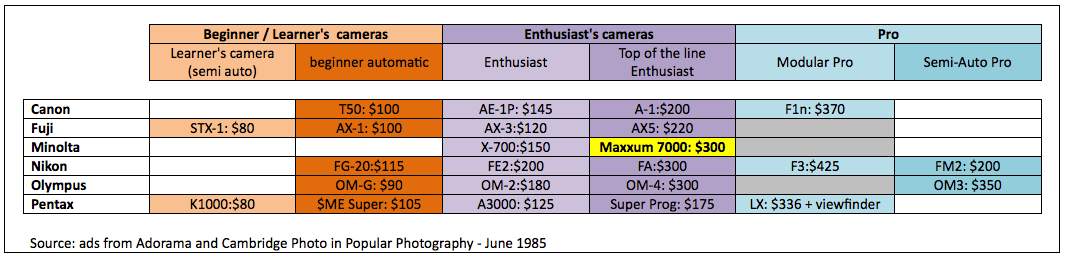
Old issues of Popular Photography have been scanned and indexed by Google, editorial content and ads. I compiled the table below from Adorama’s and Cambridge Photo’s ads.
Price of Cameras – 1985
A few interesting points….
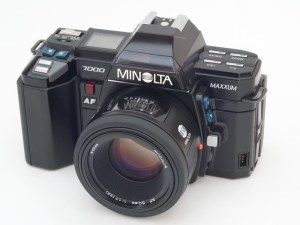
Minolta Maxxum 7000 – source Wikipedia
the models most popular with enthusiasts (Canon AE-1P and Minolta X-700) were in the $150 price range (body only).
Beginners could buy “a learner’s cameras” – with semi-auto-exposure – or a spec’d down aperture priority automatic cameras for less than $100.00.
Very few models were competing in the $300 price bracket: serious or wealthy enthusiasts and pros could buy the Nikon FA, splurge on an OM-4, or spend even more on modular cameras with interchangeable viewfinders (like the Nikon F3, the Canon F1 or the Pentax LX).
The Minolta Maxxum 7000, priced at $300 (when you could find it), completely changed the equilibrium of the market. Targeted at the enthusiast photographer crowd (there was a more expensive Maxxum 9000 for the aspiring pros), it moved the average price of a camera a few notches upwards.
In a few years, the major vendors had converted their product line to autofocus, and relegated what was left of their manual focus SLR lines to the status of low margin items targeted at impecunious customers. Minolta and Pentax moved the production line of their manual focus SLRs to China, while Canon, Nikon and Olympus commissioned companies like Cosina to design and manufacture entry level manual focus cameras for them (Canon T60, Nikon FM10 and Olympus OM-2000 respectively).
On a side note, the Maxxum product line was so successful that Minolta leapfrogged Canon to become the #1 vendor on the market. It took Canon a few years (and the EOS series) to take their crown back.
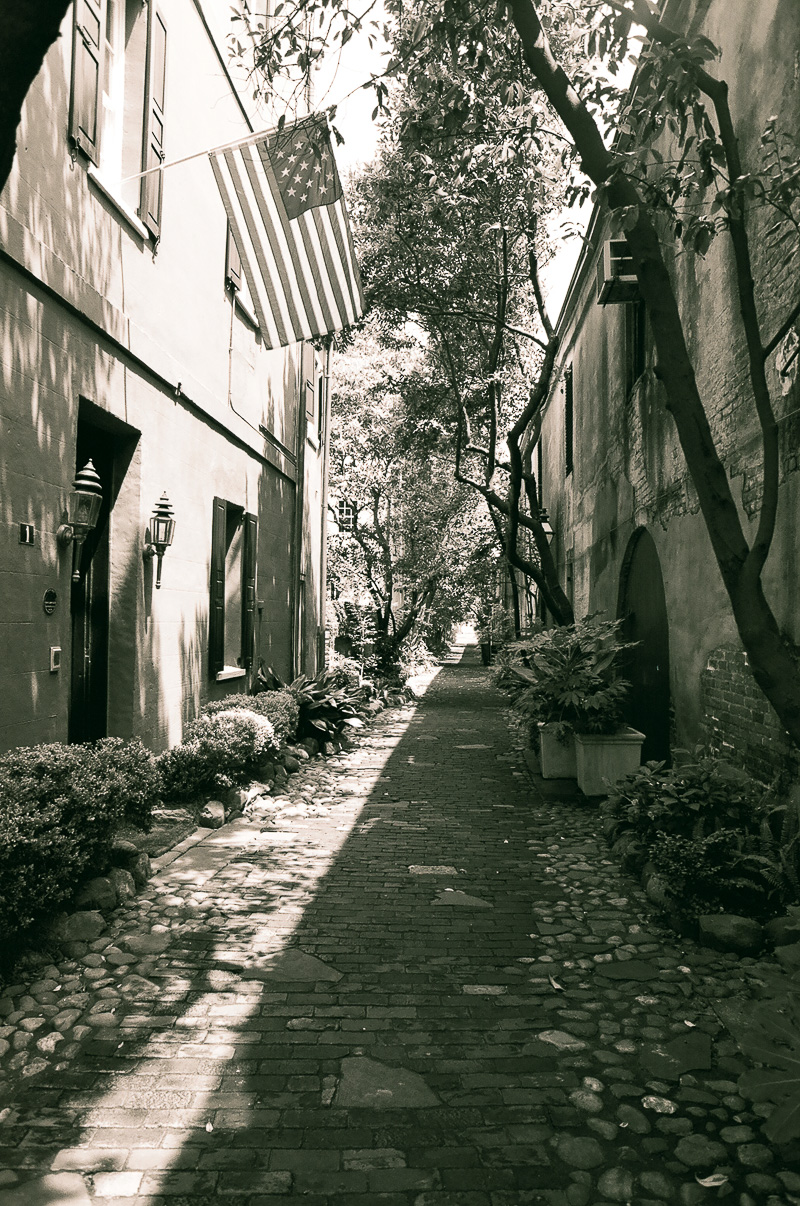
Charleston, SC – Shot in 2009 – Nikon FM – Kodak CN400
The AV-1 is a variant of the A series developed as an entry level model to compete with the myriad of spec’d down SLRs of lesser brands (Chinon, Cosina, Ricoh, Vivitar and the private label cameras sold by Sears and the like). It was primarily designed for the US market. It’s an aperture priority auto-exposure camera, which is stripped of any ability to control the exposure manually or in semi-automatic mode, or to pre-visualize the depth of field. But it will accept most of the accessories of its bigger A series brothers (winder, flash, …), and of course Canon’s FD lenses.
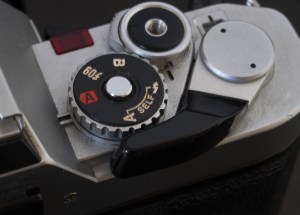
Canon AV-1 with a Canon 35-105 zoom.Canon AV-1 – the photographer can not select the shutter speed. (no semi-auto mode)
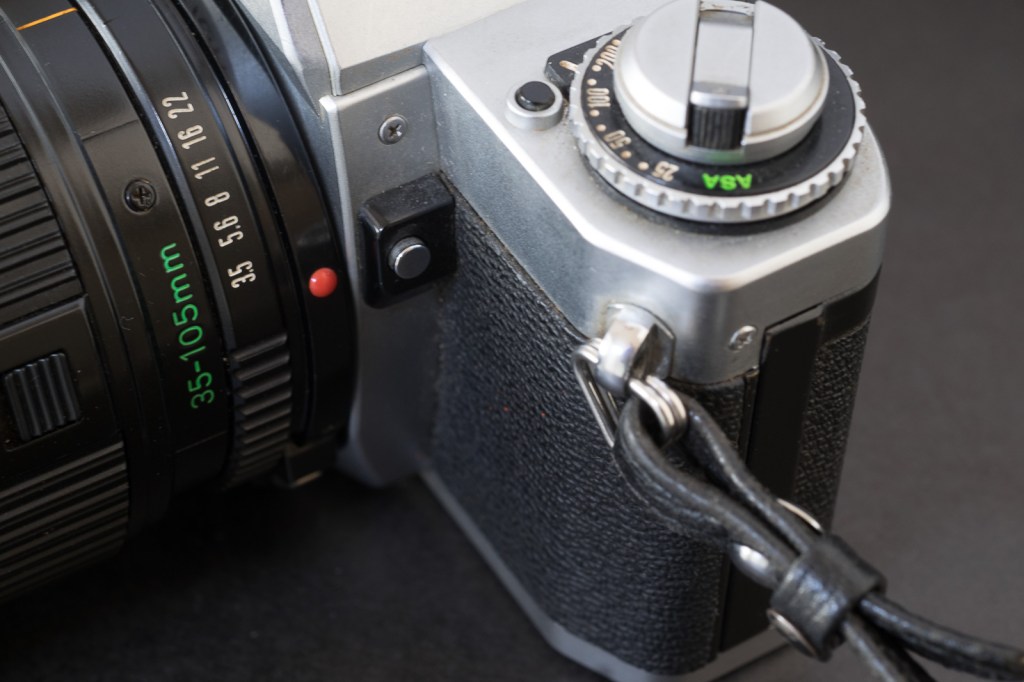
The shutter speed selected by the camera is indicated by a needle in the viewfinder, and a button on the left side of the camera can be used to adjust the exposure if the subject is backlit. A trained photographer will feel deprived of control on the camera, but in simple situations, it’s good enough.
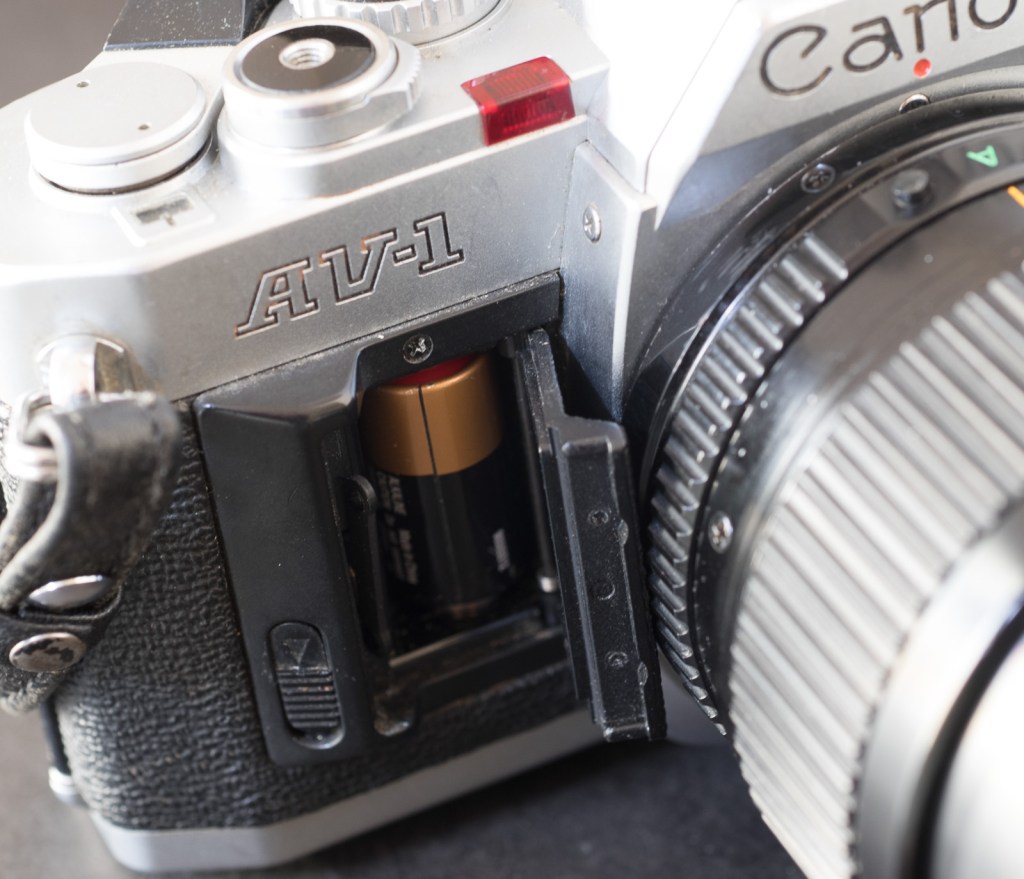
Most AV-1s I’ve seen have a broken battery door. The one I found is not different. But it does not prevent the camera from operating, and delivering good pictures in the standard situations that an amateur would face.
Because it’s an automatic-only camera, the AV-1 is not a very sought after item, and it can be found for next to nothing – I bought mine as part of a bundle of 4 cameras, for the princely sum of $8.95.
Canon AV-1 – the button on the top plate is the battery check. The button on the side of the reflex chamber is for exposure compensationCanon AV-1 – The lock on the battery door is broken, but it does not prevent the camera from working.
Canon FD Lenses
The Canon FD lenses are abundant and, because they could not be mounted on modern Canon autofocus bodies, they remained cheap. With the advent of full frame mirrorless system cameras (the Sony A7 family), it became easy to use an FD lens on a modern camera, and the most sought after lenses (mostly the “AL” or “L” fast prime tele objective lenses) are now selling for prices in excess of $1,000. Zoom lenses are not as highly valued, the most expensive ones selling for $500 to $700.
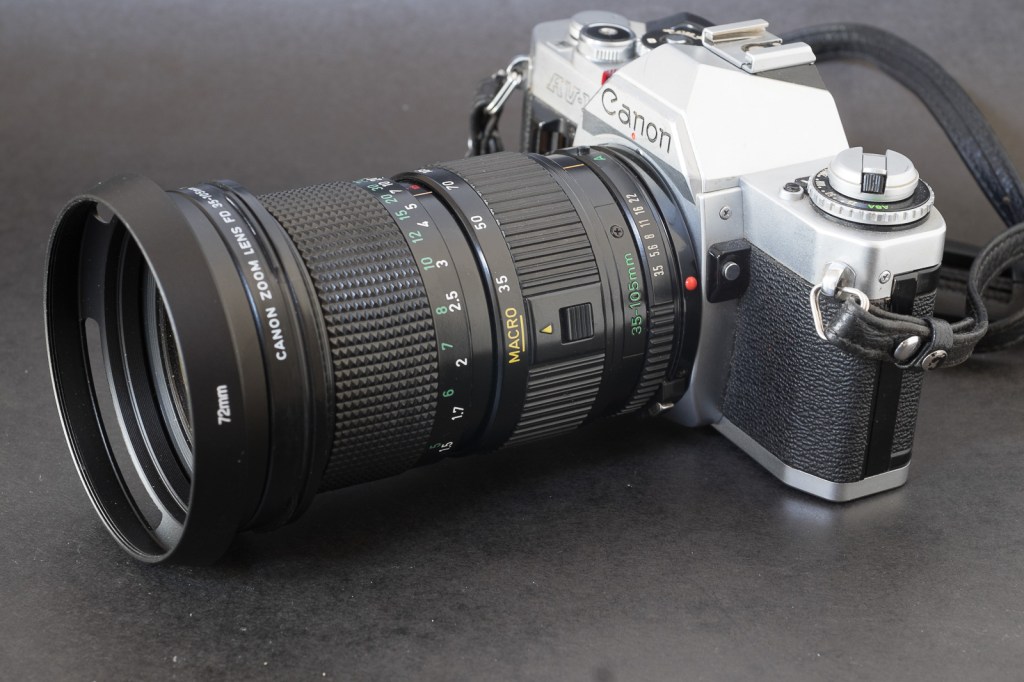
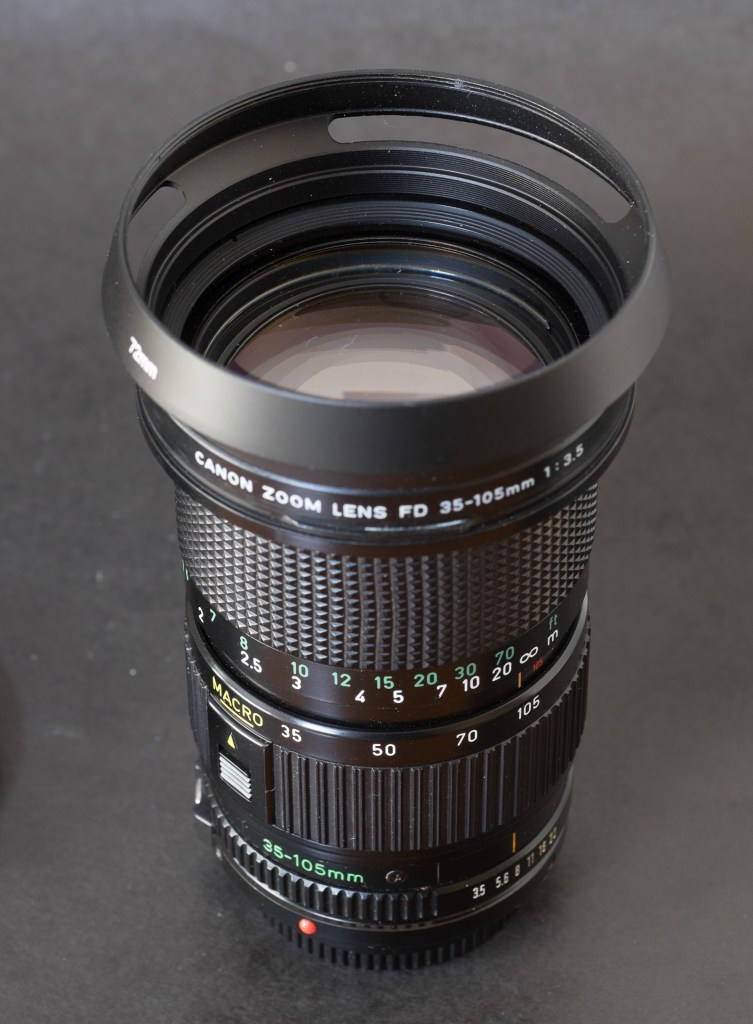
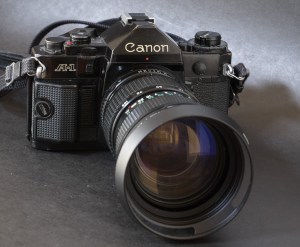
Canon FD Zoom 35-105 f/3.5 (3 rings).
Zoom lenses (even those with a very good reputation when new like the three ring 35-105 F/3.5 I’m using for this blog post) are somehow disappointing today, even when mounted on a old film cameras: they’re large and heavy, sensitive to flare, and three rings (zoom, focus, aperture) is a lot to play with for photographers used to working with modern autofocus bodies. That being said, this particular zoom is a very beautiful piece of glass.
It was Canon’s first 35-105 lens. It is a true (or parfocal ) zoom which stays in focus when magnification/focal length is changed, with a constant F/3.5 aperture. The front element of the lens is rather large, and the zoom requires 72mm filters.
It was replaced a few years later by a much more compact lens, with a sliding aperture (f/3.5-4.5), an aspherical element and a 58mm filter ring. Canon derived an autofocus version of that lens, and it’s the precursor of the consumer grade trans-standard zooms still sold with digital SLRs today.
I bought my copy of the lens from a Japanese store on eBay. Their description of the articles is sometimes difficult to understand (poor translation in English), but in my experience, Japanese resellers tend to have very nice items at a very reasonable price.
Japanese resellers generally ship with Chronopost. This global service is extremely efficient and works seamlessly with the US Postal Service: you typically get your purchase delivered to your door step by the USPS in 3 to 4 days.
In 1976, Canon launched the AE-1, an automatic camera with shutter speed priority automatic exposure. It was a very capable, judiciously priced camera which sold in excess of 1 million units. It was driven by a microprocessor, and Canon took advantage of the flexibility of its architecture to derive rapidly more models – the AT-1 (semi auto) in 1977, the AV-1 (aperture priority automatic in 1978), the AE-1 Program in 1981, and the AL-1 (a camera with an electronic focus assist system) in 1982. The A-1, launched in 1978, was the top of the “A” line, and was the first system camera to combine 3 types of exposure automation modes – shutter priority, aperture priority and program, in the same body.
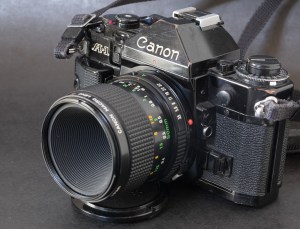
Canon A-1. Still impressive after all these years.
Until the launch of the A-1 (and of Minolta’s XD-7 at about the same time), an auto-exposure camera only operated in one mode. Minolta, Nikon and Pentax were in the “Aperture Priority” camp (the photographer selects the aperture, the camera sets the shutter speed automatically), while Canon and Konica were defending “shutter priority” (the photographer selects the shutter speed, and the camera sets the aperture automatically). Each camera manufacturer was presenting the solution it had picked as the best, but the truth is that a photographer could have benefited from Aperture Priority one day (if he was shooting landscapes, for instance) and from Shutter Priority another day (when he was shooting sports events, for instance). With the A-1, Canon not only offered Aperture and Shutter Priority modes (which required the user to pick the most appropriate mode and set the aperture or the speed accordingly), but also a program mode, where the camera automatically selected the Aperture and Shutter speed combination, without any intervention from the photographer.
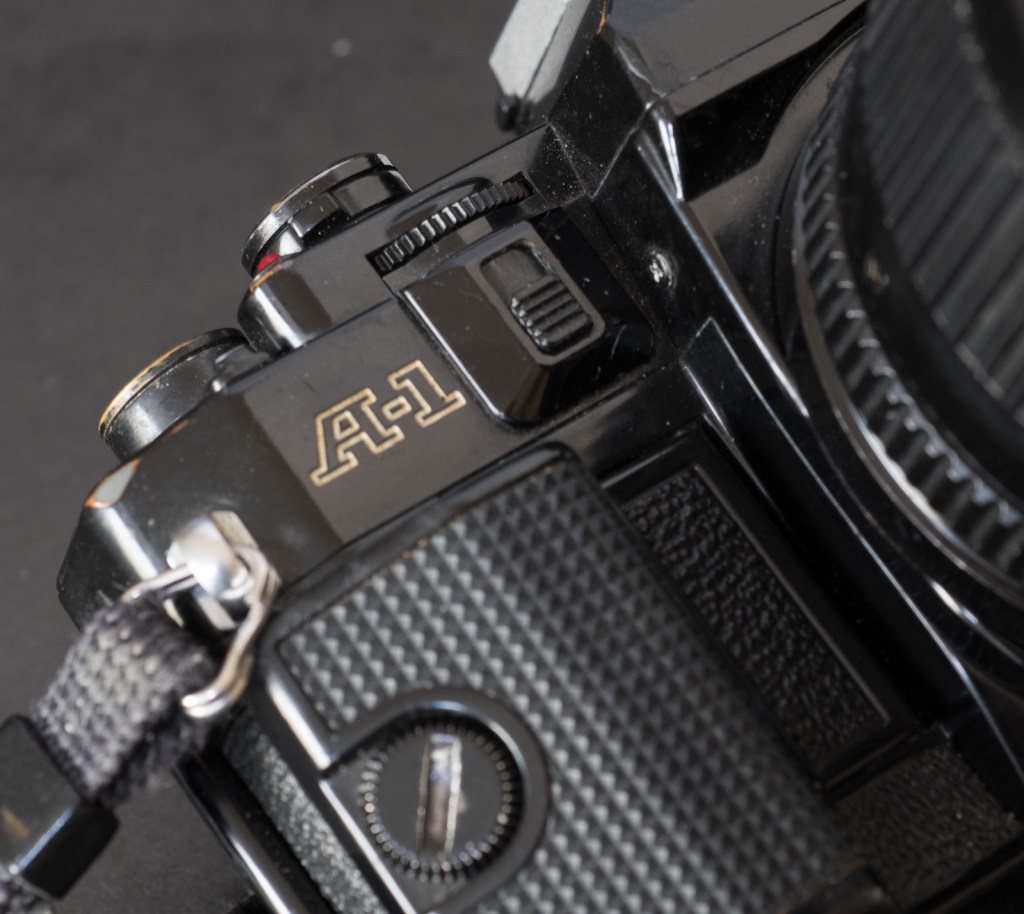
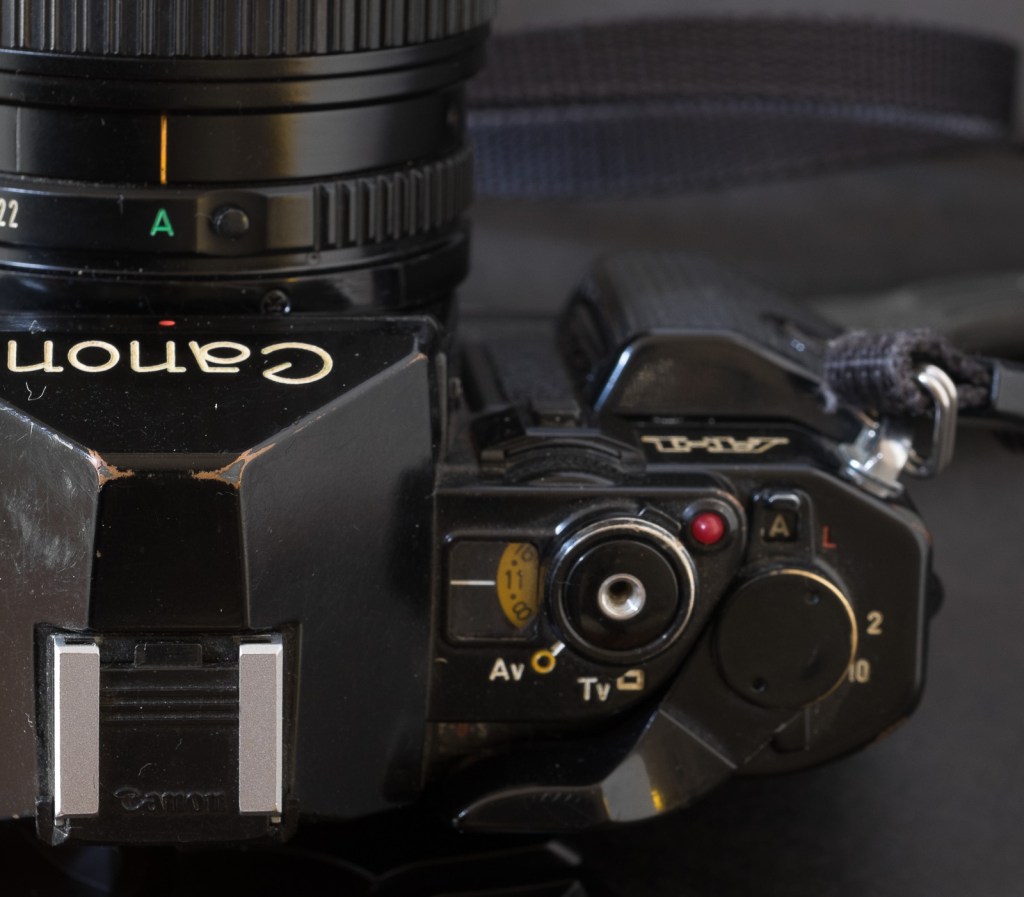
Canon A-1 – battery check, exposure memorization, depth of field preview – buttons, switches and cursors
Today, most of the “A” series cameras of Canon are still abundant and cheap – they were manufactured in huge quantities, and they have withstood the test of time much better than most of their less reliable competitors. With the exception of the A-1 which has a stronger personality, the cameras of the “A” generation are rather unremarkable. They’re not big (but not as small as the Olympus OM cameras), their build quality is good, but not exceptional (compared to a Nikon FM or FE of the same vintage, they feel plasticky), the view finder is large and luminous enough – but … not exceptional (you guessed it right). They need a battery to work, but the battery is an easy to find a 6v alcaline or silver oxide battery. They’re easy to use, and in the hands of a moderately competent photographer, will produce good pictures.
The A-1 is a bit different. It was designed as Canon’s top of the line, and it was intimidating when it was launched (there had never been so many buttons and switches and cursors on a camera). But the controls were very logically implemented and the learning curve must have been short. Canon’s implementation of the controls for the three automatic exposure modes was very clever and was a decisive step towards the modern ergonomics (control wheel and LCD) of the Canon T90 and its EOS successors.
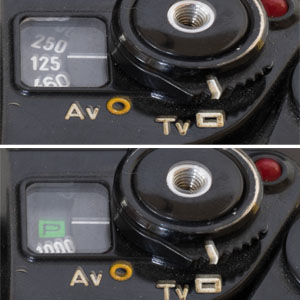
In order to operate in auto-exposure mode, first set the lens’ aperture ring to “A”. Then move the mode switch to “Av” (Aperture priority) and select the aperture with the control wheel, or set the mode switch to “Tv” (Shutter priority), and use the control wheel to select the shutter speed (from 30 sec to 1/1000 sec.). The Program Mode is accessible from the “Tv” position – there is no dedicated position of the mode switch for the Program Mode.
Canon A-1 – Shutter Priority Mode and Program Mode. The photographer can not pick the aperture, so the aperture dial is hidden and only the shutter speed values are shown.
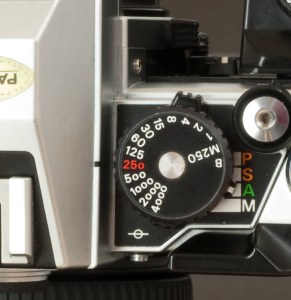
Canon’s implementation of the multi-mode auto exposure is more user friendly that Nikon’s. When they launched the FA (5 years after the A-1), Nikon kept the conventional shutter speed knob next to the mode selector. In the picture above, the camera is set in Aperture Priority Mode (the photographer selects the aperture and the camera picks the shutter speed, that could be anything from a few seconds to 1/4000 second), but the shutter speed knob still shows 1/250, which can be misleading.
Today, the A-1 is still a very good tool. It offers all sorts of controls (exposure memorization, depth of field preview, multiple exposure of the same frame) and its only limitation is its shutter. Film is now significantly faster than in 1978 (200 or 400 ISO is the new normal), and a shutter with a fastest speed of 1/1000 can be a limitation.
The “T” models that followed were ugly plastic bricks controlled by push buttons – with the exception of the T90 which is a beautiful precursor of the EOS models, but suffers from reliability issues (sticky shutter).
In my opinion, the A-1 is the last great camera using FD lenses that can still be used today. It is not a beautiful piece of classical photographic machinery like a Canon F-1, but it’s a solid and very capable tool, that a photographer trained on modern “control wheel” SLRs will learn how to use easily.
Canon A-1. The control wheel is used to change the lens aperture or the shutter speed in auto modeCanon A-1. The mode switch is in the “Av” position – the photographer can only pick the aperture and that’s what’s displayed on the mode dial.On the Nikon FA, the value displayed on the shutter speed will not necessarily be used to take the picture. The camera is set in “A” (aperture priority) mode and the shutter speed will be determined by the electronics of the camera.
What were the competitors doing when Canon was launching the AE-1 and the A-1?
The Nikon cameras of 1978 were conventional semi auto and aperture-priority auto exposure cameras.
Nikon was selling three models, the F2, FM and FE, with AI lenses.
The AI bayonet mount could not have supported Shutter Priority and Program modes. A new variant of the Nikon F mount, the AI-S, was launched in parallel with the FG and FA, the multi-auto cameras of 1983.
In 1978, Pentax was selling the ME/MX cameras with the K mount (not capable of supporting Shutter Priority and Program modes).
The bayonet mount was revised in 1983 to become the KA for the launch of the Pentax Super A.
The Super-A was Pentax’s only manual focus reflex camera supporting the same 3 auto-exposure modes as the Canon A-1.
In 1978 Minolta was selling the XD-7 and its derivatives (dual auto, but no Program mode) in addition to a line of Aperture Priority cameras.
Minolta’s MD lenses (launched in 1977) benefited from an updated version of the SR mount and could support cameras with Shutter Priority auto-exposure in addition to the Aperture Priority mode that the MC lenses already supported
The first Minolta SLR to offer also a Program Mode was the X-700 in 1981.
Interestingly none of those newer generation “X” models offered the 3 auto-exposure modes of the A-1: the shutter priority mode was missing.
With its 3 auto-exposure modes, the Canon A-1 was definitely unique among the system cameras of the Big 4.
Midtown Atlanta from Piedmont Park – Canon A-1 – 35-105 Zoom – My father in law is the original owner of the camera. Nice gift. Thank you.


 CamerAgX - a new life for old gear