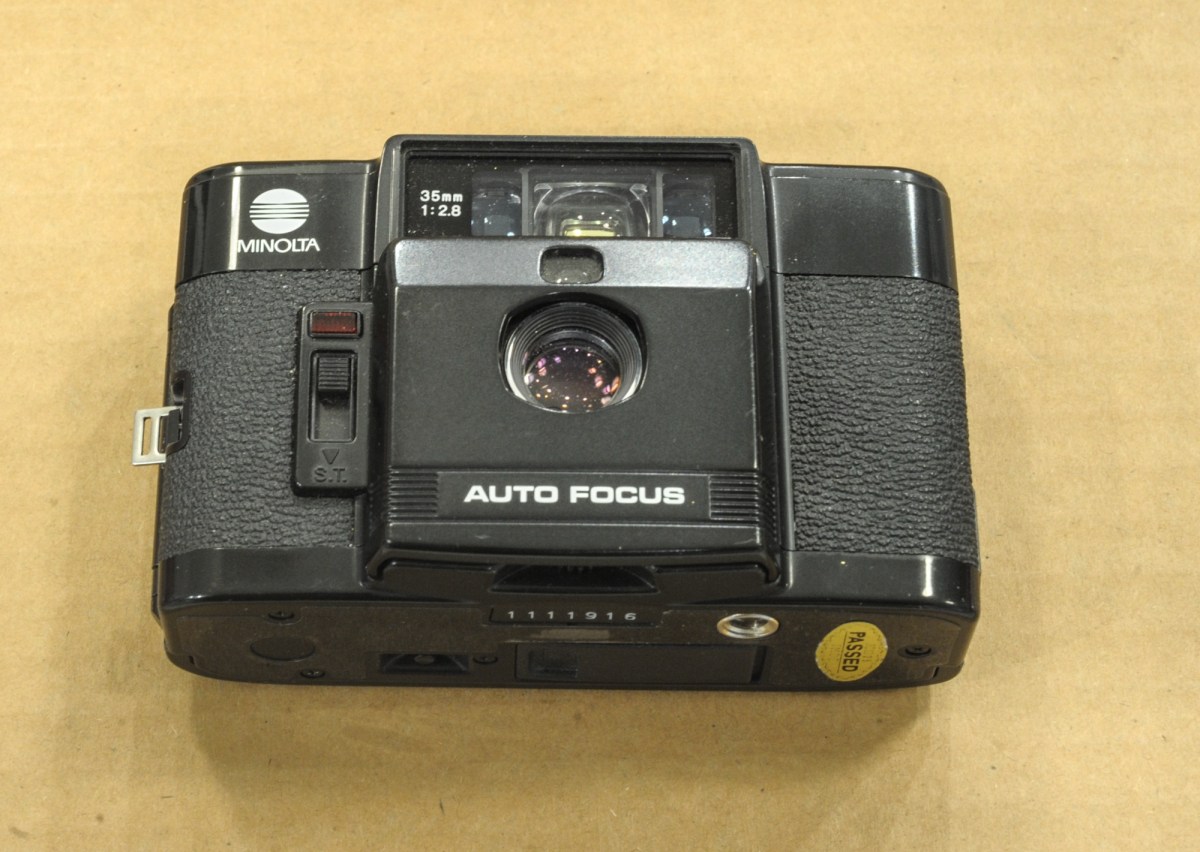
Minolta, once a major camera maker – second only to Canon in terms of volume – was absorbed by Konica in the late nineties (correction: I was a few years off – the merger was announced in Jan 2003).
The newly formed Konica-Minolta entity left the photography market in 2006 – with Sony inheriting some of their camera and lens designs when they entered the dSLR market.
For the anecdote, the Minolta name is now used under license by a company distributing (very) entry level digital cameras, that – based on the horrendous reviews they get on Amazon – I won’t bother testing.
Sic transit…
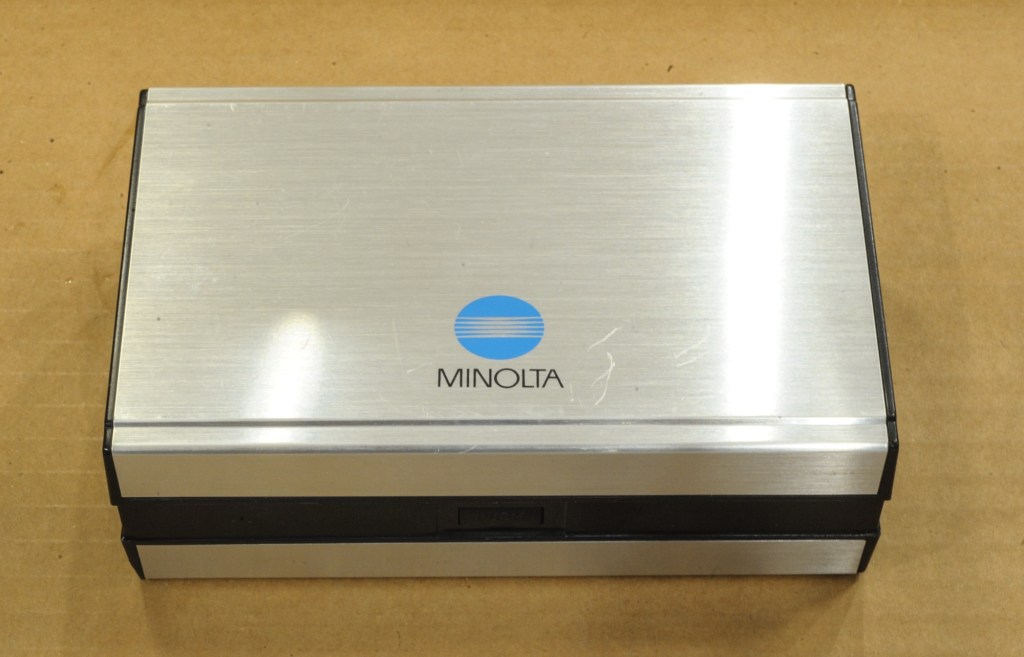
In 1983 though , Minolta were at their peak. In addition to their bread and butter point and shoot cameras, they had decided to go after the market of photographers looking for an ultra compact camera of quality, and proposed a Minolta alternative to the Olympus XA, the Minox 35 EL and Cosina’s CX-2.
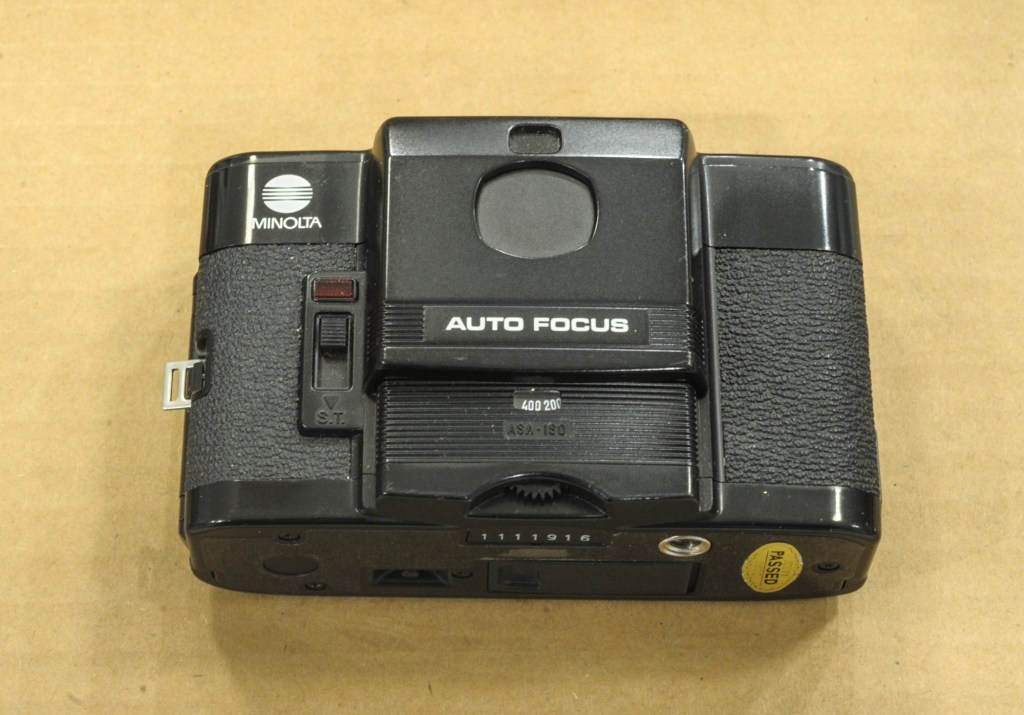
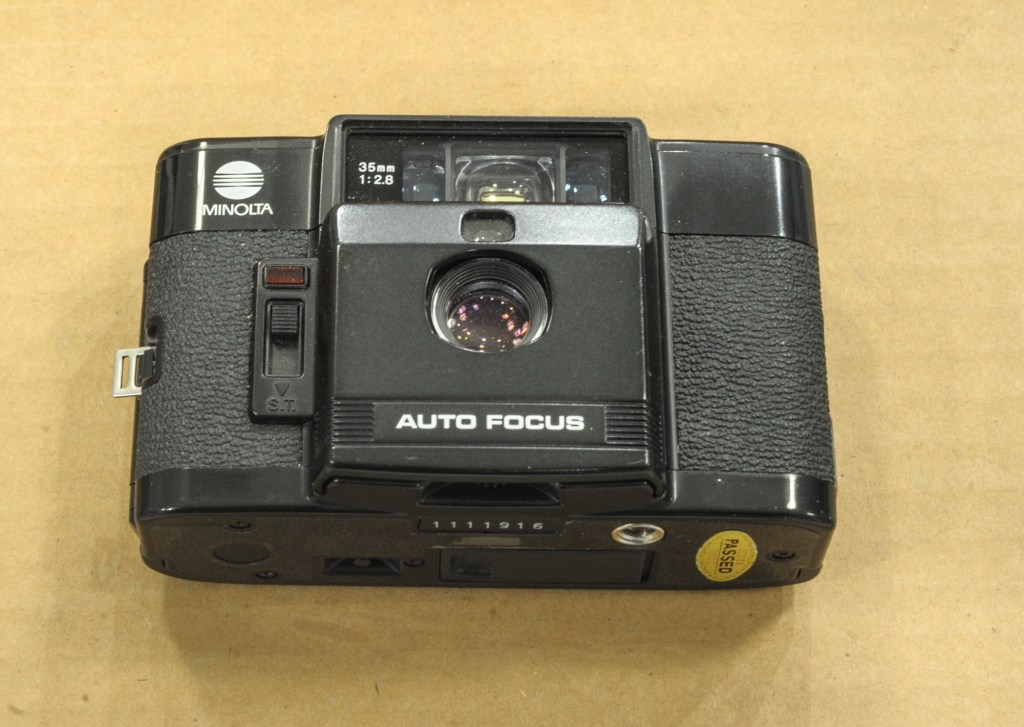
Like its competitors, the AF-C was extremely compact – it integrated a rather fast wide angle lens – a 35mm opening at f/2.8, and was devoid of an electronic flash (it was sold as a separate unit, to be attached to the left of the camera) or from any motorized film advance system. The AF-C’s unique selling proposition was its autofocus – all their competitors relied on zone focus (Minox, Cosina) or on a small rangefinder (Olympus) for focusing.
The AF-C’s unique selling proposition was its autofocus
On all those ultra-compact cameras the lens and the viewfinder are protected when the camera is not in use. In the case of the AF-C, a “sliding shield” protects the lens and the viewfinder when the camera is not in use, and has to be moved down to unlock the camera. Simple, and it works.
Today, the AF-C is not as sought after as the XA or the CX-2 (if eBay prices are an indication). And a derivative of the Cosina CX-2, the Lomo LC-A, reaches much higher prices. Why is it so? Probably because the AF-C is a totally automatic camera, with no ability for the photographer to adjust the settings. You’ll have to trust the performance of its autofocus – there is an AF lock feature to help with off-center subjects, but that’s all. A green LED is lit when the camera has set the focus on “something”, but you will only know what it was after you examine the prints, a few days (or weeks) later.
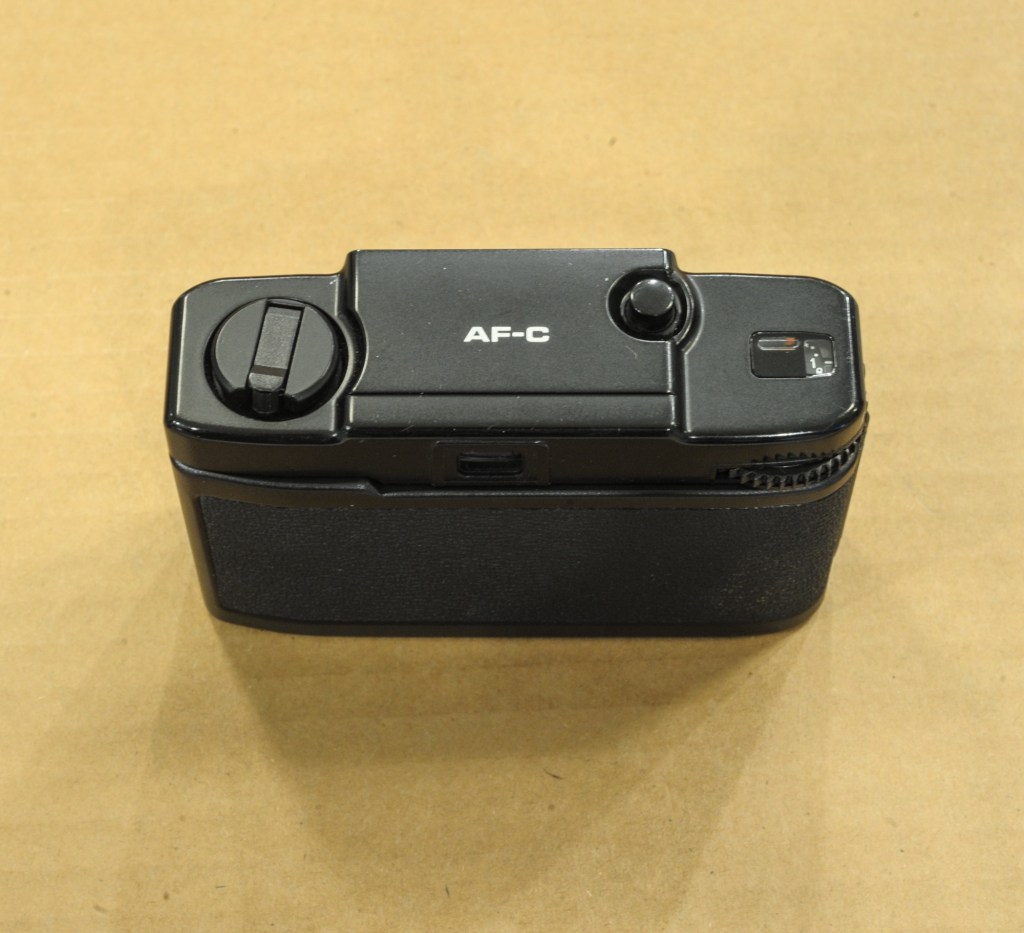
Similarly you’ll have to trust the CdS meter – a program controls the combination aperture-shutter speed, with no indication of what the camera has decided to do, and no manual override. In fact, the only thing that the photographer can set is the film speed – between 25 and 400 ISO. Considering that the meter operates between IL6 to IL17 – (1/8s at f/2.8 to 1/430s at f/17)- I would probably use 200 ISO film to cover my bases without risking reaching the limits of the shutter on very bright subjects.
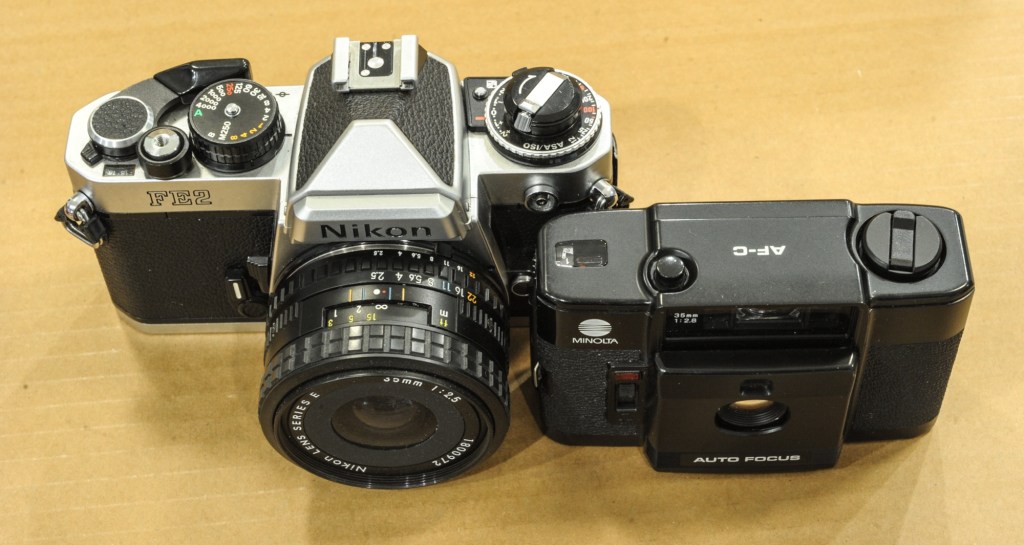
Another reason the demand for the AF-C is pretty low nowadays is that it does not operate without batteries (4×1.5v silver oxide batteries). None of its competitors does – all have electronic shutters – but in the case of the AF-C, even the non-motorized film advance is inoperative in the absence of batteries (the film advance wheel is locked). Which leads people to believe that the camera is dead, when it’s just asking for fresh batteries.

Shooting with the AF-C
Film loading is easy, if you are used to operating a fully manual 35mm camera.
As for shooting, there’s not much to say. You point the camera towards the subject, you press the shutter release button, and you expect that the AF-C will do the rest. Because you don’t have much to do beyond that.
a young lady seating at the table next to ours asked us whether I was shooting with a disposable camera
Oh yes, film advance is not automated, and the camera is too small for a conventional film advance lever: you have to turn the film advance wheel, like you would do on an old Instamatic. It’s making the same noise – and it’s intriguing for people who are not in the know: I was taking a few casual snapshots of my wife at the terrace of a cafe, and a young lady seating at the table next to ours asked us whether I was shooting with a disposable camera.

Fresh from the lab
I had this little camera with me when walking in the streets of Atlanta for the Inman Park festival a few weeks ago. It was loaded with Kodak UltraMax 400, not my preferred stock, but I thought it would be a better fit for the camera than my usual Ektar 100.
I was impressed by the sharpness and the contrast of the pictures
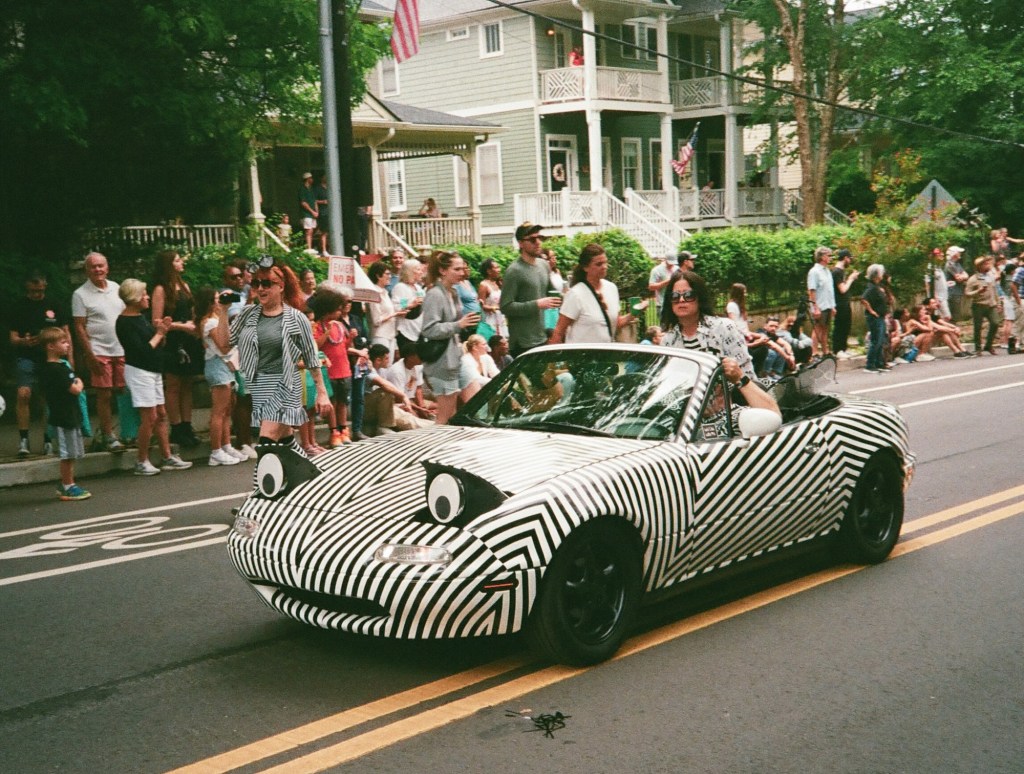
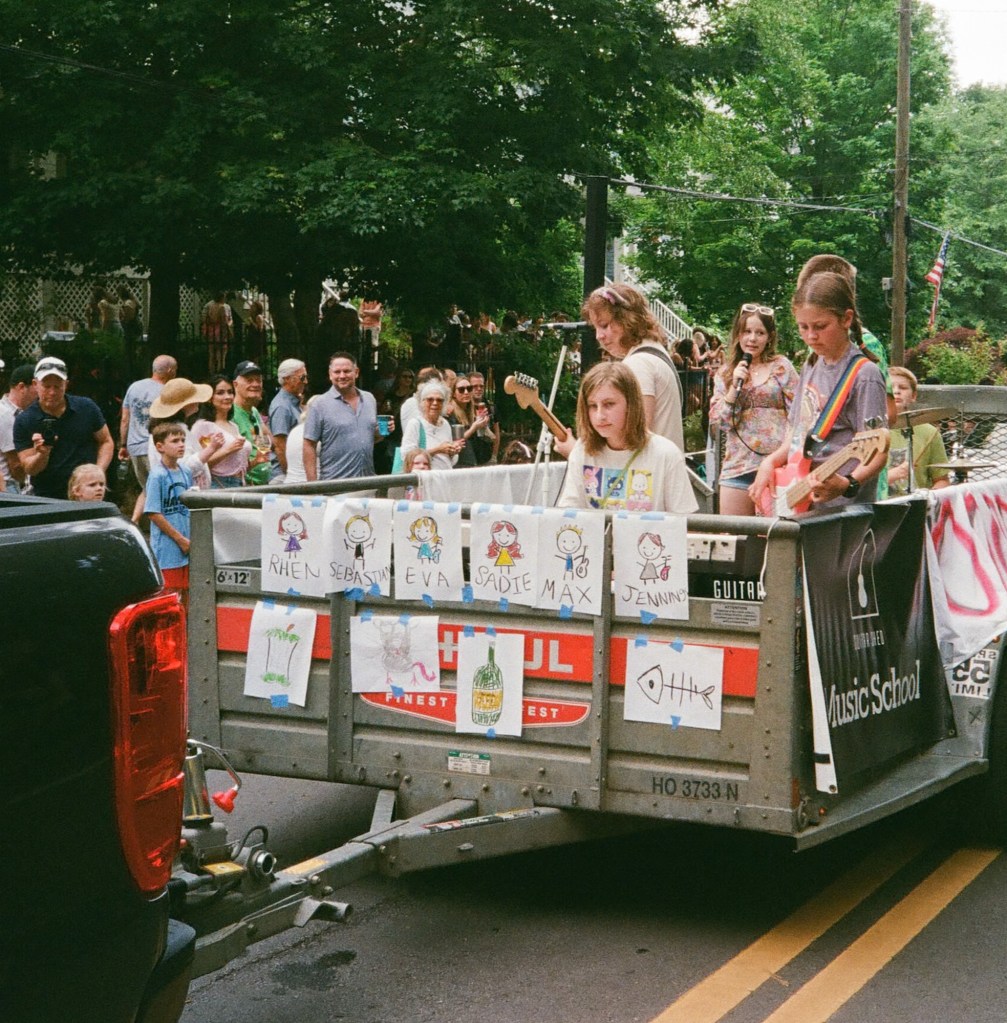
When I received the scans, I was impressed by the sharpness and the contrast of the pictures – which points to a good lens. I also liked the camera’s ability to freeze movement – the program controlling the exposure parameters seems to have its priorities in order.
As long as the subject is a street scene or the portrait of a human being, the focus is tack on. But if the subject is not at the center of the frame, or moving too rapidly inside the frame, or too small, the camera can not get the focus right. You should not use the AF-C to take pictures of pets (and of children who can’t stay in place).
I was not overly impressed by the colors though. It could come from the scanner of the lab, but I suspect that the camera had under-exposed most of the pictures. I used Lightroom’s “modern” Profiles to bring the tones to my taste, and the final results are not bad at all for a 40 year old ultra-compact camera. They have the 1980s minilab look that people seem to like at the moment.

As a conclusion
The Minolta AF-C is a nice little camera, very compact, and delivering good pictures if you keep it in its zone of comfort. The copy I was using was probably under exposing, and I would need to test it more thoroughly to find by how much.
But I’m afraid I won’t do it. Because I’m not really interested in spending more time with this camera.
We all shoot film for different reasons.
For me, the end result matters, of course, but the quality of the interaction with the camera is also an important factor – and shooting with this auto-everything little camera does not cut it for me.
The AF-C does the job but its approach to photography is ultimately frustrating – you know its automatic exposure and autofocus systems are relatively primitive, but there’s no way of knowing what they’re doing, let alone overriding them. And the long travel shutter release, the click of the shutter, the ratcheted film advance wheel, all give you the feeling of shooting with a cheap entry level camera.
the feeling of shooting with a cheap entry level camera
Shooting film has become seriously expensive – in the region of $1.00 per scanned image once you’ve factored the cost of film and processing by a lab. You can reduce the cost per picture if you process and scan the film yourself, but in this case you’ll be paying with your own time.
For that amount of money or personal time, I want the process of creating pictures to be enjoyable. Even if the pictures it captures are of good quality – the 35mm f/2.8 lens lives up to Minolta’s reputation – the AF-C feels too much like an Instamatic to my taste.


 CamerAgX - a new life for old gear