Just before Thanksgiving, I posted a picture taken a few years ago in Atlanta’s Little Five Points neighborhood with a Pentax P3, a film camera that suffered a terminal failure a few rolls of film later (an issue with the film advance mechanism like most of the P3s, of course). The lens – the Pentax A 35-70 f/3.5-4.5 – was so bad I got rid of it (my copy was faulty – the lens has a decent reputation otherwise). The image was not that great either but was made more interesting in post-processing with Lightroom, and in a few weeks, it has become my most appreciated image of the year in Flickr.
I even received a request to use it from a pro-bicycle user group…. Go figure.
I’ve been traveling recently, and will be on the road again during the holiday season. I’m not forgetting this blog, in fact I’m harvesting more images for later use, but it’s very likely that this post will be the last one before Christmas.
Happy Holidays to you and to your families.
Atlanta Little Five Points. Pentax P3/P30 – Pentax A 35-70mm f/3.5-4.5 – the wall has been repainted since, and is far less interesting…
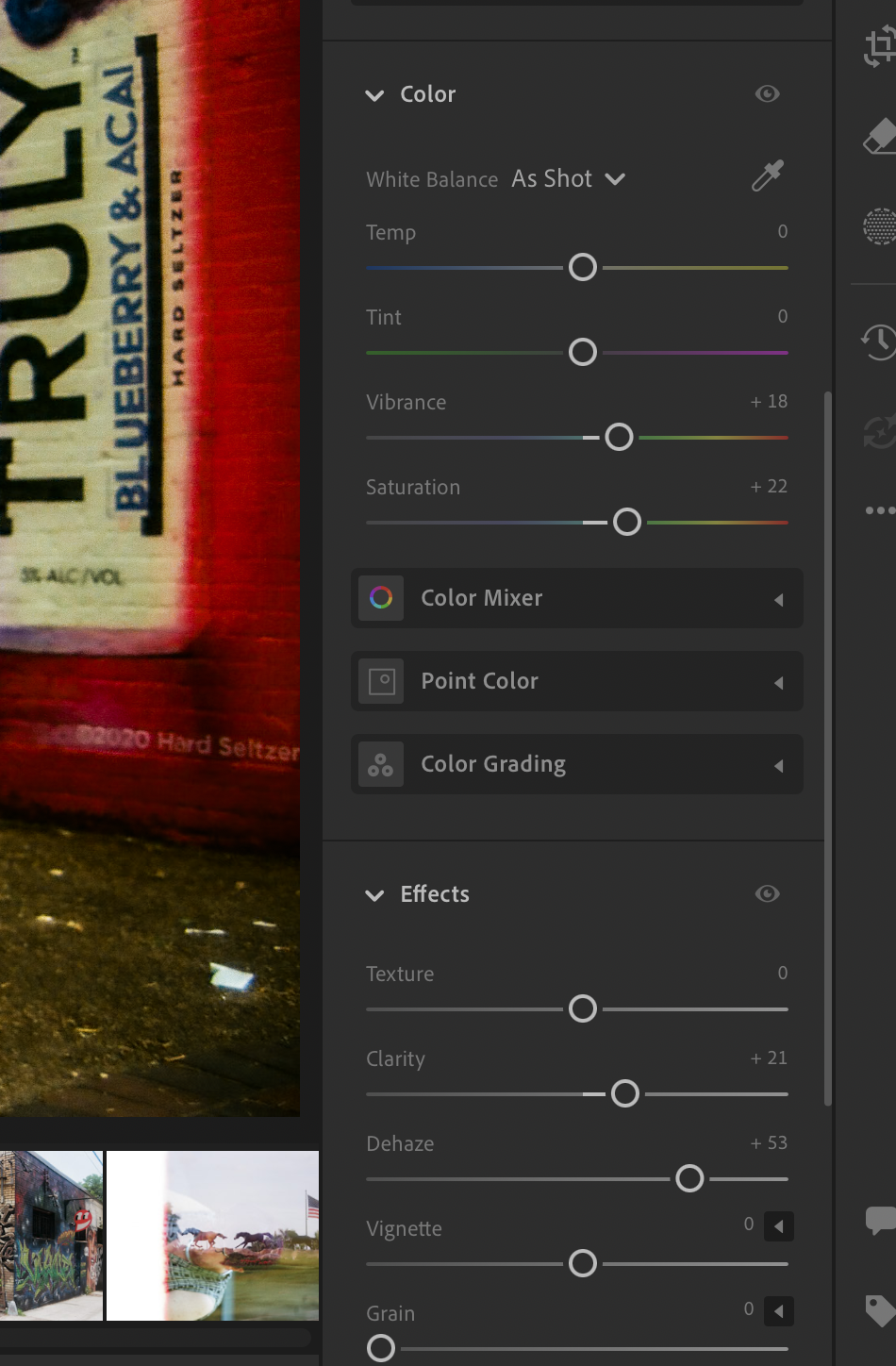
Trying to save a compromised image in Lightroom.
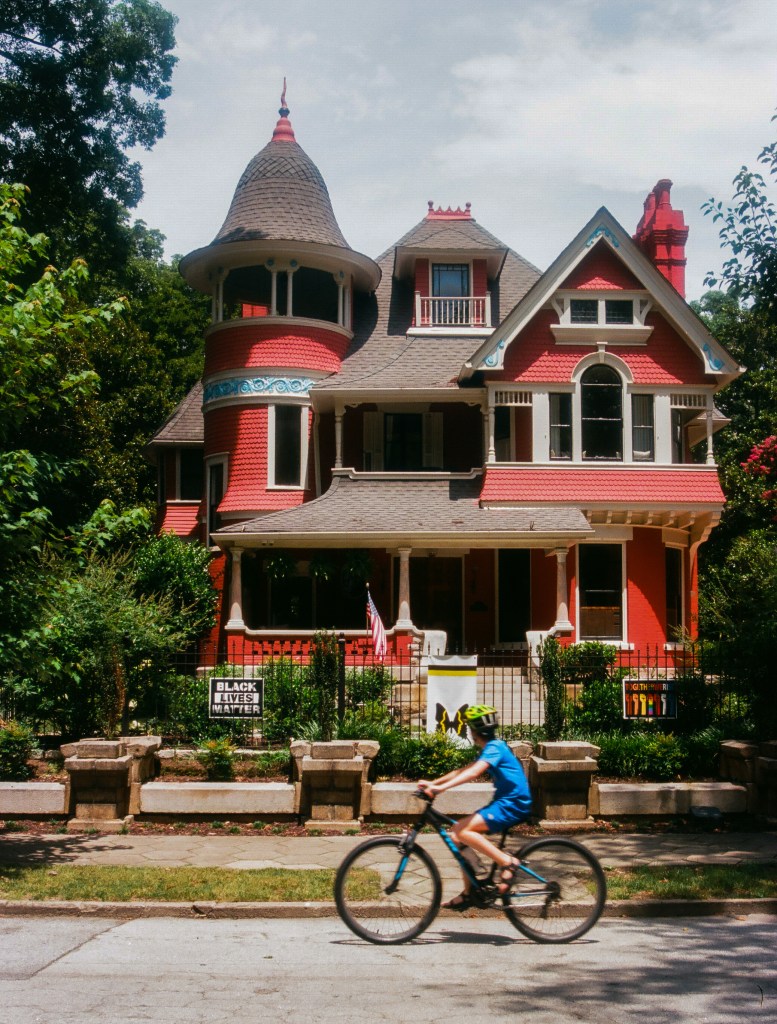
More of the same series….Same camera, same lens, same roll of film.
Another image from the same roll of film – Atlanta, Inman Park.
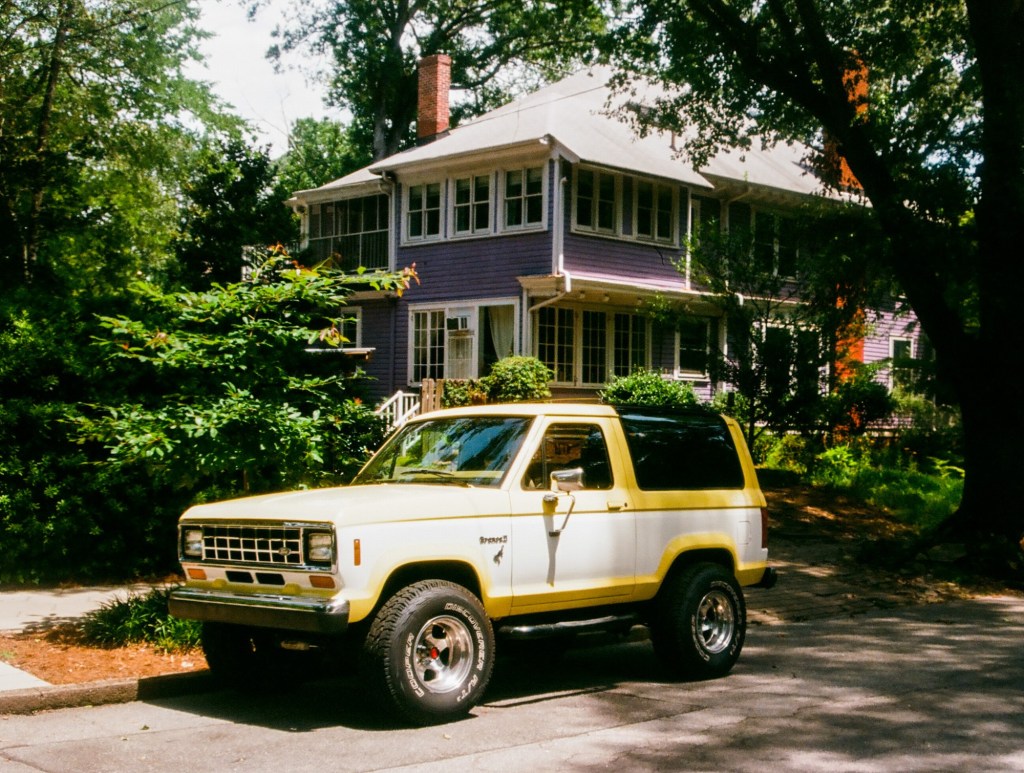
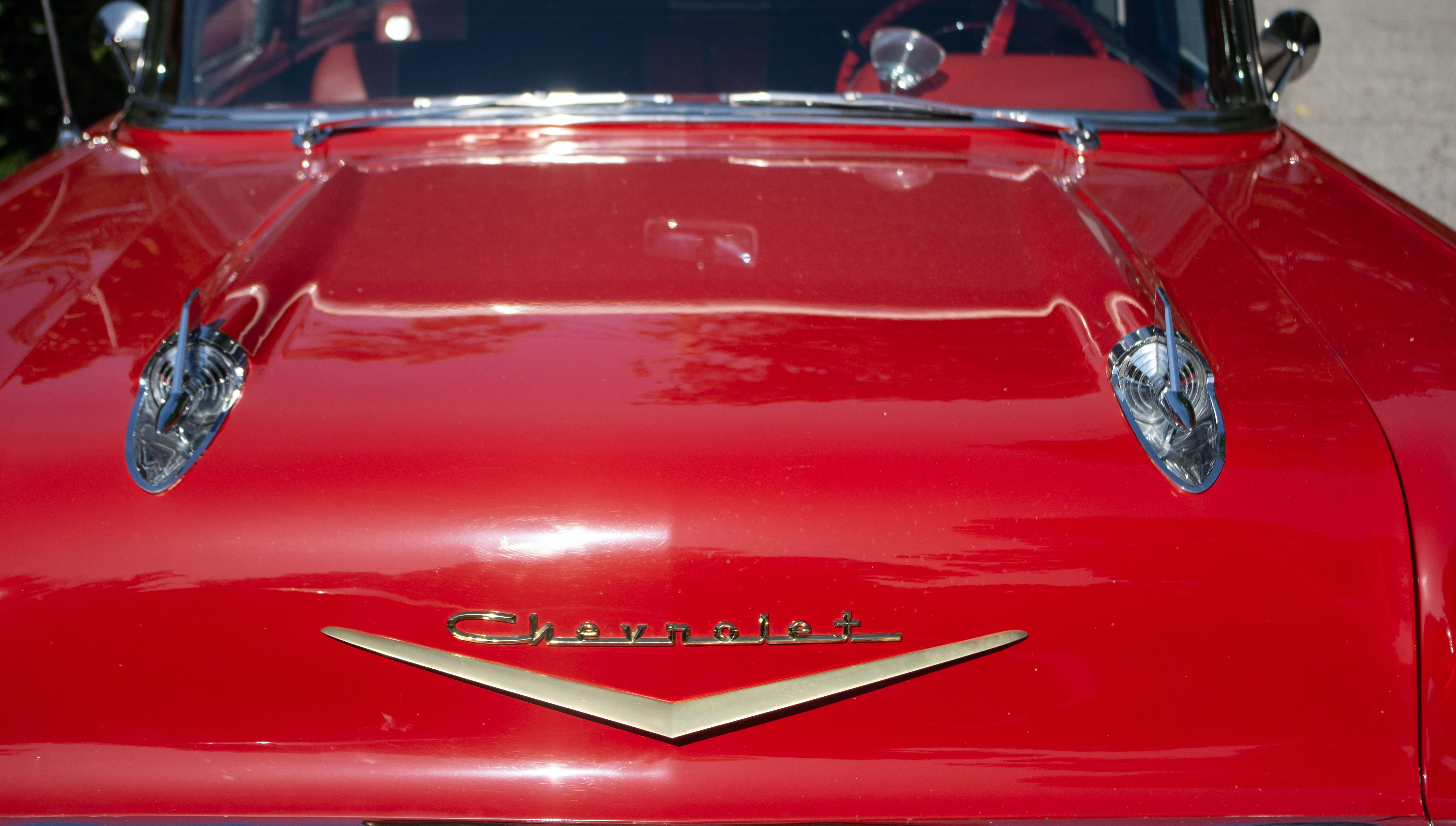
Ford Bronco II – Inman Park Neighborhood, Atlanta.
Digital single-lens reflex (dSLR) cameras still have unique qualities. Even though modern mirrorless cameras outperform them in many situations, using the optical viewfinder on a good digital SLR is a real pleasure. I’ve used almost exclusively SLRs in my formative years, and it probably conditioned my eyes and my brain to be more comfortable and creative when I see a scene through an optical viewfinder. That’s why I finally decided to add another dSLR to my kit in complement to my mirrorless equipment.
Pentax K-5 and its kit lens
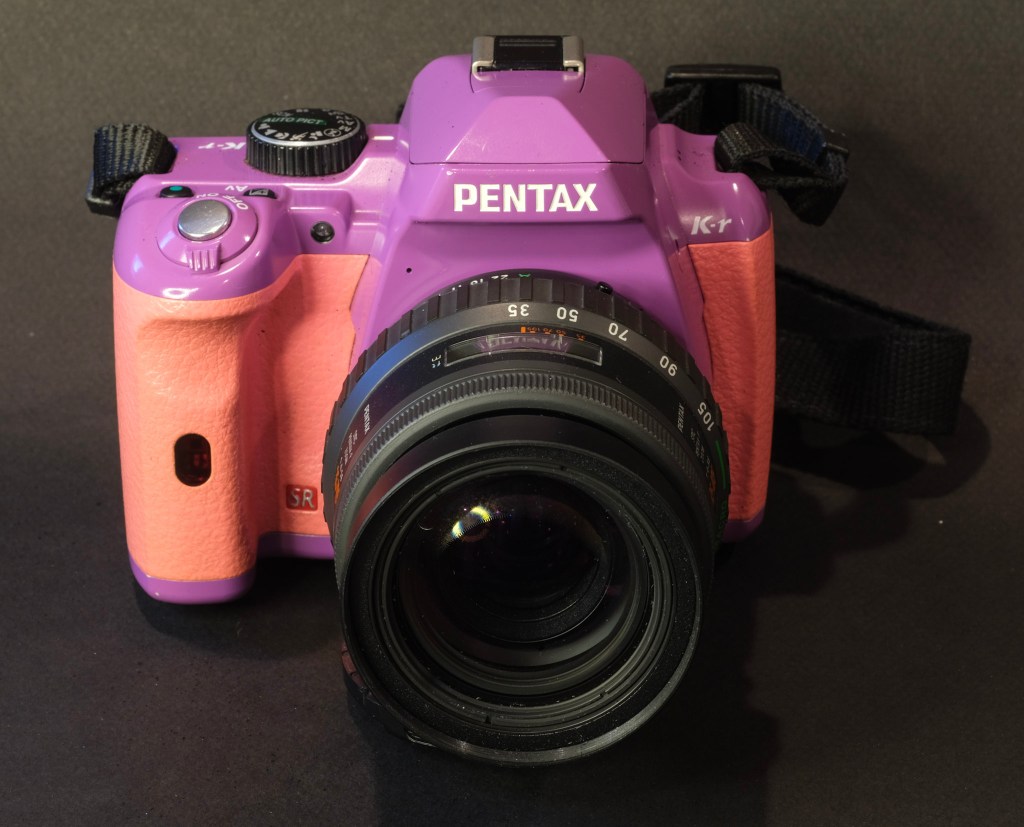
I was not willing to spend too much money on this nostalgia trip – I had set a limit of about $150 but I still wanted the camera to have a great viewfinder, a lot of directly accessible commands, and a sensor capable of delivering technically satisfying pictures. The colorful Pentax K-r I reviewed recently was a good introduction to Pentax’s dSLRs family, but certainly not the “advanced”, “semi-pro” APS-C dSLR I was looking for.
My $150 budget consigned me to “advanced” or “prosumer” APS-C cameras from the early 2010s, with an image sensor in the 15 to 20 megapixel range. In that category, Pentax has always had a strong offering, with compact, well built cameras benefiting from a great optical viewfinder. Between the K-7, the K-5 and the K-3, which one was going to be my pick?
Pentax K-5 Mk II – a typical “modal” user interface – most of the settings have their own dedicated key.
Which Pentax K camera to choose?
Over the years, Pentax have introduced three generations of their “advanced” APS-C model line (the K-7, the K-5, the K-3), and have derived Mark II variants of the K-5 and K-3. The current K-3 Mark III launched in 2021 is not as directly related to the K-7 as its predecessors. It’s a very significant upgrade over the K-3 Mark II (it could have been named K-1 if there was not already a K-1 camera in Pentax’s line-up) and part of its appeal is that it’s also available with a monochrome sensor (as the K-3 Mark III Monochrome, of course).
The family saga started in 2009 with the K-7, equipped with a 14 mpix sensor manufactured by Samsung. The camera was so good it was used as the basis of the subsequent K-5 and K-3 models proposed by Pentax, up to the K-3 Mark II. The sensor, on the other hand, could have been better. It yielded good results up to 800 ISO, but gave up at higher sensitivities, producing images with significantly more noise than the competition. Even the K-7’s little brother, the Pentax K-r, equipped with a 12 Mpix Sony sensor, delivered better results in those situations.
Pentax K-5 Mk II – this iteration of the camera has gained an “air gapless LCD screen”
Not surprisingly, the Samsung sensor was replaced by a very good 16 Megapixel sensor in the follow up model, the K-5, launched only one year later. This sensor belonged to a family of high performance chips developed by Sony, which were also used to great results in Fujifilm, Nikon and Sony’s own cameras.
In 2012, the K-5 was replaced by two models, the K-5 II (or K-5 Mark II) – more or less the same camera but with an improved autofocus system, and the K-5 IIs (or Mark II ‘S’) – equipped with a sensor deprived of an anti-liaising filter, and offering a higher resolution of fine details as a result.
The K-3 of 2014 adopted a new 24 MPIX sensor, and was followed by a K-3 Mk II variant equipped with a GPS chip in 2015. As mentioned above, the current Mark III came seven years later with a more modern 26 Megapixel BSI sensor, a vastly improved autofocus system, an extra control wheel, a joystick to select the focus point, and new menus. It is the most “advanced” of all Pentax APS-C cameras, and, with the now discontinued Nikon D500, one of the two most elaborate APS-C dSLRs, ever.
The Pentax K Mount is 50 years old – note the metal bayonet and the red gasket on the 18-55 DA AL WR zoom.
Let’s talk money
Very often the price of a camera on the second hand market is not an exact reflection of its technical capabilities: the K-7 and the first generation K-5 can be found at the same price (between $150 and $200.00), when there is a real performance gap between the two models. The K-5 IIs is often $100.00 more expensive than a K-5, because of the higher resolution of fine details promised by its 16 Megapixel sensor, deprived of an anti-liaising filter.
The K-3 is much more expensive than any variant of the K-5 on the second hand market: with a 24 or 26 Megapixel sensor and no anti-liaising filter, its image quality is on par with the best in the current crop of mid level APS-C cameras, and its price is often established in reference to the hefty sum that Pentax is charging for a new K-3 Mark III. A used first generation K-3 can not easily be found for less than $450.00, and a second-hand K-3 Mark III will cross the $1,000 barrier.
For my needs the K-5 (the non “s” model) represented the best deal in the K-7-5-3 family. I found a very nice K-5 Mark II in the price range I was targeting, and it’s the model we’re going to review today.
Colonial Homes – Blue Symmetry – Pentax K-5 / Pentax lens 18-55 f/3.5-5.6 AL WR
First impressions
Yes, the camera is remarkably compact for a dSLR (in general), and for a model targeting enthusiasts, in particular. It’s not really larger than entry level dSLRs such as the Pentax K-r or the Nikon D3100, and it’s smaller than film era SLRs like a Nikon F90 or a Canon EOS 620. And next to a full frame digital dSLR like a Nikon D800 or a Canon 5d, it’s a dwarf.
Two “advanced” dSLRs – Full frame on the left, APS-C sensor on the right. The difference in size and weight is striking.
In comparison to a K-r or a D3100, it’s almost twice as heavy, though, because it’s built out of metal instead of plastic. It’s very substantial and seems very well built – and really feels like a tool a “pro” would use.
Another reason it’s heavier than a K-r or a D3100 is its viewfinder, which provides a significantly larger and brighter image. It’s visibly not as large or luminous as what you would find on a “pro” full frame camera (film or digital), but when you start considering the size and weight of the combo formed by a full frame body and its trans-standard zoom, then the K-5 looks like a very interesting compromise for action or travel photography.
Lastly, if you’ve been used to the modal interface of autofocus SLRs and dSLRs of any brand, you’ll feel right at home. The most current settings can be changed by pressing a dedicated touch, and then adjusting the value with the control wheel – and there are two of them, as it should be. If you trust Pentax’s default settings, you’ll be ready to shoot in no time.
Pentax K-5 – note the lock on the battery door – Pentax takes “weather proofing” very seriously.
Not everything is perfect, though, and in some areas it shows its age.
The menus look dated (big, low res fonts, plenty of tabs) and not inviting. The large LCD display at the back is fixed, and is not touch enabled. Of course there is no joystick to select the active autofocus area, and no way to upload wirelessly the images to a smartphone or a tablet. And I will not mention “live view” or video capabilities – the K-5 can’t compete with a mirrorless camera on the former, and not even with a recent smartphone on the latter.
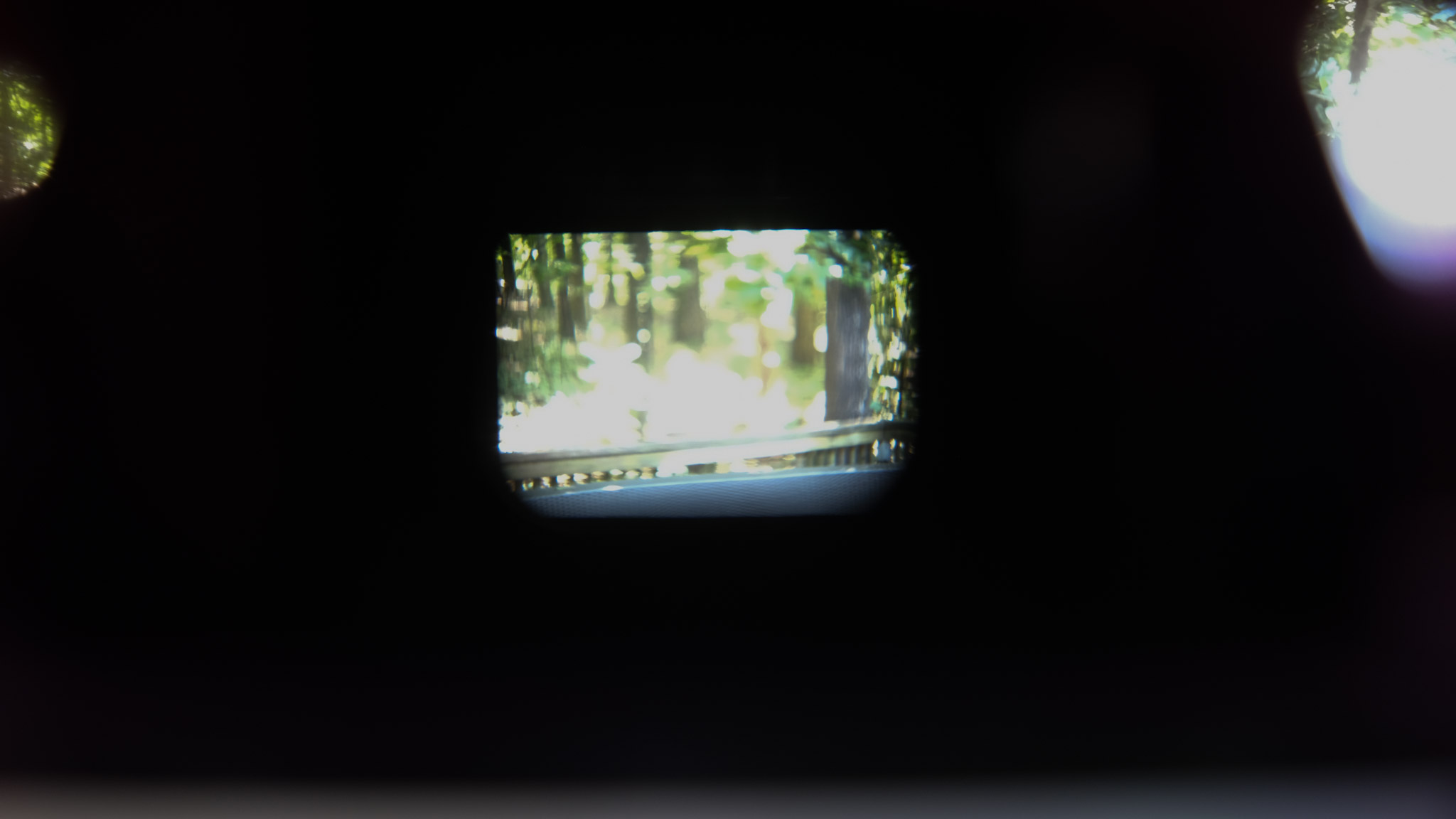
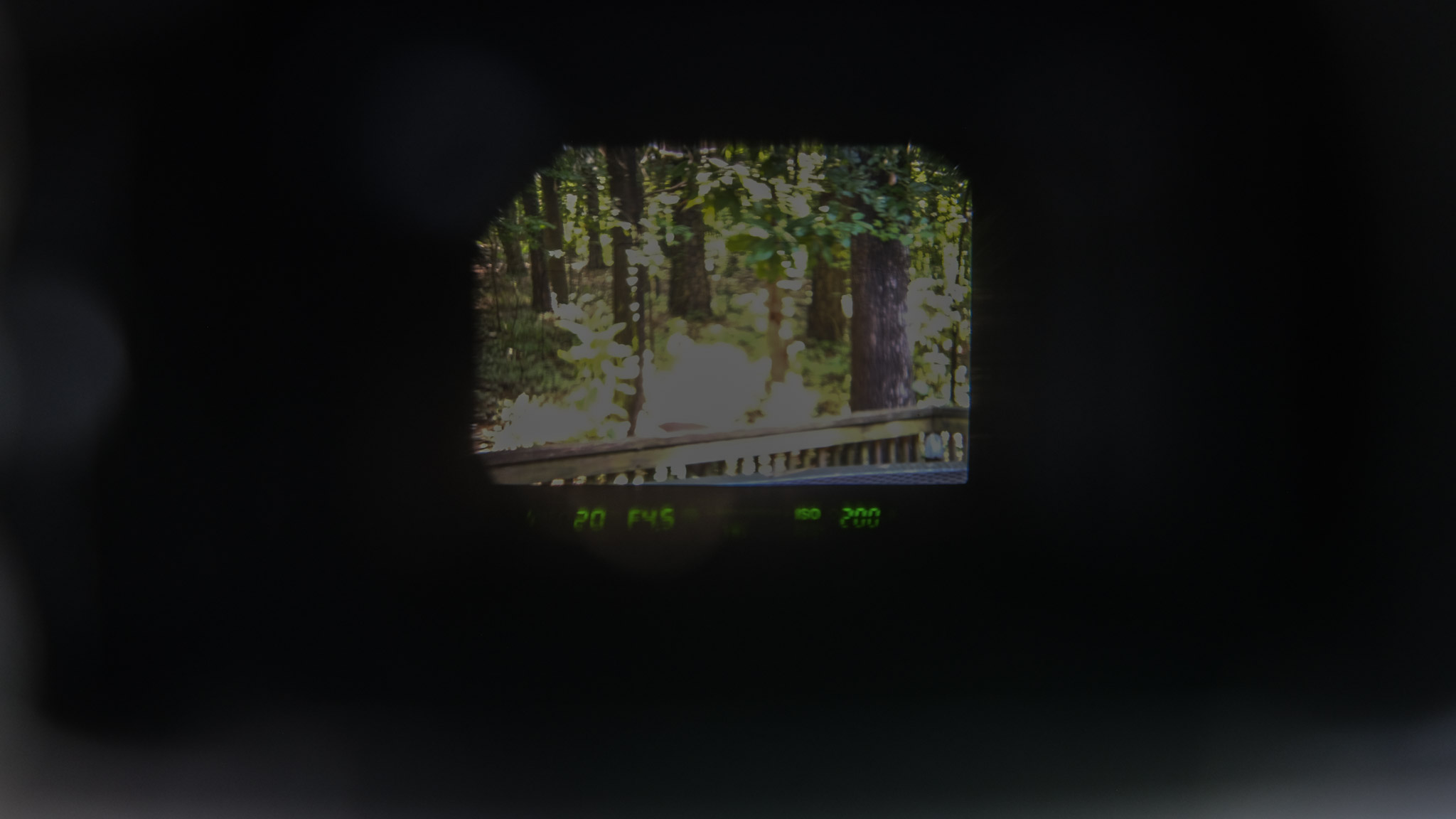
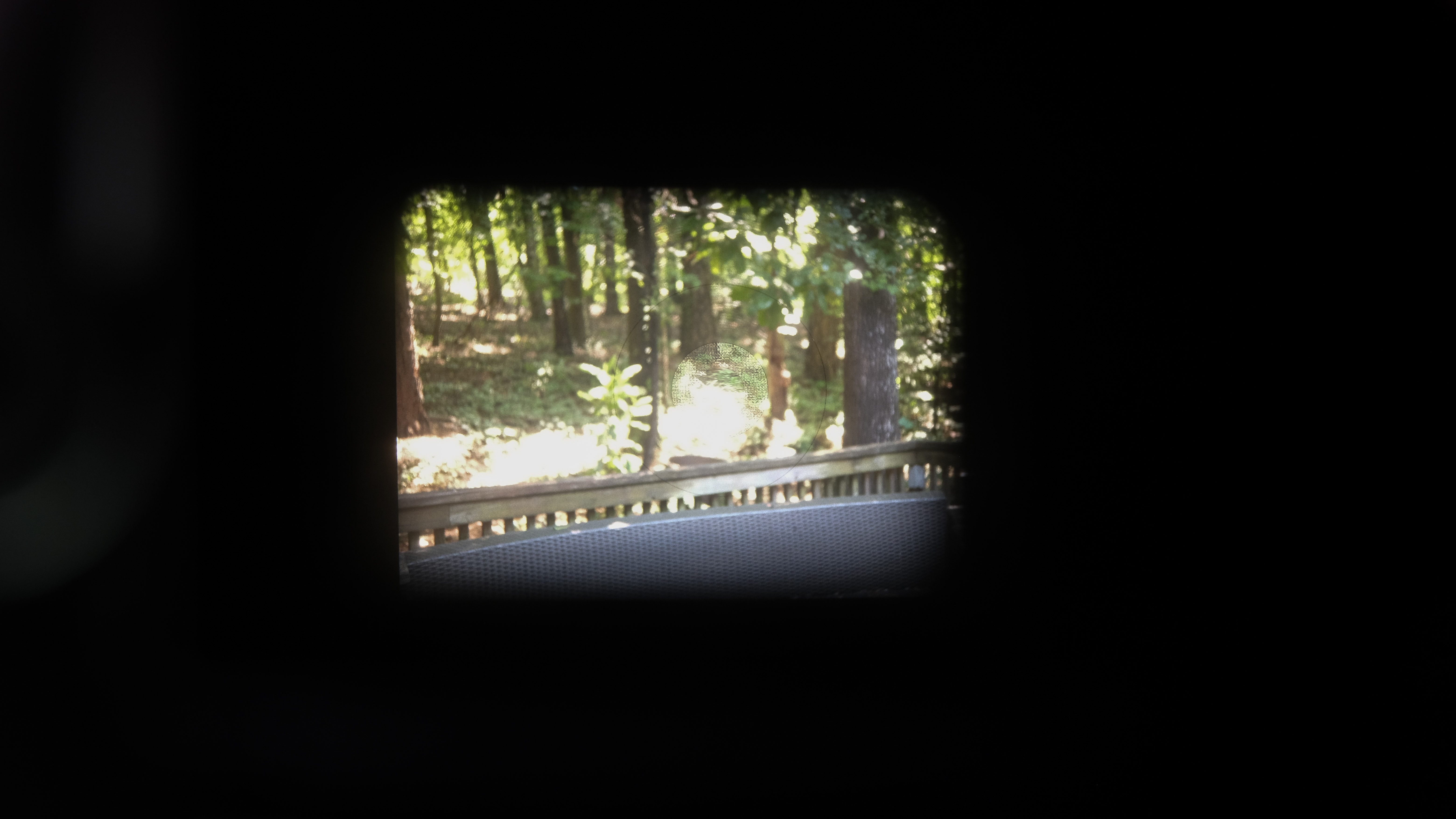
Through the viewfinder of a Pentax K-rThrough the viewfinder of a Pentax K-5Through the viewfinder of a Canon T90.
In the gallery above – shot from the exact same distance from the rear lens of the viewfinder and not cropped in any way- what you see from the viewfinder of a Pentax K-r, a Pentax K-5, and a very good “pro-level” film camera: the Canon T90. The K-5’s viewfinder is not as large as a the viewfinder of a “full-frame” camera, but it’s actually pretty good for an APS-C. The difference with a K-r is very visible.
Shooting with the K-5
Shooting with the K-5 is a pleasant experience The combination of small size, impressive build quality and great ergonomics with a good viewfinder makes for a pretty unique experience.
With the K-5, most commands fall naturally under the fingers while shooting, and after a few minutes you’re totally comfortable with the camera.
You would have to move up to full frame dSLRs to find a larger viewfinder, but I’m not sure the improvement is significant enough to justify the weight and heft penalty, at least when you need to be mobile or operate discreetly.
Image quality was considered among the best for an APS-C camera in 2010 – its 16 Megapixel was praised by testers and users, but obviously 15 years later, the best in class APS-C mirrorless cameras will outclass it when it comes to fine detail resolution and control of noise.
Another area where camera makers have made significant progress since the K-5 was launched is the quality of the JPEG images out of camera – they can be uploaded to a phone wirelessly and from there shared on social media without any post-processing. But since the K-5 does not offer any form of wireless connectivity and can not interact with Ricoh’s iOS and Android app (it’s only supported on cameras launched after 2014), you will need to connect an SD card reader to a computer to upload the images anyway, and you might as well shoot RAW and post-process your images quickly in Lightroom Mobile or Classic while you’re at it.
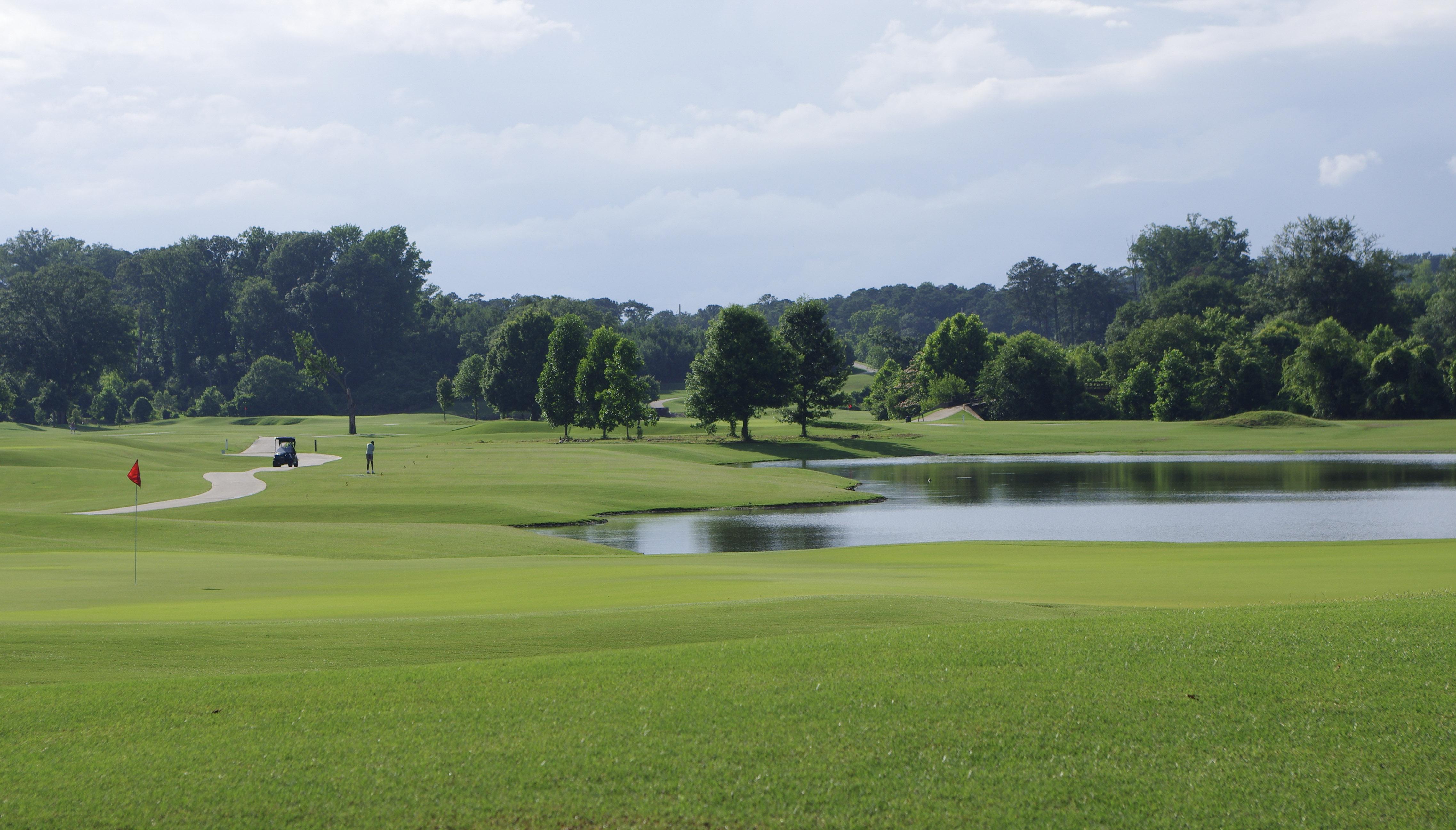
Atlanta – Bobby Jones Golf Course – Pentax K-5 / Pentax lens 18-55 f/3.5-5.6 AL WR
A characteristic unique to Pentax dSLRs is the brand’s “Shake Reduction” system (the SR logo has been on their cameras since 2006). The image sensor is mounted on a platina that moves to counteract camera shake, allowing photographers to capture sharp hand-held images at shutter speeds 2.5 to 4 stops slower than would otherwise be possible – you won’t be afraid of shooting at 1/20sec with a short tele anymore.
Other dSLRs have to rely on an image stabilization system implemented in their lenses (which increases the lenses’ size and their cost) – but Pentax’s SR system works with any lens mounted on the camera (old and recent) because it’s implemented in the camera’s body.
We know that Pentax has been using the same physical “K” lens mount since 1975. Of course the current “KAF4” variant of the lens mount has more electrical contacts and all the autofocus gear needed to support the features specific to today’s cameras, but the K-5 is compatible to various degrees with any Pentax lens made since the mid seventies.
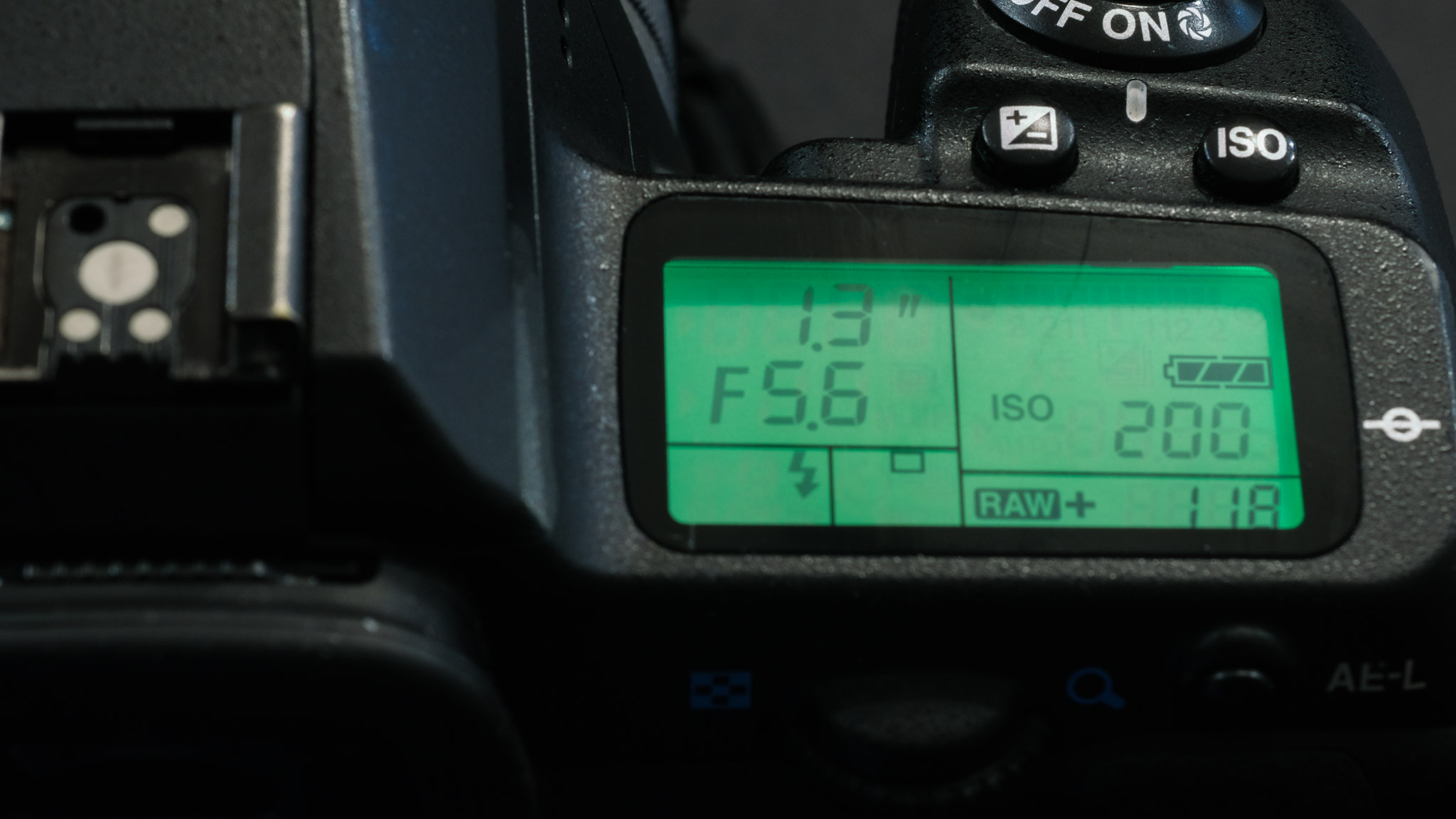
The top plate display – very few APS-C cameras still have one.
As a conclusion
A K-5 can be had for $150, with patience and a bit of luck. It was launched fifteen years ago, and it’s futile to compare its capabilities and performance to what its younger Pentax brother the K-3 Mark III or a Nikon D500 can deliver. And I won’t even start comparing the K-5 with current top of line APS-C mirrorless cameras from Canon, Fujifilm or Nikon.
But dollar for dollar, the K-5 offers a tremendous value: as an introduction to high quality cameras (for photographers upgrading from a smartphone or a digital point and shoot camera), it’s difficult to beat and it’s definitely worth every cent.
For the nostalgics of the optical viewfinder, shooting with a K-5 is also a way to indulge without breaking the bank. Used for what it’s good at, the camera is a pleasure to use and delivers high quality results. As far I could find, it’s also reliable, without any of the issues experienced with Pentax’s more amateur oriented cameras (like the K-30/K-50).
A modern mirrorless camera will do better in more situations and I don’t expect any mirrorless user to sell all their equipment to go back to a K-5, but as a complement to a good mirrorless kit, the K-5 also makes a lot of sense. Enjoy!
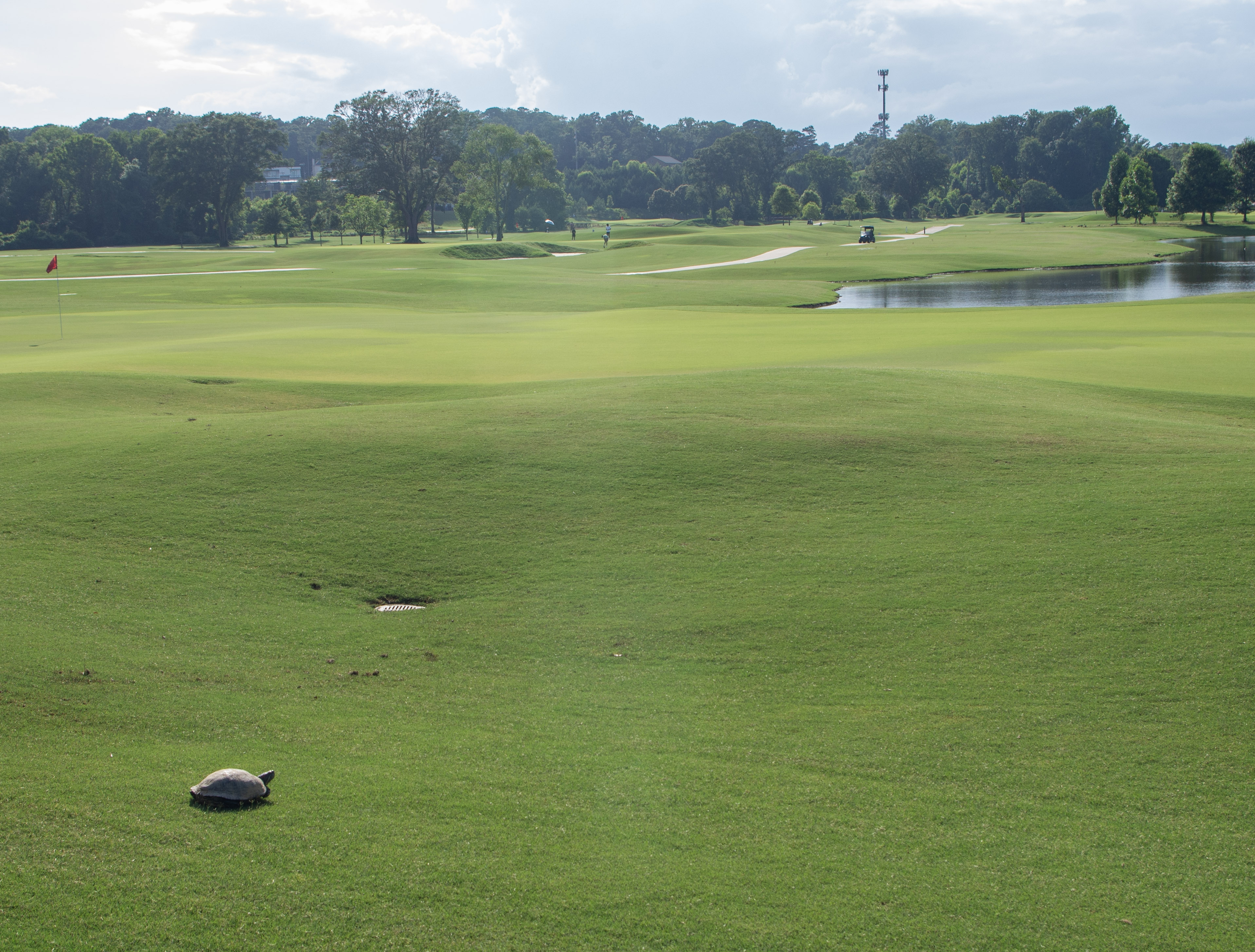
Tortoise lost on the golf course – Atlanta – Pentax K-5 / Pentax lens 18-55 f/3.5-5.6 AL WR
Do cameras and megapixels really matter?
Concerned about working with a “small” 16 megapixel sensor?
I have posted approximately 500 pictures on Flickr since the beginning of the year. The four images with the highest all time views were shot (recently) with a seventeen year old 12 Megapixel dSLR.
Even if high end PCs and laptops can support resolutions up to 8K (that would be 33 million points), most web sites and apps recommend not to upload images larger than 1920×1080 – (roughly 2 million points), and the most popular social network will down scale your images so that they fit in a square no larger than 2048x 2048 (4 million points).
What about prints?
As long as you don’t crop at all, a 10 Megapixel sensor has enough resolution for a high quality print in A4 or Letter format (assuming 300dpi), without any form of interpolation or over-sampling.
A 12 Megapixel sensor will give you more headroom, but you’ll need at least 16 Megapixels for a 11×14 inch high quality print (20 Megapixels would be better), and 24 Megapixels for a high quality 30×45 print (that’s centimeters- roughly 11x17in).
Obviously printing at a marginally lower resolution (250 dpi, for instance) will raise the maximum print size proportionately.
More megapixels and a large sensor may be needed in some circumstances, but ultimately, the old saying “f8 and be there” still rules. Be there. With a camera you’re comfortable with. Nothing else really counts.
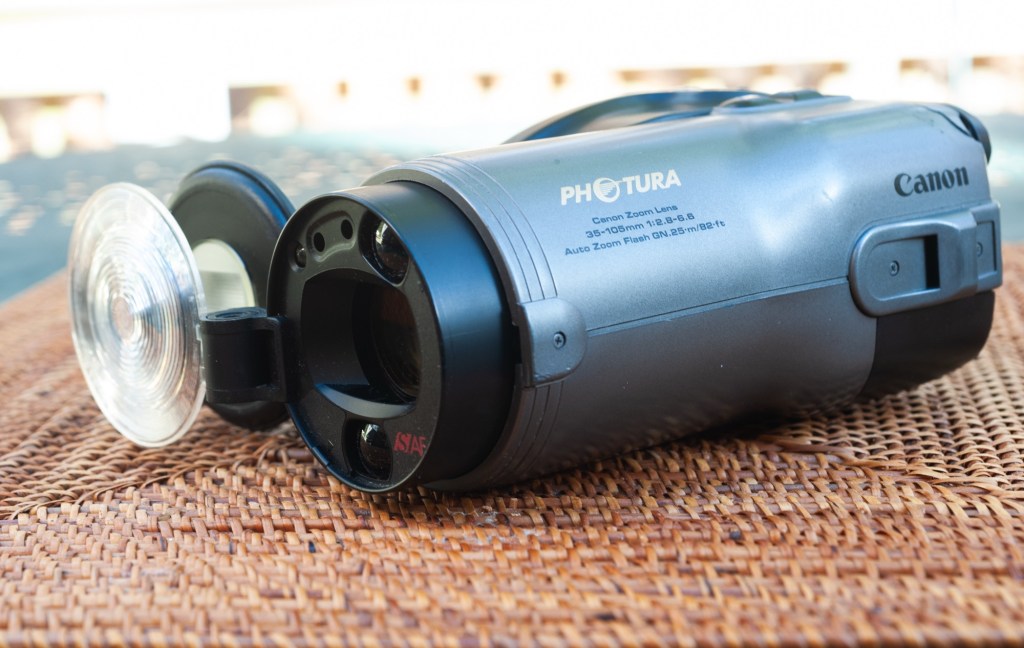
This is the other cheap camera I bought on Xmas eve on shopgoodwill.com. I paid less than $14.00 for it. The 2Cr5 battery it needed cost me more.
Launched in 1990, it was known to the North American public as the Photura, in Europe as the Epoca and in Japan as the Autoboy Jet. That’s the first generation model, and the one I bought.
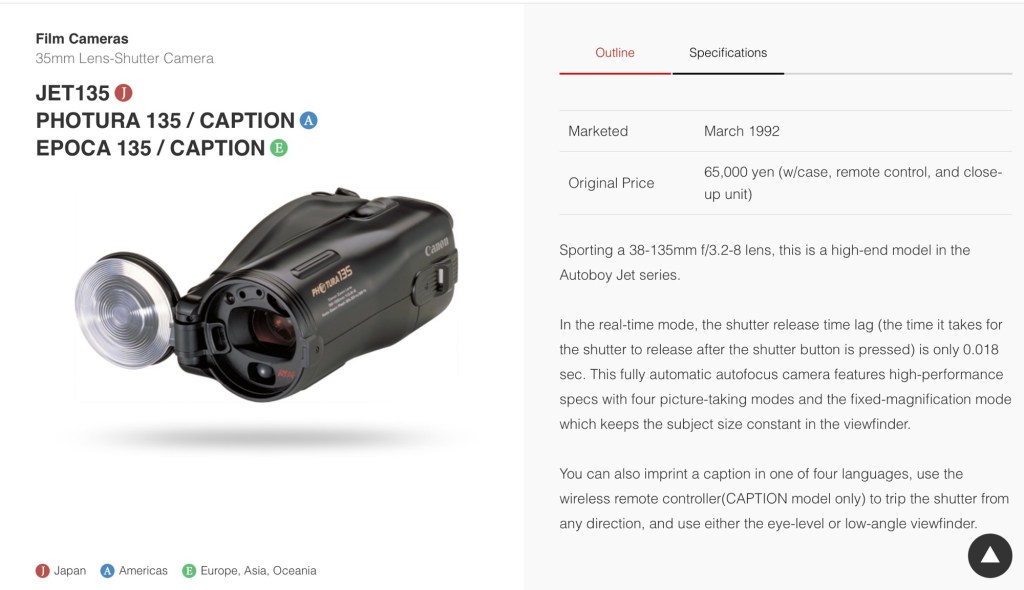
A second model (the Photura 135) was released 2 years later, with a zoom offering longer reach (38-135) instead of 35-105 for the original model and a darker body color. That’s the one presented in Canon’s virtual museum.
Because my copy of this camera was bought in the US, it’s a Photura, and that’s what we’ll call it it for the rest of this blog entry.
Screenshot from Canon’s virtual museum pages
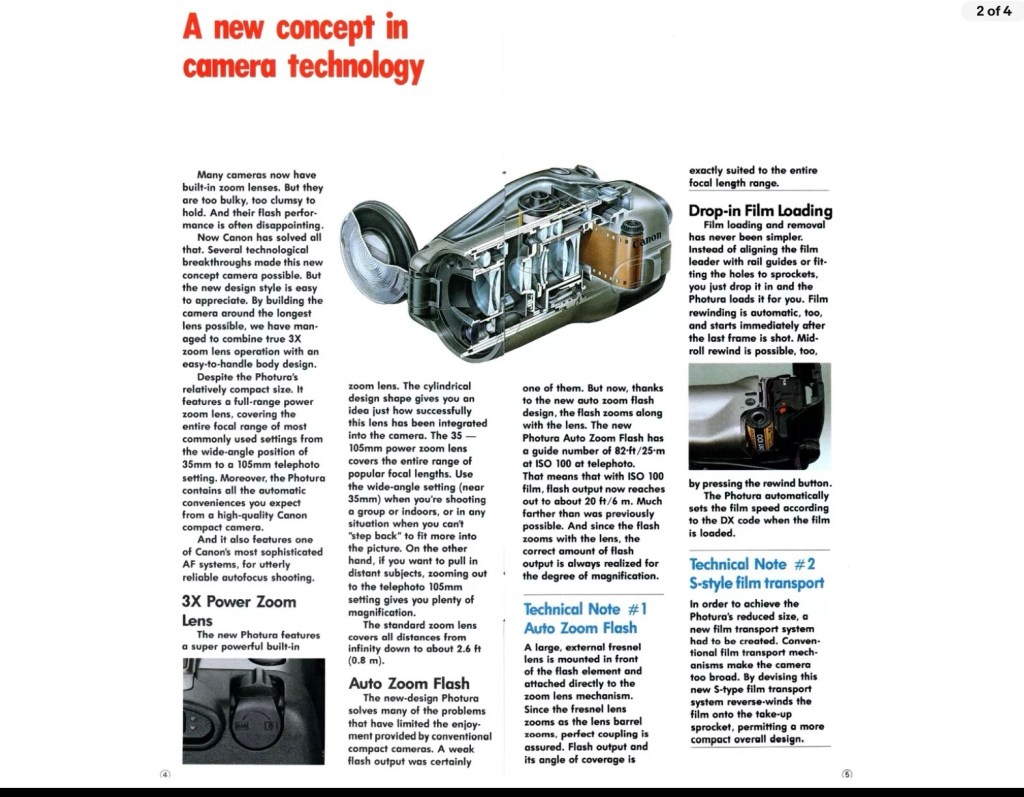
To this day, Canon’s official litterature still presents it as a top of the line camera.
Top of the line, for a point and shoot camera of its day: motorized 35-105 zoom, infra-red based autofocus, motorized film advance, drop in film loading, DX coding, dioptric correction, and all sorts of override modes for the autofocus – nothing’s missing.
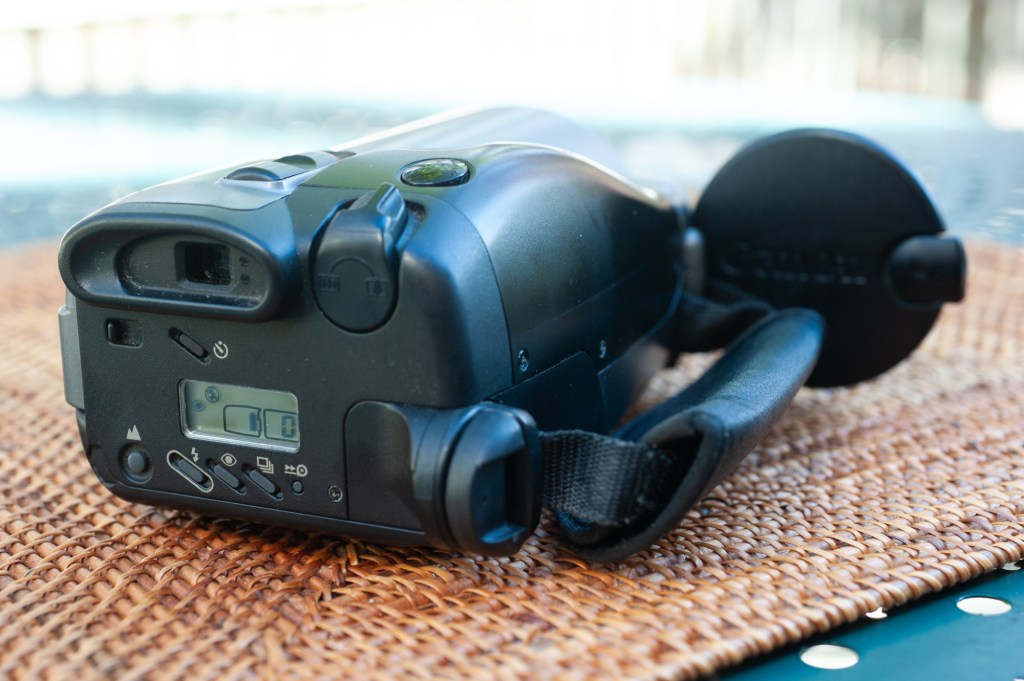
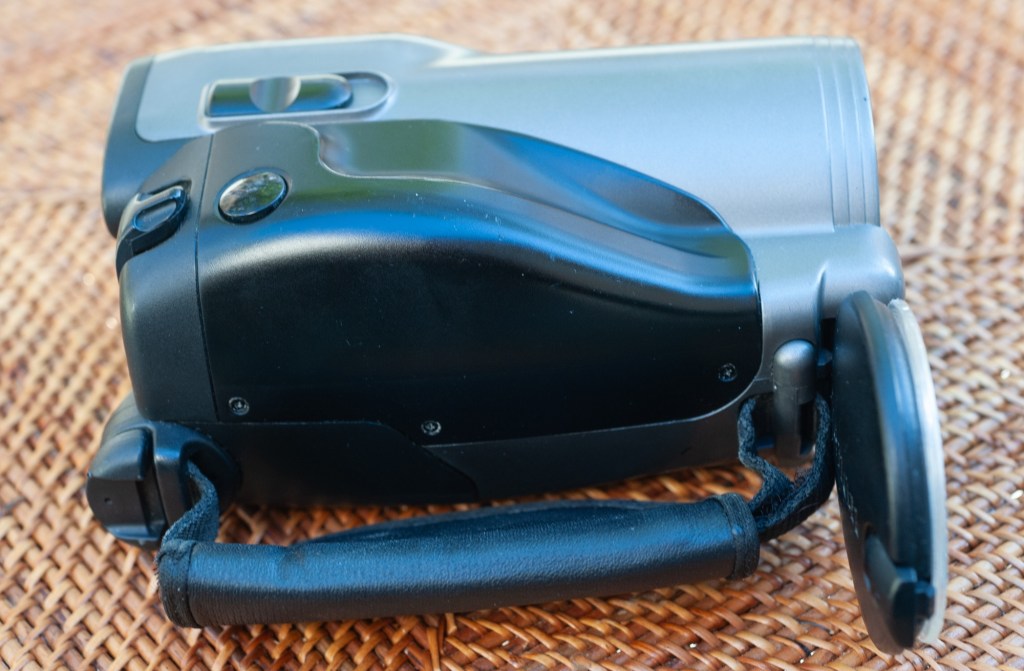
Viewed from the back now.
The bridge cameras
In the late nineteen eighties (because they had missed the boat of the autofocus SLRs) , Ricoh, Olympus and Chinon started pushing cameras of a new type, that “bridged” the gap between conventional Point and Shoot cameras and Single Lens Reflex (SLR) . Like a Point and Shoot, they had a non removable zoom, and like SLRs, image framing was done through the lens. A flash was also built-in. It made for a large and heavy combo, but in the mind of the people who designed them, those all-in-one bridge cameras were supposed to be cheaper, less intimidating and easier to carry around than an autofocus SLR with an equivalent 35-135 zoom and a big cobra flash.
Because they tried to combine all the features of an autofocus SLR and its accessories (zoom and flash) in one compact design, the bridge cameras looked strange – and their form factor would not be widely accepted by the buying public before the beginning of the digital camera era – when the smaller size of the image sensor made much smaller lenses (and therefore much smaller cameras) easier to design.
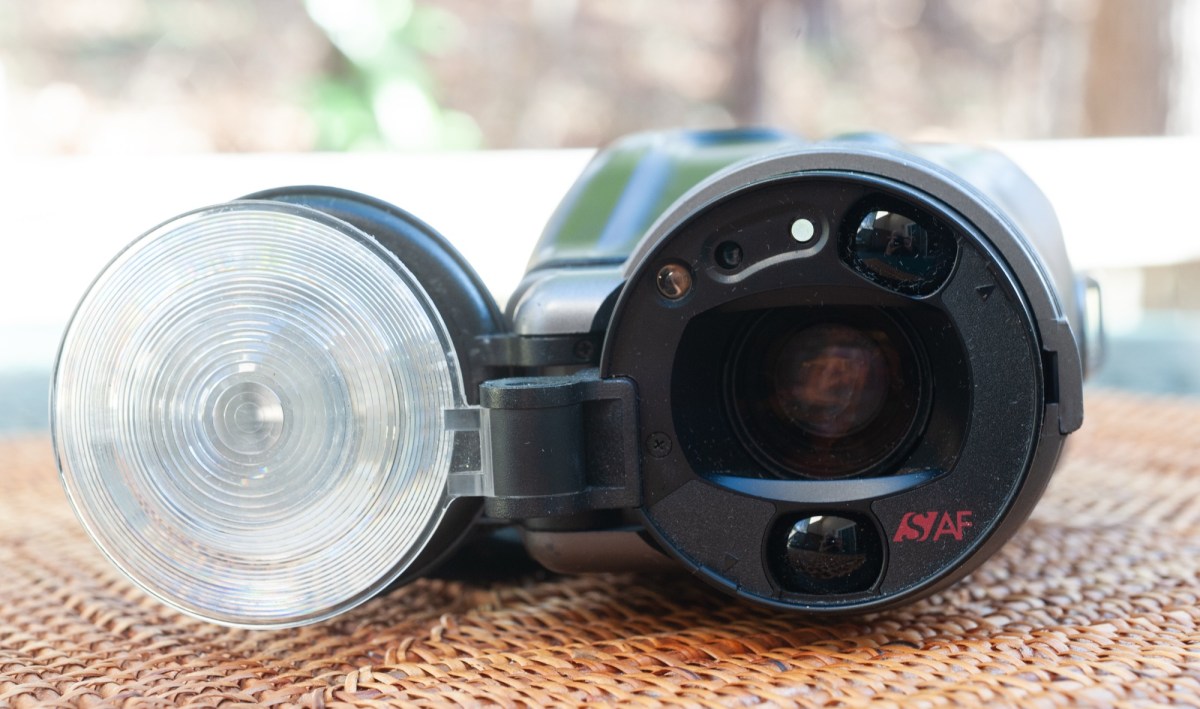
The Photura was Canon’s late entry in the bridge camera category – except it was not really a bridge camera. Like a bridge camera it was designed around a 35-105 zoom, with an electronic flash (hidden in the front lens cover in this case) and a hand strap, but it was not a single lens reflex camera – the viewfinder was a simple Galilean design with variable magnification, similar to what you would have found on a point and shoot camera of that era. And the photo cell used for metering did not operate through the zoom lens, but through a separate tiny lens next to it. So did the infra-red autofocus system. Like on a point and shoot camera.
The Photura as it’s generally represented, from the lens side.
First impressions
The biggest surprise is how heavy (600g without its disposable 2CR5 battery), and how big the Photura is. Even considering that the zoom has a relatively broad range and that it’s rather luminous at the wide end (f/2.8 at 35mm), it’s shocking. It’s not as if Canon had integrated a constant aperture zoom in the camera – the aperture at the long end is only f/6.6, and and the reason why Canon recommended using 200 or 400 ISO film. To Canon’s defense, the (real) bridge cameras proposed by Ricoh, Olympus and Chinon were even bulkier and heavier, the Ricoh Mirai tipping the scale at more than one kilogram (2.2 lbs), with a lens less luminous than the Canon’s.
The second biggest surprise is that you don’t hold the Photura like you would hold any other camera. At least when you’re keeping the frame horizontal (shooting a landscape, for instance) and at the wide end of the zoom range, you simply insert your right hand between the body of the camera and the hand strap, and access the zoom rocker switch and the shutter release button with the tip of your fingers. Like you would do with a video camera. It’s not unpleasant, it’s just strange and a bit disconcerting.
The first experience is positive: the camera is reactive, the viewfinder is rather large, and it’s fun to use – for a point and shoot camera. Even if it’s bulky and heavy compared to most compact cameras, it’s still light enough that you can walk for one hour with your hand wrapped around the camera, which makes it a surprisingly discreet and convenient tool for street photography.
Lefties beware…
Unfortunately, the unconventional design doesn’t work as well if you’re a leftie, or if you shoot at the tele end of the zoom, or if you’re shooting a portrait and keep the frame vertical – you’ll need to hold the camera with two hands.
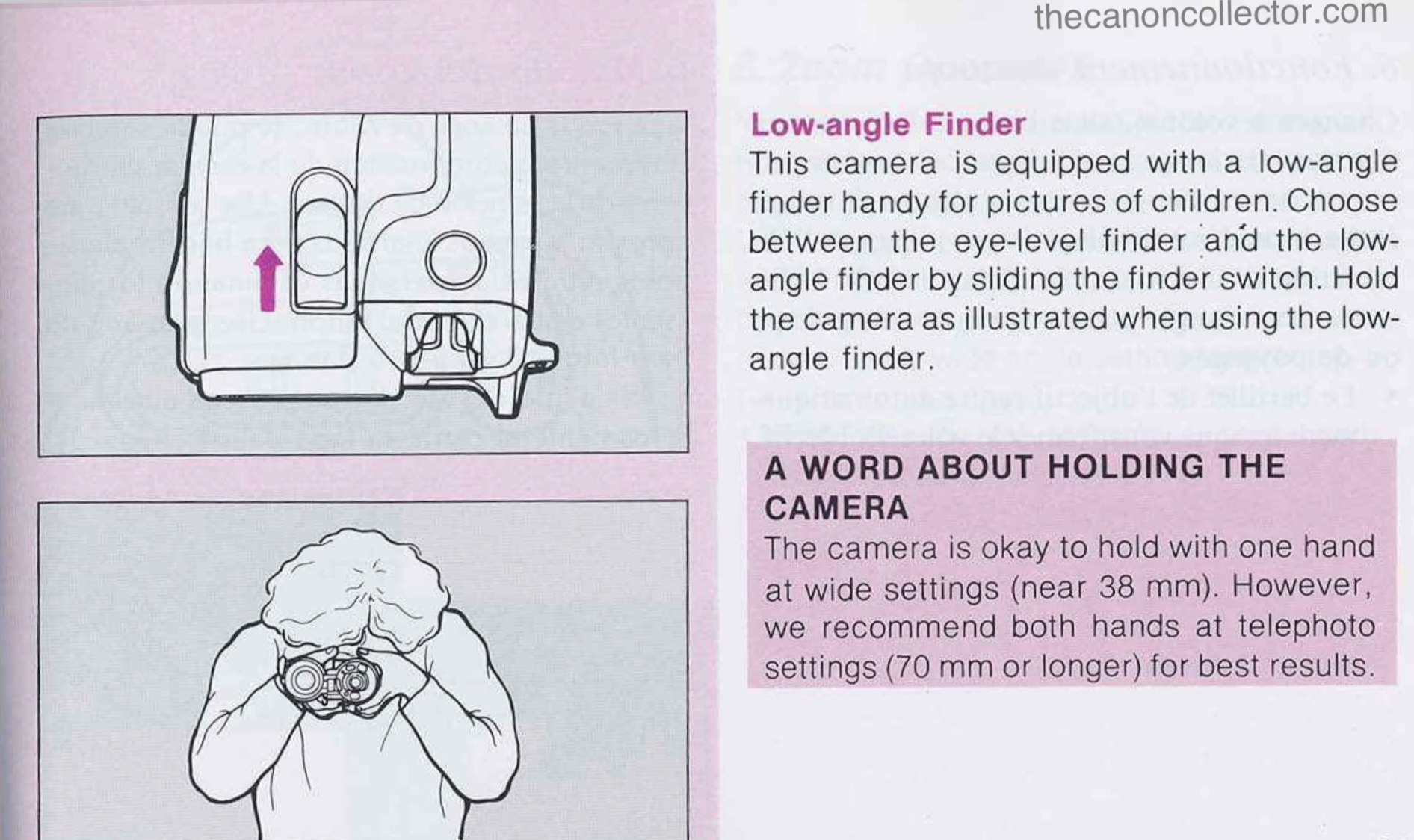
Another thing that does not work at all is what Canon calls the low angle viewfinder – it’s a second and very small viewfinder located at the top of the camera’s body – it’s so small you have to have your eye just above it (less than a centimeter) or you don’t see anything. In their user manual, Canon write that it’s to take pictures of children. Look at the posture of the photographer shown in Canon’s own user manual – the kids will laugh at the poor guy and will be gone before he can take the first picture. But it works if you’re kneeling, and trying to shoot something very close to the ground, like a very calm dog sitting in his bed.
Photura user manual – courtesy of thecanoncollector.com – note the very unnatural posture of the photographer trying to use the “low angle viewfinder”
Lastly, and maybe it was unavoidable with the technology of the day (and the price point being targeted), the autofocus system still seems to require a lot of work from the photographer: it can not focus to the infinite on its own – you have to force it by pressing a tiny button; it can not focus on tiny objects, and, because its detection zone is a rather small area at the center of the frame, you have to use an early form of AF lock if your subject is off center. Which is often the case if you shoot a portrait and want the focus on the eyes of your subject – not very amateur friendly.
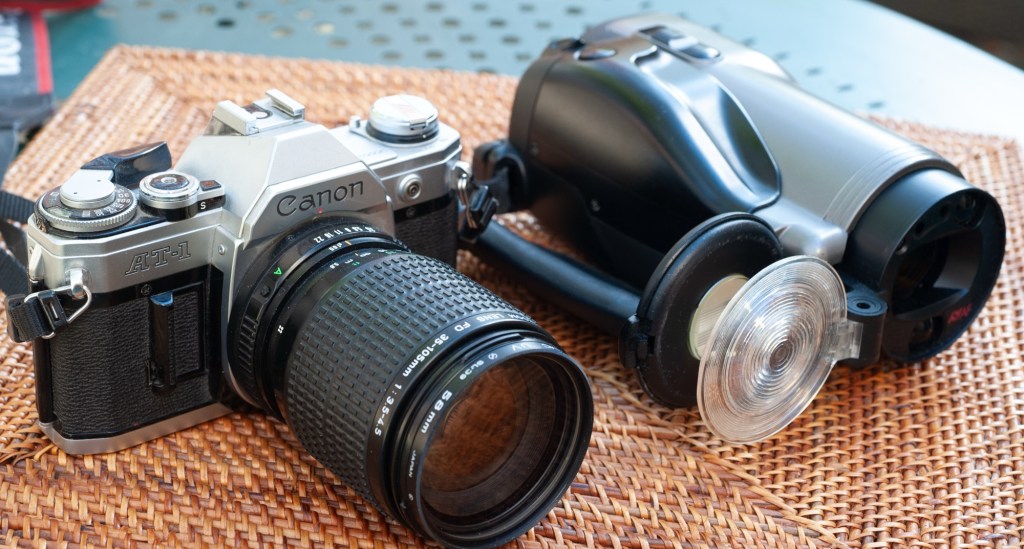
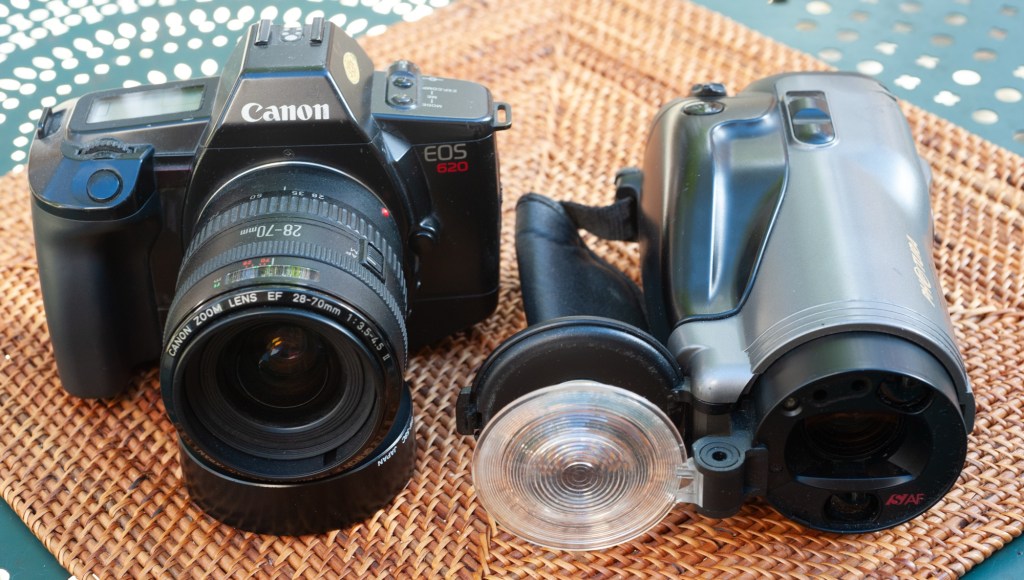
The Photura is very large for a “compact” camera. A zoom of similar range is mounted on the AT-1.
That’s my biggest gripe with this camera – when it was launched in 1990, very good motorized autofocus SLRs were already available from Canon, Minolta, Nikon, Pentax and a few others, and their phase detect autofocus was already more efficient and reliable than what we have here. Their reflex viewfinder was incomparably better than what the Photura could offer – and you could see directly whether your subject was in focus or not (on the Photura you have to rely on a green/red LED that will simply confirm that it did focus on… something). And they also provided more control over the exposure. A Canon Rebel of the same vintage (with its 35-80 kit zoom) was not that much more expensive (only 10% more), was not that much heavier (if it even was), and would have been my choice without any hesitation if I had been looking for my first “serious” camera.
As can be expected, the Photura line stopped at the 135 model. Canon’s next big hit in the compact camera sector would have to wait for a few years, with the very small Elph/Ixus – one of few good APS cameras of the late nineties, which later morphed into the digital Elph, one of the first really good digital compact cameras in the early years of this century.
Canon Photura brochureEven next to an autofocus SLR it’s not really smaller.
What about the pictures?
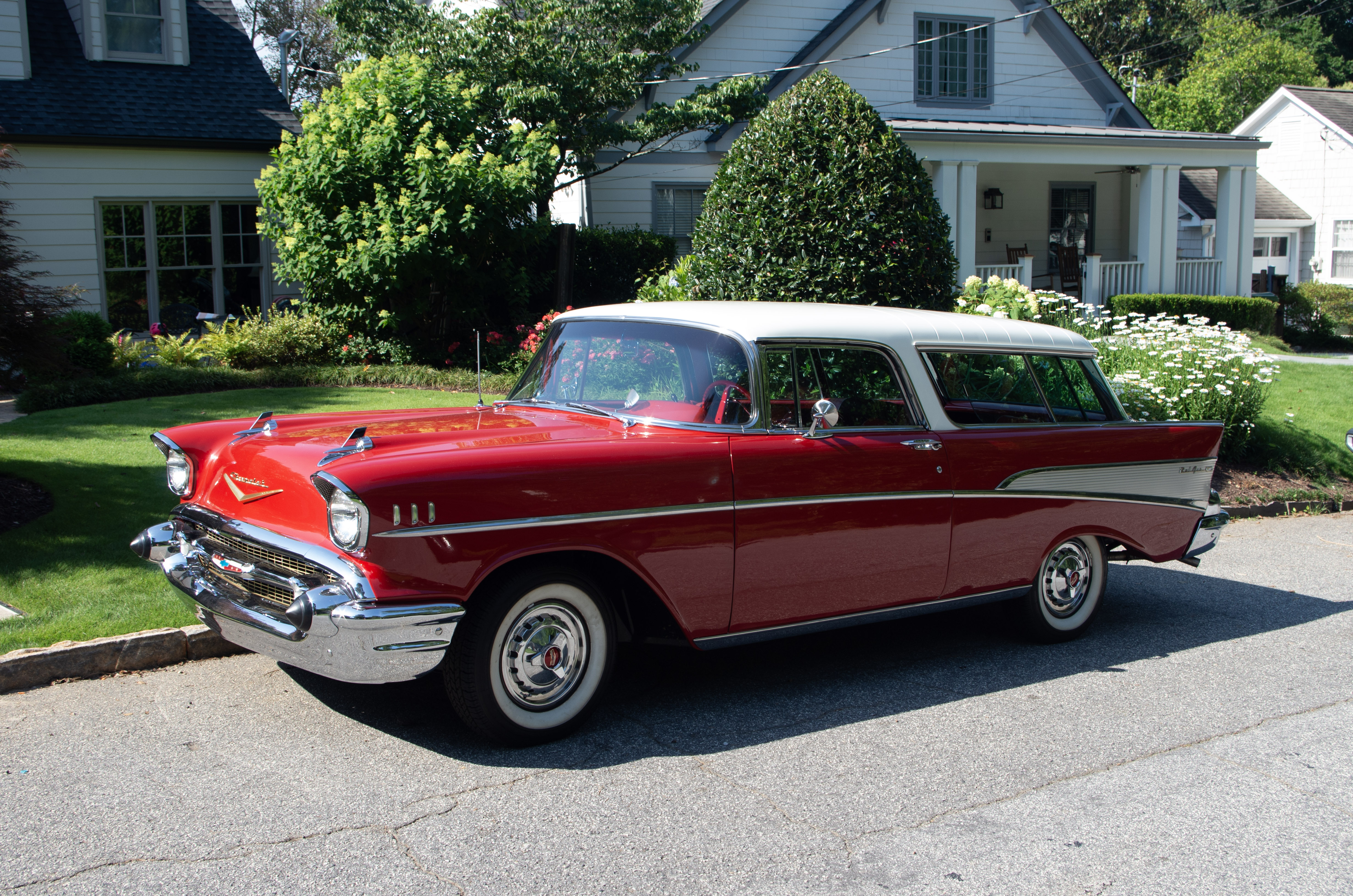
I loaded the Photura with a roll of UltraMax 400 and spent a few hours walking in an area of Atlanta named Cabbagetown. Its population has almost fully completed the transition from “working class” to “young urban professional” – Teslas, Porsches and Volvos are more common in the streets than old American iron.
I already mentioned that the Photura is a pleasant camera to carry around, and the images it captures are generally very good – sharp enough and correctly exposed – very few are technically deficient. I simply boosted vibrance and clarity to add punch to the pictures shown below. On the other hand, close-ups and interior scenes can’t be shot without the flash, which tends to over-expose massively subjects located at less than 4 ft.
All in all, I was pleasantly surprised by the Photura. I bought it as a curiosity, but the quality of the images it delivered impressed me. It’s an almost entirely automatic camera, with comparatively simple auto exposure and autofocus systems, and it works very well. Modern cameras will yield much better results indoors, but as a street and travel photography camera, it’s very efficient and a pleasure to shoot with. A keeper. Who would have guessed it?









 CamerAgX - a new life for old gear