Only Canon, Nikon and Pentax still have dSLRs in their product catalogs, but although they’re still on the shelves of the retailers, I don’t know if any of those dSLRs is still being manufactured.
Pentax is committed to the dSLR architecture, and with the full frame K-1 Mk II, and no less than three cropped sensor models, the KF, the K-3 Mk III and the K-3 Monochrome, they have the youngest dSLR model range of the remaining big three (all four Pentax models were launched between 2018 and 2023).
Between the predecessor of the current KF (the K-70) and a then to come K-3 Mk III, Pentax thought there was room for an intermediate model, the KP, a technical evolution of the K-3 Mk II, but with a totally different design.
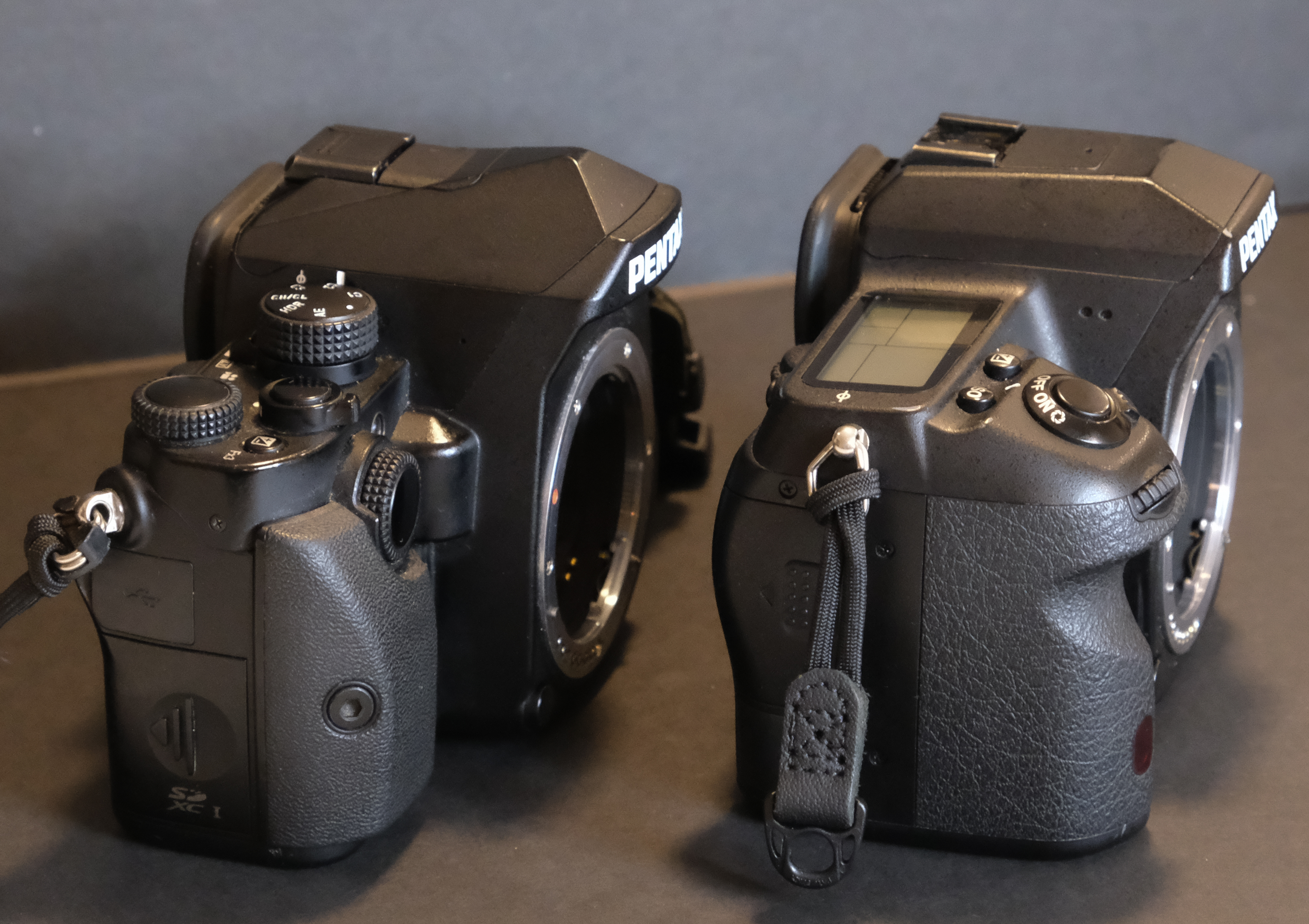
Launched in 2017 and retired in 2021, the KP begged to be different – from its Pentax siblings and from Canon & Nikon’ remaining dSLRs.
The KP was designed as a sort of mini K-1, with the aim of looking physically smaller than the K-3, but be more configurable and more solidly built than the entry level K-70. Its styling was reminiscent of the manual focus, non motorized cameras of the nineteen seventies, with a slim body and a shutter release button placed in the middle of the top plate.
Equipped with a newer generation 24 Mpix sensor, the KP retained the autofocus module of the “pro” K-3 Mk II. Like it, it could be fitted with an optional battery grip. It inherited the image processing engine of the K-1, and improved on its full frame brother with a more flexible configuration for its third control wheel.
Beyond the style, the KP’s main differentiation point with the K-70 and the K-3 Mk II was the ability for the photographer to choose between 3 sizes of hand grips.
The design of those interchangeable hand grips is somehow controversial. Professional reviewers like Chris Nichols of DPReview and Petapixel fame positively hated it. Among the Pentax photographers, some like it, some shoot with a KP in spite of it, and some remained true to the K-3 Mk II because of it.
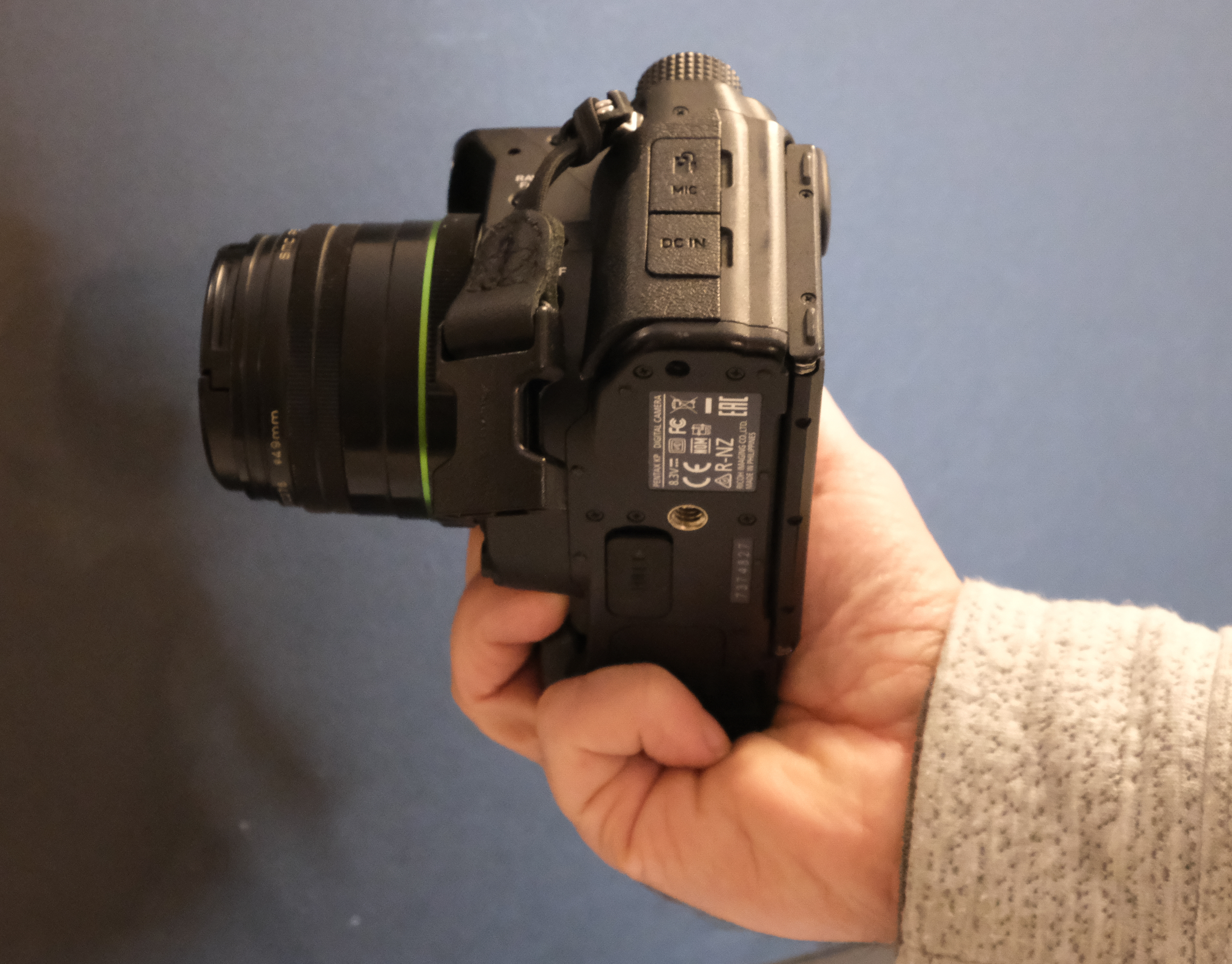
The small grip was supposed to be mounted on the KP when the photographer was shooting with small (and light) primes, the large grip (and the battery grip) when shooting with a long and heavy tele-lens or tele-zoom, and the medium one the rest of time.
In the American market, the camera was packaged with the three hand grips initially, but after a while Pentax only included the small grip in the base configuration, the large one being part of an extra cost bundle also including a battery grip, and the medium sized one being sold separately for $49.99. None of those grips is available now, and my KP will be stuck with its small grip for the time being.
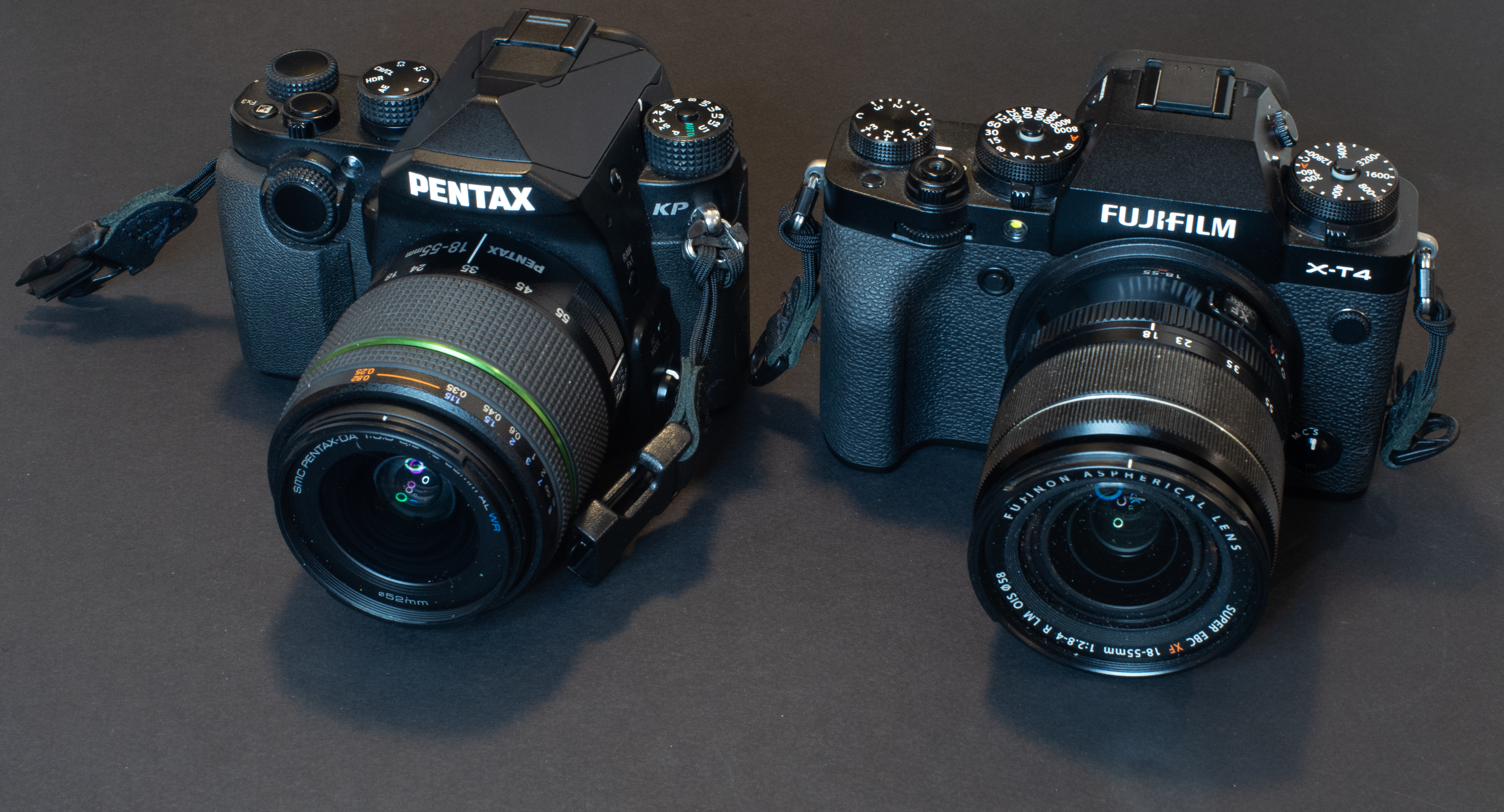
The Pentax KP is not the only camera with a retro-inspired, small grip design – look no further than the very successful Fujifilm X series, but what works very well on a X-100 or a X-T4 does not click on the KP.
First impressions – is the grip worth the buzz?
Pentax APS-C cameras tend to be small, and the KP looks even smaller than its siblings. But it’s not its compact size that strikes you the most when you bring the viewfinder of the camera to your eye for the first time, it’s its weight. It’s not really heavier than a Pentax K-5 or K-3 (all tip the scales at approximately 700 g), but its compact design and its small grip make its weight much more noticeable.
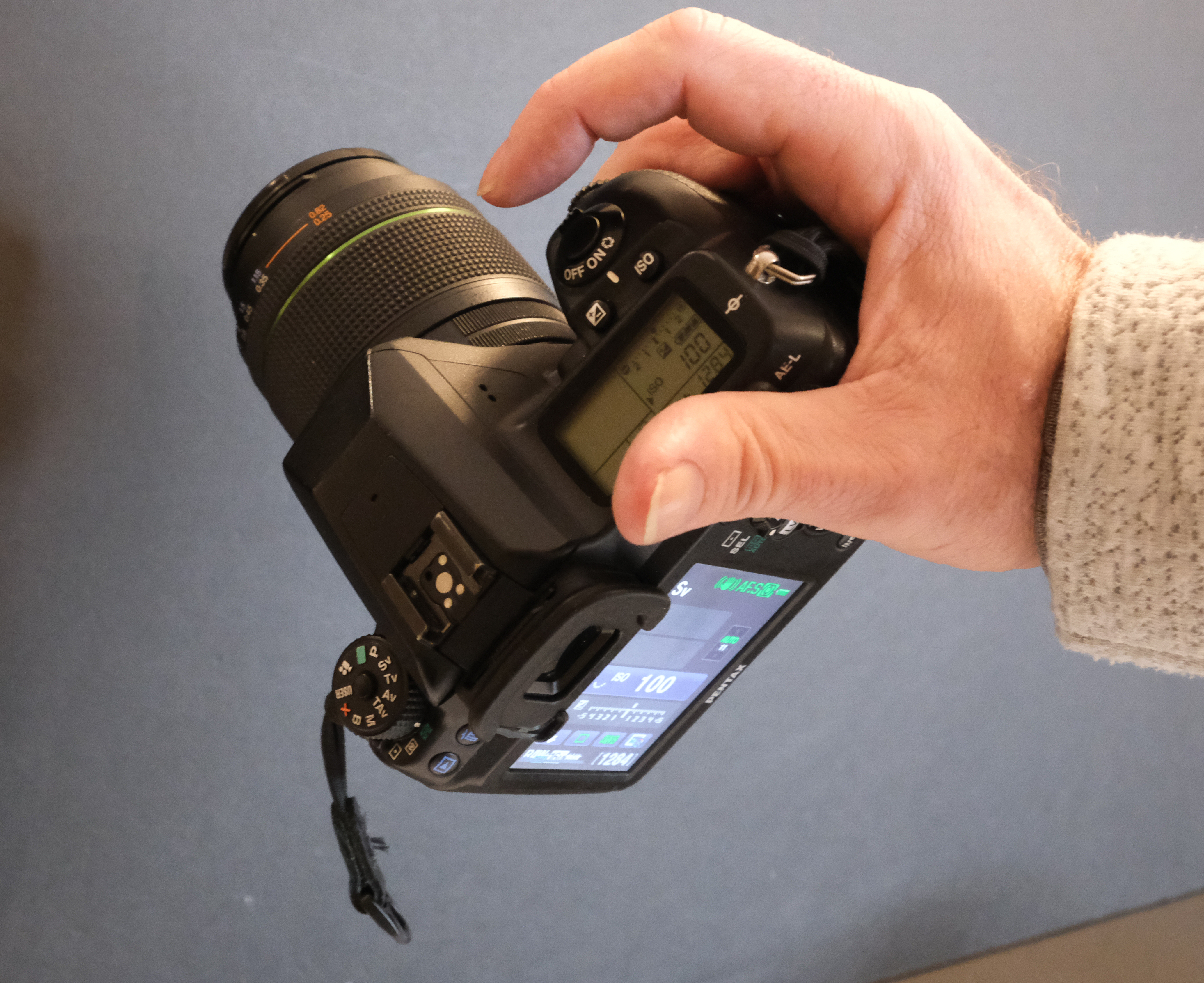
On a K-5 or a K-3 (and on other dSLRs of more conventional design), the camera can be held firmly with the palm of the right hand and the three lower fingers, leaving the thumb and the index free to move and reach the different control wheels and commands. You can be confident that you won’t drop the camera while you’re moving around your subject, looking for the right angle.
If you try and hold the KP with one hand, you have to pinch the right side of the camera between your thumb and three of your remaining fingers (no room for the pinky). Even with a prime lens or a light zoom, we’re talking about two pounds of glass and metal here, that you will be afraid to drop if your fingers start releasing their grip (it’s not a coincidence that the previous owner of this camera had included a wrist strap in the package I received).
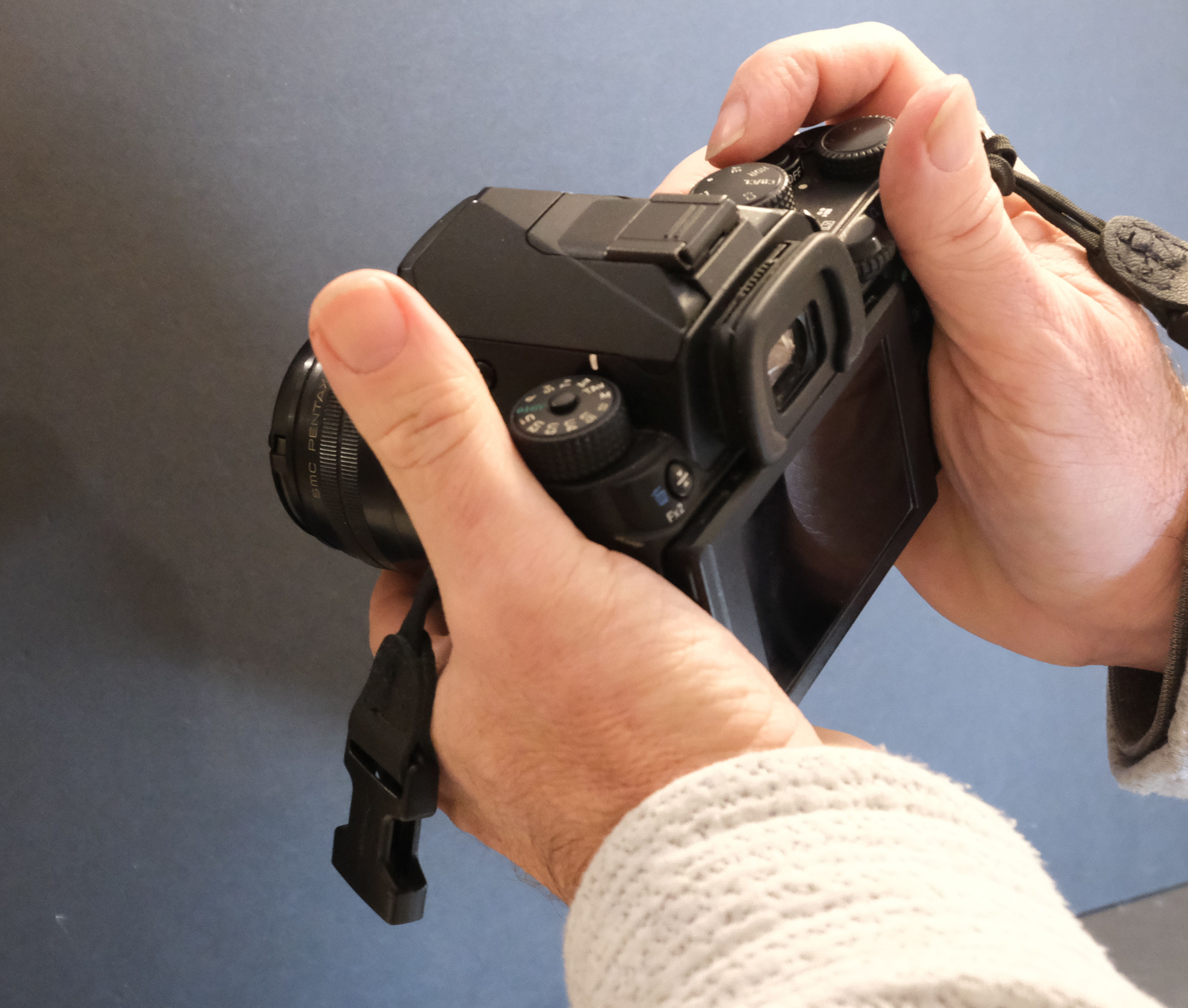
With the small grip in place, the KP definitely requires a two-hand operation.
Solutions to the hand grip challenge
The design, the ergonomics and the small grip of the KP may work for you. Personally I would have liked the camera to be more conducive to one hand operations, and I believe that the slim design of the KP would have worked better if the camera had been one or two hundred grams lighter and its body just a bit taller.
The simplest way for me to address my “grip problem” would be to buy the OEM large grip (Pentax reference O-GP1672). Based on the input of other KP users, it should make “one hand operations” easier. If only I could locate one.
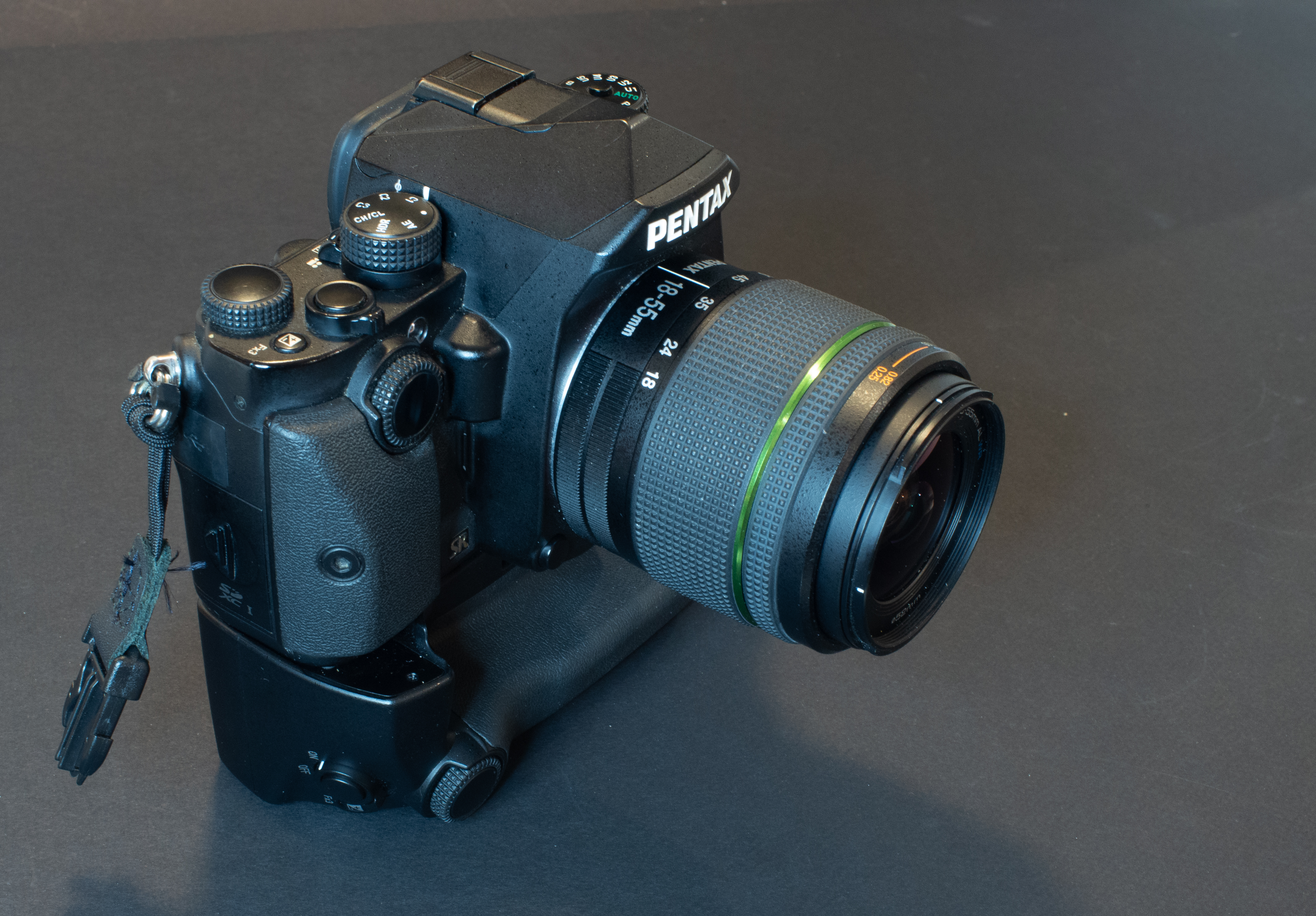
The camera I bought came with the optional Pentax D-BG7 battery grip (but without the large hand grip, unfortunately). I’m not a fan of battery grips in general because they make the camera bulkier and often require to remove the battery door, but in the case of the KP, the battery door (and the OEM battery) remain in place, and the grip addresses two of the KP’s glaring issues – the battery life and the ergonomics, without much of a weight penalty (300g approx).
With the battery grip in place, the battery capacity of the camera almost triples: the 1050 mAh battery remains in the body of the camera, and only starts being drained when the battery located in the grip is depleted (the grip accepts the same 1050 mAh battery as the camera does, or the larger 1860 mAh battery of the Pentax K-5/K-3 series).
As for the ergonomics, the battery grip is a huge improvement. It’s supposed to help with vertical composition, but even when composing an horizontal image it makes the camera much easier to hold and control : I’m not afraid to grab it with one hand anymore, and although the front control wheel remains difficult to access, the one at the back of the body is easily reached.
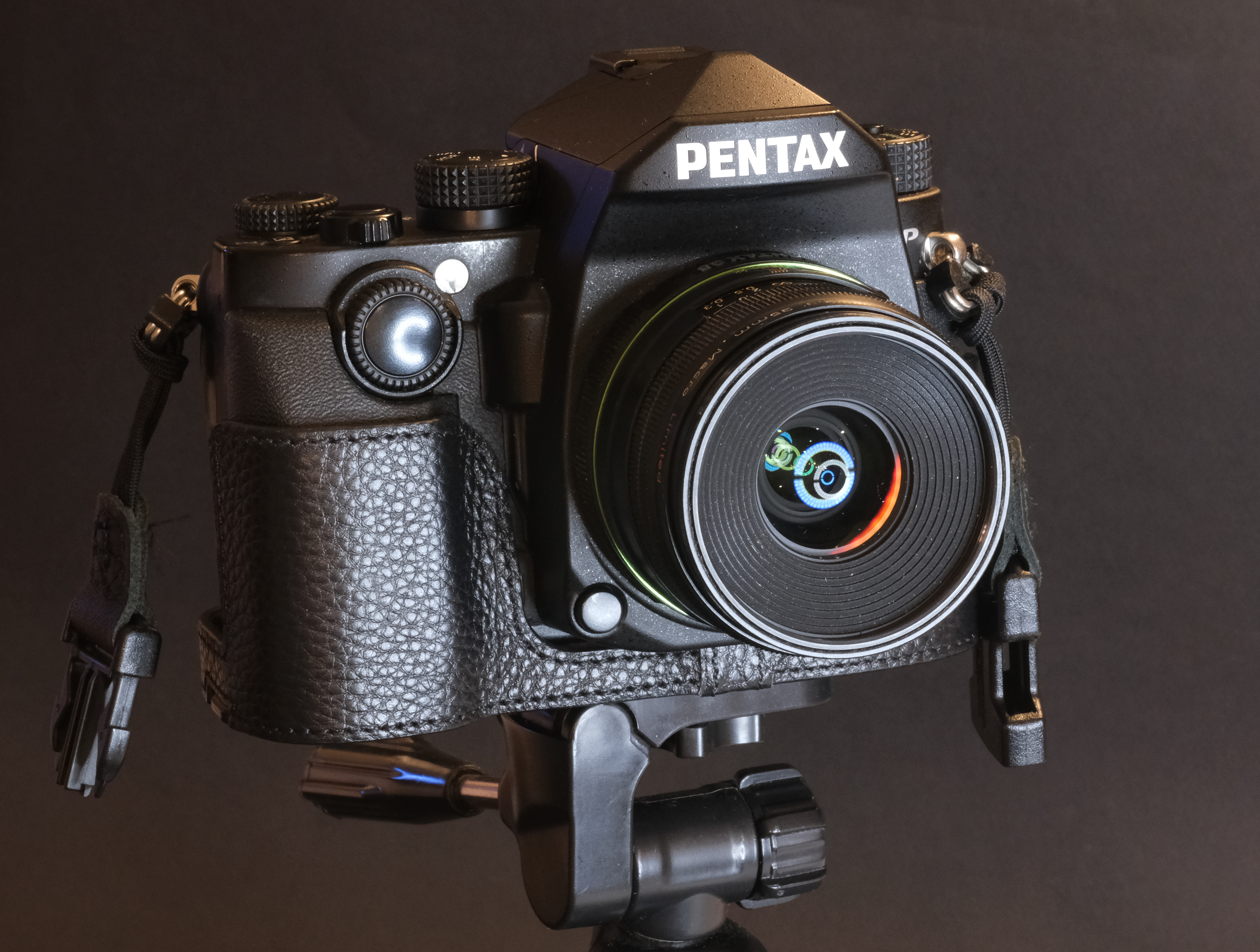
A last option is to do for the KP what I did for my other “slim bodied” cameras (the Fujifilm X series and Sony HX-60): I ordered a Leather Half Case from a non specified Chinese vendor on AliExpress. Those half cases add almost a centimeter of leather under the bottom plate, they also make the front of the camera’s body a bit thicker and increase the surface presented to the fingers, making the camera much easier to hold.
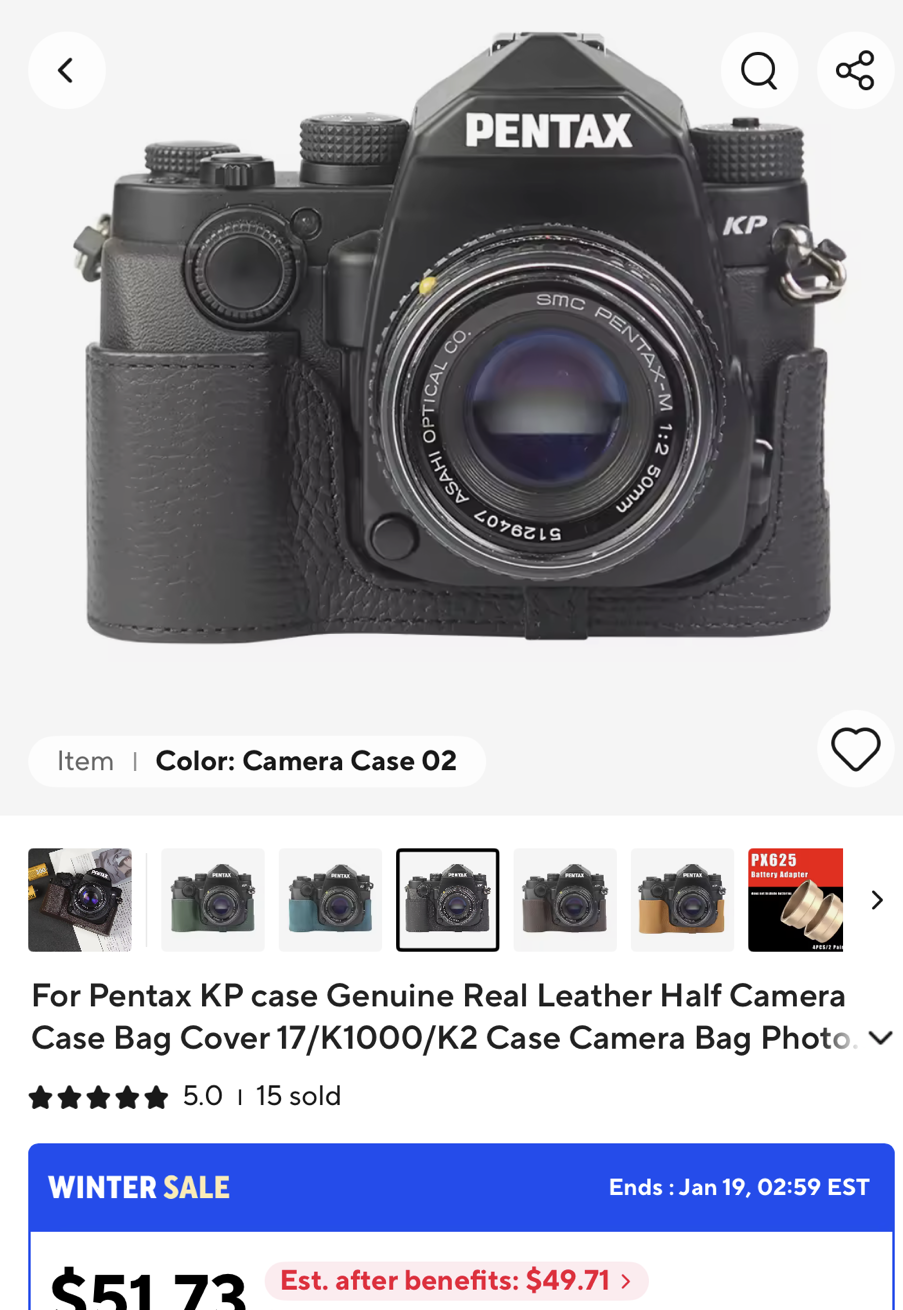
I picked the black one (it’s also available in fancier colors). This half case is well finished, and makes the KP much more comfortable to hold. A few millimeters here and there can do a lot. I can even reach the rear control wheel while holding the camera firmly in the palm of my right hand. A definitive improvement, and a permanent fixture on my camera now.
Shooting with the Pentax KP
Now that I’ve described in length my two major gripes with the KP, it’s time to discuss the positives. Optical viewfinder, abundance of physical controls, configurability, and of course, image quality. It’s a very pleasant camera to use, that begs to be taken to a photo stroll, and will reward you with great pictures. More about the Pentax KP in the next blog post, in two weeks.
More recent content in CamerAgX

Georgia pictures from my Flickr Album





 CamerAgX - a new life for old gear