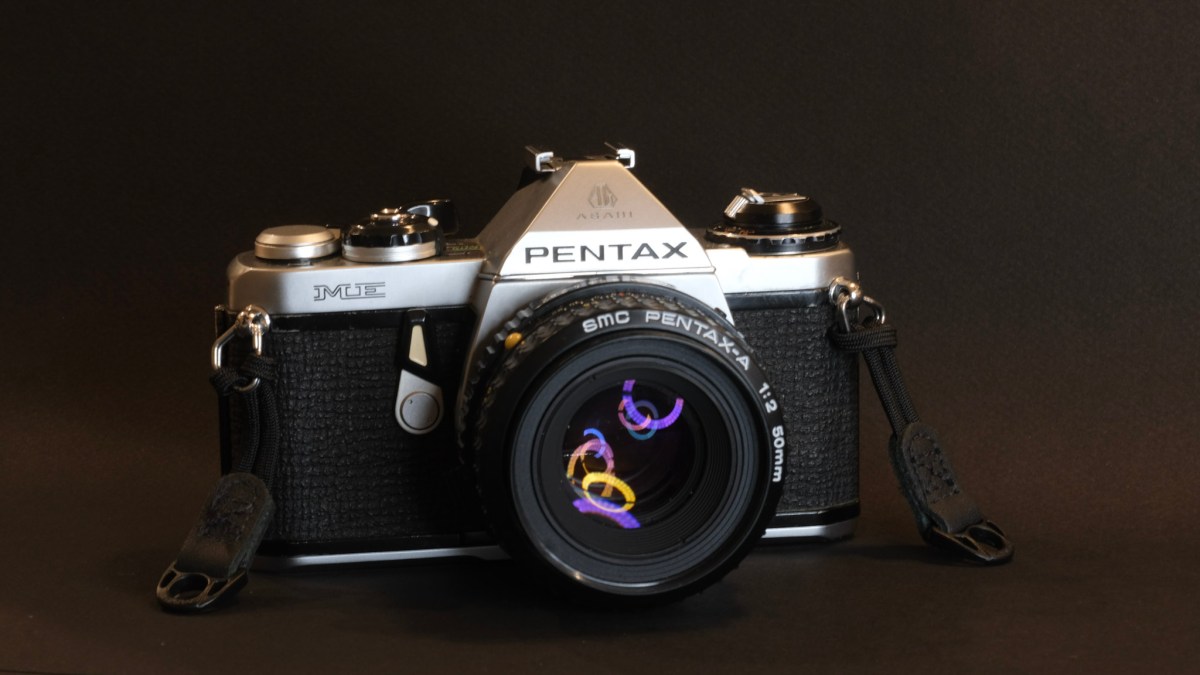
I rediscovered the Pentax ME and its close family of derivatives recently, after having been disappointed by the Pentax P3 (also know as the P30).
I would have loved to like the Pentax P3. When it works, it’s a great camera. But I bought three copies of them (a P3, a P3n, a P3t) at different times, and they all failed me. Always an issue with the film advance. But if I could not rely on a P3, what about shooting with the Pentax cameras of the following or previous generations?
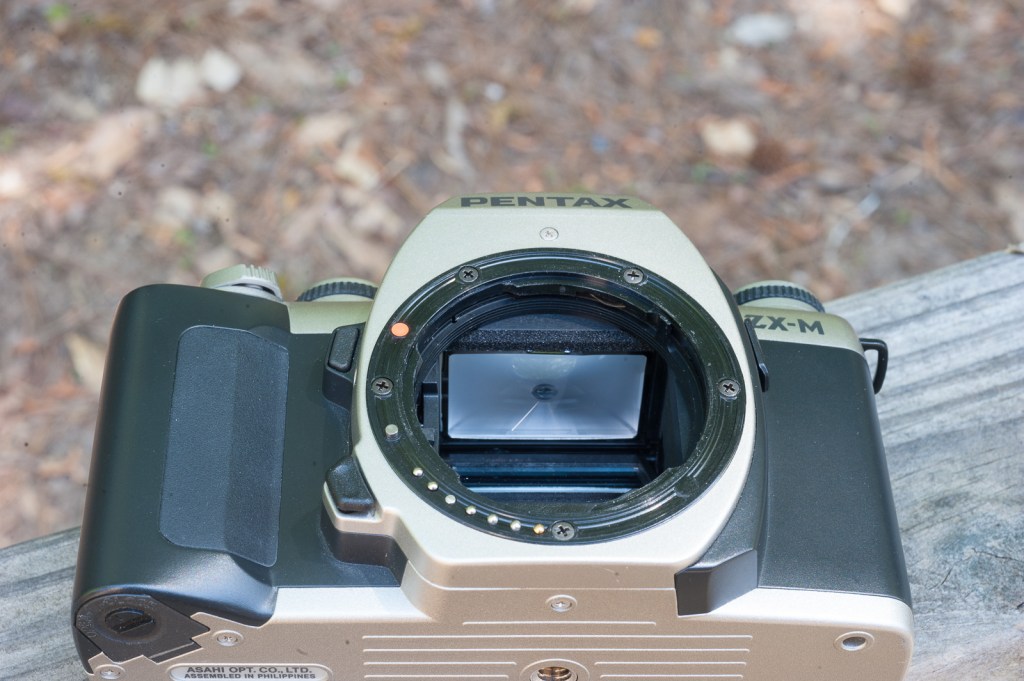
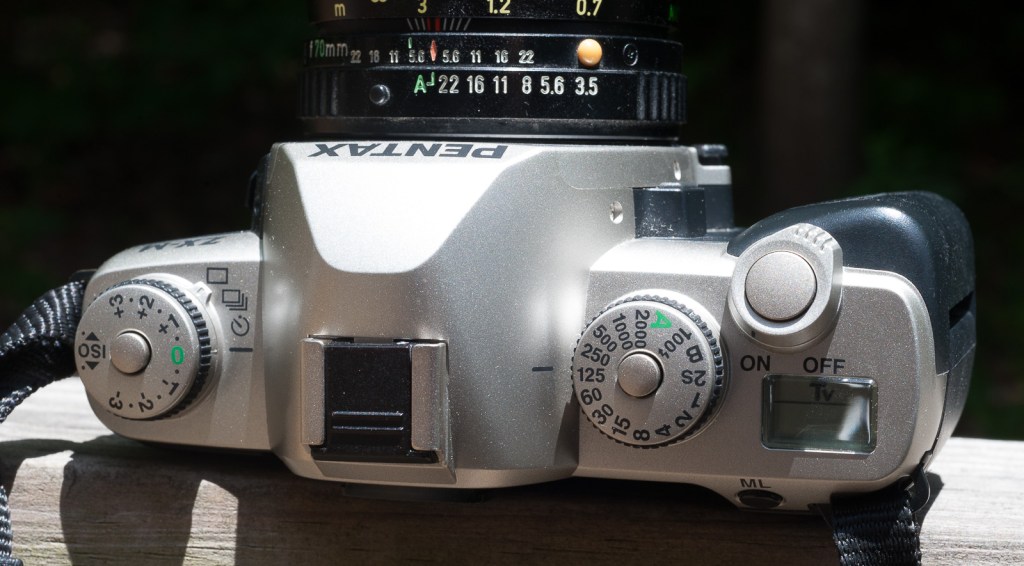
I’ve burned a few rolls of film with a plastic-fantastic ZX-M (also sold as the MZ-M), a motorized entry-level autofocus camera that Pentax had deprived of its autofocus system to make it a “learner’s camera”. Launched in 1997 to replace at the same time the venerable K1000 and the P3, the ZX-M was one of the last film SLRs released by a major vendor before the amateur photographers switched to digital, and for that reason it did not sell in large quantities.
It works well, but it’s plasticky, it’s loud, the exposure metering is a bit too primitive, and its pentamirror viewfinder is dark and narrow. People shooting with film nowadays do it at least partially for the gratifying experience of interacting with a nice piece of conventional machinery – and it’s definitely something that the MZ-M can’t provide.
At the other end of the timescale, pre-dating the K1000 and the P3, the Pentax ME and all its derivatives – ME Super, MV, MG, Super Program, Program-A – were a sales success, and are still abundant on the second hand market. They are all built on the same very compact platform. So compact there was no room for a conventional shutter speed selector. That’s the series we’re going to explore today.
The ME generation
In 1975, Pentax finally abandoned the 42mm screw mount for the “K” bayonet, and launched a new line of K cameras (KM, KX, K2) which were – to a large extent – similar to their screw mount predecessors, except for the bayonet mount, of course. The K1000 was not part of the initial launch – its turn came a few years later – essentially a KM with a few minor features removed.
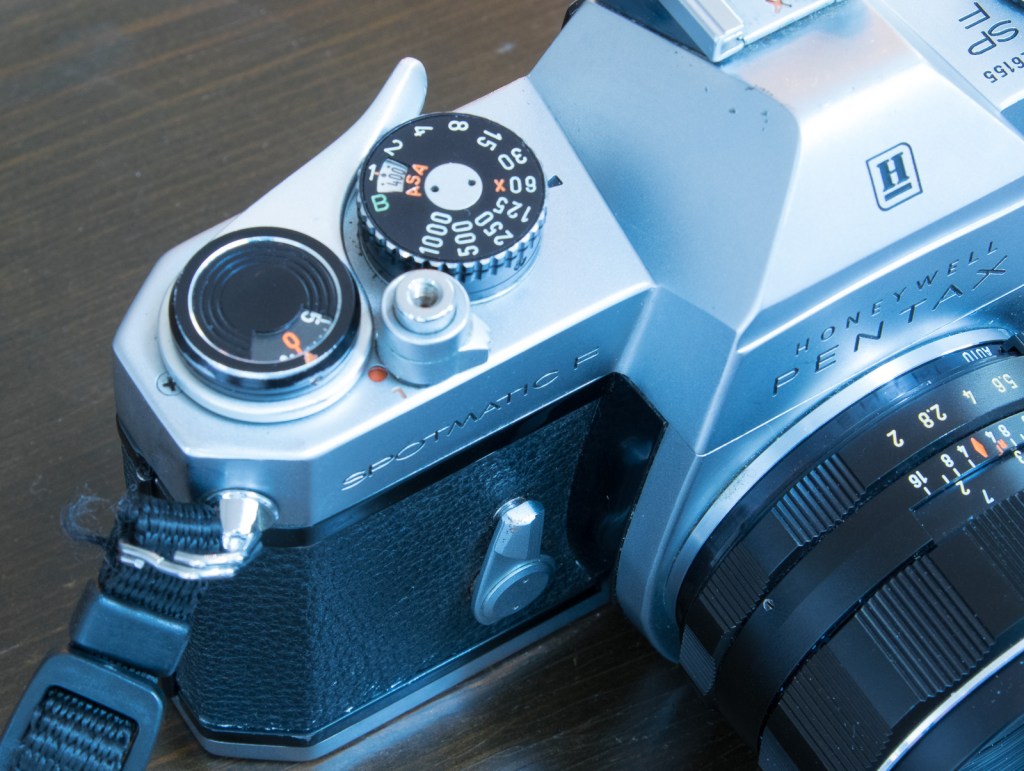
One year after the KM-KX-K2 cameras, Pentax launched two completely new models, the semi-auto MX, and the Aperture Priority Auto Exposure ME. Both were technically advanced, and really represented the state of the art in the heart of the market. Except for their small size, the two cameras had little in common (their winders and motor drives were physically different and not inter-compatible, for instance).

The Pentax MX is what an Olympus OM-1 Mark II could have been if Olympus had bothered updating the technology content of their camera. The MX is a super compact, semi auto SLR, with a huge viewfinder. It was my main camera in my younger days. Its electronics ultimately failed, otherwise I’d probably still be shooting film with it. But while it worked (a good 15 years) it was a great little camera.
The MX remained unchanged until Pentax sent it into retirement in 1985, with no direct successor. In the meantime, the buying public had shown it was more interested in cameras offering auto exposure modes, and it was the ME and its derivatives that brought the money to Pentax’s coffers.
When it was launched, the Pentax ME had a singular characteristic: contrarily to almost every single lens reflex before it, it did not have a shutter speed selector – just a rather difficult to move four position switch (off, auto, synchro flash and B). It could only operate in auto exposure mode (you set the aperture, the camera picks the shutter speed), and in totally manual mode at 1/100sec (no meter indication to guide the photographer).

A simplified MV model was launched at a lower price point in 1979, followed one year later by the ME-Super, which offered the ability to select the shutter speed by pushing two small buttons on the top plate. Then came the MG (spec’d like the original ME), then the Super-Program and the Program-Plus [*], with the same tiny shutter speed push buttons already seen on the ME Super, and more automatic modes (Program mode for the Program-Plus, Program and Shutter priority modes for the Super-Program). All models were developed on the same technical platform, and could share accessories like winders and motor drives.
* [Like most Japanese camera companies, Pentax was selling its cameras under different models names in different geographies – the camera sold as the Super-Program in North America was sold as the Super-A in the rest of the world, and the Program-Plus was simply known as the Program-A outside of North America]

Shooting with the ME
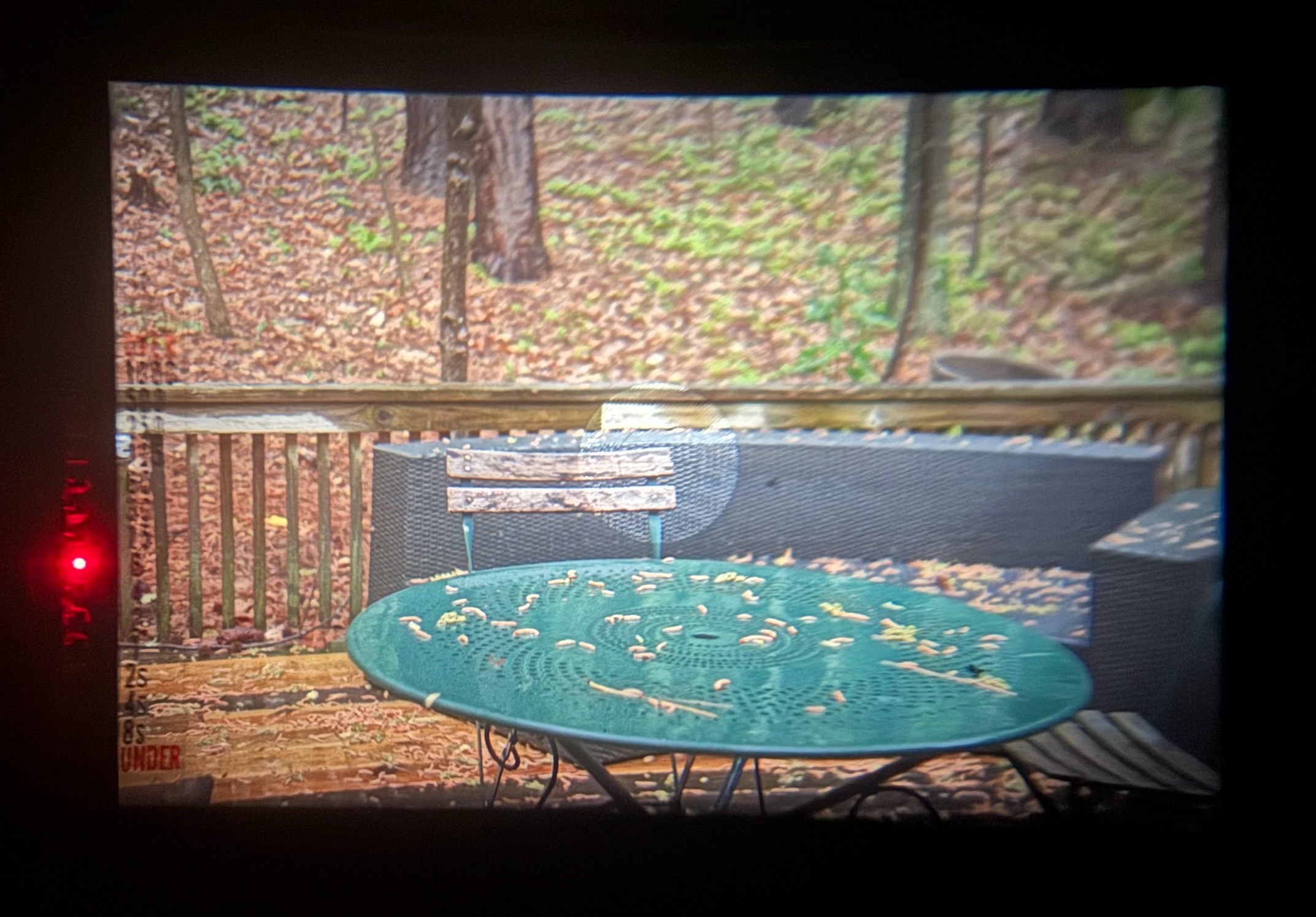
Shooting with a Pentax camera such as the ME is a pleasure. The camera is small, light, reactive, and provided you control from time to time that the shutter speed (determined automatically by the camera) is still the desired range, you’ll be fine. The viewfinder is extremely large, but I was surprised by how difficult it was to set the focus though – I know I’m getting older (aren’t we all) but I found the glass plane rather dark and the micro-prism telemeter difficult to use. I was shooting with a not very luminous zoom (and not very good if I judge by the results) Pentax A 35-70 f/3.5-4.5 zoom, on a camera that was originally designed and sold for more luminous prime lenses such as the 50mm f/1.7, so it could explain some of that.
A Pentax Program-Plus I was testing in parallel fared better in that regard – in the viewfinder the ring of micro-prisms offered more contrast and focusing was significantly easier.

The absence of a depth of field preview is not a problem for me (I seldom use it when a camera offers the option), and not having a conventional shutter speed knob at my disposal was not really a hindrance. But when the lighting of the scene becomes complex, and without an exposure memorization button and no semi-auto exposure mode, you have to play with the ISO settings dial for exposure compensation, which I’ve always found very difficult (I never know if I need to set the dial to +2 or -2). If only for that reason, I would not bring a ME with me if I knew in advance that the lighting conditions would be tricky.
The camera is nicely finished with a few Pentax touches (red markers on the top plate, little indicator on the back of the camera to show that the film is correctly attached to the film spool). The film spool itself follows an original Pentax design (they called it “Magic Needles”) that makes loading film easier than with most contemporary competitors.
What about the reliability?
The ME and its derivatives are 40 to 45 year old, and as with any other camera of the same vintage, there are quite a few things that can go wrong: their electronics (in general), their exposure metering and their film advance mechanism to name the most obvious.

By very empirical means (counting the hits on Google for a question about film advance reliability) – I came to the conclusion that the ME Super definitely had an issue with the film advance as well. I’m on the fence for the ME, the MV and the Super-Program – there seem to be far fewer Google hits about reliability issues with those cameras, but they sold in smaller numbers than the ME Super. In any case, it’s highly preferable to buy a vintage Pentax SLR from a photographer who has actually used it to shoot film, as those film advance issues are often impossible to detect without having put a roll of film in the camera.
How much?
Film cameras are getting more expensive these days – but you can still find a nice ME for $50.00 on eBay, and probably for a bit less on various auction sites if you’re patient.
Of all major camera vendors, Pentax is the one that has maintained the inter-compatibility between new and old bodies and lenses for the longest time – anything – manual focus, autofocus – sold by Pentax until they launched their first digital SLRs in 2004 will work with the ME.

Pentax has been catering to amateurs more than pros, and it will be difficult to find on the second hand market the specialty lenses (ultra-wide angle, f/2.8 constant aperture zooms) that are relatively abundant in Nikon F or Canon EOS mounts. But as long as you look for lenses typically purchased by amateurs, the offer is plentiful and the prices reasonable.
As a conclusion
The Pentax ME was launched in 1976, at the beginning of a ten year period which saw a whole new generation of amateurs come to “serious” photography and buy their first SLR. Ultra compact, reactive, nicely finished, with a good (for the time) viewfinder and a simplified set of commands, the ME was the right camera at the right time, and sold in the millions.
But this new breed of photographers was demanding more convenience, program mode auto-exposure and zoom lenses, and as result the SLRs launched towards the end of the period of manual focus SLR supremacy (1983, 1984) are simpler to use and have more luminous viewfinders.
Prices on the second hand market do not necessarily follow a perfect logic – and cameras or lenses of the same family (in this case the ME, ME Super, Super Program and the Program Plus) can be had for roughly the same price – irrespective of the performance hierarchy between the different models.
So… the ME is a nice little camera, eminently likable, but if for the same $50.00 price you can find a Super Program or a Program Plus, I would recommend you pick the “Program” over the ME.
More about Pentax Manual Focus SLRs in CamerAgX:



A few shots taken during the Inman Park festival a few weeks ago. The Pentax ME behaved – it’s very nice to use as a street photography camera, but the Pentax SMC A 35-70 lens disappointed me, again.
The film was developed in a Lomography Daylight Developing tank with Ilford Simplicity chemicals, and digitized on an APS-C camera using a JJC adapter.




 CamerAgX - a new life for old gear