Should we start collecting digital cameras?

Collecting is different from hoarding junk.

I’m sure we all have a few compact digital cameras stored in a drawer somewhere, that we don’t use anymore because, let’s be honest, any decent smartphone will do a much better job at taking, editing and publishing pictures than a dedicated compact digital camera sold 10 years ago. It does not make us digital camera collectors. We’re simply consolidating our inventory of obsolete electronics before a future trip to the recycling center.
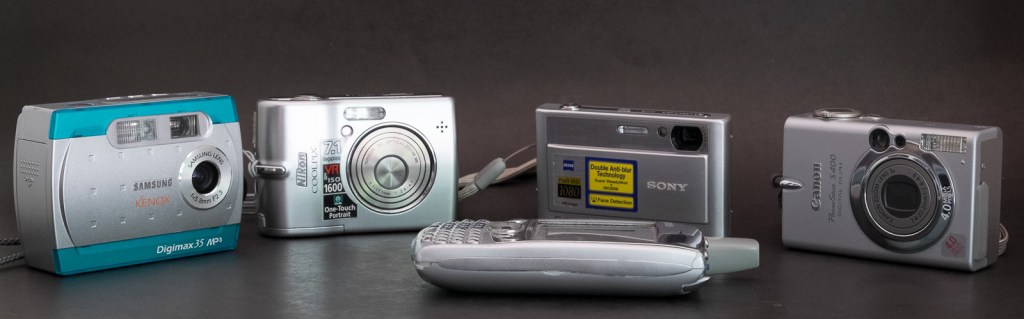
Samsung Digimax 35 (0.3 MP, 2001), Nikon Coolpix L14 (7 MP, 2007) , Sony DSC-T20(8 MP, 2007), Canon Powershot S400 (2003, 4 MP)  and the Palm Treo 600 (0.3 MP, 2004) in the fore plan. Are my old digital cameras collector items, or just drawer-ware?

Collecting implies an intent.

A collection tells a story. The collector assembles objects which are significant for him or her, because of their esthetic or sentimental value, or to satisfy some form of intellectual curiosity. He or she may hope that, over time, objects in his or her collection will gain value, but financial gain is not the primary motive (if it was, he or she would not be a collector, but simply a speculator, a scalper).

We have the benefit of hindsight, and it’s easy to see what makes a particular model of film camera a better collectible than another one. I will group the criteria in three categories:

  • what the camera was in its early days: its technical significance, its build quality, its beauty, its performance, its cost, its rarity,
  • what it can do for you now: its usability (are film, batteries and lenses still available for that type of camera), its reliability over the long run, its ability to help you get great pictures, and the satisfaction you derive from using it,
  • the legend around it: is the brand prestigious, was this model of camera used to shoot a  famous picture, or used by a whole generation of war correspondents or reporters, did this particular item belong to a star or a famous criminal?

Obviously, by all three groups of criteria, a Leica M3 will be a better collectible than a mass produced, entry level, plastic bodied and unreliable APS camera from the late nineties.
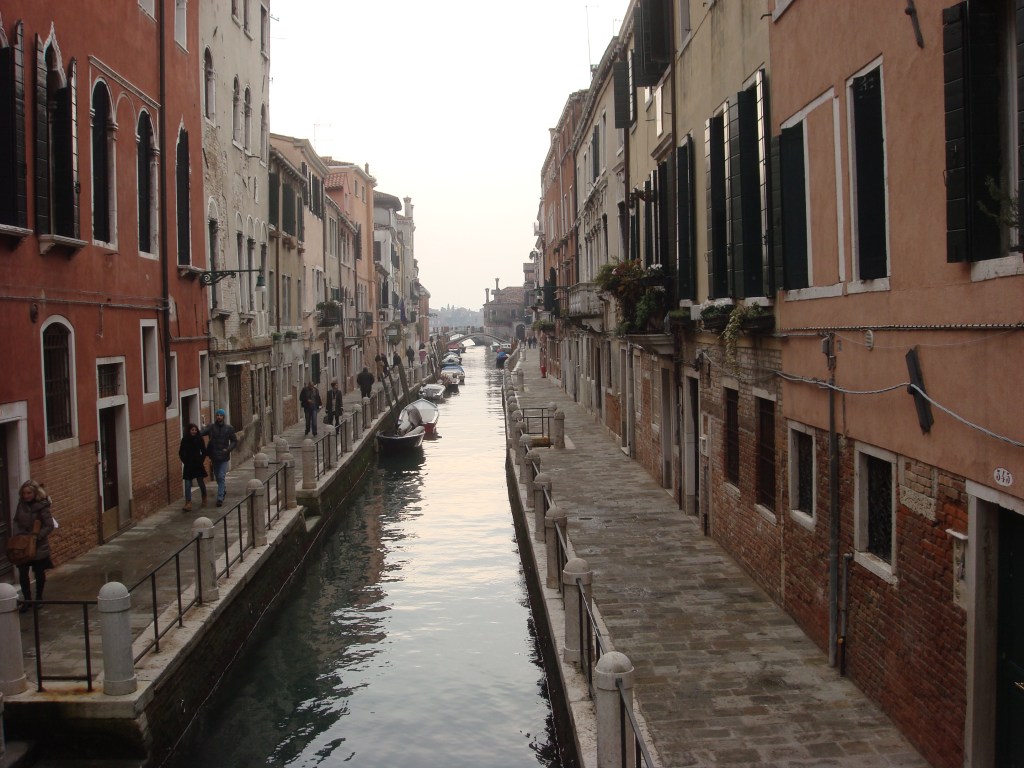
Venice – Dec 2011 – Sony DSC-T20 (Photo: Valerie M.) A good digicam could take good pictures. A modern smartphone could probably do as well today.

What if we apply the same list of criteria to digital cameras?

  • what it can do for you now: that’s the biggest issue: older digital cameras are not as good as modern ones. A film camera has the benefit of being different from a modern digital camera with which it can not be directly compared (it’s a different user experience, a different workflow, and the output is somehow different), but an old digital camera can directly be compared to a modern one, and it’s not to its advantage: the resolution and the ability to shoot in low light are massively inferior, and the dynamics of the sensor is much narrower. And to add insult to injury, old digital cameras are also outperformed by smartphones in many casual shooting situations.
    Older digital cameras may not be as durable as film cameras – they’re full of electronics, and are generally powered by proprietary batteries that may not age well, and will require specific chargers, specific cables that, if lost, will rapidly become difficult to replace.
    Some of the most technically original (and therefore interesting) digital cameras like the Sigma cameras using Foveon sensors or the old Fujifilm S3 or S5 cameras using SuperCCD sensors require specific software to process or get the best of their raw files – but the software may not work with current or future versions of Windows and Mac OS.
  • what the camera was in its early days: it has to be put in perspective with what it can do now. Does it really matter that a Panasonic compact camera was considered the best compact camera for enthusiasts in the fall of 2005, when it’s in any case outperformed by an iPhone 7 Plus?
    By that measure, only a few cameras that made history technically are worth of attention : you can argue that the Nikon D3 changed the way we take pictures in low light and made flash  photography obsolete – and as a consequence deserves be part of a collection focused on important digital cameras. Similarly, cameras of an unusual design like the Nikon Coolpix 995 or equipped with a unique sensor that helps create different pictures (like the Sigma Foveon cameras) could become interesting curiosities.
  • the legend around it: I don’t think any digital camera has reached the legendary status yet.  Some cameras may be of special interest to collectors of equipment from a legendary brand – the first digital M camera from Leica, or the last digital camera made by Contax. But so far, I can’t see any digital camera that defines its generation, the way the Leica M3, the Nikon F or the Olympus OM-1 did in their heyday.

What digital camera would I collect?

Pinup and Naomi playing – The oldest jpeg file on my computer’s hard drive – taken in 2002 with a Samsung Digicam 35 camera. 640 x 480 pixels (0.3 Mpx). Does it  qualify as a collector, or as junk?

What is  important to me is not necessarily what’s important to you. To me, a camera has to be usable for casual photography, at home with my dogs, on a stroll in my neighborhood or while traveling. That’s why, when I shoot with film, I prefer cameras from the late seventies-early eighties to their ancestors of the fifties or sixties, too complex and too slow to operate for my taste.

In the world of digital cameras, I would not buy anything not capable of providing a good 8 x11 print, which places the bar at 6 Megapixels. I would also want the digital camera to be better at doing its job than a smartphone (if it was not, I would never use it and it would collect dust on a shelf):  it would need a viewfinder (optical or electronic), and would have access to focal lengths ranging from  24mm to 135mm. I’m not necessarily willing to invest in a whole new system: if the camera accepted interchangeable lenses, I would prefer some compatibility with the lenses I already own (through an adapter, possibly).

Lastly, I’d like the camera to represent a significant step in the evolution of digital cameras, and to have a few unique characteristics that would differentiate it from the mass of the me-too products of its generation.

What camera would qualify? A few Nikon pro cameras from the mid 2000s (D1x, D3) because they pushed the boundaries of image quality and  low light capabilities and made the film SLRs and flash photography obsolete, their cousins from Fujifilm (a S5 Pro, maybe) for their original SuperCCD sensor and the unique images it captures, or the Epson R-D1, the first digital rangefinder camera, or one of the most original bridge cameras from Sony, the F828.

Your choice would be different. Up to you.


More about using old digital cameras today: Ashley Pomeroy’s blog – http://women-and-dreams.blogspot.com with interesting reviews of  the Fujifilm S series (Fujifilm S1 Pro, Fujifilm S3 Pro, Fujifilm S5 Pro) and its competitors from Nikon (Nikon D1, Nikon D1x).


Venice – Dec 2011 – Sony DSC-T20- (Photo Valerie M.)

Fujifilm and the instant film bonanza


The Photokina took place in Cologne a few weeks ago. To a large extent, it was a Fujikina. Fujifilm announced a brand new medium format digital system, and presented a black and white version of their Instax Mini film. And they pre-announced a square (6cm by 6cm) version of their Instax Color film. And special editions (Michael Kors, Colette, ..) of their Instax instant film cameras. At the same time, Leica was showing a Leica branded Fujifilm camera (the Leica Sofort), a clone of the Fuji Instax Mini 90 Neo Classic, with Leica branded black and white and color instant film.

Instax Mini Film - Holga 120 CFN camera with Holga 120 -IB back
Instax Mini Film – Holga 120 CFN camera with Holga 120 -IB back.


Fujifilm has been in the instant film business for a very long time – with their own technology and through cross licensing agreements with Polaroid. Until April 2016 Fuji was still producing peel apart film compatible with Polaroid pack film cameras and backs, years after Polaroid themselves had ceased to manufacture instant film. As a sidebar, the conventional Polaroid film was called peel-apart film, because the photographer had to wait for the image to be processed, and then had to peel a sort of negative apart from the developed picture on paper. A more modern implementation of instant photography is the “integral” film, in which  the picture itself contains all the chemicals needed for an automatic development of the photo.


Fujifilm’s integral film success story started at the end of the nineties, when they introduced the Instax Mini, a new small size instant film system in Japan (the Instax Mini image size is approx 6 x 4.5cm, and as a consequence the size of the cameras can be kept reasonably small). The system was adopted with enthusiasm by  pre-teen and teen age Japanese girls, and Fuji has been very intelligently building on this initial success to convert foreign and older customers (first in Asia, and more recently in the West). In addition to the Instax Mini film, Fujifilm also introduced Instax Wide films and cameras. The Instax Wide image is larger than the Mini’s (twice the size at 10cm x 6cm), but the cameras are anything but pocket friendly.


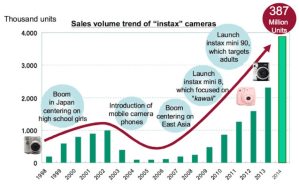
The growth has been phenomenal (3.8 Million cameras sold in 2014, 5 million in 2015, and on target to 6 million in 2016).

sales_Instax_other
Sales of Fujifilm Instax cameras – 1998 to 2014. The sales volume in 2014 is 3.87 million. Source: Fuji film

 
Those volumes are far from being negligible if compared to the 40 million digital cameras  sold in 2015.


More important still for Fujifilm’s bottom line, instant film photography is a repeat business:  each camera consumes film, and a pack of Instax Mini film which costs approximately US$ 10.00  is only good for… 10 pictures.


On the instant film market, Fuji has only one competitor: The Impossible Project, aka TIP. TIP took over a Polaroid plant in the Netherlands when Polaroid left the film business, and started manufacturing their own integral films (they don’t have the original Polaroid recipes, their films are their own creations). I had tested their first black and white integral film just after they started their business a few years ago – and I had not been impressed. They have improved their products massively in terms of predictability and usability, and they’ve extended their product line to include color films and to support more models of Polaroid cameras; I’ve seen really beautiful pictures made with their current line of films. However, compared to Fujifilm, they remain a small scale operations with expensive products and a very limited distribution network. As opposed to Fujifilm, The Impossible Project can only propose one model  to people who want to buy a new camera. Their customers still  primarily use very capable but old SX70 and 600 Polaroid cameras – which are still abundant on the used market, but don’t have a reputation for aging gracefully.

holga2
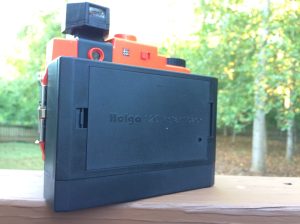
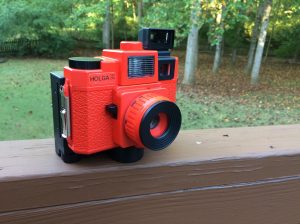
Holga 120 with 120-IB Instax back.


Lomography (the promoters of Lo-Fi photography and makers of the Lomo, Holga, Diana and Belair cameras) have developed two lines of instant film cameras,  one for the Instax Mini film, one for the Instax Wide, as well as add-on backs for the Holga, the Diana and the Belair.  They offer more control to the photographer but they don’t have the reputation of being user friendly or to offer consistent results. More about it below.


Lastly, a cottage industry has been busy refurbishing old Polaroid cameras (for use with The Impossible Project’s film or with Instax), and converting old medium format cameras – in particular the Mamiya Press – to Instax film. For all sorts of reasons, Fujifilm recently stopped producing the conventional peel and apart instant film that many lovers of high quality instant photography were using. Since Fujifilm’s  own Instax Wide cameras are rather basic, the best option for serious photographers is to convert old medium format cameras to accept Fuji’s integral film. At the moment, it’s a very limited market – the  cameras capable of taking advantage of the size of the Instax Wide film are necessarily very large,  heavy, and difficult to use, and the conversion is as expensive as the camera itself. But the release of the Instax Square film in 2017 will open the door for the conversion to integral film of smaller 6×6 and 6×7 cameras. If the Instax Square cartridge is designed like the Instax Mini, cameras with a deep interchangeable back will be the easiest to convert. It’s time to buy a good medium format SLR system before the prices go up.

holga_1
Holga with 120-IB Instax back (with add-on viewfinder and Neutral density filter)
Jules (French Bouledogue). Holga camera with defective shutter.


A few weeks ago, I wanted to have a feel for the Instant film phenomenon, and I mounted an Instax Mini back (the Holga 120-IB) on the Holga 120 CFN  I had brough with me to Rome a few years back. I bought the kit from a on-line store in Hong-Kong. It is composed of the back itself, a corrective lens  to place at the front of the Holga’s lens, and an additional viewfinder. It’s very simple – there is no battery as the picture is processed and extracted when the photographer turns a crank hidden under the bottom of the back.


My first test was not devoid of issues: either the back was poorly assembled, or I did not insert the pack of film properly, but I could not extract the pictures from the camera with the crank as I was supposed to: after each shot, I had to go to a dark room, open the camera and extract the picture manually. I finally solved the problem, probably by brute force, and the back worked flawlessly with the subsequent packs of film. Then with  the second pack of film, the shutter of the Holga decided to misbehave. I had to disassemble  it and lube it. The third pack of film gave better results, but almost all of the pictures were over or under exposed:  the exposure latitude of the Instax film is rather narrow, and nailing the right exposure is very difficult: don’t believe the specs sheet, the Holga only has one aperture (there is a sunny day/ cloudy day selector, but the aperture is F/13 in both cases) and the shutter is inconsistent and unreliable. Not the best recipe for success. Overall, it’s a frustrating experience as you feel you are wasting a good film in a poor camera.

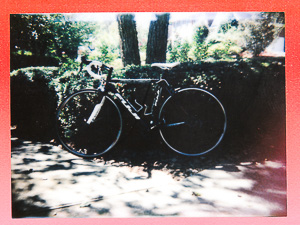
But as always with an Holga, some of the pictures – while technically flawed – have an almost surrealistic quality.

Fuji bicycle - Instax Mini film - Holga camera with Instax back (AFAIK Fujifim is not in the bicycle business. It's a coincidence)
Fuji bicycle – Instax Mini film – Holga camera with Instax back (AFAIK Fujifim is not in the bicycle business. It’s a coincidence)

More about Fujifilm’s instant photography adventures:


Fujifim and Instant Photography (camera-wiki.org)