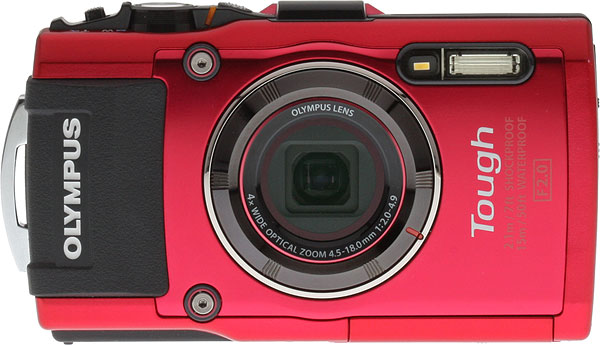
Olympus Tough TG-4 vs TG-5

I regularly keep an eye on Shopgoodwill.com auctions. Looking for the unexpected opportunity. A nice camera for a pitance. It’s not very frequent – I’m surprised by how much people are ready to spend on cameras donated to a charity and sold untested.

Sometimes you are lucky. A good camera gets unnoticed – so poorly described that almost nobody can guess what it really is – or the online auction ends at a time when most people have better things to do, and can not be on line to “snipe”.

There were a few auctions ending on Xmas eve and I ended up being the highest bidder for two cameras – a Canon Photura I’m currently testing, and this black Olympus Tough TG-5. The item was correctly described, was said to have passed some basic tests (both points which are not that frequent at Shopgoodwill) but there was very little competition to acquire it – no bidding war and no absurd high sale price. For a change.

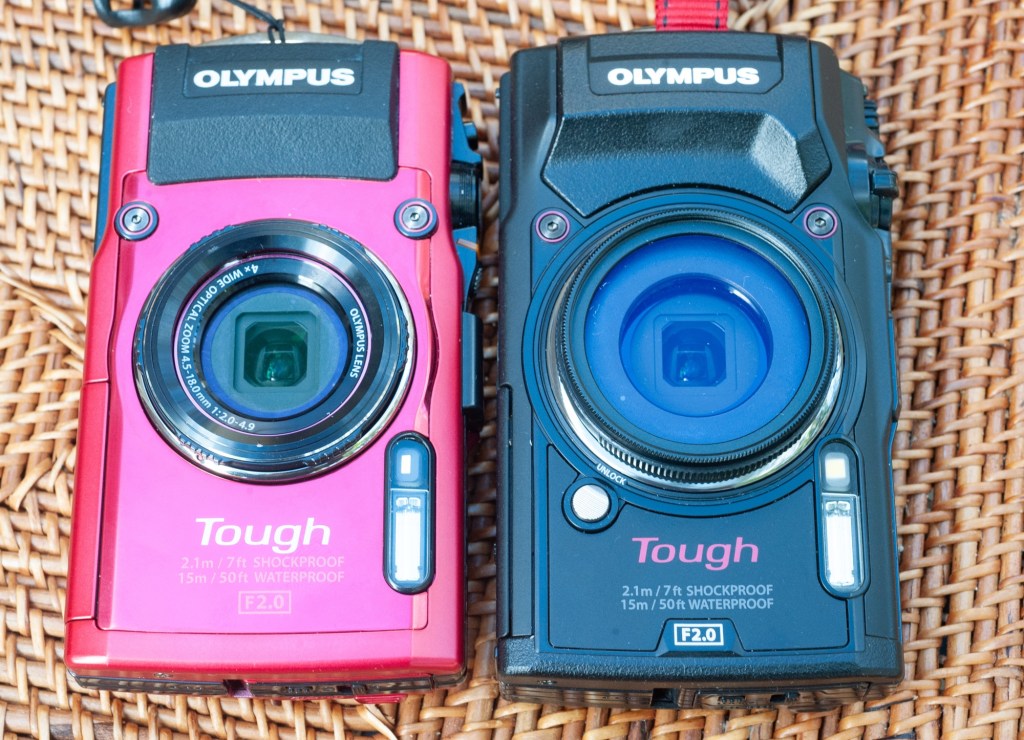
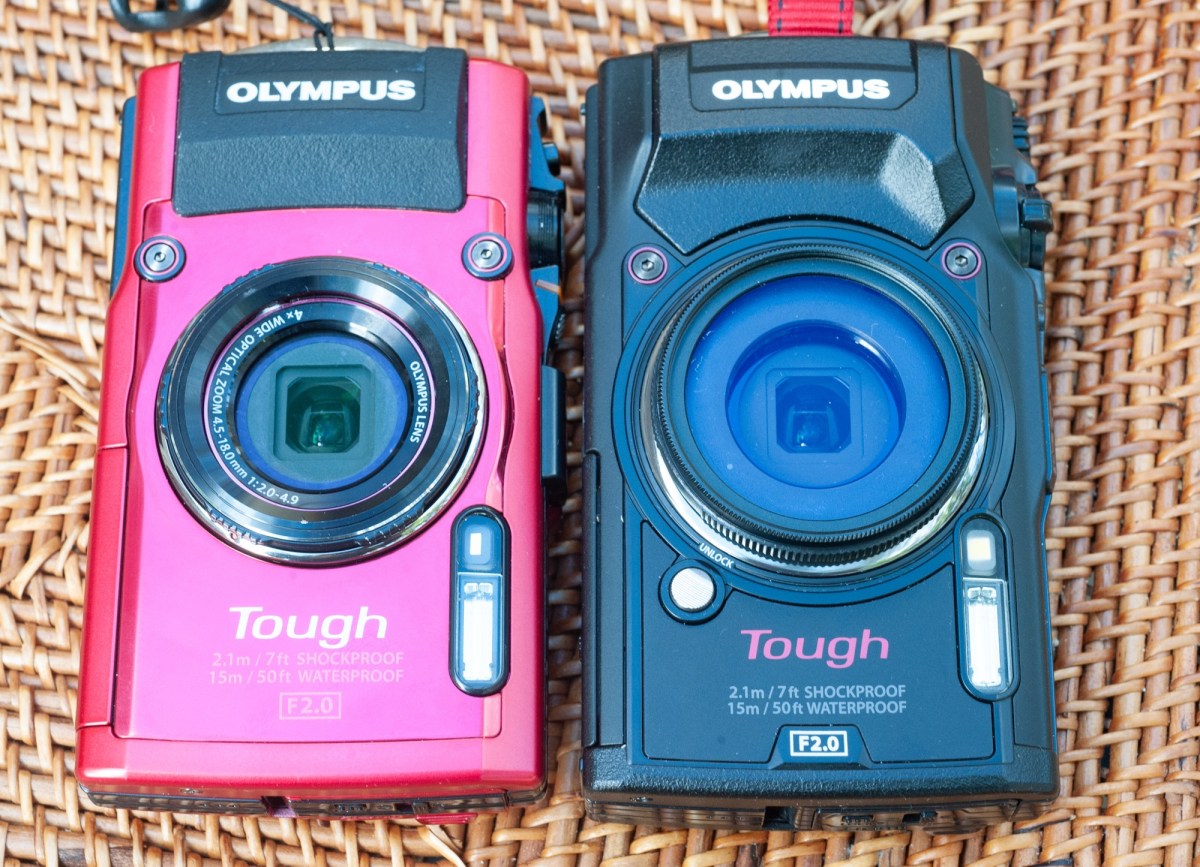
The first thing I did of course was to compare it with the Olympus Tough TG-4 I had bought a few months ago.
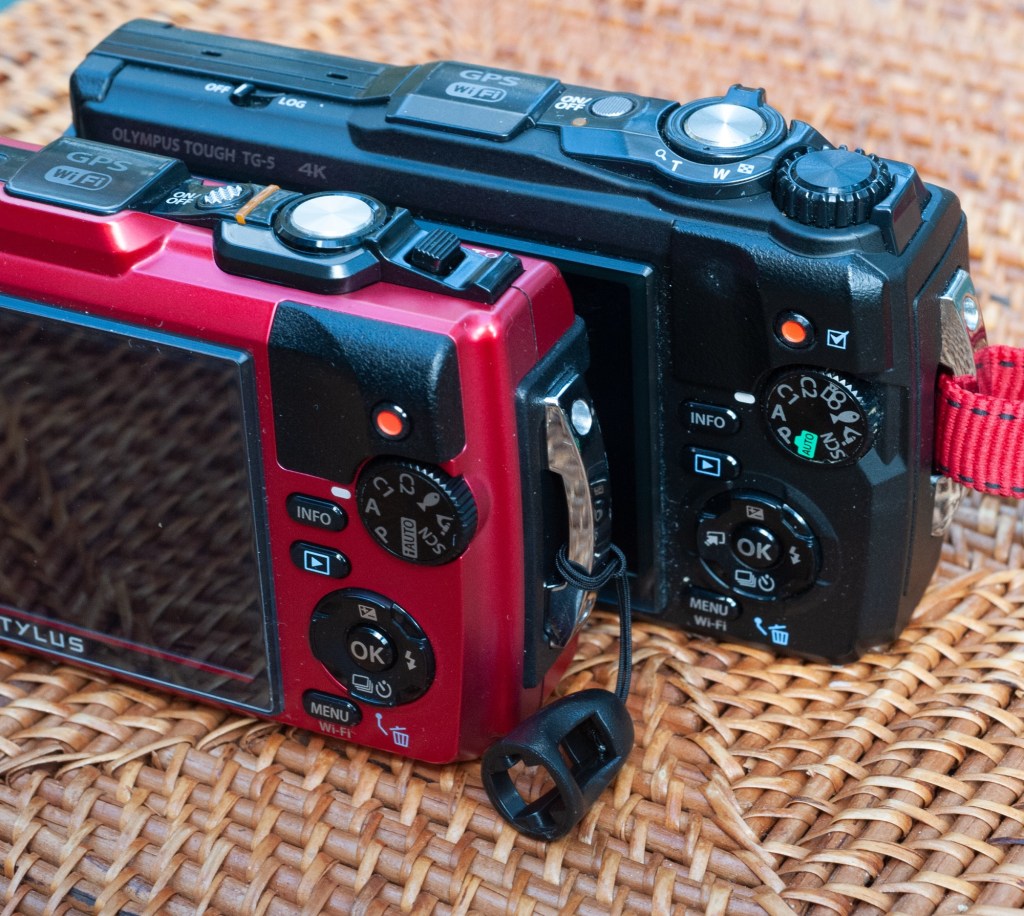
The top plate of the TG-5 (the black camera) with the extra control wheel, the improved zoom command and the GPS (Log) switch.

What are the differences?

The big difference is the sensor. All Tough TG-x models are built around a 1/2.3in sensor. In the first two models (TG-1 and TG-2), the sensor was a 12 megapixel backlit CMOS. The TG-3 benefited from an upgrade to 16 megapixels, which was carried over to the TG-4. The TG-3 and 4 were criticized for their poor control of noise in the darker areas of an image, and for the TG-5, Olympus reverted to 12 megapixel design. With a pixel pitch of 1.53μm versus 1.33μm for the TG-4 each pixel gets 15% more light. Combined with a more powerful image processing engine (a dual quad core Olympus truepic VIII as opposed to the TG-4’s truepic VII), the TG-5 should offer an improved control over noise and deliver cleaner pictures.

The new 12 megapixel sensor also brings a larger sensitivity range – up to 12,800 ISO to whomever is brave enough to test such a setting on a 1/2.3″ sensor, and the support of 4k video.

The other changes relate to the fit and finish and the ergonomics for the most part – there is now a conventional zoom lever and a new control knob on the top plate, and a switch to activate and deactivate the on-board GPS. And big news, the proprietary Olympus connector (used to charge the camera’s battery) has finally been replaced with a standard USB connector (yes!).
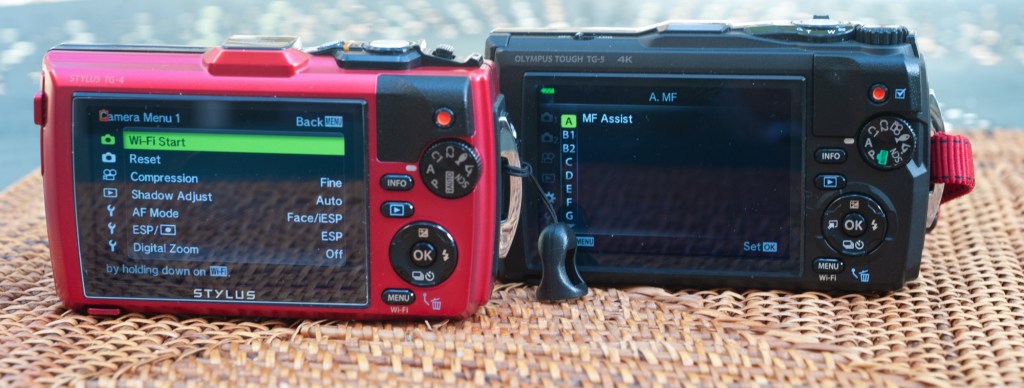
The new menus are hardly an improvement

Nothing is perfect, and the menus have been revised. Olympus has gained a bad reputation for its confusing and un-intuitive menus, and proves it’s deserved with the TG-5. On the Tough TG-s, Olympus have given a particular emphasis to what they call “live control”: some important settings are not available through the menus, but only when the photographer is ready to shoot a new picture and presses the “OK” key – a column of options is displayed as an overlay at the right of the image, with the different values that each setting can take displayed on an horizontal bar at the bottom of the picture. It’s the only way to chose the form factor of the images (4:3, 3:2 or 16:9, for instance, or the image quality (RAW, RAW+JPEG Fine, JPEG Low) and so on).

At the same time, additional settings have been added to the conventional menus of the TG-5. Some are obviously useful (like setting the standard and high limits of the Auto ISO sensitivity control, the color space or entering copyright information), but others seem to duplicate (or refine) settings already available in the “live control” mode. And they’re not always available – some options are greyed out when the camera is set to “scene” mode, for instance. To make matters worse, instead of giving meaningful names to the new options, Olympus simply designated them as A, B1, B2, C, and so on. Confusing.
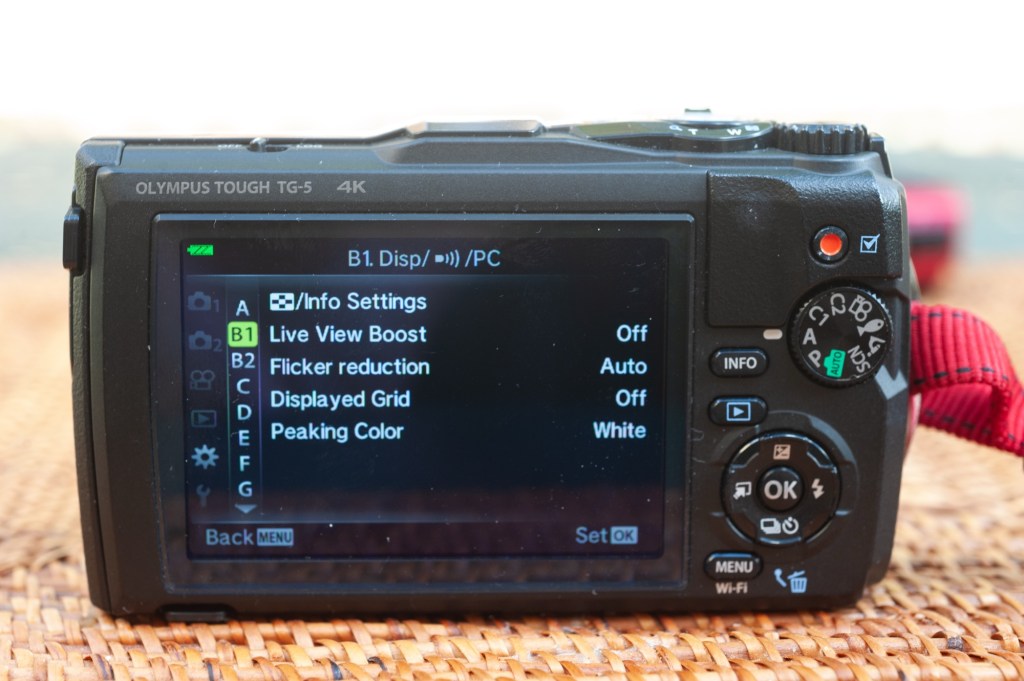
The TG-5 menus are cryptic (why B1 and B2?)

Shooting with the TG-5

Are the new sensor and the new processing engine improving the noise situation? Imaging-Resource had compared a new TG-5 with a TG-4 a few years ago ( https://www.imaging-resource.com/PRODS/olympus-tg-5/olympus-tg-5-image-quality.htm) and had mixed feelings about it.

Yes, the TG-5 delivered an improvement, but not as large as the testers had expected. The improvement was particularly obvious in the 100 to 800 ISO range, where the noise reduction algorithm was at the same time much less aggressive and more efficient – resulting in more details and less chroma noise.

In my experience, the TG-4 was producing images with very visible noise in the shadows, even by sunny weather under the tropics, and it was not easy to get rid of it. Any improvement in that area would be welcome, and would justify an upgrade to the TG-5, if it delivered the goods.

I compared the two cameras in the real life and tried to validate the conclusions of Imaging-Resource. Firstly, on both cameras, there is more noise on the Raw files than on the jpegs. Which means that the processing engine does a good job at removing it when it generates jpegs. Secondly, the TG-5’s jpegs show more detail in the shadows than the TG-4. The difference is not huge, but big enough to be visible on the Retina screen of an iPad. So, yes, the TG-5’s pictures look better. And what about the rest of the user experience?

The TG-5’s body is made of a different type of plastic and feels more substantial in the hands. Because it offers more controls (physical like the wheel on the top plate or logical with more options in the menus), the TG-5 does not seem as simple to use as the TG-4, and will require more peeks in the user manual than the TG-4, before the photographer is totally familiar with it.
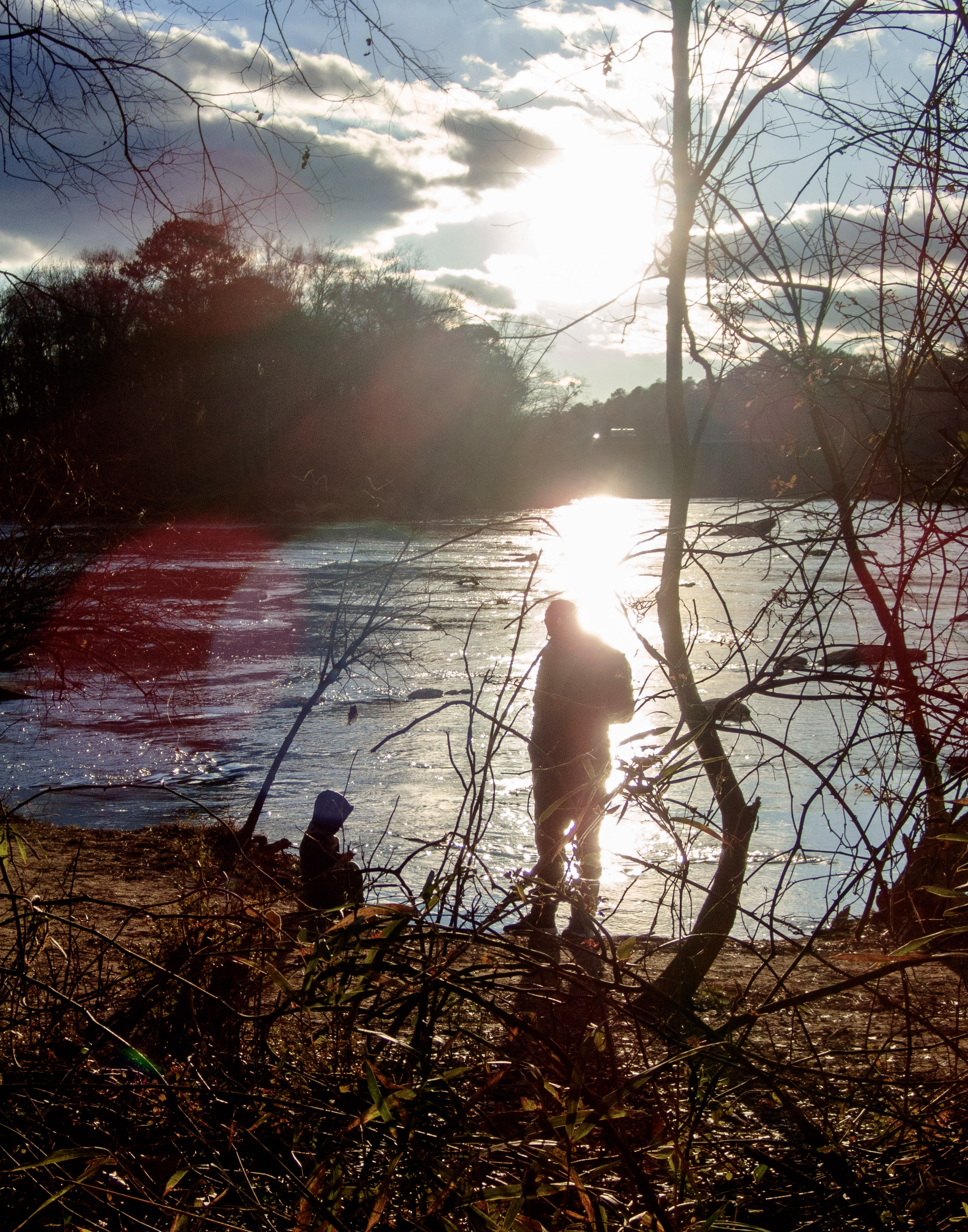
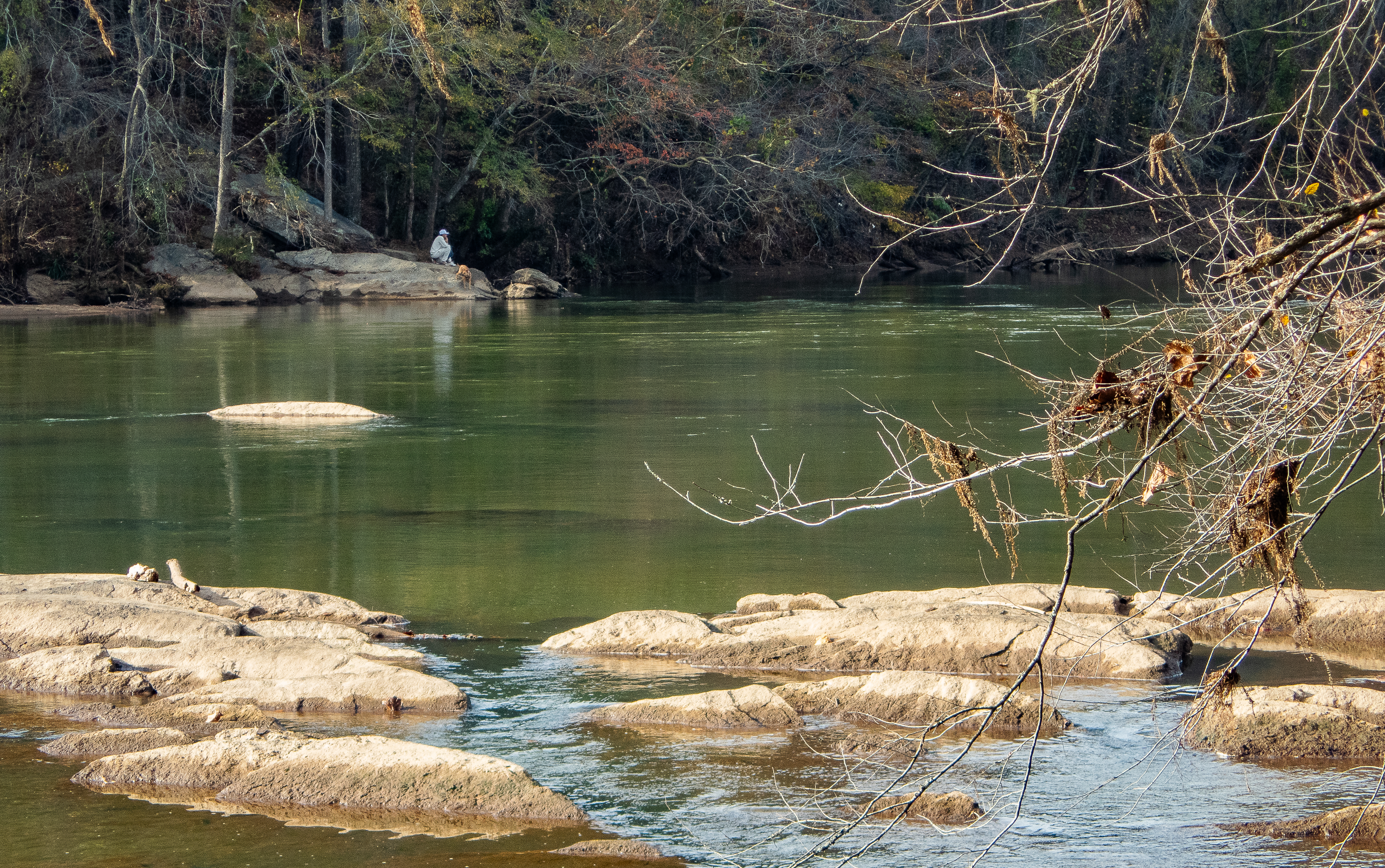
Father and son – along the Chattahoochee River, Atlanta – Olympus TG-5 – adjusted in Lightroom from Raw.

As a conclusion, I would say that the TG-5 has a higher potential than the TG-4 (more details in the shadows, greater ability to be configured to the preferences of the photographer) – but that it’s also a tad more complicated to use. Although it’s difficult to quantify, the TG-5 seems to deliver better images in more circumstances than the TGs of previous generations could. Not having to carry and use a proprietary connection cable to charge the battery of the camera (and using any standard USB cable instead) could very well be the most significant (and the most welcome) improvement.

In the grand scheme of things

As of today (early 2025), there are very few new compact cameras on the shelves of the resellers, and even fewer which are shockproof, waterproof and adventure ready. The OM System TG-7 is the most competent of those always ready cameras – but like all the previous versions of the Tough TG, it will be limited by its 1/2.3″ sensor.

Premium compact cameras, like the Sony RX100 or the Canon G7X, have a much larger sensor. The same can be said of the iPhone (the sensor behind the 16 Pro Max’s main camera is almost as large as the RX100’s at 1/1.14in). Without even considering the “computational photography” trickery of the iPhone, all are obviously going to yield much better results than the TGs in low light and in the shadows. But the Sony and the Canon are not weather resistant, and their long telescopic zoom makes them more delicate than a Tough TG (you won’t bring them to the beach or on a dusty trail ride), while the iPhone (and similar high end smart phones) are fully automated wizards that can’t compete with a dedicated camera when it comes to ergonomics and flexibility of the settings.
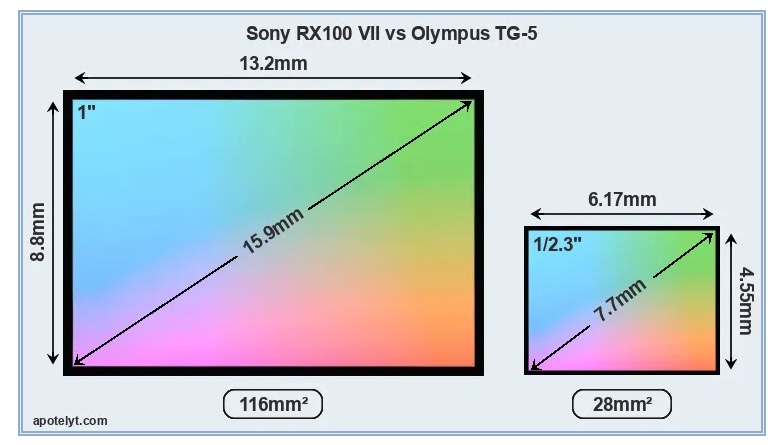
Comparison of the 1″ sensor of the Sony RX100 (or the Canon G7X) with the 1/2.3″ sensor the TG-5 (courtesy: apotelyt.com).

The TG-7 is a very limited upgrade of the TG-6, itself a rather limited upgrade of the TG-5. The improvement in image quality and ergonomics between the three most recent TGs and the previous generations is not huge, but any improvement in the 100 to 800 ISO range is good to take, and if you can find a TG-5 at a reasonable price, my recommendation would be to take it over a TG-4. If only for its universal USB connector.


Olympus TG-5
Olympus TG-5
Olympus TG-5.
Olympus TG-5 – Chattahoochee National Forest – images above are jpegs straight out of the camera – the noise seems much better controlled than with the TG-4.

the Olympus Tough TG series – when you don’t want to risk ruining a $1000 smartphone

Nice smartphones are expensive and they control so much of our lives – the access to our bank accounts, our virtual credit cards, our boarding passes, our text messages, our emails, our Facebook, Instagram or TikTok posts, our watch, sometimes, that we can’t afford to break or lose them.

Olympus TG-4 – the commands are simple – it’s a compact, not a “pro” camera


And for those situations when we don’t want to put our precious phones in danger, a few camera companies still offer ruggedized, waterproof, shock resistant compact point and shoot digital cameras. Kodak, Fujifilm, Panasonic all have one risk-all camera in their catalog, but the Tough TG series of Olympus (now doing business as OM System) is the undisputed favorite of the specialized journalists and bloggers, who can’t stop singing its praise.

Olympus TG-4 – images can be saved simultaneously as RAW and JPEGs.


Originally launched in 2012 as the Tough TG-1, the camera has been regularly upgraded along the years. The TG-2 introduced a better water resistance, the TG-3 a 16 megapixel sensor and WiFi connectivity, and the TG-4 the ability to save RAW images. The TG-5 adopted a new 12 megapixel sensor (and a more elaborate image processing engine) for better results in low light, and finally abandoned Olympus’ proprietary connector for a standard USB plug. The TG-C adopted an USB-C connector. And to a large extent, the current TG-7 is just a TG-6 where the glorious Olympus name has been replaced with « OM System ».
(a few weeks after this blog entry was published, I found a very nice (and cheap) TG-5 – click here to read the TG-4 / TG-5 comparison).

The Tough TG-4 equipped with a few accessories (wide angle lens adapter, lens cap from JJC, attachment for floating strap OM System


All Tough TGs share the same look, and a very luminous f/2 to f/4.9, 25 to 100mm (equivalent) zoom, which reduces the need for high ISO in low lights, and help contain the noise of the sensor. It’s a very small 1/2.3 inch sensor by the way, smaller than the sensor of the main camera of an iPhone Pro, and the biggest performance limiting factor of the camera.
Down a cliff – ready for the next adventure

The Tough TG is well built, with a particular care given to protection against water ingress. In addition to the modes and scenes you would expect on a compact digital camera, it is equipped with functions befitting its calling as a camera for adventurers : GPS, compass and manometer.
A learners camera for snorkeling. Scuba divers will need a waterproof housing and strobe lights.
It has no viewfinder, but the fixed LCD display is well defined and luminous enough to allow the photographer to get a feel for what’s in the frame in bright sun light.

What is it for?

As a waterproof / shockproof camera, it fits the bill. It will shine in all adventures, all water sports, from family beach outing to canyoning, rafting, sailing or snorkeling. On its own, it’s too limited for scuba diving (it can’t go deeper than 15m), but OM System can sell you a waterproof housing and a strobe light if you want to go deeper.


Is it also a good everyday camera? Definitely, if there’s enough light. It’s very reactive, it nails the exposure and the white balance almost all the time, and the jpegs are very nice, natural with just enough clarity, vibrance and sharpness to make them pleasant to look at. They don’t look over processed and artificial like the images shot with a smartphone, or mushy because of overly aggressive noise cancellation. In the shade, image quality suffers from visible digital noise and working on RAW files does not seem to improve the situation much. And in poorly lit interiors, you have to use the integrated flash, and the less said about it, the better. A smartphone will deliver much nicer pictures in the same situation, without the need for a flash.

On the beach – it will resist a drop in the sand or a long swim in the ocean


Is it a substitute to high end compact cameras like Sony Rx100? No – except in really bad weather or aggressive environments. Its sensor is too small, and it lacks some of the the controls an enthusiast photographer expects (you can’t select the shutter speed, for instance) – but I would pick a Tough TG over any small sensor compact digital camera, be it a Canon, a Panasonic or a Sony: it’s a very coherent package, solidly built, which will deliver the best images you can get in really difficult environments, and good enough pictures the rest of the time.

The camera I reviewed is a TG-4. The conclusions would be similar for the TG-3, which is almost identical. The TG-5, 6 and 7 benefit from a 12 megapixel sensor and a more recent image processing engine and are said to deliver better images in low light scenes. There is not much difference between the three more recent models. All three are significantly more expensive than a TG-4, and I was not sure a TG-5 or a TG-6 was worth the extra cost. With the benefit of the experience, I’m happy with the TG-4, which does what I expected it to do and I don’t feel the need for more.

Because it’s been on the market for so long, the price you have to pay for a nice TG will vary widely. On market places like eBay, you will find a Tough TG-1 for little more than $100.00, and a TG-3 or 4 will sell typically for less than $200.00. TG-5 and TG-6 are second hand purchases whose price is ultimately defined in relation to the cost of a new TG-7, which is currently listed at $550 by OM-System.

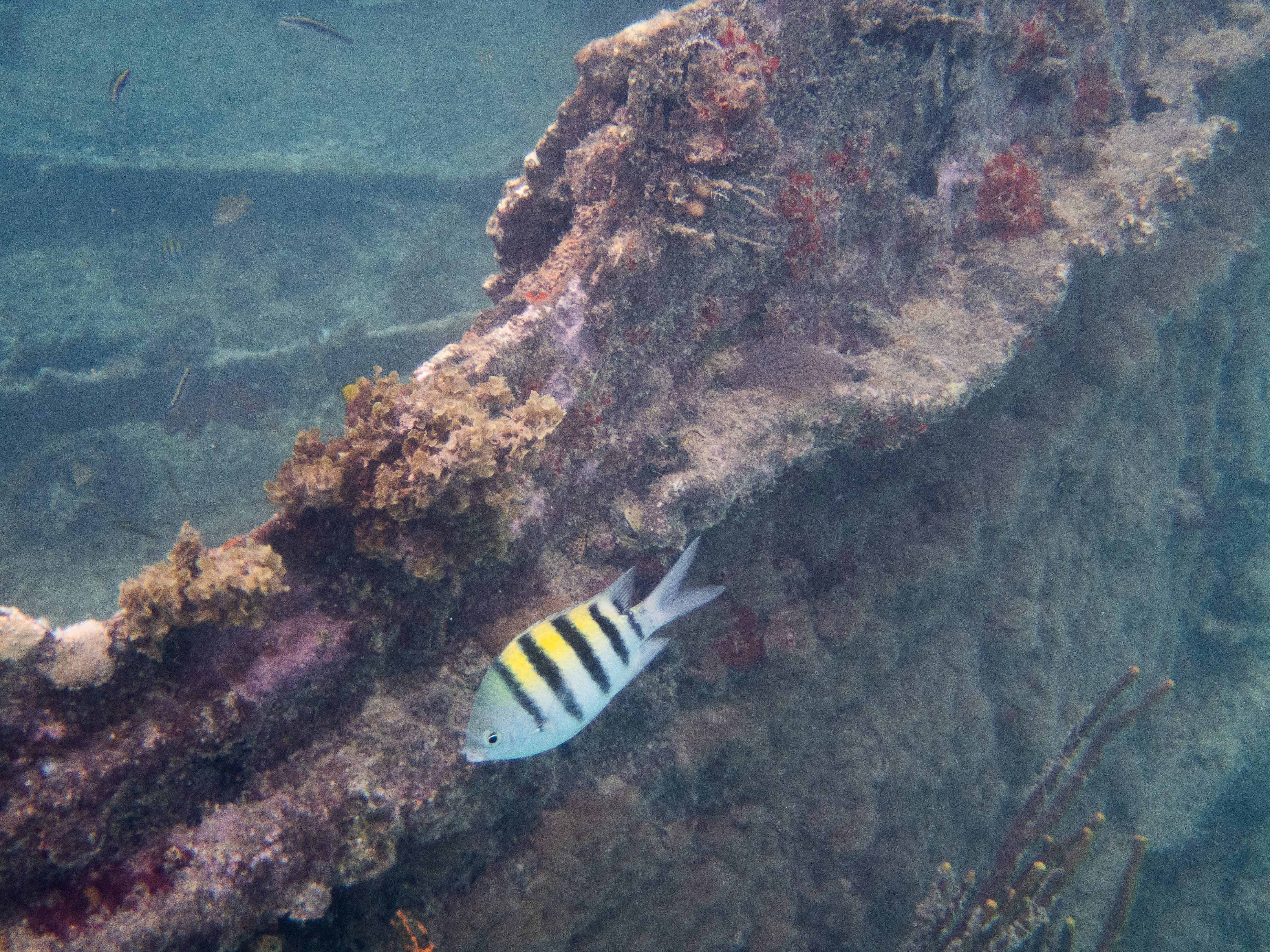
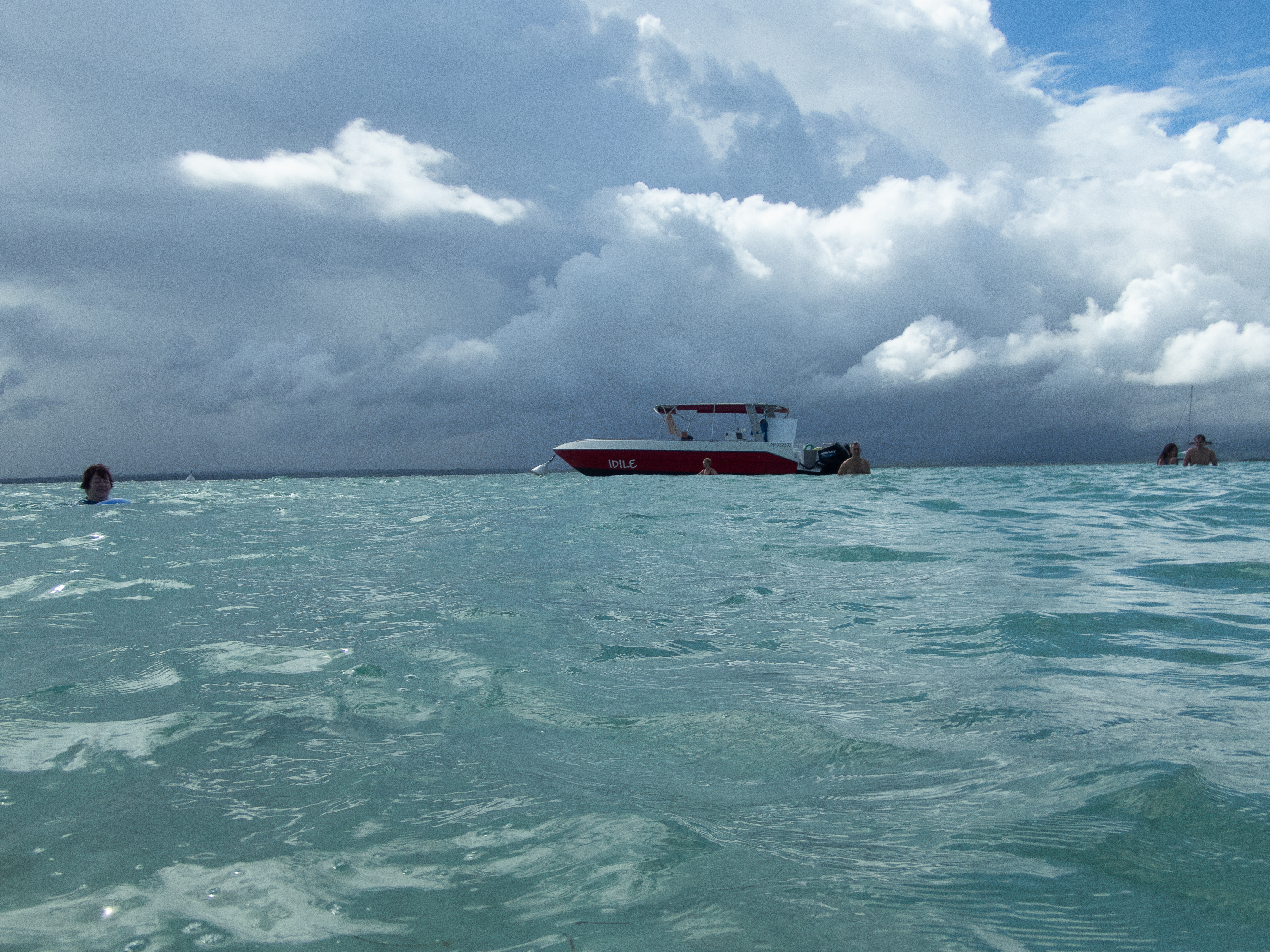
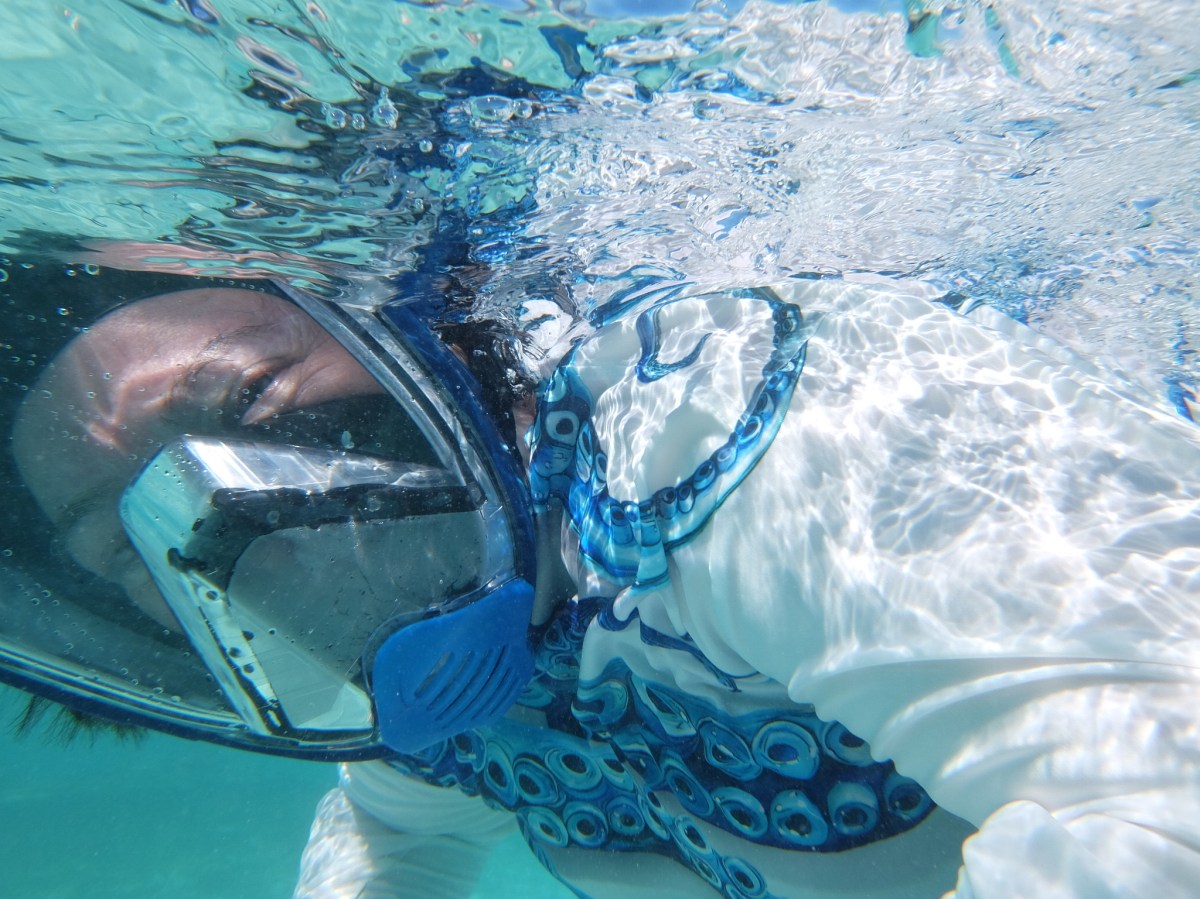
All pictures taken in the island of La Guadeloupe, in the Caribbean. The water is incredibly clean and transparent.

The compact digital camera – in demand but not available

Compact cameras – digital cameras with fixed lenses that could fit in pocket – are in high demand, but unavailable. Fujifilm can’t meet the demand for its most recent X100, Canon’s G7x is always out of stock, the Panasonic LX 100 Model II is no longer available.

Fujifilm XQ2 (left) and Z1000EXR – the 12 Mpix XQ2 produces much better images than the 16Mpix Z1000.

Cameras manufacturers have retreated almost completely from the compact digital camera market (the “point and shoot” of yore), and very few are still offering “premium” or “niche” compact cameras. The smartphone is king, the historical camera makers seem to believe they can’t compete with the thousands of software engineers working for Apple and Google, and are leaving them all the space.

But as good as they are, the smartphones are still limited by their ergonomics (you need two hands, one to hold the phone, one to tap, pinch, swipe or whatever), their absence of long telephoto lens and viewfinder, and their relative frailness. They offer very little in terms of direct controls – they’re extremely capable, but you have to trust them. At the top of that, they’re expensive. And we depend so much on them that we don’t want to risk them on the beach or while rock climbing.

Nelson’s Dockyard – Antigua – shot with a Fujifilm QX2

There is still room for small but good quality cameras, with good ergonomics an a complete set of controls.

The camera companies are primarily focused on the full frame, interchangeable lens camera market, but full frame ILCs are not really pocketable. Their little brothers with APS-C sensors are smaller, but not by much. Even the Fujifilm X100 is still too large to fit in a coat pocket.

So, what’s left? In the cheap point and shoot camera segment, only a few cameras proudly wearing famous brand names such as Kodak or Minolta. I’ve read relatively good reviews of the Kodak Pixpro cameras, but they’re very basic and you can’t expect too much from their tiny sensor.

Olympus (now OM-System) is still leading the fray when it comes to rugged, waterproof cameras – the Tough TG, currently in its 7th iteration – has discouraged all competition.

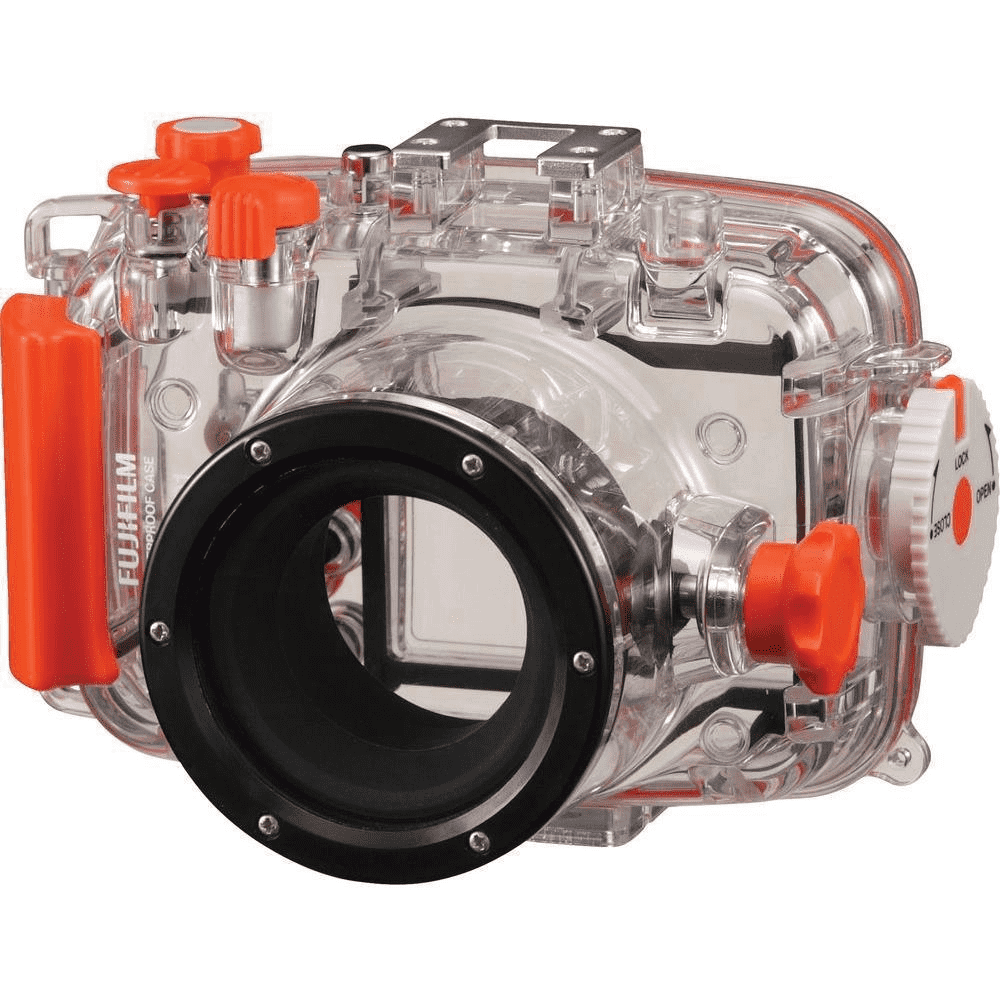
Fujifilm XQ2 with the WP-XQ1 waterproof case.

It leaves us with the premium category – with the cameras from Canon, Panasonic and Leica largely unobtainable, and Sony’s RX100 series in a state of virtual monopoly.

Older versions of the cameras listed above can be found on the second hand market, but you have to understand what you’re losing by going for a five or ten year old camera:

  • Video capabilities – most of the progress in recent years has been in that area, 
  • Easier Bluetooth and WiFi connectivity, with a better integration with smartphone apps,
  • Reactivity (autofocus), 
  • Quality of the JPEGs (“out of the box”) thanks to better processing engines – you won’t need to process RAW files as frequently
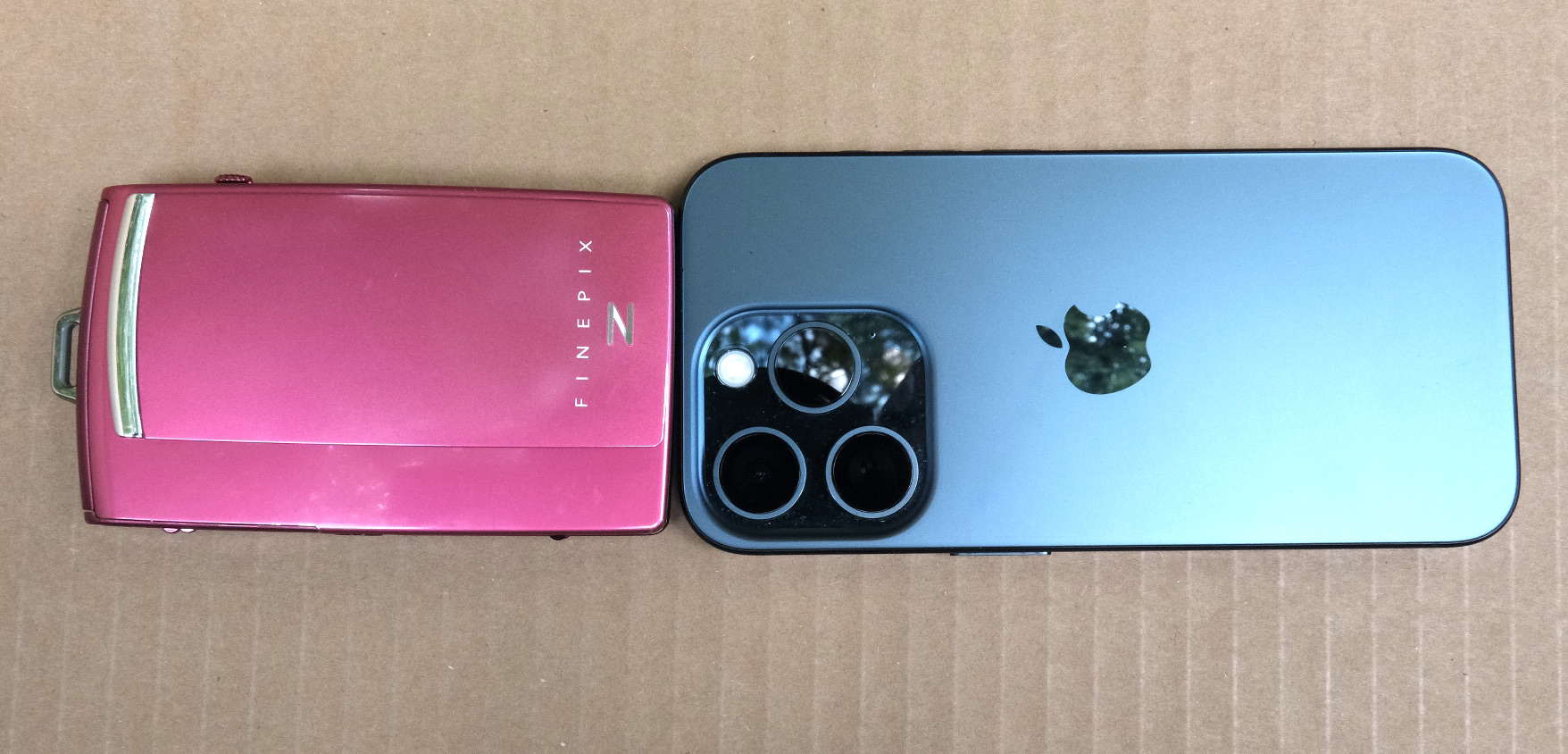
Fujifilm z1000 (left) and iPhone 15 Pro (right). Today a standard sized iPhone can be bigger than a dedicated camera.

More conventional P&S such as the Canon Powershoot S90 or S120; the Sony HX and WX series, Nikon’s Coolpix 9000 series are somehow cheaper, but they’re also more limited: the last models were launched in pre-COVID days, and they have tiny sensors and relatively slow zooms – which makes the use of a flash a necessity in low light.

You could also look for a compact film camera. At the top of the heap the Contax T series reigns supreme (but these cameras are now extremely expensive), followed by a group of still expensive models from Nikon (35ti, 28ti), Leica (Minilux), Ricoh (the GR1), Konica (the Big Mini) and others from Minolta or Olympus. 

But those cameras are now twenty five year old at best – and some of their components didn’t age well (electronics in general and LCDs in particular). Most of those models have at least one big flaw that makes buying them at today’s prices a risky proposition (and even if it works today, will the camera work tomorrow?). The cost of film is also an issue (we’re currently trending towards a total cost of $1.00 per scanned image).

Olympus Tough TG-4 – generations differ by their sensors and processing engines, but the fundamentals of the camera have not changed since the TG-1.

What am I shooting with when I don’t use my smartphone, and can’t bring a mirrorless camera? I have a bit of everything in my bag. I tested (but did not keep) a Nikon J1 and I kept but don’t use a tiny Fujifilm z1000EXR – they’re cute but the quality of the images they were delivering was sub-par. I still use a very compact Fujifilm XQ2 – a sort of semi-premium homage to Sony’s RX100, and an Olympus Tough TG-4. They’re pocketable, produce images which are not as nice as what a recent iPhone can deliver but look more natural, and are a pleasure to use.  I found an original Fujifilm waterproof case for the XQ2, and even with the case, it remains reasonably compact, if not pocketable. As for the Olympus, I’m waiting impatiently for my next trip to the beach to test it in its element – but it has already earned his stripes as a carry-along camera for my hikes in the nearby parks.

Chattahoochee National Recreation Area – Olympus TG-4
Chattahoochee National Recreation Area – the bamboo forest – Olympus TG-4

And now for something completely different: the Fujifilm XQ2

My everyday camera is an iPhone 11 – it’s a smartphone, of course, but it’s also a great camera – really – I like the ultra-wide angle lens (13mm equivalent) and its incredible capacity at making nice portraits or group photos in relatively poor lit scenes. But the iPhone 11 still has a few inherent limitations – its longest focal length is equivalent to a 26mm lens in a 35mm film camera (on the wide side even for a wide-angle, then), and the sensor is so small that even with the best digital signal processing, the best picture enhancement algorithms and a dose of “semantic image analysis”, it’s still not that great when there is really not much light.

Fujiflm XQ2-6632
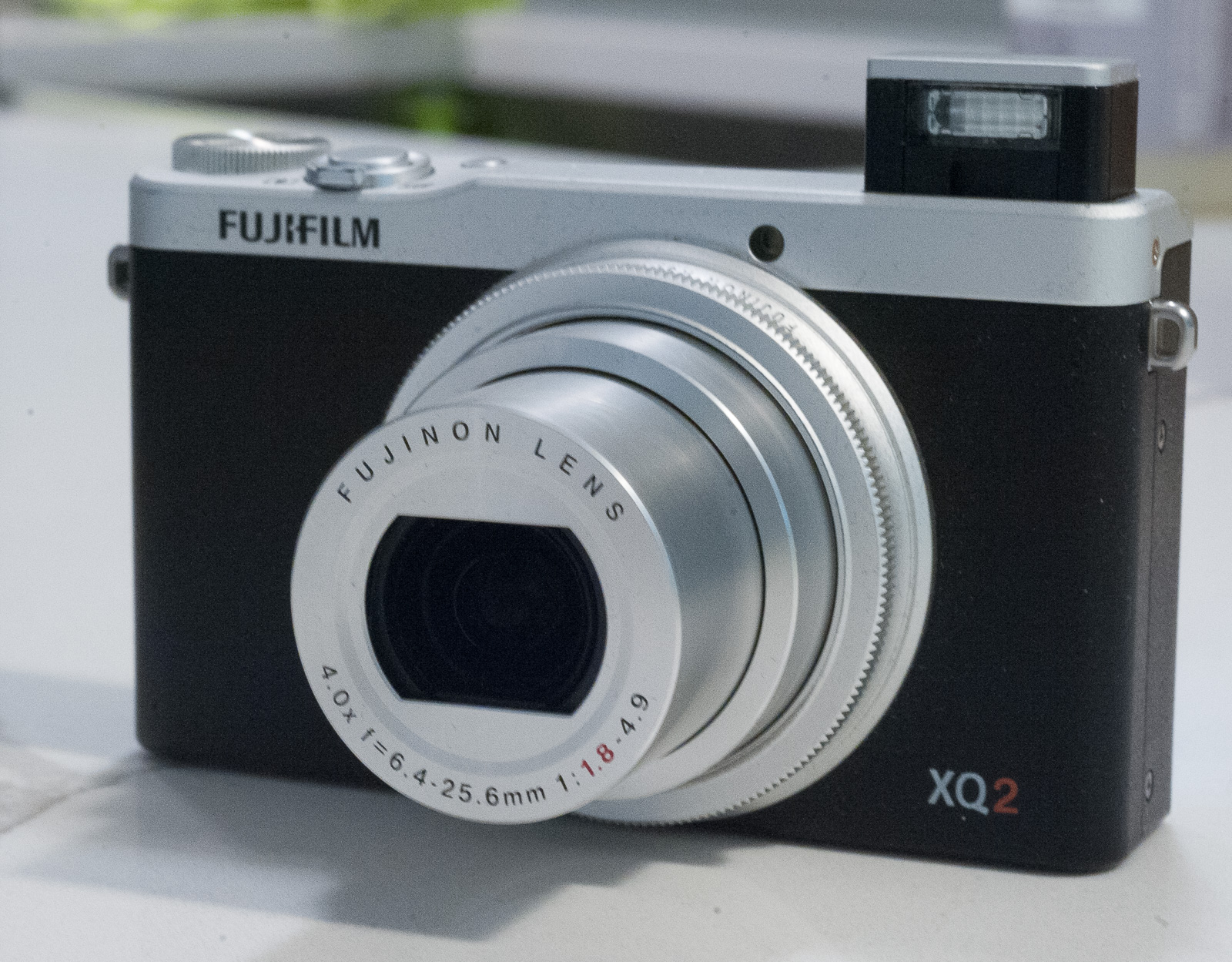
Fujifilm XQ2 with lens and flash extended. The lens covers the same range as a 25-100 zoom on a full frame (135) camera

Enter my latest acquisition, the Fujifilm XQ2, an ultra-compact point and shoot camera launched in 2015. It’s an old camera by digicam standards,  and with a sensor area of 0.58cm2, the XQ2 it’s a sort of tweener. Its sensor is twice the size of the 1/2.3in chip you could find in an entry level digicam, but half the size of the 1 Inch sensor of the current gold standard of ultra-compact digital cameras, the Sony RX100. Using a smaller sensor made the XQ2 smaller (marginally) and cheaper (massively) than the RX100, but took its toll on image quality in poorly lit scenes.

Relative Size of Image Sensors
Relative Size of Image Sensors (courtesy Simon Crisp in new atlas.com) – the Fujifilm XQ2 has a 2/3in sensor – as opposed to the 1/2.5″ sensor of an iPhone

The size of the sensors of small digital cameras is often expressed in Inches. An iPhone 11 has a 1/2.5in sensor, a Sony RX100 has a 1in sensor, and the Fujifilm XQ2 sits in between with a 2/3in sensor.

  • The “Inches” do not represent the actual size of the sensor – the figure is derived from the length of a video tube that would capture an image of a similar size in an old TV camera: for instance, a 1in video tube captures an image with a diagonal of 16mm, so a silicon chip with a 16mm diagonal will be advertised as a 1inch sensor, even if it’s much smaller than one inch in any of its dimensions (*).
Fujiflm XQ2-6631
I leave the camera in full automatic mode most of the time (that’s the SR+ position on the mode selector).
  • Obviously, there is more to image quality than the sole sensor size – but all things being equal, any time the area of the sensor doubles, its ability to deliver noise free images at high ISOs improves by the same factor: if a 1in sensor (area of 1.16cm2) delivers noise free images up to 800 ISO, a 4/3rd sensor (area of 2.25cm2) will deliver noise free images up to 1600 ISO.
Fujiflm XQ2-6630
The Fujifilm conventional commands.
  • In the grand scheme of things, we’re still in the realm of very small sensors: a so called full frame camera (Sony A7, Canon RF, Nikon D850 or Z6, ..) has a sensor which has 30 times the area of the sensor of an iPhone, and 12 times the area of a 1in sensor.
0F421249-0EDD-40C7-BD8E-4781A176A0D0
Atlanta – Chattahoochee – iPhone 11. Focal length equivalent : 14mm

DB4A7004-D70A-4DA1-A4D7-6455A70B8216
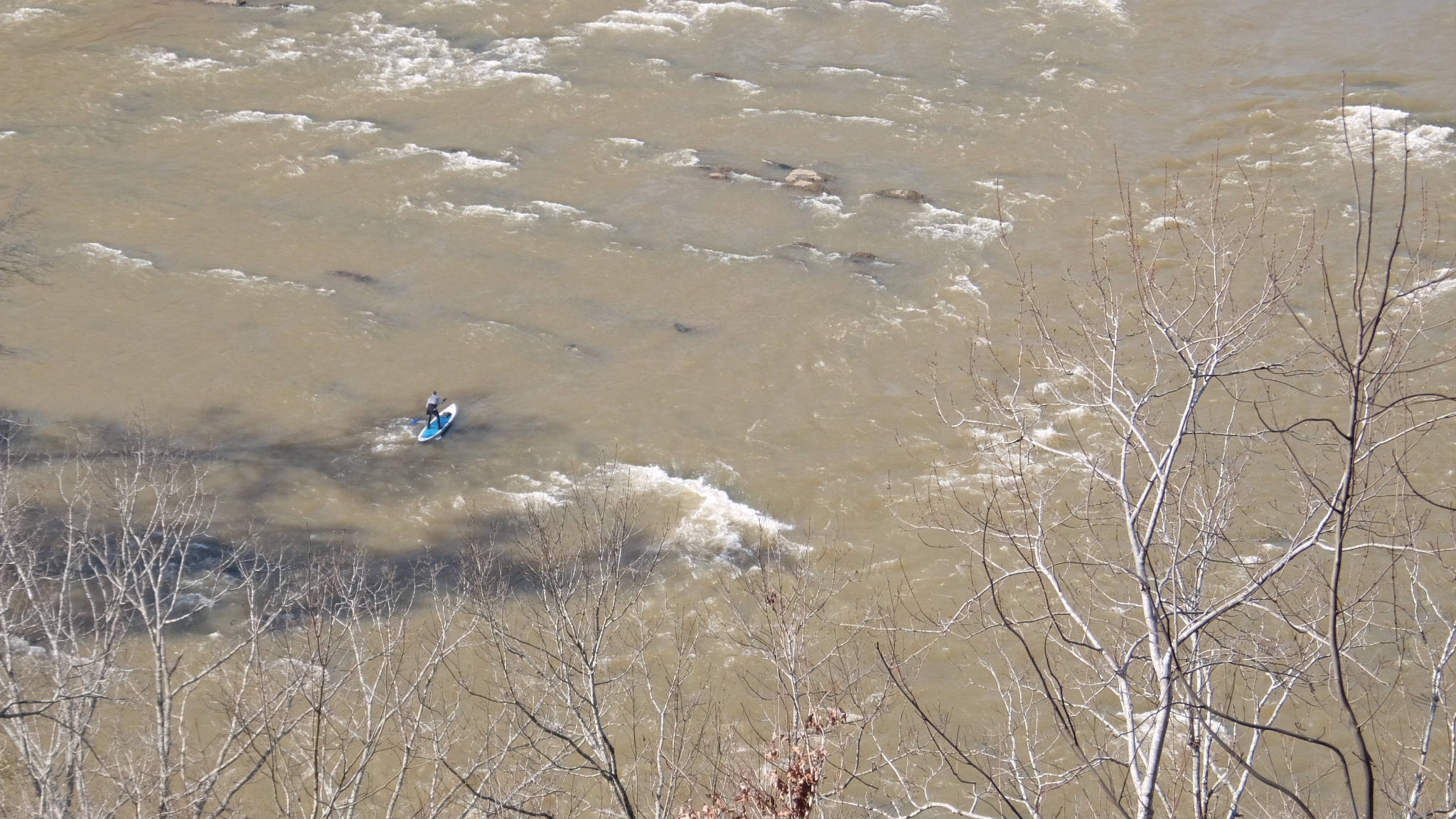
Atlanta – paddleboard on the Chattahochee – Fujifilm XQ2 F/4.9. Focal length 25mm (100mm équivalent) – the two images were taken from the same vantage point, a few minutes apart.

9DF12F88-EAA5-4301-825A-66C277DA8206
Horses at the Vinings Polo field, Atlanta – GA – Apple iPhone 11 – f/1.7 – Digital zoom x 3.5 (equivalent to 91mm)

8B213BF4-1F4C-4E90-AB78-2284E22F03D6
Horses at Vinings. Fujifilm XQ2 – f/5.6 – 21mm (equivalent to 85mm) – the two images were taken from the same vantage point, a few minutes apart.

In the real life

I’ve already sang the praise of the iPhone’s camera – it’s truly impressive – in particular when the images are viewed on a smartphone screen. The larger the screen (or the monitor), the less convincing the images, as the effects of the digital zoom (and of aggressive noise reduction) become more visible.  The images are pleasant, but very saturated and borderline loud. [images of the horses above]

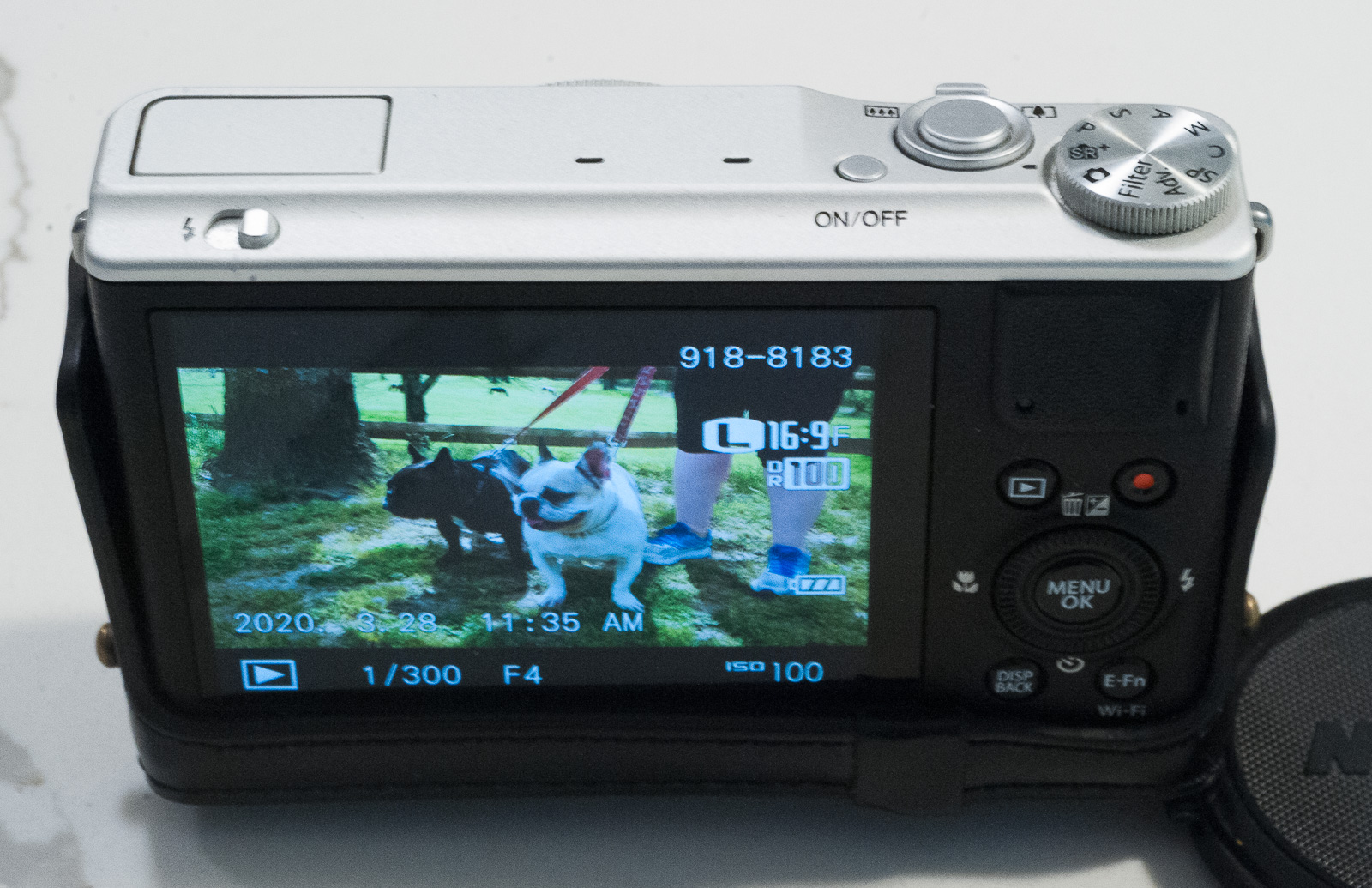
The XQ2 (under the standard film simulation mode) delivers more subdued images, closer to the output of a conventional camera. In my experience, the XQ2 manages scenes requiring a high dynamic range better than the iPhone, even if it’s not as good as a camera with an APS-C sensor like the Fujifilm X100T. [pictures of the French Bouledogue taking the sun].

The big difference of course is the focal range of the lens(es). With its ultra-wide angle lens (13mm equivalent on a full frame camera), the iPhone lets you create dramatic landscapes. But its longest focal length is a short 26mm (equivalent), and most of the pictures involve a modicum of digital zoom. Which is costly in terms of image quality.

The XQ2, on the other hand, can zoom optically up to 100mm, which is very useful when you want to isolate a detail, or a human being in a wide landscape, without needing to crop the image.

D1BD6313-1A73-415A-A13A-93E5F8829CA3
Max sleeping. Fujifilm XQ2 – shot at f/4.5 – 15mm focal length (equivalent to 70mm full frame)


D76DF4E5-9FED-4F4D-A392-8667B2238915
Max. iPhone 11. F/1.7 Digital Zoom x 2.8


2020-03-Fuji_tests-8147
Max – Fujifilm X100T – for comparison – the APS-C sensor of the X100T has a much better dynamic than the tiny sensor of the XQ2 (or the iPhone’s)

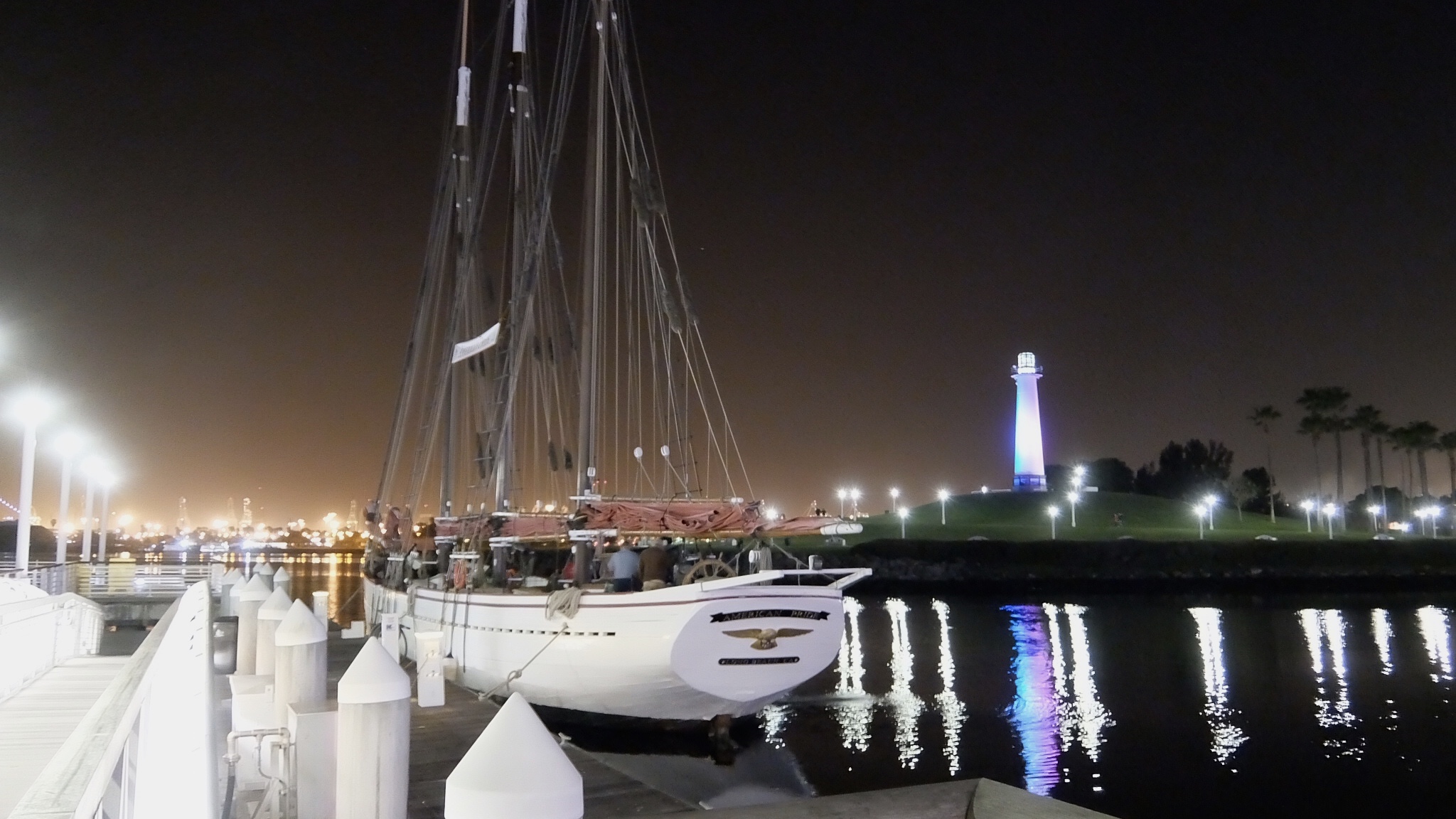
The iPhone particularly shines at night – the images it creates are more dramatic than the images of the XQ2 – even if on a large monitor, they show more noise artifacts. In comparison, the XQ2 uses a more aggressive noise reduction algorithm, and the images lack details and have a distinct artificial look

0E67F7DD-D10B-4D5E-8442-4B051F5D4E96
Long Beach. iPhone 11. F/1.7 40mm équivalent.


608E739B-611B-436F-860E-3802ECC19F58
Long Beach. Fujifilm XQ2. F/3.5. 1/8 sec. 3200 iso. 8.7mm focal (equiv to 27mm)


002047E4-443F-4F32-838F-5E31CE738F42
Long Beach. Fujifilm XQ2. F/2.6 1/10 sec 3200 ISO Focal Length 7mm

As a conclusion

Honestly, at the beginning, I was a bit disappointed with the output of the Fujifilm XQ2. The images shot on an iPhone are more dramatic, more spectacular, almost brash. The ultra-wide angle lens has no real equivalent in the world of dedicated amateur cameras, and the iPhone’s night landscapes are spectacular. The iPhone’s camera is incredibly easy and intuitive to use, you just have to pinch and point to adjust the framing and the exposure.

Because it’s a conventional camera, the XQ2 is not as easy to use (no touch screen) and its default output is less pleasing, but more in line with the expectations of seasoned photographers, looking less artificial. The camera can be operated with one hand – the iPhone can’t – and proposes more control options.

Practically, the big difference is the reach of the XQ2’s zoom – 100mm vs 26mm (equivalent) on the iPhone. In both cases you can use a digital zoom to bring you closer to the subject, but the quality suffers rapidly . To get to the field of view of  a short tele-photo lens (100mm), the iPhone will have to rely on a 4 x digital zoom and will in fact crop a very small section of the image at the center of the sensor, while the  XQ2 will still use the full 12 Million pixels of its sensor. And if you don’t mind the loss of quality, a 2.5 crop factor will allow the XQ2 to emulate a 250mm lens.

Lastly, and paradoxically for a photographer like me who had been taught that cameras were precious objets to be treated with the utmost care, I would not be afraid to risk the XQ2 in situations where I would not dare expose my phone. On the second hand market, the XQ2 is far less expensive than a new iPhone 11 (by a factor of 5, maybe). It’s also less important for my professional and personal lives than my iPhone – I would be sad to lose it but it would not have the same consequences as losing or destroying my phone.

ABF118C1-0E28-46EA-9938-D831E23083BC
Long Beach. The marina. Apple iPhone 11. F/1.7. 1/4 sec. 640 ISO – Digital zoom x 2.2. (56mm equiv)


39498BF3-3D2C-4455-93C2-11740B7AD440
Long Beach – Fujifilm XQ2 – f/4.5. 1/8sec 3200 ISO. Focal length: 19mm (equivalent to 76mm)


Fujiflm XQ2-6629
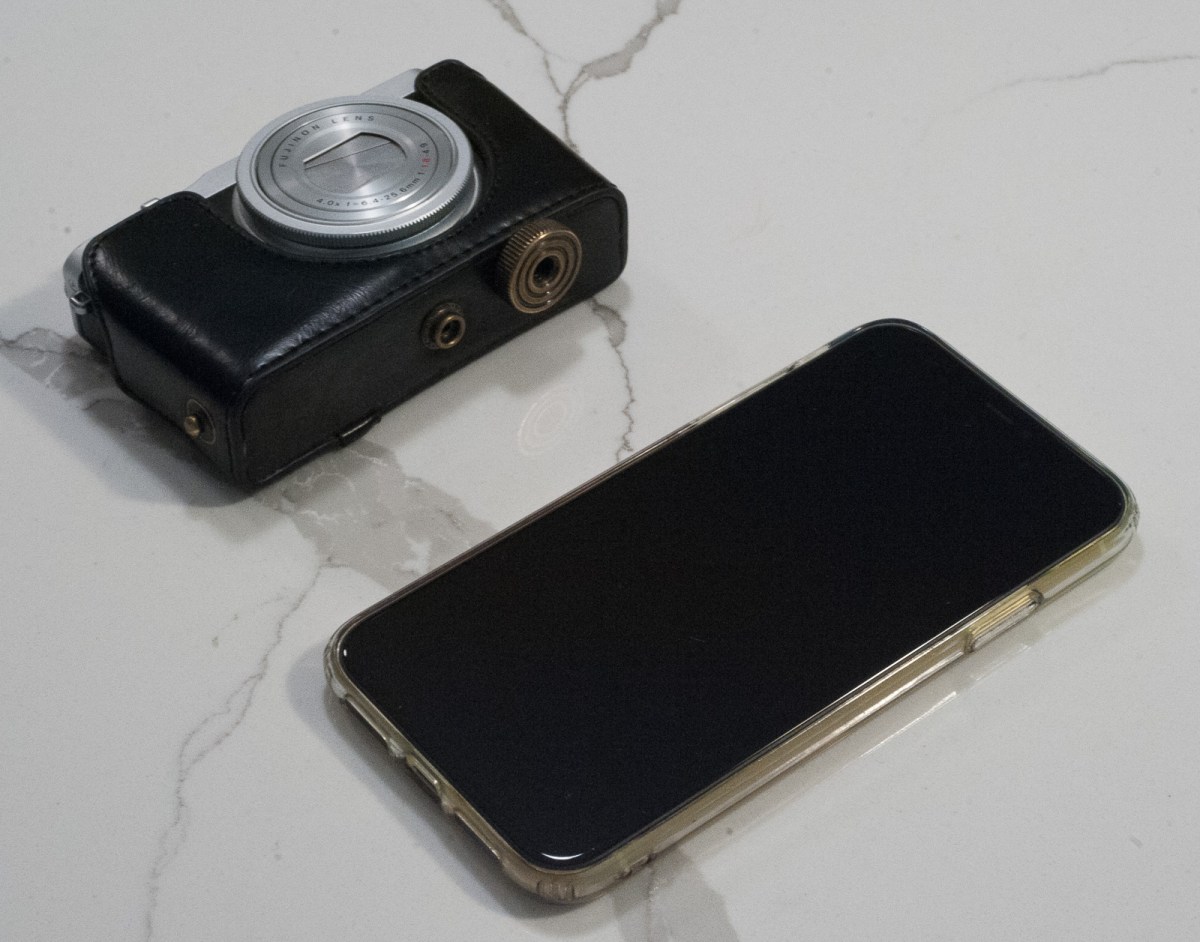
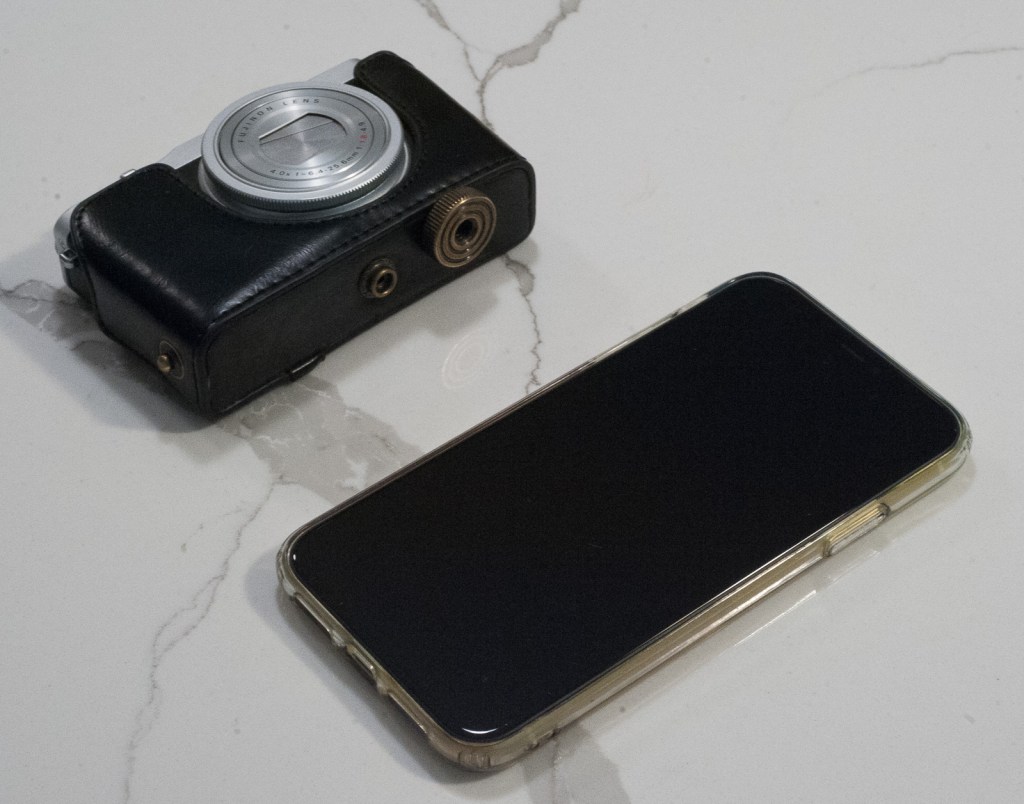
It’s a tiny camera – it’s thicker than an iPhone but smaller in the other dimensions. The case is not an original Fujifilm accessory, and it’s not in leather, but it’s convenient.

Will I keep this camera? Yes. Will I use it? Yes.

Because it’s very light and ultra-compact, it’s not a big burden to carry it around.

Of course the iPhone is more convenient – it’s smaller, you always have it with you and it’s the go-to device when you only have 2 seconds to locate a camera and shoot.

But the XQ2 is a real camera, far better than the iPhone at capturing and isolating remote subjects. Because it’s dedicated to the task of taking pictures, its ergonomics make it easier to hold and to set up than a smartphone, and its output is more similar to what a real camera (film or digital) would deliver.

Last by not least, the availability of an OEM underwater housing, specifically designed for the XQ series, and good for a depth of up to 40m (130 ft), is the cherry on the cake. I don’t know if I will ever dive with it, but it came with the camera and could always be used to protect it  from the rain or mud projections on the surface of the earth.


(*) For the anecdote, this nonsense of expressing the size of a sensor in relation to the length of a video tube from the 1950s is not unique to the photo industry – we’re still using Horse Power (HP) as a unit of power for the engines of our cars because in 1782 James Watt (the inventor of the high pressure steam engine)  had found it convenient to express the capabilities of his machines as an equivalent to a source of  power that everybody had experience with: the horse.


More about sensors: a good overview (written in 2013 but still pertinent):

Camera sensor size guide by Simon Crisp


A few words added in June 2025 – I’m not collecting cameras for a profit, but if I was, I would consider this XQ2 a very good investment. Like a few other compact digital cameras of quality, it has appreciated over the years – I would need to pay twice as much for it as I paid when I bought it, in 2018. Which also means it’s not the cheap/risk all camera I was describing above.

I still like this camera, and still bring it with me on family vacations by the beach. Even with the WP-XQ1 waterproof case, it’s very compact. And when you remove the case, it’s a discreet and unobtrusive note taker, a complement to the smartphone we all carry with us. The pictures it takes are less brash, “in your face”, than what you get from an iPhone, and the XQ2’s ergonomics are much more satisfying for the photographer than any smartphone’s.

Fujifilm’s WP-XQ1 waterproof case. It also works with the XQ2.

More about compact digital cameras in CamerAgX


Shot with the Fujifilm XQ2 in the WP-XQ1 waterproof case.
Antigua – around the island in a cigarette (Fujifilm XQ2)
Antigua – Nelson’s Dockyard (Fujifilm XQ-2)

Underwater adventures – digital cameras make more sense


I recently had the pleasure to spend one week snorkeling and scuba diving in the Caribbean. True to my calling, I had decided to bring a film camera, and purchased a Nikonos V on eBay a few weeks before the departure.


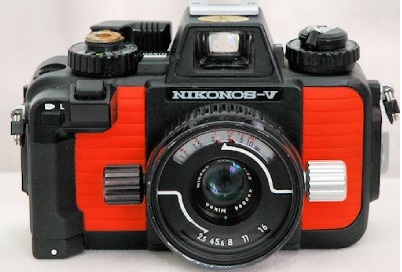
The Nikonos V


Nikonos V
The Nikonos V (source: eBay)


The Nikonos V, launched in 1984 and sold until 2001, is an underwater viewfinder camera with interchangeable lenses. It can operate at depths of 50m (150ft), beyond what is considered the limit for recreational scuba diving. Some lenses were specifically designed for underwater use, but the “standard” lens (a 35mm W-Nikkor) could also be used above the water, for white water sports or for photography in all sorts of very humid environments. A special “camouflage” version was even manufactured by Nikon for war correspondents following conflicts in some remote jungle.


Technically, the Nikonos V – which is a viewfinder camera – is more or less aligned on the Nikon SLR bodies of the mid eighties: Through The Lens (TTL) exposure, aperture priority automatic shutter, and – importantly for an underwater camera – Through the Lens flash metering. I uses the same W and U/W Nikkor lenses as the previous Nikonos bodies, and provides no focusing assistance to the photographer, who has to guess the distance between the camera and the subject, and set the lens accordingly.


I could not test the Nikonos V in its element. The one I bought on eBay happened to have a defective metering system, and the seller did not know enough about the camera to understand it did not work as it should have. I returned it and go my money back, but I was back to square one, with no camera for my vacation.


Lesson #1: if you really want to buy a Nikonos V, buy it from a store specialized in underwater equipment. You will pay more (a good Nikonos V costs between $250.00 and $350.00) but the seller will be able to certify that the camera really works, and has not suffered from an unplanned bath of salt water in the past.


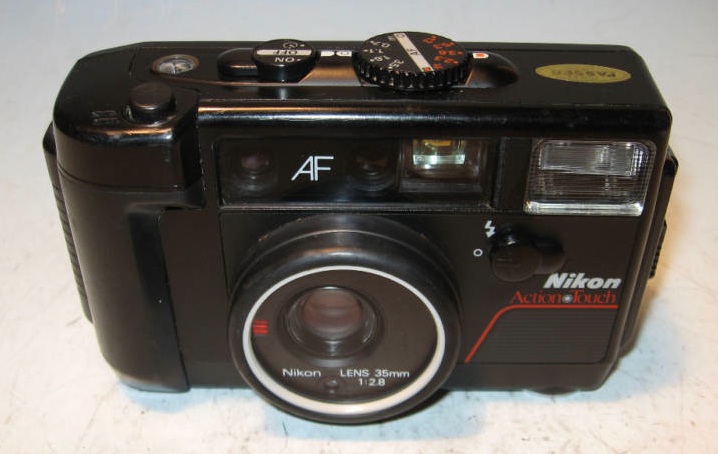
The Nikon Action Touch


Nikon Action Touch (source: eBay)


When I bought the Nikonos V, I decided I needed a backup camera. I found (on eBay again) an old Nikon Action Touch, an autofocus Point and Shoot from the eighties, designed for use in depths of 10 ft (3 meter) or less. I had read good reviews of the camera, and since I could have it for less than $8.00, the risk was minimal. I tried it in a swimming pool. It seemed to work. On the first dive in the ocean, it died. Salty water had found its way in the film chamber, making the camera unusable.


Lesson #2: old waterproof cameras do not necessarily stay waterproof over time, and a dip in a swimming pool can not be compared to a dive in the ocean.


Lesson #3 is to take the claims of the manufacturers regarding the water resistance of their products with a grain of salt (no pun intended). Cameras manufacturers now use the IP code (International Protection Rating) to define the water resistance of their products in different circumstances (sprays, water jets, immersion, for instance), but the performance of older cameras was more loosely defined, and important safety margins have to be taken.


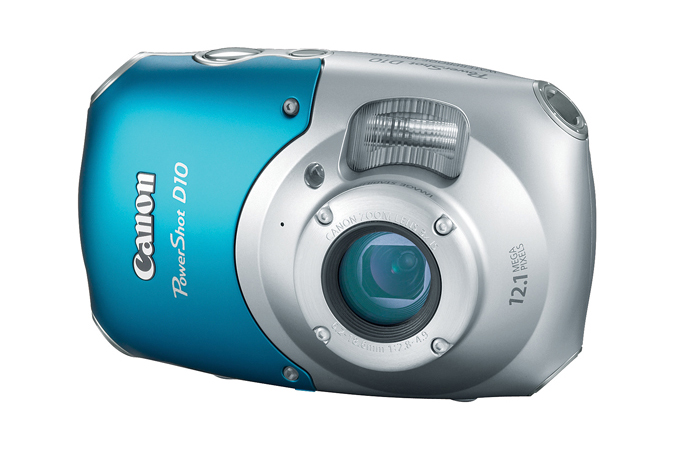
The Canon Powershot D10


Canon D10 (source: Canon)


With two old film cameras out of commission, I had to admit that underwater cameras do not age well, and that buying a new digital Point and Shoot camera was the safest solution if I wanted to bring back at least one picture from my trip. The Canon Powershot D10 was the winner of a dpreview test last summer. It is rated “IP8X” equivalent at 10m (33 ft), making it appropriate for beach activities and for snorkeling. The Canon D10 is a typical middle of the range digicam – with a 12 Mega Pixel sensor, a 35-105 equivalent zoom, and 18 different “special shooting modes”, including “underwater” and “beach”. Selecting a special shooting mode is the only thing the photographer can do: the camera will take care of the rest. It does a good job at it – most of the time – but the inability for the photographer to really control the exposure parameters can be frustrating in complex lighting situations (sunsets, for instance).


Rated for depths up to 10 meters, the Canon D10 can not be used for scuba diving, but can be brought along when snorkeling. Its “underwater” special shooting mode is very good at finding the right color balance, but the shutter lag is typical of a point and shoot camera (far to high), the autofocus reacts too slowly – or not at all, and pictures of mobile subjects are very difficult to take. The LCD monitor has to be “on” all the time, which drains the battery rapidly. That being said, a good diver should be able to bring back decent pictures of relatively static subjects located in shallow waters.


Lesson #4: even dpreview comparative test winners can not overcome the limitations of their middle of the range point and shoot origins. Waterproof digicams are small and light, and will be faithful companions of white water or snorkeling adventures. But they offer little control over the pictures and are limited to a few feet of depth, which explains why dedicated diver-photographers use high-end digicams or SLRs, that they protect with massive (and often massively expensive) underwater housings.


What good diver-photographers do


While on vacation, I had the pleasure to meet Dr Alain Feulvarc’h – he’s an MD, a passionate diver and amateur photographer who was volunteering as the scuba-doctor of our little group.


He was not on the boat to teach underwater photography, but he shared a few tidbits of information: like most of the diver-photographers, he’s using a digital SLR enclosed in a metal underwater housing, and equipped with a very wide angle (10mm) lens. He also uses a 100 mm macro for close ups. Most pictures are taken with a flash (one strobe at least), and at close distance from the subject. He does not rely on the automation capabilities of the camera, and operates in manual mode. Underwater photography is a fairly complex activity, and using digital technologies improves the learning curve dramatically. I was surprised to see that even underwater, some photographers took the time to check the histograms of their images, and to adjust their settings accordingly; this trial and error process would be impossible with film.


You can watch Dr Alain’s stunning pictures on Flickr.


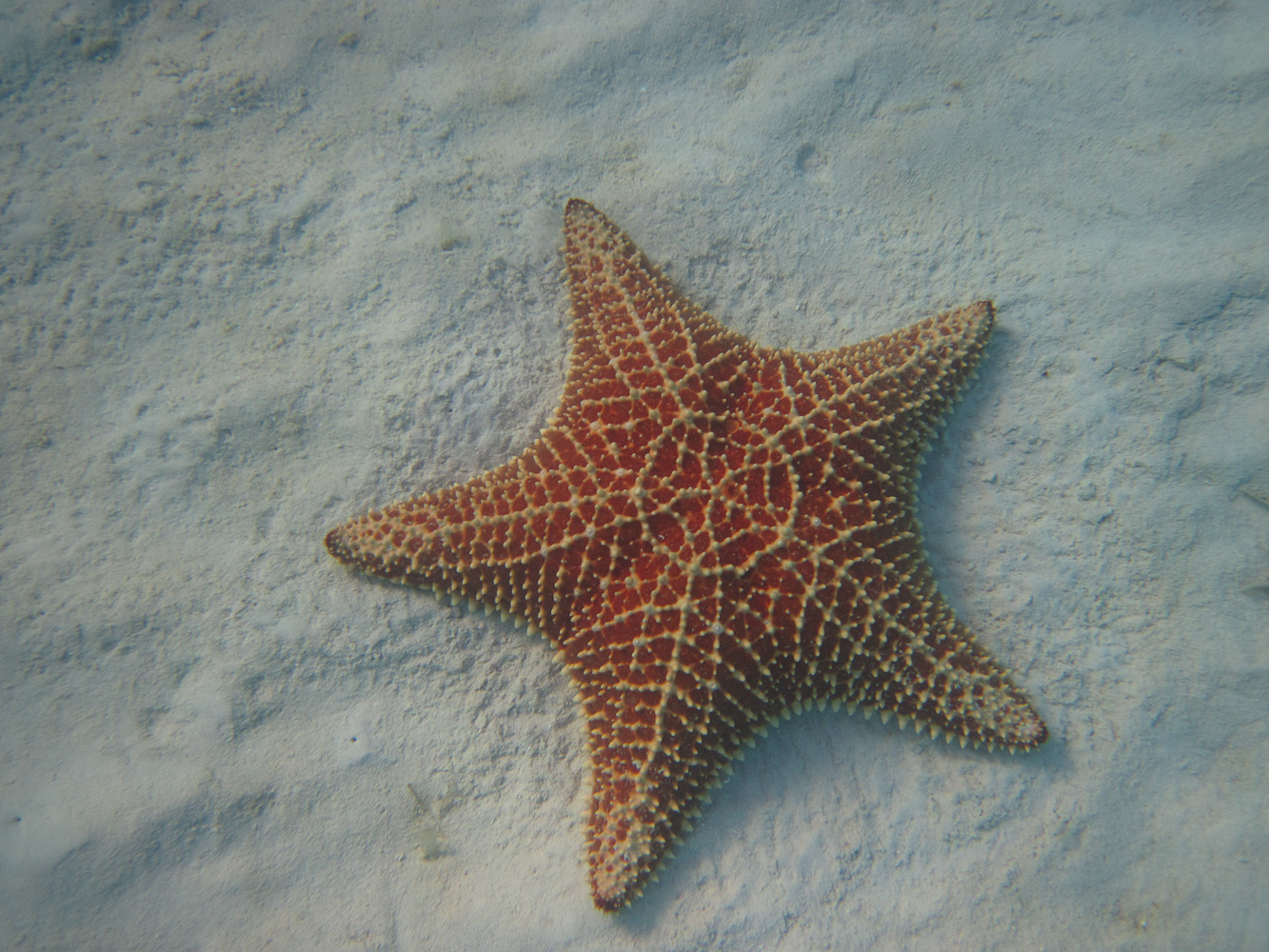
Star Fish - Turks and Caicos - Canon D10
Star Fish - Turks and Caicos - Canon Powershot D10 - The star fish was lying on the sand, at a depth of 2m. (6 ft) approximately. It was well lit and static, and the camera had no difficulty capturing its image.


More about underwater photography


The excellent Photo.net published an interesting Underwater Photography Primer more than 10 years ago. At that time film photography still reigned supreme, but most of the principles exposed in the article still hold true.


The pictures of Alain Feulvarch are on Flickr (aka Alain76 on Flickr)


The characteristics of the Canon Powershot D10 are on Canon’s official site.


The Nikonos family on Photography in Malaysia‘s web pages


And for geekiest of us all, the detailed description of the IP ratings