Extracting the best Image Quality from the Olympus Tough TG-5 when traveling

Why use a digital compact camera (aka point and shoot) when traveling, rather than a mirrorless interchangeable lens camera (ILC) or a smartphone?

I can see two reasons:

  • a better size-reach combination – only a point and shoot like this Sony HX-60 can offer a 720mm full-frame equivalent focal length at the long end and still be pocketable;
  • a unique size-ruggedness combination – only a rugged compact point and shoot like an Olympus Tough TG can be carried around all the time, without fear of dust, sand, water. If it gets drowned, crushed or falls in a crevasse, it’s not so much of a big deal. You don’t need it to authenticate to your employer’s VPN, and you don’t store your electronic plane tickets on it. And if you have to replace it, a similar camera will only cost you a fraction of the cost of an ILC or a smartphone on the second hand market.
The 30x zoom has no equivalent in APS-C or full frame camera systems

Conventional, long zoom (non-rugged) point and shoot sometimes have relatively large sensors (up to 1in) and a well designed telescopic lens; they offer an impressive image quality, but their motorized telescopic zooms with their retracting lens cap won’t take sand, rain or a fall to the floor lightly.

On long zoom compact cameras, the lens is protected by a group of retracting blades. You don’t want a grain of sand or a few drops of water to make a mess of it.

What constraints Image Quality on the Olympus TG-5?

High level, the Olympus TG-5 and its close derivatives the TG-6 and TG-7 deliver a pretty good Image Quality (IQ) for rugged cameras, but are limited by the small size and resolution of their sensor (1/2.3in and 12 Megapixel respectively), and the design and implementation of the lens, a folding internal optic.

That being said, if you’re intended to extract the maximum image quality from the TG-5, it’s important to understand how the camera controls the exposure parameters, and aperture in particular.

On the Olympus TG, the lens is hidden behind this blade of glass (a decorative bezel normally hides the bayonet over which accessories can be mounted)

Very few compact cameras (and it was also true at the time of film) use a conventional iris for a linear control of the aperture, with the well known sequence of stops (f/2.0; f/2.8; f/4, f/5.6, f/8, … and so on). In a typical compact camera, aperture control is often performed by the shutter. This design comes with its own set of limitations: only a few aperture values can be selected, and they’re not available with all shutter speeds.

On the TG-5, the maximum aperture of the 25-100mm zoom (full frame equivalent) varies between 2.0 at the widest angle and f/4.9 at the longest focal length (it’s a sliding aperture lens). In order to limit diffraction, the camera only offers two “real” aperture settings (f/2.0 and f/2.8 at 25mm), with higher values (up to f/8 at 25mm) being simply simulated by a Neutral Density (ND) filter. Therefore, image quality will peak at f/2.8, and stopping down beyond won’t improve it (IQ could even be marginally worse because of the ND filter) .

The lens, now protected by the UV filter and the lens hood.

If you decide like me to travel with a Olympus Tough TG-5 (or TG-6 or 7), how to extract the best Image Quality from the camera?

IQ is all relative. If pictures are to be viewed on a social media app installed on a smartphone, the TG-5’s Image Quality is more than adequate. Color balance, exposure, focus, dynamic range are spot-on. Images uploaded to social networks are generally downsampled to a resolution of 3 to 4 million points, a far cry from the 12 Mpix of the Olympus sensor, and not enough to start making the performance limitations of the lens and the heavy hand of the JPEG rendering engine noticeable.

But if the final destination of your image is a 8x11in print, or an 8k monitor, the weaknesses of the lens and the aggressiveness of the sharpening algorithm will become visible, unless you follow a series of steps to ensure the camera always delivers its best.

Olympus Tough TG-5 – how to get the highest quality images:
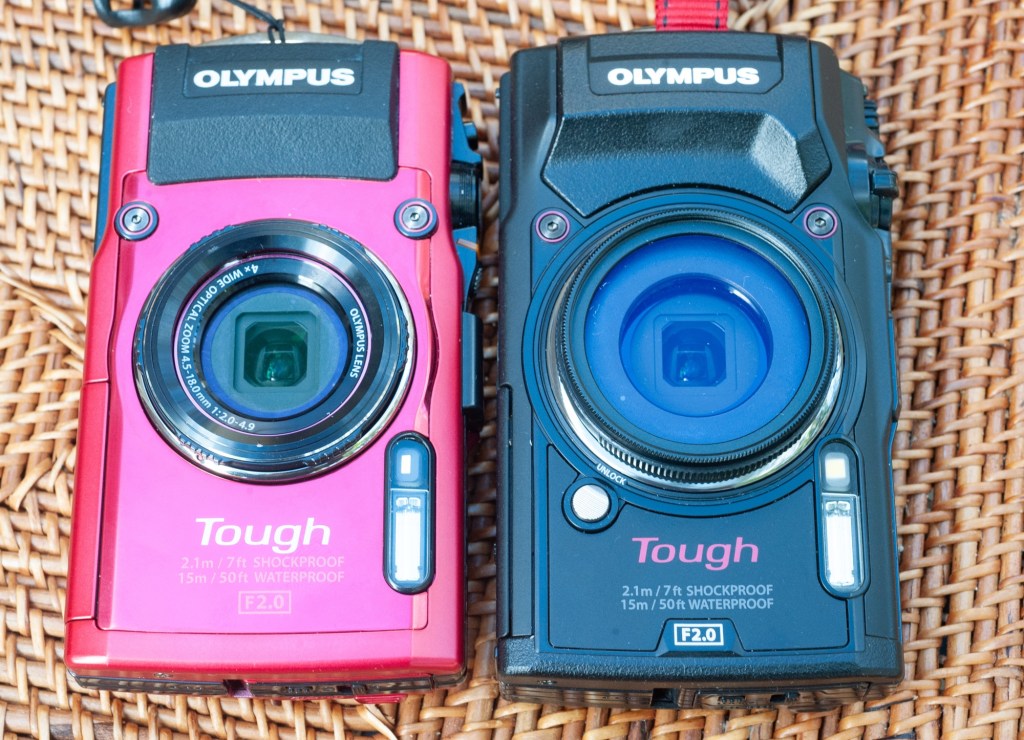
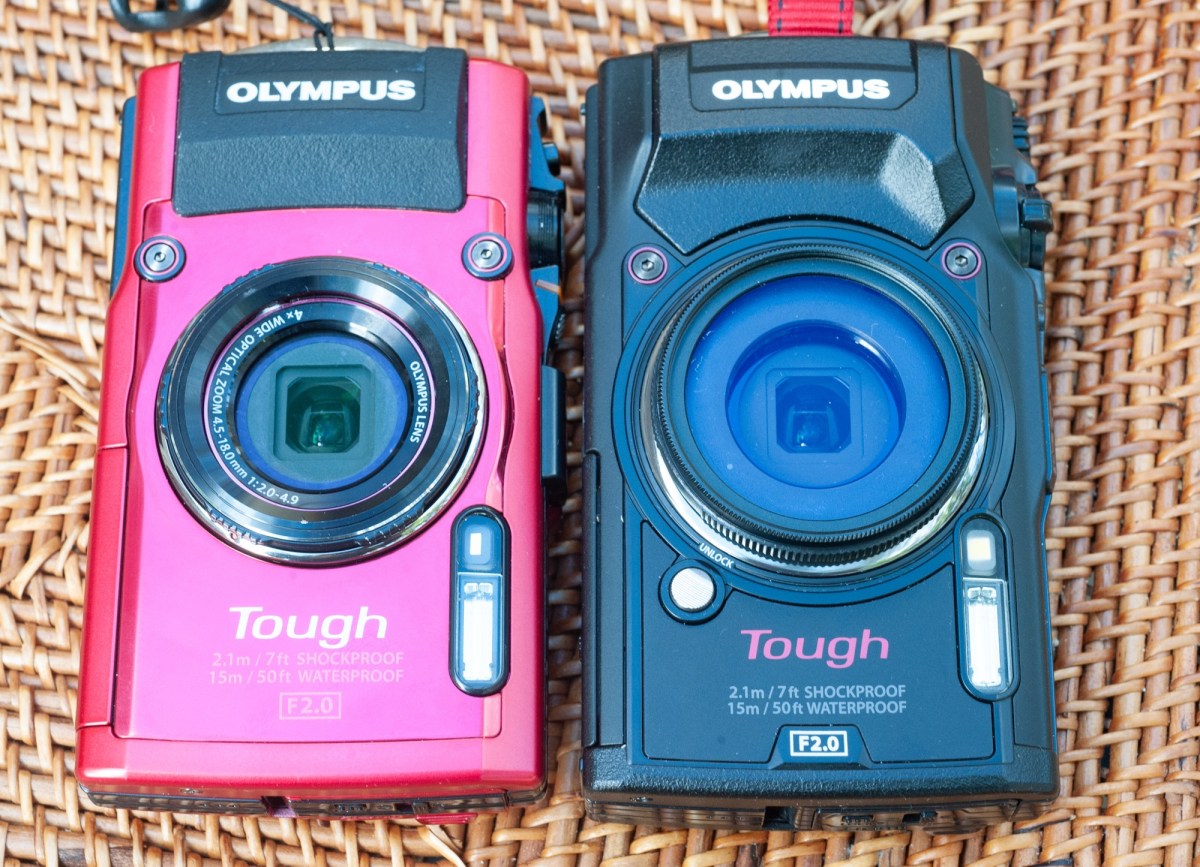
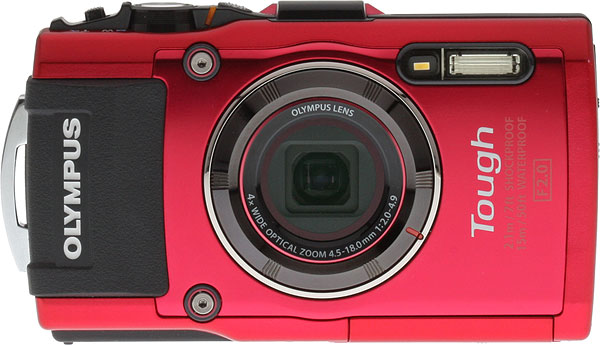
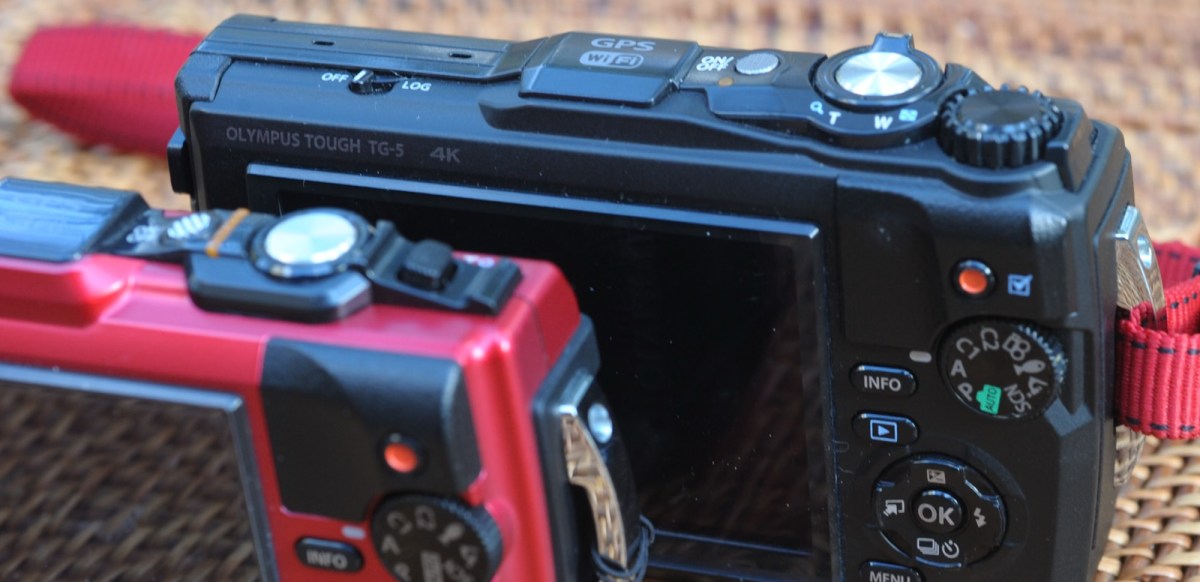
The Tough TGs are all available in black and in red. TG-4 on the left, TG-5 on the right (with a JJC UV filter mounted on the accessory adapter).
  • Read the manual – The Olympus TG-5 may be a point and shoot, but it’s a highly configurable, and therefore relatively complex camera. Settings are dispersed across multiple menus, and navigating them is unfortunately less than intuitive. In your quest for the best IQ, you’ll have to understand how to save your images as RAW files, how exposure memorization and correction work and after the picture has been shot, how to review and adjust some of the technical parameters. So, read the manual.
  • If you don’t want to read the dreaded user manual (who does?), ask precise questions to your favorite AI chat application. AI is getting very good at answering questions about cameras and photography, most of the time. ChatGPT 5, for example, combines the information and the test results it gets from DPR, Imaging Resource and Photographyblog with customer feedback collected on forums to provide detailed and mostly exact answers.
  • Shoot RAW. If you’re really interested in maximizing IQ, it’s definitely much better to shoot RAW and fine tune Clarity, Dehaze and Sharpening in a dedicated image editing app.
  • Use the sensor where it’s at its best, at 100 ISO, taking advantage of Olympus’ image stabilization capabilities to operate at low shutter speeds.
  • ChatGPT 5 recommends shooting in A mode (Aperture Priority) and selecting an aperture of one stop above full aperture (that would be f/2.8 at 25mm, which slides to f/6.3 at 100mm) for best performance. That’s the aperture where the lens is the best, but in A mode you are in charge and have to keep an eye on everything (on the shutter speed in particular).
  • In the real world, the Program P mode does more or less the same job as the A mode – at 100 ISO, for instance, the program sets the aperture at f/2.0 as long as the shutter speed has not reached 1/100s, then steps up to f/2.8 and remains there if possible.
  • The camera comes with a long list of scene modes – the Scenery/ Landscape scene works well with static subjects when traveling, and I use it often – and it appears to keep the aperture at f/2.8 as much as possible. There are other interesting scene modes – use them if they get you the result you want. Just be aware that Scene modes don’t let you chose the sensitivity or correct the exposure values.
  • Finally, the obvious – protect the lens from fingers prints and smudges with an easy to clean UV filter, and from incident light with a lens hood.

Of course, you can’t always work with low shutter speeds at 100 ISO. If your idea of a good vacation is to visit ball parks around the country and shoot the players in action at dusk, maybe the TG-5 is not the camera you need.

Why you should shoot RAW with the Olympus TG-5: an example.
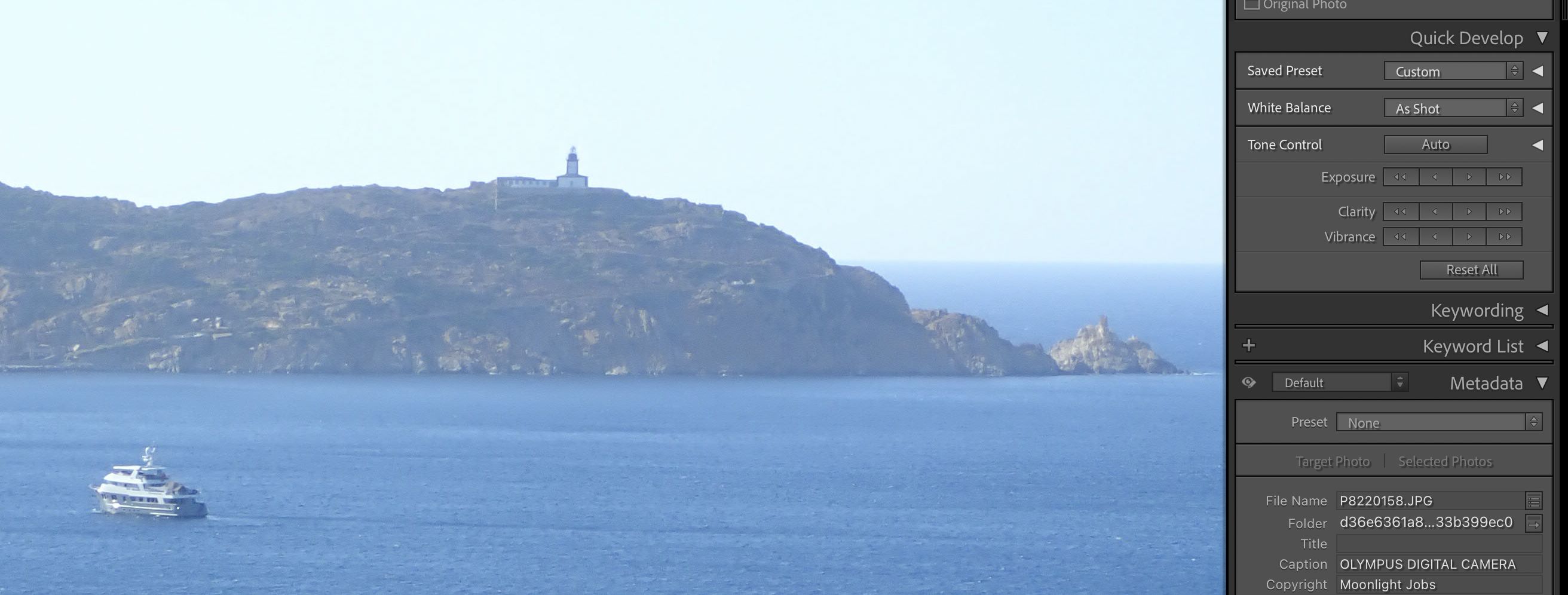
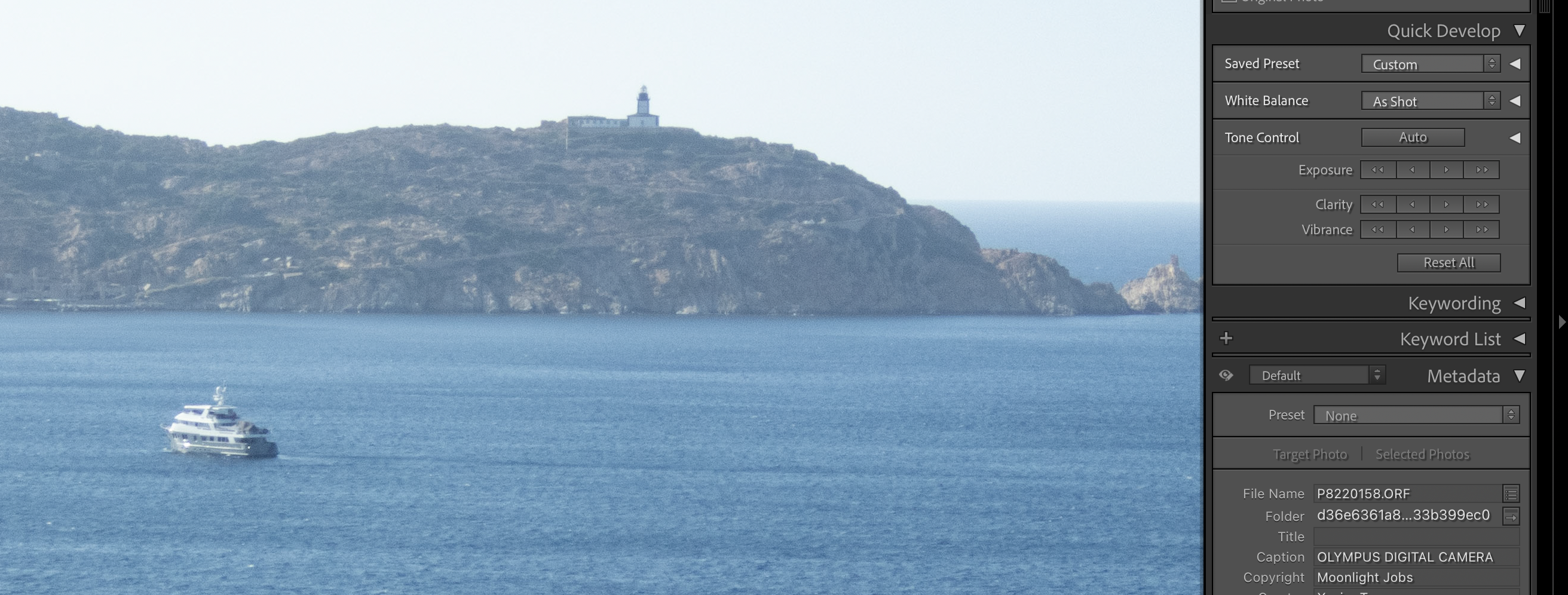
Calvi, Pointe de la Revellata – enlarged section of a JPEG (straight out of the camera) – screenshot taken on Adobe Lightroom Classic
Calvi, Pointe de la Revellata – enlarged section of a RAW file, (moderately adjusted in Adobe Lightroom Classic).

The TG-5 can be setup to save an image as a RAW file and as a JPEG simultaneously. The images shown above are two screenshots of “La Pointe de la Revellata” in the bay of Calvi, Corsica, taken while editing in Lightroom Classic.

WordPress is downsampling the images massively, but click on each picture and you will see the screenshots at full resolution. And you will really see a difference between the JPEG and the ORF file. The JPEG (the first of the two) shows a much more pronounced accentuation, which translates into an almost cubist representation of the mountain in the backgroud. The RAW file, below, is more subdued. The full image (exported from RAW) is shown at the end of this blog post.

Will all the Olympus Tough TG cameras offer the same Image Quality?

In the heyday of compact digital cameras, Olympus was proposing three different lines of Tough cameras, with multiple variants in each line. This blog entry only covers the “one digit” Tough TGs, and specifically the TG-5 and its close derivatives, the TG-6 and the TG-7.

I don’t think there is much of a difference between the TG-5, TG-6 and TG-7 – mainly progressive improvements on the video capture side (the photo section is identical). The TG-3 and TG-4 have a different sensor (16 Mpix, with a lower dynamic range and more noise), but only the TG-4 can save RAW files. And all models before the TG-5 have an Olympus proprietary USB port, which will force you to carry around an easy to lose proprietary USB cord to recharge the battery of the camera. To me, a used TG-5 is a very good compromise – they abound on the second hand market (eBay, Shopgoodwill) and can be found for less than $200.00.

As a conclusion

A camera is always a compromise between conflicting design goals, and a compact, rugged, water-resistant point and shoot camera can’t be expected to beat a 60 mpix full frame ILC when it comes to image quality.

From an IQ point of view, the TG-5 is probably the rugged compact camera with the highest potential, and if the photographer shoots RAW and pays attention to the exposure parameters (exposure modes, aperture, ISO), the output will reach a much higher level than what could be expected from a compact camera with such a small sensor.


More recent content in CamerAgX

All pictures of Calvi shot last summer with an Olympus TG-5 set at 100 ISO – and saved as RAW files – Clarity, Dehaze and Sharpening applied with moderation in Adobe Lightroom.


Calvi, Corsica – from Notre Dame de la Serra.
Calvi, Corsica. The flag of the region at the city hall.
Calvi, la citadelle (and two exhausted tourists)
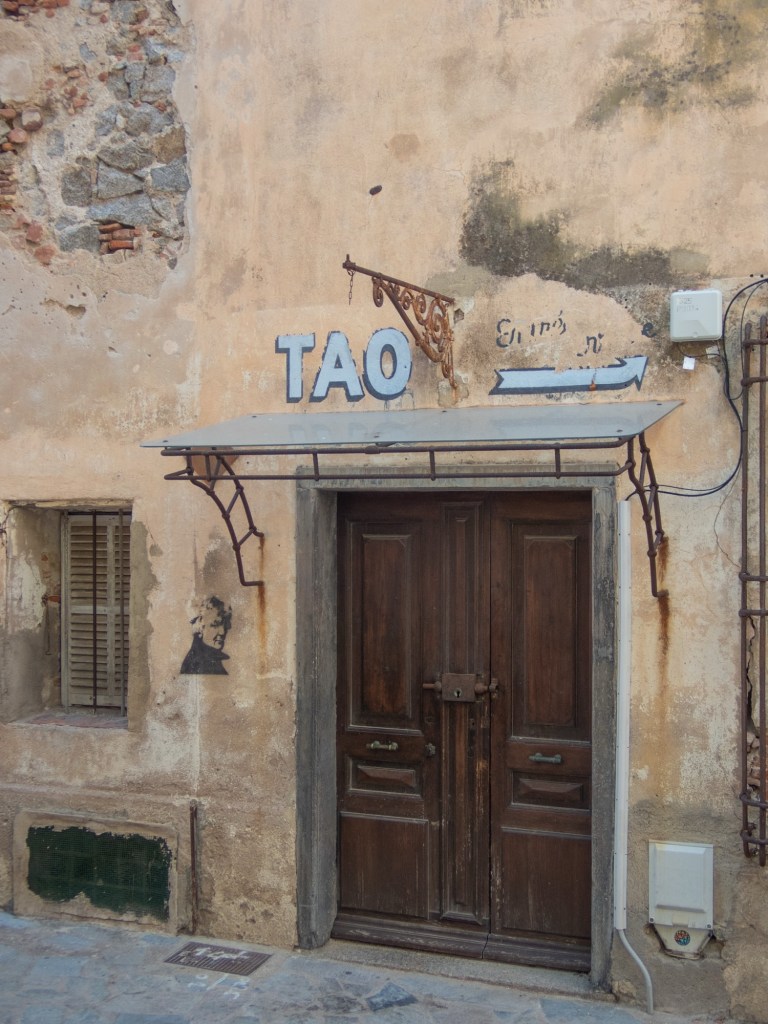
Calvi (Corsica). “Chez Tao” is a famous piano bar, where music lovers and night owls congregate.

Olympus Tough TG-4 vs TG-5

I regularly keep an eye on Shopgoodwill.com auctions. Looking for the unexpected opportunity. A nice camera for a pitance. It’s not very frequent – I’m surprised by how much people are ready to spend on cameras donated to a charity and sold untested.

Sometimes you are lucky. A good camera gets unnoticed – so poorly described that almost nobody can guess what it really is – or the online auction ends at a time when most people have better things to do, and can not be on line to “snipe”.

There were a few auctions ending on Xmas eve and I ended up being the highest bidder for two cameras – a Canon Photura I’m currently testing, and this black Olympus Tough TG-5. The item was correctly described, was said to have passed some basic tests (both points which are not that frequent at Shopgoodwill) but there was very little competition to acquire it – no bidding war and no absurd high sale price. For a change.

The first thing I did of course was to compare it with the Olympus Tough TG-4 I had bought a few months ago.

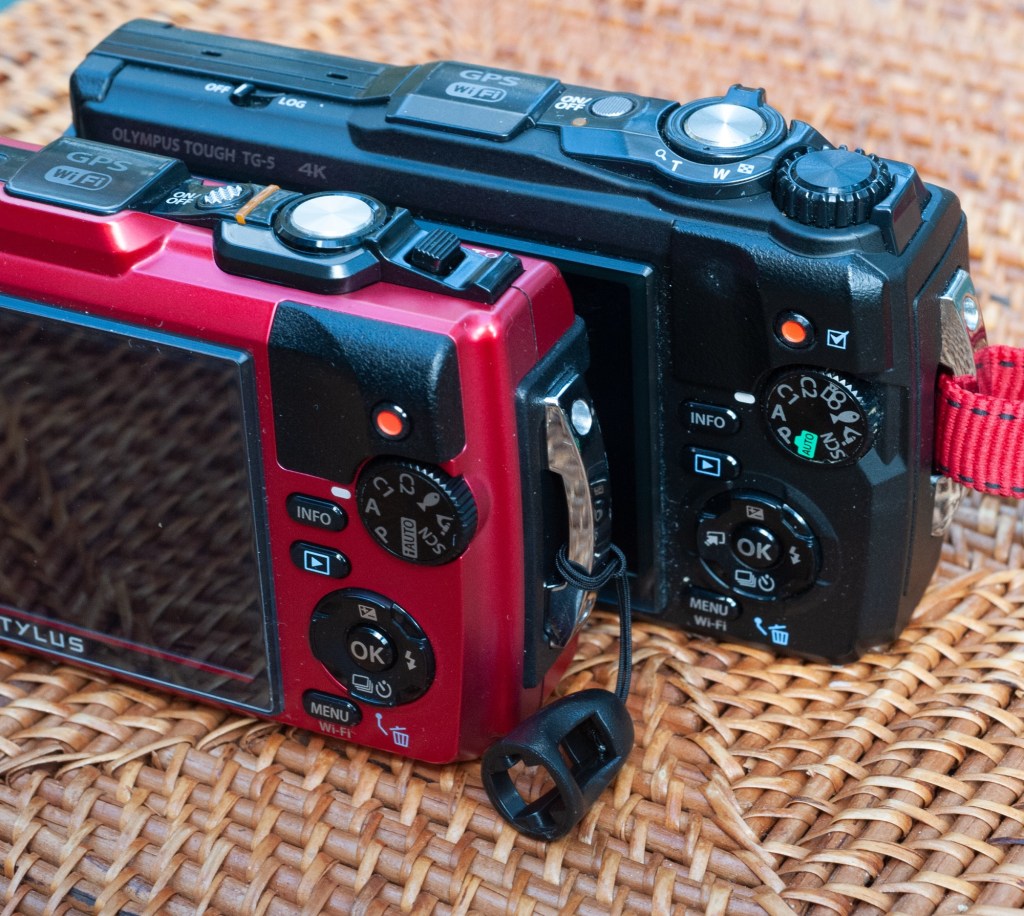
The top plate of the TG-5 (the black camera) with the extra control wheel, the improved zoom command and the GPS (Log) switch.

What are the differences?

The big difference is the sensor. All Tough TG-x models are built around a 1/2.3in sensor. In the first two models (TG-1 and TG-2), the sensor was a 12 megapixel backlit CMOS. The TG-3 benefited from an upgrade to 16 megapixels, which was carried over to the TG-4. The TG-3 and 4 were criticized for their poor control of noise in the darker areas of an image, and for the TG-5, Olympus reverted to 12 megapixel design. With a pixel pitch of 1.53μm versus 1.33μm for the TG-4 each pixel gets 15% more light. Combined with a more powerful image processing engine (a dual quad core Olympus truepic VIII as opposed to the TG-4’s truepic VII), the TG-5 should offer an improved control over noise and deliver cleaner pictures.

The new 12 megapixel sensor also brings a larger sensitivity range – up to 12,800 ISO to whomever is brave enough to test such a setting on a 1/2.3″ sensor, and the support of 4k video.

The other changes relate to the fit and finish and the ergonomics for the most part – there is now a conventional zoom lever and a new control knob on the top plate, and a switch to activate and deactivate the on-board GPS. And big news, the proprietary Olympus connector (used to charge the camera’s battery) has finally been replaced with a standard USB connector (yes!).

The new menus are hardly an improvement

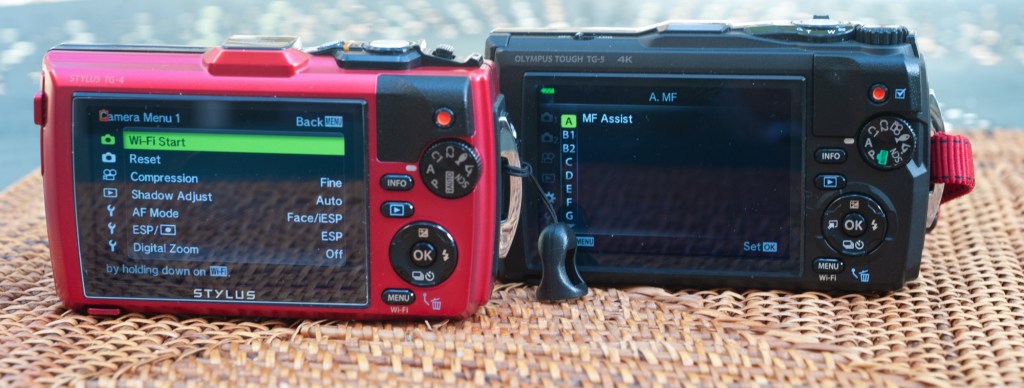
Nothing is perfect, and the menus have been revised. Olympus has gained a bad reputation for its confusing and un-intuitive menus, and proves it’s deserved with the TG-5. On the Tough TG-s, Olympus have given a particular emphasis to what they call “live control”: some important settings are not available through the menus, but only when the photographer is ready to shoot a new picture and presses the “OK” key – a column of options is displayed as an overlay at the right of the image, with the different values that each setting can take displayed on an horizontal bar at the bottom of the picture. It’s the only way to chose the form factor of the images (4:3, 3:2 or 16:9, for instance, or the image quality (RAW, RAW+JPEG Fine, JPEG Low) and so on).

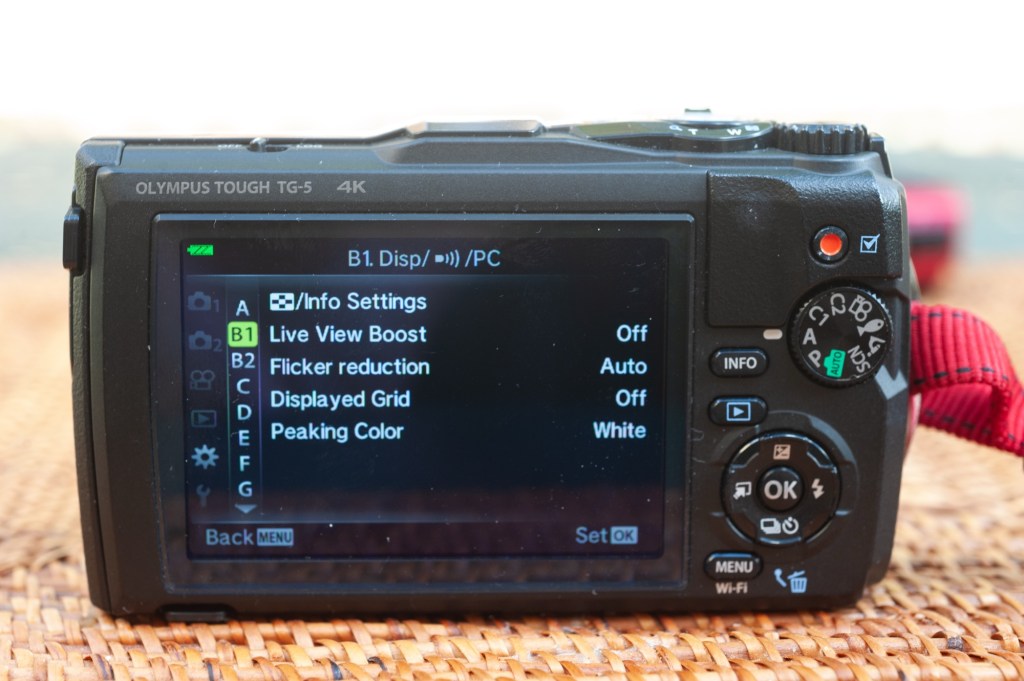
At the same time, additional settings have been added to the conventional menus of the TG-5. Some are obviously useful (like setting the standard and high limits of the Auto ISO sensitivity control, the color space or entering copyright information), but others seem to duplicate (or refine) settings already available in the “live control” mode. And they’re not always available – some options are greyed out when the camera is set to “scene” mode, for instance. To make matters worse, instead of giving meaningful names to the new options, Olympus simply designated them as A, B1, B2, C, and so on. Confusing.

The TG-5 menus are cryptic (why B1 and B2?)

Shooting with the TG-5

Are the new sensor and the new processing engine improving the noise situation? Imaging-Resource had compared a new TG-5 with a TG-4 a few years ago ( https://www.imaging-resource.com/PRODS/olympus-tg-5/olympus-tg-5-image-quality.htm) and had mixed feelings about it.

Yes, the TG-5 delivered an improvement, but not as large as the testers had expected. The improvement was particularly obvious in the 100 to 800 ISO range, where the noise reduction algorithm was at the same time much less aggressive and more efficient – resulting in more details and less chroma noise.

In my experience, the TG-4 was producing images with very visible noise in the shadows, even by sunny weather under the tropics, and it was not easy to get rid of it. Any improvement in that area would be welcome, and would justify an upgrade to the TG-5, if it delivered the goods.

I compared the two cameras in the real life and tried to validate the conclusions of Imaging-Resource. Firstly, on both cameras, there is more noise on the Raw files than on the jpegs. Which means that the processing engine does a good job at removing it when it generates jpegs. Secondly, the TG-5’s jpegs show more detail in the shadows than the TG-4. The difference is not huge, but big enough to be visible on the Retina screen of an iPad. So, yes, the TG-5’s pictures look better. And what about the rest of the user experience?

The TG-5’s body is made of a different type of plastic and feels more substantial in the hands. Because it offers more controls (physical like the wheel on the top plate or logical with more options in the menus), the TG-5 does not seem as simple to use as the TG-4, and will require more peeks in the user manual than the TG-4, before the photographer is totally familiar with it.

Father and son – along the Chattahoochee River, Atlanta – Olympus TG-5 – adjusted in Lightroom from Raw.

As a conclusion, I would say that the TG-5 has a higher potential than the TG-4 (more details in the shadows, greater ability to be configured to the preferences of the photographer) – but that it’s also a tad more complicated to use. Although it’s difficult to quantify, the TG-5 seems to deliver better images in more circumstances than the TGs of previous generations could. Not having to carry and use a proprietary connection cable to charge the battery of the camera (and using any standard USB cable instead) could very well be the most significant (and the most welcome) improvement.

In the grand scheme of things

As of today (early 2025), there are very few new compact cameras on the shelves of the resellers, and even fewer which are shockproof, waterproof and adventure ready. The OM System TG-7 is the most competent of those always ready cameras – but like all the previous versions of the Tough TG, it will be limited by its 1/2.3″ sensor.

Premium compact cameras, like the Sony RX100 or the Canon G7X, have a much larger sensor. The same can be said of the iPhone (the sensor behind the 16 Pro Max’s main camera is almost as large as the RX100’s at 1/1.14in). Without even considering the “computational photography” trickery of the iPhone, all are obviously going to yield much better results than the TGs in low light and in the shadows. But the Sony and the Canon are not weather resistant, and their long telescopic zoom makes them more delicate than a Tough TG (you won’t bring them to the beach or on a dusty trail ride), while the iPhone (and similar high end smart phones) are fully automated wizards that can’t compete with a dedicated camera when it comes to ergonomics and flexibility of the settings.

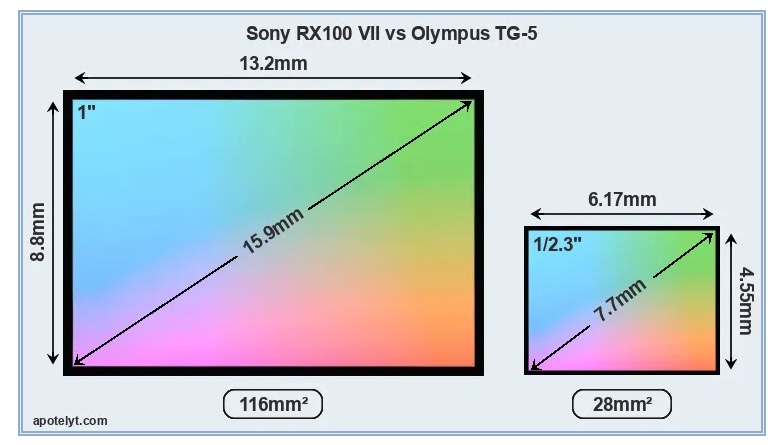
Comparison of the 1″ sensor of the Sony RX100 (or the Canon G7X) with the 1/2.3″ sensor the TG-5 (courtesy: apotelyt.com).

The TG-7 is a very limited upgrade of the TG-6, itself a rather limited upgrade of the TG-5. The improvement in image quality and ergonomics between the three most recent TGs and the previous generations is not huge, but any improvement in the 100 to 800 ISO range is good to take, and if you can find a TG-5 at a reasonable price, my recommendation would be to take it over a TG-4. If only for its universal USB connector.


Olympus TG-5
Olympus TG-5
Olympus TG-5.
Olympus TG-5 – Chattahoochee National Forest – images above are jpegs straight out of the camera – the noise seems much better controlled than with the TG-4.

Olympus OM-40 / OM-PC : the ugly little duckling

In the times of manual focus (film) cameras, Olympus followed a pretty simple rule to name its SLRs – there was a line of one digit OM bodies (OM-1, OM-2, OM-4, OM-2SP, OM-3, OM-4ti, OM-3ti) for the enthusiasts and the pros –  those cameras were very compact, very well built, and fairly innovative. 

And a second line of “two digit” models (OM-10, OM-20, OM-30, OM-40) – designed for amateurs –  not as compact, with more plastic and fewer innovations. Obviously, the “two-digit” models were also much cheaper than their “one-digit” siblings. 

As often, some of the amateur models went by a different name on the US market: the OM-20 was sold as the OM-G, and OM-40 as OM-PC – all leading Japanese cameras makers were using US-market specific model names in the eighties and nineties – probably as a way to fight grey market imports.

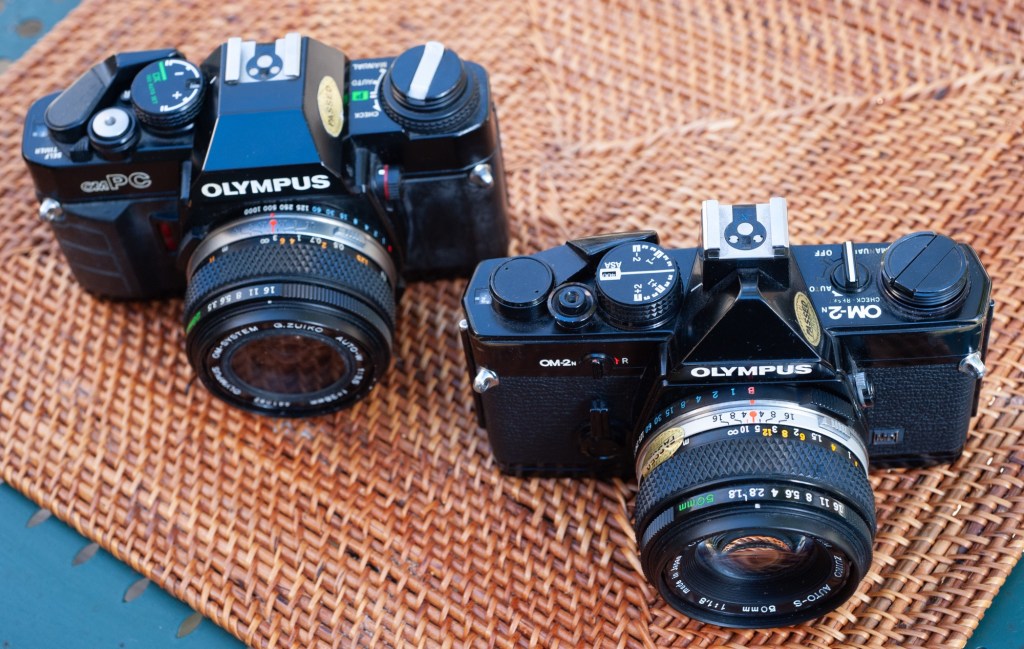
Miami – Olympus OM-2

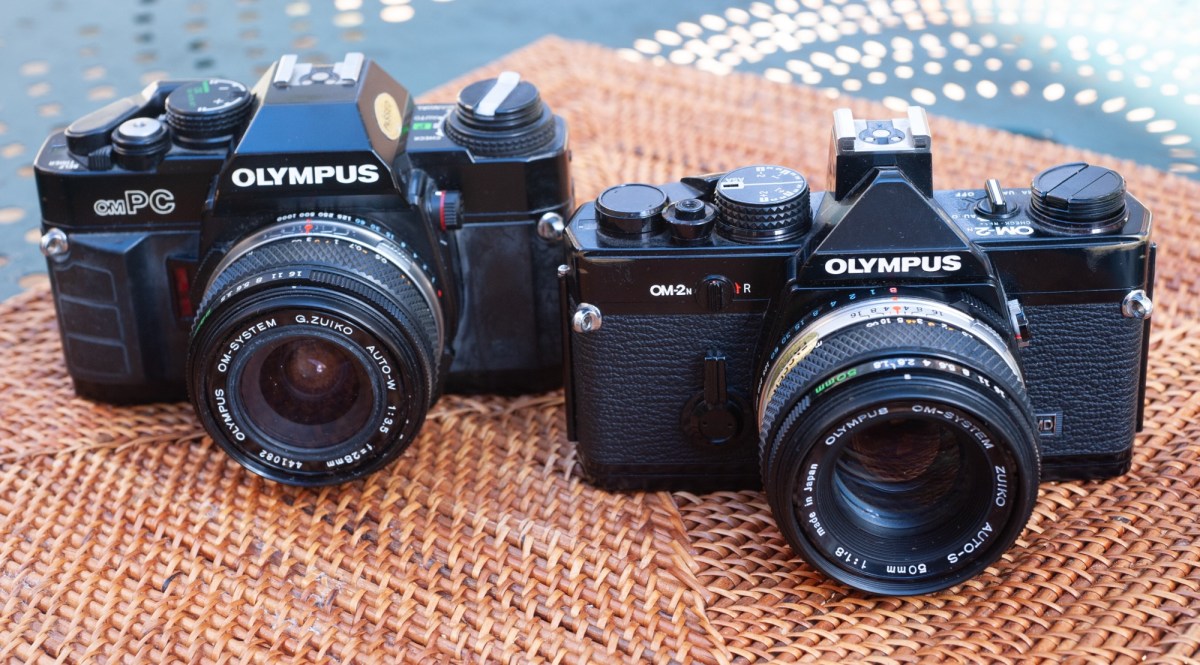
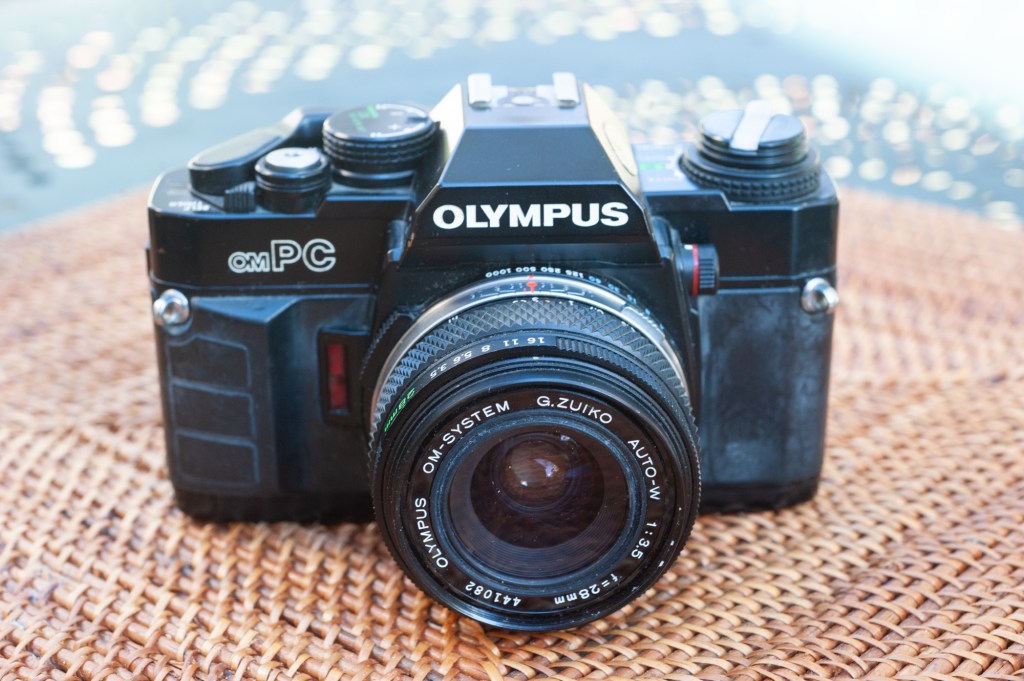
OM-40 / OM-PC

The OM-PC was launched in 1985, at the very end of the manual focus era (the revolutionary Minolta AF 7000 was launched in January that same year, and nothing would be the same afterwards).

Typically for an Olympus SLR from the eighties (like the OM-2SP or the OM-4), it has no on-off switch – and therefore tends to depletes its batteries rapidly.

Also typically for an Olympus of the eighties, its exposure metering system is  a bit “different”:  like the Nikon FA, it offers some primitive form of matrix metering (called ESP in this case).

  • Like the OM-2, the OM-40 determines the exposure by measuring the light reflected on the curtains of the shutter or on the film when the picture is being taken (they call that “OTF” for “on the film”, of course). OTF follows the conventional center weighted pattern. 
  • In addition to OTF, Olympus also designed an “Electro-Selective Pattern” or “ESP”. It’s an embryonic evaluative system, which compares the luminosity of the center of the image with the periphery, and follows a clever algorithm to determine the right exposure (more detailed explanations on the OM-40 user manual, that can be downloaded from Buktus’ excellent site).

The user manual leaves no doubt that using the ESP in conjunction with the Program mode is what Olympus recommends, but an Aperture Priority and a manual modes are also available.

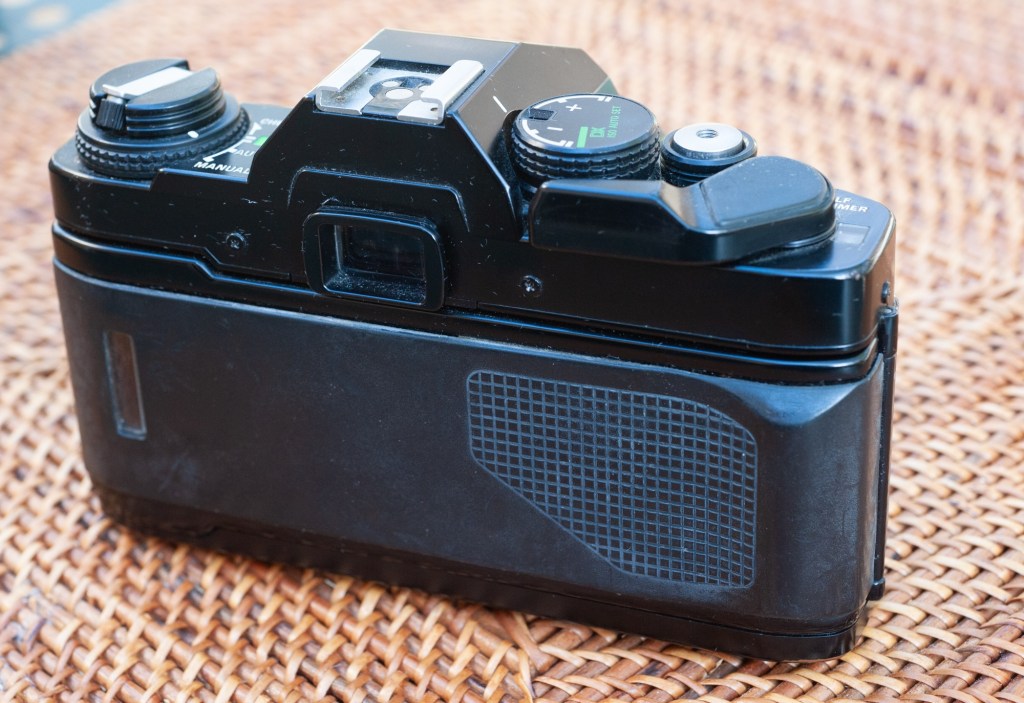
The black plastic did not age well – note the white residue.

The OM Zuiko bayonet mount remained the same all along the production run of OM cameras, which may explain why the implementation of the Program auto-exposure mode is also different from what is done by all other camera makers, and why there never was an Olympus OM camera with “Shutter Priority” auto-exposure.

Most camera makers had to create a new version of their lenses in order to support multiple auto-exposure modes: some have a lock on the smallest aperture (Nikon), some have a specific  “A” position added to the aperture ring (Canon), and some needed a new version of their bayonet mount, with a proportional control of the iris (Yashica-Contax) or with electrical contacts (Pentax KA).

Olympus did not create a new line of lenses or modify their bayonet mount – they simply expected the photographer shooting with the OM-PC to select the narrowest aperture of the lens (generally f/16 on an Olympus Zuiko lens) when operating the camera in Program mode.

But Olympus being Olympus, there’s a catch: selecting the smallest aperture is not mandatory: if the photographer sets the aperture ring to another value (f/8 for example), the “program” will try and find the right shutter speed/aperture combination without going beyond the aperture selected on the aperture ring (f/8 in our case). Interesting, if not perfectly intuitive for the beginner, who is at risk of hitting the fastest shutter speed of the camera (1/1000 sec) on a bright sunny day without understanding what’s happening. 

Miami – Olympus OM-2

The ergonomics of the OM-PC is also typical of Olympus OM bodies, with the shutter speed ring at the periphery of the bayonet lens mount. It works great with Olympus Zuiko prime lenses (which have their aperture ring at the front of the lens, not at the back): the right hand holds the camera and presses the shutter release, and the left hand takes care of the shutter speed, the aperture and the focusing, with enough distance between each ring to avoid confusion.

Contrarily to most of their competitors, Olympus did not have a cheap line of lenses for amateurs, a line of better lenses for enthusiasts, and a “pro” line for… pro photographers. All OM Zuiko lenses were supposed to be of equal build quality and performance, the only technical differentiation between lenses of a given focal length being the maximum aperture. Therefore, for a given focal length, Olympus was typically proposing 3 models with a  maximum aperture of f/3.5, f/2.8 and f/2.0, at different price points.

 All lenses were very compact, with their own depth of field preview lever, and the aperture ring pushed at the front of the lens. Today, Olympus OM Zuiko lenses are easy to find, and the f/3.5 version of most lenses is the most common and very affordable.

Maybe it looked modern in 1985 – lots of black plastic

The so-so and the ugly

The viewfinder of the OM-PC is nowhere as good as what you find in a one-digit OM, but correct for a camera designed for the budget of amateurs. All the information is provided in a column at the left of the viewfinder (shutter speed, metering mode), but – as usual for cameras of this era, the photographer has no information about the aperture selected by the camera when operating in Program Mode.

Untypical for an Olympus OM camera, the OM-PC is ugly, and did not age well – it’s built of black plastic covered with a sort of artificial rubber, which tends to exude a white residue over time. And at the top of that, all this rubber cladding makes the camera bulky. Ugly and bulky, nothing of the grace of an OM-1 or OM-2. 

Miami – Calle Ocho – Olympus OM-2

As a conclusion

It’s difficult to love this camera – it’s not bad, it’s not expensive, the metering system is innovative, and I’ve no doubt it will produce nice pictures most of the time. But an OM-2 is in the same price range on the second hand market, and will be  as good of a tool in the hands of a knowledgeable photographer. The OM-2 is so much more beautiful. And with such a great, wide and luminous viewfinder!

Like the “amateur-oriented” manual focus SLRs of the other major brands, the OM-PC was made obsolete by the Minolta AF-7000 and its cheaper derivatives, and rapidly disappeared from the market. Contrarily to the  other four big Japanese camera makers, Olympus failed at launching an attractive autofocus camera system, and aimed their subsequent efforts at the point of shoot and bridge cameras markets, simply keeping two titanium clad and very expensive “single-digit” OM cameras (the OM-4ti and the OM-3ti) in their product line until the end of the century. 

Olympus would only return to the interchangeable lens camera market after the switch to digital (with the E1 Four-Thirds camera of 2003). They followed up with an innovative and attractive line of Micro-Four-Thirds cameras in 2009, but lost momentum – and after suffering large financial losses year after year, they finally sold their camera business to a private equity firm a few years ago. We don’t know what the new owner will do with the brand, but considering they won’t have the profits made by Olympus with their medical equipment business to keep them afloat, it’s likely they will focus their diminished resources on fewer models and fewer markets. Sic Transit Gloria Mundi. 

The commands are organized in a very similar “Olympus” way

One of the rules I had set when I started this blog fifteen years ago was that I would not write about a camera I had not tested with at least one roll of film. This post is one of the rare exceptions – there is no photo taken with the OM-PC. Because I could not resolve myself to shoot with an OM-PC, when I had an OM-2 waiting at my disposal.


Miami – Olympus OM-2.

The best OM (film) camera?

“Single digit” OM manual focus SLRs are some of the most beautiful and rewarding cameras of the film era – but some models are specially desirable:

  • OM-2 – it’s really two cameras in one – set it to manual, and you could believe you’re shooting with a semi automatic OM-1; push the selector to Auto, and a shutter speed scale shows up in the viewfinder, making it an aperture priority auto exposure camera. In my personal opinion, the OM camera to buy – not too complex, very compact, beautifully designed, and graced with an incredible viewfinder. The OM-2n is almost identical. Both run with easy to find SR44 batteries. You can find a good one for as little as $50.00.
  • OM-4t/OM-4ti – the t and the ti are the same camera – but with different names depending on the geography where they were sold, and on the finish of the top and bottom plates: made of titanium, some were painted black, some wore a more natural “champagne” color. Technically the OM-4t/ti is similar to the OM-4, except for the circuitry controlling the flash, which supports a “high speed sync” function. On those models, Olympus also fixed the battery drainage issue seen on the OM-2SP, OM-3 and OM-4. All the OM-4s have a very elaborate multi-spot metering option, and two high key and low key exposure compensation buttons on the top plate. The exposure values sampled (up to eight) are shown on a small LCD bar graph display at the bottom edge of the viewfinder. To me, it’s far too complex, but some photographers swear by it (and Canon shamelessly copied the multi-spot and high key/low key features on their T90). The champagne finish tends to be fragile and the cameras often look scruffy, but the black models are to die for if you like compact, all metal cameras. The scruffy ones sell for at least $250.00, nice copies can go up to $1000.00.
  • The OM-3ti was produced in very small volumes (assembled by hand – they were built using freshly manufactured OM4ti models as donor cameras). Not surprisingly considering how it was manufactured, the OM-3ti was also extremely expensive – in Leica M territory. Used copies are currently selling for anything between $1,500 and $3,000.

I would avoid: the OM-1 (because it needs mercury oxide batteries, which are impossible to find), the OM-2SP, OM-3 (non-t or non-ti models), and OM-4 (non-t or non-ti) because they all deplete their batteries extremely quickly due to issues with the design of their electronic circuits. Those issues were addressed with the t or ti versions of the OM-3 and OM-4.


More about Olympus cameras in CamerAgX

More pictures on CamerAgx.com Flickr Gallery

the Olympus Tough TG series – when you don’t want to risk ruining a $1000 smartphone

Nice smartphones are expensive and they control so much of our lives – the access to our bank accounts, our virtual credit cards, our boarding passes, our text messages, our emails, our Facebook, Instagram or TikTok posts, our watch, sometimes, that we can’t afford to break or lose them.

Olympus TG-4 – the commands are simple – it’s a compact, not a “pro” camera


And for those situations when we don’t want to put our precious phones in danger, a few camera companies still offer ruggedized, waterproof, shock resistant compact point and shoot digital cameras. Kodak, Fujifilm, Panasonic all have one risk-all camera in their catalog, but the Tough TG series of Olympus (now doing business as OM System) is the undisputed favorite of the specialized journalists and bloggers, who can’t stop singing its praise.

Olympus TG-4 – images can be saved simultaneously as RAW and JPEGs.


Originally launched in 2012 as the Tough TG-1, the camera has been regularly upgraded along the years. The TG-2 introduced a better water resistance, the TG-3 a 16 megapixel sensor and WiFi connectivity, and the TG-4 the ability to save RAW images. The TG-5 adopted a new 12 megapixel sensor (and a more elaborate image processing engine) for better results in low light, and finally abandoned Olympus’ proprietary connector for a standard USB plug. The TG-C adopted an USB-C connector. And to a large extent, the current TG-7 is just a TG-6 where the glorious Olympus name has been replaced with « OM System ».

(a few weeks after this blog entry was published, I found a very nice (and cheap) TG-5 – click here to read the TG-4 / TG-5 comparison).

The Tough TG-4 equipped with a few accessories (wide angle lens adapter, lens cap from JJC, attachment for floating strap OM System


All Tough TGs share the same look, and a very luminous f/2 to f/4.9, 25 to 100mm (equivalent) zoom, which reduces the need for high ISO in low lights, and help contain the noise of the sensor. It’s a very small 1/2.3 inch sensor by the way, smaller than the sensor of the main camera of an iPhone Pro, and the biggest performance limiting factor of the camera.

Down a cliff – ready for the next adventure

The Tough TG is well built, with a particular care given to protection against water ingress. In addition to the modes and scenes you would expect on a compact digital camera, it is equipped with functions befitting its calling as a camera for adventurers : GPS, compass and manometer.

A learners camera for snorkeling. Scuba divers will need a waterproof housing and strobe lights.

It has no viewfinder, but the fixed LCD display is well defined and luminous enough to allow the photographer to get a feel for what’s in the frame in bright sun light.

What is it for?

As a waterproof / shockproof camera, it fits the bill. It will shine in all adventures, all water sports, from family beach outing to canyoning, rafting, sailing or snorkeling. On its own, it’s too limited for scuba diving (it can’t go deeper than 15m), but OM System can sell you a waterproof housing and a strobe light if you want to go deeper.


Is it also a good everyday camera? Definitely, if there’s enough light. It’s very reactive, it nails the exposure and the white balance almost all the time, and the jpegs are very nice, natural with just enough clarity, vibrance and sharpness to make them pleasant to look at. They don’t look over processed and artificial like the images shot with a smartphone, or mushy because of overly aggressive noise cancellation. In the shade, image quality suffers from visible digital noise and working on RAW files does not seem to improve the situation much. And in poorly lit interiors, you have to use the integrated flash, and the less said about it, the better. A smartphone will deliver much nicer pictures in the same situation, without the need for a flash.

On the beach – it will resist a drop in the sand or a long swim in the ocean


Is it a substitute to high end compact cameras like Sony Rx100? No – except in really bad weather or aggressive environments. Its sensor is too small, and it lacks some of the the controls an enthusiast photographer expects (you can’t select the shutter speed, for instance) – but I would pick a Tough TG over any small sensor compact digital camera, be it a Canon, a Panasonic or a Sony: it’s a very coherent package, solidly built, which will deliver the best images you can get in really difficult environments, and good enough pictures the rest of the time.

The camera I reviewed is a TG-4. The conclusions would be similar for the TG-3, which is almost identical. The TG-5, 6 and 7 benefit from a 12 megapixel sensor and a more recent image processing engine and are said to deliver better images in low light scenes. There is not much difference between the three more recent models. All three are significantly more expensive than a TG-4, and I was not sure a TG-5 or a TG-6 was worth the extra cost. With the benefit of the experience, I’m happy with the TG-4, which does what I expected it to do and I don’t feel the need for more.

Because it’s been on the market for so long, the price you have to pay for a nice TG will vary widely. On market places like eBay, you will find a Tough TG-1 for little more than $100.00, and a TG-3 or 4 will sell typically for less than $200.00. TG-5 and TG-6 are second hand purchases whose price is ultimately defined in relation to the cost of a new TG-7, which is currently listed at $550 by OM-System.

All pictures taken in the island of La Guadeloupe, in the Caribbean. The water is incredibly clean and transparent.

The compact digital camera – in demand but not available

Compact cameras – digital cameras with fixed lenses that could fit in pocket – are in high demand, but unavailable. Fujifilm can’t meet the demand for its most recent X100, Canon’s G7x is always out of stock, the Panasonic LX 100 Model II is no longer available.

Fujifilm XQ2 (left) and Z1000EXR – the 12 Mpix XQ2 produces much better images than the 16Mpix Z1000.

Cameras manufacturers have retreated almost completely from the compact digital camera market (the “point and shoot” of yore), and very few are still offering “premium” or “niche” compact cameras. The smartphone is king, the historical camera makers seem to believe they can’t compete with the thousands of software engineers working for Apple and Google, and are leaving them all the space.

But as good as they are, the smartphones are still limited by their ergonomics (you need two hands, one to hold the phone, one to tap, pinch, swipe or whatever), their absence of long telephoto lens and viewfinder, and their relative frailness. They offer very little in terms of direct controls – they’re extremely capable, but you have to trust them. At the top of that, they’re expensive. And we depend so much on them that we don’t want to risk them on the beach or while rock climbing.

Nelson’s Dockyard – Antigua – shot with a Fujifilm QX2

There is still room for small but good quality cameras, with good ergonomics an a complete set of controls.

The camera companies are primarily focused on the full frame, interchangeable lens camera market, but full frame ILCs are not really pocketable. Their little brothers with APS-C sensors are smaller, but not by much. Even the Fujifilm X100 is still too large to fit in a coat pocket.

So, what’s left? In the cheap point and shoot camera segment, only a few cameras proudly wearing famous brand names such as Kodak or Minolta. I’ve read relatively good reviews of the Kodak Pixpro cameras, but they’re very basic and you can’t expect too much from their tiny sensor.

Olympus (now OM-System) is still leading the fray when it comes to rugged, waterproof cameras – the Tough TG, currently in its 7th iteration – has discouraged all competition.

Fujifilm XQ2 with the WP-XQ1 waterproof case.

It leaves us with the premium category – with the cameras from Canon, Panasonic and Leica largely unobtainable, and Sony’s RX100 series in a state of virtual monopoly.

Older versions of the cameras listed above can be found on the second hand market, but you have to understand what you’re losing by going for a five or ten year old camera:

  • Video capabilities – most of the progress in recent years has been in that area, 
  • Easier Bluetooth and WiFi connectivity, with a better integration with smartphone apps,
  • Reactivity (autofocus), 
  • Quality of the JPEGs (“out of the box”) thanks to better processing engines – you won’t need to process RAW files as frequently
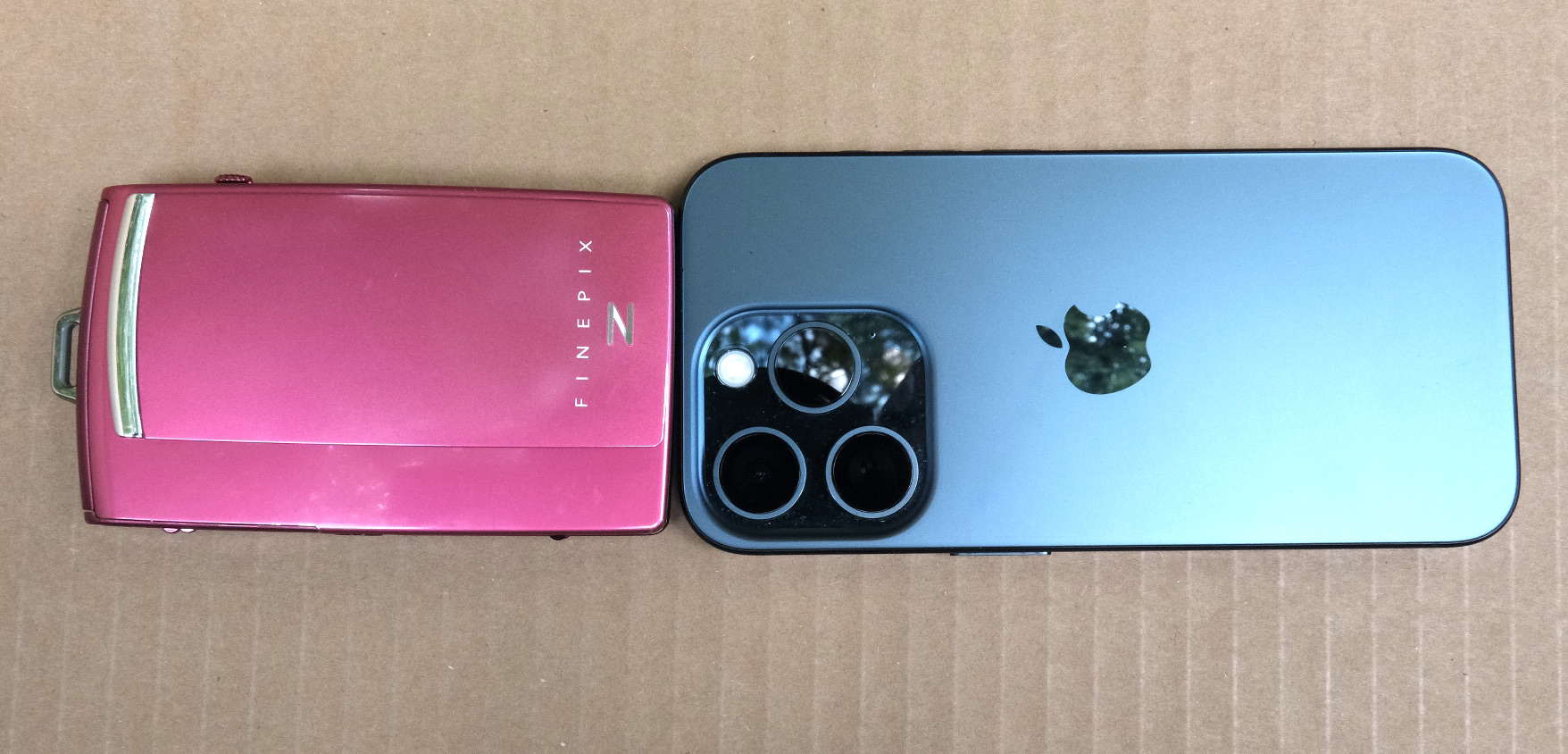
Fujifilm z1000 (left) and iPhone 15 Pro (right). Today a standard sized iPhone can be bigger than a dedicated camera.

More conventional P&S such as the Canon Powershoot S90 or S120; the Sony HX and WX series, Nikon’s Coolpix 9000 series are somehow cheaper, but they’re also more limited: the last models were launched in pre-COVID days, and they have tiny sensors and relatively slow zooms – which makes the use of a flash a necessity in low light.

You could also look for a compact film camera. At the top of the heap the Contax T series reigns supreme (but these cameras are now extremely expensive), followed by a group of still expensive models from Nikon (35ti, 28ti), Leica (Minilux), Ricoh (the GR1), Konica (the Big Mini) and others from Minolta or Olympus. 

But those cameras are now twenty five year old at best – and some of their components didn’t age well (electronics in general and LCDs in particular). Most of those models have at least one big flaw that makes buying them at today’s prices a risky proposition (and even if it works today, will the camera work tomorrow?). The cost of film is also an issue (we’re currently trending towards a total cost of $1.00 per scanned image).

Olympus Tough TG-4 – generations differ by their sensors and processing engines, but the fundamentals of the camera have not changed since the TG-1.

What am I shooting with when I don’t use my smartphone, and can’t bring a mirrorless camera? I have a bit of everything in my bag. I tested (but did not keep) a Nikon J1 and I kept but don’t use a tiny Fujifilm z1000EXR – they’re cute but the quality of the images they were delivering was sub-par. I still use a very compact Fujifilm XQ2 – a sort of semi-premium homage to Sony’s RX100, and an Olympus Tough TG-4. They’re pocketable, produce images which are not as nice as what a recent iPhone can deliver but look more natural, and are a pleasure to use.  I found an original Fujifilm waterproof case for the XQ2, and even with the case, it remains reasonably compact, if not pocketable. As for the Olympus, I’m waiting impatiently for my next trip to the beach to test it in its element – but it has already earned his stripes as a carry-along camera for my hikes in the nearby parks.

Chattahoochee National Recreation Area – Olympus TG-4
Chattahoochee National Recreation Area – the bamboo forest – Olympus TG-4

Are film cameras grossly over valued today?

I don’t know what percentage of film cameras collectors actually use them.  But the value of a camera is at least in part related to its capacity to be used … as a camera, and help the photographer shoot good, beautiful, interesting pictures.  Without film, film cameras are little more than paper weights.

IMG_5924
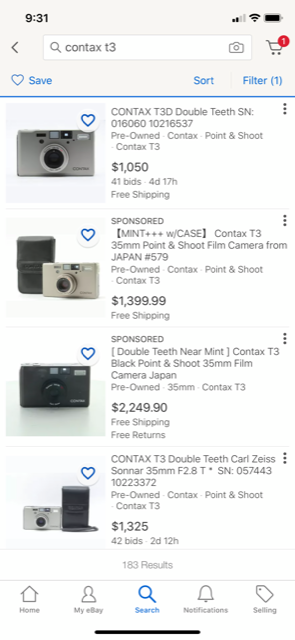
Contax T3 – cameras proposed for sale on eBay 0n 4/24/2020

So if film was to become unavailable, the value of film cameras would change. I don’t believe it’s going to happen anytime soon – Kodak  (Altaris) and Ilford (Harman) are still committed to film because it’s their core business, and Fujifilm will keep one or two film plants running, if only for sentimental reasons. The rebirth of the Polaroid instant film packs (the Impossible Project) and the success of Lomography are also showing that when the big players disengage, boutique producers step in and fill in the void.

Contax T2 - completed listings
Contax T2 – a bit cheaper than the T3. The “completed” listings on eBay show that even if sellers ask for prices in excess of $2,000, the cameras that actually sell are priced a bit more reasonably.

So, let’s assume that film remains available and affordable, and that 35mm film cameras keep a certain usage value. And let’s forget about those commemorative editions, cameras with remarkable serial numbers or other gold plated models, that Leica (and to a lesser extent Nikon), release from time to time for avid collectors. They are destined to be kept forever in their original packaging and in a safe, with no concern for their potential usage value.

In the realm of cameras that actual photographers use to take pictures, Leica cameras hold a special place. They’re “classics“.

On eBay, the price of Leica’s rangefinders has been remarkably stable over the years, with the M5 and the M4 at the bottom of the ladder (around $800), followed by the M2 and M3 a bit above $1,000 (depending on condition, of course). The more modern Leica M (M6, M6 TTL, M7) are selling for two or three times more, reflecting their comparatively higher usage value.

image3
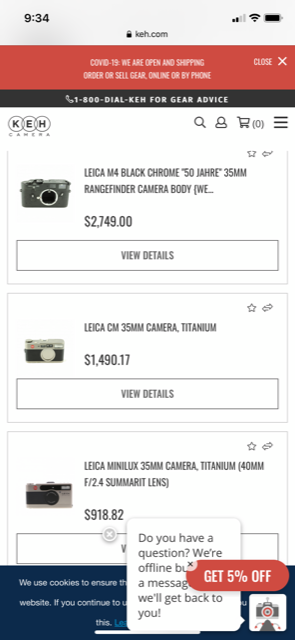
KEH app – the price asked for the T2 is a bit more reasonable – but still in Leica M territory

Manual focus SLRs designed for enthusiasts or pros, and known to be at the same time simple to use and reliable have seen their value rise spectacularly (Nikon FM2, FE2, FM3a or F3, Canon AE-1, Pentax Super Program or LX), while more complex or less reliable models don’t attract the same high prices (Nikon FA, Canon T90). Those new classics were launched between 1975 and 1985, a decade which is increasingly being seen as the golden age of film SLRs.

dirt cheap
Entry level manual focus SLRs with lots of polycarbonate (Canon T50), or amateur-grade autofocus cameras – nobody wants them and the prices reflect that.

At the other end of the price scale, cameras that did not do very well on the second hand market a few years ago are doing even worse now. The list includes any entry level model from any manufacturer if it was launched after 1980, and almost any autofocus SLR except for the very last enthusiast and pro models, probably because of their good compatibility with the current digital offerings of their respective manufacturer (Nikon F100 and F6, Minolta Maxxum 9 and 7, Canon EOS-3).

Photographs don’t like that those cameras were built out of plastics, with a bizarre feature set (often deprived of useful functions – reserved for the “pro” models – and at the same time loaded with useless gimmicks and encumbered by unconventional controls). And many of them require expensive and hard to find single use Lithium batteries. They have little appeal for today’s would-be film shooters,  and can be had for a few dollars, even from specialized stores.

“La Mode, c’est ce qui se démode”*

What’s hot? Any luxury compact (point and shoot) camera, with a titanium body and a lens with a famous name: the top of the top is occupied by Contax with the T2 and T3: the craze started with a few actors and celebrities in Hollywood posting pictures of themselves shooting with their T2 on Instagram), but similarly positioned models such as the  Leica CM and Minilux or the Nikon 35ti also command big bucks (they’re all in Leica M territory).

Pictured-Kendall-Jenner
Kendall Jenner and a Contax T2. Image Source: Getty / Kevin Mazur/MG18

Cameras like the Olympus XA, and even the Cosina CX-2**, which were far cheaper than the luxury cameras from Contax or Leica in the eighties, have also been contaminated – with sellers asking for hundreds if not thousands of dollars for a somehow basic camera.

cosina CX-2
The Cosina CX-2 – the ancestor of the Lomo LC-A – a cheap camera in its heyday. Prices are all over the map now ($240 to $1,250 for what looks like two cameras in the same condition)

As a conclusion:

Old classics hold their value, new classics are on the rise: if you buy one of those, you may not win big, but you won’t lose money if you decide to resell  it after a few years.

Contax luxury compacts are reaching insane values. They’re nice cameras, with a great little Zeiss lens, and demand currently outstrips supply. But those luxury compact cameras (Contax’s and the others) rely heavily on electronics and generally can’t be repaired if a component goes bad. If you don’t have one already, you missed the boat, and I would not spend thousands of dollars trying to get one. You can also wonder how long will celebrities be seen playing with their T2, pushing demand and prices to the sky? Prices could very well go back to more normal levels in a few years.

leica_cm
Two other Titanium-clad point and shoot cameras (Leica CM and Leica Minilux) selling for more than old Leica M3s

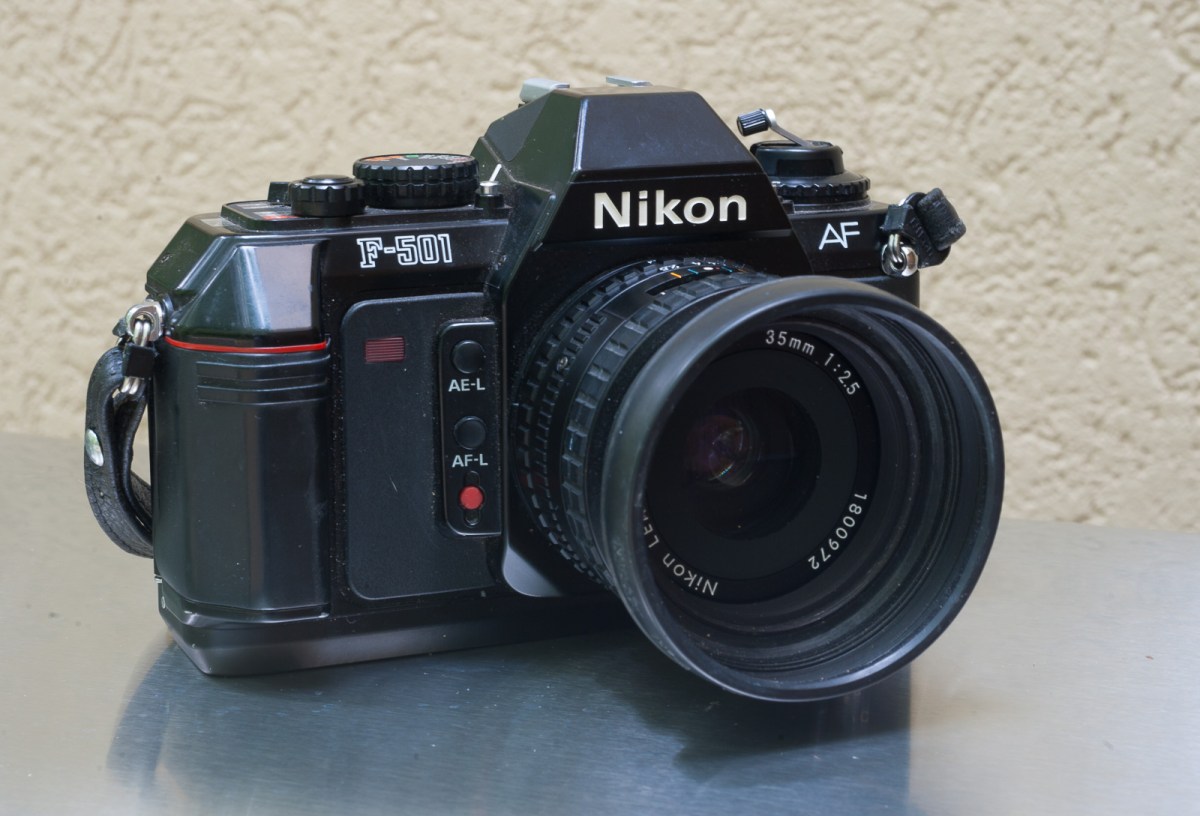
There are still bargains to be found if you’re not obsessed with shooting with a “classic” : the Canon AT-1 has not reached the “new classic” level of the AE-1 and AE-1 Program, and sells for half the price. But in my view, it’s a better camera for an enthusiast photographer. Early Canon EOS cameras  (650, 620) are solid, very pleasant to use (a T90 with matrix metering and without the bugs), and dirt cheap. An entry level camera from the mid eighties, the Pentax P3n, is at least as competent as its more expensive Super Program predecessor, but can still be had for next to nothing. Nikon’s partially motorized N2000/F301 (the manual focus version of the N2020/F501) is also a great buy. So is the Olympus OM-2. Future classics? I don’t think so. But great everyday cameras at a great price, for sure.


(*) “La Mode, c’est ce qui se démode”  (Literally, “Fashion, that’s what going out of fashion” or “Fashion is made to become unfashionable”) – the aphorism is generally attributed to Jean Cocteau and Coco Chanel. Coco Chanel famously added that “Fashion fades, only style remains the same”.

(**) Cosina CX-1 and CX-2  – those cute and very small point and shoot cameras sold reasonably well in the early eighties. With their tiny wide-angle lens they were subject to severe vignetting but they offered more controls to the photographers than the other ultra-compact P&S cameras. A few years later, an almost identical camera was launched as the Lomo LC-A by the LOMO PLC in Saint Petersburg (Russia). The little Lomos were adopted enthusiastically by a group of photographers in Austria, and it started the Lomography movement. But that’s a whole other story.


The Olympus OM-2n – a “new classic” – in my opinion the best camera of the Olympus OM single digit series (OM-1,OM-2, OM-3, OM-4, OM-4ti) for everyday use. Photos shot a few years ago at the Universal Studios in Burbank, CA.

2010-08_California-24040023
Universal studios – Burbank CA – the Studio tour – here the house from Psycho. Olympus OM-2n.

2010-08_California-24040019
Universal Studio (Burbank, CA) – the set of the movie “Waterworld”. Olympus OM-2n

2010-08_California-24040037
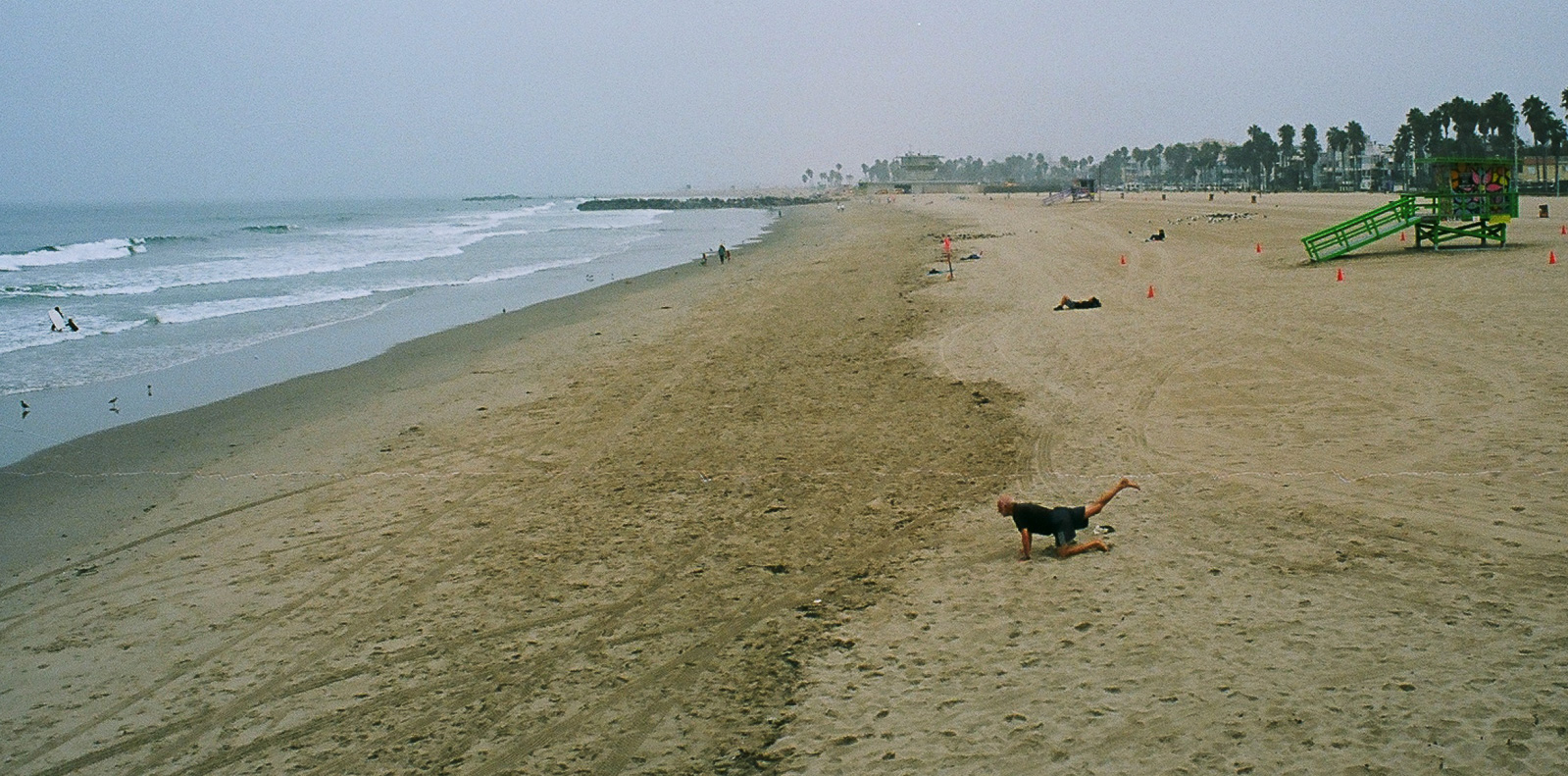
Venice Beach (CA). Olympus OM-2n


DP Review’s preferred “analog gems”

After Thom Hogan’s list of Nikon Classics, another list, this time coming from no other than dpreview.

The “DP” in dpreview stands for “Digital Photography” of course, and the site was launched in 1998, at the beginning of the digital camera craze. And they’ve never reviewed a film camera. As far as I know. But over the years, they compiled two lists of recommended,  “excellent and affordable” film cameras, the first one in 2017, with a follow up in June 2019.

A few of the cameras listed as “analog gems” by DPreview have been presented in this site over the years (the Nikons FE2, N90, the Olympus OM-1 and the Canon T90). Very often, my preference goes to other models of the same family (I prefer the Olympus OM-2 to the OM-1 because its battery is much easier to find, the Canon AT-1 to the AE-1 because I’m not a fan of shutter speed priority automatism, and the EOS-620 to the EOS-5 for its simplicity).

Nikon FM
Nikon FM

I’ve never been a fan of compact cameras in the days of film (poor viewfinder, not enough controls for the photographer). Their only advantages were their small size and their ease of use, but a film SLR with a pancake lens was not much larger and delivered much better images. And today, why would you spend money on film and processing to use a compact camera which will give you less control over your images than a good smartphone?

My absolute favorite? The ones I would bring on the proverbial desert island (assuming the desert island has no electricity, no Internet access but a huge stack of film cartridges waiting for me)?

Canon-T90-6241
Canon T90 – the ergonomics of an EOS camera with an FD lens mount

  • a compact, mechanical, semi-auto SLR – not the Olympus OM-1, not the Pentax MX, but the rugged and supremely reliable Nikon FM. The FM2 is probably an even better camera, but it’s also more expensive.
  • the most elaborate pre-autofocus SLR, the Canon T90, for the looks, the ergonomics, the crazy exposure system, with no concern for its questionable reliability or its mass, because I would always have the Nikon FM as a backup.

And of course, when I would be back from the desert island, I would reconnect with my cherished Nikon FE2…


summer2017-R4---12

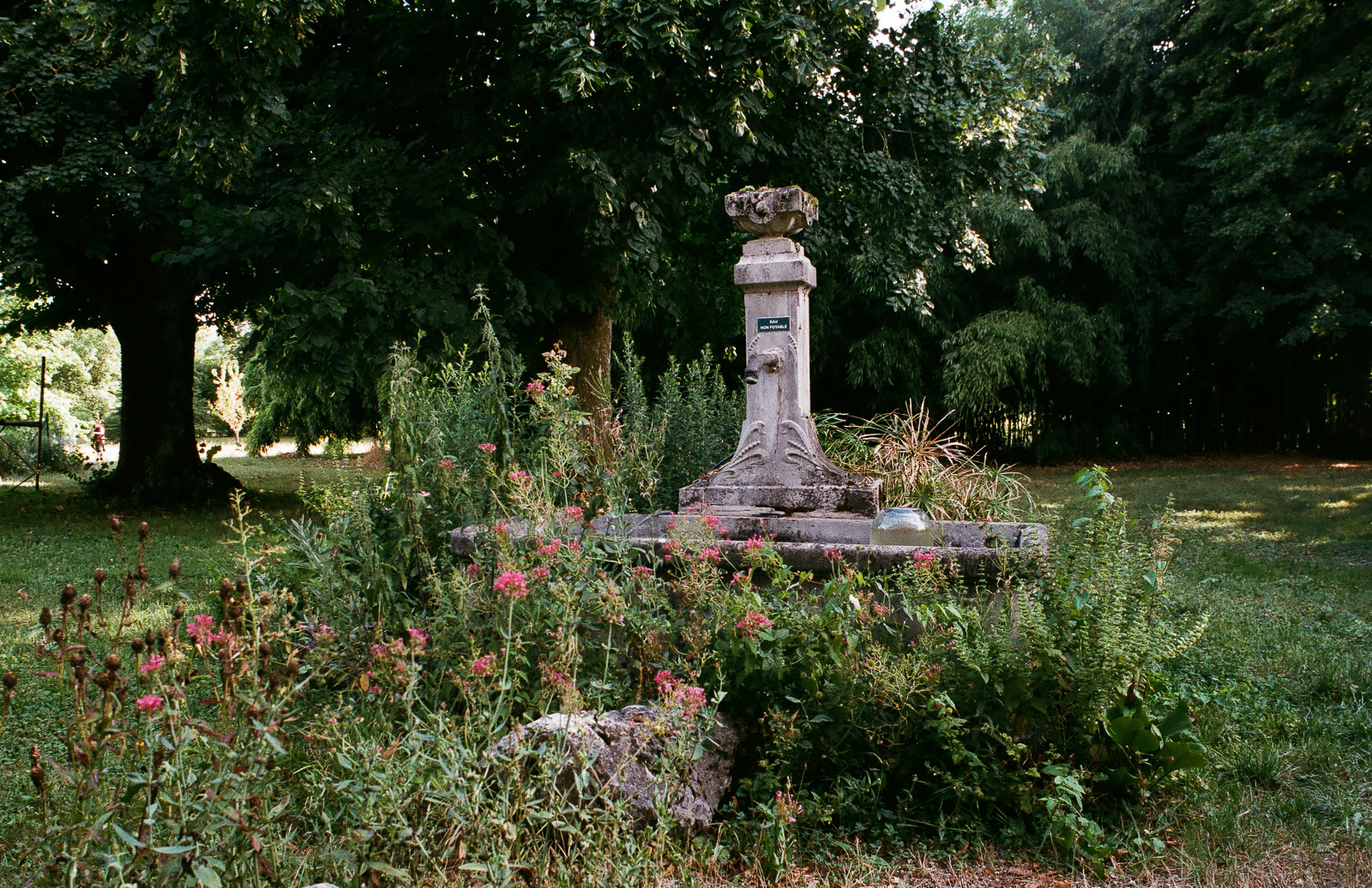
“La Maison aux Bambous” – Bed and Breakfast – Vinay (France). Canon T90 – Canon FD 24mm – Fujicolor 400.

Spring cleaning in January…

It’s time to trim my  collection of film cameras, and make room for newer entrants.

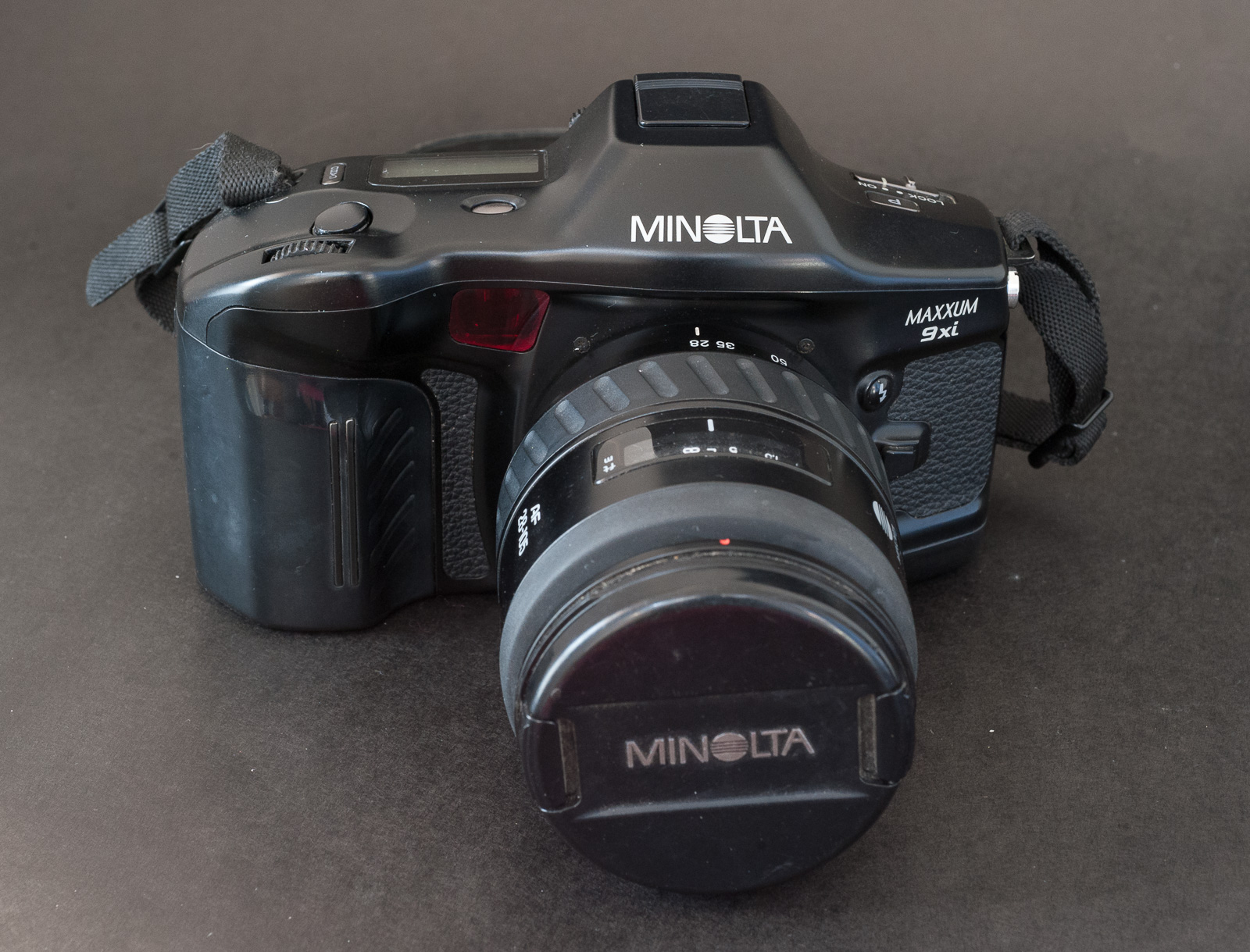
The Minolta Maxxum 9xi has to go – I like it but I can’t use it to its full potential unless I spend more money on a set of Minolta A lenses and, maybe, a flash. I already have 4 sets of lenses for as many different makes of cameras. That’s already one or two too many, I won’t add a fifth one.

The Olympus OM 2000 falls into the same category as my Nikon FM (a modern semi-auto SLR), and is also competing for my attention with an Olympus OM-2 and my beloved Nikon FE2 (which both have very good semi-auto modes). I know I won’t be using it and I need to find a better place for it.

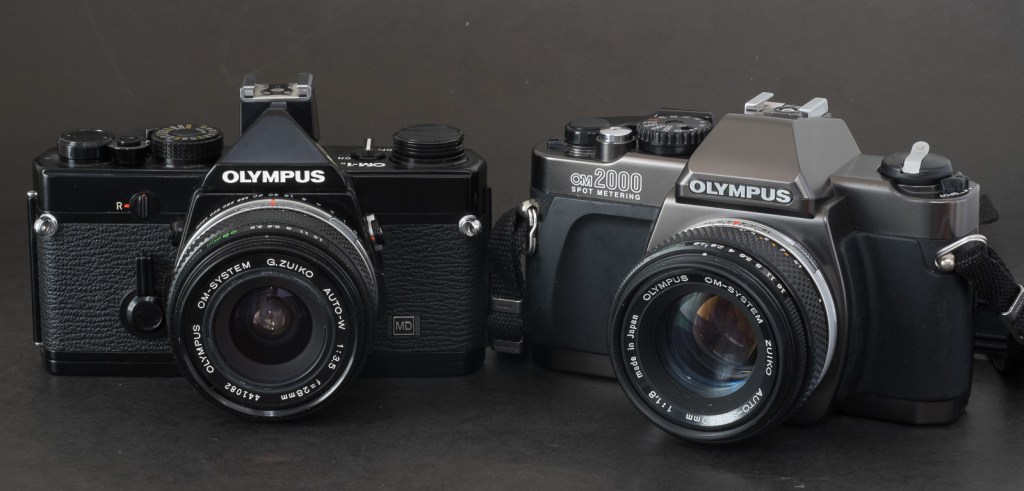
The two cameras are currently listed on eBay. It took them for one last photo shoot …

One last round with the Minolta Maxxum 9xi

I don’t know what drove Minolta out of the photography market – the expensive (and ultimately lost) lawsuit against Honeywell over auto-focus patents, the APS format debacle, or their inability to get more than a tiny fraction of the “pro” market –  but at some point they decided to throw the towel and sold themselves to Konica (forming Konica-Minolta). Two years later, Konica-Minolta stopped manufacturing film, and sold its photography line of business to Sony. It explains why current Sony a77 and a99 still work with the same Minolta lenses that the 9xi uses.

The Minolta autofocus SLRs designed for enthusiasts and pros were very pleasant to use and worked very well.  The Maxxum 9xi is no exception. It falls very well into the hands, gets the exposure right, and does not impose an information overflow to the photographer. Being designed as a “pro” model, it’s very well made (better than the 700si, for instance) and still looks good (no panel gap, no sticky paint) after all these years. If you love the Minolta brand, or if you are an active Sony Alpha photographer, it’s a camera to have.

  • Links to previous blog posts in CamerAgx

Minolta Maxxum 9xi – a fuzzy logic camera for the “Pros”? (part I)

Minolta Maxxum 9xi – part II


xtalfu-6014
Minolta Maxxum 9xi –

dogs_on_9xi-14
Heritage Park – Mableton – Minolta 9xi 28-105 AF zoom – Fujicolor 400.

Olympus OM 2000 Spot Metering

The Olympus OM 2000 is a Cosina-made semi-auto SLR, and has little in common with the rest of the Olympus OM family, except for its bayonet mount, of course.

It’s still an interesting camera – good looking, simple, with spot metering (in addition to the conventional weighted-average metering). A good introduction to the OM family of cameras, and a good backup for owners of an OM-3ti or OM-4ti who don’t want to risk damaging their expensive and sometimes temperamental camera in difficult situations.

  • Links to previous blog posts in CamerAgx

The Olympus OM-2000 – not a true blood Olympus, but a cheap and convenient bearer of Zuiko lenses


xtalfu-6001
Olympus OM 2000 Spot Metering

xtalfu-6005
Olympus OM 2000 – the fastest shutter on any Olympus SLR (1/2000sec, Flash X sync up to 1/125)

06-2017-OM2000-3
Florida sunrise – Olympus OM 2000


The league of the $5.00 film cameras

How cheap can it get?

The price of used film cameras on eBay is racing to the bottom. No brand is immune – not even Nikon or Leica –  only a few models seem to be worthy of the consideration of the buyers  and still sell for more than $100.00:

  • single digit Nikon F models,
  • Nikon FM2 or  FM3A,
  • Contax 159mm or ST,
  • pristine and tested Canon T90 or Canon New F-1,
  • all rangefinder cameras from Leica and a few of their SLRs,
  • Olympus OM-3t / OM-4t.

The very last high end film auto-focus SLRs of Canon, Minolta and Nikon – such as the EOS-3 and EOS-1 V, the Maxxum 7 and 9, and the F100 and F6 – are also in a a category of their own. As the “ultimate” film SLRs, very close technically from the current dSLRs of the same brand, they can be sold for anything between $200.00 and $2,000.00.

OM-2000-6210
Olympus OM-2000 – a beautiful member of my $5.00 league

The rest is trending towards being virtually free, and autofocus SLRs fare even worse than manual focus bodies: I recently paid  $3.25 for a nice N6006, a Nikon SLR from the early auto-focus era and $15.00 for a beautiful Minolta 9xi with a good lens,  its original catalog and user manual. We already passed the point where the shipping costs exceed the sale price of the camera, and where a set of batteries can be many times more expensive than the camera itself – the lithium battery of the N6006 cost me $12.00, almost 4 times the price of the camera.

cameras--6624
Nikon N6006 – a very competent auto-focus camera, to be had for less than $5.00 on eBay

For the photographer starting to shoot with film, there has never been a better time to buy a good camera on the cheap. Collectors are more attracted by pro or high-end cameras which were expensive when new, and still are in top condition. The  “last pro or last high-end film cameras manufactured by a given brand…” fare particularly well: a tested and working Pentax LX, a beautiful Olympus OM-4Ti or a Canon EOS-1 V are relatively rare and can sometimes reach prices between $400 and $1,000.

cameras-2-21
Canon AV-1 – It was part of a $8.00 bundle which also included 3 other cameras. In all fairness the other cameras were all defective, but this one worked pretty well.

SLRs  originally positioned as mid level cameras for enthusiasts or experts provide the best opportunities, in particular if you’re willing to accept a few scratches or blemishes on the body: they tend to be much more usable than entry level cameras (they’re almost as feature rich as the high end models, if not as solid), but don’t catch the attention of the collectors because they’re too ordinary and too easy to find.

On my short list of recommended cameras:

Manual Focus cameras: strangely enough, manual-focus cameras from big brands tend to be more expensive than most of their auto-focus SLRs.

Although not as expensive as a T90, a FM3A or an OM-4Ti, the three cameras listed below can still command prices in the $70.00 to $100.00 range. They are very competent tools, they benefit from a large supply of good lenses, and are a great way to move one step higher with  film photography:

  • Canon A-1
  • Nikon FE2
  • Olympus OM-2n

they could be bought in 1983
Nikon FE2 – Canon A-1 – certainly not cheap cameras – but still a bargain at the current price level

You can find cheaper manual focus alternatives – the Olympus OM-2000 is one of my $5.00 cameras, but I’d be more prudent with brands like Fujica (and other brands which did not have strong following on the expert or enthusiast markets). Not that they did not make good cameras – but good lenses are going to be more difficult to find – and without a set of good lenses, a SLR camera is not really worth having.

02-2017-camera-5848
Fujica AZ-1 – the camera can be had for cheap, but apart for the ubiquitous 50mm lens and the zoom shown here, Fujinon EBC lenses (operating at full aperture) are rare and expensive.

Auto-focus Cameras: manufactured in the early to mid-nineties by the big four (Canon, Nikon, Minolta, Pentax), they are mature technically, with a good multi-sensor auto-focus, matrix metering, and a long eye point viewfinder. The lenses are still somehow  compatible with the current dSLRs of the brand – and they’re incredibly cheap.  A few examples of the “expert” or “enthusiast” category:

  • Minolta 600si
  • Minolta 9xi
  • Nikon N90s

cameragx-6594
The “prosumer” cameras of the early to mid eighties – they can be yours for $15.00 to $25.00 now, with a (good) zoom included.

Auto-focus cameras designed for amateurs (such as the Minolta 3xi or the Nikon N6006) are the cheapest of them all, but the price difference with the “expert”, “enthusiast” or “prosumer” model of the same brand is minimal (the price of their disposable Lithium battery, roughly). Don’t hesitate. Go for the top of the line.

As usual,  I only recommended cameras I’ve used and liked. I’m sure there are very good auto-focus cameras from Canon (EOS mount), and great manual focus cameras from Minolta (MD mount) or Pentax (K mount). They’re all supported by a great line of lenses and will also constitute very good buys.

One last word…of caution

When you buy a camera for less than $5.00, you don’t always win.

  • shopgoodwill.com  is a very good source for cheap equipment, but you have to consider it’s sold as is, by people  who – generally –  have absolutely no clue of what they’re selling and can’t describe it in any useful way.  To me, it has been a bit of a hit and miss – cameras from the 90s (the Olympus OM-2000, the Minolta 9xi, the Nikon N90s) were diamonds in the rough, and after a good cleaning, they worked perfectly. Older cameras (a Spotmatic, a Fujica AX-3) were broken and could not be fixed. The older the camera, the riskiest it gets. But most cameras are sold with a lens, and even if the camera is defective, the value of its lens alone sometimes makes buying the set a good deal.
  • eBay – thanks to the system of feedback, sellers tend to describe their items with some level of accuracy. In my experience, if you stick with sellers with an almost perfect feedback score (99% or better), and read the item description extremely carefully,  you won’t be disappointed.

Image
Dogs playing. Nikon N90s – Fujicolor 400 – The Nikon N90s nailed the exposure and the focus perfectly.


The Olympus OM-2000 – not a true blood Olympus, but a cheap and convenient bearer of Zuiko lenses

Nobody’s going to argue that in the hands of a reasonably  competent photographer, and in most situations, a recent “pro-level” digital SLR is going to deliver much better pictures than an amateur dSLR released 10 years ago. Resolution, Dynamic Range, Low Light Sensitivity, Color Accuracy are all going to be significantly better. And for a much smaller level of effort:  scenes that used to require the photographer to shoot in RAW and spend 10 minutes “processing” each picture in  Adobe Lightroom (or even worse, hours in Photoshop) can now reliably be shot in JPEG and uploaded directly from the camera to whatever social network or on-line photo gallery.

Olympus OM-1n MD (left) and Olympus OM-2000 Spot (right). The OM-1 was launched in 1972, the OM-2000 in 1997.

In the world of film cameras, it’s different. As long as the camera meets a few basic requirements: mount the lenses with precision, meter and expose with accuracy and consistency, maintain the film plane flat, inform the photographer of the decisions taken by its automatic systems, and let him adjust the parameters when necessary, there will not be much of a difference between the pictures created with a pro and an entry level camera. The pro camera will be faster, more accurate, more solid, more durable and will provide more control options to its user, but ultimately, the quality of the results will be a function of the quality of the lens, of the film, and of the skills of the photographer.

OM-1 and OM-2000 – the organization of the commands is very different (the shutter speed ring is between the lens and the body on the OM-1, and classically on the top plate for the OM-2000. The film sensitivity is set on with a knob on the top plate (OM-1) and in a window in the shutter speed knob (OM-2000)

Which brings us to the mid-nineties. The big Four (Canon, Minolta, Nikon, Pentax) all have successfully converted their SLRs to autofocus, electronics and polycarbonate, and have persuaded most of the photographers to buy them. There are a few hold outs at the high end of the market who still buy and use manual focus semi-auto cameras built traditionally out of aluminum and brass or titanium (Leica R and M series, Nikon FM2, Olympus OM-3ti for instance), and “learners” or photography students, who are looking for cheap cameras to learn the basics of photography, and who generally end up buying entry level Pentax and Minolta cameras. Both manufacturers already have relocated the production lines of the K1000 and of the X-300 to China, and can propose them (body only) for less than $150.00. In comparison, Nikon’s FM2 is approaching $500.00, Olympus’ (automatic) OM-4ti  sells for $1,000.00, and the semi-auto OM-3ti – produced in very limited quantities –  is probably in Leica territory when you can get one (a semi-auto Leica R6.2 sells for $2,800.00 at Adorama in 1995).
OM-1 (bottom) and OM-2000 (top). The OM-2000 does not accept a winder or a motor. A totally different bottom plate denotes a fundamentally different internal architectures. Note the “made in Japan” engraving.

Following the example of Canon and Nikon (who had commissioned the design and the manufacturing of their entry level manual focus / semi-auto T60 and  FM10 to Cosina), Olympus launches the OM-2000 in 1997. Like its predecessors on the Cosina production lines, the OM-2000 is based on a platform originally developed for the Cosina CT-1, and somehow customized to Olympus’ requirements: unique to the OM-2000 are the Olympus bayonet, the gun metal color of the camera’s body, and the presence of a spot/average meter switch. It is generally sold in a bundle with a 35-70 f/3.5-4.8 lens, also made by Cosina. I did not test this lens and can’t comment on it.

OM-2000 – the SPOT/Average metering selector. When SPOT is selected, a LED acts as a reminder in the viewfinder.

The OM-2000 is not designed  to be great, but cheap and simply good-enough. The outer shell is of polycarbonate, the film rewind and the self timer lever are fragile (I had an issue with the rewind knob – I applied too much force to it and ended up unscrewing it from there body), the metallic shutter tends to be loud, but the camera, though basic and unsophisticated (the LEDs in the viewfinder look a bit crude), is pleasant to use (large viewfinder, smooth commands) and with its nice color, makes a good impression. The shutter is fast (1/2000 sec, 1/125 synchro), the spot meter useful and easy to use (there is a reminder in the viewfinder).

Contrarily to the OM-2 whose mirror and shutter are very well damped (you can shoot at 1/15sec without a tripod in a museum, for instance), the mirror or the shutter of the OM-2000 tends to generate strong vibrations, some of the pictures I took with it show it clearly. My advice: avoid low shutter speeds unless the camera is firmly held in place.

Vertical metal shutter – 100% Cosina. 1/2000th second and X-Sync at 1/125th second (the fastest of any Olympus OM camera).

As for the real value of this camera, it depends on your point of view. For a collector of  the “real” Olympus OM series cameras, it’s not worth much. It has nothing to do with the renown single digit family of OM cameras (OM-1, OM-2, OM-3, OM-4). It can not share any of their accessories (winder, focusing screen) and can not take advantage of the TTL flash capabilities of the units designed for the OM-2 and its followers.

Olympus OM-2000 – pull the wind lever to activate the meter and unlock the shutter (no separate on/off switch on the OM-2000)

With a good lens (Olympus’ Zuiko lenses have a great reputation), a good film and a good photographer, it will take good pictures – and should serve its owner well. It’s not as solid as a Nikon FM2, it’s not as beautifully made as an Olympus OM-3, it vibrates more than an OM-2, but when new, it was a fraction of the price of those cameras, and now, it can be had for a few dozens of US dollars. If you’ve heavily invested in OM Zuiko lenses and in expensive OM Ti bodies, adding a cheap  OM-2000 to your equipment list is a good insurance plan – you can use it when you don’t want to risk your precious OM-3Ti, and it can save your day if the electronics of your OM-4T decides it had enough.

Olympus OM-2000 – Viewfinder – 3 LEDs + o – to set the exposure. When the camera is set in Spot, a fourth round LED is lit at the bottom.

With the right lens and a good photographer, simple film cameras can take great pictures. The OM-2000, while clearly not a true blood Olympus OM camera, maybe the cheapest and easiest way to shoot film using Olympus Zuiko lenses  today.


06-2017-OM2000-14
On the beach in the morning – Florida – Olympus OM-2000 – OM Zuiko 135mm f/3.5 – Kodak Ektar 100

SaveSaveSaveSave

SaveSave

SaveSave

SaveSave

SaveSave

SaveSave